
Wednesday, 25 March 2015
Presentation by : Aman Sharma
Cyber Crime is a term used to broadly describe criminal
activity in which computers or computer networks are a
tool, a target, or a place of criminal activity and include
everything from electronic cracking to denial of service
attacks. It also include traditional crimes in which
computers or networks are used to enable the illicit
activity.
We can categorize cyber crime in two ways:
 The computer as a target :- using a computer to
attacks other computer, e.g. Hacking, virus/worms
attacks etc.
 The computer as a weapon :- using a computer to
commit real world crime e.g. cyber terrorism, credit
card fraud and pornography etc.
TYPES OF
CYBER CRIME
Hacking
 Hacking is not defined in the amended IT Act, 2000.
Hacking means unauthorized attempts to bypass the
security mechanisms of an information system or
network.
 In simple words Hacking is the unauthorized access to a
computer system, programs, data and network resources.
 Government websites are the hot target of the hackers.
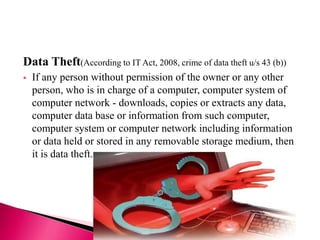
Data Theft(According to IT Act, 2008, crime of data theft u/s 43 (b))
 If any person without permission of the owner or any other
person, who is in charge of a computer, computer system of
computer network - downloads, copies or extracts any data,
computer data base or information from such computer,
computer system or computer network including information
or data held or stored in any removable storage medium, then
it is data theft.
Trojan attacks
 Malicious software that attaches itself to
other software and act like something useful
for the system but do the things that are
quiet damping. For eg. VIRUS , WORMS,
TROJAN HORSE
 In most of the cases, viruses can do any
amount of damage, the creator intends them
to do. They can send your data to a third
party and even delete your data from your
computer.
CHILD PORNOGRAPHY
 The Internet is being highly used by its
abusers to reach and abuse children sexually,
worldwide.
 Pornography is describing or showing sexual
acts in order to cause sexual excitement
through books, films, pornography websites
etc.
Computer Vandalism
 Damaging or destroying data rather than stealing or
misusing them is called cyber vandalism. These are
program that attach themselves to a file and then
circulate.
E-mail spamming
 Sending email to thousand and thousand of user- similar
to a chain letter.
Cyber Stalking
 Cyber Stalking is use of the Internet or other electronic
means to stalk someone. Stalking generally involves
harassing or threatening behaviour that an individual
engages repeatedly.
E-mail bombing
 Characterised by abusers repeatedly sending an
identical email message to a particular address.
Sale of illegal article
 This would include trade of narcotics, weapons etc.,
by posting websites, auction websites, bulletin boards
by using email communication.
Online gambling
 Also known as i-gambling or internet gambling.
 Generally gambling offered through internet is
termed as online gambling.
Cyber terrorism
 The intentional use of computer, networks and, public
internet to cause destruction and harm for personal
objectives. Objectives may be political , religious or
ideological.
Software Piracy
 Theft of software through the illegal copying of
genuine programs or the counterfeiting and distribution
of products intended to pass for the original.
 Phishing is just one of the many frauds on the Internet, trying
to fool people into parting with their money. Phishing refers to
the receipt of unsolicited emails by customers of Financial
Institutions, requesting them to enter their Username,
Password or other personal information to access their
Account for some reason.
 The fraudster then has access to the customer's online bank
account and to the funds contained in that account.
Cyber Crimes threatens National Security and
rising level of cyber crime is an indication of
enormous threat to national security. Fan clubs
of Underworld Dons like Dawood Ibrahim and
Chhota Shakeel and other wanted underworld
dons are also doing the rounds on orkut. There
is huge potential for damage to national security
through cyber attacks. The internet is a means
for money bounding and funding terrorist
attacks in an organized manner.
 Under Section (2) (b) of IT Act, 2008,”cyber
security means protecting information,
equipment, devices computer, computer
resource, communication device and
information stored therein from unauthorized
access, use, disclosure, disruption,
modification or destruction.”
 In India, The IT Act, 2000 as amended by The
IT (Amendment) Act, 2008 is known as the
Cyber law
Antivirus And Anti Spyware Software:
 Antivirus software consists of computer programs that
attempt to identify, thwart and eliminate computer viruses
and other malicious software. Anti spy wares are used to
restrict backdoor program, Trojans and other spy wares to
be installed on the computer.
Firewalls:
 A firewall protects a computer network from
unauthorized access. Network firewalls may be hardware
devices, software programs, or a combination of the two.
A network firewall typically guards an internal computer
network against malicious access from outside the
network.
Cyber Security : Cyber Security involves protection of
sensitive personal and business information through
prevention, detection and response to different online
attacks. Cyber security actually preventing the attacks,
cyber security.
Privacy Policy : Before submitting your name , e-mail ,
address, on a website look for the site’s privacy policy.
Cryptography: Cryptography is the science of encrypting and
decrypting information. Encryption is like sending a postal
mail to another party with a lock code on the envelope which
is known only to the sender and the recipient.
Cyber Ethics and Laws: Cyber ethics and cyber laws are also
being formulated to stop cyber crimes. It is a responsibility of
every individual to follow cyber ethics and cyber laws so that
the increasing cyber crimes shall reduce. Security Software
like Anti Viruses and Anti Spy Wares should be installed on all
computers, in order to remain secure from Cyber Crimes.
Cyber crime can involve criminal activities that are
traditional in nature, such as theft, fraud, deformation
and mischief, all of which were subjected to the India
Penal code. In simple way we can say that cyber crime
is unlawful acts where in the computer is either a tool
or both.
The abuse of computer has also given birth of new age
crime that are addressed by the Information Technology
Act, 2000.
“If any person, dishonestly, or fraudulently,
Destroys, Deletes or Alters any Information residing in a computer
resource or diminishes its value or utility or affects it injuriously by
any means;
Steals, conceals, destroys or alters or causes any person to steal,
conceal, destroy or alter any computer source code used for a
computer resource with an intention to cause damage;
he shall be punishable with imprisonment for a term which may
extend to two to three years or with fine which may extend to five lakh
rupees or with both.”
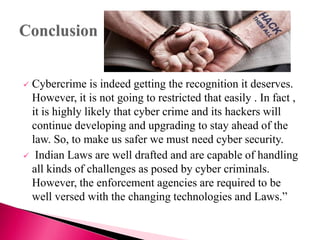
 Cybercrime is indeed getting the recognition it deserves.
However, it is not going to restricted that easily . In fact ,
it is highly likely that cyber crime and its hackers will
continue developing and upgrading to stay ahead of the
law. So, to make us safer we must need cyber security.
 Indian Laws are well drafted and are capable of handling
all kinds of challenges as posed by cyber criminals.
However, the enforcement agencies are required to be
well versed with the changing technologies and Laws.”
THANK YOU!!!

CYBER CRIME - A Threat To Internet Users

  • 1.
    Wednesday, 25 March2015 Presentation by : Aman Sharma
  • 2.
    Cyber Crime isa term used to broadly describe criminal activity in which computers or computer networks are a tool, a target, or a place of criminal activity and include everything from electronic cracking to denial of service attacks. It also include traditional crimes in which computers or networks are used to enable the illicit activity.
  • 3.
    We can categorizecyber crime in two ways:  The computer as a target :- using a computer to attacks other computer, e.g. Hacking, virus/worms attacks etc.  The computer as a weapon :- using a computer to commit real world crime e.g. cyber terrorism, credit card fraud and pornography etc.
  • 4.
  • 5.
    Hacking  Hacking isnot defined in the amended IT Act, 2000. Hacking means unauthorized attempts to bypass the security mechanisms of an information system or network.  In simple words Hacking is the unauthorized access to a computer system, programs, data and network resources.  Government websites are the hot target of the hackers.
  • 6.
    Data Theft(According toIT Act, 2008, crime of data theft u/s 43 (b))  If any person without permission of the owner or any other person, who is in charge of a computer, computer system of computer network - downloads, copies or extracts any data, computer data base or information from such computer, computer system or computer network including information or data held or stored in any removable storage medium, then it is data theft.
  • 7.
    Trojan attacks  Malicioussoftware that attaches itself to other software and act like something useful for the system but do the things that are quiet damping. For eg. VIRUS , WORMS, TROJAN HORSE  In most of the cases, viruses can do any amount of damage, the creator intends them to do. They can send your data to a third party and even delete your data from your computer.
  • 8.
    CHILD PORNOGRAPHY  TheInternet is being highly used by its abusers to reach and abuse children sexually, worldwide.  Pornography is describing or showing sexual acts in order to cause sexual excitement through books, films, pornography websites etc.
  • 9.
    Computer Vandalism  Damagingor destroying data rather than stealing or misusing them is called cyber vandalism. These are program that attach themselves to a file and then circulate. E-mail spamming  Sending email to thousand and thousand of user- similar to a chain letter.
  • 10.
    Cyber Stalking  CyberStalking is use of the Internet or other electronic means to stalk someone. Stalking generally involves harassing or threatening behaviour that an individual engages repeatedly. E-mail bombing  Characterised by abusers repeatedly sending an identical email message to a particular address.
  • 11.
    Sale of illegalarticle  This would include trade of narcotics, weapons etc., by posting websites, auction websites, bulletin boards by using email communication. Online gambling  Also known as i-gambling or internet gambling.  Generally gambling offered through internet is termed as online gambling.
  • 12.
    Cyber terrorism  Theintentional use of computer, networks and, public internet to cause destruction and harm for personal objectives. Objectives may be political , religious or ideological. Software Piracy  Theft of software through the illegal copying of genuine programs or the counterfeiting and distribution of products intended to pass for the original.
  • 13.
     Phishing isjust one of the many frauds on the Internet, trying to fool people into parting with their money. Phishing refers to the receipt of unsolicited emails by customers of Financial Institutions, requesting them to enter their Username, Password or other personal information to access their Account for some reason.  The fraudster then has access to the customer's online bank account and to the funds contained in that account.
  • 14.
    Cyber Crimes threatensNational Security and rising level of cyber crime is an indication of enormous threat to national security. Fan clubs of Underworld Dons like Dawood Ibrahim and Chhota Shakeel and other wanted underworld dons are also doing the rounds on orkut. There is huge potential for damage to national security through cyber attacks. The internet is a means for money bounding and funding terrorist attacks in an organized manner.
  • 17.
     Under Section(2) (b) of IT Act, 2008,”cyber security means protecting information, equipment, devices computer, computer resource, communication device and information stored therein from unauthorized access, use, disclosure, disruption, modification or destruction.”  In India, The IT Act, 2000 as amended by The IT (Amendment) Act, 2008 is known as the Cyber law
  • 18.
    Antivirus And AntiSpyware Software:  Antivirus software consists of computer programs that attempt to identify, thwart and eliminate computer viruses and other malicious software. Anti spy wares are used to restrict backdoor program, Trojans and other spy wares to be installed on the computer. Firewalls:  A firewall protects a computer network from unauthorized access. Network firewalls may be hardware devices, software programs, or a combination of the two. A network firewall typically guards an internal computer network against malicious access from outside the network.
  • 19.
    Cyber Security :Cyber Security involves protection of sensitive personal and business information through prevention, detection and response to different online attacks. Cyber security actually preventing the attacks, cyber security. Privacy Policy : Before submitting your name , e-mail , address, on a website look for the site’s privacy policy.
  • 20.
    Cryptography: Cryptography isthe science of encrypting and decrypting information. Encryption is like sending a postal mail to another party with a lock code on the envelope which is known only to the sender and the recipient. Cyber Ethics and Laws: Cyber ethics and cyber laws are also being formulated to stop cyber crimes. It is a responsibility of every individual to follow cyber ethics and cyber laws so that the increasing cyber crimes shall reduce. Security Software like Anti Viruses and Anti Spy Wares should be installed on all computers, in order to remain secure from Cyber Crimes.
  • 21.
    Cyber crime caninvolve criminal activities that are traditional in nature, such as theft, fraud, deformation and mischief, all of which were subjected to the India Penal code. In simple way we can say that cyber crime is unlawful acts where in the computer is either a tool or both. The abuse of computer has also given birth of new age crime that are addressed by the Information Technology Act, 2000.
  • 22.
    “If any person,dishonestly, or fraudulently, Destroys, Deletes or Alters any Information residing in a computer resource or diminishes its value or utility or affects it injuriously by any means; Steals, conceals, destroys or alters or causes any person to steal, conceal, destroy or alter any computer source code used for a computer resource with an intention to cause damage; he shall be punishable with imprisonment for a term which may extend to two to three years or with fine which may extend to five lakh rupees or with both.”
  • 23.
     Cybercrime isindeed getting the recognition it deserves. However, it is not going to restricted that easily . In fact , it is highly likely that cyber crime and its hackers will continue developing and upgrading to stay ahead of the law. So, to make us safer we must need cyber security.  Indian Laws are well drafted and are capable of handling all kinds of challenges as posed by cyber criminals. However, the enforcement agencies are required to be well versed with the changing technologies and Laws.”
  • 24.