CYBER THREATS AND
SECURITY
If we can defeat them sitting at
home……whoneeds to fight with tanks
and guns!!!!
Presented By
Ms. Sultana Shaikh
CONTENTS
• Cybercrime
• Cybercrimes Against an Individual Person
• Cybercrimes Against Property
• Cybercrimes Against
Organisation/Society
• Cyber Security
INTRODUCTION
The internet in India is growing rapidly. It has
given rise to new opportunities in every field we can
think of, be it entertainment, business, sports or
education.
There’re two sides to a coin. Internet also has its
own disadvantages which Cyber crime- Any illegal
activity committed on the internet.
DEFININGCYBERCRIME
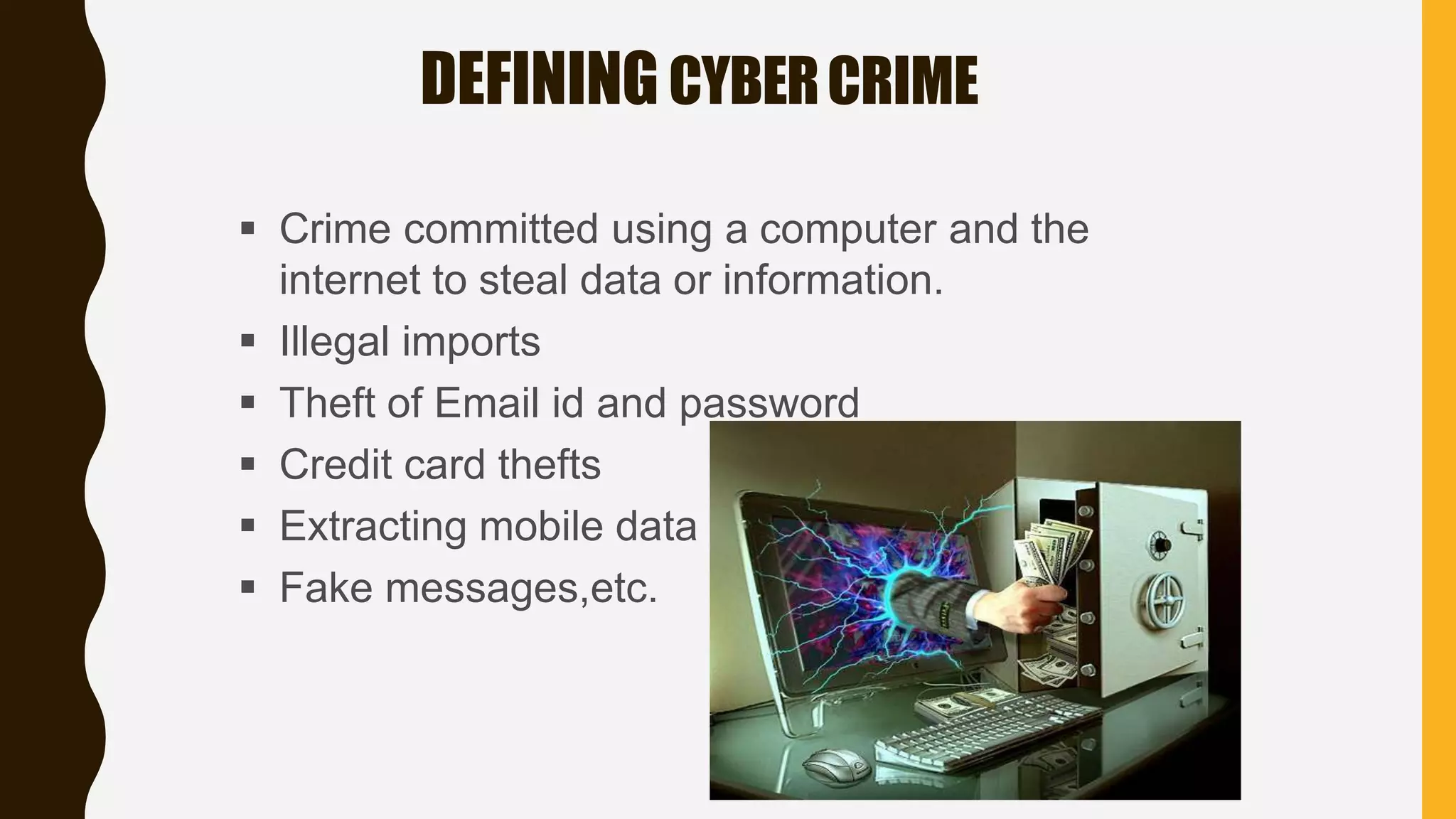
 Crime committed using a computer and the
internet to steal data or information.
 Illegal imports
 Theft of Email id and password
 Credit card thefts
 Extracting mobile data
 Fake messages,etc.
Cyber crime
IS NOTHING BUT WHERE
THE COMPUTER USED AS AN
OBJECT OR SUBJECT OF CRIME..
HISTORY
• The first recorded cyber crime took place
in the year 1820.
TYPES OF CYBER CRIME
 Cybercrimes Against an Individual
Person
 Cybercrimes Against Property
 Cybercrimes Against
Organisation/Society
CYBERCRIMES AGAINST AN INDIVIDUAL PERSON
• Email Spoofing – Receiver is fooled to believe that the message
is from trusted source.
• Cyber Stalking – Attacker harasses or humiliate a person by
false messages, threaten the family.
• Cyber Bullying – Harming and threating the person by posting
embarrassing content on the internet or social sites and torturing
the person mentally leading to the significant loss.
KNOW THE FACT
• STUDENTS VIEW
CYBERCRIMES AGAINST PROPERTY
• Identity Theft – Misusing or stealing person’s personal
information by hacking the network or placing software in
computer.
• Phishing – Sending an email misleading to believe the
message from the trusted source and diverting to the fake
website where the user enters his credentials(Eg. Winning
lottery)
• Pharming – Piece of malicious program is installed in a
computer which misdirects the user to the fraudulent sites
without their knowledge.
CYBERCRIMES AGAINST ORGANISATION/SOCIETY
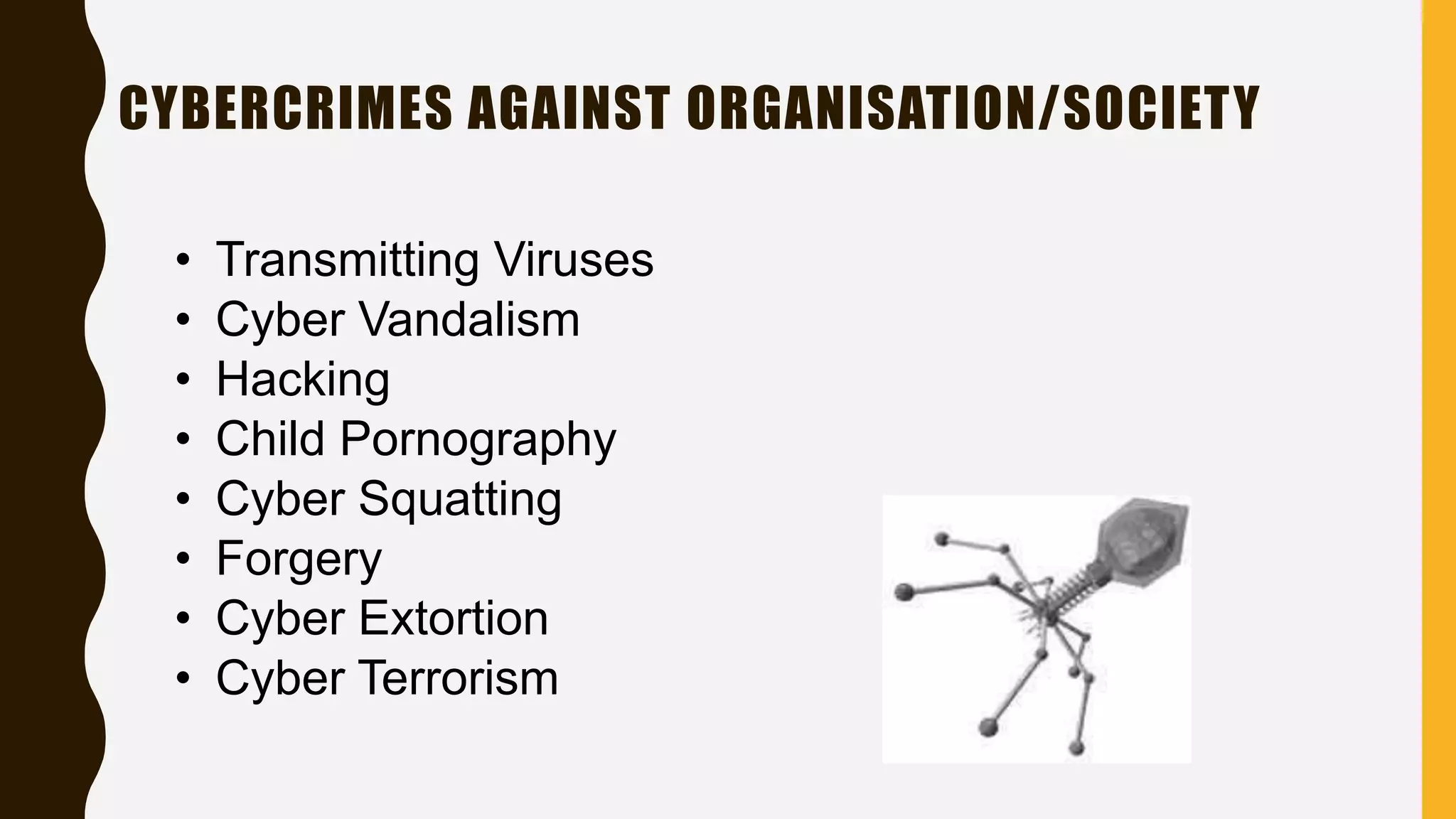
• Transmitting Viruses
• Cyber Vandalism
• Hacking
• Child Pornography
• Cyber Squatting
• Forgery
• Cyber Extortion
• Cyber Terrorism
TRANSMITTING VIRUSES
Types of Viruses 
• Boot Sector Virus – It damages the boot sector of a hard
disc which manages the reading and loading of OS gets
activated at the time of booting.
• Program File Virus – It destroys executable file and
damages the computer while installing these
files(.com,.exe,.ovl,.drv,.sys,etc.). It gets active replicate
itself and infect the files permanently.
A computer virus is a set of programs that disrupts the
normal functioning of a computer by damaging its data.
• VIRUS – “Vital Information Resources Under Seize”
• Multipartite Virus – Its a hybrid of Boot
sector and Program file virus. It gets entry
into system through some infected media
and then resides inside the computer
memory. It moves to hard disc and infects
the executable files.
• Polymorphic Virus – It changes its forms
every time it runs to hide from antivirus
program.
• Network Virus – It spreads through the LAN
or Internet. It spreads through shared drives
or folders, files, etc. It destroys one
computer and moves to the next and
repeats cycle.
• Macro Virus – It infects application files such
as Word, PowerPoint, Excel. Once this virus
gets activated in your computer, every file
you access will be corrupted.
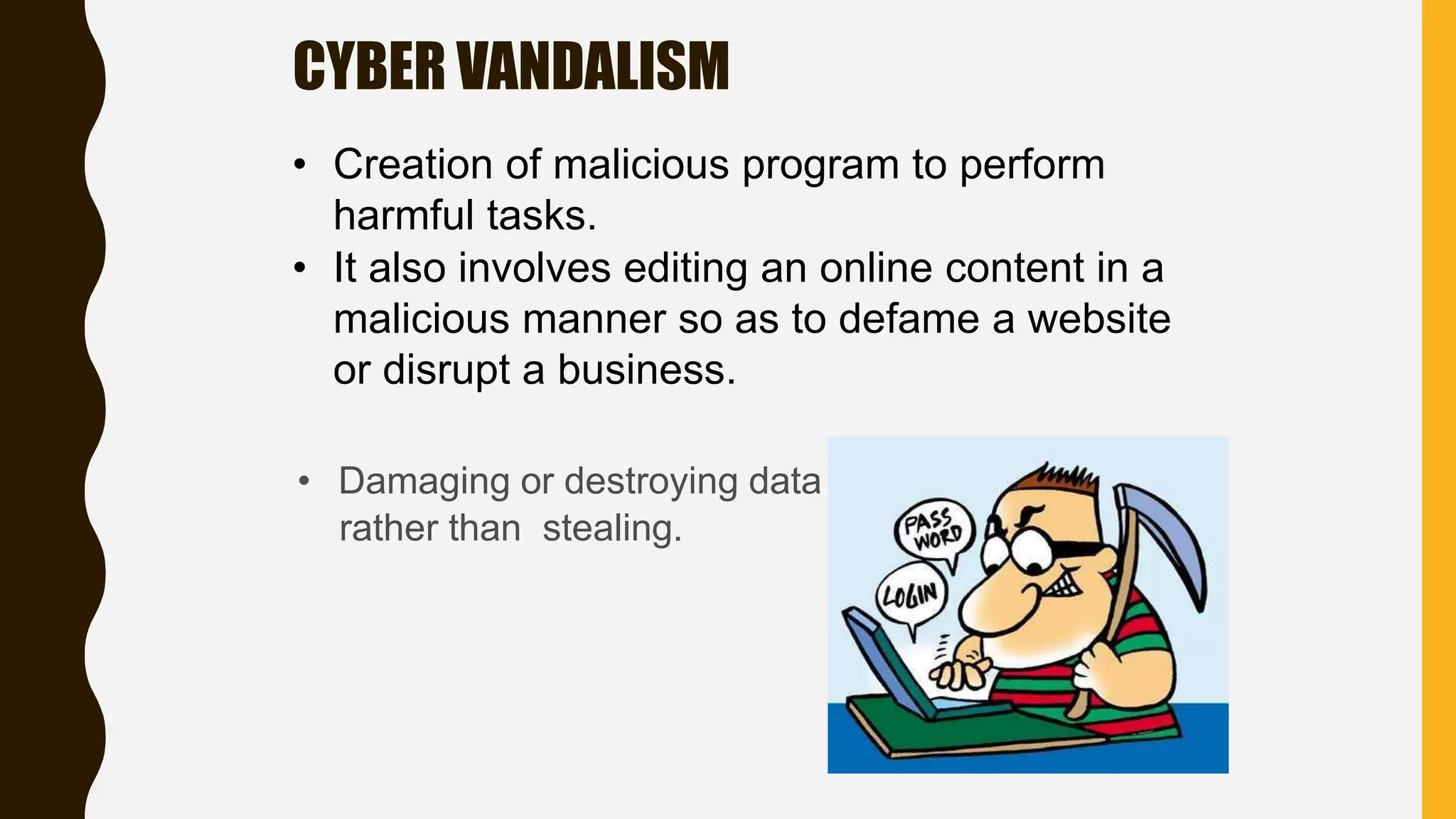
CYBER VANDALISM
• Creation of malicious program to perform
harmful tasks.
• It also involves editing an online content in a
malicious manner so as to defame a website
or disrupt a business.
• Damaging or destroying data
rather than stealing.
HACKING
• Hacking in simple terms means an illegal
intrusion(entry) into a computer system and/or
network.
• Hackers writes or use the readymade
programs to attack the target computer and
steal the information.
• It refers to the act of using the goodwill
of a trademark belonging to someone
else and to get benefit out of it.
CYBER SQUATTING
FORGERY
• It is an act of making a false copy of a
document or making any false certificate
to perform illegal means.
CYBER EXTORTION
• In this the victim is attacked first and then
demanded a money to stop the further attacks.
CYBER TERRORISM
• Use of Internet based attacks in terrorist activities
to create fear and panic in the name of religion or
politics to attack the defence system.
SAFETY TIPS FOR CYBERCRIME
• Use antivirus software’s.
• Insert firewalls.
• Uninstall unnecessary software
• Maintain backup.
• Check security settings.
• Stay anonymous - choose a
genderless screen name.
• Never give your full name or
address to strangers.
• Learn more about Internet
privacy.
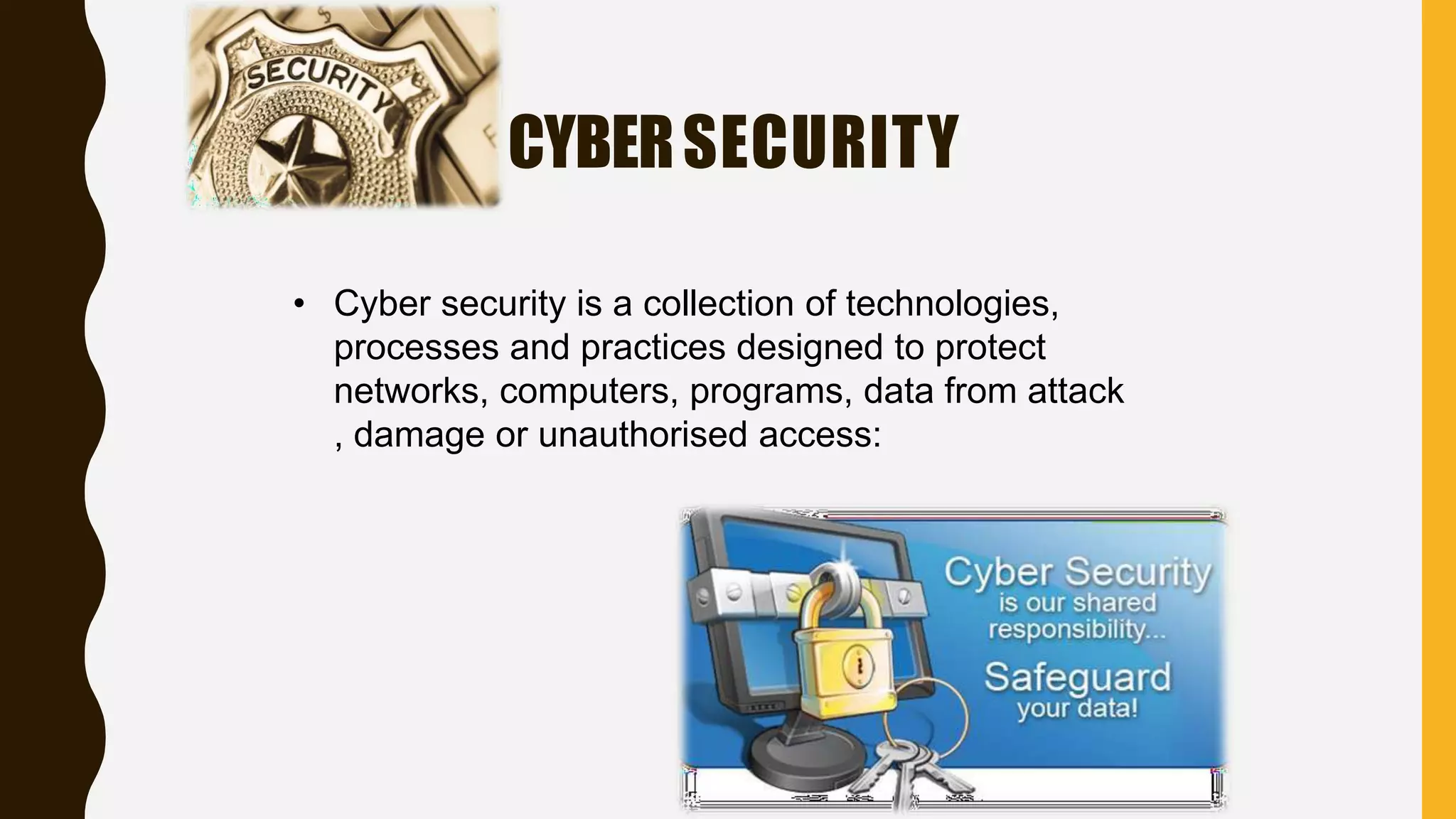
CYBERSECURITY
• Cyber security is a collection of technologies,
processes and practices designed to protect
networks, computers, programs, data from attack
, damage or unauthorised access:
ANTIVIRUS
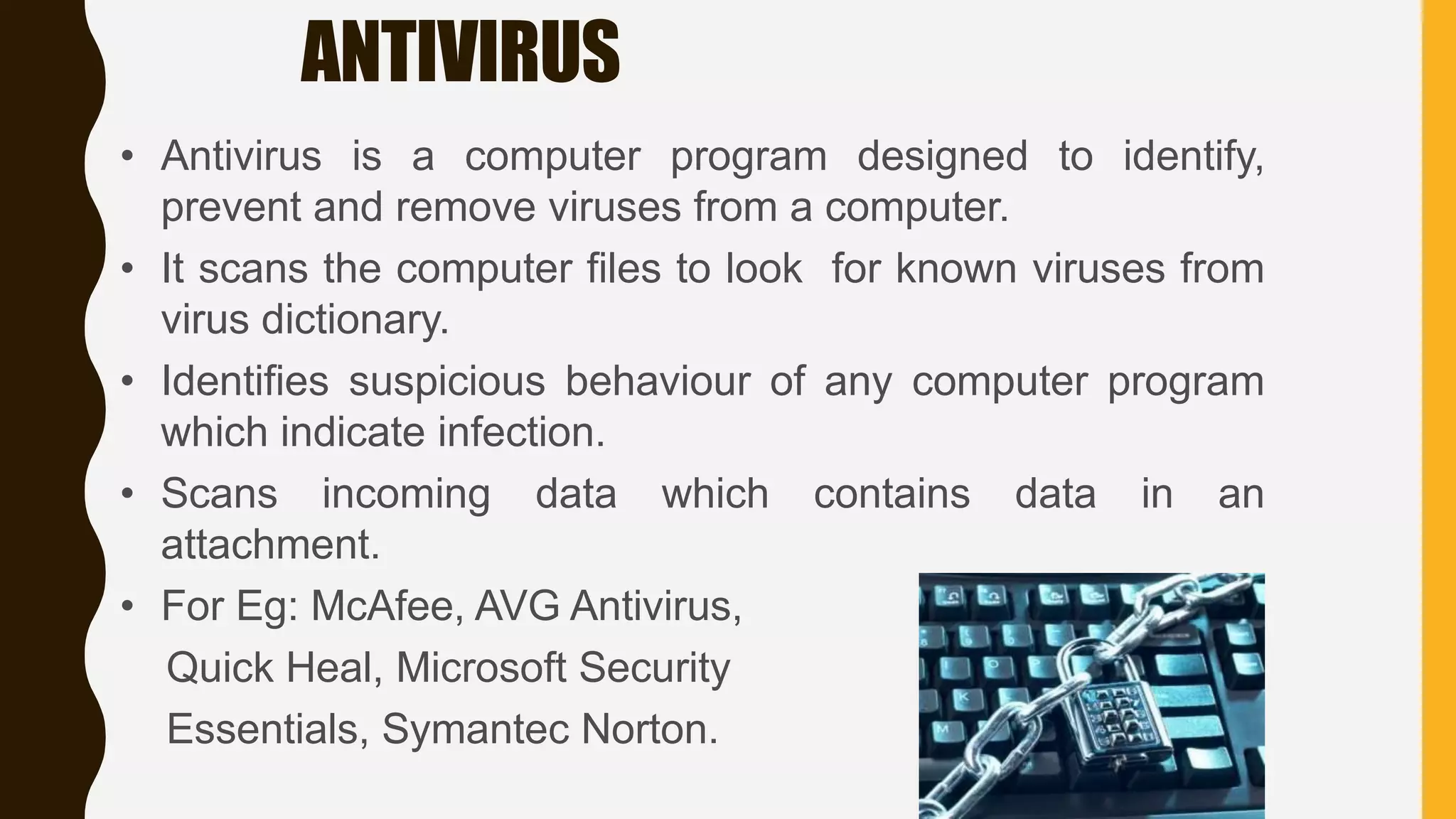
• Antivirus is a computer program designed to identify,
prevent and remove viruses from a computer.
• It scans the computer files to look for known viruses from
virus dictionary.
• Identifies suspicious behaviour of any computer program
which indicate infection.
• Scans incoming data which contains data in an
attachment.
• For Eg: McAfee, AVG Antivirus,
Quick Heal, Microsoft Security
Essentials, Symantec Norton.
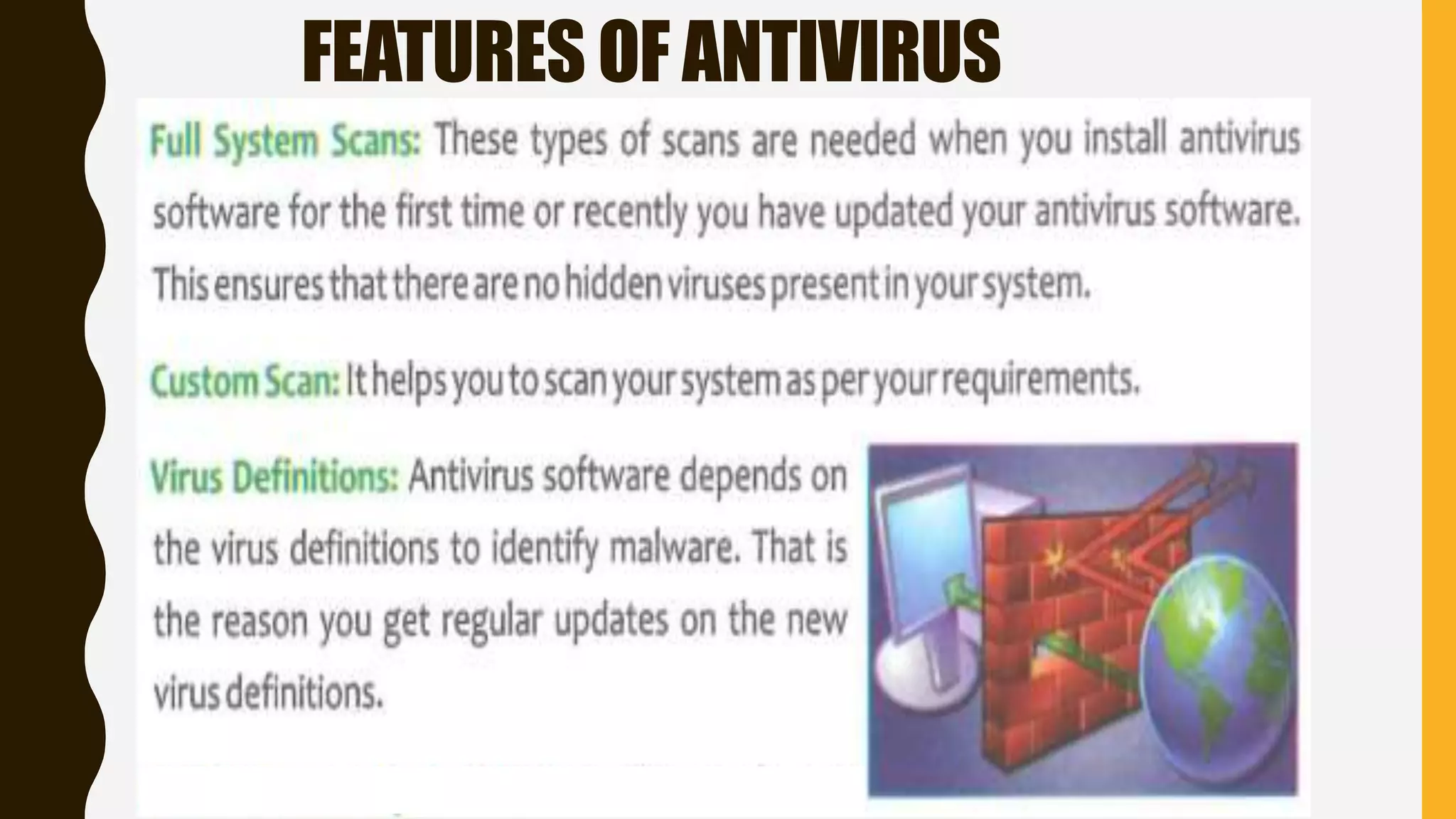
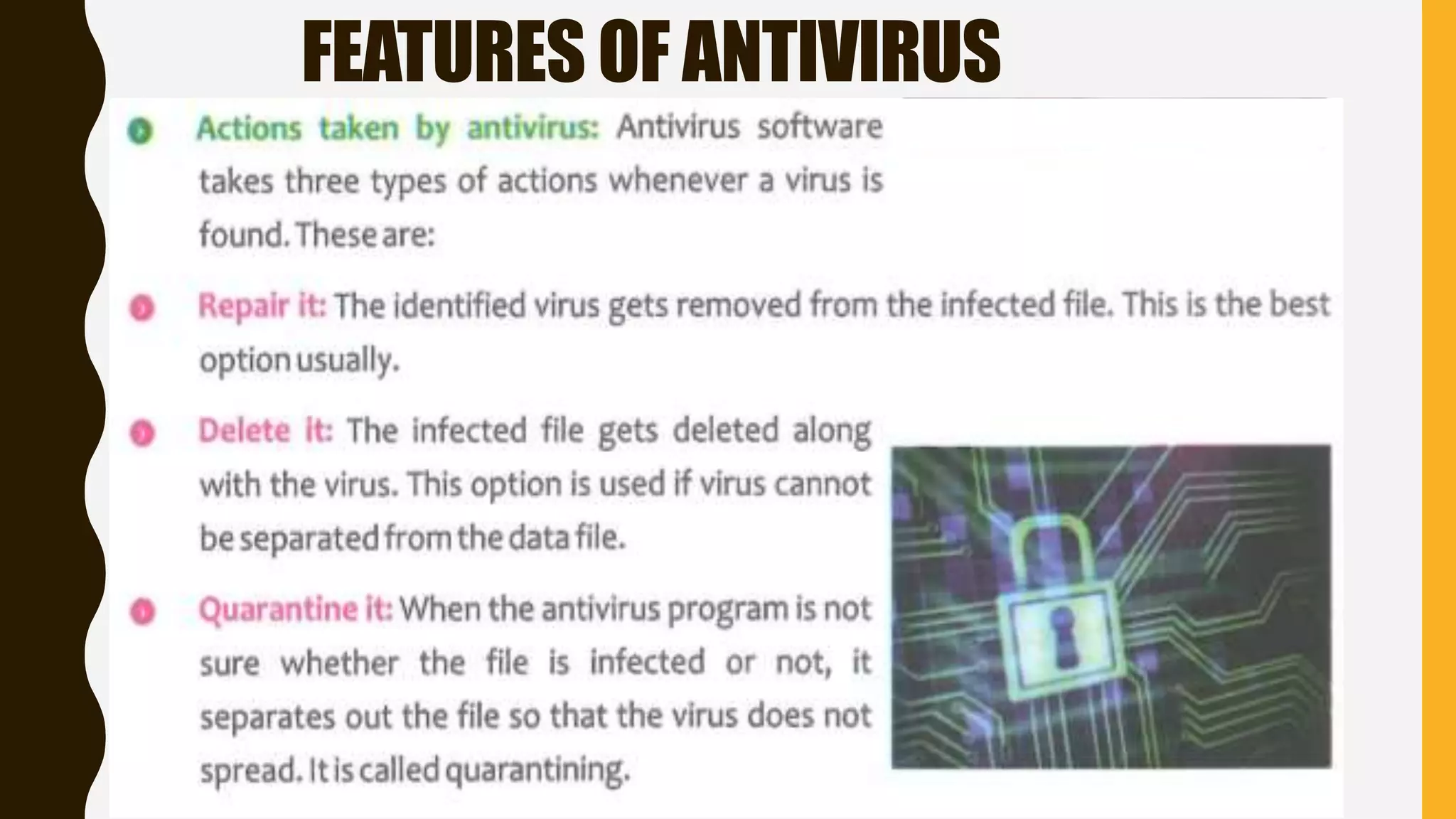
FEATURES OF ANTIVIRUS
FIREWALL
• Firewall is a security system that protects your computer
by preventing unauthorised users from gaining access to it
through network or internet.
• It can either be hardware or software or combination of
both.
• It has certain set of rules based on which it controls the
incoming and outgoing network traffic.
ENCRYPTION SOFTWARE
• Biometrics
• Passwords
• Backups
• Cookies
CONCLUSION
Technology is destructive only in the hands of
people who do not realize that they are one
and the same process as the universe.

Grade 7 Chap 10 Cyber Threats and Security

  • 1.
    CYBER THREATS AND SECURITY Ifwe can defeat them sitting at home……whoneeds to fight with tanks and guns!!!! Presented By Ms. Sultana Shaikh
  • 2.
    CONTENTS • Cybercrime • CybercrimesAgainst an Individual Person • Cybercrimes Against Property • Cybercrimes Against Organisation/Society • Cyber Security
  • 3.
    INTRODUCTION The internet inIndia is growing rapidly. It has given rise to new opportunities in every field we can think of, be it entertainment, business, sports or education. There’re two sides to a coin. Internet also has its own disadvantages which Cyber crime- Any illegal activity committed on the internet.
  • 4.
    DEFININGCYBERCRIME  Crime committedusing a computer and the internet to steal data or information.  Illegal imports  Theft of Email id and password  Credit card thefts  Extracting mobile data  Fake messages,etc.
  • 5.
    Cyber crime IS NOTHINGBUT WHERE THE COMPUTER USED AS AN OBJECT OR SUBJECT OF CRIME..
  • 6.
    HISTORY • The firstrecorded cyber crime took place in the year 1820.
  • 7.
    TYPES OF CYBERCRIME  Cybercrimes Against an Individual Person  Cybercrimes Against Property  Cybercrimes Against Organisation/Society
  • 8.
    CYBERCRIMES AGAINST ANINDIVIDUAL PERSON • Email Spoofing – Receiver is fooled to believe that the message is from trusted source. • Cyber Stalking – Attacker harasses or humiliate a person by false messages, threaten the family. • Cyber Bullying – Harming and threating the person by posting embarrassing content on the internet or social sites and torturing the person mentally leading to the significant loss.
  • 9.
    KNOW THE FACT •STUDENTS VIEW
  • 10.
    CYBERCRIMES AGAINST PROPERTY •Identity Theft – Misusing or stealing person’s personal information by hacking the network or placing software in computer. • Phishing – Sending an email misleading to believe the message from the trusted source and diverting to the fake website where the user enters his credentials(Eg. Winning lottery) • Pharming – Piece of malicious program is installed in a computer which misdirects the user to the fraudulent sites without their knowledge.
  • 11.
    CYBERCRIMES AGAINST ORGANISATION/SOCIETY •Transmitting Viruses • Cyber Vandalism • Hacking • Child Pornography • Cyber Squatting • Forgery • Cyber Extortion • Cyber Terrorism
  • 12.
    TRANSMITTING VIRUSES Types ofViruses  • Boot Sector Virus – It damages the boot sector of a hard disc which manages the reading and loading of OS gets activated at the time of booting. • Program File Virus – It destroys executable file and damages the computer while installing these files(.com,.exe,.ovl,.drv,.sys,etc.). It gets active replicate itself and infect the files permanently. A computer virus is a set of programs that disrupts the normal functioning of a computer by damaging its data. • VIRUS – “Vital Information Resources Under Seize”
  • 13.
    • Multipartite Virus– Its a hybrid of Boot sector and Program file virus. It gets entry into system through some infected media and then resides inside the computer memory. It moves to hard disc and infects the executable files. • Polymorphic Virus – It changes its forms every time it runs to hide from antivirus program.
  • 14.
    • Network Virus– It spreads through the LAN or Internet. It spreads through shared drives or folders, files, etc. It destroys one computer and moves to the next and repeats cycle. • Macro Virus – It infects application files such as Word, PowerPoint, Excel. Once this virus gets activated in your computer, every file you access will be corrupted.
  • 15.
    CYBER VANDALISM • Creationof malicious program to perform harmful tasks. • It also involves editing an online content in a malicious manner so as to defame a website or disrupt a business. • Damaging or destroying data rather than stealing.
  • 16.
    HACKING • Hacking insimple terms means an illegal intrusion(entry) into a computer system and/or network. • Hackers writes or use the readymade programs to attack the target computer and steal the information.
  • 17.
    • It refersto the act of using the goodwill of a trademark belonging to someone else and to get benefit out of it. CYBER SQUATTING FORGERY • It is an act of making a false copy of a document or making any false certificate to perform illegal means.
  • 18.
    CYBER EXTORTION • Inthis the victim is attacked first and then demanded a money to stop the further attacks. CYBER TERRORISM • Use of Internet based attacks in terrorist activities to create fear and panic in the name of religion or politics to attack the defence system.
  • 19.
    SAFETY TIPS FORCYBERCRIME • Use antivirus software’s. • Insert firewalls. • Uninstall unnecessary software • Maintain backup. • Check security settings. • Stay anonymous - choose a genderless screen name. • Never give your full name or address to strangers. • Learn more about Internet privacy.
  • 20.
    CYBERSECURITY • Cyber securityis a collection of technologies, processes and practices designed to protect networks, computers, programs, data from attack , damage or unauthorised access:
  • 21.
    ANTIVIRUS • Antivirus isa computer program designed to identify, prevent and remove viruses from a computer. • It scans the computer files to look for known viruses from virus dictionary. • Identifies suspicious behaviour of any computer program which indicate infection. • Scans incoming data which contains data in an attachment. • For Eg: McAfee, AVG Antivirus, Quick Heal, Microsoft Security Essentials, Symantec Norton.
  • 22.
  • 23.
  • 24.
    FIREWALL • Firewall isa security system that protects your computer by preventing unauthorised users from gaining access to it through network or internet. • It can either be hardware or software or combination of both. • It has certain set of rules based on which it controls the incoming and outgoing network traffic.
  • 25.
    ENCRYPTION SOFTWARE • Biometrics •Passwords • Backups • Cookies
  • 26.
    CONCLUSION Technology is destructiveonly in the hands of people who do not realize that they are one and the same process as the universe.