CDS-121: Fundamentals of Cyber Security
Unit 1: Introduction to Cyber Security and various challenges in cyber security
1.1. Overview of Cyber Security,
1.2. Internet Governance – Challenges and Constraints,
1.3. Cyber Threats: - Cyber Warfare-Cyber Crime-Cyber
Terrorism-Cyber Espionage,
1.4. Need for a Comprehensive Cyber Security Policy,
1.5. Need for a Nodal Authority,
1.6. Need for an International convention on Cyberspace.
Dr Sharmila Sharad More,
Assistant Professor , Dept Of Science and Computer Science,
MIT, ACSC,Alandi, Pune
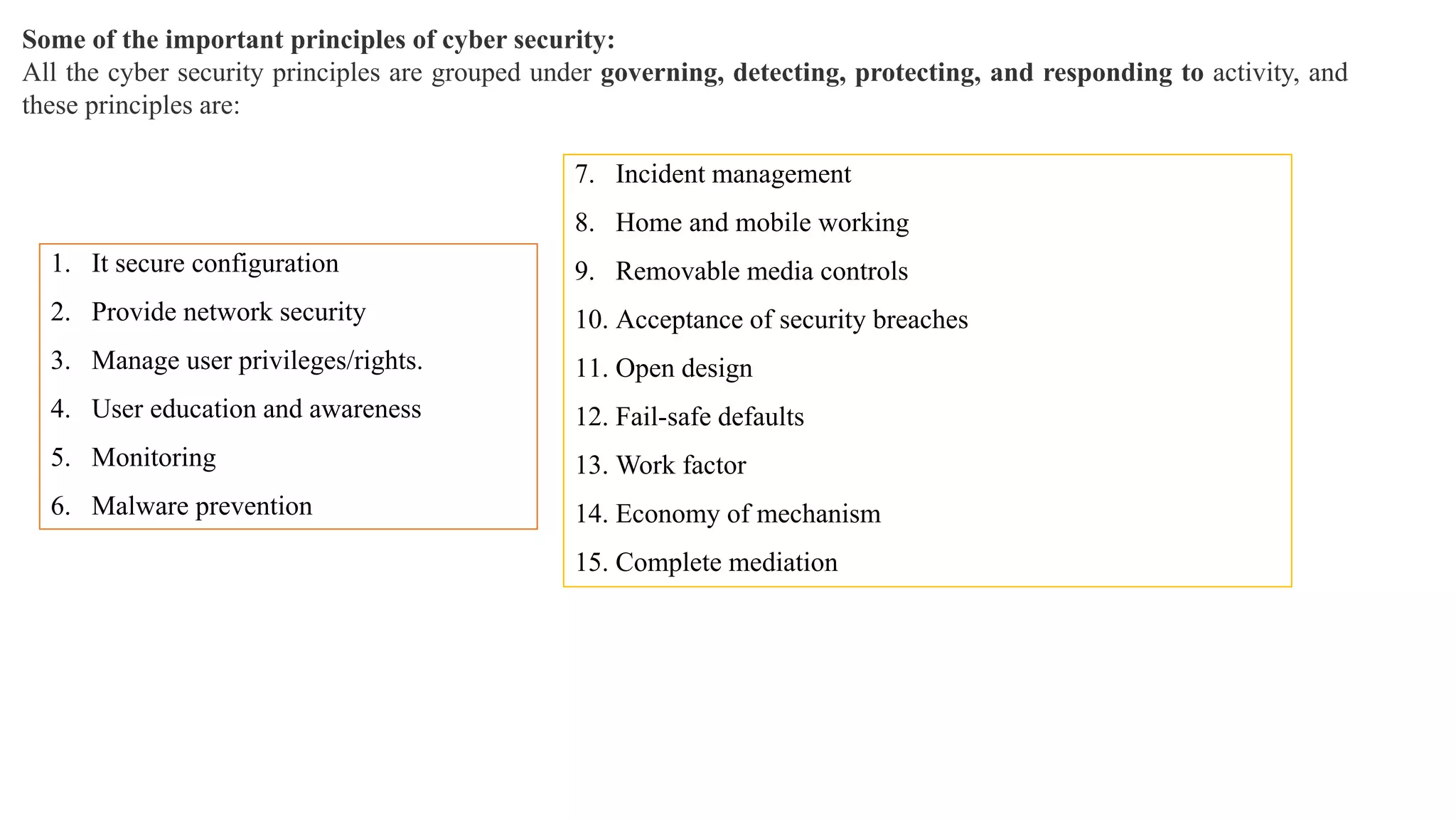
Cybersecurity is the practice of protecting systems, networks, and programs from digital attacks. These cyberattacks are usually aimed at
accessing, changing, or destroying sensitive information; extorting money from users; or interrupting normal business processes.
Cyber security refers to a set of techniques used to protect the integrity of networks, programs and data from attack, damage or unauthorized
access.
 In simple words, Cyber security is the practice of protecting systems, networks, and programs from digital attacks.
 These cyber-attacks are usually aimed at accessing, changing, or destroying sensitive information; extorting money from users; or
interrupting normal business processes.
 Cyber security is very important for today’s life. Cyber safety provides enhanced cyberspace security, improves cyber resilience, speeds up
cyber, data & information protection for businesses it protects individual private information, it protects networks & resources & tackles
computer hackers and theft of identity.
The use of cyber security can help prevent cyber attacks, data breaches, and
identity theft and can aid in risk management.
It aims to reduce the risk of cyber attacks and protect against the
unauthorized exploitation of systems, networks, and technologies.
Cyber security refers to every aspect of protecting an organization and its
employees and assets against cyber threats. As cyber attacks become more
common and sophisticated and corporate networks grow more complex, a
variety of cyber security solutions are required to mitigate corporate cyber risk.
Some of the important principles of cyber security:
All the cyber security principles are grouped under governing, detecting, protecting, and responding to activity, and
these principles are:
1. It secure configuration
2. Provide network security
3. Manage user privileges/rights.
4. User education and awareness
5. Monitoring
6. Malware prevention
7. Incident management
8. Home and mobile working
9. Removable media controls
10. Acceptance of security breaches
11. Open design
12. Fail-safe defaults
13. Work factor
14. Economy of mechanism
15. Complete mediation
The following are the system that can be affected by security breaches and
attacks:
o Communication: Cyber attackers can use phone calls, emails, text messages,
and messaging apps for cyberattacks.
o Finance: This system deals with the risk of financial information like bank
and credit card detail. This information is naturally a primary target for cyber
attackers.
o Governments: The cybercriminal generally targets the government
institutions to get confidential public data or private citizen information.
o Transportation: In this system, cybercriminals generally target connected
cars, traffic control systems, and smart road infrastructure.
o Healthcare: A cybercriminal targets the healthcare system to get the
information stored at a local clinic to critical care systems at a national
hospital.
o Education: A cybercriminals target educational institutions to get their
confidential research data and information of students and employees.
a) Data safety from hackers
b) Reduces computer crash
c) Decreased data theft hazard
d) System availability and improved data
e) Protect business reputation
f) Assist remote working
g) Saves the bottom line
h) Cyber posture is improved
i) Handles data management
j) Improve customer's and stakeholders' trust
k) Detection and deletion of unwanted and harmful programs
l) Deny unwanted access from the possible threat
m) Recovery of the system
Advantages Of Cyber Security
Disadvantages Of Cyber Security
a) Not affordable to everyone
b) Can be complicated
c) Security patches may backfire
d) Need of constant monitoring
e) Slow down the system
f) Can be risky
g) Incorrect configured system blocks firewall
h) Only some updations are suitable for the system
i) Not a one-time thing
Advantages Of Cyber Security
- Cyber security will defend us from critical cyber- attacks.
- It helps us to browse the safe website.
- Cyber security will defend us from hacks & virus.
- The application of cyber security used in our PC needs to update every week.
- Internet security processes all the incoming & outgoing data on our computer.
- It helps to reduce computer chilling & crashes.
- Gives us privacy.
- It was expensive; most of the users can’t afford this.
- A normal user can’t use this properly, requiring special expertise.
- Lack of knowledge is the main problem.
- It was not easy to use.
- It makes the system slower.
- It could take hours to days to fix a breach in security.
Disadvantages Of Cyber Security
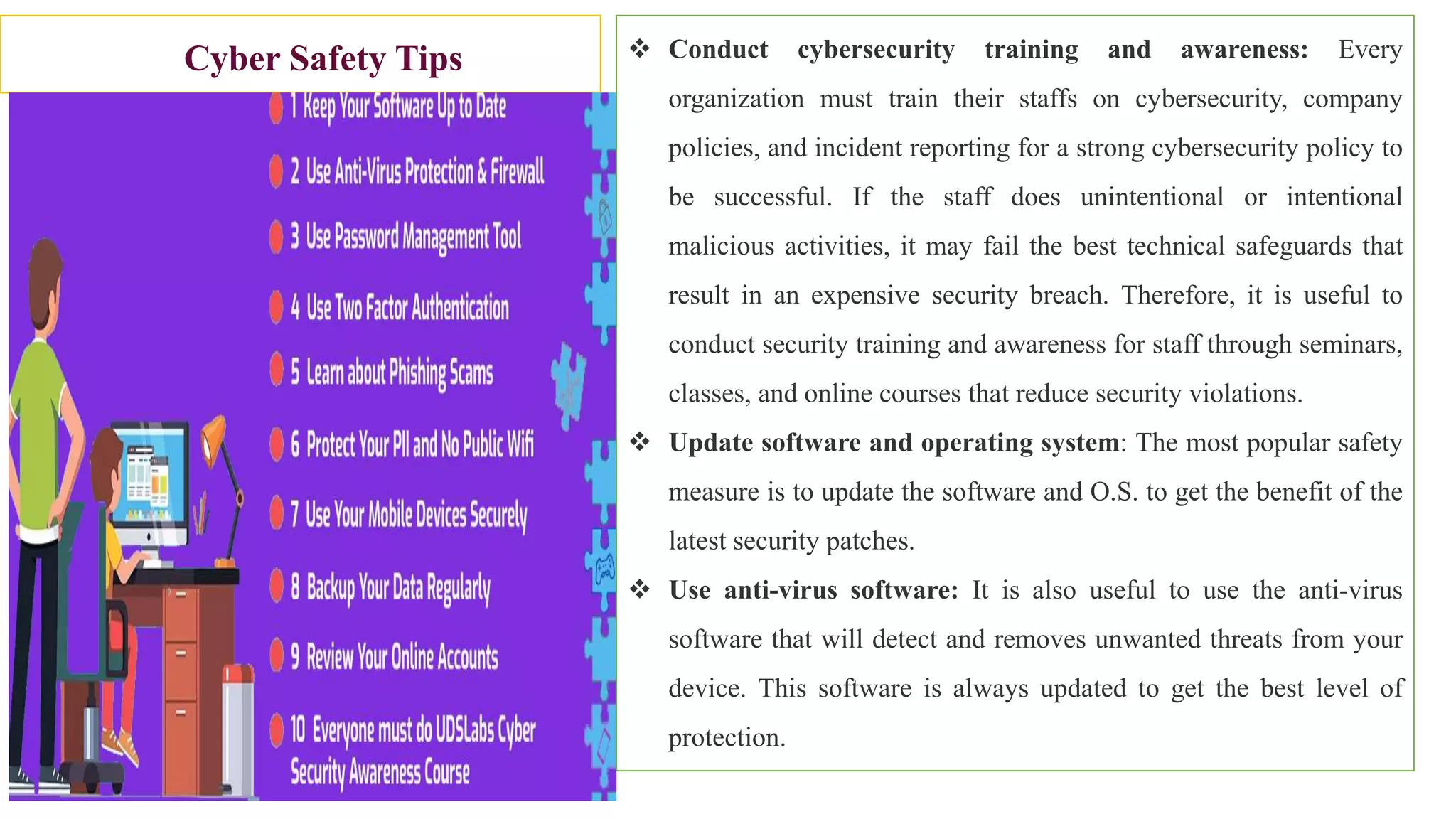
Cyber Safety Tips  Conduct cybersecurity training and awareness: Every
organization must train their staffs on cybersecurity, company
policies, and incident reporting for a strong cybersecurity policy to
be successful. If the staff does unintentional or intentional
malicious activities, it may fail the best technical safeguards that
result in an expensive security breach. Therefore, it is useful to
conduct security training and awareness for staff through seminars,
classes, and online courses that reduce security violations.
 Update software and operating system: The most popular safety
measure is to update the software and O.S. to get the benefit of the
latest security patches.
 Use anti-virus software: It is also useful to use the anti-virus
software that will detect and removes unwanted threats from your
device. This software is always updated to get the best level of
protection.
Cyber Criminals
Cybercriminals are individual or group of people who use technology to commit cybercrime with the intention of stealing
sensitive company information or personal data and generating profits. In today's, they are the most prominent and most active
type of attacker.
Cybercriminals use computers in three broad ways to do cybercrimes-
o Select computer as their target- In this, they attack other people's computers to do cybercrime, such as spreading viruses,
data theft, identity theft, etc.
o Uses the computer as their weapon- In this, they use the computer to do conventional crime such as spam, fraud, illegal
gambling, etc.
o Uses the computer as their accessory- In this, they use the computer to steal data illegally.
Cybercrime is any type of illegal activity that takes place via digital means. Data theft is, of course, one of the most
common types of cybercrime, but cybercrime also includes a wide range of malicious activity as well, such as cyberbullying or
planting worms or viruses.
Cybercrimes are divided into two different categories as follows −
 Those that cause intentional damage
 Those that can cause unintentional damage.
A cybercrime is a criminal act in which someone targets a computer or a network of devices in order to gain illegal rights, steal
data from them, frauds etc.
This type of crime is carried out using technology which primarily takes place online.
Some cybercrime even include the following −
 Harassment
 Cyber-stalking
 Bullying
Cybercrime or a computer-oriented crime is a crime that includes a computer and a network. The computer may have
been used in the execution of a crime or it may be the target. Cybercrime is the use of a computer as a weapon for
committing crimes such as committing fraud, identity theft, or breaching privacy. Cybercrime, especially through the
Internet, has grown in importance as the computer has become central to every field like commerce, entertainment, and
government. Cybercrime may endanger a person or a nation’s security and financial health. Cybercrime encloses a wide
range of activities, but these can generally be divided into two categories:
 Crimes that aim at computer networks or devices. These types of crimes involve different threats (like virus,
bugs etc.) and denial-of-service (DoS) attacks.
 Crimes that use computer networks to commit other criminal activities. These types of crimes include cyber
stalking, financial fraud or identity theft.
Classification of Cyber Crime:
Cyber Terrorism –
Cyber terrorism is the use of the computer and internet to perform violent acts that result in loss of life. This may include
different type of activities either by software or hardware for threatening life of citizens.
In general, Cyber terrorism can be defined as an act of terrorism committed through the use of cyberspace or computer
resources.
Cyber Extortion –
Cyber extortion occurs when a website, e-mail server or computer system is subjected to or threatened with repeated
denial of service or other attacks by malicious hackers. These hackers demand huge money in return for assurance to stop
the attacks and to offer protection.
Cyber Warfare –
Cyber warfare is the use or targeting in a battle space or warfare context of computers, online control systems and
networks. It involves both offensive and defensive operations concerning to the threat of cyber attacks, espionage and
sabotage.
Internet Fraud –
Internet fraud is a type of fraud or deceit which makes use of the Internet and could include hiding of information or
providing incorrect information for the purpose of deceiving victims for money or property. Internet fraud is not
considered a single, distinctive crime but covers a range of illegal and illicit actions that are committed in cyberspace.
Cyber Stalking –
This is a kind of online harassment wherein the victim is subjected to a barrage of online messages and emails. In this
case, these stalkers know their victims and instead of offline stalking, they use the Internet to stalk. However, if they
notice that cyber stalking is not having the desired effect, they begin offline stalking along with cyber stalking to make
the victims’ lives more miserable.
Challenges of Cyber Crime:
People are unaware of their cyber rights-
The Cybercrime usually happen with illiterate people around the world who are unaware about their cyber rights
implemented by the government of that particular country.
Anonymity-
Those who Commit cyber crime are anonymous for us so we cannot do anything to that person.
Less numbers of case registered-
Every country in the world faces the challenge of cyber crime and the rate of cyber crime is increasing day by day because
the people who even don’t register a case of cyber crime and this is major challenge for us as well as for authorities as
well.
Mostly committed by well educated people-
Committing a cyber crime is not a cup of tea for every individual. The person who commits cyber crime is a
very technical person so he knows how to commit the crime and not get caught by the authorities.
No harsh punishment-
In Cyber crime there is no harsh punishment in every cases. But there is harsh punishment in some cases like when
somebody commits cyber terrorism in that case there is harsh punishment for that individual. But in other cases there is no
harsh punishment so this factor also gives encouragement to that person who commits cyber crime.
Prevention of Cyber Crime:
Below are some points by means of which we can prevent cyber crime:
Use strong password –
Maintain different password and username combinations for each account and resist the temptation to write them down.
Weak passwords can be easily cracked using certain attacking methods like Brute force attack, Rainbow table attack etc,
So make them complex. That means combination of letters, numbers and special characters.
Use trusted antivirus in devices –
Always use trustworthy and highly advanced antivirus software in mobile and personal computers. This leads to the
prevention of different virus attack on devices.
Keep social media private –
Always keep your social media accounts data privacy only to your friends. Also make sure only to make friends who are
known to you.
Keep your device software updated –
Whenever you get the updates of the system software update it at the same time because sometimes the previous version
can be easily attacked.
Use secure network –
Public Wi-Fi are vulnerable. Avoid conducting financial or corporate transactions on these networks.
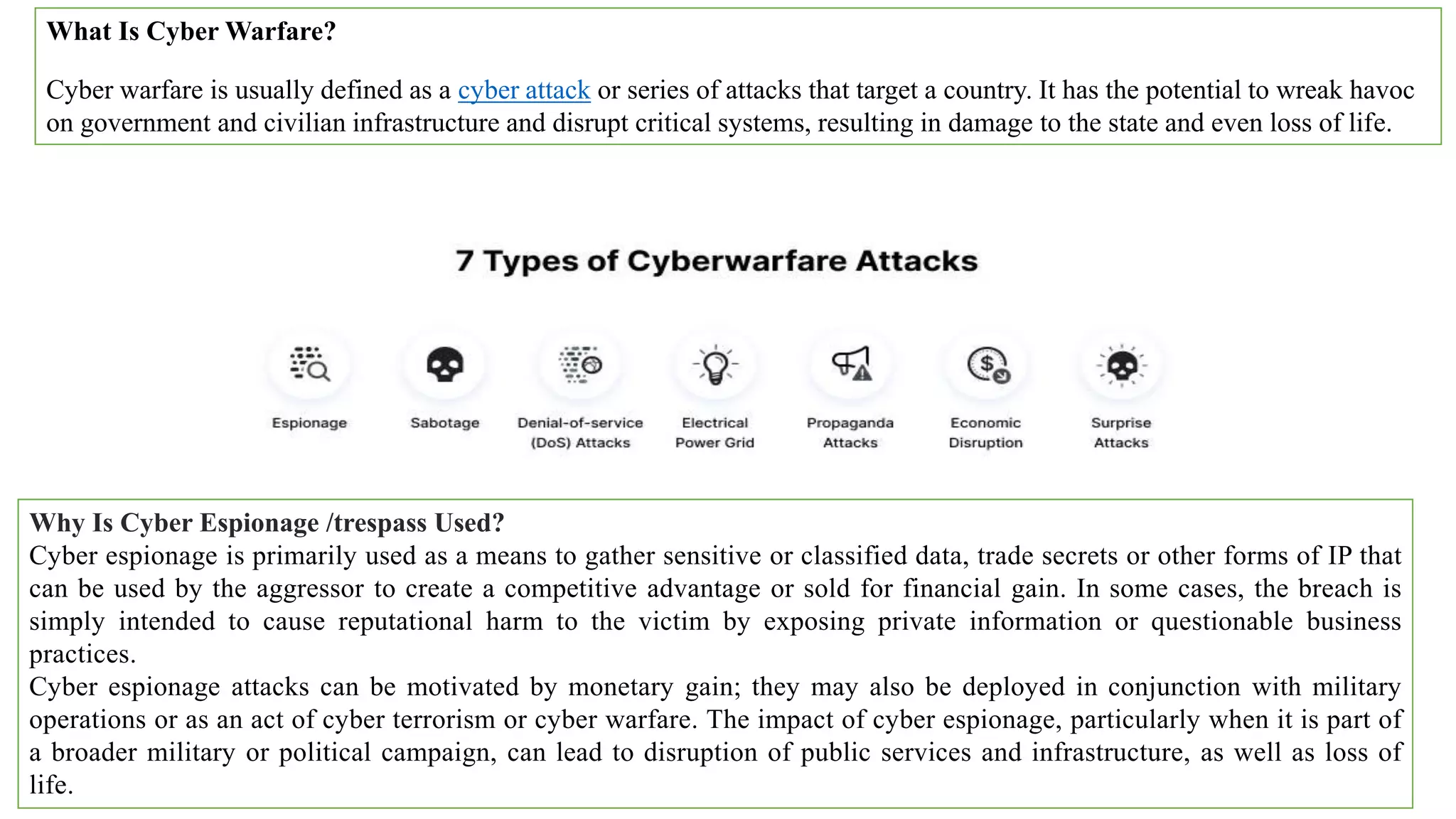
What Is Cyber Warfare?
Cyber warfare is usually defined as a cyber attack or series of attacks that target a country. It has the potential to wreak havoc
on government and civilian infrastructure and disrupt critical systems, resulting in damage to the state and even loss of life.
Why Is Cyber Espionage /trespass Used?
Cyber espionage is primarily used as a means to gather sensitive or classified data, trade secrets or other forms of IP that
can be used by the aggressor to create a competitive advantage or sold for financial gain. In some cases, the breach is
simply intended to cause reputational harm to the victim by exposing private information or questionable business
practices.
Cyber espionage attacks can be motivated by monetary gain; they may also be deployed in conjunction with military
operations or as an act of cyber terrorism or cyber warfare. The impact of cyber espionage, particularly when it is part of
a broader military or political campaign, can lead to disruption of public services and infrastructure, as well as loss of
life.
Cyber Espionage Targets
The most common targets of cyber espionage include large corporations, government agencies, academic institutions,
think tanks or other organizations that possess valuable IP and technical data that can create a competitive advantage
for another organization or government. Targeted campaigns can also be waged against individuals, such as
prominent political leaders and government officials, business executives and even celebrities.
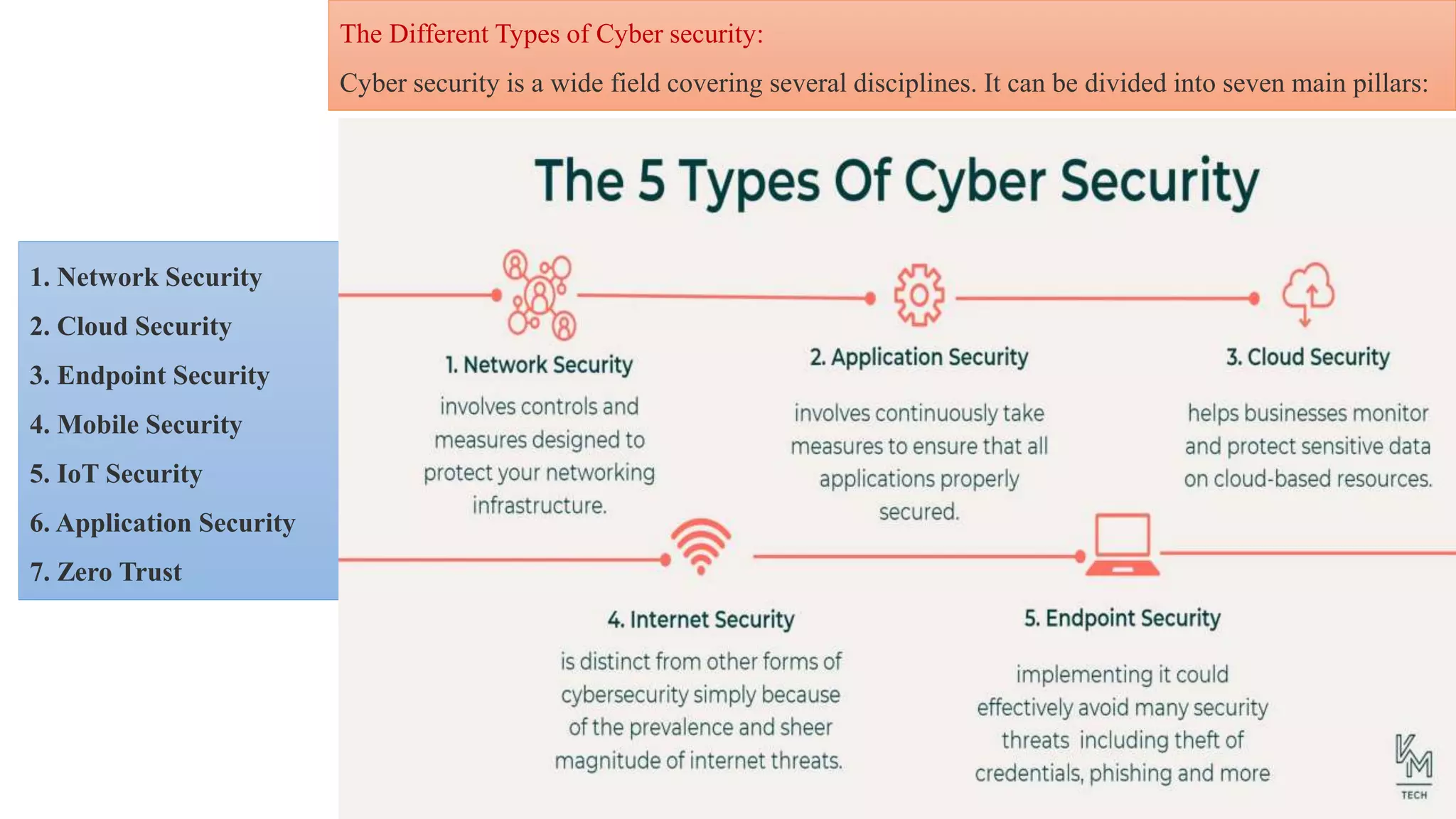
1. Network Security
2. Cloud Security
3. Endpoint Security
4. Mobile Security
5. IoT Security
6. Application Security
7. Zero Trust
The Different Types of Cyber security:
Cyber security is a wide field covering several disciplines. It can be divided into seven main pillars:
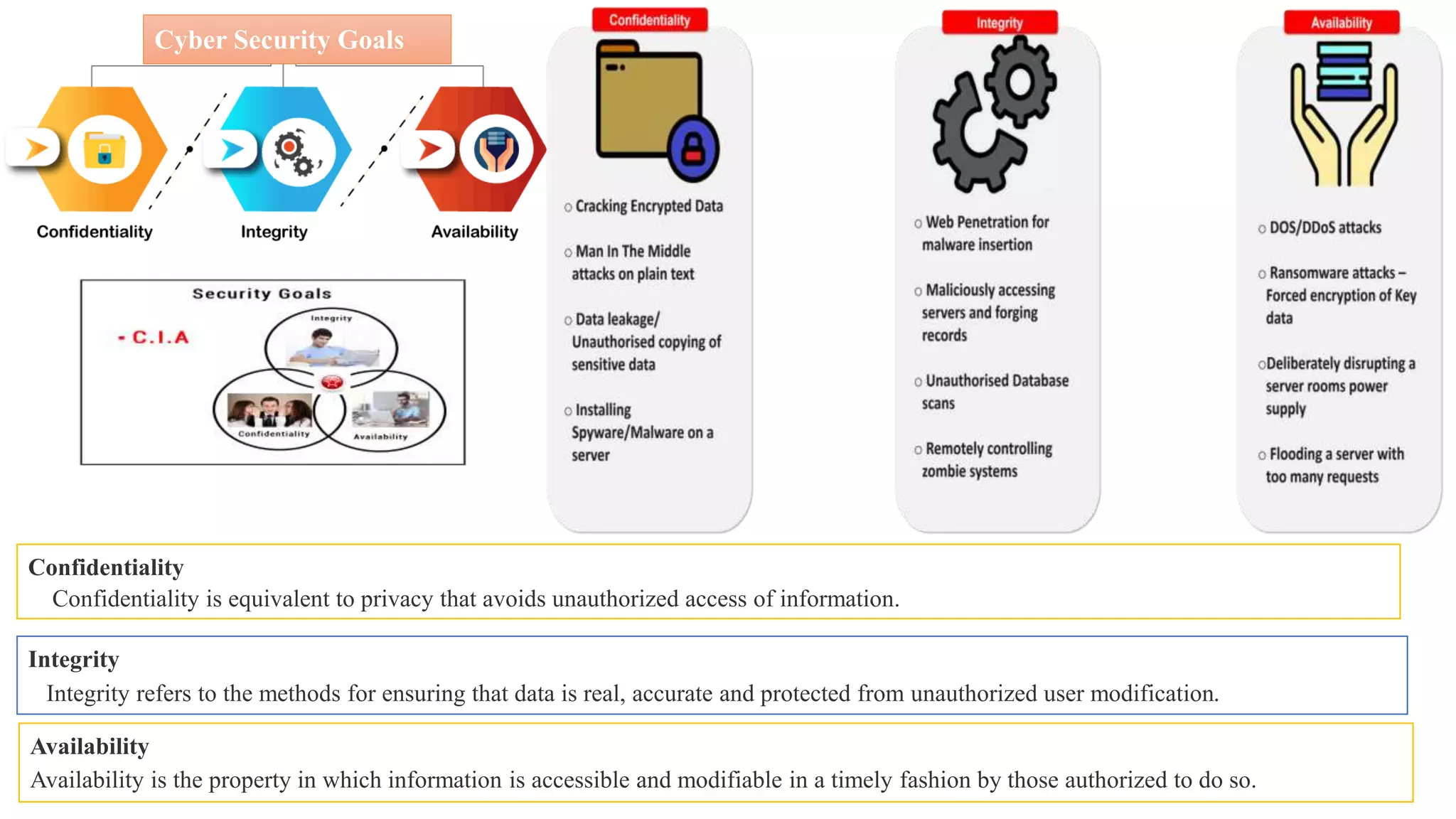
Cyber Security Goals
Confidentiality
Confidentiality is equivalent to privacy that avoids unauthorized access of information.
Integrity
Integrity refers to the methods for ensuring that data is real, accurate and protected from unauthorized user modification.
Availability
Availability is the property in which information is accessible and modifiable in a timely fashion by those authorized to do so.
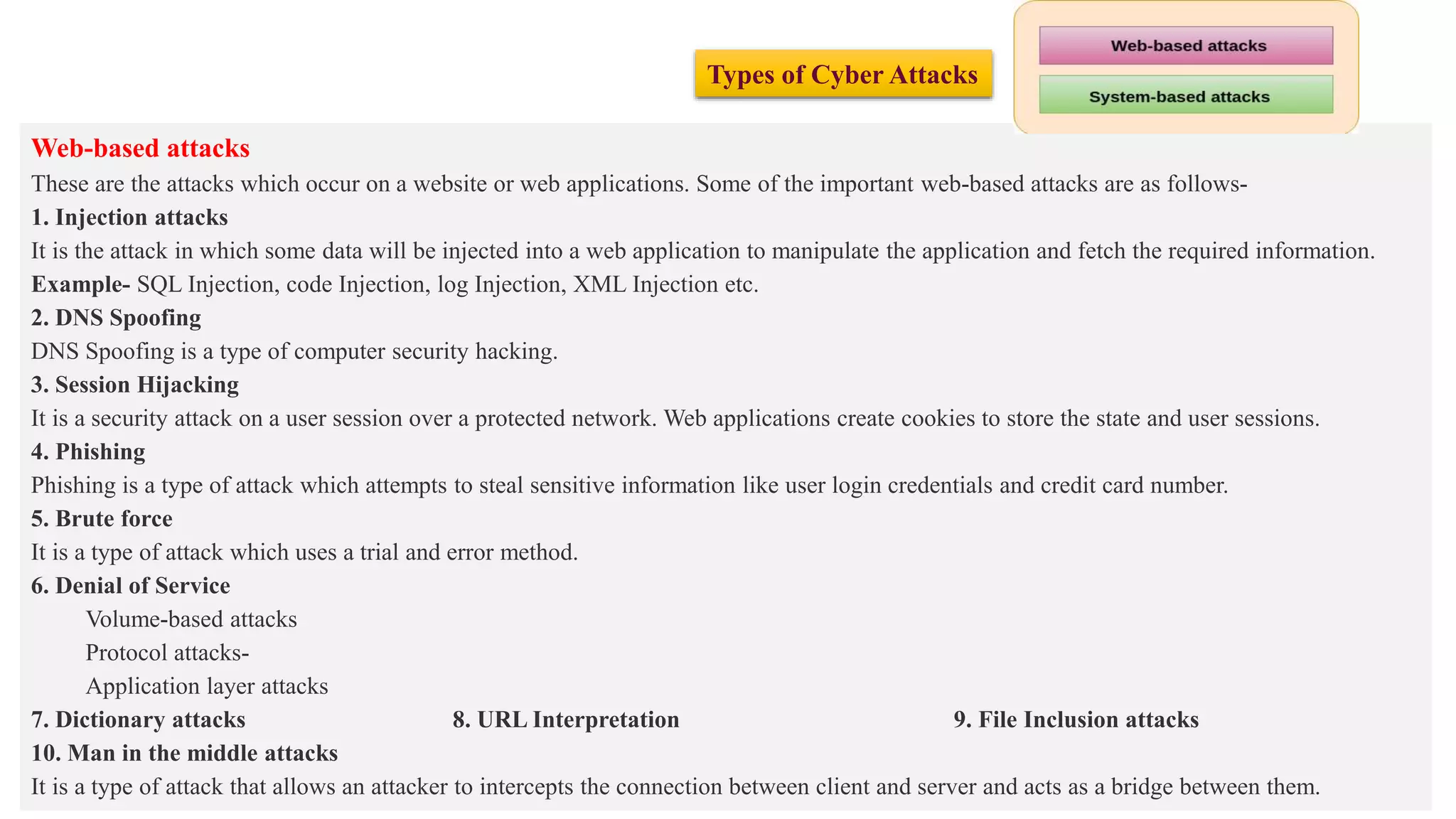
Types of Cyber Attacks
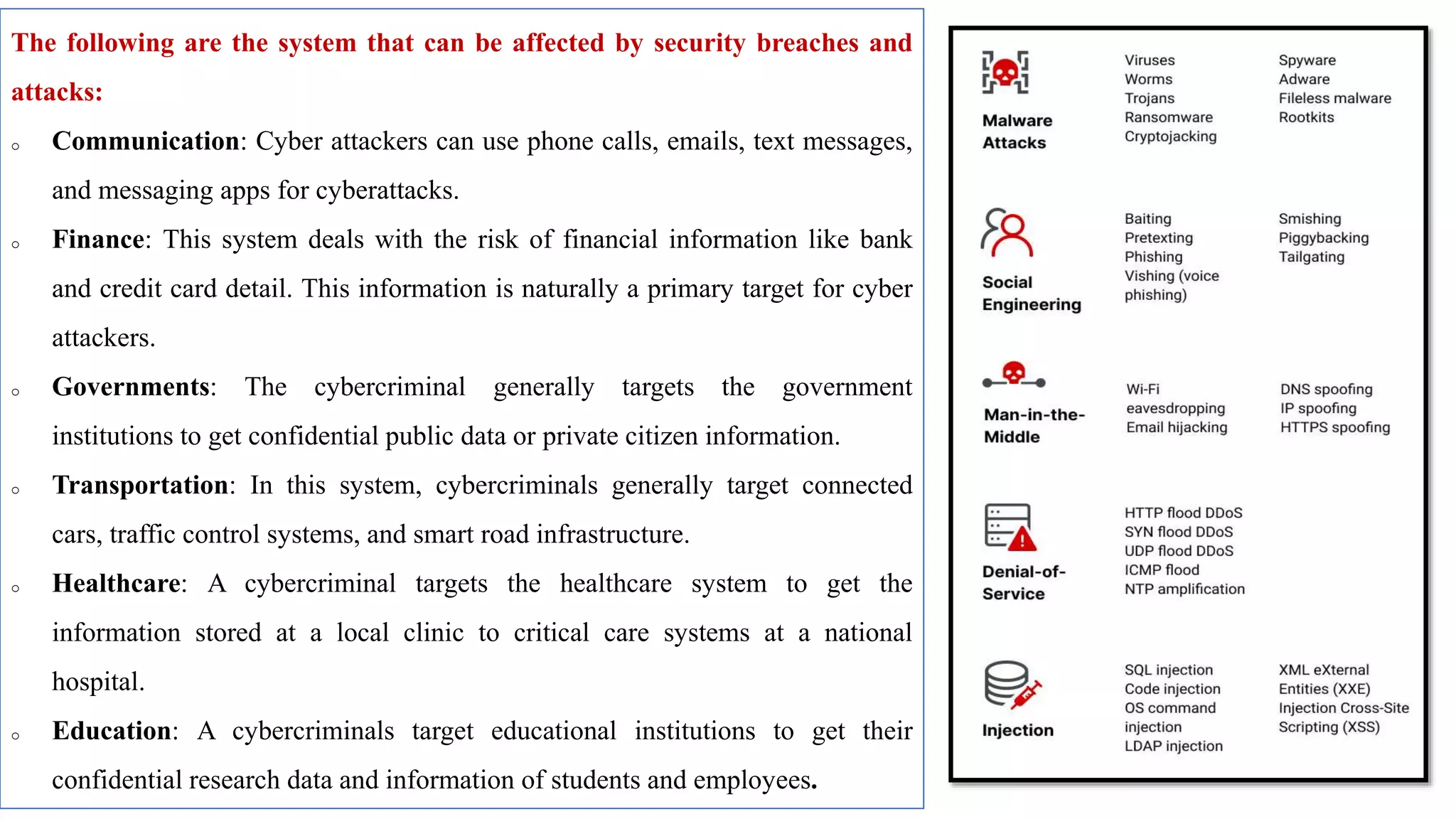
Web-based attacks
These are the attacks which occur on a website or web applications. Some of the important web-based attacks are as follows-
1. Injection attacks
It is the attack in which some data will be injected into a web application to manipulate the application and fetch the required information.
Example- SQL Injection, code Injection, log Injection, XML Injection etc.
2. DNS Spoofing
DNS Spoofing is a type of computer security hacking.
3. Session Hijacking
It is a security attack on a user session over a protected network. Web applications create cookies to store the state and user sessions.
4. Phishing
Phishing is a type of attack which attempts to steal sensitive information like user login credentials and credit card number.
5. Brute force
It is a type of attack which uses a trial and error method.
6. Denial of Service
Volume-based attacks
Protocol attacks-
Application layer attacks
7. Dictionary attacks 8. URL Interpretation 9. File Inclusion attacks
10. Man in the middle attacks
It is a type of attack that allows an attacker to intercepts the connection between client and server and acts as a bridge between them.
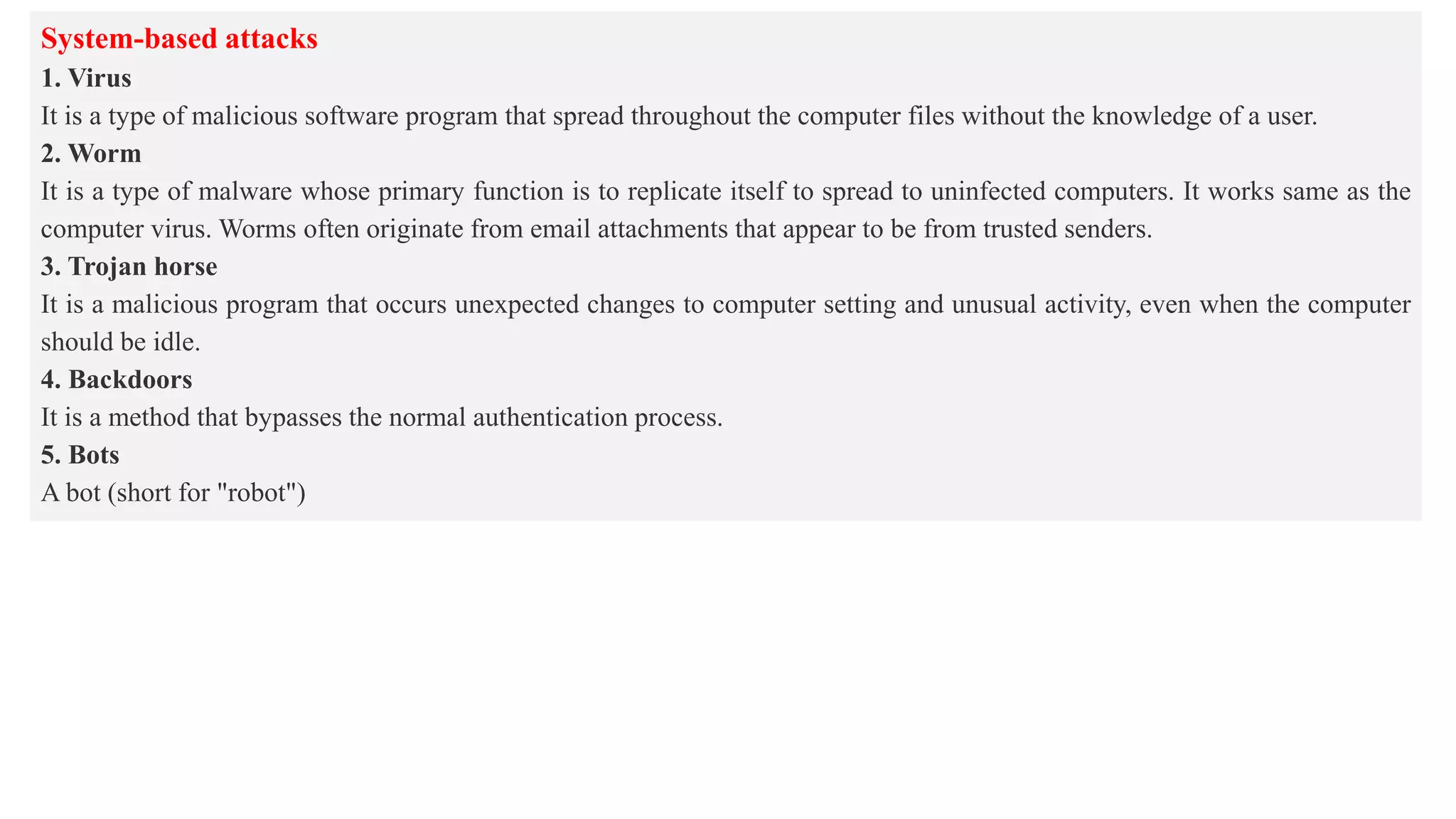
System-based attacks
1. Virus
It is a type of malicious software program that spread throughout the computer files without the knowledge of a user.
2. Worm
It is a type of malware whose primary function is to replicate itself to spread to uninfected computers. It works same as the
computer virus. Worms often originate from email attachments that appear to be from trusted senders.
3. Trojan horse
It is a malicious program that occurs unexpected changes to computer setting and unusual activity, even when the computer
should be idle.
4. Backdoors
It is a method that bypasses the normal authentication process.
5. Bots
A bot (short for "robot")
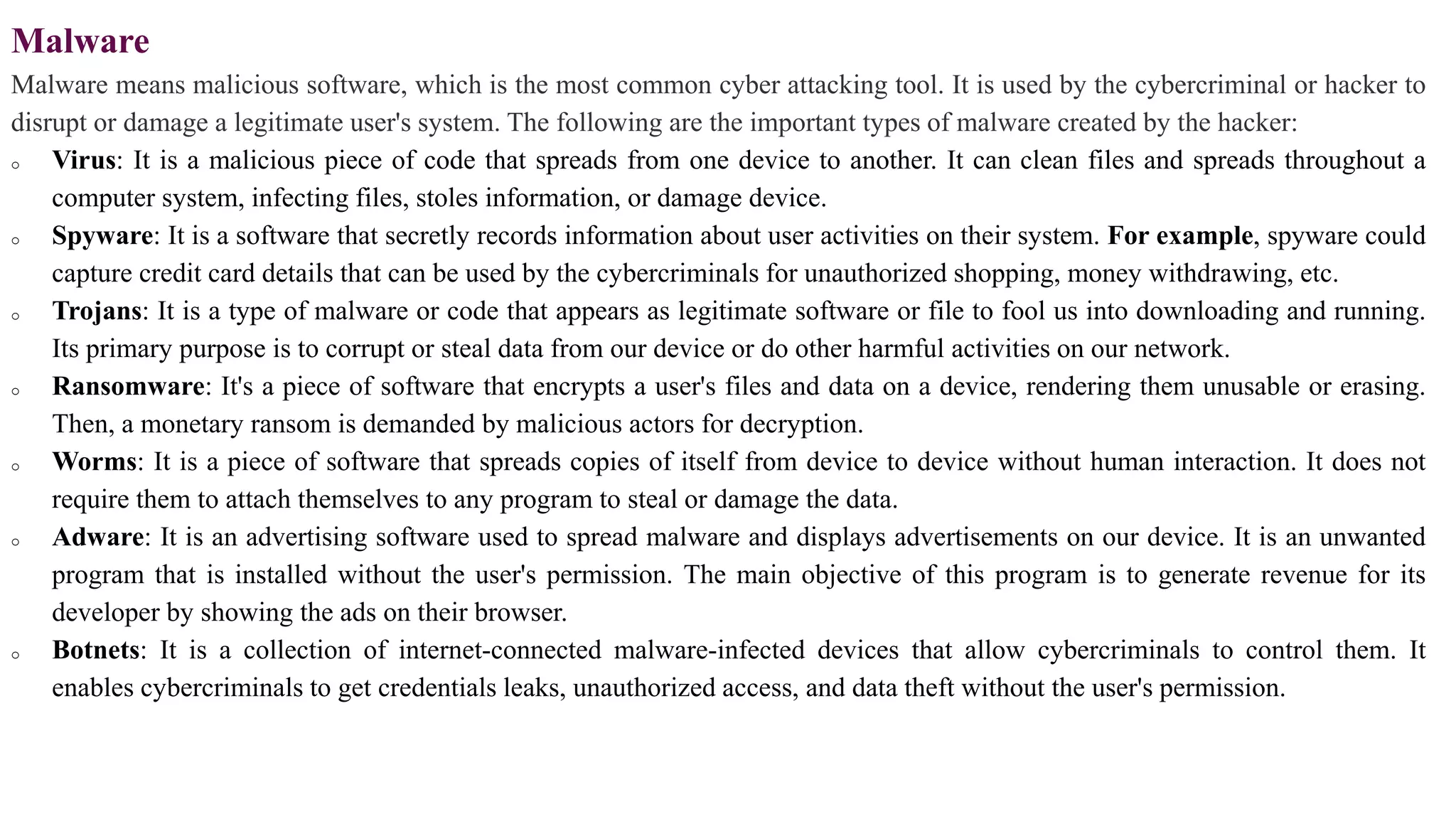
Malware
Malware means malicious software, which is the most common cyber attacking tool. It is used by the cybercriminal or hacker to
disrupt or damage a legitimate user's system. The following are the important types of malware created by the hacker:
o Virus: It is a malicious piece of code that spreads from one device to another. It can clean files and spreads throughout a
computer system, infecting files, stoles information, or damage device.
o Spyware: It is a software that secretly records information about user activities on their system. For example, spyware could
capture credit card details that can be used by the cybercriminals for unauthorized shopping, money withdrawing, etc.
o Trojans: It is a type of malware or code that appears as legitimate software or file to fool us into downloading and running.
Its primary purpose is to corrupt or steal data from our device or do other harmful activities on our network.
o Ransomware: It's a piece of software that encrypts a user's files and data on a device, rendering them unusable or erasing.
Then, a monetary ransom is demanded by malicious actors for decryption.
o Worms: It is a piece of software that spreads copies of itself from device to device without human interaction. It does not
require them to attach themselves to any program to steal or damage the data.
o Adware: It is an advertising software used to spread malware and displays advertisements on our device. It is an unwanted
program that is installed without the user's permission. The main objective of this program is to generate revenue for its
developer by showing the ads on their browser.
o Botnets: It is a collection of internet-connected malware-infected devices that allow cybercriminals to control them. It
enables cybercriminals to get credentials leaks, unauthorized access, and data theft without the user's permission.
 Perform periodic security reviews: Every organization ensures periodic security inspections of all software and networks
to identify security risks early in a secure environment. Some popular examples of security reviews are application and
network penetration testing, source code reviews, architecture design reviews, and red team assessments. In addition,
organizations should prioritize and mitigate security vulnerabilities as quickly as possible after they are discovered.
 Use strong passwords: It is recommended to always use long and various combinations of characters and symbols in the
password. It makes the passwords are not easily guessable.
 Do not open email attachments from unknown senders: The cyber expert always advises not to open or click the email
attachment getting from unverified senders or unfamiliar websites because it could be infected with malware.
 Avoid using unsecured Wi-Fi networks in public places: It should also be advised not to use insecure networks because
they can leave you vulnerable to man-in-the-middle attacks.
 Backup data: Every organization must periodically take backup of their data to ensure all sensitive data is not lost or
recovered after a security breach. In addition, backups can help maintain data integrity in cyber-attack such as SQL
injections, phishing, and ransomware
Internet governance is the development and application by Governments, the private sector and civil society, in their
respective roles, of shared principles, norms, rules, decision making procedures, and programmes that shape the evolu4on and
use of the Internet.
Internet governance refers to the rules, policies, standards and practices that coordinate and shape global
cyberspace.
History: Evoluton of Internet governance
• 1969 – early 1990’s: Building the Internet – decentralized insLtuLons, cooperaLve arrangements – RFCs for standards, Postel’s
IANA for names, numbers
• Early 90’s - 2002: CommercializaLon accelerates – Acceptable use policies – Domain name industry takes off
• 2003 - present : Entry of governments, WSIS, – Governments take Internet seriously – WSIS, WGIG, IGF, NaLonal IGFs, Net
Mundial
Internet governance is the development and application by Governments, the private sector and civil society, in their
respective roles, of shared principles, norms, rules, decision-making procedures, and programmes that shape the
evolution and use of the Internet.
The Internet is a vast network of independently-managed networks, woven together by globally standardized data
communication protocols (primarily, Internet Protocol, TCP, UDP, DNS and BGP). The common adoption and use of these
protocols unified the world of information and communications like never before. Millions of digital devices and massive
amounts of data, software applications, and electronic services became compatible and interoperable. The Internet created a
new environment, a complex and dynamic “cyberspace.”
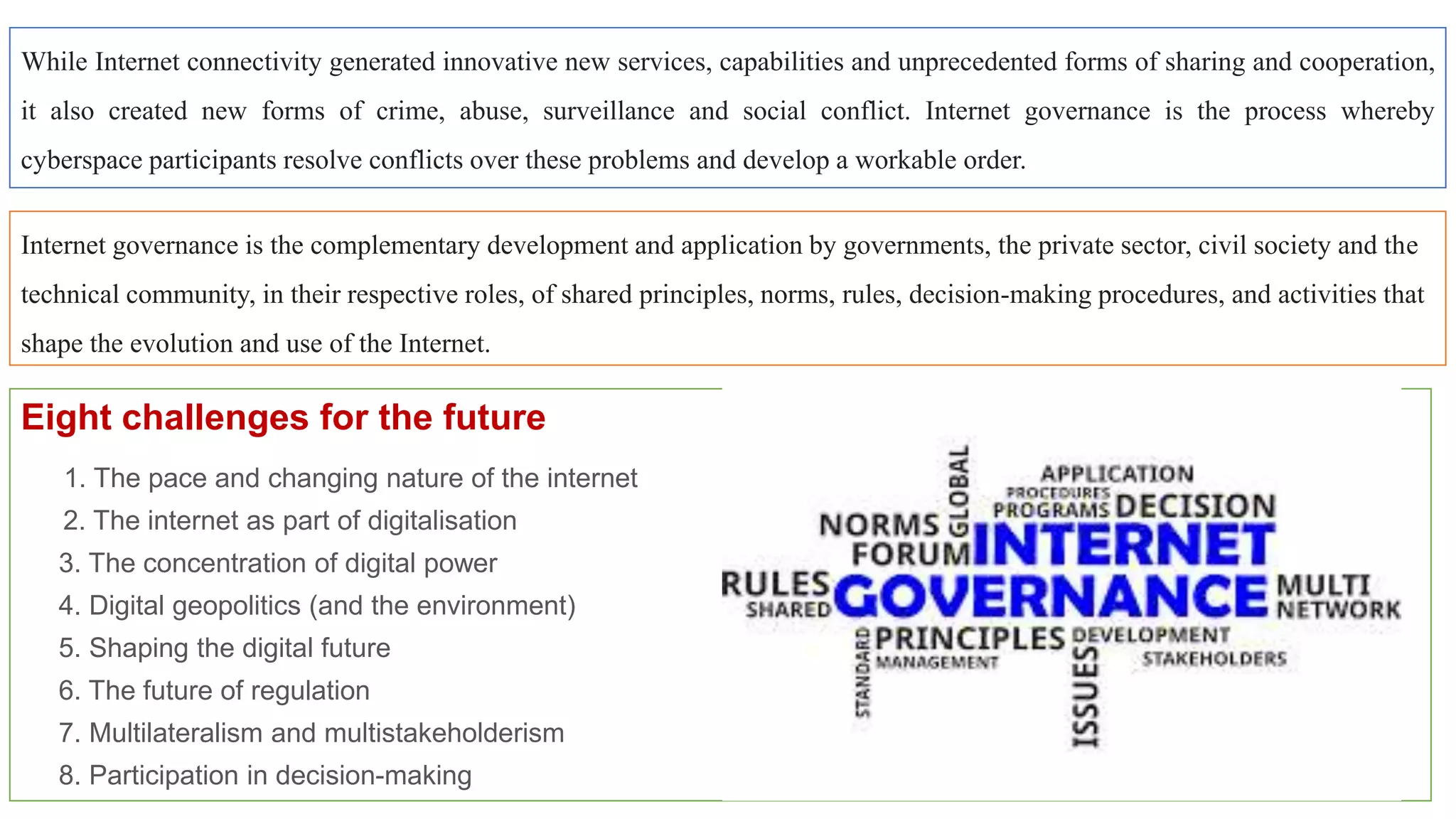
Eight challenges for the future
1. The pace and changing nature of the internet
2. The internet as part of digitalisation
3. The concentration of digital power
4. Digital geopolitics (and the environment)
5. Shaping the digital future
6. The future of regulation
7. Multilateralism and multistakeholderism
8. Participation in decision-making
While Internet connectivity generated innovative new services, capabilities and unprecedented forms of sharing and cooperation,
it also created new forms of crime, abuse, surveillance and social conflict. Internet governance is the process whereby
cyberspace participants resolve conflicts over these problems and develop a workable order.
Internet governance is the complementary development and application by governments, the private sector, civil society and the
technical community, in their respective roles, of shared principles, norms, rules, decision-making procedures, and activities that
shape the evolution and use of the Internet.
A global domain within the information environment consisting of the interdependent network of information
systems infrastructures including the Internet, telecommunications networks, computer systems, and embedded
processors and controllers.
Cyberspace:---
Cyberspace is the global domain within the information environment consisting of the interdependent network of
information technology infrastructures, including the Internet, telecommunications networks, computer systems, and
embedded processors and controllers. Among many other things, cyberspace enables users to conduct business,
communicate, socialize, connect, exchange ideas, play games, participate in social forums, and share information.
Cyberspace can be viewed as three layers (physical, logical, and social) made up of five components (geographic, physical
network, logical network, cyber persona, and persona).
Cyberspace is "the environment in which communication over computer networks occurs.“

Chap 1 Fundamentals of Cyber Security _ Intr to Cyber types.pptx

  • 1.
    CDS-121: Fundamentals ofCyber Security Unit 1: Introduction to Cyber Security and various challenges in cyber security 1.1. Overview of Cyber Security, 1.2. Internet Governance – Challenges and Constraints, 1.3. Cyber Threats: - Cyber Warfare-Cyber Crime-Cyber Terrorism-Cyber Espionage, 1.4. Need for a Comprehensive Cyber Security Policy, 1.5. Need for a Nodal Authority, 1.6. Need for an International convention on Cyberspace. Dr Sharmila Sharad More, Assistant Professor , Dept Of Science and Computer Science, MIT, ACSC,Alandi, Pune
  • 2.
    Cybersecurity is thepractice of protecting systems, networks, and programs from digital attacks. These cyberattacks are usually aimed at accessing, changing, or destroying sensitive information; extorting money from users; or interrupting normal business processes. Cyber security refers to a set of techniques used to protect the integrity of networks, programs and data from attack, damage or unauthorized access.  In simple words, Cyber security is the practice of protecting systems, networks, and programs from digital attacks.  These cyber-attacks are usually aimed at accessing, changing, or destroying sensitive information; extorting money from users; or interrupting normal business processes.  Cyber security is very important for today’s life. Cyber safety provides enhanced cyberspace security, improves cyber resilience, speeds up cyber, data & information protection for businesses it protects individual private information, it protects networks & resources & tackles computer hackers and theft of identity. The use of cyber security can help prevent cyber attacks, data breaches, and identity theft and can aid in risk management. It aims to reduce the risk of cyber attacks and protect against the unauthorized exploitation of systems, networks, and technologies. Cyber security refers to every aspect of protecting an organization and its employees and assets against cyber threats. As cyber attacks become more common and sophisticated and corporate networks grow more complex, a variety of cyber security solutions are required to mitigate corporate cyber risk.
  • 3.
    Some of theimportant principles of cyber security: All the cyber security principles are grouped under governing, detecting, protecting, and responding to activity, and these principles are: 1. It secure configuration 2. Provide network security 3. Manage user privileges/rights. 4. User education and awareness 5. Monitoring 6. Malware prevention 7. Incident management 8. Home and mobile working 9. Removable media controls 10. Acceptance of security breaches 11. Open design 12. Fail-safe defaults 13. Work factor 14. Economy of mechanism 15. Complete mediation
  • 4.
    The following arethe system that can be affected by security breaches and attacks: o Communication: Cyber attackers can use phone calls, emails, text messages, and messaging apps for cyberattacks. o Finance: This system deals with the risk of financial information like bank and credit card detail. This information is naturally a primary target for cyber attackers. o Governments: The cybercriminal generally targets the government institutions to get confidential public data or private citizen information. o Transportation: In this system, cybercriminals generally target connected cars, traffic control systems, and smart road infrastructure. o Healthcare: A cybercriminal targets the healthcare system to get the information stored at a local clinic to critical care systems at a national hospital. o Education: A cybercriminals target educational institutions to get their confidential research data and information of students and employees.
  • 5.
    a) Data safetyfrom hackers b) Reduces computer crash c) Decreased data theft hazard d) System availability and improved data e) Protect business reputation f) Assist remote working g) Saves the bottom line h) Cyber posture is improved i) Handles data management j) Improve customer's and stakeholders' trust k) Detection and deletion of unwanted and harmful programs l) Deny unwanted access from the possible threat m) Recovery of the system Advantages Of Cyber Security Disadvantages Of Cyber Security a) Not affordable to everyone b) Can be complicated c) Security patches may backfire d) Need of constant monitoring e) Slow down the system f) Can be risky g) Incorrect configured system blocks firewall h) Only some updations are suitable for the system i) Not a one-time thing
  • 6.
    Advantages Of CyberSecurity - Cyber security will defend us from critical cyber- attacks. - It helps us to browse the safe website. - Cyber security will defend us from hacks & virus. - The application of cyber security used in our PC needs to update every week. - Internet security processes all the incoming & outgoing data on our computer. - It helps to reduce computer chilling & crashes. - Gives us privacy. - It was expensive; most of the users can’t afford this. - A normal user can’t use this properly, requiring special expertise. - Lack of knowledge is the main problem. - It was not easy to use. - It makes the system slower. - It could take hours to days to fix a breach in security. Disadvantages Of Cyber Security
  • 7.
    Cyber Safety Tips Conduct cybersecurity training and awareness: Every organization must train their staffs on cybersecurity, company policies, and incident reporting for a strong cybersecurity policy to be successful. If the staff does unintentional or intentional malicious activities, it may fail the best technical safeguards that result in an expensive security breach. Therefore, it is useful to conduct security training and awareness for staff through seminars, classes, and online courses that reduce security violations.  Update software and operating system: The most popular safety measure is to update the software and O.S. to get the benefit of the latest security patches.  Use anti-virus software: It is also useful to use the anti-virus software that will detect and removes unwanted threats from your device. This software is always updated to get the best level of protection.
  • 8.
    Cyber Criminals Cybercriminals areindividual or group of people who use technology to commit cybercrime with the intention of stealing sensitive company information or personal data and generating profits. In today's, they are the most prominent and most active type of attacker. Cybercriminals use computers in three broad ways to do cybercrimes- o Select computer as their target- In this, they attack other people's computers to do cybercrime, such as spreading viruses, data theft, identity theft, etc. o Uses the computer as their weapon- In this, they use the computer to do conventional crime such as spam, fraud, illegal gambling, etc. o Uses the computer as their accessory- In this, they use the computer to steal data illegally.
  • 9.
    Cybercrime is anytype of illegal activity that takes place via digital means. Data theft is, of course, one of the most common types of cybercrime, but cybercrime also includes a wide range of malicious activity as well, such as cyberbullying or planting worms or viruses. Cybercrimes are divided into two different categories as follows −  Those that cause intentional damage  Those that can cause unintentional damage. A cybercrime is a criminal act in which someone targets a computer or a network of devices in order to gain illegal rights, steal data from them, frauds etc. This type of crime is carried out using technology which primarily takes place online. Some cybercrime even include the following −  Harassment  Cyber-stalking  Bullying
  • 10.
    Cybercrime or acomputer-oriented crime is a crime that includes a computer and a network. The computer may have been used in the execution of a crime or it may be the target. Cybercrime is the use of a computer as a weapon for committing crimes such as committing fraud, identity theft, or breaching privacy. Cybercrime, especially through the Internet, has grown in importance as the computer has become central to every field like commerce, entertainment, and government. Cybercrime may endanger a person or a nation’s security and financial health. Cybercrime encloses a wide range of activities, but these can generally be divided into two categories:  Crimes that aim at computer networks or devices. These types of crimes involve different threats (like virus, bugs etc.) and denial-of-service (DoS) attacks.  Crimes that use computer networks to commit other criminal activities. These types of crimes include cyber stalking, financial fraud or identity theft.
  • 11.
    Classification of CyberCrime: Cyber Terrorism – Cyber terrorism is the use of the computer and internet to perform violent acts that result in loss of life. This may include different type of activities either by software or hardware for threatening life of citizens. In general, Cyber terrorism can be defined as an act of terrorism committed through the use of cyberspace or computer resources. Cyber Extortion – Cyber extortion occurs when a website, e-mail server or computer system is subjected to or threatened with repeated denial of service or other attacks by malicious hackers. These hackers demand huge money in return for assurance to stop the attacks and to offer protection. Cyber Warfare – Cyber warfare is the use or targeting in a battle space or warfare context of computers, online control systems and networks. It involves both offensive and defensive operations concerning to the threat of cyber attacks, espionage and sabotage. Internet Fraud – Internet fraud is a type of fraud or deceit which makes use of the Internet and could include hiding of information or providing incorrect information for the purpose of deceiving victims for money or property. Internet fraud is not considered a single, distinctive crime but covers a range of illegal and illicit actions that are committed in cyberspace. Cyber Stalking – This is a kind of online harassment wherein the victim is subjected to a barrage of online messages and emails. In this case, these stalkers know their victims and instead of offline stalking, they use the Internet to stalk. However, if they notice that cyber stalking is not having the desired effect, they begin offline stalking along with cyber stalking to make the victims’ lives more miserable.
  • 12.
    Challenges of CyberCrime: People are unaware of their cyber rights- The Cybercrime usually happen with illiterate people around the world who are unaware about their cyber rights implemented by the government of that particular country. Anonymity- Those who Commit cyber crime are anonymous for us so we cannot do anything to that person. Less numbers of case registered- Every country in the world faces the challenge of cyber crime and the rate of cyber crime is increasing day by day because the people who even don’t register a case of cyber crime and this is major challenge for us as well as for authorities as well. Mostly committed by well educated people- Committing a cyber crime is not a cup of tea for every individual. The person who commits cyber crime is a very technical person so he knows how to commit the crime and not get caught by the authorities. No harsh punishment- In Cyber crime there is no harsh punishment in every cases. But there is harsh punishment in some cases like when somebody commits cyber terrorism in that case there is harsh punishment for that individual. But in other cases there is no harsh punishment so this factor also gives encouragement to that person who commits cyber crime.
  • 13.
    Prevention of CyberCrime: Below are some points by means of which we can prevent cyber crime: Use strong password – Maintain different password and username combinations for each account and resist the temptation to write them down. Weak passwords can be easily cracked using certain attacking methods like Brute force attack, Rainbow table attack etc, So make them complex. That means combination of letters, numbers and special characters. Use trusted antivirus in devices – Always use trustworthy and highly advanced antivirus software in mobile and personal computers. This leads to the prevention of different virus attack on devices. Keep social media private – Always keep your social media accounts data privacy only to your friends. Also make sure only to make friends who are known to you. Keep your device software updated – Whenever you get the updates of the system software update it at the same time because sometimes the previous version can be easily attacked. Use secure network – Public Wi-Fi are vulnerable. Avoid conducting financial or corporate transactions on these networks.
  • 14.
    What Is CyberWarfare? Cyber warfare is usually defined as a cyber attack or series of attacks that target a country. It has the potential to wreak havoc on government and civilian infrastructure and disrupt critical systems, resulting in damage to the state and even loss of life. Why Is Cyber Espionage /trespass Used? Cyber espionage is primarily used as a means to gather sensitive or classified data, trade secrets or other forms of IP that can be used by the aggressor to create a competitive advantage or sold for financial gain. In some cases, the breach is simply intended to cause reputational harm to the victim by exposing private information or questionable business practices. Cyber espionage attacks can be motivated by monetary gain; they may also be deployed in conjunction with military operations or as an act of cyber terrorism or cyber warfare. The impact of cyber espionage, particularly when it is part of a broader military or political campaign, can lead to disruption of public services and infrastructure, as well as loss of life.
  • 15.
    Cyber Espionage Targets Themost common targets of cyber espionage include large corporations, government agencies, academic institutions, think tanks or other organizations that possess valuable IP and technical data that can create a competitive advantage for another organization or government. Targeted campaigns can also be waged against individuals, such as prominent political leaders and government officials, business executives and even celebrities.
  • 16.
    1. Network Security 2.Cloud Security 3. Endpoint Security 4. Mobile Security 5. IoT Security 6. Application Security 7. Zero Trust The Different Types of Cyber security: Cyber security is a wide field covering several disciplines. It can be divided into seven main pillars:
  • 17.
    Cyber Security Goals Confidentiality Confidentialityis equivalent to privacy that avoids unauthorized access of information. Integrity Integrity refers to the methods for ensuring that data is real, accurate and protected from unauthorized user modification. Availability Availability is the property in which information is accessible and modifiable in a timely fashion by those authorized to do so.
  • 18.
    Types of CyberAttacks Web-based attacks These are the attacks which occur on a website or web applications. Some of the important web-based attacks are as follows- 1. Injection attacks It is the attack in which some data will be injected into a web application to manipulate the application and fetch the required information. Example- SQL Injection, code Injection, log Injection, XML Injection etc. 2. DNS Spoofing DNS Spoofing is a type of computer security hacking. 3. Session Hijacking It is a security attack on a user session over a protected network. Web applications create cookies to store the state and user sessions. 4. Phishing Phishing is a type of attack which attempts to steal sensitive information like user login credentials and credit card number. 5. Brute force It is a type of attack which uses a trial and error method. 6. Denial of Service Volume-based attacks Protocol attacks- Application layer attacks 7. Dictionary attacks 8. URL Interpretation 9. File Inclusion attacks 10. Man in the middle attacks It is a type of attack that allows an attacker to intercepts the connection between client and server and acts as a bridge between them.
  • 19.
    System-based attacks 1. Virus Itis a type of malicious software program that spread throughout the computer files without the knowledge of a user. 2. Worm It is a type of malware whose primary function is to replicate itself to spread to uninfected computers. It works same as the computer virus. Worms often originate from email attachments that appear to be from trusted senders. 3. Trojan horse It is a malicious program that occurs unexpected changes to computer setting and unusual activity, even when the computer should be idle. 4. Backdoors It is a method that bypasses the normal authentication process. 5. Bots A bot (short for "robot")
  • 20.
    Malware Malware means malicioussoftware, which is the most common cyber attacking tool. It is used by the cybercriminal or hacker to disrupt or damage a legitimate user's system. The following are the important types of malware created by the hacker: o Virus: It is a malicious piece of code that spreads from one device to another. It can clean files and spreads throughout a computer system, infecting files, stoles information, or damage device. o Spyware: It is a software that secretly records information about user activities on their system. For example, spyware could capture credit card details that can be used by the cybercriminals for unauthorized shopping, money withdrawing, etc. o Trojans: It is a type of malware or code that appears as legitimate software or file to fool us into downloading and running. Its primary purpose is to corrupt or steal data from our device or do other harmful activities on our network. o Ransomware: It's a piece of software that encrypts a user's files and data on a device, rendering them unusable or erasing. Then, a monetary ransom is demanded by malicious actors for decryption. o Worms: It is a piece of software that spreads copies of itself from device to device without human interaction. It does not require them to attach themselves to any program to steal or damage the data. o Adware: It is an advertising software used to spread malware and displays advertisements on our device. It is an unwanted program that is installed without the user's permission. The main objective of this program is to generate revenue for its developer by showing the ads on their browser. o Botnets: It is a collection of internet-connected malware-infected devices that allow cybercriminals to control them. It enables cybercriminals to get credentials leaks, unauthorized access, and data theft without the user's permission.
  • 21.
     Perform periodicsecurity reviews: Every organization ensures periodic security inspections of all software and networks to identify security risks early in a secure environment. Some popular examples of security reviews are application and network penetration testing, source code reviews, architecture design reviews, and red team assessments. In addition, organizations should prioritize and mitigate security vulnerabilities as quickly as possible after they are discovered.  Use strong passwords: It is recommended to always use long and various combinations of characters and symbols in the password. It makes the passwords are not easily guessable.  Do not open email attachments from unknown senders: The cyber expert always advises not to open or click the email attachment getting from unverified senders or unfamiliar websites because it could be infected with malware.  Avoid using unsecured Wi-Fi networks in public places: It should also be advised not to use insecure networks because they can leave you vulnerable to man-in-the-middle attacks.  Backup data: Every organization must periodically take backup of their data to ensure all sensitive data is not lost or recovered after a security breach. In addition, backups can help maintain data integrity in cyber-attack such as SQL injections, phishing, and ransomware
  • 22.
    Internet governance isthe development and application by Governments, the private sector and civil society, in their respective roles, of shared principles, norms, rules, decision making procedures, and programmes that shape the evolu4on and use of the Internet. Internet governance refers to the rules, policies, standards and practices that coordinate and shape global cyberspace. History: Evoluton of Internet governance • 1969 – early 1990’s: Building the Internet – decentralized insLtuLons, cooperaLve arrangements – RFCs for standards, Postel’s IANA for names, numbers • Early 90’s - 2002: CommercializaLon accelerates – Acceptable use policies – Domain name industry takes off • 2003 - present : Entry of governments, WSIS, – Governments take Internet seriously – WSIS, WGIG, IGF, NaLonal IGFs, Net Mundial Internet governance is the development and application by Governments, the private sector and civil society, in their respective roles, of shared principles, norms, rules, decision-making procedures, and programmes that shape the evolution and use of the Internet. The Internet is a vast network of independently-managed networks, woven together by globally standardized data communication protocols (primarily, Internet Protocol, TCP, UDP, DNS and BGP). The common adoption and use of these protocols unified the world of information and communications like never before. Millions of digital devices and massive amounts of data, software applications, and electronic services became compatible and interoperable. The Internet created a new environment, a complex and dynamic “cyberspace.”
  • 23.
    Eight challenges forthe future 1. The pace and changing nature of the internet 2. The internet as part of digitalisation 3. The concentration of digital power 4. Digital geopolitics (and the environment) 5. Shaping the digital future 6. The future of regulation 7. Multilateralism and multistakeholderism 8. Participation in decision-making While Internet connectivity generated innovative new services, capabilities and unprecedented forms of sharing and cooperation, it also created new forms of crime, abuse, surveillance and social conflict. Internet governance is the process whereby cyberspace participants resolve conflicts over these problems and develop a workable order. Internet governance is the complementary development and application by governments, the private sector, civil society and the technical community, in their respective roles, of shared principles, norms, rules, decision-making procedures, and activities that shape the evolution and use of the Internet.
  • 24.
    A global domainwithin the information environment consisting of the interdependent network of information systems infrastructures including the Internet, telecommunications networks, computer systems, and embedded processors and controllers. Cyberspace:--- Cyberspace is the global domain within the information environment consisting of the interdependent network of information technology infrastructures, including the Internet, telecommunications networks, computer systems, and embedded processors and controllers. Among many other things, cyberspace enables users to conduct business, communicate, socialize, connect, exchange ideas, play games, participate in social forums, and share information. Cyberspace can be viewed as three layers (physical, logical, and social) made up of five components (geographic, physical network, logical network, cyber persona, and persona). Cyberspace is "the environment in which communication over computer networks occurs.“