Cyber Crime and security
Contents:
• Definition
• Brief history
• Categories
• types of cyber crime
• Cyber crime security
• Cyber security advantages
• Safety tips to cyber crime
• Cyber law
• Conclusion
Definition:
• Cybercrime is a term for any illegal activity that uses a computer as
its primary means of commission or to include any illegal activity
that uses a computer for the storage of evidence.
History:
• Cybercrime first started with hackers trying to break into computer networks. Some
did it just for the thrill of accessing high-level security networks, but others sought
to gain sensitive, classified material. Eventually, criminals started to infect computer
systems with computer viruses, which led to breakdowns on personal and business
computers.
• 1973 Teller at New York's Dime Savings Bank uses a computer to embezzle over $2
million
• The first virus was installed on an Apple computer in 1982 when a high school
student, Rich skrenta, developed the EIK Cloner.
Categories:
We can categorize cyber crime in two ways.
• The computer as a target :-
using a computer to attacks other computer, e.g.
Hacking, virus/worms attacks, Dos attack etc.
• The computer as a weapon :-
using a computer to commit real world crime e.g. cyber terrorism
and credit card fraud etc.
Types of cyber crime:
• HACKING:
Hacking in simple terms means an illegal intrusion info a computer
system and/or network . It is also known as CRACKING. Government
websites are the hot target of the hackers due to the press coverage, it
receives. Hackers enjoy the media coverage.
Motive behind the crime called HACKERS
Motive behind the crime called hacking greed power, publicity, revenge,
adventure desire to access forbidden information destructive mindset
wants to sell n/w security services.
DENIAL OF SERVICE ATTACKS:
This is an act by the criminals who
floods the bandwidth of the victims network or fills his E-mail
box with spam mail depriving him of the service he is entitled to
access or provide. Many DOS attacks, such as the ping of death
and Tear drop attacks.
VIRUS DISSMINITION :
Malicious software that attaches itself to other
software. VIRUS , WORMS, TROJAN HORSE ,WEB JACKING, E-
MAIL BOMBING etc.
CYBER TERRORISM:
Terrorist attacks on the Internet is by
distributed denial of service attacks, hate websites and hate E-mails ,
attacks on service network etc.
SOFTWARE PIRACY :
Theft of software through the illegal copying
of genuine programs or the counterfeiting and distribution of
products intended to pass for the original.
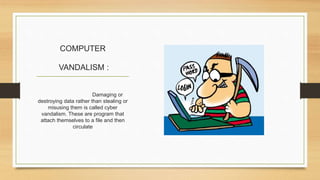
COMPUTER
VANDALISM :
Damaging or
destroying data rather than stealing or
misusing them is called cyber
vandalism. These are program that
attach themselves to a file and then
circulate
Cyber security:
• Internet security is branch of security
specifically related to internet.
• It’s objective is to establish rules and
measures to use against attacks over the
internet
Cyber security advantages:
• The cyber security will defend us from critical attacks.
• It helps us to browse the site, website.
• Internet Security process all the incoming and outgoing data on
your computer.
• It will defend us from hacks and virus.
• Application of cyber security used in our PC needs update every
week
Safety tips to cyber crime:
• Use antivirus Software
• Insert Firewalls
• Uninstall unnecessary software
• Maintain backup
• Check security settings
Cyber law:
• In Pakistan there is law for cyber crime.
• There are different punishments for different cyber crimes.
• There is an agency working for controlling cyber crime named as
NATIONAL RESPONSE CENTRE FOR CYBER CRIME.
Conclusion:
Cybercrime is indeed getting the recognition it deserves. However, it
is not going to restricted that easily . In fact , it is highly likely that
cyber crime and its hackers will continue developing and upgrading
to stay ahead of the law.
So, to make us a safer we must need cyber security.

Cyber crime

  • 1.
  • 2.
    Contents: • Definition • Briefhistory • Categories • types of cyber crime • Cyber crime security • Cyber security advantages • Safety tips to cyber crime • Cyber law • Conclusion
  • 3.
    Definition: • Cybercrime isa term for any illegal activity that uses a computer as its primary means of commission or to include any illegal activity that uses a computer for the storage of evidence.
  • 4.
    History: • Cybercrime firststarted with hackers trying to break into computer networks. Some did it just for the thrill of accessing high-level security networks, but others sought to gain sensitive, classified material. Eventually, criminals started to infect computer systems with computer viruses, which led to breakdowns on personal and business computers. • 1973 Teller at New York's Dime Savings Bank uses a computer to embezzle over $2 million • The first virus was installed on an Apple computer in 1982 when a high school student, Rich skrenta, developed the EIK Cloner.
  • 5.
    Categories: We can categorizecyber crime in two ways. • The computer as a target :- using a computer to attacks other computer, e.g. Hacking, virus/worms attacks, Dos attack etc. • The computer as a weapon :- using a computer to commit real world crime e.g. cyber terrorism and credit card fraud etc.
  • 6.
    Types of cybercrime: • HACKING: Hacking in simple terms means an illegal intrusion info a computer system and/or network . It is also known as CRACKING. Government websites are the hot target of the hackers due to the press coverage, it receives. Hackers enjoy the media coverage. Motive behind the crime called HACKERS Motive behind the crime called hacking greed power, publicity, revenge, adventure desire to access forbidden information destructive mindset wants to sell n/w security services.
  • 7.
    DENIAL OF SERVICEATTACKS: This is an act by the criminals who floods the bandwidth of the victims network or fills his E-mail box with spam mail depriving him of the service he is entitled to access or provide. Many DOS attacks, such as the ping of death and Tear drop attacks. VIRUS DISSMINITION : Malicious software that attaches itself to other software. VIRUS , WORMS, TROJAN HORSE ,WEB JACKING, E- MAIL BOMBING etc.
  • 8.
    CYBER TERRORISM: Terrorist attackson the Internet is by distributed denial of service attacks, hate websites and hate E-mails , attacks on service network etc. SOFTWARE PIRACY : Theft of software through the illegal copying of genuine programs or the counterfeiting and distribution of products intended to pass for the original.
  • 9.
    COMPUTER VANDALISM : Damaging or destroyingdata rather than stealing or misusing them is called cyber vandalism. These are program that attach themselves to a file and then circulate
  • 10.
    Cyber security: • Internetsecurity is branch of security specifically related to internet. • It’s objective is to establish rules and measures to use against attacks over the internet
  • 11.
    Cyber security advantages: •The cyber security will defend us from critical attacks. • It helps us to browse the site, website. • Internet Security process all the incoming and outgoing data on your computer. • It will defend us from hacks and virus. • Application of cyber security used in our PC needs update every week
  • 12.
    Safety tips tocyber crime: • Use antivirus Software • Insert Firewalls • Uninstall unnecessary software • Maintain backup • Check security settings
  • 13.
    Cyber law: • InPakistan there is law for cyber crime. • There are different punishments for different cyber crimes. • There is an agency working for controlling cyber crime named as NATIONAL RESPONSE CENTRE FOR CYBER CRIME.
  • 14.
    Conclusion: Cybercrime is indeedgetting the recognition it deserves. However, it is not going to restricted that easily . In fact , it is highly likely that cyber crime and its hackers will continue developing and upgrading to stay ahead of the law. So, to make us a safer we must need cyber security.