Prevention & Detection
*Cyber crime is an evil having its origin in the growing
 dependence on computers in modern life:


      A simple definition of cyber crime would be
“Unlawful act where in the computer is either a tools or a
target or both or a Acts that are punishable by the
Information Technology Act”
Cyber crime refer to all activities done with criminal
intent in cyber space.
* Cyber crime falls into three slots:

1.   Those against a person.

2.   Against Business & Non-Business organization.

3.   Crime targeting the government.
The act wherein the computer is a tools for an
unlawful acts.
* Financial Claims: This would include cheating,
 credit card frauds, money laundering etc.
* CYBER PORNOGRAPHY: This would include
 pornographic websites; pornographic magazines produced
 using computer and the Internet (to down load and
 transmit pornographic pictures, photos, writings etc.)
* Sale of Illegal Articles: This would include sale of
 narcotics, weapons and wildlife etc., by posting
 information on websites, bulletin boards or simply by
 using e-mail communications.
* Online Gambling:There are millions of websites, all
 hosted on servers abroad, that offer online gambling.
 In fact, it is believed that many of these websites are
 actually fronts for money laundering.
* Intellectual Property Crimes: These include
 software piracy, copyright infringement, trademarks
 violations etc.
* E-mail spoofing: A spoofed email is one that appears
 to originate from one source but actually has been sent
 from another source. This can also be termed as E-Mail
 forging.
* Forgery: Counterfeit currency notes, postage and
 revenue stamps, mark sheets etc., can be forged using
 sophisticated computers, printers and scanners.
* Cyber Defamation:
* Unauthorized access to Compute System or
 Network : This activity is commonly referred to as
 hacking. Indian Law has however given a different
 connotation to the term hacking
* Theft of information contained in electronic
 form: This includes information stored in computer hard
 disks, removable storage media etc
* E-Mail bombing:Email bombing refers to sending a large
 amount of e-mails to the victim resulting in the victims’ e-
 mail account or mail servers.
* Data diddling:This kind of an attack involves altering the
 raw data just before it is processed by a computer and then
 changing it back after the processing is completed.
* Salami Attack:Those attacks are used for the commission
 of financial crimes. The key here is to make the alteration so
 insignificant that in a single case it would go completely
 unnoticed e.g. A bank employee inserts a program into bank’s
 servers, that deducts a small amount from the account of
 every customer.
* Denial of Service:This involves flooding computer
 resources with more requests than it can handle. This causes
 the resources to crash thereby denying authorized users the
 service offered by the resources.
* Virus/Worm: Viruses are programs that attach themselves
 to a computer or a file and then circulate themselves to other
 files and to other computers on a network. They usually affect
 the data on a computer, either by altering or deleting it.
 Worms, unlike viruses don not need the host to attach
 themselves to.
* Logic Bomb:
* Trojan Horse:
* Internet Time Theft:
* Physically damaging the computer system:
Preventive steps for Individuals

* CHILDREN:
         Children should not give out identifying information
such as Name, Home address, School name or Telephone no in
chat room. They should not respond to messages, which are
suggestive, obscene, belligerent or threatening, and not to
arrange a face-to –face meeting without telling parents or
guardians. They should remember that people online might not
be who they seem.

* PARENTS:
         Parent should use content filtering software on PC to
protect children from pornography, gambling, hate speech,
drugs and alcohol. There is also software to establish time
controls for use of limpets (for example blocking usage after a
particulars time) and allowing parents to see which site item
children have visited. Use this software to keep track of the
type of activities of children.
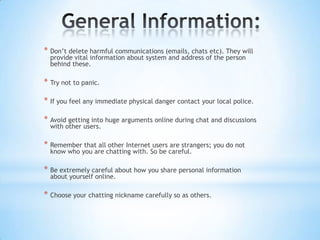
* Don’t delete harmful communications (emails, chats etc). They will
  provide vital information about system and address of the person
  behind these.

* Try not to panic.

* If you feel any immediate physical danger contact your local police.

* Avoid getting into huge arguments online during chat and discussions
  with other users.

* Remember that all other Internet users are strangers; you do not
  know who you are chatting with. So be careful.

* Be extremely careful about how you share personal information
  about yourself online.

* Choose your chatting nickname carefully so as others.
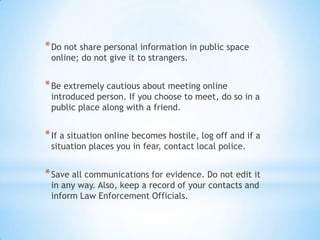
* Do not share personal information in public space
 online; do not give it to strangers.


* Be extremely cautious about meeting online
 introduced person. If you choose to meet, do so in a
 public place along with a friend.


* If a situation online becomes hostile, log off and if a
 situation places you in fear, contact local police.


* Save all communications for evidence. Do not edit it
 in any way. Also, keep a record of your contacts and
 inform Law Enforcement Officials.
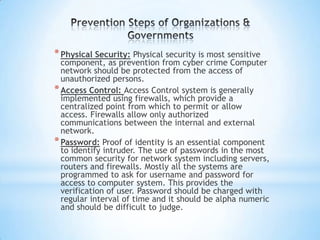
* Physical Security: Physical security is most sensitive
  component, as prevention from cyber crime Computer
  network should be protected from the access of
  unauthorized persons.
* Access Control: Access Control system is generally
  implemented using firewalls, which provide a
  centralized point from which to permit or allow
  access. Firewalls allow only authorized
  communications between the internal and external
  network.
* Password: Proof of identity is an essential component
  to identify intruder. The use of passwords in the most
  common security for network system including servers,
  routers and firewalls. Mostly all the systems are
  programmed to ask for username and password for
  access to computer system. This provides the
  verification of user. Password should be charged with
  regular interval of time and it should be alpha numeric
  and should be difficult to judge.
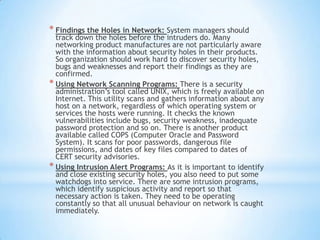
* Findings the Holes in Network: System managers should
  track down the holes before the intruders do. Many
  networking product manufactures are not particularly aware
  with the information about security holes in their products.
  So organization should work hard to discover security holes,
  bugs and weaknesses and report their findings as they are
  confirmed.
* Using Network Scanning Programs: There is a security
  administration’s tool called UNIX, which is freely available on
  Internet. This utility scans and gathers information about any
  host on a network, regardless of which operating system or
  services the hosts were running. It checks the known
  vulnerabilities include bugs, security weakness, inadequate
  password protection and so on. There is another product
  available called COPS (Computer Oracle and Password
  System). It scans for poor passwords, dangerous file
  permissions, and dates of key files compared to dates of
  CERT security advisories.
* Using Intrusion Alert Programs: As it is important to identify
  and close existing security holes, you also need to put some
  watchdogs into service. There are some intrusion programs,
  which identify suspicious activity and report so that
  necessary action is taken. They need to be operating
  constantly so that all unusual behaviour on network is caught
  immediately.
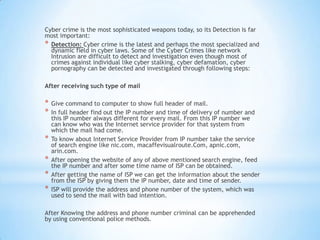
Cyber crime is the most sophisticated weapons today, so its Detection is far
most important:
* Detection: Cyber crime is the latest and perhaps the most specialized and
  dynamic field in cyber laws. Some of the Cyber Crimes like network
  Intrusion are difficult to detect and investigation even though most of
  crimes against individual like cyber stalking, cyber defamation, cyber
  pornography can be detected and investigated through following steps:

After receiving such type of mail

*   Give command to computer to show full header of mail.
*   In full header find out the IP number and time of delivery of number and
    this IP number always different for every mail. From this IP number we
    can know who was the Internet service provider for that system from
    which the mail had come.
*   To know about Internet Service Provider from IP number take the service
    of search engine like nic.com, macaffevisualroute.Com, apnic.com,
    arin.com.
*   After opening the website of any of above mentioned search engine, feed
    the IP number and after some time name of ISP can be obtained.
*   After getting the name of ISP we can get the information about the sender
    from the ISP by giving them the IP number, date and time of sender.
*   ISP will provide the address and phone number of the system, which was
    used to send the mail with bad intention.

After Knowing the address and phone number criminal can be apprehended
by using conventional police methods.
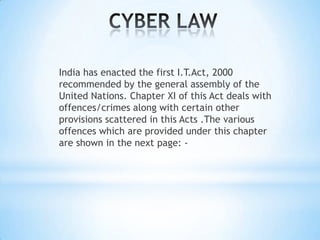
India has enacted the first I.T.Act, 2000
recommended by the general assembly of the
United Nations. Chapter XI of this Act deals with
offences/crimes along with certain other
provisions scattered in this Acts .The various
offences which are provided under this chapter
are shown in the next page: -
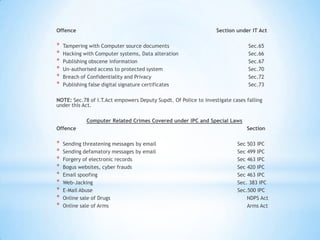
Offence                                                           Section under IT Act

*   Tampering with Computer source documents                                   Sec.65
*   Hacking with Computer systems, Data alteration                             Sec.66
*   Publishing obscene information                                             Sec.67
*   Un-authorised access to protected system                                   Sec.70
*   Breach of Confidentiality and Privacy                                      Sec.72
*   Publishing false digital signature certificates                            Sec.73

NOTE: Sec.78 of I.T.Act empowers Deputy Supdt. Of Police to investigate cases falling
under this Act.

             Computer Related Crimes Covered under IPC and Special Laws
Offence                                                                       Section

*   Sending threatening messages by email                                 Sec 503 IPC
*   Sending defamatory messages by email                                  Sec 499 IPC
*   Forgery of electronic records                                         Sec 463 IPC
*   Bogus websites, cyber frauds                                          Sec 420 IPC
*   Email spoofing                                                        Sec 463 IPC
*   Web-Jacking                                                           Sec. 383 IPC
*   E-Mail Abuse                                                          Sec.500 IPC
*   Online sale of Drugs                                                      NDPS Act
*   Online sale of Arms                                                       Arms Act
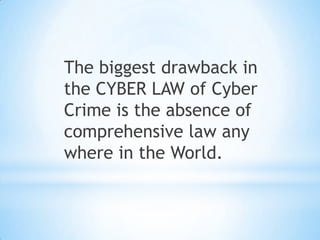
The biggest drawback in
the CYBER LAW of Cyber
Crime is the absence of
comprehensive law any
where in the World.

Cyber crime

  • 1.
  • 2.
    *Cyber crime isan evil having its origin in the growing dependence on computers in modern life: A simple definition of cyber crime would be “Unlawful act where in the computer is either a tools or a target or both or a Acts that are punishable by the Information Technology Act”
  • 3.
    Cyber crime referto all activities done with criminal intent in cyber space. * Cyber crime falls into three slots: 1. Those against a person. 2. Against Business & Non-Business organization. 3. Crime targeting the government.
  • 4.
    The act whereinthe computer is a tools for an unlawful acts. * Financial Claims: This would include cheating, credit card frauds, money laundering etc. * CYBER PORNOGRAPHY: This would include pornographic websites; pornographic magazines produced using computer and the Internet (to down load and transmit pornographic pictures, photos, writings etc.) * Sale of Illegal Articles: This would include sale of narcotics, weapons and wildlife etc., by posting information on websites, bulletin boards or simply by using e-mail communications. * Online Gambling:There are millions of websites, all hosted on servers abroad, that offer online gambling. In fact, it is believed that many of these websites are actually fronts for money laundering.
  • 5.
    * Intellectual PropertyCrimes: These include software piracy, copyright infringement, trademarks violations etc. * E-mail spoofing: A spoofed email is one that appears to originate from one source but actually has been sent from another source. This can also be termed as E-Mail forging. * Forgery: Counterfeit currency notes, postage and revenue stamps, mark sheets etc., can be forged using sophisticated computers, printers and scanners. * Cyber Defamation: * Unauthorized access to Compute System or Network : This activity is commonly referred to as hacking. Indian Law has however given a different connotation to the term hacking
  • 6.
    * Theft ofinformation contained in electronic form: This includes information stored in computer hard disks, removable storage media etc * E-Mail bombing:Email bombing refers to sending a large amount of e-mails to the victim resulting in the victims’ e- mail account or mail servers. * Data diddling:This kind of an attack involves altering the raw data just before it is processed by a computer and then changing it back after the processing is completed. * Salami Attack:Those attacks are used for the commission of financial crimes. The key here is to make the alteration so insignificant that in a single case it would go completely unnoticed e.g. A bank employee inserts a program into bank’s servers, that deducts a small amount from the account of every customer.
  • 7.
    * Denial ofService:This involves flooding computer resources with more requests than it can handle. This causes the resources to crash thereby denying authorized users the service offered by the resources. * Virus/Worm: Viruses are programs that attach themselves to a computer or a file and then circulate themselves to other files and to other computers on a network. They usually affect the data on a computer, either by altering or deleting it. Worms, unlike viruses don not need the host to attach themselves to. * Logic Bomb: * Trojan Horse: * Internet Time Theft: * Physically damaging the computer system:
  • 8.
    Preventive steps forIndividuals * CHILDREN: Children should not give out identifying information such as Name, Home address, School name or Telephone no in chat room. They should not respond to messages, which are suggestive, obscene, belligerent or threatening, and not to arrange a face-to –face meeting without telling parents or guardians. They should remember that people online might not be who they seem. * PARENTS: Parent should use content filtering software on PC to protect children from pornography, gambling, hate speech, drugs and alcohol. There is also software to establish time controls for use of limpets (for example blocking usage after a particulars time) and allowing parents to see which site item children have visited. Use this software to keep track of the type of activities of children.
  • 9.
    * Don’t deleteharmful communications (emails, chats etc). They will provide vital information about system and address of the person behind these. * Try not to panic. * If you feel any immediate physical danger contact your local police. * Avoid getting into huge arguments online during chat and discussions with other users. * Remember that all other Internet users are strangers; you do not know who you are chatting with. So be careful. * Be extremely careful about how you share personal information about yourself online. * Choose your chatting nickname carefully so as others.
  • 10.
    * Do notshare personal information in public space online; do not give it to strangers. * Be extremely cautious about meeting online introduced person. If you choose to meet, do so in a public place along with a friend. * If a situation online becomes hostile, log off and if a situation places you in fear, contact local police. * Save all communications for evidence. Do not edit it in any way. Also, keep a record of your contacts and inform Law Enforcement Officials.
  • 11.
    * Physical Security:Physical security is most sensitive component, as prevention from cyber crime Computer network should be protected from the access of unauthorized persons. * Access Control: Access Control system is generally implemented using firewalls, which provide a centralized point from which to permit or allow access. Firewalls allow only authorized communications between the internal and external network. * Password: Proof of identity is an essential component to identify intruder. The use of passwords in the most common security for network system including servers, routers and firewalls. Mostly all the systems are programmed to ask for username and password for access to computer system. This provides the verification of user. Password should be charged with regular interval of time and it should be alpha numeric and should be difficult to judge.
  • 12.
    * Findings theHoles in Network: System managers should track down the holes before the intruders do. Many networking product manufactures are not particularly aware with the information about security holes in their products. So organization should work hard to discover security holes, bugs and weaknesses and report their findings as they are confirmed. * Using Network Scanning Programs: There is a security administration’s tool called UNIX, which is freely available on Internet. This utility scans and gathers information about any host on a network, regardless of which operating system or services the hosts were running. It checks the known vulnerabilities include bugs, security weakness, inadequate password protection and so on. There is another product available called COPS (Computer Oracle and Password System). It scans for poor passwords, dangerous file permissions, and dates of key files compared to dates of CERT security advisories. * Using Intrusion Alert Programs: As it is important to identify and close existing security holes, you also need to put some watchdogs into service. There are some intrusion programs, which identify suspicious activity and report so that necessary action is taken. They need to be operating constantly so that all unusual behaviour on network is caught immediately.
  • 13.
    Cyber crime isthe most sophisticated weapons today, so its Detection is far most important: * Detection: Cyber crime is the latest and perhaps the most specialized and dynamic field in cyber laws. Some of the Cyber Crimes like network Intrusion are difficult to detect and investigation even though most of crimes against individual like cyber stalking, cyber defamation, cyber pornography can be detected and investigated through following steps: After receiving such type of mail * Give command to computer to show full header of mail. * In full header find out the IP number and time of delivery of number and this IP number always different for every mail. From this IP number we can know who was the Internet service provider for that system from which the mail had come. * To know about Internet Service Provider from IP number take the service of search engine like nic.com, macaffevisualroute.Com, apnic.com, arin.com. * After opening the website of any of above mentioned search engine, feed the IP number and after some time name of ISP can be obtained. * After getting the name of ISP we can get the information about the sender from the ISP by giving them the IP number, date and time of sender. * ISP will provide the address and phone number of the system, which was used to send the mail with bad intention. After Knowing the address and phone number criminal can be apprehended by using conventional police methods.
  • 14.
    India has enactedthe first I.T.Act, 2000 recommended by the general assembly of the United Nations. Chapter XI of this Act deals with offences/crimes along with certain other provisions scattered in this Acts .The various offences which are provided under this chapter are shown in the next page: -
  • 15.
    Offence Section under IT Act * Tampering with Computer source documents Sec.65 * Hacking with Computer systems, Data alteration Sec.66 * Publishing obscene information Sec.67 * Un-authorised access to protected system Sec.70 * Breach of Confidentiality and Privacy Sec.72 * Publishing false digital signature certificates Sec.73 NOTE: Sec.78 of I.T.Act empowers Deputy Supdt. Of Police to investigate cases falling under this Act. Computer Related Crimes Covered under IPC and Special Laws Offence Section * Sending threatening messages by email Sec 503 IPC * Sending defamatory messages by email Sec 499 IPC * Forgery of electronic records Sec 463 IPC * Bogus websites, cyber frauds Sec 420 IPC * Email spoofing Sec 463 IPC * Web-Jacking Sec. 383 IPC * E-Mail Abuse Sec.500 IPC * Online sale of Drugs NDPS Act * Online sale of Arms Arms Act
  • 16.
    The biggest drawbackin the CYBER LAW of Cyber Crime is the absence of comprehensive law any where in the World.