Cyber crime
In 1960s internet was developed for better
communication and research.With
advancement of technology and expansion of
internet every area becomes easy to access
but it also provides a pathway to commit
crimes easily without any effort only sitting
on a system.
Some human minds of criminal nature use
internet as a tool of crime which is now
known as cyber crime committed in all
countries first cyber crime reported in 1820
 Crime is a social and economic phenomenon
 “a legal wrong that can be followed by criminal
proceedings which may result into
punishment.”
definition : Crime is an intentional act of
commission or omission in contravention to
the law of the land and accordingly
punishable when proved in judicial
proceeding
 The term “cyber crime” was first coined by
Barry Collins in 1980’s
 “Any criminal activity that uses a computer
either as an instrumentality, target or a means
for perpetuating further crimes comes within
the ambit of cyber crime”
 A generalized definition of cyber crime may
be “ unlawful acts wherein the computer is
either a tool or target or both”
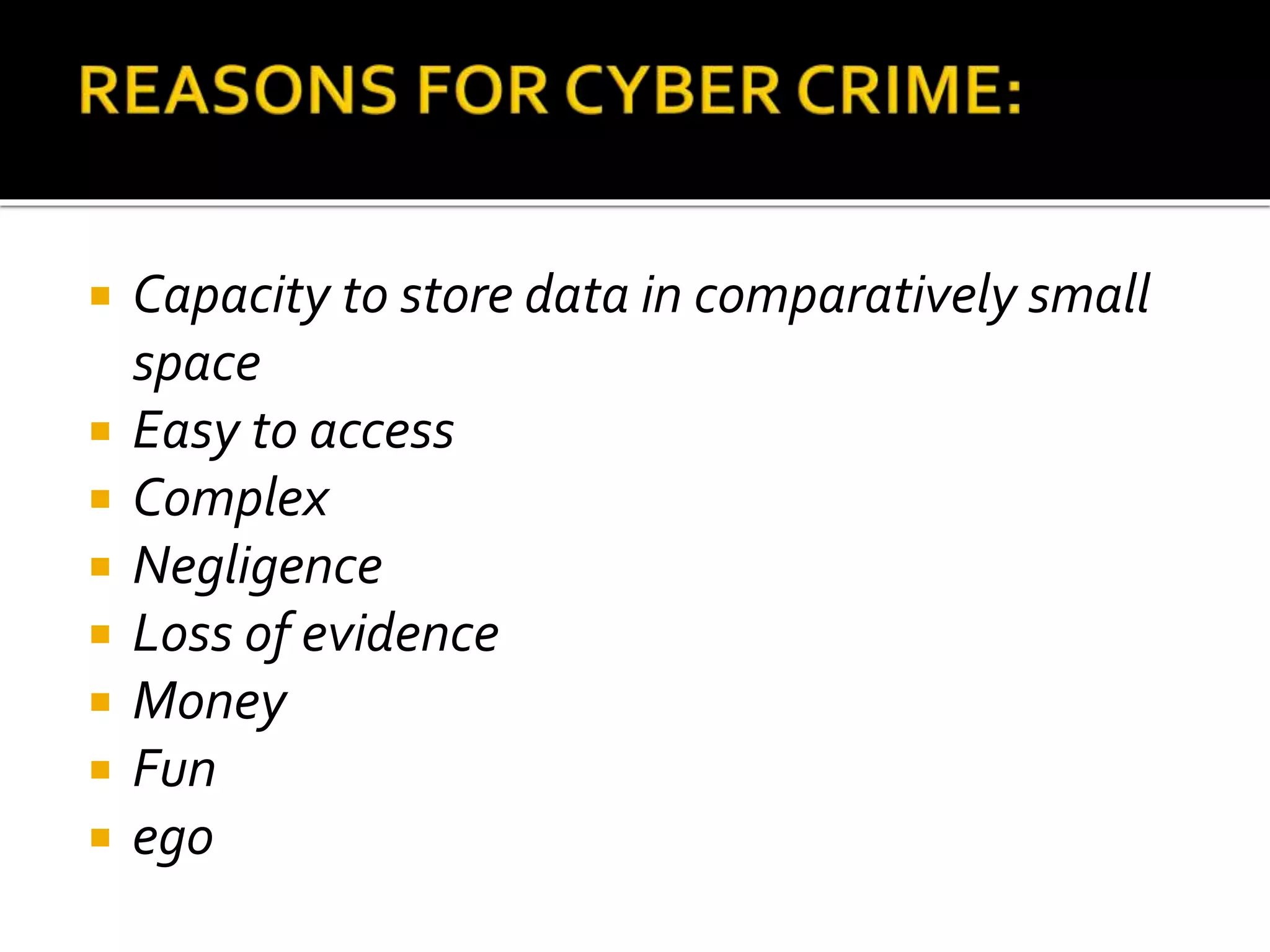
 Capacity to store data in comparatively small
space
 Easy to access
 Complex
 Negligence
 Loss of evidence
 Money
 Fun
 ego
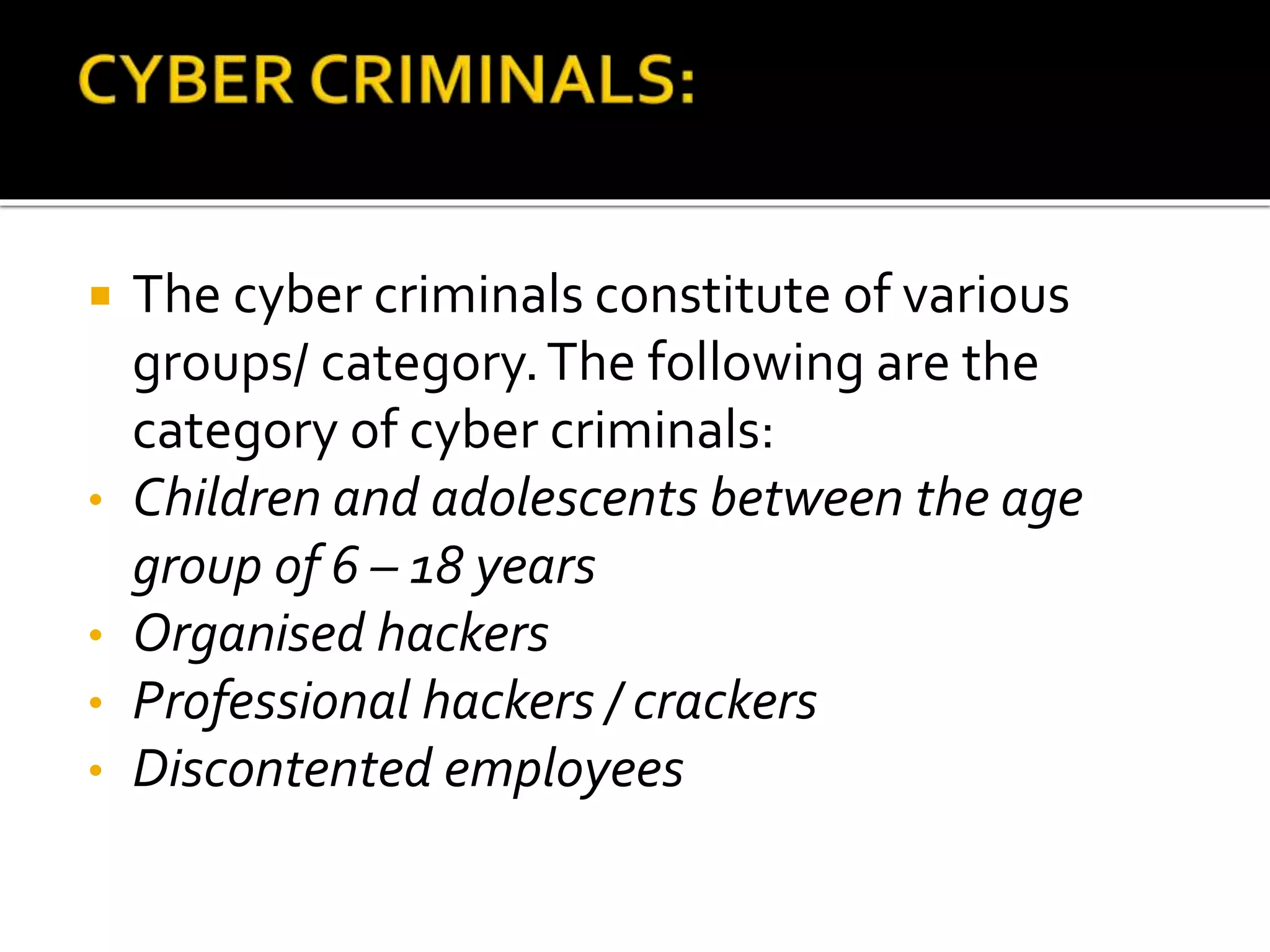
 The cyber criminals constitute of various
groups/ category.The following are the
category of cyber criminals:
• Children and adolescents between the age
group of 6 – 18 years
• Organised hackers
• Professional hackers / crackers
• Discontented employees
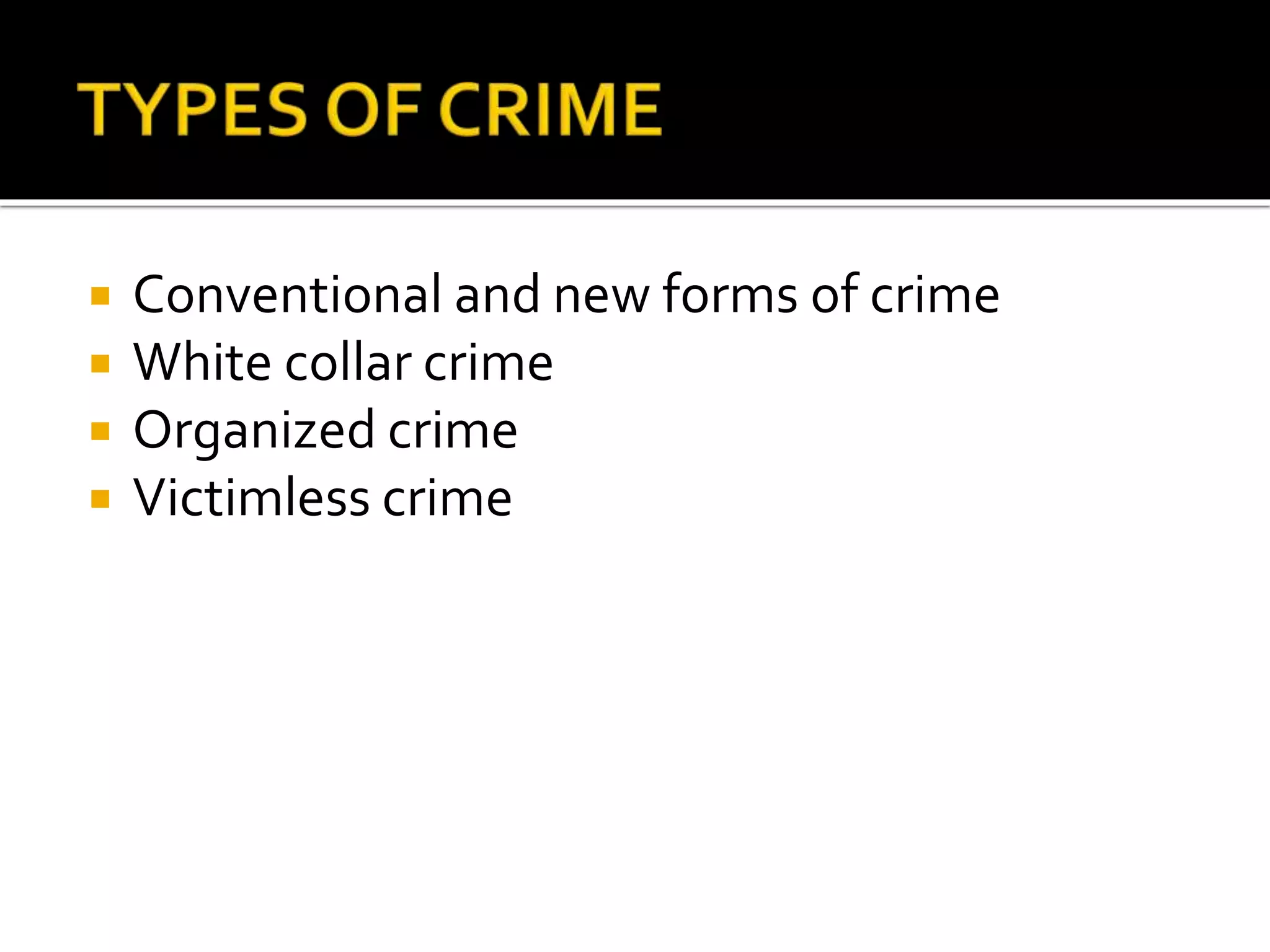
 Conventional and new forms of crime
 White collar crime
 Organized crime
 Victimless crime
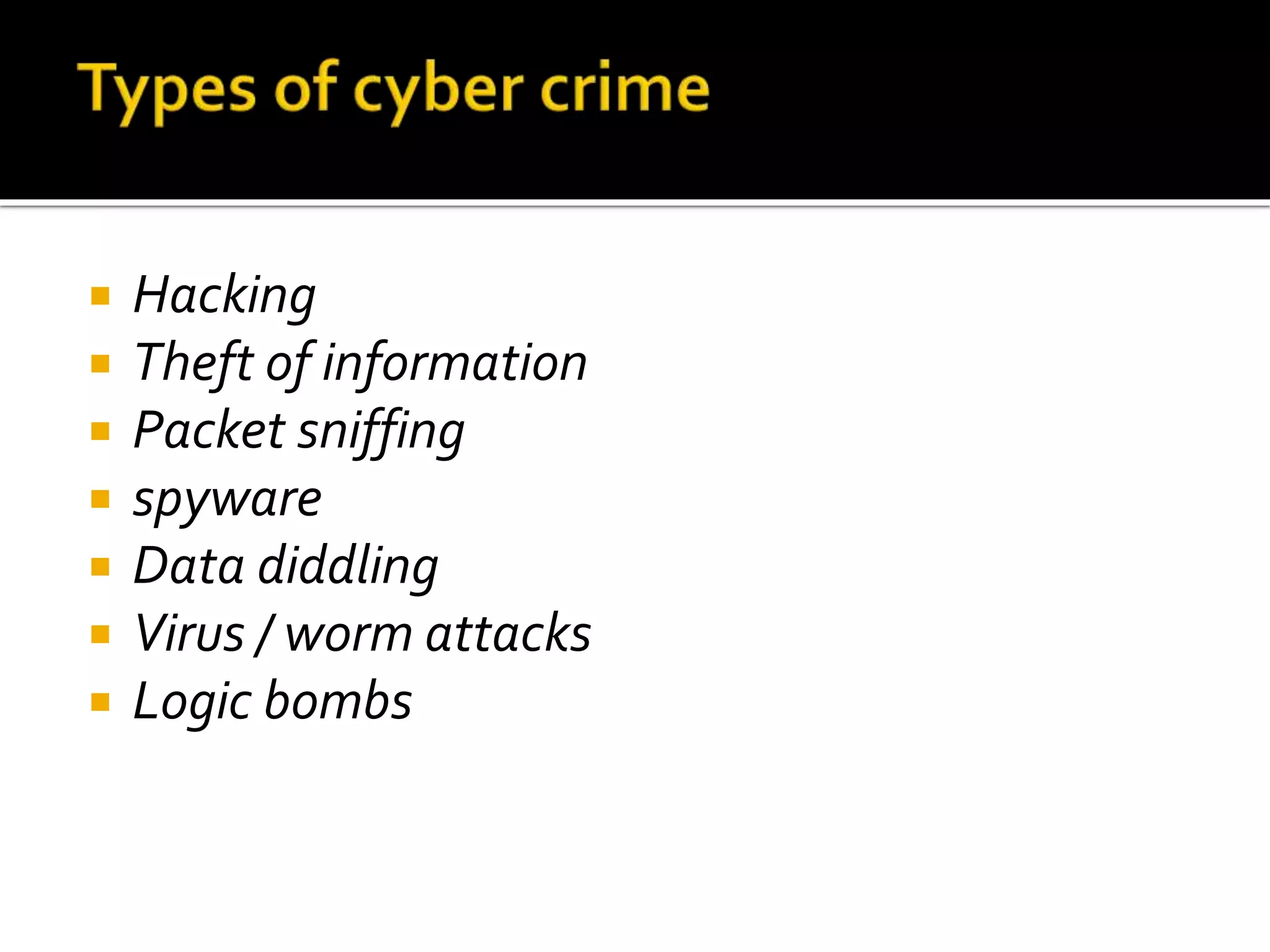
 Hacking
 Theft of information
 Packet sniffing
 spyware
 Data diddling
 Virus / worm attacks
 Logic bombs
 Trojan attacks
 Internet time thefts
 Web jacking
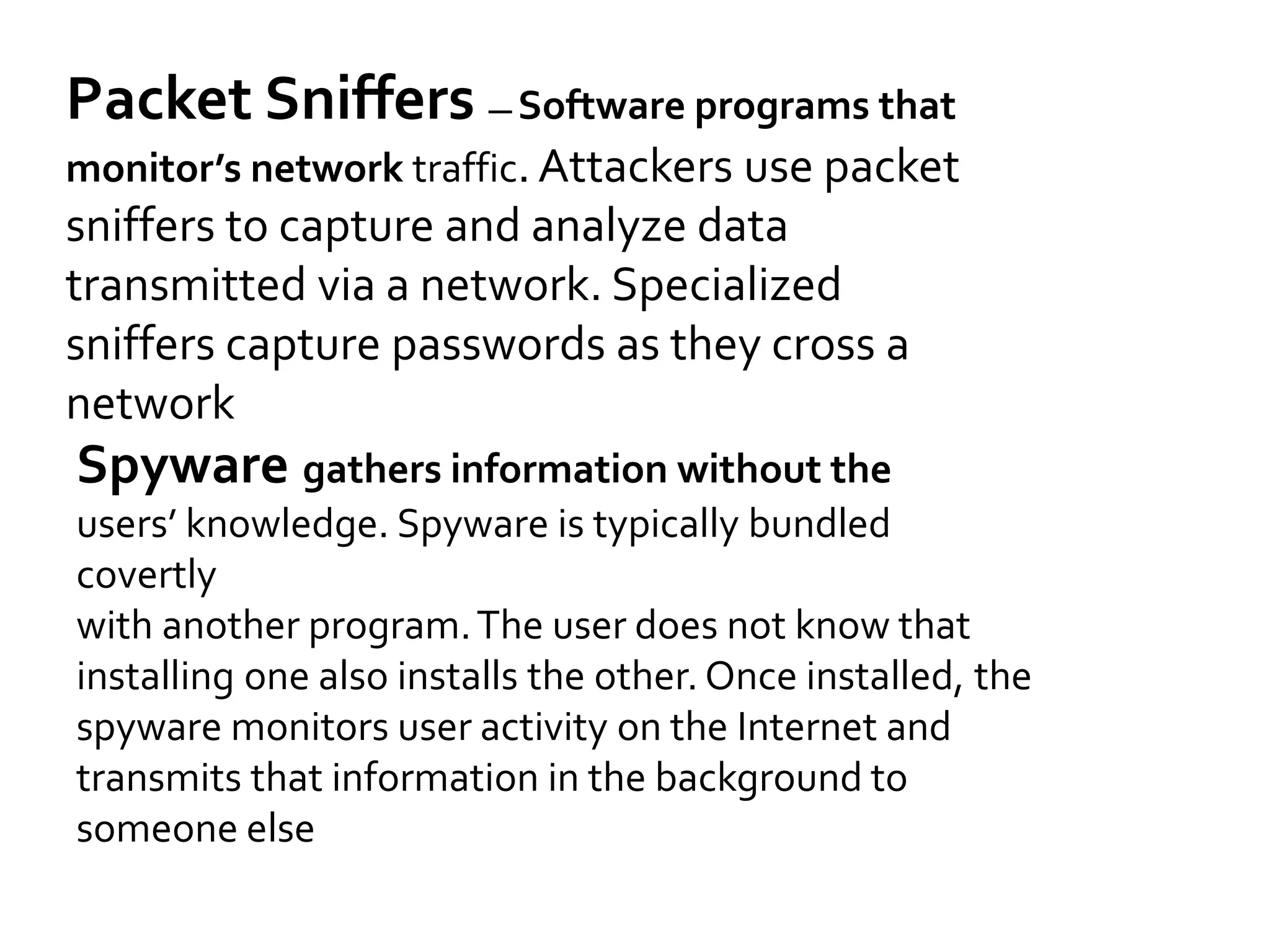
Packet Sniffers — Software programs that
monitor’s network traffic. Attackers use packet
sniffers to capture and analyze data
transmitted via a network. Specialized
sniffers capture passwords as they cross a
network
Spyware gathers information without the
users’ knowledge. Spyware is typically bundled
covertly
with another program.The user does not know that
installing one also installs the other. Once installed, the
spyware monitors user activity on the Internet and
transmits that information in the background to
someone else
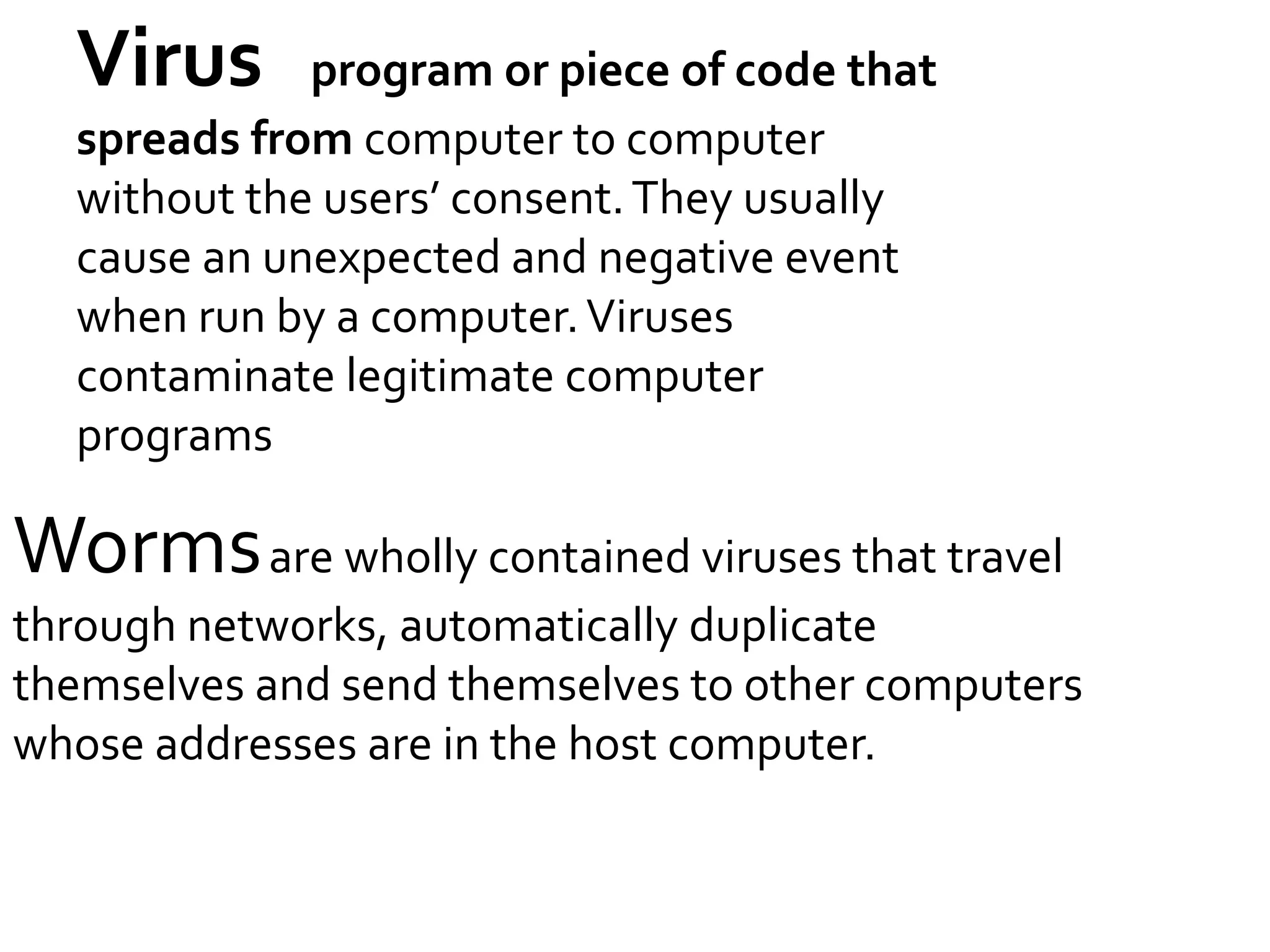
Virus program or piece of code that
spreads from computer to computer
without the users’ consent.They usually
cause an unexpected and negative event
when run by a computer.Viruses
contaminate legitimate computer
programs
Wormsare wholly contained viruses that travel
through networks, automatically duplicate
themselves and send themselves to other computers
whose addresses are in the host computer.
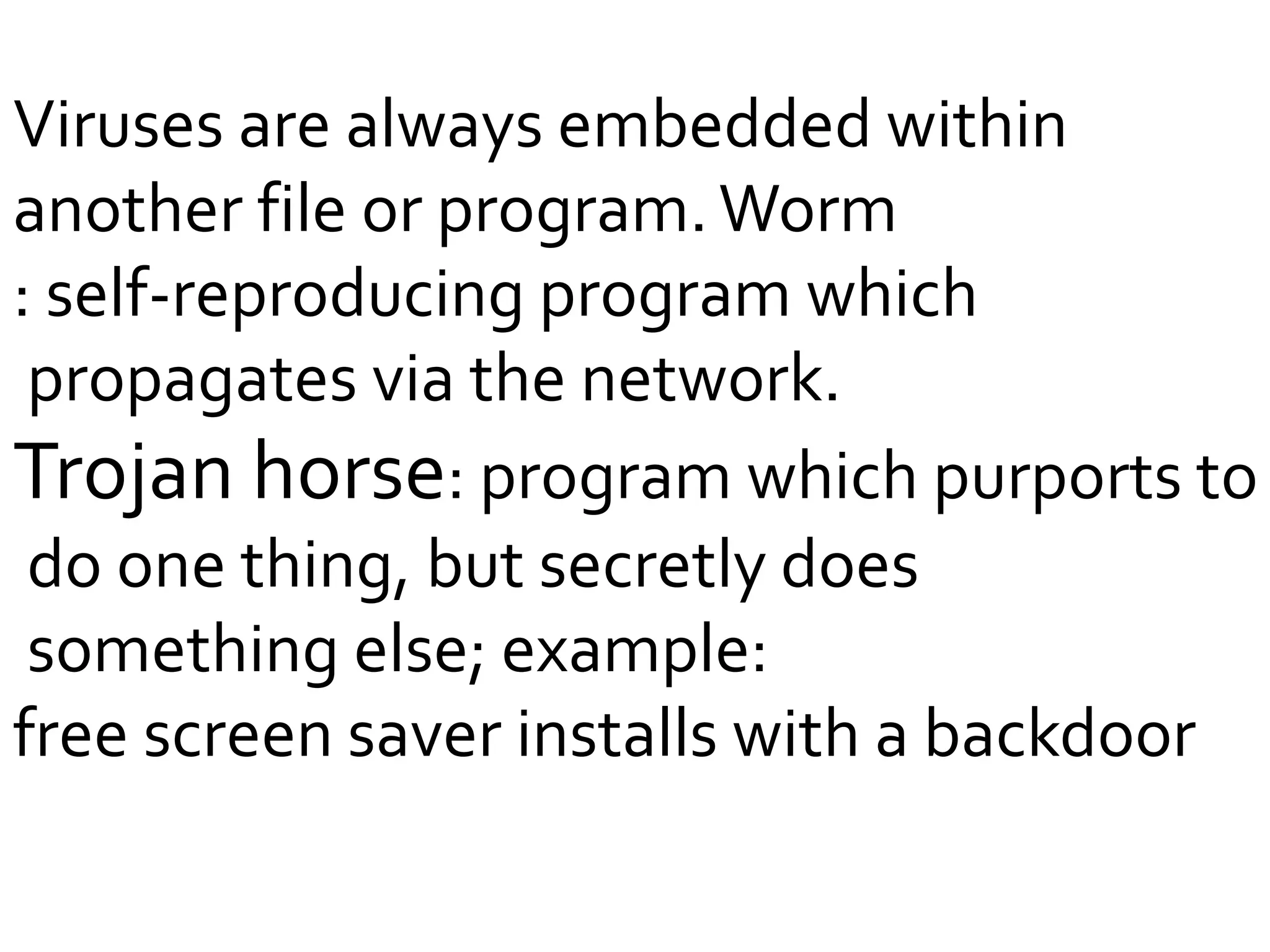
Viruses are always embedded within
another file or program.Worm
: self-reproducing program which
propagates via the network.
Trojan horse: program which purports to
do one thing, but secretly does
something else; example:
free screen saver installs with a backdoor
Data diddling:This is altering raw
data just before a computer processes it and
then changing it back after the processing is
completed.
Denial of Service attack:The
computer is flooded with more requests
than it can handle which cause it to crash.
Distributed Denial of Service (DDOS) attack
is a example.
Web jacking:This term is derived from
the term hi jacking. In these kinds of offences
the hacker gains access and control over the
web site of another.
Email bombing: It refers to sending large
numbers of mail to the victim, which may be an
individual or a company by ultimately resulting
into crashing.
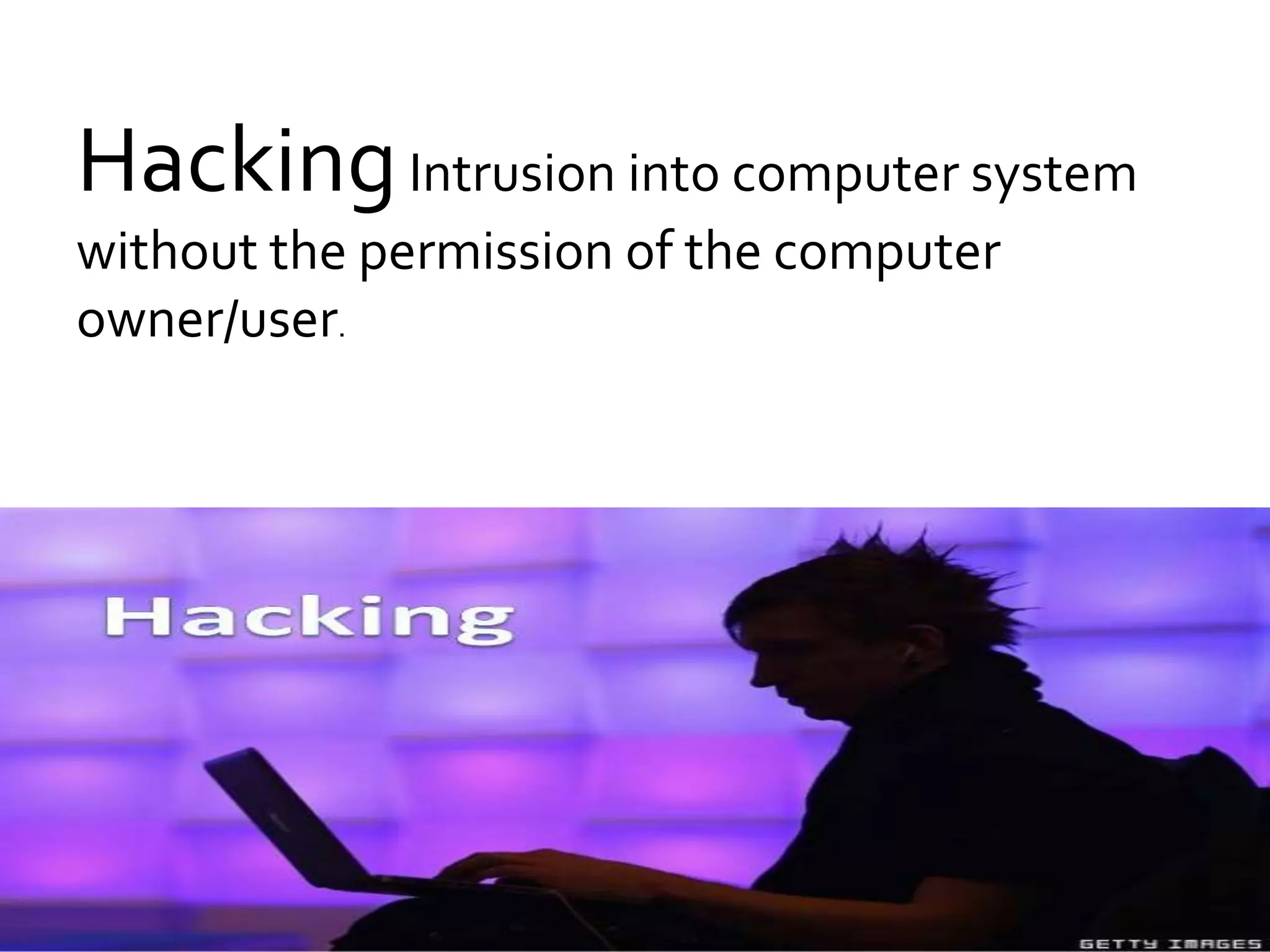
HackingIntrusion into computer system
without the permission of the computer
owner/user.
. IdentityTheft • A form of fraud in which a person
pretends to be someone else by assuming the other person’s
identity • Undertaken to access resources or obtain credit
and other benefits in the victim’s name .
E-mail spoofing• A technique used by hackers to send
mails in which sender’s address and other parts of the email
are altered. •This method is used to disguise the actual email
address from which phishing and spam messages are sent •
Motive: to trick users into providing personal and
confidential information
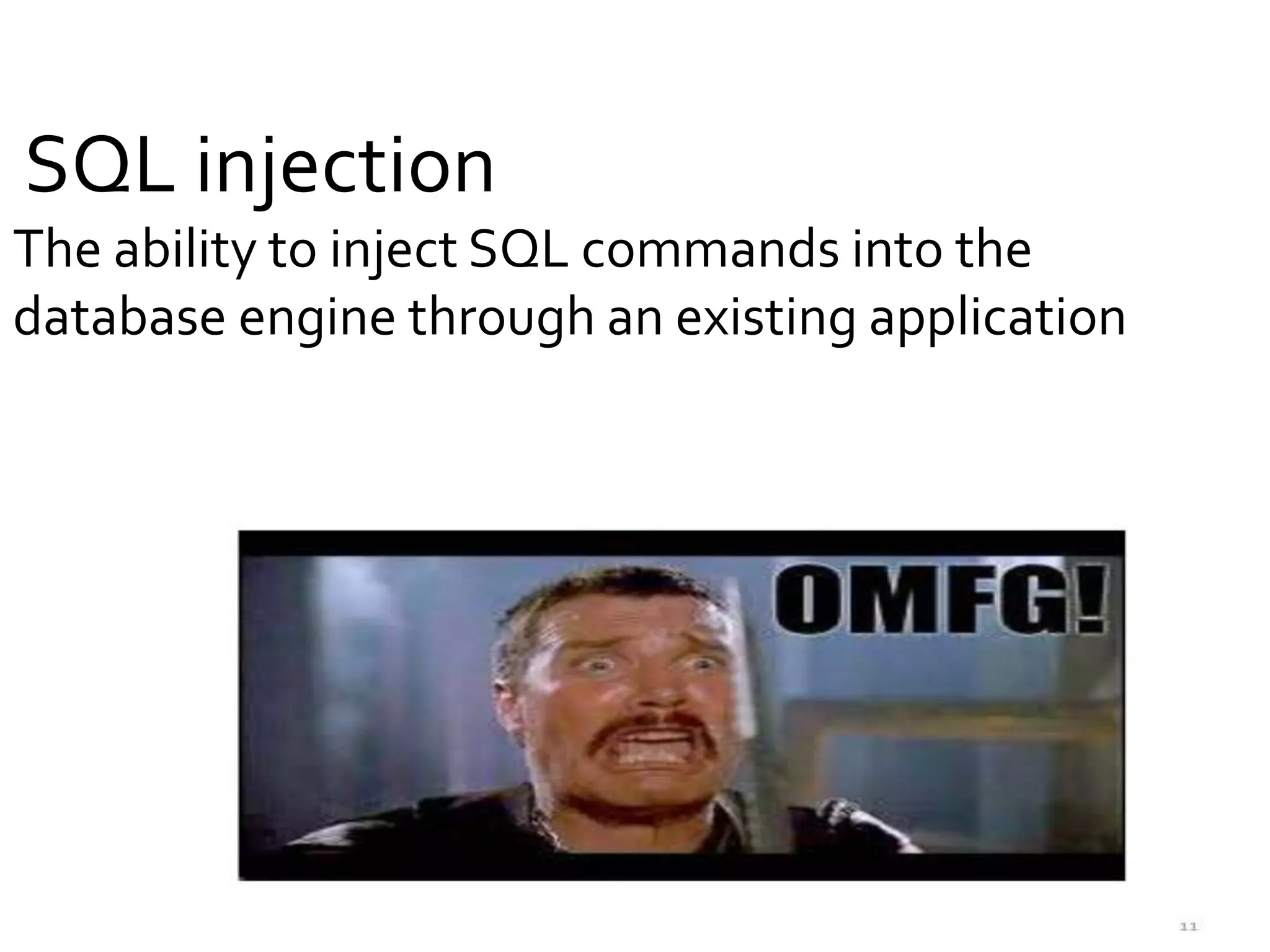
SQL injection
The ability to inject SQL commands into the
database engine through an existing application
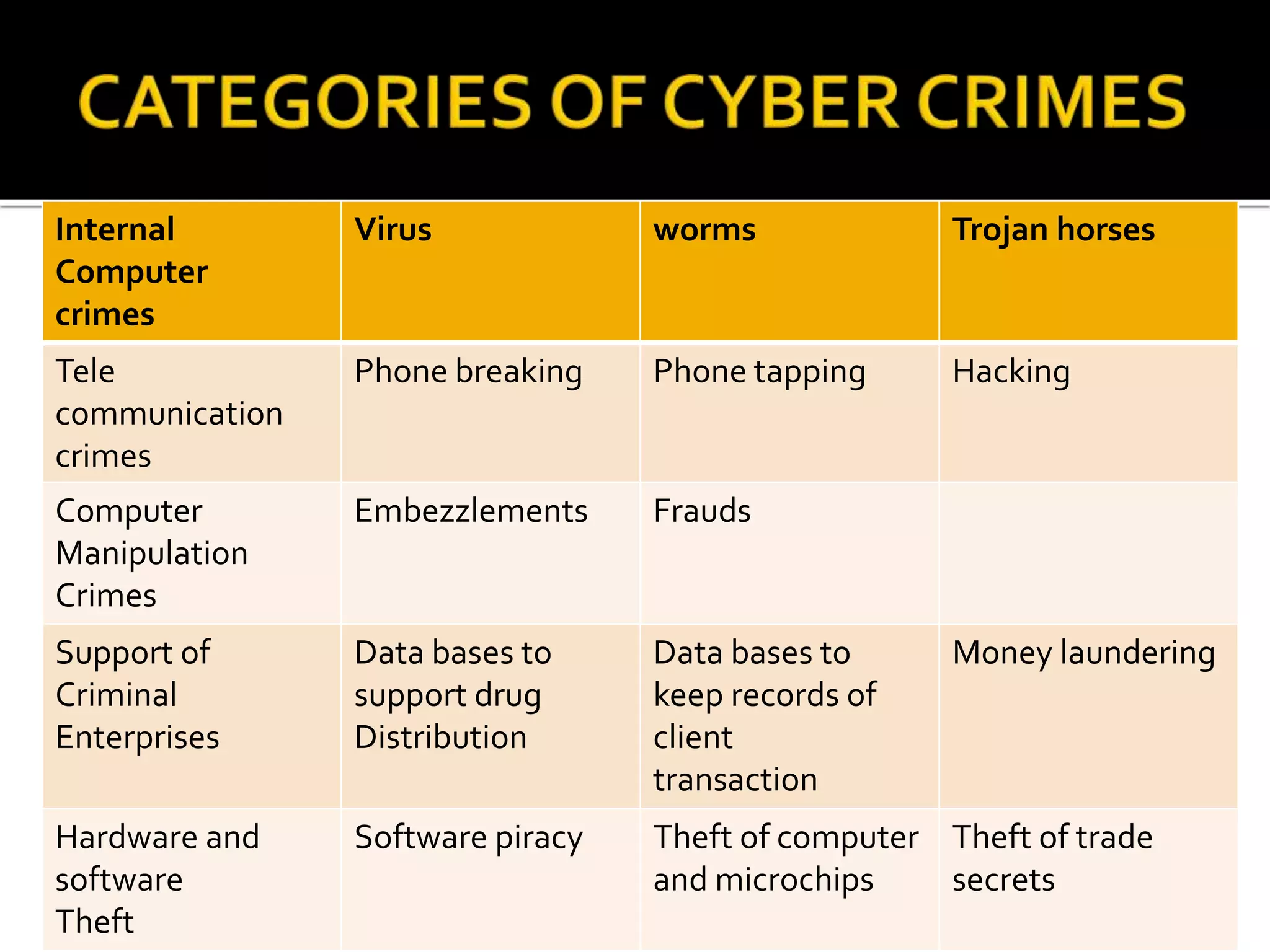
Internal
Computer
crimes
Virus worms Trojan horses
Tele
communication
crimes
Phone breaking Phone tapping Hacking
Computer
Manipulation
Crimes
Embezzlements Frauds
Support of
Criminal
Enterprises
Data bases to
support drug
Distribution
Data bases to
keep records of
client
transaction
Money laundering
Hardware and
software
Theft
Software piracy Theft of computer
and microchips
Theft of trade
secrets
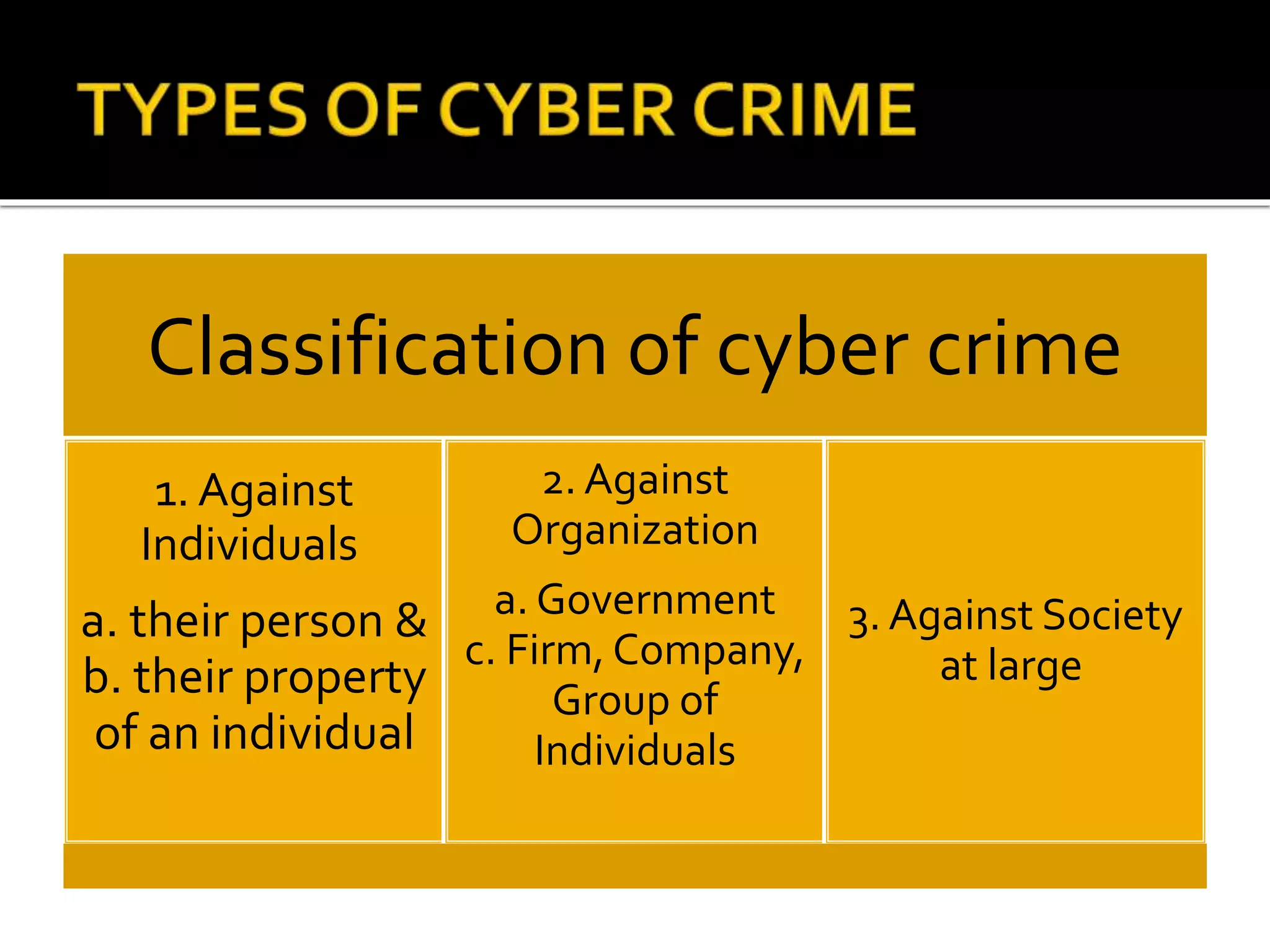
Classification of cyber crime
1. Against
Individuals
a. their person &
b. their property
of an individual
2. Against
Organization
a. Government
c. Firm, Company,
Group of
Individuals
3. Against Society
at large
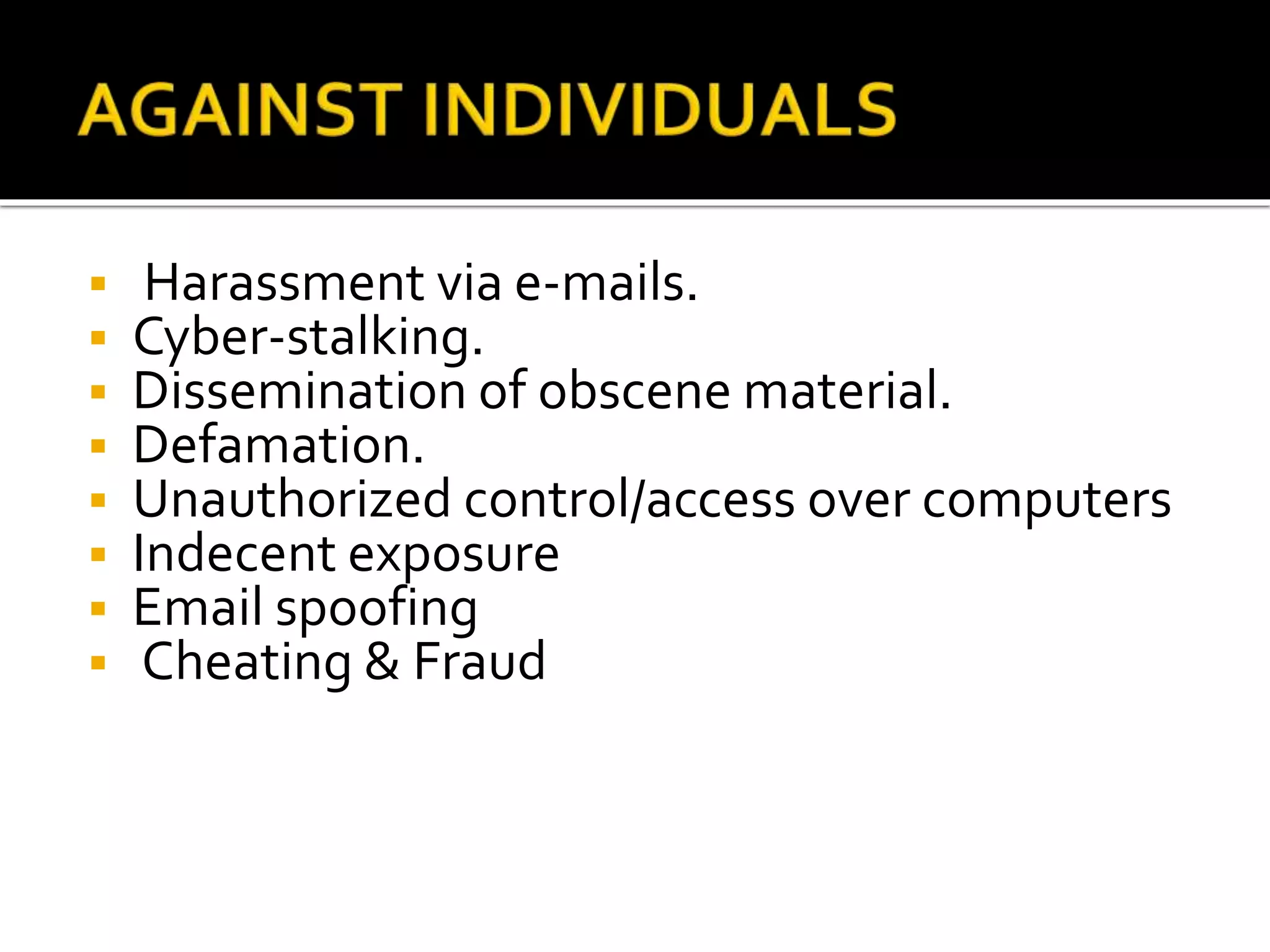
 Harassment via e-mails.
 Cyber-stalking.
 Dissemination of obscene material.
 Defamation.
 Unauthorized control/access over computers
 Indecent exposure
 Email spoofing
 Cheating & Fraud
 Computer vandalism.
 Transmitting virus.
 Net trespass
 Unauthorized control/access over computers
 Intellectual Property crimes
 Internet time thefts
 Cyber terrorism against the government
organization.
 Distribution of pirated software etc.
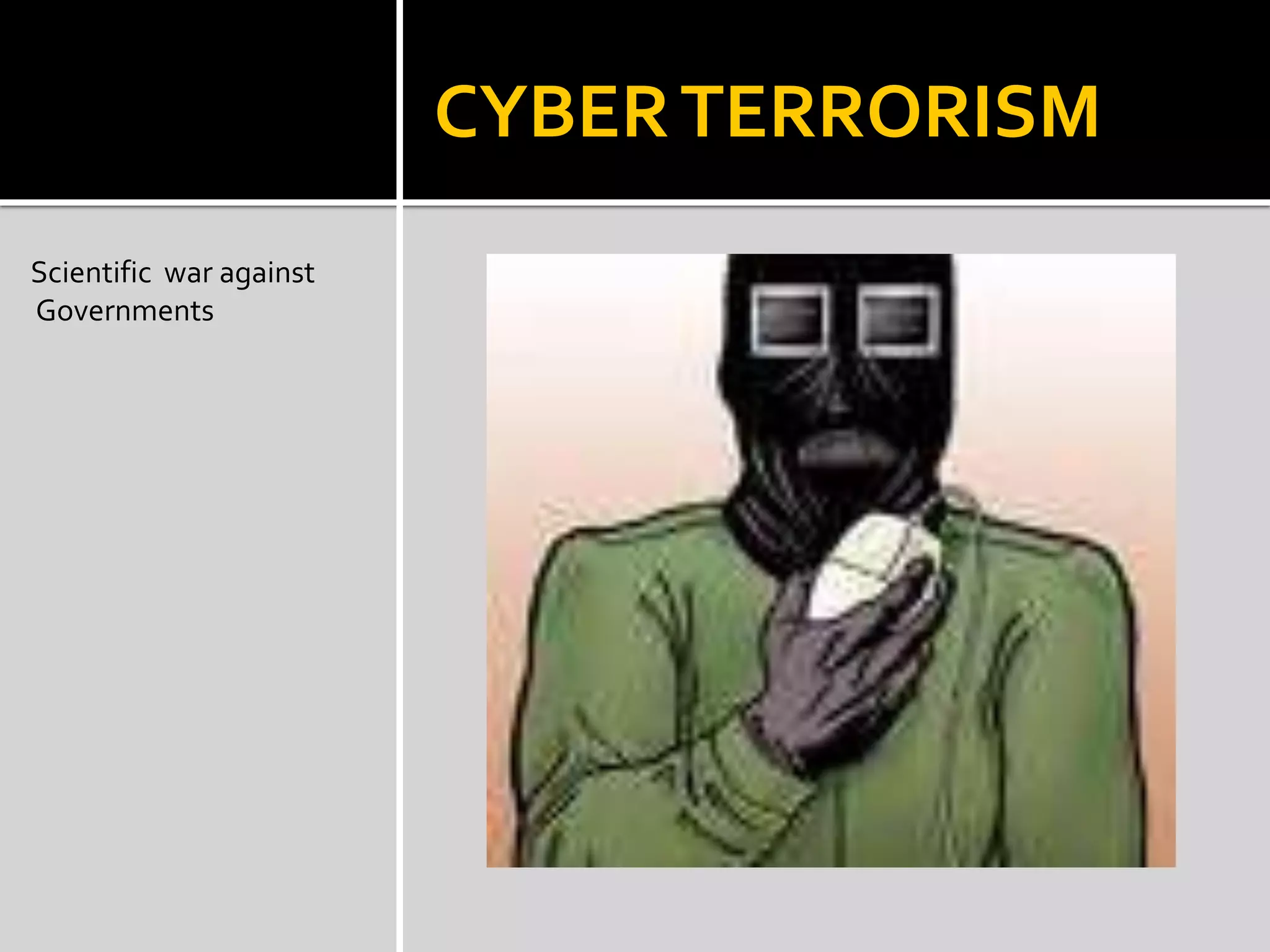
CYBERTERRORISM
Scientific war against
Governments
 Cyber terrorism is the convergence of terrorism
and cyberspace. It is generally understood to
mean unlawful attacks and threats of attack
against computers, networks, and the
information stored therein when done to
intimidate or coerce a government or its people
in furtherance of political or social objectives.
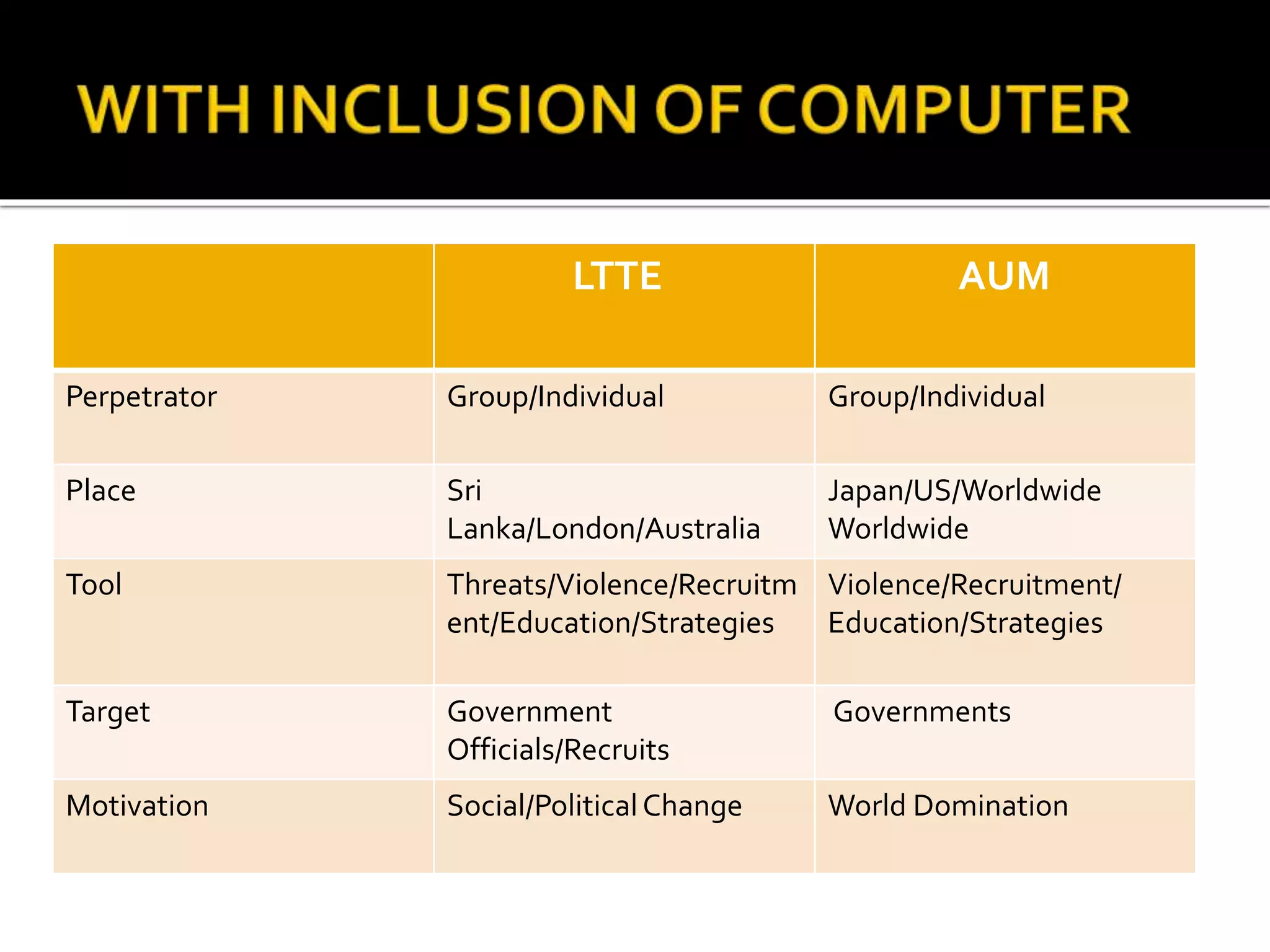
LTTE AUM
Perpetrator Group/Individual Group/Individual
Place Sri
Lanka/London/Australia
Japan/US/Worldwide
Worldwide
Tool Threats/Violence/Recruitm
ent/Education/Strategies
Violence/Recruitment/
Education/Strategies
Target Government
Officials/Recruits
Governments
Motivation Social/PoliticalChange World Domination
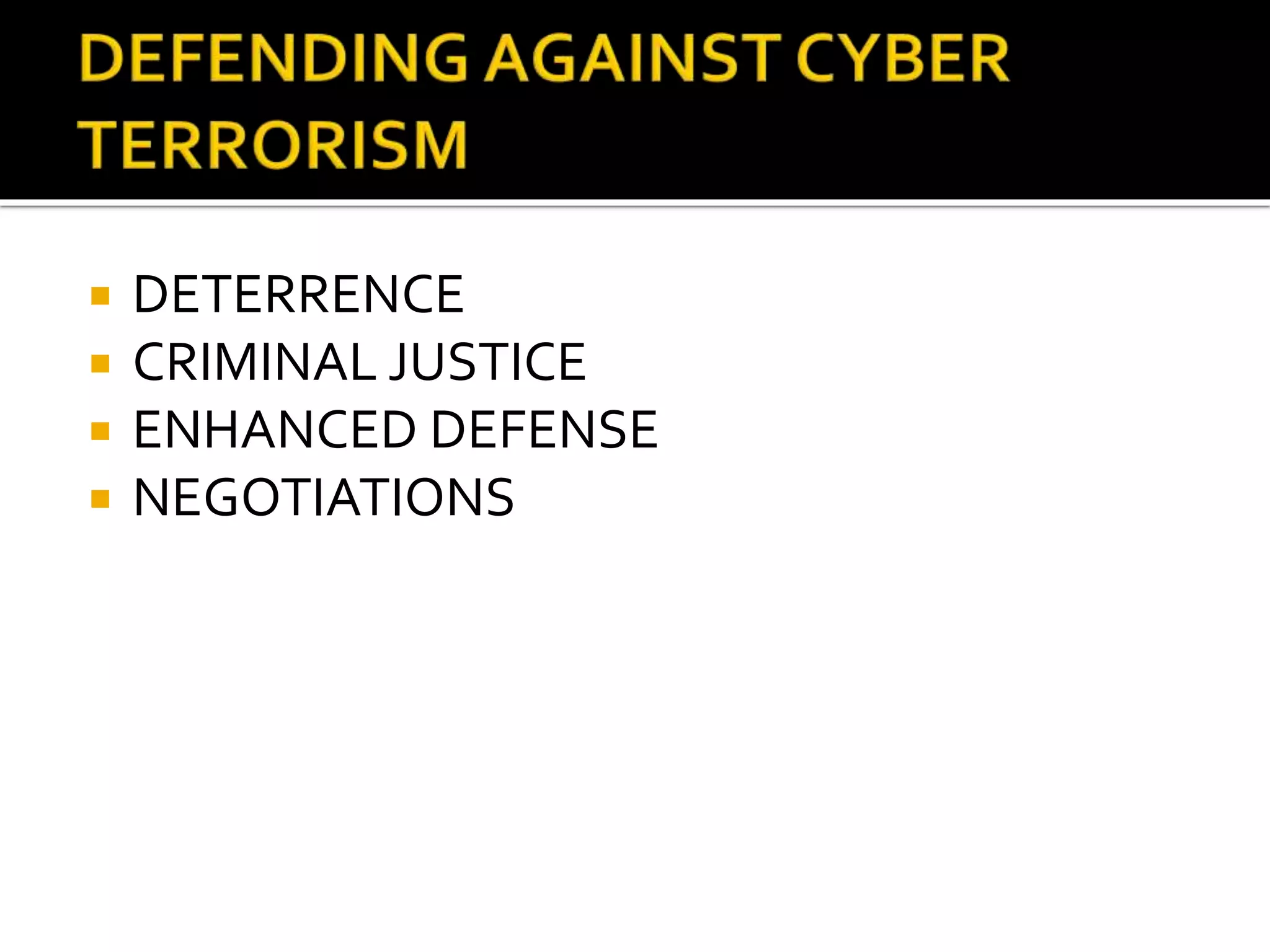
 DETERRENCE
 CRIMINAL JUSTICE
 ENHANCED DEFENSE
 NEGOTIATIONS
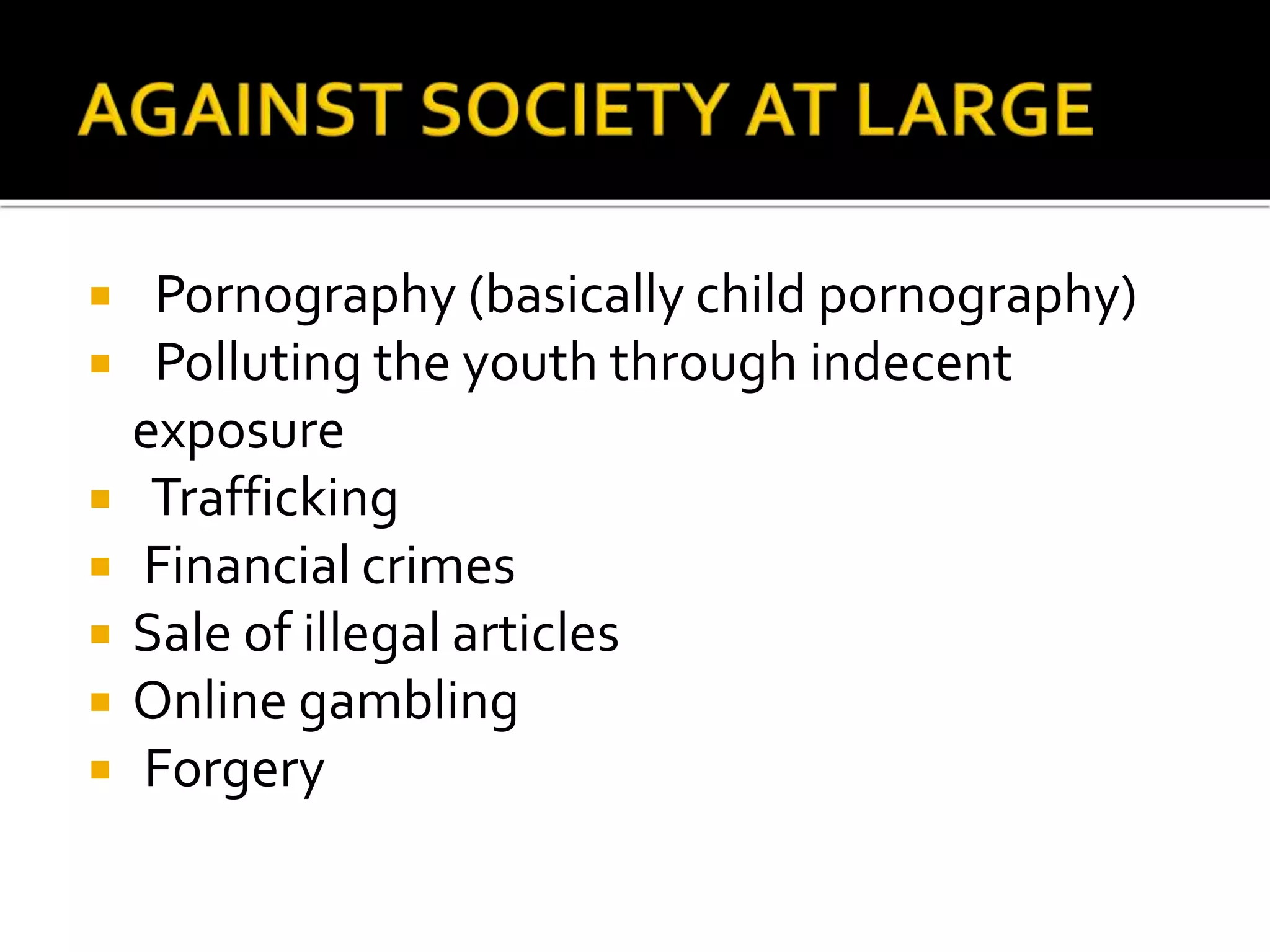
 Pornography (basically child pornography)
 Polluting the youth through indecent
exposure
 Trafficking
 Financial crimes
 Sale of illegal articles
 Online gambling
 Forgery
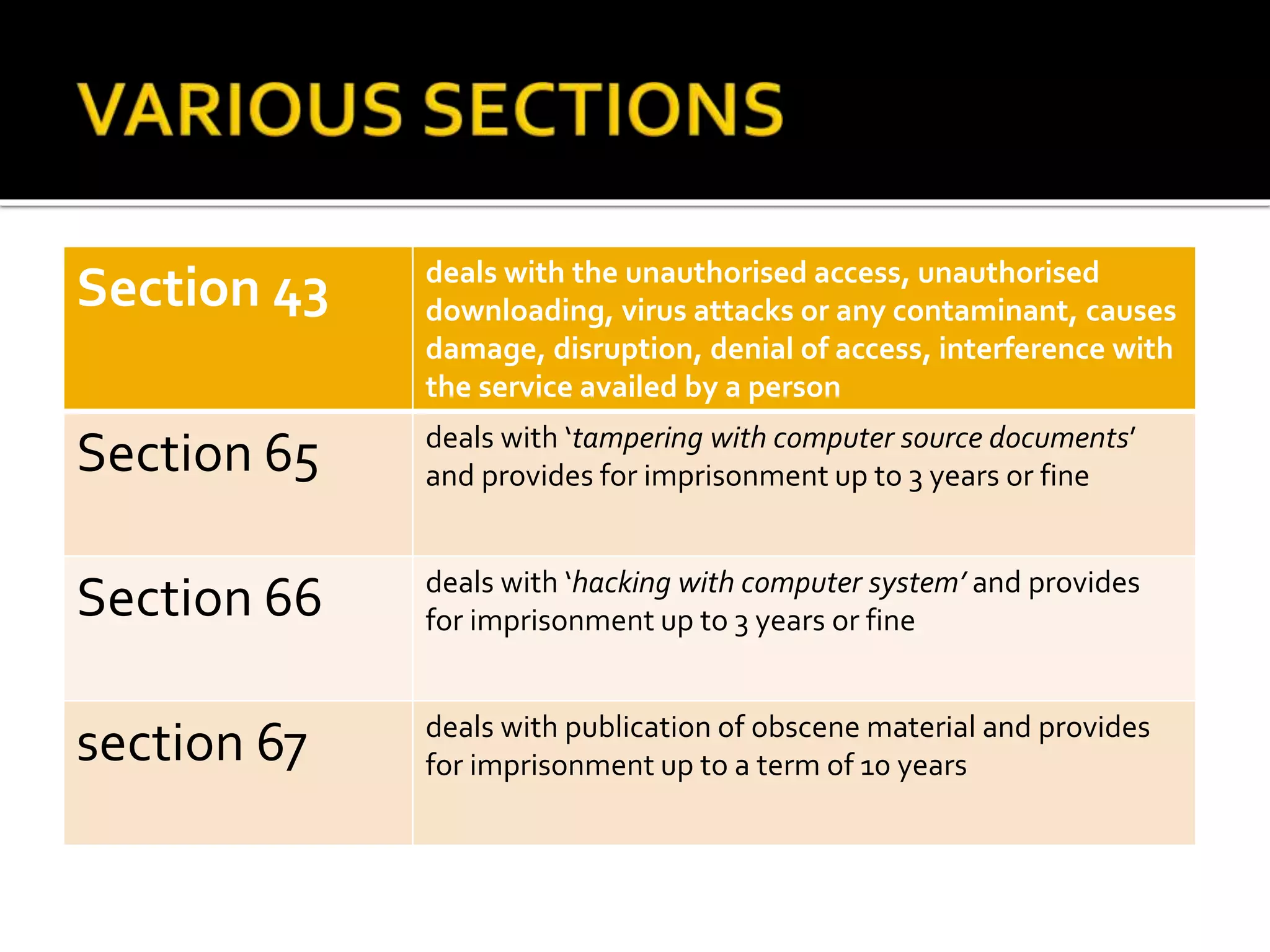
Section 43 deals with the unauthorised access, unauthorised
downloading, virus attacks or any contaminant, causes
damage, disruption, denial of access, interference with
the service availed by a person
Section 65 deals with ‘tampering with computer source documents’
and provides for imprisonment up to 3 years or fine
Section 66 deals with ‘hacking with computer system’ and provides
for imprisonment up to 3 years or fine
section 67 deals with publication of obscene material and provides
for imprisonment up to a term of 10 years
.Use antivirus software’s
.Insert firewalls
.uninstall unnecessary software
.maintain backup
.check security settings
.Stay anonymous –
.choose a genderless screen name
.Never give your full name or address to strangers..
 To prevent cyber stalking avoid disclosing any
information pertaining to oneself.This is as good as
disclosing your identity to strangers in public place.
 Always avoid sending any photograph online
particularly to strangers and chat friends as there
have been incidents of misuse of the photographs.
 Always use latest and up date anti virus software to
guard against virus attacks.
 Always keep back up volumes so that one may not
suffer data loss in case of virus contamination
 Never send your credit card number to any site that is
not secured, to guard against frauds.
 Always keep a watch on the sites that your
children are accessing to prevent any kind of
harassment or depravation in children.
 Web site owners should watch traffic and check
any irregularity on the site. Putting host-based
intrusion detection devices on servers may do
this
 Web servers running public sites must be
physically separate protected from internal
corporate network.
 History is the witness that no legislation has
succeeded in totally eliminating crime from the globe.
 The only possible step is to make people aware of
their rights and duties (to report crime as a collective
duty towards the society) and further making the
application of the laws more stringent to check crime.
 Undoubtedly the IT Act is a historical step in the cyber
world. Further I all together do not deny that there is a
need to bring changes in the InformationTechnology
Act to make it more effective to combat cyber crime.
Cybercrime 111205224958-phpapp02

  • 1.
  • 2.
    In 1960s internetwas developed for better communication and research.With advancement of technology and expansion of internet every area becomes easy to access but it also provides a pathway to commit crimes easily without any effort only sitting on a system. Some human minds of criminal nature use internet as a tool of crime which is now known as cyber crime committed in all countries first cyber crime reported in 1820
  • 3.
     Crime isa social and economic phenomenon  “a legal wrong that can be followed by criminal proceedings which may result into punishment.” definition : Crime is an intentional act of commission or omission in contravention to the law of the land and accordingly punishable when proved in judicial proceeding
  • 4.
     The term“cyber crime” was first coined by Barry Collins in 1980’s  “Any criminal activity that uses a computer either as an instrumentality, target or a means for perpetuating further crimes comes within the ambit of cyber crime”  A generalized definition of cyber crime may be “ unlawful acts wherein the computer is either a tool or target or both”
  • 5.
     Capacity tostore data in comparatively small space  Easy to access  Complex  Negligence  Loss of evidence  Money  Fun  ego
  • 6.
     The cybercriminals constitute of various groups/ category.The following are the category of cyber criminals: • Children and adolescents between the age group of 6 – 18 years • Organised hackers • Professional hackers / crackers • Discontented employees
  • 7.
     Conventional andnew forms of crime  White collar crime  Organized crime  Victimless crime
  • 8.
     Hacking  Theftof information  Packet sniffing  spyware  Data diddling  Virus / worm attacks  Logic bombs
  • 9.
     Trojan attacks Internet time thefts  Web jacking
  • 10.
    Packet Sniffers —Software programs that monitor’s network traffic. Attackers use packet sniffers to capture and analyze data transmitted via a network. Specialized sniffers capture passwords as they cross a network Spyware gathers information without the users’ knowledge. Spyware is typically bundled covertly with another program.The user does not know that installing one also installs the other. Once installed, the spyware monitors user activity on the Internet and transmits that information in the background to someone else
  • 11.
    Virus program orpiece of code that spreads from computer to computer without the users’ consent.They usually cause an unexpected and negative event when run by a computer.Viruses contaminate legitimate computer programs Wormsare wholly contained viruses that travel through networks, automatically duplicate themselves and send themselves to other computers whose addresses are in the host computer.
  • 12.
    Viruses are alwaysembedded within another file or program.Worm : self-reproducing program which propagates via the network. Trojan horse: program which purports to do one thing, but secretly does something else; example: free screen saver installs with a backdoor
  • 13.
    Data diddling:This isaltering raw data just before a computer processes it and then changing it back after the processing is completed. Denial of Service attack:The computer is flooded with more requests than it can handle which cause it to crash. Distributed Denial of Service (DDOS) attack is a example.
  • 14.
    Web jacking:This termis derived from the term hi jacking. In these kinds of offences the hacker gains access and control over the web site of another. Email bombing: It refers to sending large numbers of mail to the victim, which may be an individual or a company by ultimately resulting into crashing.
  • 15.
    HackingIntrusion into computersystem without the permission of the computer owner/user.
  • 16.
    . IdentityTheft •A form of fraud in which a person pretends to be someone else by assuming the other person’s identity • Undertaken to access resources or obtain credit and other benefits in the victim’s name . E-mail spoofing• A technique used by hackers to send mails in which sender’s address and other parts of the email are altered. •This method is used to disguise the actual email address from which phishing and spam messages are sent • Motive: to trick users into providing personal and confidential information
  • 17.
    SQL injection The abilityto inject SQL commands into the database engine through an existing application
  • 18.
    Internal Computer crimes Virus worms Trojanhorses Tele communication crimes Phone breaking Phone tapping Hacking Computer Manipulation Crimes Embezzlements Frauds Support of Criminal Enterprises Data bases to support drug Distribution Data bases to keep records of client transaction Money laundering Hardware and software Theft Software piracy Theft of computer and microchips Theft of trade secrets
  • 19.
    Classification of cybercrime 1. Against Individuals a. their person & b. their property of an individual 2. Against Organization a. Government c. Firm, Company, Group of Individuals 3. Against Society at large
  • 20.
     Harassment viae-mails.  Cyber-stalking.  Dissemination of obscene material.  Defamation.  Unauthorized control/access over computers  Indecent exposure  Email spoofing  Cheating & Fraud
  • 21.
     Computer vandalism. Transmitting virus.  Net trespass  Unauthorized control/access over computers  Intellectual Property crimes  Internet time thefts
  • 22.
     Cyber terrorismagainst the government organization.  Distribution of pirated software etc.
  • 23.
  • 24.
     Cyber terrorismis the convergence of terrorism and cyberspace. It is generally understood to mean unlawful attacks and threats of attack against computers, networks, and the information stored therein when done to intimidate or coerce a government or its people in furtherance of political or social objectives.
  • 25.
    LTTE AUM Perpetrator Group/IndividualGroup/Individual Place Sri Lanka/London/Australia Japan/US/Worldwide Worldwide Tool Threats/Violence/Recruitm ent/Education/Strategies Violence/Recruitment/ Education/Strategies Target Government Officials/Recruits Governments Motivation Social/PoliticalChange World Domination
  • 26.
     DETERRENCE  CRIMINALJUSTICE  ENHANCED DEFENSE  NEGOTIATIONS
  • 27.
     Pornography (basicallychild pornography)  Polluting the youth through indecent exposure  Trafficking  Financial crimes  Sale of illegal articles  Online gambling  Forgery
  • 29.
    Section 43 dealswith the unauthorised access, unauthorised downloading, virus attacks or any contaminant, causes damage, disruption, denial of access, interference with the service availed by a person Section 65 deals with ‘tampering with computer source documents’ and provides for imprisonment up to 3 years or fine Section 66 deals with ‘hacking with computer system’ and provides for imprisonment up to 3 years or fine section 67 deals with publication of obscene material and provides for imprisonment up to a term of 10 years
  • 30.
    .Use antivirus software’s .Insertfirewalls .uninstall unnecessary software .maintain backup .check security settings .Stay anonymous – .choose a genderless screen name .Never give your full name or address to strangers..
  • 31.
     To preventcyber stalking avoid disclosing any information pertaining to oneself.This is as good as disclosing your identity to strangers in public place.  Always avoid sending any photograph online particularly to strangers and chat friends as there have been incidents of misuse of the photographs.  Always use latest and up date anti virus software to guard against virus attacks.  Always keep back up volumes so that one may not suffer data loss in case of virus contamination  Never send your credit card number to any site that is not secured, to guard against frauds.
  • 32.
     Always keepa watch on the sites that your children are accessing to prevent any kind of harassment or depravation in children.  Web site owners should watch traffic and check any irregularity on the site. Putting host-based intrusion detection devices on servers may do this  Web servers running public sites must be physically separate protected from internal corporate network.
  • 33.
     History isthe witness that no legislation has succeeded in totally eliminating crime from the globe.  The only possible step is to make people aware of their rights and duties (to report crime as a collective duty towards the society) and further making the application of the laws more stringent to check crime.  Undoubtedly the IT Act is a historical step in the cyber world. Further I all together do not deny that there is a need to bring changes in the InformationTechnology Act to make it more effective to combat cyber crime.