

What is Cyber crime ? 
Cyber crime is a crime committed over the Internet. 
 It could be against the government, property and 
against any person in various forms. 
 The law enforcement agencies are facing difficulties 
in dealing with cyber crime. 
 In India, Information Technology Act, 2000 is the 
legislation that deals with issue related to cyber crime.
HISTORY 
 The first recorded cyber crime took place in the year 
1820 in FRANCE 
 Joseph-Marie Jacquard, a textile manufacturer in 
France, produced the loom 
 This device allowed the repetition of a series of steps 
in the weaving of special fabrics. 
 This resulted in a fear amongst employees that their 
tradiotional employment was being threatened 
 They committed acts of sabotage(Destruction of 
property or obstruction of normal operations, as by 
civilians or enemy agents in time of war.) to 
discourge further use of the new technology
Introduction 
 Advancements in modern technology have 
helped countries develop and expand their 
communication networks, enabling faster 
and easier networking and information 
exchange. 
 Currently, there are nearly 2 billion internet 
users and over 5 billion mobile phone 
connections worldwide. 
 Every day, 294 billion emails and 5 billion 
phone messages are exchanged.
As businesses and societies in general 
increasingly rely on computers and internet-based 
networking, cyber crime and digital 
attack incidents have increased around the 
world. 
 These attacks — generally classified as any 
crime that involves the use of a computer 
network — include financial scams, 
computer hacking, downloading 
pornographic images from the internet, virus 
attacks, e-mail stalking and creating 
websites that promote racial hatred.
The first major instance of cyber crime was 
reported in 2000, when a mass-mailed 
computer virus affected nearly 45 million 
computer users worldwide 
 In 2011, at least 2.3 billion people, the 
equivalent of more than one third of the 
world’s total population, had access to the 
internet 
 Over 60 per cent of all internet users are in 
developing countries, with 45 per cent of all 
internet users below the age of 25 years.
 In the hyperconnected world of tomorrow, it 
will become hard to imagine a ‘computer 
crime’, and perhaps any crime, that does not 
involve electronic evidence linked with 
internet protocol (IP) connectivity. 
 In 2009, the cost of information lost to cyber 
crime nearly doubled, from US$265 million in 
2008 to US$560 million
CYBER CRIMINALS 
 Kids (age group 9-16 ) 
 Organized hacktivists 
 Disgruntled employees 
 Professional hackers (corporate 
espionage)
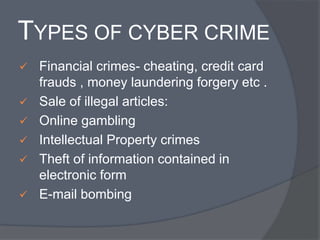
TYPES OF CYBER CRIME 
 Financial crimes- cheating, credit card 
frauds , money laundering forgery etc . 
 Sale of illegal articles: 
 Online gambling 
 Intellectual Property crimes 
 Theft of information contained in 
electronic form 
 E-mail bombing
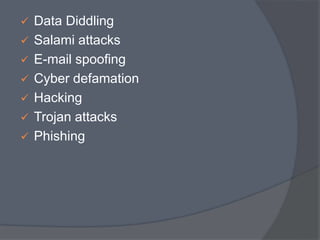
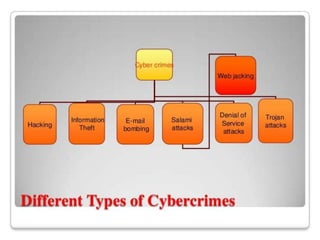
 Data Diddling 
 Salami attacks 
 E-mail spoofing 
 Cyber defamation 
 Hacking 
 Trojan attacks 
 Phishing
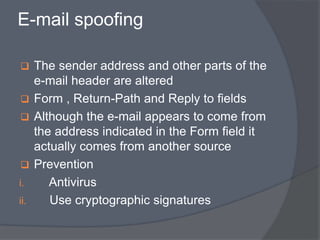
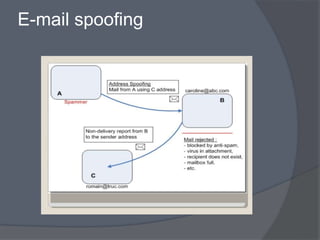
E-mail spoofing 
 The sender address and other parts of the 
e-mail header are altered 
 Form , Return-Path and Reply to fields 
 Although the e-mail appears to come from 
the address indicated in the Form field it 
actually comes from another source 
 Prevention 
i. Antivirus 
ii. Use cryptographic signatures
E-mail spoofing
Salami Attack 
 A series of minor attacks that togrther 
results in a larger attack 
 Used for financial crimes in which criminals 
steal money or resources a bit at a time 
from a system 
 Preventation 
i. Find indications of an attack 
ii. Random audits 
iii. Don’t ignor what appears to be errors in 
computer-based financial systems
Data Diddling 
o Changing of data before or during entry 
into the computer system 
o Forging or counterfeiting documents 
used for data entry 
o Exchanging valid disks and tapes with 
modified replacements 
o Prevention 
i. Regular audits 
ii. Supervising employees
Cyber crime – a growing 
challenge for governments 
o In a digital age, where online communication 
has become the norm, internet users and 
governments face increased risks of becoming 
the targets of cyber attacks. As cyber criminals 
continue to develop and advance their 
techniques, they are also shifting their targets 
— focusing less on theft of financial 
information and more on business espionage 
and accessing government information. To 
fight fast-spreading cyber crime, governments 
must collaborate globally to develop an 
effective model that will control the threat.
Cost of cyber crime in india 
 29.9 million people felt victim to cyber 
crime 
 $4 billion in direct financial losses, 
 $3.6 billion in time spent resolving the 
crime, 
 4 in 5 online adults (80%) have been a 
victim of cybercrime 
 17% of adults online have experienced 
cybercrime on their mobile phones.
LAW ENFORCEMENT 
Section 66: Hacking 
 Destruction, deletion, alteration, diminishing 
value or utility or injuriously affecting 
informaion residing in a computer resource 
 Punishment 
Imprisonment up to three years, and fine up 
to 2 lac 
Section 70: Protected System 
 Securing unauthorised access or attempting 
to secure unauthorised access to protected 
system 
 Punishment 
Imprisonment up to 10 years and fine
Sec 67: Pronography 
 Publishing or transmitting or causing to be 
published in the electronic form 
 Obscene material 
 Punishment 
 On first conviction 
Imprisonment of either description up to five 
years and fine up to 1 lac rupees 
 On subesquent conviction 
Imprisonment of either description up to 10 
years and fine up to 2 lac rupees
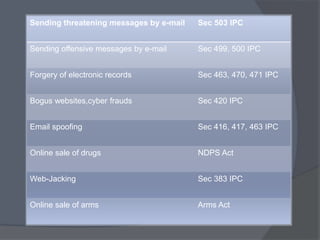
Sending threatening messages by e-mail Sec 503 IPC 
Sending offensive messages by e-mail Sec 499, 500 IPC 
Forgery of electronic records Sec 463, 470, 471 IPC 
Bogus websites,cyber frauds Sec 420 IPC 
Email spoofing Sec 416, 417, 463 IPC 
Online sale of drugs NDPS Act 
Web-Jacking Sec 383 IPC 
Online sale of arms Arms Act
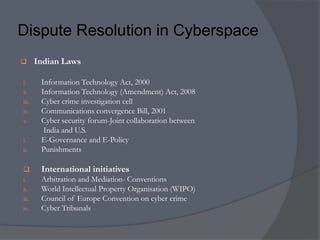
Dispute Resolution in Cyberspace 
 Indian Laws 
i. Information Technology Act, 2000 
ii. Information Technology (Amendment) Act, 2008 
iii. Cyber crime investigation cell 
iv. Communications convergence Bill, 2001 
v. Cyber security forum-Joint collaboration between 
India and U.S. 
i. E-Governance and E-Policy 
ii. Punishments 
 International initiatives 
i. Arbitration and Mediation- Conventions 
ii. World Intellectual Property Organisation (WIPO) 
iii. Council of Europe Convention on cyber crime 
iv. Cyber Tribunals
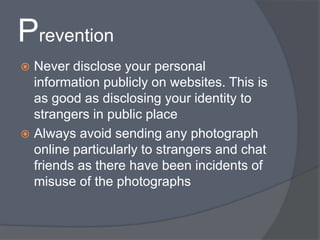
Prevention 
 Never disclose your personal 
information publicly on websites. This is 
as good as disclosing your identity to 
strangers in public place 
 Always avoid sending any photograph 
online particularly to strangers and chat 
friends as there have been incidents of 
misuse of the photographs
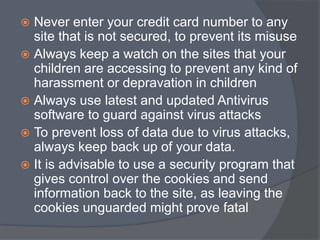
 Never enter your credit card number to any 
site that is not secured, to prevent its misuse 
 Always keep a watch on the sites that your 
children are accessing to prevent any kind of 
harassment or depravation in children 
 Always use latest and updated Antivirus 
software to guard against virus attacks 
 To prevent loss of data due to virus attacks, 
always keep back up of your data. 
 It is advisable to use a security program that 
gives control over the cookies and send 
information back to the site, as leaving the 
cookies unguarded might prove fatal
 Use of firewalls proves beneficial 
 Website owners should watch traffic and 
check any irregularity on the site. Putting 
host-based intrusion detection devices on 
servers will serve the purpose
Solution 
 An important question arises that how can 
these crimes be prevented 
 A number of techniques & solution have been 
presented but the problem still exists & are 
increasing day by day 
 Antivirus & Anti Spyware Software: 
Antivirus software consists of computer 
programs that attempt to identify, thwart & 
eliminate computer viruses & other malicious 
software. Anti spy wares are used to restrict 
backdoor program, trojans & other spy wares 
to be installed on the computer
 Firewalls: 
A firewall protect a computer network form 
unauthorized access. Network firewalls may 
be hardware devices, software programs, or 
a combination of the two. A network firewall 
typically guards an internal computer 
network against malicious access from 
outside the network 
 Cyber security must be pursued with the 
same intensity as efforts to eradicate global 
poverty or tackle climate change
CONCLUSION…. 
 Indian laws are well drafted & are capable of 
handling all kinds of challenges as posed by 
cyber criminals. However, the enforcement 
agencies are required to be well versed with 
the changing technologies & laws 
 As internet technology advances so does the 
threat of cyber crime. In times like these we 
must protect ourselves from cyber crime. Anti-virus 
software, firewalls & security patches are 
just the beginning. Never open suspicious e-mails 
& only navigate to trusted sites.
PRACHI

Cyber crime

  • 2.
    What is Cybercrime ? Cyber crime is a crime committed over the Internet.  It could be against the government, property and against any person in various forms.  The law enforcement agencies are facing difficulties in dealing with cyber crime.  In India, Information Technology Act, 2000 is the legislation that deals with issue related to cyber crime.
  • 3.
    HISTORY  Thefirst recorded cyber crime took place in the year 1820 in FRANCE  Joseph-Marie Jacquard, a textile manufacturer in France, produced the loom  This device allowed the repetition of a series of steps in the weaving of special fabrics.  This resulted in a fear amongst employees that their tradiotional employment was being threatened  They committed acts of sabotage(Destruction of property or obstruction of normal operations, as by civilians or enemy agents in time of war.) to discourge further use of the new technology
  • 5.
    Introduction  Advancementsin modern technology have helped countries develop and expand their communication networks, enabling faster and easier networking and information exchange.  Currently, there are nearly 2 billion internet users and over 5 billion mobile phone connections worldwide.  Every day, 294 billion emails and 5 billion phone messages are exchanged.
  • 6.
    As businesses andsocieties in general increasingly rely on computers and internet-based networking, cyber crime and digital attack incidents have increased around the world.  These attacks — generally classified as any crime that involves the use of a computer network — include financial scams, computer hacking, downloading pornographic images from the internet, virus attacks, e-mail stalking and creating websites that promote racial hatred.
  • 7.
    The first majorinstance of cyber crime was reported in 2000, when a mass-mailed computer virus affected nearly 45 million computer users worldwide  In 2011, at least 2.3 billion people, the equivalent of more than one third of the world’s total population, had access to the internet  Over 60 per cent of all internet users are in developing countries, with 45 per cent of all internet users below the age of 25 years.
  • 8.
     In thehyperconnected world of tomorrow, it will become hard to imagine a ‘computer crime’, and perhaps any crime, that does not involve electronic evidence linked with internet protocol (IP) connectivity.  In 2009, the cost of information lost to cyber crime nearly doubled, from US$265 million in 2008 to US$560 million
  • 9.
    CYBER CRIMINALS Kids (age group 9-16 )  Organized hacktivists  Disgruntled employees  Professional hackers (corporate espionage)
  • 10.
    TYPES OF CYBERCRIME  Financial crimes- cheating, credit card frauds , money laundering forgery etc .  Sale of illegal articles:  Online gambling  Intellectual Property crimes  Theft of information contained in electronic form  E-mail bombing
  • 11.
     Data Diddling  Salami attacks  E-mail spoofing  Cyber defamation  Hacking  Trojan attacks  Phishing
  • 13.
    E-mail spoofing The sender address and other parts of the e-mail header are altered  Form , Return-Path and Reply to fields  Although the e-mail appears to come from the address indicated in the Form field it actually comes from another source  Prevention i. Antivirus ii. Use cryptographic signatures
  • 14.
  • 15.
    Salami Attack A series of minor attacks that togrther results in a larger attack  Used for financial crimes in which criminals steal money or resources a bit at a time from a system  Preventation i. Find indications of an attack ii. Random audits iii. Don’t ignor what appears to be errors in computer-based financial systems
  • 16.
    Data Diddling oChanging of data before or during entry into the computer system o Forging or counterfeiting documents used for data entry o Exchanging valid disks and tapes with modified replacements o Prevention i. Regular audits ii. Supervising employees
  • 17.
    Cyber crime –a growing challenge for governments o In a digital age, where online communication has become the norm, internet users and governments face increased risks of becoming the targets of cyber attacks. As cyber criminals continue to develop and advance their techniques, they are also shifting their targets — focusing less on theft of financial information and more on business espionage and accessing government information. To fight fast-spreading cyber crime, governments must collaborate globally to develop an effective model that will control the threat.
  • 19.
    Cost of cybercrime in india  29.9 million people felt victim to cyber crime  $4 billion in direct financial losses,  $3.6 billion in time spent resolving the crime,  4 in 5 online adults (80%) have been a victim of cybercrime  17% of adults online have experienced cybercrime on their mobile phones.
  • 20.
    LAW ENFORCEMENT Section66: Hacking  Destruction, deletion, alteration, diminishing value or utility or injuriously affecting informaion residing in a computer resource  Punishment Imprisonment up to three years, and fine up to 2 lac Section 70: Protected System  Securing unauthorised access or attempting to secure unauthorised access to protected system  Punishment Imprisonment up to 10 years and fine
  • 21.
    Sec 67: Pronography  Publishing or transmitting or causing to be published in the electronic form  Obscene material  Punishment  On first conviction Imprisonment of either description up to five years and fine up to 1 lac rupees  On subesquent conviction Imprisonment of either description up to 10 years and fine up to 2 lac rupees
  • 22.
    Sending threatening messagesby e-mail Sec 503 IPC Sending offensive messages by e-mail Sec 499, 500 IPC Forgery of electronic records Sec 463, 470, 471 IPC Bogus websites,cyber frauds Sec 420 IPC Email spoofing Sec 416, 417, 463 IPC Online sale of drugs NDPS Act Web-Jacking Sec 383 IPC Online sale of arms Arms Act
  • 23.
    Dispute Resolution inCyberspace  Indian Laws i. Information Technology Act, 2000 ii. Information Technology (Amendment) Act, 2008 iii. Cyber crime investigation cell iv. Communications convergence Bill, 2001 v. Cyber security forum-Joint collaboration between India and U.S. i. E-Governance and E-Policy ii. Punishments  International initiatives i. Arbitration and Mediation- Conventions ii. World Intellectual Property Organisation (WIPO) iii. Council of Europe Convention on cyber crime iv. Cyber Tribunals
  • 24.
    Prevention  Neverdisclose your personal information publicly on websites. This is as good as disclosing your identity to strangers in public place  Always avoid sending any photograph online particularly to strangers and chat friends as there have been incidents of misuse of the photographs
  • 25.
     Never enteryour credit card number to any site that is not secured, to prevent its misuse  Always keep a watch on the sites that your children are accessing to prevent any kind of harassment or depravation in children  Always use latest and updated Antivirus software to guard against virus attacks  To prevent loss of data due to virus attacks, always keep back up of your data.  It is advisable to use a security program that gives control over the cookies and send information back to the site, as leaving the cookies unguarded might prove fatal
  • 26.
     Use offirewalls proves beneficial  Website owners should watch traffic and check any irregularity on the site. Putting host-based intrusion detection devices on servers will serve the purpose
  • 27.
    Solution  Animportant question arises that how can these crimes be prevented  A number of techniques & solution have been presented but the problem still exists & are increasing day by day  Antivirus & Anti Spyware Software: Antivirus software consists of computer programs that attempt to identify, thwart & eliminate computer viruses & other malicious software. Anti spy wares are used to restrict backdoor program, trojans & other spy wares to be installed on the computer
  • 28.
     Firewalls: Afirewall protect a computer network form unauthorized access. Network firewalls may be hardware devices, software programs, or a combination of the two. A network firewall typically guards an internal computer network against malicious access from outside the network  Cyber security must be pursued with the same intensity as efforts to eradicate global poverty or tackle climate change
  • 29.
    CONCLUSION….  Indianlaws are well drafted & are capable of handling all kinds of challenges as posed by cyber criminals. However, the enforcement agencies are required to be well versed with the changing technologies & laws  As internet technology advances so does the threat of cyber crime. In times like these we must protect ourselves from cyber crime. Anti-virus software, firewalls & security patches are just the beginning. Never open suspicious e-mails & only navigate to trusted sites.
  • 30.