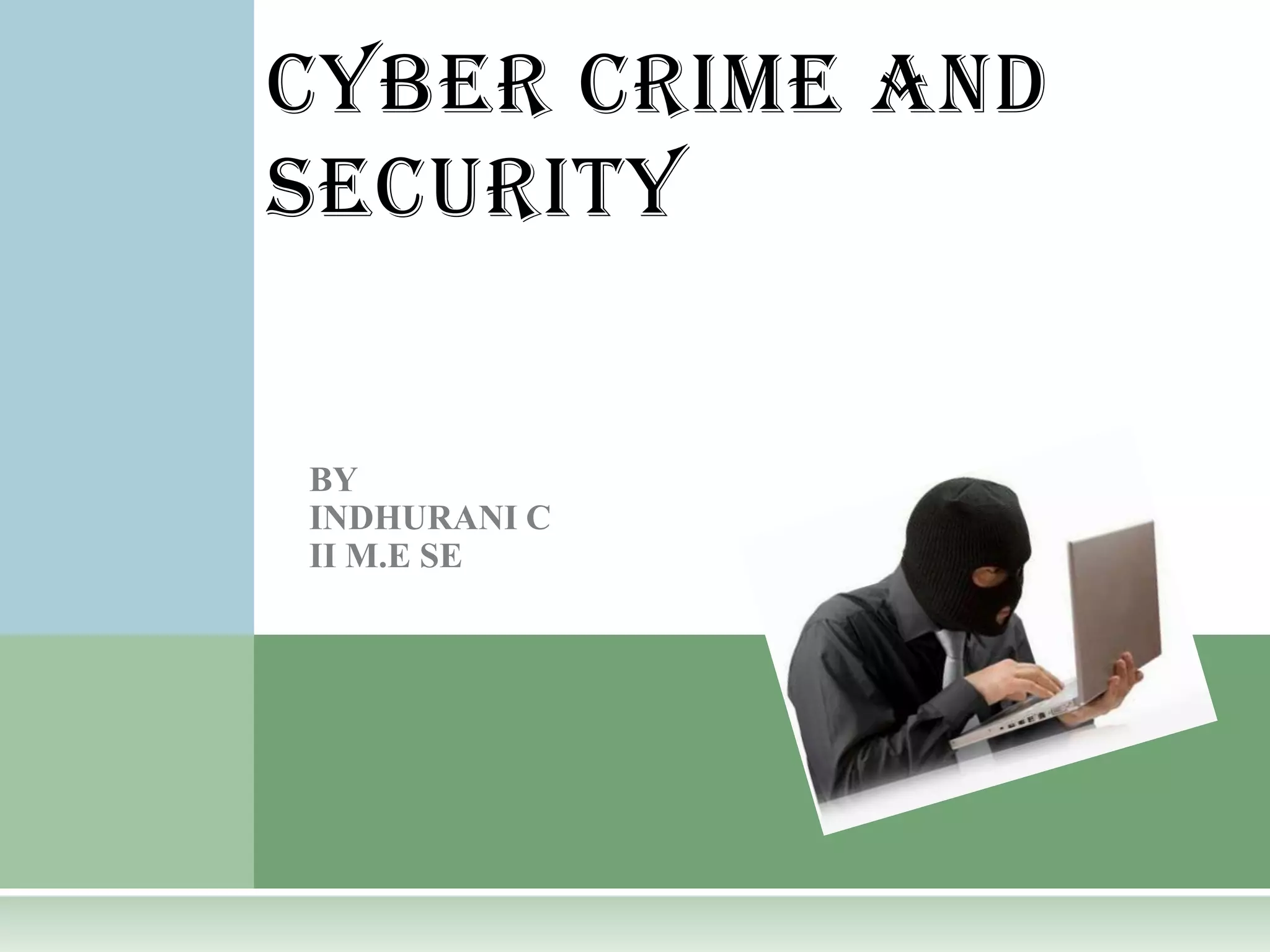
CYBER CRIME AND
SECURITY
CONTENTS

   What is cyber crime?
   History
   Classification of cyber crime
   Types of cyber crime
   Cyber Security
   Cyber Security standards
   Cyber Law
W HAT        IS CYBER CRIME ?

   Cyber crime refers to any crime that involves a
    computer/mobile and a network. The computer may have
    been used in the commission of a crime, or it may be the
    target.

   Cyber hackers apply all sorts of techniques (hacking, use
    of malware for intercepting data, etc.) in stealing personal
    or financial data from their victims, generally from their
    computers.
HISTORY


   The first spam email took place in 1978 when it was sent
    out over the ARPANET (Advanced Research Projects Agency
    Network).
   The first virus was installed on an Apple computer by a high
    school student, Rich Skrenta in the year 1982.
Cyber Crime refers to all activities done with criminal
    intent in cyberspace. These fall into three slots.
    Cyberspace is the electronic medium of computer
    networks in which online communication takes place.
   Those against persons.
   Against Business and Non-business organizations.
   Crime targeting the government.
C LASSIFICATION OF CYBER
            CRIME

   Computer as a tool
   Computer as a target
   Computer as an instrumentality
   Crime associated with prevalence of computers
C OMPUTER             AS A TOOL


   When the individual is the main target of the crime the
    computer can be considered as a tool rather than target.
   These crimes are not done by technical experts.
   Eg: Spam, cyber stalking , cyber theft etc.
C OMPUTER            AS A TARGET


   These crimes are committed by a selected group of
    people with technical knowledge.
   Destruction of information in the computer by spreading
    virus.
   Eg : Defacement, cyber terrorism etc.
C OMPUTER AS AN
           INSTRUMENTALITY


   The crime is committed by manipulating the contents of
    computer systems.
   With the advent of computer the criminal have started
    using the technology as an aid for its perpetuation.
   Eg: Drug trafficking, money laundering etc.
C RIME ASSOCIATED WITH
              PREVALENCE OF COMPUTERS


   Copyright violation
   Material copied from sources that are not public domain
    or compatibly licensed without the permission of
    copyright holder.
   Copyright violation causes legal issues.
T YPES        OF CYBER CRIME


   Financial crimes
   Sale of illegal articles
   Online gambling
   Intellectual Property crimes
   Theft of information contained in electronic form
   Email bombing
   Key loggers
C ONTD .

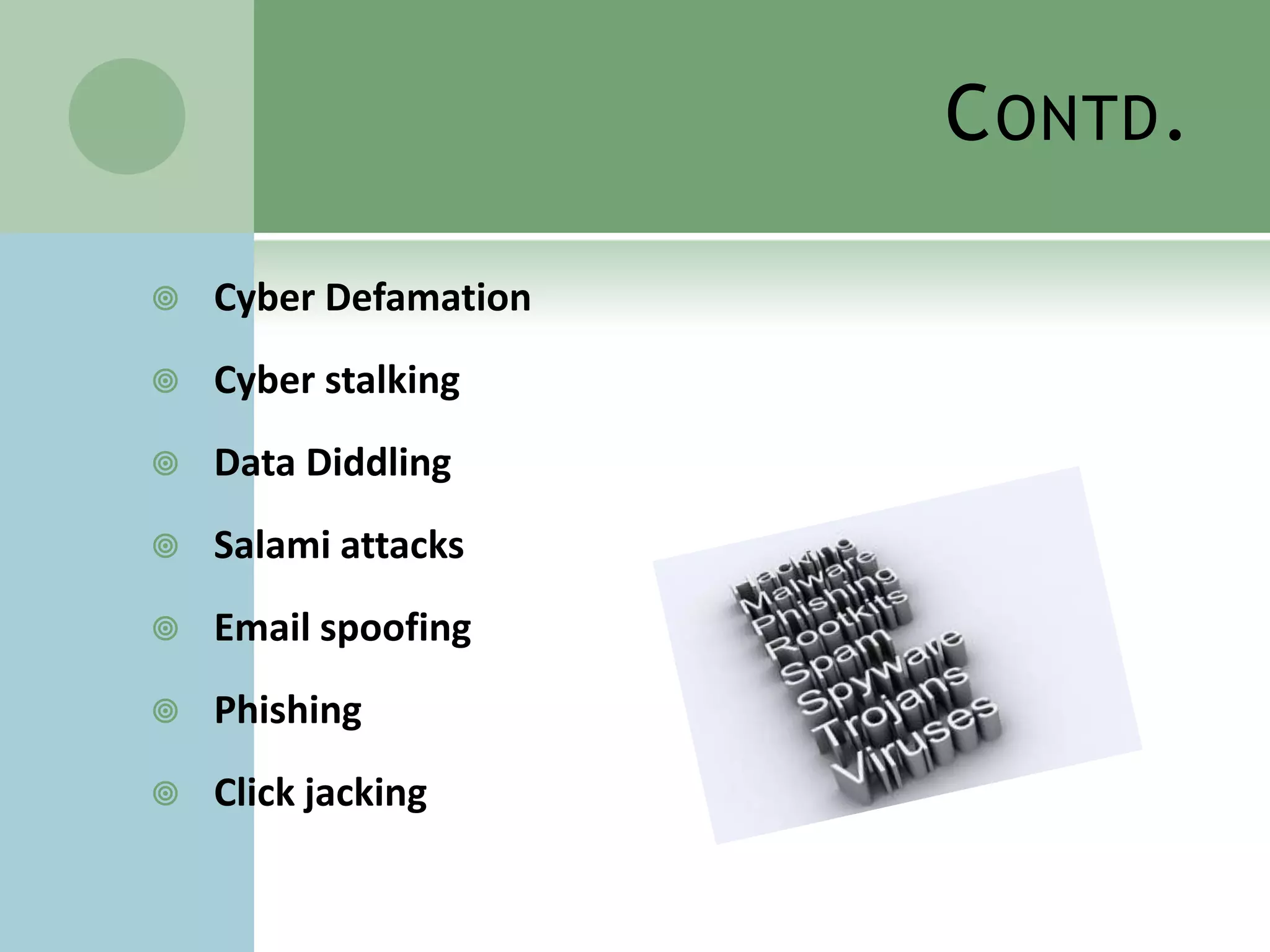
   Cyber Defamation
   Cyber stalking
   Data Diddling
   Salami attacks
   Email spoofing
   Phishing
   Click jacking
C ONTD .

   Hacking
   Denial of Service attack
   Virus/worm attacks
   Logic bombs
   Trojan attacks
   Internet time theft
   Web jacking
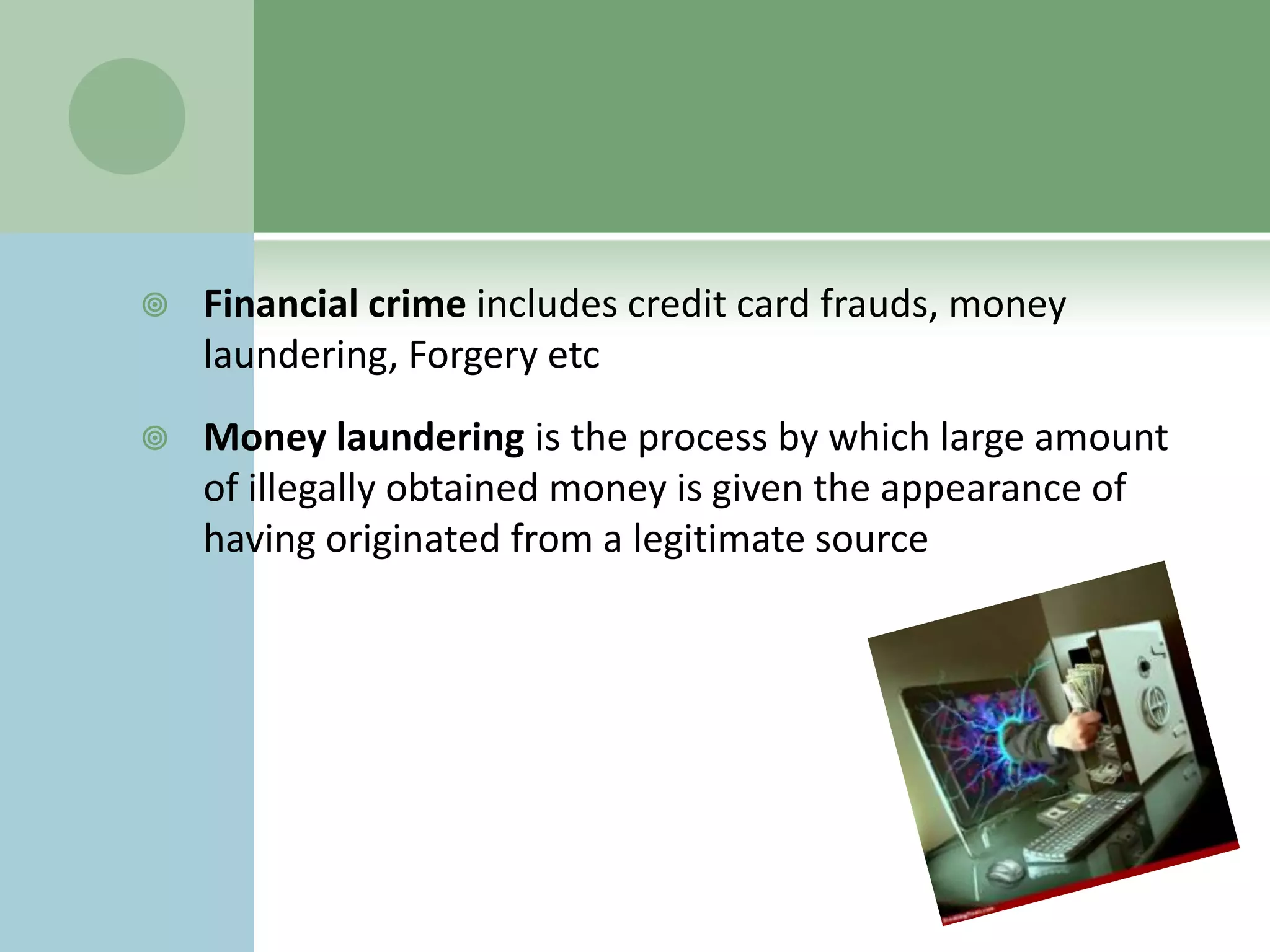
   Financial crime includes credit card frauds, money
    laundering, Forgery etc
   Money laundering is the process by which large amount
    of illegally obtained money is given the appearance of
    having originated from a legitimate source
   Sale of illegal articles includes selling of narcotic
    drugs, weapons, wildlife etc to terrorists.
   Email bombing refers to sending a large amount of e-
    mails to the victim resulting in crashing of victims e-mail
    account or mail servers.
   Data diddling is a kind of an attack which involves
    altering of raw data just before it is processed by a
    computer and then changing it back after the processing
    is completed.
   Intellectual Property Crimes includes software piracy,
    copyright infringement, trademarks violations etc.
   Theft of information contained in electronic from-This
    includes information stored in computer hard disks,
    removable storage media etc.
   Web defacement is usually the substitution of the
    original home page of a website with another page
    (usually pornographic or defamatory in nature) by a
    hacker.
   Cyber Defamation occurs when defamation takes place
    with the help of computers and or the Internet e.g. e-mail
    containing defamatory information about that person.
   What is defamation?
    Defamation is the act of harming the reputation of person
    by making a false statement to another.
   Cyber Stalking refers to the use of the Internet, e-mail, or
    other electronic communications devices to stalk another
    person.
   Stalking generally involves harassing or threatening
    behavior that an individual engages in repeatedly, such as
    following a person, appearing at a person's home or place
    of business, making harassing phone calls, leaving written
    messages or objects, or vandalizing a person's property.
   Denial of Service involves flooding computer resources
    with more requests than it can handle. This causes the
    resources to crash thereby denying authorized users the
    service offered by the resources.
   Virus/worm are programs that attach themselves to a
    computer or a file and then circulate themselves to other
    files and to other computers on a network. They usually
    affect the data on a computer, either by altering or
    deleting it. Worms, unlike viruses don not need the host
    to attach themselves to.
   Trojan Horse-A Trojan as this program is aptly called, is an
    unauthorized program which functions from inside what
    seems to be an authorized program, thereby concealing
    what it is actually doing.
   Internet Time Theft-This connotes the usage by
    unauthorized persons of the Internet hours paid for by
    another person.
   Web jacking-This occurs when someone forcefully takes
    control of a website (by cracking the password ). The
    actual owner of the website does not have any more
    control over what appears on that website.
   Logic bombs are dependent programs. This implies that
    these programs are created to do something only when a
    certain event occurs, e.g. some viruses may be termed
    logic bombs because they lie dormant all through the year
    and become active only on a particular date.
   E-Mail spoofing-A spoofed email is one that appears to
    originate from one source but actually has been sent from
    another source. This can also be termed as E-Mail forging.
   Salami attacks are used for the commission of financial
    crimes. The key here is to make the alteration so
    insignificant that in a single case it would go completely
    unnoticed e.g. A bank employee inserts a program into
    bank’s servers, that deducts a small amount from the
    account of every customer.
   Clickjacking is a form of cyber attack where the hacker
    uses an invisible layer over the embedded web content
    (this could be an image, video or button) to intercept and
    ‘hijack’ you to a mirror website and mine information
    from you.
   Cyber terrorism is the premeditated use of disruptive
    activities, or the threat thereof, in cyber space, with the
    intention to further social, ideological, religious, political
    or similar objectives, or to intimidate any person in
    furtherance of such objectives.
   Eg: A simple propaganda in the Internet/SMS, that there
    will be bomb attacks during the holidays
   Mobile pickpocketing (SMS/call fraud), or the ability to
    charge a phone bill via SMS billing and phone calls.
    Malware uses these mechanisms to steal directly from
    user accounts.
   Keyloggers are regularly used in computers to log all the
    strokes a victim makes on the keyboard.
   Eg: If a key logger is installed on a computer which is
    regularly used for online banking and other financial
    transactions then their passwords can be taken without
    the knowledge of the user
C YBER        SECURITY

   It is not possible to eliminate cyber crime from the cyber
    space. It is quite possible to check them.
   Awareness is the first step in protecting yourself.
   Invest in Anti-virus, Firewall, and SPAM blocking software
    for your PC.
   Change passwords on a regular basis
   Use complex passwords (include numbers and special
    characters)
C ONTD .

   Do not automatically check boxes before reading the
    contents of any agreement of the software.
   Avoiding use of unauthorized software.
   Avoid opening of unknown emails.
   Use internet filtering software.
   Data Level Security Using encrypting softwares
   Disable remote connectivity (such as Bluetooth)
C YBER SECURITY STANDARDS

   Cyber security standards are security standards which
    enable organizations to practice safe security techniques
    to minimize the number of successful cyber security
    attacks.
   It provides general outlines as well as specific techniques
    for implementing cyber security.
   Some of the standards are ISO 27002,NERC, NIST,ISO
    15408,RFC 2196,ISA-99.
L EGAL ACTS

•   The Computer Fraud and Abuse Act
•   The Digital Millennium Copyright Act
•   The Electronic Communications Privacy Act
•   The Stored Communications Act
•   Identity Theft and Aggravated Identity Theft
•   Identity Theft and Assumption Deterrence Act
•   Gramm-Leach-Bliley Act
•   Internet Spyware Prevention Act
C ONTD .

   Stored Communications Act which is passed in 1986 is
    focused on protecting the confidentiality, integrity and
    availability of electronic communications that are
    currently in some form of electronic storage
   Digital Millennium Copyright Act which is passed in
    1998 is a United States copyright law that criminalizes
    the production and dissemination of technology,
    devices
   Electronic Communications Privacy Act of 1986
    extends the government restrictions on wiretaps from
    telephones.
C ONTD .

   Internet Spyware Prevention Act (I-SPY) prohibits the
    implementation and use of spyware.
   Gramm-Leach-Bliley Act (GLBA) requires financial
    institutions and credit agencies increase the security of
    systems that contain their customers’ personal
    information.
   Identity Theft and Aggravated Identity Theft defines
    the conditions under which an individual has violated
    identity theft laws.
C YBER       LAW


   Cyberlaw is a generic term which refers to all the legal
    and regulatory aspects of Internet and the World Wide
    Web. Anything concerned with or related to or
    emanating from any legal aspects or issues concerning
    any activity of netizens in and concerning Cyberspace
    comes within the ambit of Cyberlaw.
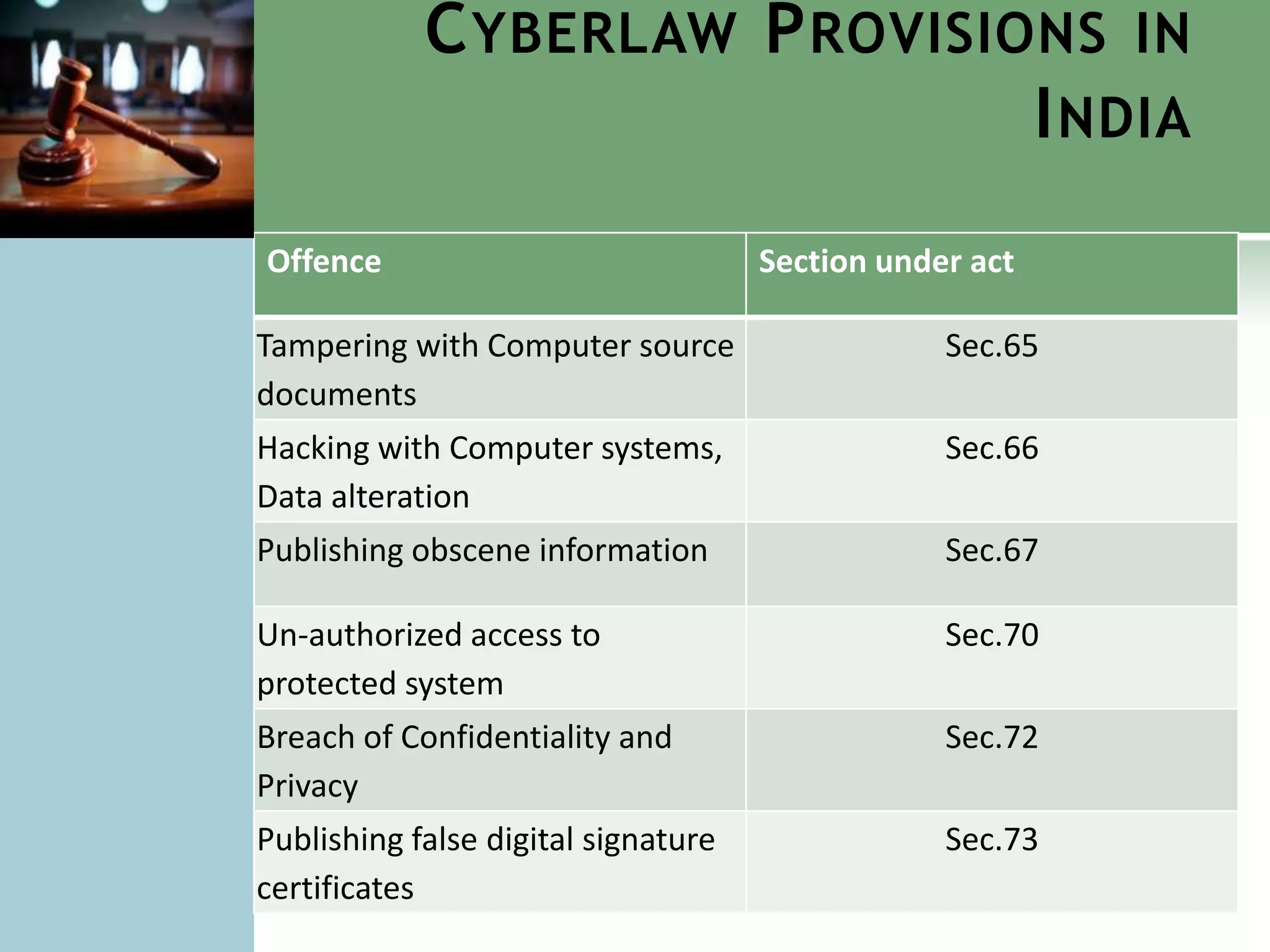
C YBERLAW P ROVISIONS IN
                               I NDIA
Offence                              Section under act

Tampering with Computer source                   Sec.65
documents
Hacking with Computer systems,                   Sec.66
Data alteration
Publishing obscene information                   Sec.67

Un-authorized access to                          Sec.70
protected system
Breach of Confidentiality and                    Sec.72
Privacy
Publishing false digital signature               Sec.73
certificates
C ONTD .
Offence                         Section under act
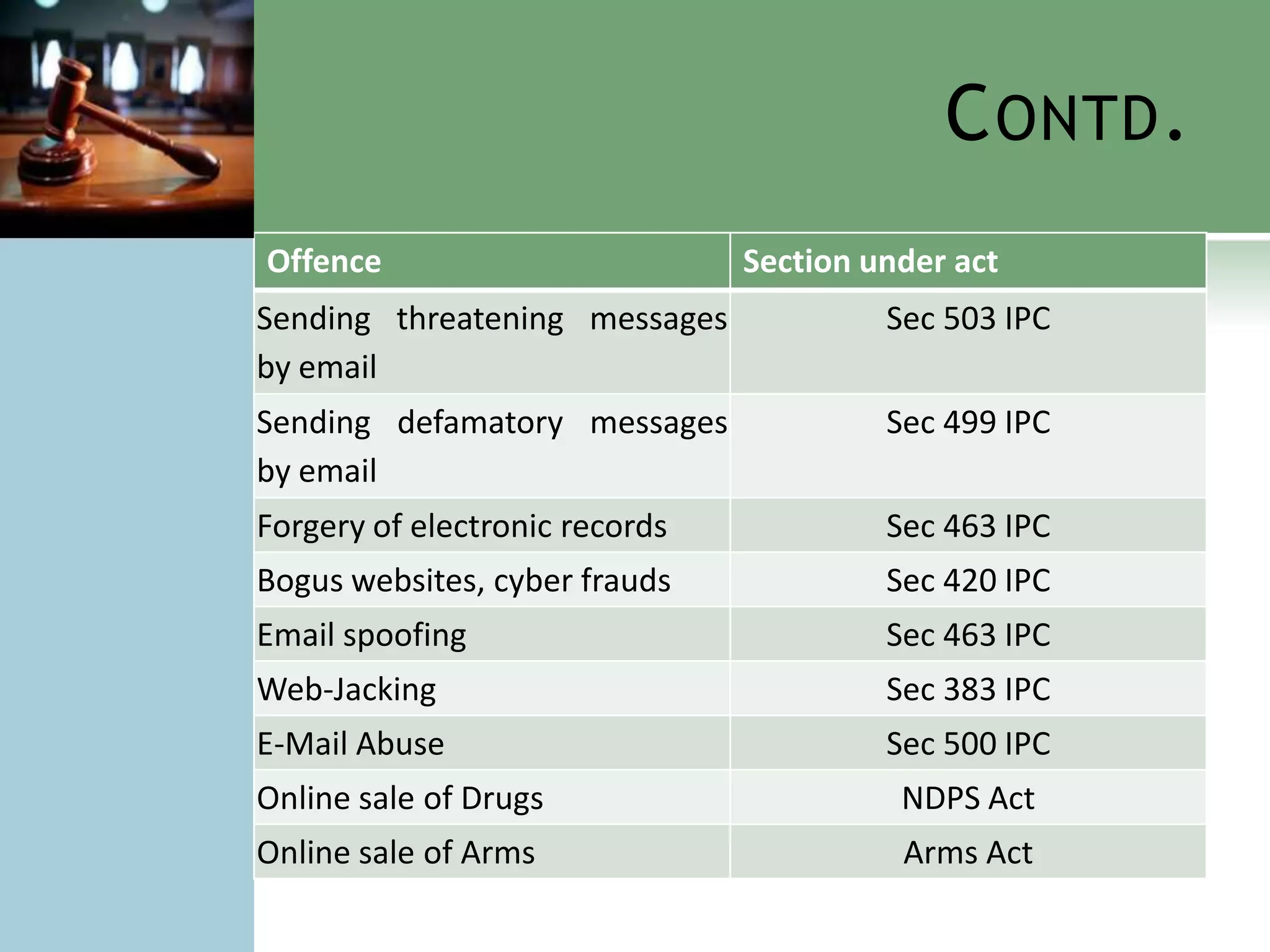
Sending threatening messages             Sec 503 IPC
by email
Sending defamatory messages              Sec 499 IPC
by email
Forgery of electronic records            Sec 463 IPC
Bogus websites, cyber frauds             Sec 420 IPC
Email spoofing                           Sec 463 IPC
Web-Jacking                              Sec 383 IPC
E-Mail Abuse                             Sec 500 IPC
Online sale of Drugs                      NDPS Act
Online sale of Arms                       Arms Act
   Though we have so many methods to protect from
    cyber crime, only awareness will help us to get rid of
    this problem.
   In case of emergency to complaint about cyber crime
    contact the following email ids and phone numbers.
   cbcyber@tn.nic.in ,cop@vsnl.net , cidap@cidap.gov.in
    , info@cidap.gov.in
   0422-23452350, 98414-94329,22201026 ,22943050 .
REFERENCES

   http://en.wikipedia.org/wiki/Computer crime

   http://en.wikipedia.org/wiki/Computer security

   http://en.wikipedia.org/wiki/Computer crime

   http://en.wikipedia.org/wiki/Cyber Security And Identity Theft

   http://en.wikipedia.org/wiki/Cyber security standards

   http://en.wikipedia.org/wiki/Cyber Security Tips

   http://en.wikipedia.org/wiki/ Cybercrime and countermeasures

   Evolution_of_Cyber_Crime.pdf
Q UERIES ??!
THANK YOU

Cyber crime and security 1

  • 1.
  • 2.
    CONTENTS  What is cyber crime?  History  Classification of cyber crime  Types of cyber crime  Cyber Security  Cyber Security standards  Cyber Law
  • 3.
    W HAT IS CYBER CRIME ?  Cyber crime refers to any crime that involves a computer/mobile and a network. The computer may have been used in the commission of a crime, or it may be the target.  Cyber hackers apply all sorts of techniques (hacking, use of malware for intercepting data, etc.) in stealing personal or financial data from their victims, generally from their computers.
  • 4.
    HISTORY  The first spam email took place in 1978 when it was sent out over the ARPANET (Advanced Research Projects Agency Network).  The first virus was installed on an Apple computer by a high school student, Rich Skrenta in the year 1982.
  • 5.
    Cyber Crime refersto all activities done with criminal intent in cyberspace. These fall into three slots. Cyberspace is the electronic medium of computer networks in which online communication takes place.  Those against persons.  Against Business and Non-business organizations.  Crime targeting the government.
  • 6.
    C LASSIFICATION OFCYBER CRIME  Computer as a tool  Computer as a target  Computer as an instrumentality  Crime associated with prevalence of computers
  • 7.
    C OMPUTER AS A TOOL  When the individual is the main target of the crime the computer can be considered as a tool rather than target.  These crimes are not done by technical experts.  Eg: Spam, cyber stalking , cyber theft etc.
  • 8.
    C OMPUTER AS A TARGET  These crimes are committed by a selected group of people with technical knowledge.  Destruction of information in the computer by spreading virus.  Eg : Defacement, cyber terrorism etc.
  • 9.
    C OMPUTER ASAN INSTRUMENTALITY  The crime is committed by manipulating the contents of computer systems.  With the advent of computer the criminal have started using the technology as an aid for its perpetuation.  Eg: Drug trafficking, money laundering etc.
  • 10.
    C RIME ASSOCIATEDWITH PREVALENCE OF COMPUTERS  Copyright violation  Material copied from sources that are not public domain or compatibly licensed without the permission of copyright holder.  Copyright violation causes legal issues.
  • 11.
    T YPES OF CYBER CRIME  Financial crimes  Sale of illegal articles  Online gambling  Intellectual Property crimes  Theft of information contained in electronic form  Email bombing  Key loggers
  • 12.
    C ONTD .  Cyber Defamation  Cyber stalking  Data Diddling  Salami attacks  Email spoofing  Phishing  Click jacking
  • 13.
    C ONTD .  Hacking  Denial of Service attack  Virus/worm attacks  Logic bombs  Trojan attacks  Internet time theft  Web jacking
  • 14.
    Financial crime includes credit card frauds, money laundering, Forgery etc  Money laundering is the process by which large amount of illegally obtained money is given the appearance of having originated from a legitimate source
  • 15.
    Sale of illegal articles includes selling of narcotic drugs, weapons, wildlife etc to terrorists.  Email bombing refers to sending a large amount of e- mails to the victim resulting in crashing of victims e-mail account or mail servers.  Data diddling is a kind of an attack which involves altering of raw data just before it is processed by a computer and then changing it back after the processing is completed.
  • 16.
    Intellectual Property Crimes includes software piracy, copyright infringement, trademarks violations etc.  Theft of information contained in electronic from-This includes information stored in computer hard disks, removable storage media etc.  Web defacement is usually the substitution of the original home page of a website with another page (usually pornographic or defamatory in nature) by a hacker.
  • 17.
    Cyber Defamation occurs when defamation takes place with the help of computers and or the Internet e.g. e-mail containing defamatory information about that person.  What is defamation? Defamation is the act of harming the reputation of person by making a false statement to another.
  • 18.
    Cyber Stalking refers to the use of the Internet, e-mail, or other electronic communications devices to stalk another person.  Stalking generally involves harassing or threatening behavior that an individual engages in repeatedly, such as following a person, appearing at a person's home or place of business, making harassing phone calls, leaving written messages or objects, or vandalizing a person's property.
  • 19.
    Denial of Service involves flooding computer resources with more requests than it can handle. This causes the resources to crash thereby denying authorized users the service offered by the resources.  Virus/worm are programs that attach themselves to a computer or a file and then circulate themselves to other files and to other computers on a network. They usually affect the data on a computer, either by altering or deleting it. Worms, unlike viruses don not need the host to attach themselves to.
  • 20.
    Trojan Horse-A Trojan as this program is aptly called, is an unauthorized program which functions from inside what seems to be an authorized program, thereby concealing what it is actually doing.  Internet Time Theft-This connotes the usage by unauthorized persons of the Internet hours paid for by another person.  Web jacking-This occurs when someone forcefully takes control of a website (by cracking the password ). The actual owner of the website does not have any more control over what appears on that website.
  • 21.
    Logic bombs are dependent programs. This implies that these programs are created to do something only when a certain event occurs, e.g. some viruses may be termed logic bombs because they lie dormant all through the year and become active only on a particular date.  E-Mail spoofing-A spoofed email is one that appears to originate from one source but actually has been sent from another source. This can also be termed as E-Mail forging.
  • 22.
    Salami attacks are used for the commission of financial crimes. The key here is to make the alteration so insignificant that in a single case it would go completely unnoticed e.g. A bank employee inserts a program into bank’s servers, that deducts a small amount from the account of every customer.  Clickjacking is a form of cyber attack where the hacker uses an invisible layer over the embedded web content (this could be an image, video or button) to intercept and ‘hijack’ you to a mirror website and mine information from you.
  • 23.
    Cyber terrorism is the premeditated use of disruptive activities, or the threat thereof, in cyber space, with the intention to further social, ideological, religious, political or similar objectives, or to intimidate any person in furtherance of such objectives.  Eg: A simple propaganda in the Internet/SMS, that there will be bomb attacks during the holidays  Mobile pickpocketing (SMS/call fraud), or the ability to charge a phone bill via SMS billing and phone calls. Malware uses these mechanisms to steal directly from user accounts.
  • 24.
    Keyloggers are regularly used in computers to log all the strokes a victim makes on the keyboard.  Eg: If a key logger is installed on a computer which is regularly used for online banking and other financial transactions then their passwords can be taken without the knowledge of the user
  • 27.
    C YBER SECURITY  It is not possible to eliminate cyber crime from the cyber space. It is quite possible to check them.  Awareness is the first step in protecting yourself.  Invest in Anti-virus, Firewall, and SPAM blocking software for your PC.  Change passwords on a regular basis  Use complex passwords (include numbers and special characters)
  • 28.
    C ONTD .  Do not automatically check boxes before reading the contents of any agreement of the software.  Avoiding use of unauthorized software.  Avoid opening of unknown emails.  Use internet filtering software.  Data Level Security Using encrypting softwares  Disable remote connectivity (such as Bluetooth)
  • 29.
    C YBER SECURITYSTANDARDS  Cyber security standards are security standards which enable organizations to practice safe security techniques to minimize the number of successful cyber security attacks.  It provides general outlines as well as specific techniques for implementing cyber security.  Some of the standards are ISO 27002,NERC, NIST,ISO 15408,RFC 2196,ISA-99.
  • 30.
    L EGAL ACTS • The Computer Fraud and Abuse Act • The Digital Millennium Copyright Act • The Electronic Communications Privacy Act • The Stored Communications Act • Identity Theft and Aggravated Identity Theft • Identity Theft and Assumption Deterrence Act • Gramm-Leach-Bliley Act • Internet Spyware Prevention Act
  • 31.
    C ONTD .  Stored Communications Act which is passed in 1986 is focused on protecting the confidentiality, integrity and availability of electronic communications that are currently in some form of electronic storage  Digital Millennium Copyright Act which is passed in 1998 is a United States copyright law that criminalizes the production and dissemination of technology, devices  Electronic Communications Privacy Act of 1986 extends the government restrictions on wiretaps from telephones.
  • 32.
    C ONTD .  Internet Spyware Prevention Act (I-SPY) prohibits the implementation and use of spyware.  Gramm-Leach-Bliley Act (GLBA) requires financial institutions and credit agencies increase the security of systems that contain their customers’ personal information.  Identity Theft and Aggravated Identity Theft defines the conditions under which an individual has violated identity theft laws.
  • 33.
    C YBER LAW  Cyberlaw is a generic term which refers to all the legal and regulatory aspects of Internet and the World Wide Web. Anything concerned with or related to or emanating from any legal aspects or issues concerning any activity of netizens in and concerning Cyberspace comes within the ambit of Cyberlaw.
  • 34.
    C YBERLAW PROVISIONS IN I NDIA Offence Section under act Tampering with Computer source Sec.65 documents Hacking with Computer systems, Sec.66 Data alteration Publishing obscene information Sec.67 Un-authorized access to Sec.70 protected system Breach of Confidentiality and Sec.72 Privacy Publishing false digital signature Sec.73 certificates
  • 35.
    C ONTD . Offence Section under act Sending threatening messages Sec 503 IPC by email Sending defamatory messages Sec 499 IPC by email Forgery of electronic records Sec 463 IPC Bogus websites, cyber frauds Sec 420 IPC Email spoofing Sec 463 IPC Web-Jacking Sec 383 IPC E-Mail Abuse Sec 500 IPC Online sale of Drugs NDPS Act Online sale of Arms Arms Act
  • 36.
    Though we have so many methods to protect from cyber crime, only awareness will help us to get rid of this problem.  In case of emergency to complaint about cyber crime contact the following email ids and phone numbers.  cbcyber@tn.nic.in ,cop@vsnl.net , cidap@cidap.gov.in , info@cidap.gov.in  0422-23452350, 98414-94329,22201026 ,22943050 .
  • 37.

    REFERENCES  http://en.wikipedia.org/wiki/Computer crime  http://en.wikipedia.org/wiki/Computer security  http://en.wikipedia.org/wiki/Computer crime  http://en.wikipedia.org/wiki/Cyber Security And Identity Theft  http://en.wikipedia.org/wiki/Cyber security standards  http://en.wikipedia.org/wiki/Cyber Security Tips  http://en.wikipedia.org/wiki/ Cybercrime and countermeasures  Evolution_of_Cyber_Crime.pdf
  • 38.
  • 39.