CUSTOMER RELATIONSHIP
MANAGEMENT AND
STRATEGY AND COMPARE
SERVICE DESIGN OF OLA
& UBER
(BLUEPRINT,STRATEGIES)
RELATIONSHIP
MARKETING⚫ Relationship marketing basically represents a paradigm shift within
marketing– away from acquisition- transaction focus towards a
retention-relationship focus.
⚫ Relationship marketing is a philosophy of doing business, a strategic
orientation that focuses on keeping and improving the current customers,
rather than acquiring new customers.
⚫ This concept assumes that the consumer prefers to have an ongoing
relationship with one organisation rather than switching organisations.
⚫ Building on this assumption and also on the fact that retention is cheaper
than acquiring new customers, the marketers of today offers prime
importance in the strategy of acquiring-satisfying-maintaining customers
⚫ Marketing companies often ends up in doing lot more in getting new
customers but often forget to do the precise little to find out what they should
do to keep the customer in their hands. It is a well-known truth that loss of
one's customer is the gain of the competitor.
THE EVOLUTION OF
CUSTOMER RELATIONSHIPS
⚫ Customer as strangers
⚫ Customers as acquitances
⚫ Customers as friends
⚫ Customers as partners
Customers as Strangers:- strangers are those customers who
have not yet had any transactions (interactions) with a firm and
may not even be aware of the firm.
At the industry level, strangers may be conceptualized as
customers who have not yet entered the market.
At the firm level, they may include customers of competitors. Firms
primary goal with these strangers is to initiate communication with
them to attract them and acquire their business.
Customers As Acquaintances:- Once customers awareness and
trail are achieved, familarity is established and the customer and
the firm becomes acquaintances, creating the basis for an
exchange relationship. A primary goal for the firm at this stage of
the relationship is satisfying the customer.
Customer as Friends:- as a customer continues to make
purchases from a firm and to receive value in the exchange
relationship, the firm begins to acquire specific knowledge of the
customers need, allowing it to create an offering that directly
adresses the customers situation. The provision of a unique
offering, and thus differential value, transforms the relationship
from acquaintance to friendship. A primary goal for firms at the
friendship stage of the relationship is customer retention.
Customers As Partners:- As a customer continues to
interact with a firm, the level of trust often depends and the
customer may receive more customized product offerings
and interactions. The trust developed in the friendship stage
is a necessary but not sufficient condition for a customer-firm
partnership to develop.
At the partnership stage, the firm is concerned with
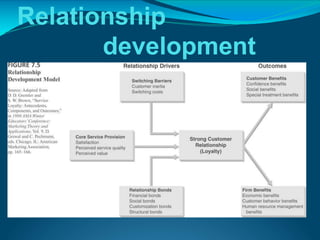
Relationship
development
strategies
CORE SERVICE
PROVISIONRetention strategies will have little long term success unless the
firm has a solid base of service quality and customer satisfaction
pn which to build. A firm needs to begin the relationship
development process by providing a good core service delivery
that,at a minimum, meets customer expectations and pro vide
customers with perceived value, it does no good to design
relationship strategies for inferior services.
SWITCHING
BARRIERSWhen considering a switch in service providers, a customer may
face a number of barriers that make it difficult to leave one
service provider and begin a relationship with another.
□ Customer inertia:-
• one reason that customers commit to developing relationships
with firms is that a certain amount of effort may be required to
change firms.
• Sometimes consumers simplistically state that “it’s just not
worth it” to switch providers. Inertia may even explain why some
dissatisfied customers stay with a provider.
Switching Costs:- These costs, both real and
perceived , monetary and non monetary, are termed
switching costs. Switching costs include investments of
time, money or effort- such as setup costs, learning
costs,and contractual costs- that makes it challenging
for the customer to move to another provider.
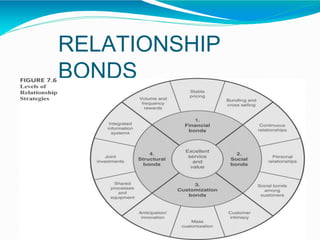
RELATIONSHIP
BONDS
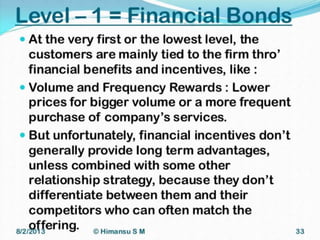
Level 1- Financial
Bonds:
BENEFITS FOR
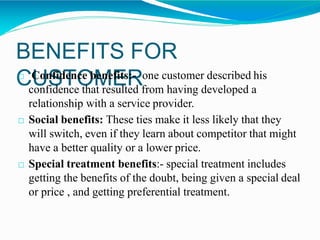
CUSTOMER□ Confidence benefits:- one customer described his
confidence that resulted from having developed a
relationship with a service provider.
□ Social benefits: These ties make it less likely that they
will switch, even if they learn about competitor that might
have a better quality or a lower price.
□ Special treatment benefits:- special treatment includes
getting the benefits of the doubt, being given a special deal
or price , and getting preferential treatment.
BENEFITS FOR
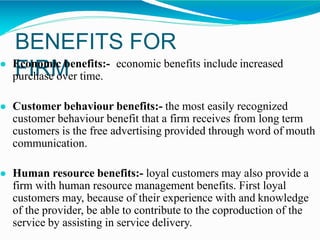
FIRM● Economic benefits:- economic benefits include increased
purchase over time.
● Customer behaviour benefits:- the most easily recognized
customer behaviour benefit that a firm receives from long term
customers is the free advertising provided through word of mouth
communication.
● Human resource benefits:- loyal customers may also provide a
firm with human resource management benefits. First loyal
customers may, because of their experience with and knowledge
of the provider, be able to contribute to the coproduction of the
service by assisting in service delivery.
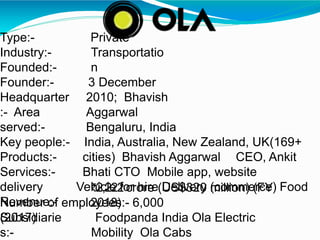
OLA
AND
UBER
Private
Transportatio
n
3 December
2010; Bhavish
Aggarwal
Bengaluru, India
India, Australia, New Zealand, UK(169+
cities) Bhavish Aggarwal CEO, Ankit
Bhati CTO Mobile app, website
Vehicle for hire Delivery (commerce) Food
Type:-
Industry:-
Founded:-
Founder:-
Headquarter
:- Area
served:-
Key people:-
Products:-
Services:-
delivery
Revenue:-
₹2,222 crore (US$320 million) (FY
2018)Number of employees:- 6,000
(2017)Subsidiarie
s:-
Foodpanda India Ola Electric
Mobility Ola Cabs
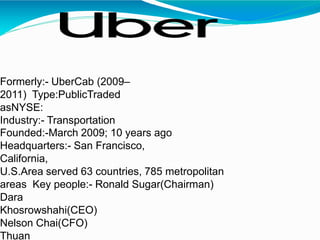
Formerly:- UberCab (2009–
2011) Type:PublicTraded
asNYSE:
Industry:- Transportation
Founded:-March 2009; 10 years ago
Headquarters:- San Francisco,
California,
U.S.Area served 63 countries, 785 metropolitan
areas Key people:- Ronald Sugar(Chairman)
Dara
Khosrowshahi(CEO)
Nelson Chai(CFO)
Thuan
MARKETING MIX STRATEGY
OF OLAAND UBER
CABS● PRODUCT: They don’t provide product rather provide service.
Ola and uber cabs is a mobile app used as a service provider for
personal transportation. It has revolutionised the concept of
travelling, Earlier hiring taxis from roads was a harassment but
now it has become hassle free as one can easily make a booking
at his/her convenience without stepping out.
● PLACE: ola company started its operations from metro city
Mumbai in Maharashtra but later shifted its base to Bengaluru in
Karnataka. By the year 2014, it had extended its network to
include nearly 200,000 cars that were running in nearly one
hundred two tier, three tier and metro cities.
● PRICE:Ola and uber cabs offer rides in a comfortable setting
with furnished and air-conditioned cabs. It offers to price
flexibility with its range of vehicles that includes
economic-range, mid-range and high-range. These both Cabs has
adopted a penetration policy and has kept its price range
reasonable so as to gain a competitive advantage over rival
companies.
● PROMOTION: The company has taken help of every available
medium like digital and print via SMS on mobiles, magazines,
newspapers and billboards. It has also used social media
platforms to garner maximum coverage via Twitter, Facebook,
Blogs and Instagram.. These companies offers incentives like
free rides, 50% discounted rides, rupees 5o off, first ride free for
new members and promo codes to increase its customer base.
Comparison Of Brand Extension
Strategies Of Ola And Uber
As Ola and Uber’s marketing war gets aggressive, their brand
expansion strategies aimed at new and existing markets
1.Brand positioning:-
From its inception Uber banks itself as a premium service where
the user is paying an affordable price for the experience of
travelling in luxury cars, whereas Ola always focussed on getting
more cars, taxis, and auto-rickshaws on their platform and more
riders to use their services. But the lines are increasingly getting
blurred with the launch of Ola’s business class service called Ola
Prime.
● 2. Marketing war continues
⚫ It took Ola four years to come out with its nationwide
(multi-channel) campaign titled ‘Chalo Niklo’ by Happy Creative
Services, which aimed to position Ola as the go-to transport
platform of choice for immediate and spontaneous city travel
needs, across cabs, autos and taxis. Before this, it made good use
of Facebook’s Marketing platform in October ’14.
⚫ Uber on the other hand banks on experiential marketing. For
instance, they rolled out their service with ‘Rider Zero’
campaign, where they roped in celebrities from every city to try
out Uber’s service for the first time. In this manner they reached
out to millions of followers, since the celebrities used Twitter to
create a significant buzz around the service.
3.Celebrity engagement:
Leveraging the power of celebrities, both brands implemented efficient
communication campaigns to become the talking point on social media
platform like Facebook and Twitter. For instance, this September Ola
announced a major revamp of its business-class offering (Ola Prime) in
Bangalore, where select customers will be picked up by celebrities like
F1 racer.
Uber gave out VIP passes and an on-demand chopper ride with DJ
Hardwell to his concert recently. It has also teamed up with the premier
IPTL (International Premier Tennis League) offering an opportunity for
Uber riders to meet tennis stars like , Sania Mirza, Rohan Bopanna.
4. Expansion plans:
It plans to enter new markets and introduce new services like
motorcycle taxis and shuttle bus service. It’s India’s third most valuable
venture-backed startup after Flipkart and Snapdeal, functioning across
102 cities across India.
Uber is catching up fast with its aggressive expansion into newer cities
with investment plans of $1 billion in India in the next nine months. In
August Tata Group's private equity arm Tata Opportunities Fund
invested around $80-100 million on this taxi hailing app, which
customer relationship management

customer relationship management

  • 1.
    CUSTOMER RELATIONSHIP MANAGEMENT AND STRATEGYAND COMPARE SERVICE DESIGN OF OLA & UBER (BLUEPRINT,STRATEGIES)
  • 2.
    RELATIONSHIP MARKETING⚫ Relationship marketingbasically represents a paradigm shift within marketing– away from acquisition- transaction focus towards a retention-relationship focus. ⚫ Relationship marketing is a philosophy of doing business, a strategic orientation that focuses on keeping and improving the current customers, rather than acquiring new customers. ⚫ This concept assumes that the consumer prefers to have an ongoing relationship with one organisation rather than switching organisations. ⚫ Building on this assumption and also on the fact that retention is cheaper than acquiring new customers, the marketers of today offers prime importance in the strategy of acquiring-satisfying-maintaining customers ⚫ Marketing companies often ends up in doing lot more in getting new customers but often forget to do the precise little to find out what they should do to keep the customer in their hands. It is a well-known truth that loss of one's customer is the gain of the competitor.
  • 3.
    THE EVOLUTION OF CUSTOMERRELATIONSHIPS ⚫ Customer as strangers ⚫ Customers as acquitances ⚫ Customers as friends ⚫ Customers as partners
  • 4.
    Customers as Strangers:-strangers are those customers who have not yet had any transactions (interactions) with a firm and may not even be aware of the firm. At the industry level, strangers may be conceptualized as customers who have not yet entered the market. At the firm level, they may include customers of competitors. Firms primary goal with these strangers is to initiate communication with them to attract them and acquire their business. Customers As Acquaintances:- Once customers awareness and trail are achieved, familarity is established and the customer and the firm becomes acquaintances, creating the basis for an exchange relationship. A primary goal for the firm at this stage of the relationship is satisfying the customer.
  • 5.
    Customer as Friends:-as a customer continues to make purchases from a firm and to receive value in the exchange relationship, the firm begins to acquire specific knowledge of the customers need, allowing it to create an offering that directly adresses the customers situation. The provision of a unique offering, and thus differential value, transforms the relationship from acquaintance to friendship. A primary goal for firms at the friendship stage of the relationship is customer retention. Customers As Partners:- As a customer continues to interact with a firm, the level of trust often depends and the customer may receive more customized product offerings and interactions. The trust developed in the friendship stage is a necessary but not sufficient condition for a customer-firm partnership to develop. At the partnership stage, the firm is concerned with
  • 7.
  • 8.
    CORE SERVICE PROVISIONRetention strategieswill have little long term success unless the firm has a solid base of service quality and customer satisfaction pn which to build. A firm needs to begin the relationship development process by providing a good core service delivery that,at a minimum, meets customer expectations and pro vide customers with perceived value, it does no good to design relationship strategies for inferior services.
  • 9.
    SWITCHING BARRIERSWhen considering aswitch in service providers, a customer may face a number of barriers that make it difficult to leave one service provider and begin a relationship with another. □ Customer inertia:- • one reason that customers commit to developing relationships with firms is that a certain amount of effort may be required to change firms. • Sometimes consumers simplistically state that “it’s just not worth it” to switch providers. Inertia may even explain why some dissatisfied customers stay with a provider.
  • 10.
    Switching Costs:- Thesecosts, both real and perceived , monetary and non monetary, are termed switching costs. Switching costs include investments of time, money or effort- such as setup costs, learning costs,and contractual costs- that makes it challenging for the customer to move to another provider.
  • 11.
  • 12.
  • 16.
    BENEFITS FOR CUSTOMER□ Confidencebenefits:- one customer described his confidence that resulted from having developed a relationship with a service provider. □ Social benefits: These ties make it less likely that they will switch, even if they learn about competitor that might have a better quality or a lower price. □ Special treatment benefits:- special treatment includes getting the benefits of the doubt, being given a special deal or price , and getting preferential treatment.
  • 17.
    BENEFITS FOR FIRM● Economicbenefits:- economic benefits include increased purchase over time. ● Customer behaviour benefits:- the most easily recognized customer behaviour benefit that a firm receives from long term customers is the free advertising provided through word of mouth communication. ● Human resource benefits:- loyal customers may also provide a firm with human resource management benefits. First loyal customers may, because of their experience with and knowledge of the provider, be able to contribute to the coproduction of the service by assisting in service delivery.
  • 18.
  • 19.
    Private Transportatio n 3 December 2010; Bhavish Aggarwal Bengaluru,India India, Australia, New Zealand, UK(169+ cities) Bhavish Aggarwal CEO, Ankit Bhati CTO Mobile app, website Vehicle for hire Delivery (commerce) Food Type:- Industry:- Founded:- Founder:- Headquarter :- Area served:- Key people:- Products:- Services:- delivery Revenue:- ₹2,222 crore (US$320 million) (FY 2018)Number of employees:- 6,000 (2017)Subsidiarie s:- Foodpanda India Ola Electric Mobility Ola Cabs
  • 20.
    Formerly:- UberCab (2009– 2011)Type:PublicTraded asNYSE: Industry:- Transportation Founded:-March 2009; 10 years ago Headquarters:- San Francisco, California, U.S.Area served 63 countries, 785 metropolitan areas Key people:- Ronald Sugar(Chairman) Dara Khosrowshahi(CEO) Nelson Chai(CFO) Thuan
  • 21.
    MARKETING MIX STRATEGY OFOLAAND UBER CABS● PRODUCT: They don’t provide product rather provide service. Ola and uber cabs is a mobile app used as a service provider for personal transportation. It has revolutionised the concept of travelling, Earlier hiring taxis from roads was a harassment but now it has become hassle free as one can easily make a booking at his/her convenience without stepping out. ● PLACE: ola company started its operations from metro city Mumbai in Maharashtra but later shifted its base to Bengaluru in Karnataka. By the year 2014, it had extended its network to include nearly 200,000 cars that were running in nearly one hundred two tier, three tier and metro cities.
  • 22.
    ● PRICE:Ola anduber cabs offer rides in a comfortable setting with furnished and air-conditioned cabs. It offers to price flexibility with its range of vehicles that includes economic-range, mid-range and high-range. These both Cabs has adopted a penetration policy and has kept its price range reasonable so as to gain a competitive advantage over rival companies. ● PROMOTION: The company has taken help of every available medium like digital and print via SMS on mobiles, magazines, newspapers and billboards. It has also used social media platforms to garner maximum coverage via Twitter, Facebook, Blogs and Instagram.. These companies offers incentives like free rides, 50% discounted rides, rupees 5o off, first ride free for new members and promo codes to increase its customer base.
  • 23.
    Comparison Of BrandExtension Strategies Of Ola And Uber As Ola and Uber’s marketing war gets aggressive, their brand expansion strategies aimed at new and existing markets 1.Brand positioning:- From its inception Uber banks itself as a premium service where the user is paying an affordable price for the experience of travelling in luxury cars, whereas Ola always focussed on getting more cars, taxis, and auto-rickshaws on their platform and more riders to use their services. But the lines are increasingly getting blurred with the launch of Ola’s business class service called Ola Prime.
  • 24.
    ● 2. Marketingwar continues ⚫ It took Ola four years to come out with its nationwide (multi-channel) campaign titled ‘Chalo Niklo’ by Happy Creative Services, which aimed to position Ola as the go-to transport platform of choice for immediate and spontaneous city travel needs, across cabs, autos and taxis. Before this, it made good use of Facebook’s Marketing platform in October ’14. ⚫ Uber on the other hand banks on experiential marketing. For instance, they rolled out their service with ‘Rider Zero’ campaign, where they roped in celebrities from every city to try out Uber’s service for the first time. In this manner they reached out to millions of followers, since the celebrities used Twitter to create a significant buzz around the service.
  • 25.
    3.Celebrity engagement: Leveraging thepower of celebrities, both brands implemented efficient communication campaigns to become the talking point on social media platform like Facebook and Twitter. For instance, this September Ola announced a major revamp of its business-class offering (Ola Prime) in Bangalore, where select customers will be picked up by celebrities like F1 racer. Uber gave out VIP passes and an on-demand chopper ride with DJ Hardwell to his concert recently. It has also teamed up with the premier IPTL (International Premier Tennis League) offering an opportunity for Uber riders to meet tennis stars like , Sania Mirza, Rohan Bopanna. 4. Expansion plans: It plans to enter new markets and introduce new services like motorcycle taxis and shuttle bus service. It’s India’s third most valuable venture-backed startup after Flipkart and Snapdeal, functioning across 102 cities across India. Uber is catching up fast with its aggressive expansion into newer cities with investment plans of $1 billion in India in the next nine months. In August Tata Group's private equity arm Tata Opportunities Fund invested around $80-100 million on this taxi hailing app, which