BANKING SERVICES 
Chinmoy Das 
1
INTRODUCTION 
• The term bank is either derived from old Italian word banca or from a French 
word banque both mean a Bench or money exchange table. 
• A bank is a financial institution and a financial intermediary that 
accepts deposits and channels those deposits into lending activities, either directly 
or through capital market. A bank connects customers with capital deficits to 
customers with capital surpluses. 
2
HISTORY OF BANKING IN INDIA 
• The first bank in India was established in 1786. From 1786 till today it has gone through 
three distinct phases. 
• PHASE 1 
Early phase from 1786 to 1969 of Indian banks. 
• PHASE 2 
Nationalization of Indian Banks and up to 1991 prior to Indian banking sector Reforms. 
• PHASE 3 
New phase of Indian Banking system with the advent of Indian Financial & Banking 
Sector Reforms after 1991. 3
DEFINITION 
Section 5 (b) of the Banking Regulation Act 1949 defines “Banking” as 
• “Accepting for the purpose of lending and investment, deposits of money from the 
public repayable on demand or otherwise and withdraw able by cheque, draft, 
order or otherwise.” 
In simple words, Banking can be defined as the business activity of accepting and 
safeguarding money owned by other individuals and entities, and then lending out 
this money in order to earn a profit. 
4
Contribution towards GDP of India 
• The total bank deposits increased from Rs. 9.1 billion($960 million) in 1970-71 
to Rs. 8309.22 billion ($620 billion) in 2009-10. Current deposit is Rs. 
67504.54 billion($1.1 trillion). 
• There are total 151 commercial banks in India by 2013 with total of 1,09,811 
number of branches. 
• It contributes INR 243294 Cr. to India’s GDP. 
• Service sector contribution is 57.3% to India's economy. And out of this 57.3%, 
banking sector contributes 80%. 
5
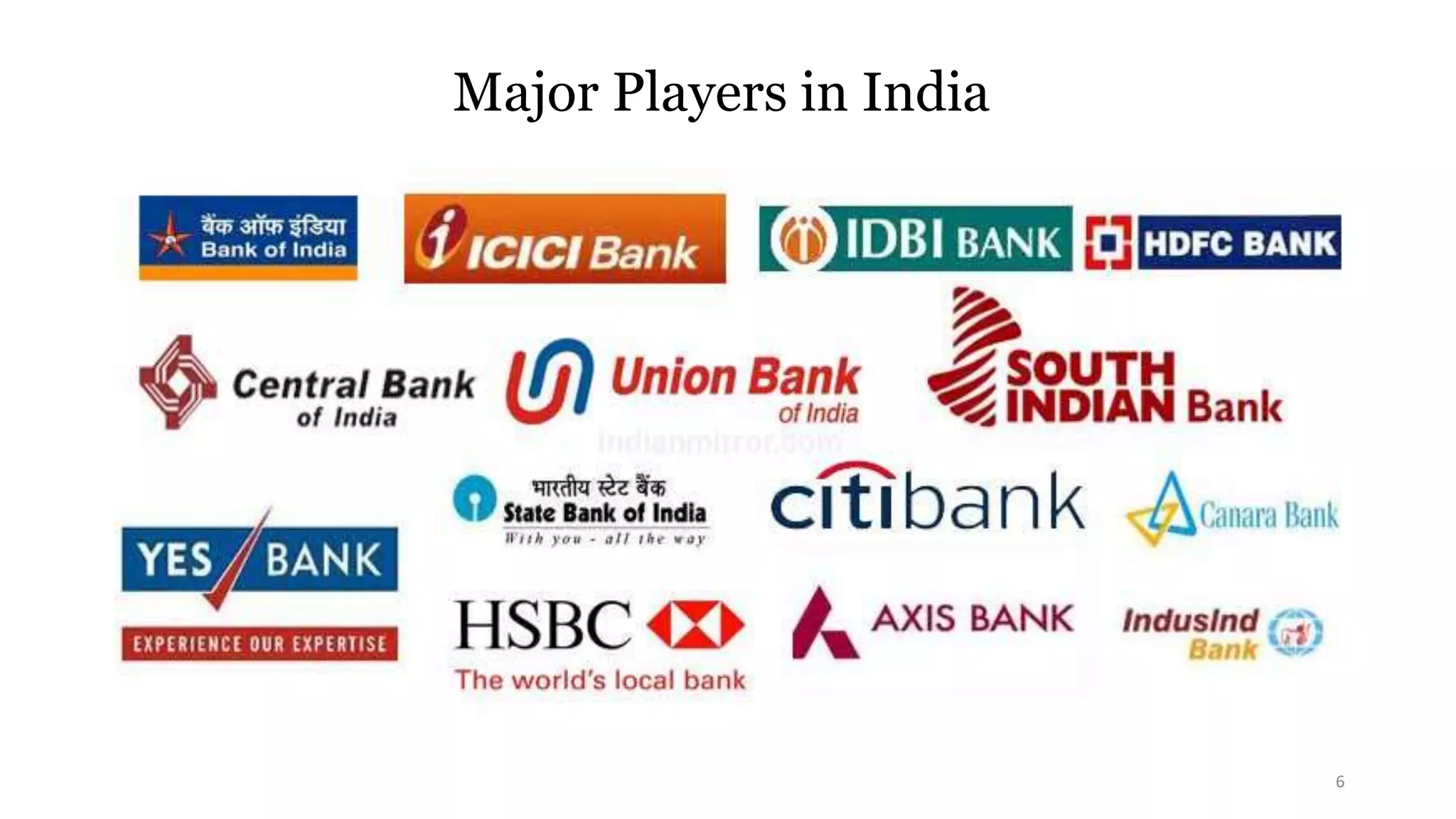
Major Players in India 
6
International Bank (Competitor) 
7
Marketing Mix 
• PRODUCT 
• PRICE 
• PLACE 
• PROMOTION 
• PEOPLE 
• PROCESS 
• PHYSICAL EVIDENCE 
8
State Bank of India 
• Founded on 2nd July 1806 as Bank of Calcutta. Bank of Madras merged into the other two 
"presidency banks" in British India, Bank of Calcutta and Bank of Bombay, to form the Imperial 
Bank of India, which in turn became the State Bank of India. 
• Government of India owned the Imperial Bank of India in 1955, with Reserve 
Bank of India (India's Central Bank) taking a 60% stake, and renamed it the 
State Bank of India. 
• State Bank of India (SBI) is an Indian multinational, Public Sector banking, and 
financial services company. It is a government-owned corporation with its headquarters in 
Mumbai, Maharashtra. 
• As of December 2013, it had assets of US$388 billion and 17,000 branches, including 190 foreign 
offices, making it the largest banking and financial services company in India. 
9
Market Capture 
10
PRODUCT 
• DEPOSITS 
• ADVANCES & LOANS 
• CONSULTANCY 
• INVESTMENTS 
• INTERNATIONAL BANKIKNG 
11
Contd.. 
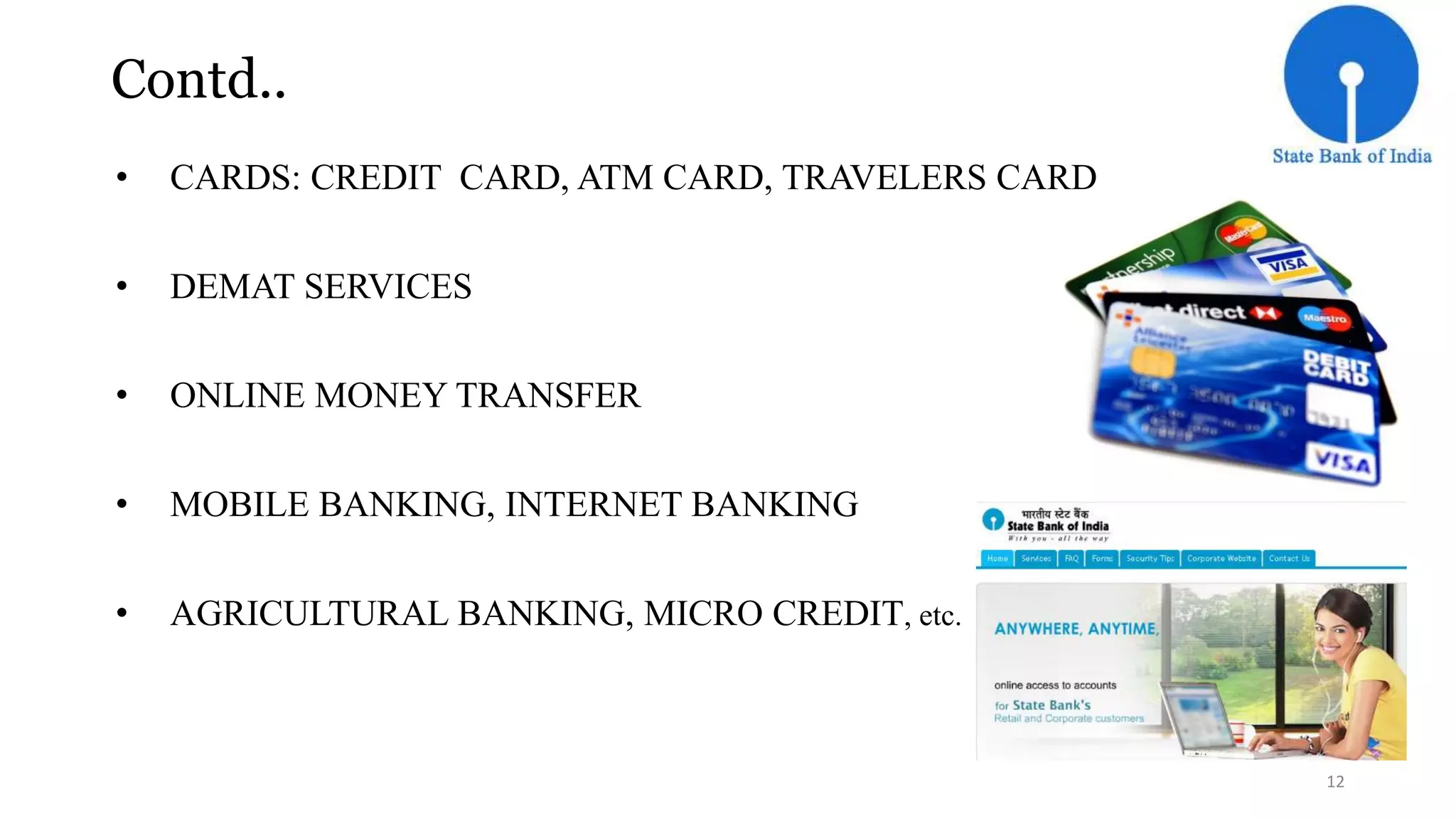
• CARDS: CREDIT CARD, ATM CARD, TRAVELERS CARD 
• DEMAT SERVICES 
• ONLINE MONEY TRANSFER 
• MOBILE BANKING, INTERNET BANKING 
• AGRICULTURAL BANKING, MICRO CREDIT, etc. 
12
13
PRICING 
• INTEREST RATES 
• CONSULTING FEES 
• COMMISSION 
Parameters for determining Price: 
• Bank product group price specification 
• Bank product price specification 
• Business partner price arrangement 
• Business partner price agreement. 
14
PLACE 
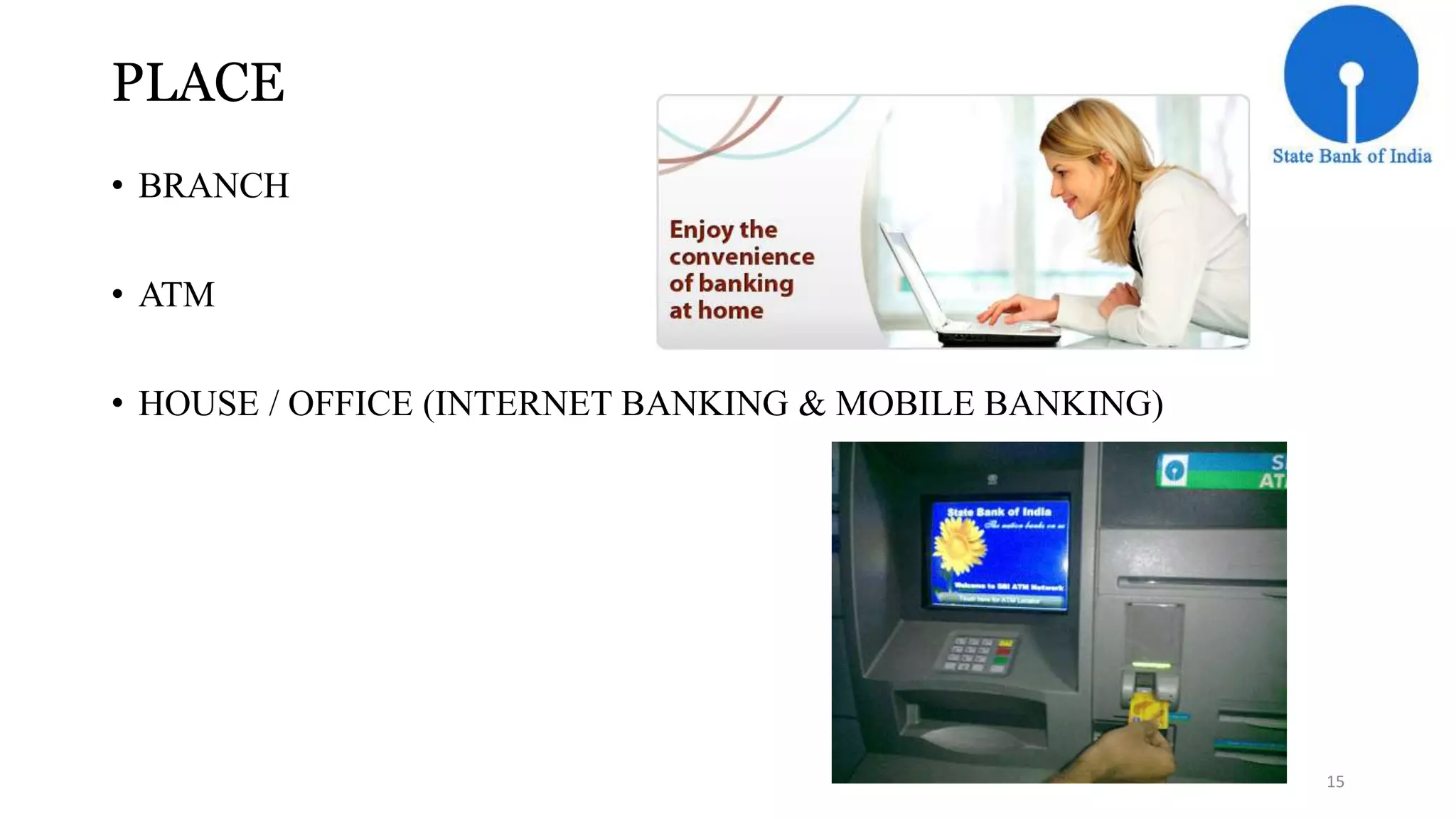
• BRANCH 
• ATM 
• HOUSE / OFFICE (INTERNET BANKING & MOBILE BANKING) 
15
Contd.. 
16
PROMOTION 
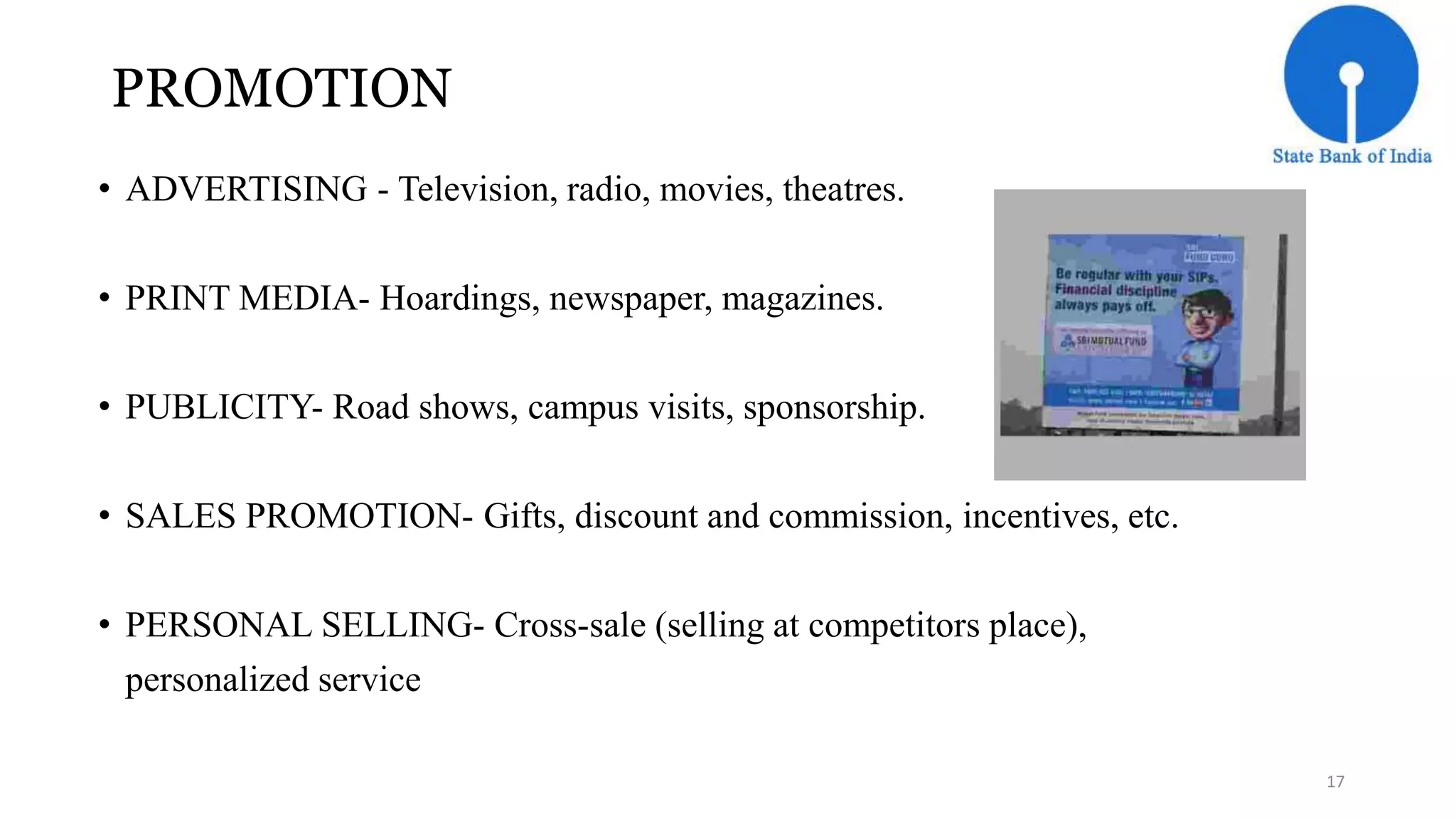
• ADVERTISING - Television, radio, movies, theatres. 
• PRINT MEDIA- Hoardings, newspaper, magazines. 
• PUBLICITY- Road shows, campus visits, sponsorship. 
• SALES PROMOTION- Gifts, discount and commission, incentives, etc. 
• PERSONAL SELLING- Cross-sale (selling at competitors place), 
personalized service 
17
18
19
20
PEOPLE 
• BRANCH MANAGER 
• FRONT LINE OFFICERS 
• EMPLOYEES 
• CUSTOMERS 
21
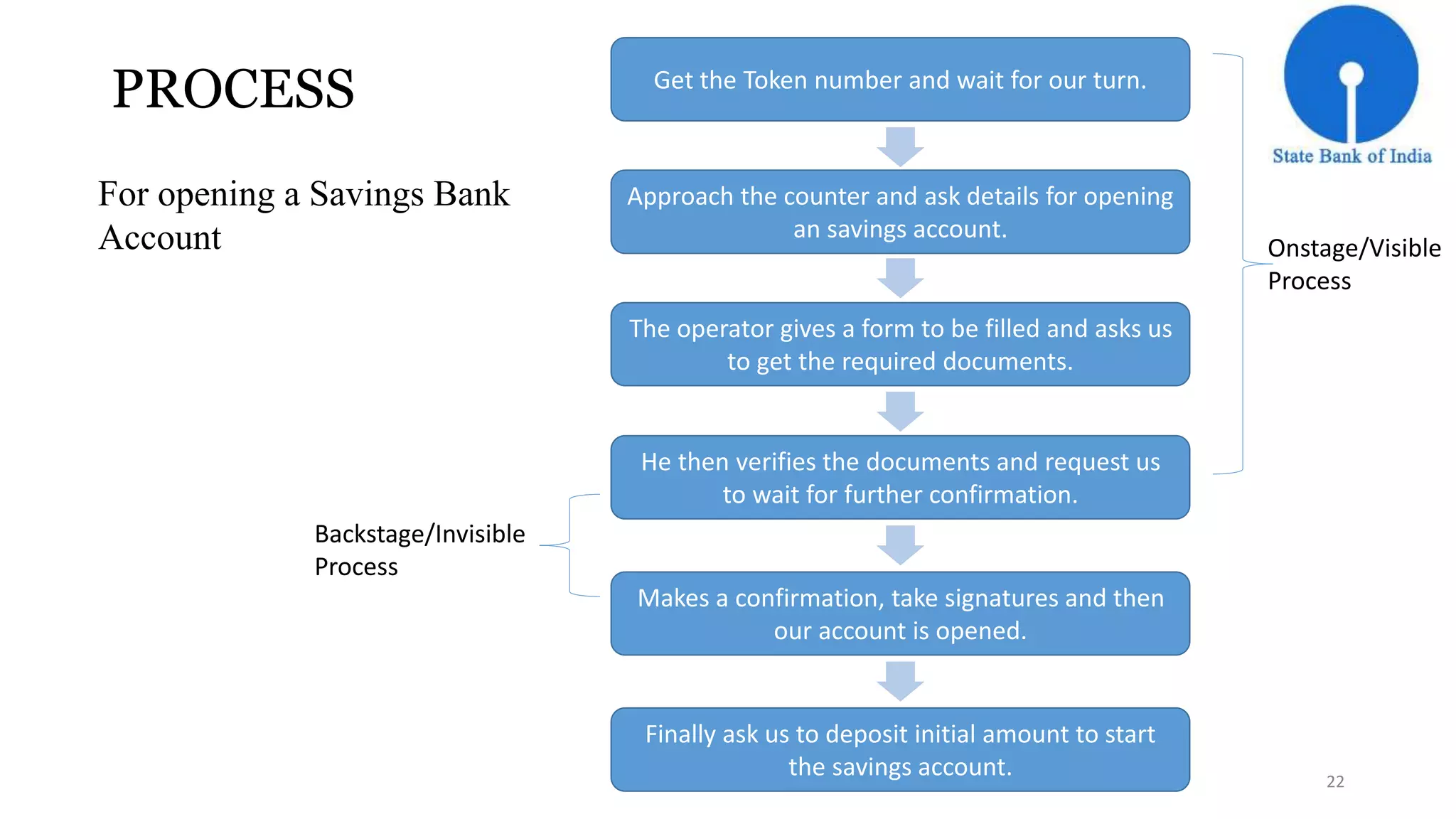
PROCESS 
For opening a Savings Bank 
Account 
Get the Token number and wait for our turn. 
Approach the counter and ask details for opening 
an savings account. 
The operator gives a form to be filled and asks us 
to get the required documents. 
He then verifies the documents and request us 
to wait for further confirmation. 
Makes a confirmation, take signatures and then 
our account is opened. 
Backstage/Invisible 
Process 
Finally ask us to deposit initial amount to start 
the savings account. 
Onstage/Visible 
Process 
22
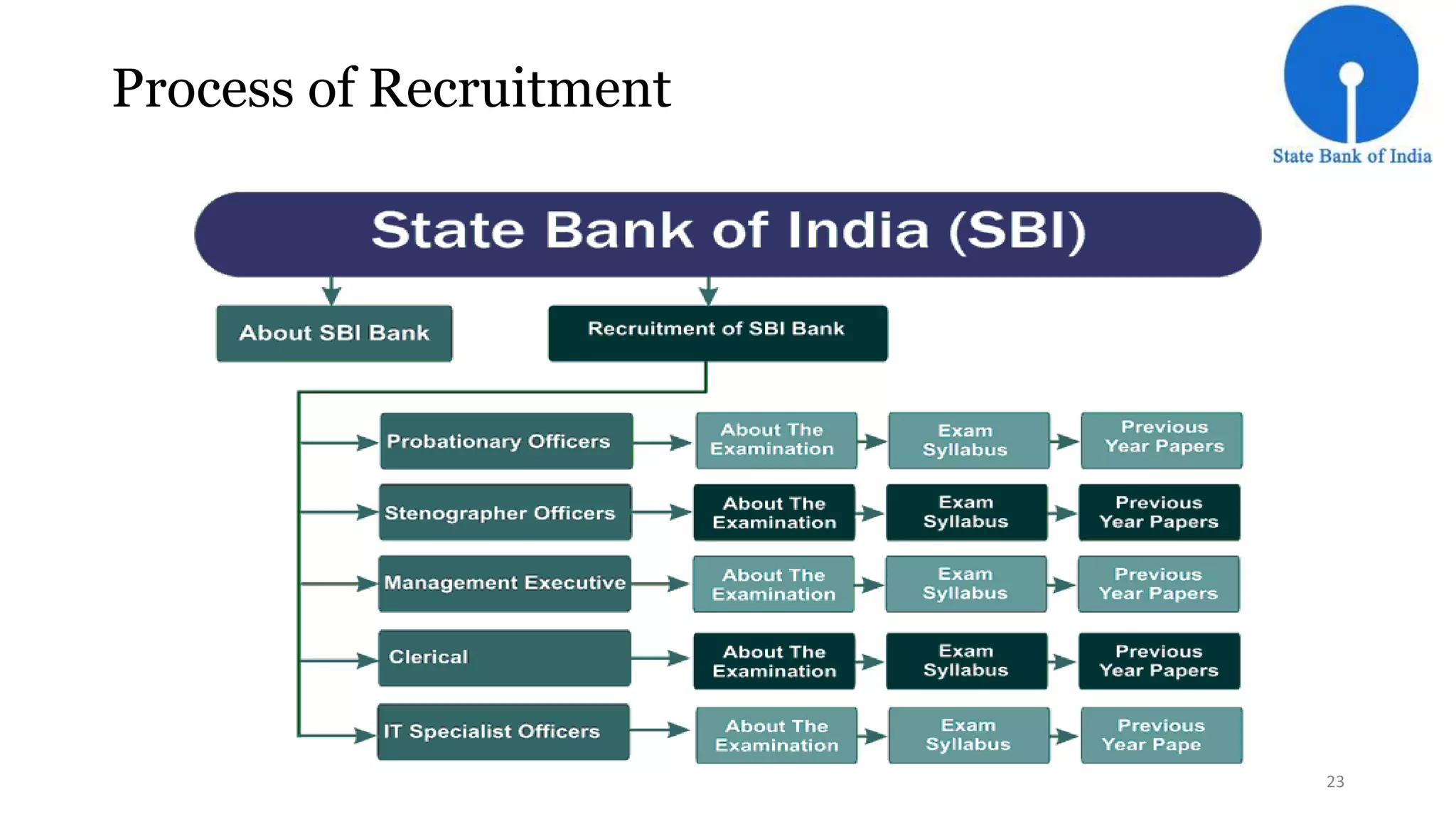
Process of Recruitment 
23
PHYSICAL EVIDENCE 
• SIGNAGE 
24
• BILLBOARDS AND HOARDINGS 
25
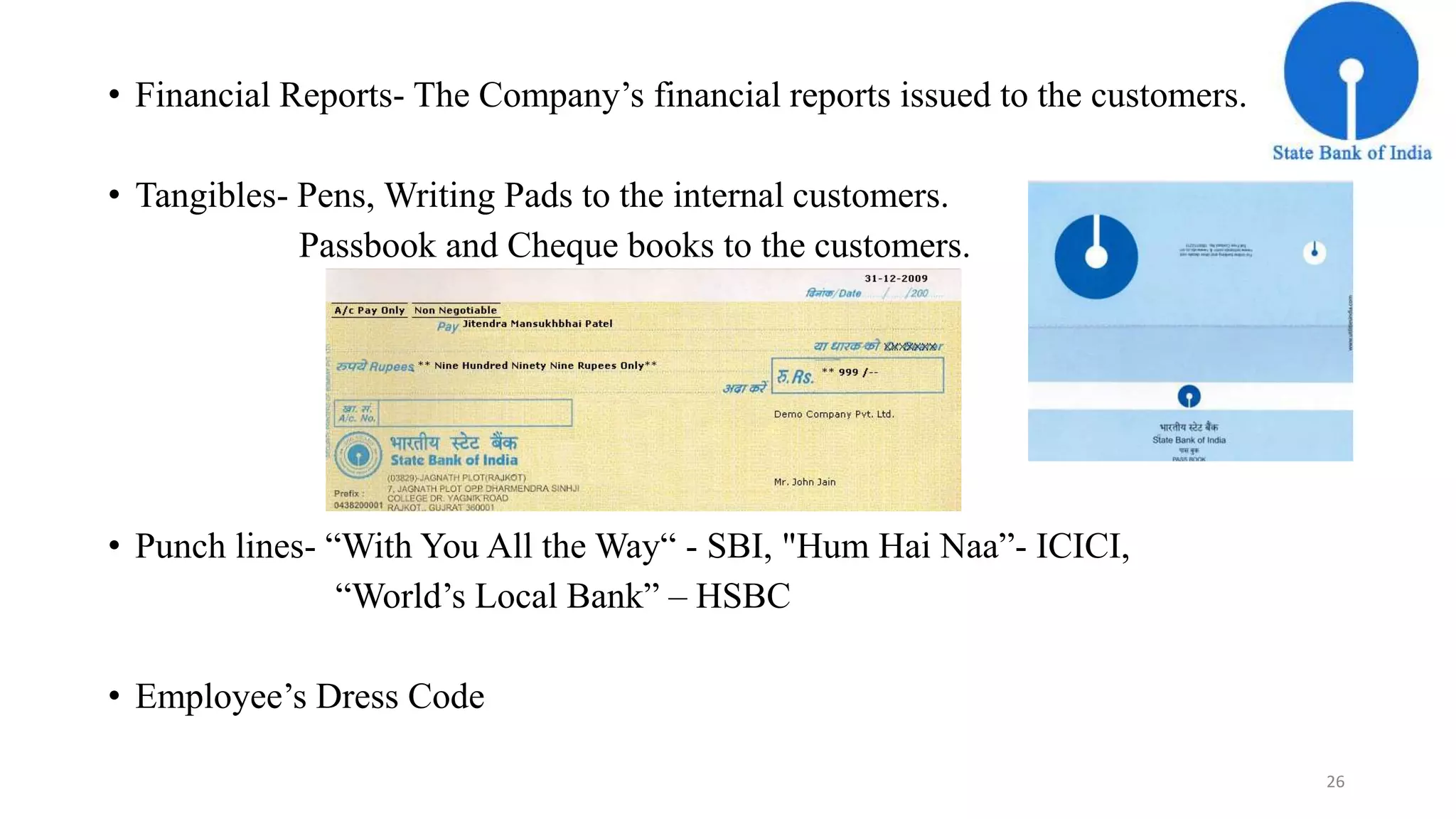
• Financial Reports- The Company’s financial reports issued to the customers. 
• Tangibles- Pens, Writing Pads to the internal customers. 
Passbook and Cheque books to the customers. 
• Punch lines- “With You All the Way“ - SBI, "Hum Hai Naa”- ICICI, 
“World’s Local Bank” – HSBC 
• Employee’s Dress Code 
26
ICICI BANK 
ICICI Bank was established by the Industrial Credit and Investment Corporation of India 
(ICICI), an Indian financial institution, as a wholly owned subsidiary in 1994. The parent company 
was formed in 1955 as a joint-venture of theWorld Bank, India's public-sector banks and public-sector 
insurance companies to provide project financing to Indian industry. 
In the 1990s, ICICI transformed its business from a development financial institution offering only 
project finance to a diversified financial services group, offering a wide variety of products and 
services, both directly and through a number of subsidiaries and affiliates like ICICI Bank. In 1999, 
ICICI become the first Indian company and the first bank or financial institution from non-Japan Asia 
to be listed on the NYSE. 
ICICI Bank is India's largest private sector bank with total assets of Rs. 5,946.42 billion (US$ 99 
billion) at March 31, 2014 and profit after tax Rs. 98.10 billion (US$ 1,637 million) for the year 
ended March 31, 2014. ICICI Bank currently has a network of 3,820 Branches and 11,798 ATM's 
across India. 
27
Contd.. 
• In 2000, ICICI Bank became the first Indian bank to list on the New York Stock 
Exchange with its five million American depository shares issue generating a 
demand book 13 times the offer size. 
• In September 2013, ICICI Bank launched a one of its kind app on 
Facebook 'Pockets by ICICI Bank' to enable customers to carry out a wide range 
of financial transactions on Facebook. Customers can access the ICICI Bank app 
by logging into their Facebook account and then going to the official ICICI Bank 
Facebook page, and clicking on the tab for Pockets by ICICI Bank. 
• ICICI Bank bags the "Best bank in SME financing (Private Sector)" at the Dun & 
Bradstreet Banking awards. 
28
Products 
Account and Deposits 
• Titanium Privilege Savings Account, 
• Family Banking 
Investments 
• Investments 
• Mutual Fund, Forex 
• Gold 
29
Insurance 
• Life Insurance 
• Health Insurance 
• Complete Health Insurance Policy 
• Health Care Plus 
• Personal Protect Insurance Policy 
• Home Insurance 
• Car Insurance 
• Two Wheeler Insurance 
• Mobile Banking, Internet Banking 
30
31
Place 
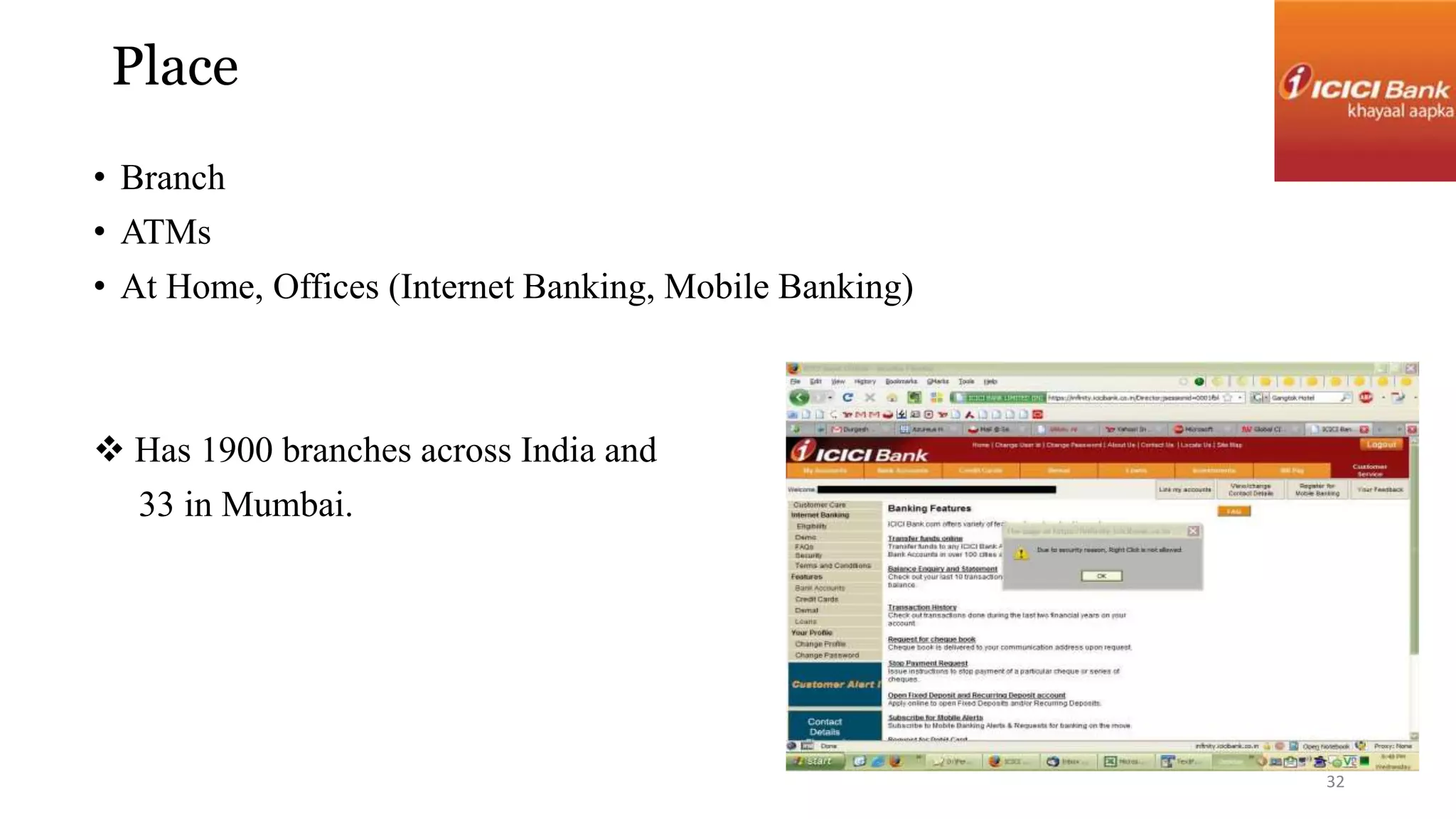
• Branch 
• ATMs 
• At Home, Offices (Internet Banking, Mobile Banking) 
 Has 1900 branches across India and 
33 in Mumbai. 
32
Promotion 
• Advertising - Television, radio, movies, theatres 
• Print Media- Hoardings, newspaper, magazines 
• Publicity- Road shows, campus visits, sandwich man, Sponsorship 
• Sales Promotion- Gifts, discount and commission, incentives, etc. 
• Personal Selling- Cross-sale (selling at competitors place), personalized service 
33
34
35
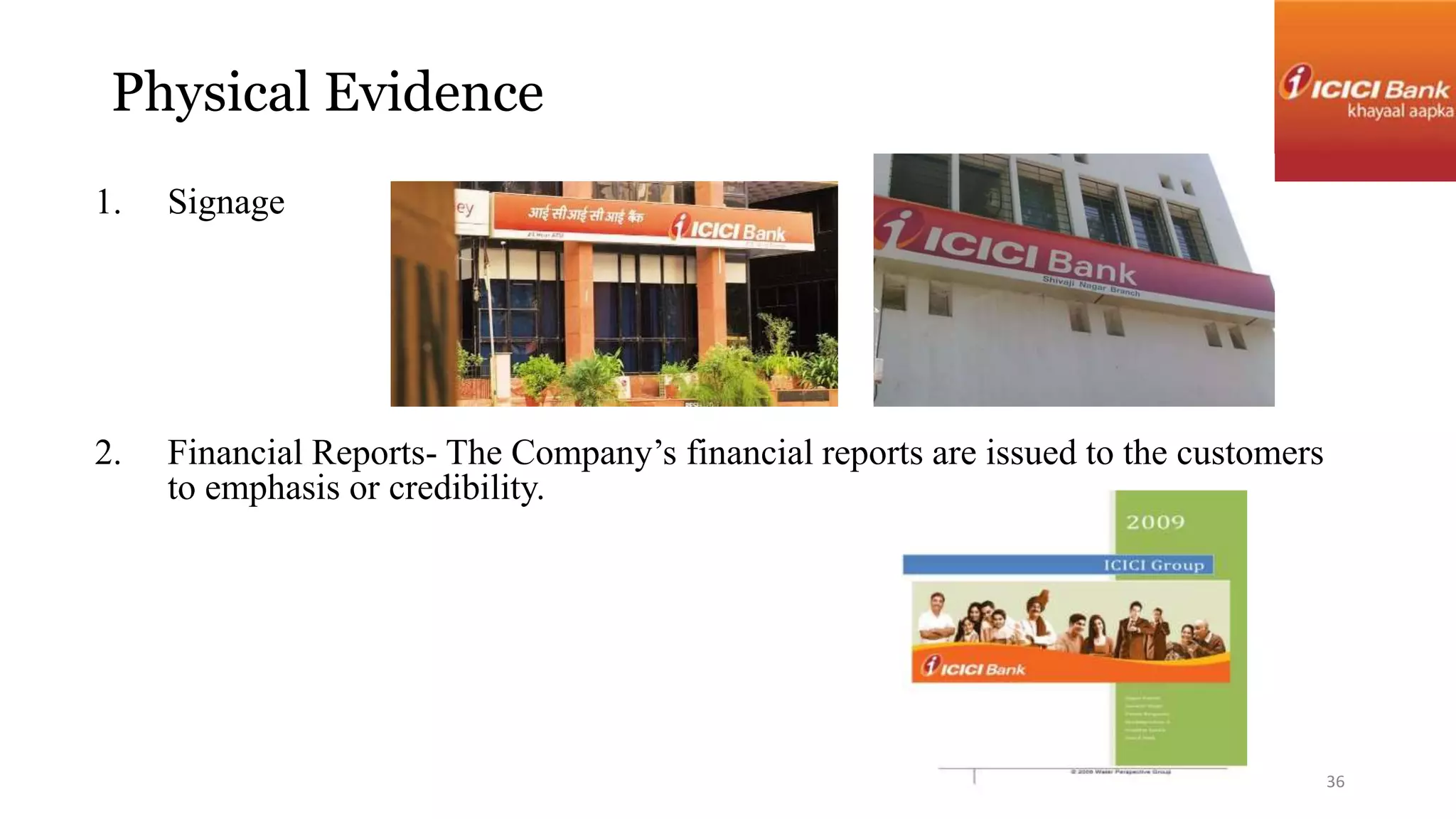
Physical Evidence 
1. Signage 
2. Financial Reports- The Company’s financial reports are issued to the customers 
to emphasis or credibility. 
36
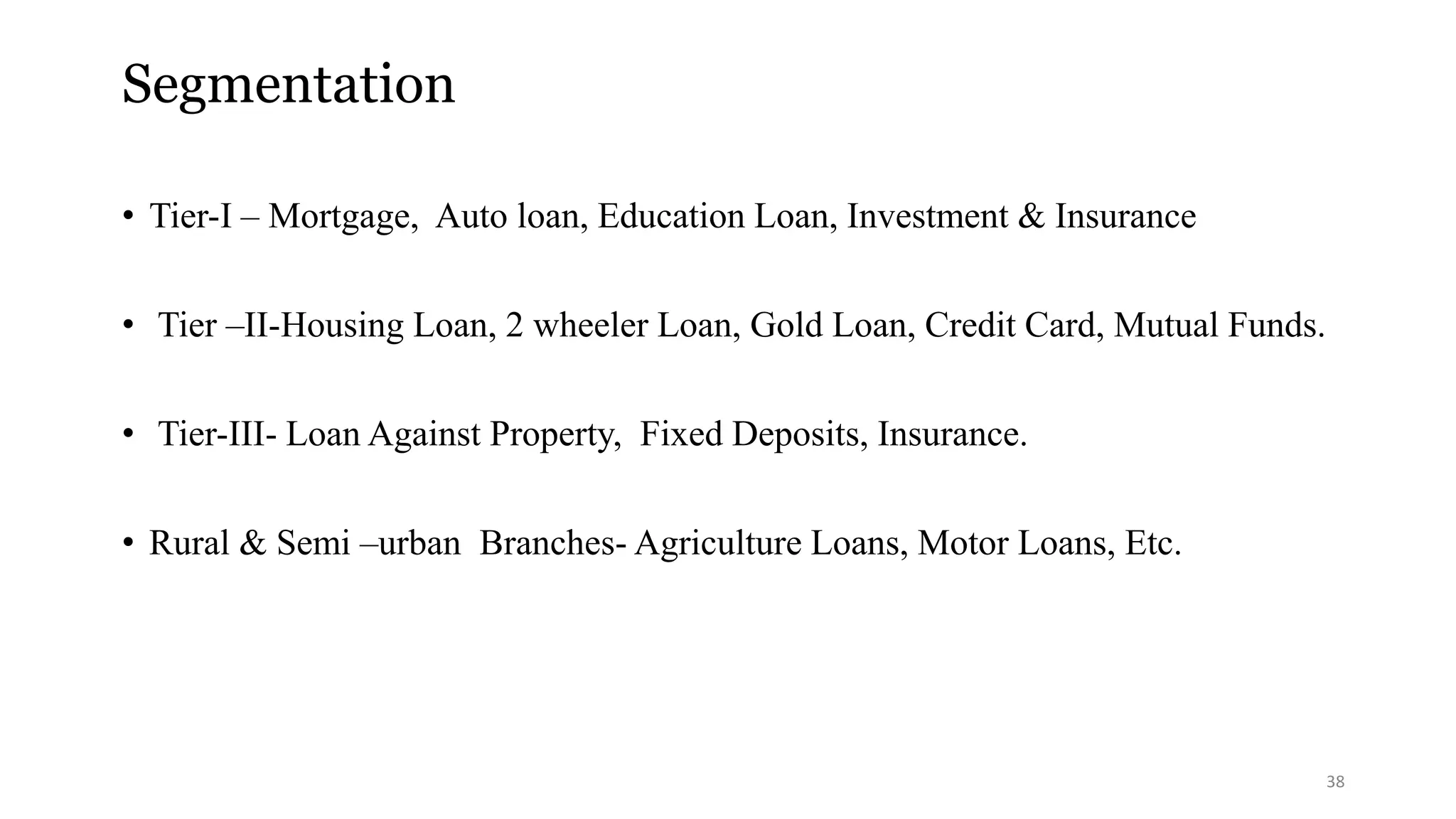
3. Tangibles- Pens, Writing Pads to the internal customers. Passbook 
and Cheque books to the customers. 
4. Billboards and Hoardings. 
4. Punch line - “Hum Hai Naa” 
37
Segmentation 
• Tier-I – Mortgage, Auto loan, Education Loan, Investment & Insurance 
• Tier –II-Housing Loan, 2 wheeler Loan, Gold Loan, Credit Card, Mutual Funds. 
• Tier-III- Loan Against Property, Fixed Deposits, Insurance. 
• Rural & Semi –urban Branches- Agriculture Loans, Motor Loans, Etc. 
38
Target People 
• Banks target all age group of people between 10-59, 60 and above. 
• Child’s savings account can be opened by their parents, for studies & other 
purposes. 
• Scheme for students availing ‘‘Student’s Account” i.e. whose minimum balance is 
zero. 
• And other various schemes and plans for adults and old people. 
39
THANK YOU 
40

Banking Services (7 P's Included)

  • 1.
  • 2.
    INTRODUCTION • Theterm bank is either derived from old Italian word banca or from a French word banque both mean a Bench or money exchange table. • A bank is a financial institution and a financial intermediary that accepts deposits and channels those deposits into lending activities, either directly or through capital market. A bank connects customers with capital deficits to customers with capital surpluses. 2
  • 3.
    HISTORY OF BANKINGIN INDIA • The first bank in India was established in 1786. From 1786 till today it has gone through three distinct phases. • PHASE 1 Early phase from 1786 to 1969 of Indian banks. • PHASE 2 Nationalization of Indian Banks and up to 1991 prior to Indian banking sector Reforms. • PHASE 3 New phase of Indian Banking system with the advent of Indian Financial & Banking Sector Reforms after 1991. 3
  • 4.
    DEFINITION Section 5(b) of the Banking Regulation Act 1949 defines “Banking” as • “Accepting for the purpose of lending and investment, deposits of money from the public repayable on demand or otherwise and withdraw able by cheque, draft, order or otherwise.” In simple words, Banking can be defined as the business activity of accepting and safeguarding money owned by other individuals and entities, and then lending out this money in order to earn a profit. 4
  • 5.
    Contribution towards GDPof India • The total bank deposits increased from Rs. 9.1 billion($960 million) in 1970-71 to Rs. 8309.22 billion ($620 billion) in 2009-10. Current deposit is Rs. 67504.54 billion($1.1 trillion). • There are total 151 commercial banks in India by 2013 with total of 1,09,811 number of branches. • It contributes INR 243294 Cr. to India’s GDP. • Service sector contribution is 57.3% to India's economy. And out of this 57.3%, banking sector contributes 80%. 5
  • 6.
  • 7.
  • 8.
    Marketing Mix •PRODUCT • PRICE • PLACE • PROMOTION • PEOPLE • PROCESS • PHYSICAL EVIDENCE 8
  • 9.
    State Bank ofIndia • Founded on 2nd July 1806 as Bank of Calcutta. Bank of Madras merged into the other two "presidency banks" in British India, Bank of Calcutta and Bank of Bombay, to form the Imperial Bank of India, which in turn became the State Bank of India. • Government of India owned the Imperial Bank of India in 1955, with Reserve Bank of India (India's Central Bank) taking a 60% stake, and renamed it the State Bank of India. • State Bank of India (SBI) is an Indian multinational, Public Sector banking, and financial services company. It is a government-owned corporation with its headquarters in Mumbai, Maharashtra. • As of December 2013, it had assets of US$388 billion and 17,000 branches, including 190 foreign offices, making it the largest banking and financial services company in India. 9
  • 10.
  • 11.
    PRODUCT • DEPOSITS • ADVANCES & LOANS • CONSULTANCY • INVESTMENTS • INTERNATIONAL BANKIKNG 11
  • 12.
    Contd.. • CARDS:CREDIT CARD, ATM CARD, TRAVELERS CARD • DEMAT SERVICES • ONLINE MONEY TRANSFER • MOBILE BANKING, INTERNET BANKING • AGRICULTURAL BANKING, MICRO CREDIT, etc. 12
  • 13.
  • 14.
    PRICING • INTERESTRATES • CONSULTING FEES • COMMISSION Parameters for determining Price: • Bank product group price specification • Bank product price specification • Business partner price arrangement • Business partner price agreement. 14
  • 15.
    PLACE • BRANCH • ATM • HOUSE / OFFICE (INTERNET BANKING & MOBILE BANKING) 15
  • 16.
  • 17.
    PROMOTION • ADVERTISING- Television, radio, movies, theatres. • PRINT MEDIA- Hoardings, newspaper, magazines. • PUBLICITY- Road shows, campus visits, sponsorship. • SALES PROMOTION- Gifts, discount and commission, incentives, etc. • PERSONAL SELLING- Cross-sale (selling at competitors place), personalized service 17
  • 18.
  • 19.
  • 20.
  • 21.
    PEOPLE • BRANCHMANAGER • FRONT LINE OFFICERS • EMPLOYEES • CUSTOMERS 21
  • 22.
    PROCESS For openinga Savings Bank Account Get the Token number and wait for our turn. Approach the counter and ask details for opening an savings account. The operator gives a form to be filled and asks us to get the required documents. He then verifies the documents and request us to wait for further confirmation. Makes a confirmation, take signatures and then our account is opened. Backstage/Invisible Process Finally ask us to deposit initial amount to start the savings account. Onstage/Visible Process 22
  • 23.
  • 24.
  • 25.
    • BILLBOARDS ANDHOARDINGS 25
  • 26.
    • Financial Reports-The Company’s financial reports issued to the customers. • Tangibles- Pens, Writing Pads to the internal customers. Passbook and Cheque books to the customers. • Punch lines- “With You All the Way“ - SBI, "Hum Hai Naa”- ICICI, “World’s Local Bank” – HSBC • Employee’s Dress Code 26
  • 27.
    ICICI BANK ICICIBank was established by the Industrial Credit and Investment Corporation of India (ICICI), an Indian financial institution, as a wholly owned subsidiary in 1994. The parent company was formed in 1955 as a joint-venture of theWorld Bank, India's public-sector banks and public-sector insurance companies to provide project financing to Indian industry. In the 1990s, ICICI transformed its business from a development financial institution offering only project finance to a diversified financial services group, offering a wide variety of products and services, both directly and through a number of subsidiaries and affiliates like ICICI Bank. In 1999, ICICI become the first Indian company and the first bank or financial institution from non-Japan Asia to be listed on the NYSE. ICICI Bank is India's largest private sector bank with total assets of Rs. 5,946.42 billion (US$ 99 billion) at March 31, 2014 and profit after tax Rs. 98.10 billion (US$ 1,637 million) for the year ended March 31, 2014. ICICI Bank currently has a network of 3,820 Branches and 11,798 ATM's across India. 27
  • 28.
    Contd.. • In2000, ICICI Bank became the first Indian bank to list on the New York Stock Exchange with its five million American depository shares issue generating a demand book 13 times the offer size. • In September 2013, ICICI Bank launched a one of its kind app on Facebook 'Pockets by ICICI Bank' to enable customers to carry out a wide range of financial transactions on Facebook. Customers can access the ICICI Bank app by logging into their Facebook account and then going to the official ICICI Bank Facebook page, and clicking on the tab for Pockets by ICICI Bank. • ICICI Bank bags the "Best bank in SME financing (Private Sector)" at the Dun & Bradstreet Banking awards. 28
  • 29.
    Products Account andDeposits • Titanium Privilege Savings Account, • Family Banking Investments • Investments • Mutual Fund, Forex • Gold 29
  • 30.
    Insurance • LifeInsurance • Health Insurance • Complete Health Insurance Policy • Health Care Plus • Personal Protect Insurance Policy • Home Insurance • Car Insurance • Two Wheeler Insurance • Mobile Banking, Internet Banking 30
  • 31.
  • 32.
    Place • Branch • ATMs • At Home, Offices (Internet Banking, Mobile Banking)  Has 1900 branches across India and 33 in Mumbai. 32
  • 33.
    Promotion • Advertising- Television, radio, movies, theatres • Print Media- Hoardings, newspaper, magazines • Publicity- Road shows, campus visits, sandwich man, Sponsorship • Sales Promotion- Gifts, discount and commission, incentives, etc. • Personal Selling- Cross-sale (selling at competitors place), personalized service 33
  • 34.
  • 35.
  • 36.
    Physical Evidence 1.Signage 2. Financial Reports- The Company’s financial reports are issued to the customers to emphasis or credibility. 36
  • 37.
    3. Tangibles- Pens,Writing Pads to the internal customers. Passbook and Cheque books to the customers. 4. Billboards and Hoardings. 4. Punch line - “Hum Hai Naa” 37
  • 38.
    Segmentation • Tier-I– Mortgage, Auto loan, Education Loan, Investment & Insurance • Tier –II-Housing Loan, 2 wheeler Loan, Gold Loan, Credit Card, Mutual Funds. • Tier-III- Loan Against Property, Fixed Deposits, Insurance. • Rural & Semi –urban Branches- Agriculture Loans, Motor Loans, Etc. 38
  • 39.
    Target People •Banks target all age group of people between 10-59, 60 and above. • Child’s savings account can be opened by their parents, for studies & other purposes. • Scheme for students availing ‘‘Student’s Account” i.e. whose minimum balance is zero. • And other various schemes and plans for adults and old people. 39
  • 40.