COLLECTIVE BARGAINING
In the words of Flippo, “Collective Bargaining is
a process in which the representatives of a
labor organization and the representatives of
business
negotiate
specifies
organization meet and attempts to
a contract or
the
agreement, which
nature of
employee-employer-union relationship.
FEATURES OF COLLECTIVE
BARGAINING
1. Continuous process
2. Group action
3. Bipartite process
4. Flexible and mobile
5. Dynamic
6. Complex
7. Representation
OBJECTIVES OF COLLECTIVE
BARGAINING
The main objectives of collective bargaining are
given below:
• To settle disputes/conflicts relating to wages and
working conditions.
• To protect the interests of workers through
collective action.
• To resolve the differences between workers and
management through voluntary negotiations and
arrive at a consensus.
• To avoid third party interventions in matters
related to employment.
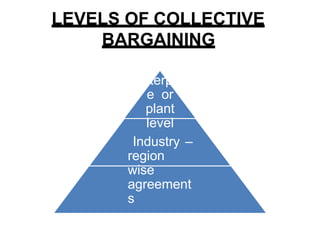
LEVELS OF COLLECTIVE
BARGAINING
Enterpris
e or
plant
level
Industry –
region
wise
agreement
s
National
LEVELS
• AT PLANT LEVEL:
Such a bargaining is limited to a particular unit or
undertaking enterprise only.
• AT THE INDUSTRY LEVEL:
Here all unions of an industry enter into an
agreement with the employers in general. In India,
collective bargaining of this type is very popular in
are reached
the various
textile industry where agreements
between labour unions and
management bodies.
• AT THE NATIONAL LEVEL:
At the national level the bargaining is mutual and
agreements usually take the form of ‘bipartite
agreements’ entered into between labor union and
managements in the presence of the government
representatives. The agreement
Tea Association,
entered into
Indian Teabetween Indian
Planters Association and Hind Mazdoor Sabha
(HMS) and INTUC is an example of collective
bargaining at the national level.
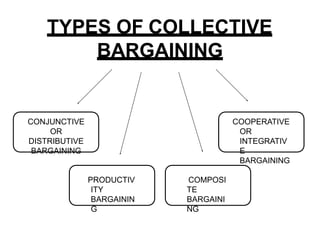
TYPES OF COLLECTIVE
BARGAINING
CONJUNCTIVE
OR
DISTRIBUTIVE
BARGAINING
PRODUCTIV
ITY
BARGAININ
G
COMPOSI
TE
BARGAINI
NG
COOPERATIVE
OR
INTEGRATIV
E
BARGAINING
1. Conjunctive Bargaining: This involves haggling over
distribution of surplus. In this, one’s gain is another party’s
loss. It is also known as Distributive bargaining.
2. Integrative Bargaining: This involves negotiation of an
issue on which both the parties may gain or at least neither
party loses. This bargaining is also known as Cooperative
bargaining.
3. Productivity Bargaining: An agreement in which
advantages of one kind or another are given to workers in
return for agreement on their part to accept changes in
working practices or in methods of work to make
productivity efficient.
4. Composite Bargaining: This type of collective
bargaining, along with the demand for increased
wages the workers also express their concern over the
working conditions, recruitment and training policies,
environmental issues, etc. with the intention to
safeguard their interest and protect the dilution of their
powers.
ISSUES OF COLLECTIVE
BARGAINING
• Wages and
working conditions
• Work norms
• Job security
• Incentive payments
• Changes in
technology
• Grievances
• Health and safety
• Union recognition
• Insurance and
benefits
• Disciplinary matters
• Work tools,
techniques and
practices
• Management rights
• Staff transfers
and promotions
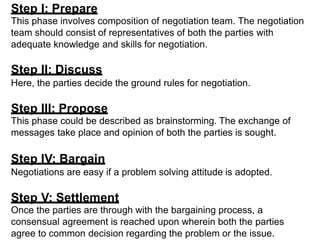
Step I: Prepare
This phase involves composition of negotiation team. The negotiation
team should consist of representatives of both the parties with
adequate knowledge and skills for negotiation.
Step II: Discuss
Here, the parties decide the ground rules for negotiation.
Step III: Propose
This phase could be described as brainstorming. The exchange of
messages take place and opinion of both the parties is sought.
Step IV: Bargain
Negotiations are easy if a problem solving attitude is adopted.
Step V: Settlement
Once the parties are through with the bargaining process, a
consensual agreement is reached upon wherein both the parties
agree to common decision regarding the problem or the issue.
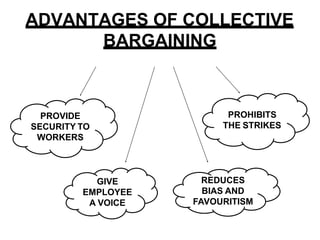
ADVANTAGES OF COLLECTIVE
BARGAINING
PROVIDE
SECURITY TO
WORKERS
GIVE
EMPLOYEE
A VOICE
REDUCES
BIAS AND
FAVOURITISM
PROHIBITS
THE STRIKES
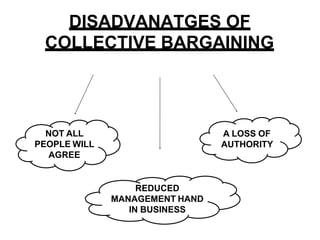
DISADVANATGES OF
COLLECTIVE BARGAINING
NOT ALL
PEOPLE WILL
AGREE
A LOSS OF
AUTHORITY
REDUCED
MANAGEMENT HAND
IN BUSINESS
Points to be kept in mind
before collective bargaining
1. Be sure to set clear objectives for every bargaining item
and be sure you understand the reason for each.
2. Do not hurry.
3. When in doubt, discuss with your associates.
4. Be well prepared with firm data supporting your position.
5. Always strive to keep some flexibility in your position.
6. Don’t concern yourself just with what the other party says
and does; find out why.
7. Respect the importance for face saving for the other party.
8. Be alert to the real intentions of the other party-mot only for
goals, but also for priorities.
9. Be a good listener.
10. Pay close attention to the wording of every clause
negotiated.
Thank you

Collective bargaining

  • 1.
  • 2.
    COLLECTIVE BARGAINING In thewords of Flippo, “Collective Bargaining is a process in which the representatives of a labor organization and the representatives of business negotiate specifies organization meet and attempts to a contract or the agreement, which nature of employee-employer-union relationship.
  • 3.
    FEATURES OF COLLECTIVE BARGAINING 1.Continuous process 2. Group action 3. Bipartite process 4. Flexible and mobile 5. Dynamic 6. Complex 7. Representation
  • 4.
    OBJECTIVES OF COLLECTIVE BARGAINING Themain objectives of collective bargaining are given below: • To settle disputes/conflicts relating to wages and working conditions. • To protect the interests of workers through collective action. • To resolve the differences between workers and management through voluntary negotiations and arrive at a consensus. • To avoid third party interventions in matters related to employment.
  • 5.
    LEVELS OF COLLECTIVE BARGAINING Enterpris eor plant level Industry – region wise agreement s National
  • 6.
    LEVELS • AT PLANTLEVEL: Such a bargaining is limited to a particular unit or undertaking enterprise only. • AT THE INDUSTRY LEVEL: Here all unions of an industry enter into an agreement with the employers in general. In India, collective bargaining of this type is very popular in are reached the various textile industry where agreements between labour unions and management bodies.
  • 7.
    • AT THENATIONAL LEVEL: At the national level the bargaining is mutual and agreements usually take the form of ‘bipartite agreements’ entered into between labor union and managements in the presence of the government representatives. The agreement Tea Association, entered into Indian Teabetween Indian Planters Association and Hind Mazdoor Sabha (HMS) and INTUC is an example of collective bargaining at the national level.
  • 8.
  • 9.
    1. Conjunctive Bargaining:This involves haggling over distribution of surplus. In this, one’s gain is another party’s loss. It is also known as Distributive bargaining. 2. Integrative Bargaining: This involves negotiation of an issue on which both the parties may gain or at least neither party loses. This bargaining is also known as Cooperative bargaining. 3. Productivity Bargaining: An agreement in which advantages of one kind or another are given to workers in return for agreement on their part to accept changes in working practices or in methods of work to make productivity efficient.
  • 10.
    4. Composite Bargaining:This type of collective bargaining, along with the demand for increased wages the workers also express their concern over the working conditions, recruitment and training policies, environmental issues, etc. with the intention to safeguard their interest and protect the dilution of their powers.
  • 11.
    ISSUES OF COLLECTIVE BARGAINING •Wages and working conditions • Work norms • Job security • Incentive payments • Changes in technology • Grievances • Health and safety • Union recognition • Insurance and benefits • Disciplinary matters • Work tools, techniques and practices • Management rights • Staff transfers and promotions
  • 13.
    Step I: Prepare Thisphase involves composition of negotiation team. The negotiation team should consist of representatives of both the parties with adequate knowledge and skills for negotiation. Step II: Discuss Here, the parties decide the ground rules for negotiation. Step III: Propose This phase could be described as brainstorming. The exchange of messages take place and opinion of both the parties is sought. Step IV: Bargain Negotiations are easy if a problem solving attitude is adopted. Step V: Settlement Once the parties are through with the bargaining process, a consensual agreement is reached upon wherein both the parties agree to common decision regarding the problem or the issue.
  • 14.
    ADVANTAGES OF COLLECTIVE BARGAINING PROVIDE SECURITYTO WORKERS GIVE EMPLOYEE A VOICE REDUCES BIAS AND FAVOURITISM PROHIBITS THE STRIKES
  • 15.
    DISADVANATGES OF COLLECTIVE BARGAINING NOTALL PEOPLE WILL AGREE A LOSS OF AUTHORITY REDUCED MANAGEMENT HAND IN BUSINESS
  • 16.
    Points to bekept in mind before collective bargaining 1. Be sure to set clear objectives for every bargaining item and be sure you understand the reason for each. 2. Do not hurry. 3. When in doubt, discuss with your associates. 4. Be well prepared with firm data supporting your position. 5. Always strive to keep some flexibility in your position. 6. Don’t concern yourself just with what the other party says and does; find out why. 7. Respect the importance for face saving for the other party. 8. Be alert to the real intentions of the other party-mot only for goals, but also for priorities. 9. Be a good listener. 10. Pay close attention to the wording of every clause negotiated.
  • 17.