
Aligning Social Media Strategies with
Revenue Management Goals
Part 1
Kate Varini
EyeforTravel, Amsterdam, Nov. 2010
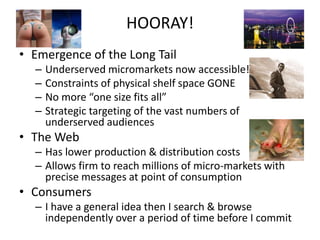
HOORAY!
• Emergence of the Long Tail
– Underserved micromarkets now accessible!
– Constraints of physical shelf space GONE
– No more “one size fits all”
– Strategic targeting of the vast numbers of
underserved audiences
• The Web
– Has lower production & distribution costs
– Allows firm to reach millions of micro-markets with
precise messages at point of consumption
• Consumers
– I have a general idea then I search & browse
independently over a period of time before I commit
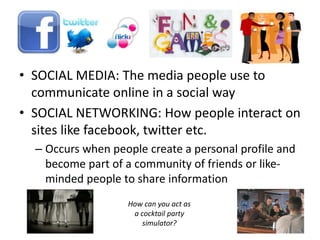
• SOCIAL MEDIA: The media people use to
communicate online in a social way
• SOCIAL NETWORKING: How people interact on
sites like facebook, twitter etc.
– Occurs when people create a personal profile and
become part of a community of friends or like-
minded people to share information
How can you act as
a cocktail party
simulator?
• DO
• Provide valuable
information
• Be helpful
• Listen
• Have no expection of
something in return
• DON’T
• Ask for “business cards”
as a condition to
“allow” interaction
• Treat everyone as it
they are a sales lead
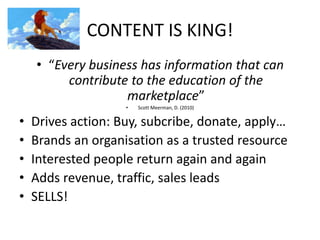
CONTENT IS KING!
• “Every business has information that can
contribute to the education of the
marketplace”
• Scott Meerman, D. (2010)
• Drives action: Buy, subcribe, donate, apply…
• Brands an organisation as a trusted resource
• Interested people return again and again
• Adds revenue, traffic, sales leads
• SELLS!
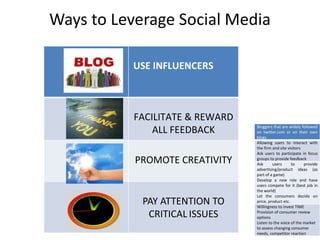
Ways to Leverage Social Media
USE INFLUENCERS
FACILITATE & REWARD
ALL FEEDBACK
PROMOTE CREATIVITY
PAY ATTENTION TO
CRITICAL ISSUES
Bloggers that are widely followed
on twitter.com or on their own
blogs
Allowing users to interact with
the firm and site visitors
Ask users to participate in focus
groups to provide feedback
Ask users to provide
advertising/product ideas (as
part of a game)
Develop a new role and have
users compete for it (best job in
the world)
Let the consumers decide on
price, product etc.
Willingness to invest TIME
Provision of consumer review
options
Listen to the voice of the market
to assess changing consumer
needs, competitor reaction
Think like a Publisher!
• Content strategy
• Identify buyer persona and the problems they
may need solving
• Clear goal & content generated specifically to
draw them into the sales consideration cycle
• Show leadership in the marketplace of ideas
to promote your online reputation
Consumer Recommendations
• Most POWERFUL form of advertising
• 98% of the 62% of US consumers that read online
reviews and find them RELIABLE enough.
• 80% of these consumers say that reading peer
reviews affected their BUYING INTENTIONS
• 97.7% of travelers who use the internet READ
other traveller reviews
• TRUST - perception that are more reliable
because reflect the genuine feelings of the
product user, who is perceived to be like
themselves
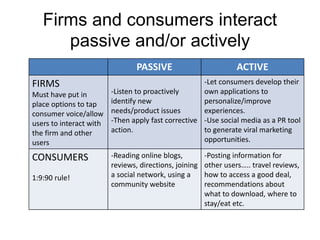
Firms and consumers interact
passive and/or actively
PASSIVE ACTIVE
FIRMS
Must have put in
place options to tap
consumer voice/allow
users to interact with
the firm and other
users
-Listen to proactively
identify new
needs/product issues
-Then apply fast corrective
action.
-Let consumers develop their
own applications to
personalize/improve
experiences.
-Use social media as a PR tool
to generate viral marketing
opportunities.
CONSUMERS
1:9:90 rule!
-Reading online blogs,
reviews, directions, joining
a social network, using a
community website
-Posting information for
other users….. travel reviews,
how to access a good deal,
recommendations about
what to download, where to
stay/eat etc.
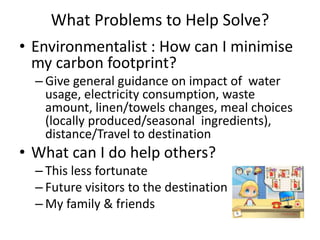
What Problems to Help Solve?
• Environmentalist : How can I minimise
my carbon footprint?
– Give general guidance on impact of water
usage, electricity consumption, waste
amount, linen/towels changes, meal choices
(locally produced/seasonal ingredients),
distance/Travel to destination
• What can I do help others?
– This less fortunate
– Future visitors to the destination
– My family & friends
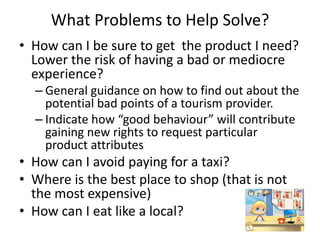
What Problems to Help Solve?
• How can I be sure to get the product I need?
Lower the risk of having a bad or mediocre
experience?
– General guidance on how to find out about the
potential bad points of a tourism provider.
– Indicate how “good behaviour” will contribute
gaining new rights to request particular
product attributes
• How can I avoid paying for a taxi?
• Where is the best place to shop (that is not
the most expensive)
• How can I eat like a local?
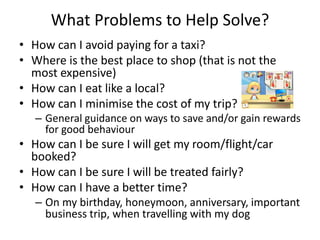
What Problems to Help Solve?
• How can I avoid paying for a taxi?
• Where is the best place to shop (that is not the
most expensive)
• How can I eat like a local?
• How can I minimise the cost of my trip?
– General guidance on ways to save and/or gain rewards
for good behaviour
• How can I be sure I will get my room/flight/car
booked?
• How can I be sure I will be treated fairly?
• How can I have a better time?
– On my birthday, honeymoon, anniversary, important
business trip, when travelling with my dog
Rewards for “Good Behaviour”
• No-show
• Book direct
• Rate higher than bid price
• Agree to a potentail walk
• Generate revenue on shoulder nights
• High spend on high margin extras
• Arrive late, leave early
• Does not consume complimentary
inclusions
• Pay cash or direct debit
• Low production cost
Inform About Good Behaviour
• Revenue Maximisation
– Purchases from partners/clicks on offers
– Competitor benchmarking executed by your customers
– Agreeing to be walked if & when needed
– Buy in advance
– Daily contribution to fixed costs
• Cost Reduction
– Channel
– Cost of production (self service tech + other behaviour),
– Size of carbon footprint
Inform About Good Behaviour
• Marketing
– New product ideas (market research)
– Provision of personal data -
– Allowing firm to push customised offers
• Recovery
– Inform us of service failure (however small)
– Making useful suggestions for improvement
Rewards
• Eligibility for entry in a prize draw
• Point value assigned based on level of “good
behaviour” achieved, the better, the more
points earned….
• For competitor benchmarking
• Look at other industries: Boots, Nectar,
Gaming, Stock exchange, Insurance, Easyjet,
Banks.
LINK 2 RM
• Spontaneous purchases – high no-show
• Overbooked? No problem
• Need ideas for a new product – Let the crowd
help
• Segmentation? Re-engineer
• Competitors match your price moves? No
issue!
Video
http://www.youtube.com/watch?v=_3o3KG5Z6GI

Varini Rm Social Media20101

  • 1.
    Aligning Social MediaStrategies with Revenue Management Goals Part 1 Kate Varini EyeforTravel, Amsterdam, Nov. 2010
  • 2.
    HOORAY! • Emergence ofthe Long Tail – Underserved micromarkets now accessible! – Constraints of physical shelf space GONE – No more “one size fits all” – Strategic targeting of the vast numbers of underserved audiences • The Web – Has lower production & distribution costs – Allows firm to reach millions of micro-markets with precise messages at point of consumption • Consumers – I have a general idea then I search & browse independently over a period of time before I commit
  • 3.
    • SOCIAL MEDIA:The media people use to communicate online in a social way • SOCIAL NETWORKING: How people interact on sites like facebook, twitter etc. – Occurs when people create a personal profile and become part of a community of friends or like- minded people to share information How can you act as a cocktail party simulator?
  • 4.
    • DO • Providevaluable information • Be helpful • Listen • Have no expection of something in return • DON’T • Ask for “business cards” as a condition to “allow” interaction • Treat everyone as it they are a sales lead
  • 5.
    CONTENT IS KING! •“Every business has information that can contribute to the education of the marketplace” • Scott Meerman, D. (2010) • Drives action: Buy, subcribe, donate, apply… • Brands an organisation as a trusted resource • Interested people return again and again • Adds revenue, traffic, sales leads • SELLS!
  • 6.
    Ways to LeverageSocial Media USE INFLUENCERS FACILITATE & REWARD ALL FEEDBACK PROMOTE CREATIVITY PAY ATTENTION TO CRITICAL ISSUES Bloggers that are widely followed on twitter.com or on their own blogs Allowing users to interact with the firm and site visitors Ask users to participate in focus groups to provide feedback Ask users to provide advertising/product ideas (as part of a game) Develop a new role and have users compete for it (best job in the world) Let the consumers decide on price, product etc. Willingness to invest TIME Provision of consumer review options Listen to the voice of the market to assess changing consumer needs, competitor reaction
  • 7.
    Think like aPublisher! • Content strategy • Identify buyer persona and the problems they may need solving • Clear goal & content generated specifically to draw them into the sales consideration cycle • Show leadership in the marketplace of ideas to promote your online reputation
  • 8.
    Consumer Recommendations • MostPOWERFUL form of advertising • 98% of the 62% of US consumers that read online reviews and find them RELIABLE enough. • 80% of these consumers say that reading peer reviews affected their BUYING INTENTIONS • 97.7% of travelers who use the internet READ other traveller reviews • TRUST - perception that are more reliable because reflect the genuine feelings of the product user, who is perceived to be like themselves
  • 9.
    Firms and consumersinteract passive and/or actively PASSIVE ACTIVE FIRMS Must have put in place options to tap consumer voice/allow users to interact with the firm and other users -Listen to proactively identify new needs/product issues -Then apply fast corrective action. -Let consumers develop their own applications to personalize/improve experiences. -Use social media as a PR tool to generate viral marketing opportunities. CONSUMERS 1:9:90 rule! -Reading online blogs, reviews, directions, joining a social network, using a community website -Posting information for other users….. travel reviews, how to access a good deal, recommendations about what to download, where to stay/eat etc.
  • 10.
    What Problems toHelp Solve? • Environmentalist : How can I minimise my carbon footprint? – Give general guidance on impact of water usage, electricity consumption, waste amount, linen/towels changes, meal choices (locally produced/seasonal ingredients), distance/Travel to destination • What can I do help others? – This less fortunate – Future visitors to the destination – My family & friends
  • 11.
    What Problems toHelp Solve? • How can I be sure to get the product I need? Lower the risk of having a bad or mediocre experience? – General guidance on how to find out about the potential bad points of a tourism provider. – Indicate how “good behaviour” will contribute gaining new rights to request particular product attributes • How can I avoid paying for a taxi? • Where is the best place to shop (that is not the most expensive) • How can I eat like a local?
  • 12.
    What Problems toHelp Solve? • How can I avoid paying for a taxi? • Where is the best place to shop (that is not the most expensive) • How can I eat like a local? • How can I minimise the cost of my trip? – General guidance on ways to save and/or gain rewards for good behaviour • How can I be sure I will get my room/flight/car booked? • How can I be sure I will be treated fairly? • How can I have a better time? – On my birthday, honeymoon, anniversary, important business trip, when travelling with my dog
  • 13.
    Rewards for “GoodBehaviour” • No-show • Book direct • Rate higher than bid price • Agree to a potentail walk • Generate revenue on shoulder nights • High spend on high margin extras • Arrive late, leave early • Does not consume complimentary inclusions • Pay cash or direct debit • Low production cost
  • 14.
    Inform About GoodBehaviour • Revenue Maximisation – Purchases from partners/clicks on offers – Competitor benchmarking executed by your customers – Agreeing to be walked if & when needed – Buy in advance – Daily contribution to fixed costs • Cost Reduction – Channel – Cost of production (self service tech + other behaviour), – Size of carbon footprint
  • 15.
    Inform About GoodBehaviour • Marketing – New product ideas (market research) – Provision of personal data - – Allowing firm to push customised offers • Recovery – Inform us of service failure (however small) – Making useful suggestions for improvement
  • 16.
    Rewards • Eligibility forentry in a prize draw • Point value assigned based on level of “good behaviour” achieved, the better, the more points earned…. • For competitor benchmarking • Look at other industries: Boots, Nectar, Gaming, Stock exchange, Insurance, Easyjet, Banks.
  • 17.
    LINK 2 RM •Spontaneous purchases – high no-show • Overbooked? No problem • Need ideas for a new product – Let the crowd help • Segmentation? Re-engineer • Competitors match your price moves? No issue!
  • 18.