SERVICE QUALITY GAP
BETWEEN PUBLIC&
PRIVATE SECTOR
INTRODUCTION
• Banking sector and its performance plays an
important role in an economy. The current scenario of
Indian banking sector is very dynamic and
competitive. To maintain market share it is necessary
for banking institutions to acquire large customer
base. Customers today are very much aware about
various financial services and institutions, moreover
they are spoilt for choice. Therefore they can only be
retained by providing quality services. The present
study focuses on the service quality and customer
satisfaction among private and public sector banks in
India.
• It also attempts to compare service quality gaps
between customer expectation and satisfaction
regarding banking service. The outcome of the
study shows that service gap is lower in private
sector banks than public sector banks.
Reliability and assurance are the dimensions
where no significant difference has been
observed between public and private sector
banks.
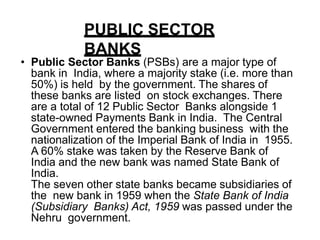
PUBLIC SECTOR
BANKS
• Public Sector Banks (PSBs) are a major type of
bank in India, where a majority stake (i.e. more than
50%) is held by the government. The shares of
these banks are listed on stock exchanges. There
are a total of 12 Public Sector Banks alongside 1
state-owned Payments Bank in India. The Central
Government entered the banking business with the
nationalization of the Imperial Bank of India in 1955.
A 60% stake was taken by the Reserve Bank of
India and the new bank was named State Bank of
India.
The seven other state banks became subsidiaries of
the new bank in 1959 when the State Bank of India
(Subsidiary Banks) Act, 1959 was passed under the
Nehru government.
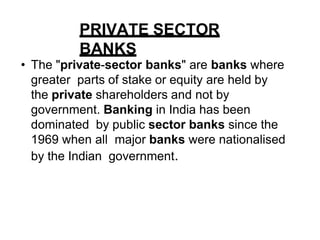
PRIVATE SECTOR
BANKS
• The "private-sector banks" are banks where
greater parts of stake or equity are held by
the private shareholders and not by
government. Banking in India has been
dominated by public sector banks since the
1969 when all major banks were nationalised
by the Indian government.
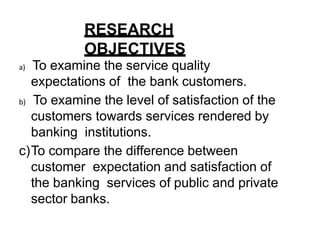
RESEARCH
OBJECTIVES
a) To examine the service quality
expectations of the bank customers.
b) To examine the level of satisfaction of the
customers towards services rendered by
banking institutions.
c)To compare the difference between
customer expectation and satisfaction of
the banking services of public and private
sector banks.
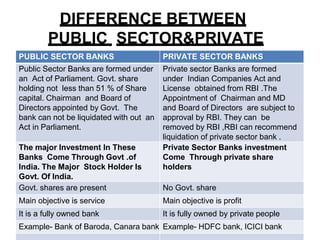
DIFFERENCE BETWEEN
PUBLIC SECTOR&PRIVATE
SECTOR BANKSPUBLIC SECTOR BANKS PRIVATE SECTOR BANKS
Public Sector Banks are formed under
an Act of Parliament. Govt. share
holding not less than 51 % of Share
capital. Chairman and Board of
Directors appointed by Govt. The
bank can not be liquidated with out an
Act in Parliament.
Private sector Banks are formed
under Indian Companies Act and
License obtained from RBI .The
Appointment of Chairman and MD
and Board of Directors are subject to
approval by RBI. They can be
removed by RBI ,RBI can recommend
liquidation of private sector bank .
The major Investment In These
Banks Come Through Govt .of
India. The Major Stock Holder Is
Govt. Of India.
Private Sector Banks investment
Come Through private share
holders
Govt. shares are present No Govt. share
Main objective is service Main objective is profit
It is a fully owned bank It is fully owned by private people
Example- Bank of Baroda, Canara bank Example- HDFC bank, ICICI bank
OVERALL SERVICE QUALITY
ANALYSIS
• The analysis shows difference between
expectation and perception concerning service
quality of public and private sector banks. On
comparing the gap score, it is found that
perceptual gap of private sector bank
customers is narrow on all the dimensions.
Therefore, it can be said that private bank
customers are more satisfied with the bank
services when compared with public sector
bank customers
DIMENSION WISE
ANALYSIS
• All tangibility service quality dimensions gap
score is higher in case of public sector banks. It
can thus be concluded that physical facilities
and availability of modern equipment is more in
private sector banks.
• RESPONSIVENESS-it is found that private
sector banks are superior in two dimensions that
is equipped ATMs and range of product and
services offered while public sector banks are
better in providing services as per customer’s
requirement and also in providing timely
services.
• RELIABILITY-There are two elements in this
dimension. One is safety of transactions with
bank employees, the gap score depicts that it’s
almost equal among public and private sector
banks of Indore. But the second element that
study trustworthiness of bank employees,
customer trust employees of private sector
banks over public sector banks.
• EMPATHY-majority of the elements explaining
empathy suggest that services of private sector banks
are better than public sector banks. Right service in
first time, promptness of service delivery, interest in
solving customer problem, polite employees,
consideration of customer interest and understanding
customer problem are the variables that shows high
gap score in public sector banks in comparison to
private sector banks. Respondents were more
satisfied with public sector banks only on two
elements that is knowledge of bank staff and
employees understand individual needs of customers.
• ASSURANCE-The data shows that gap is
more in private sector with respect to product
and service quality. The data show that gap
is more in private sector with respect to
product and service pricing and parking
facility provided to customers. While
customers are satisfied with private sector
bank’s services in respect of error free
statements and documents and also
informing customers about service delivery
time.
CONCLUSI
ON
• The present study attempted to examine service
quality dimensions of banking institutions and
also to understand difference between
expectation and satisfaction of customers of two
main banking sectors that is public and private.
The study reveals that most important service
quality practice on customer satisfaction is
empathy followed by responsiveness, tangibility,
reliability, and assurance. Private Banks seems
to have provided better services and give better
facilities than public sector banks in most of the
areas and thereby they are successful in
maintaining long association with their
customers.
• Public sector banks on the other hand enjoy
customer trust, which they have been using for their
survival. Private sector banks need to be innovative
and adaptive to maintain their market place while
public sector banks must improve their physical
facilities, technology usage and also impart soft skill
training to their employees. Customer satisfaction is
a pre-requisite to compete successfully in market. It
acts as a leading indicator of the customer purchase
intention and loyalty. Satisfied customer tends to
repeatedly avail same bank’s services and also buy
their products
• They also create new customers by
communicating positive message about it to
others. As there is a stiff competition between
banks, they are forced to be customer- centric
in order to retain the existing customers and to
acquire new ones. It is necessary for all banking
institutions to deliver high quality services and
attempt to assess and monitor their service
quality periodically. Such practice will enable
them to identify improvement areas and
incorporate customer’s views while taking
control measures.
BIBLIOGRAP
HY
• https://acadpubl.eu/hub/2018-120-5/3/287.pdf
• https://www.researchgate.net/publication/286204
7
13_Service_quality_assessment_in_banking_ind
ustry
_of_India_A_comparative_study_between_publi
c_a
nd_private_sectors
• file:///C:/Users/user/Downloads/05.pdf
• https://www.researchgate.net/publication/307871
8
87_Service_Quality_in_Public_and_Private_Sec

Service quality gap converted

  • 1.
    SERVICE QUALITY GAP BETWEENPUBLIC& PRIVATE SECTOR
  • 2.
    INTRODUCTION • Banking sectorand its performance plays an important role in an economy. The current scenario of Indian banking sector is very dynamic and competitive. To maintain market share it is necessary for banking institutions to acquire large customer base. Customers today are very much aware about various financial services and institutions, moreover they are spoilt for choice. Therefore they can only be retained by providing quality services. The present study focuses on the service quality and customer satisfaction among private and public sector banks in India.
  • 3.
    • It alsoattempts to compare service quality gaps between customer expectation and satisfaction regarding banking service. The outcome of the study shows that service gap is lower in private sector banks than public sector banks. Reliability and assurance are the dimensions where no significant difference has been observed between public and private sector banks.
  • 4.
    PUBLIC SECTOR BANKS • PublicSector Banks (PSBs) are a major type of bank in India, where a majority stake (i.e. more than 50%) is held by the government. The shares of these banks are listed on stock exchanges. There are a total of 12 Public Sector Banks alongside 1 state-owned Payments Bank in India. The Central Government entered the banking business with the nationalization of the Imperial Bank of India in 1955. A 60% stake was taken by the Reserve Bank of India and the new bank was named State Bank of India. The seven other state banks became subsidiaries of the new bank in 1959 when the State Bank of India (Subsidiary Banks) Act, 1959 was passed under the Nehru government.
  • 5.
    PRIVATE SECTOR BANKS • The"private-sector banks" are banks where greater parts of stake or equity are held by the private shareholders and not by government. Banking in India has been dominated by public sector banks since the 1969 when all major banks were nationalised by the Indian government.
  • 6.
    RESEARCH OBJECTIVES a) To examinethe service quality expectations of the bank customers. b) To examine the level of satisfaction of the customers towards services rendered by banking institutions. c)To compare the difference between customer expectation and satisfaction of the banking services of public and private sector banks.
  • 7.
    DIFFERENCE BETWEEN PUBLIC SECTOR&PRIVATE SECTORBANKSPUBLIC SECTOR BANKS PRIVATE SECTOR BANKS Public Sector Banks are formed under an Act of Parliament. Govt. share holding not less than 51 % of Share capital. Chairman and Board of Directors appointed by Govt. The bank can not be liquidated with out an Act in Parliament. Private sector Banks are formed under Indian Companies Act and License obtained from RBI .The Appointment of Chairman and MD and Board of Directors are subject to approval by RBI. They can be removed by RBI ,RBI can recommend liquidation of private sector bank . The major Investment In These Banks Come Through Govt .of India. The Major Stock Holder Is Govt. Of India. Private Sector Banks investment Come Through private share holders Govt. shares are present No Govt. share Main objective is service Main objective is profit It is a fully owned bank It is fully owned by private people Example- Bank of Baroda, Canara bank Example- HDFC bank, ICICI bank
  • 8.
    OVERALL SERVICE QUALITY ANALYSIS •The analysis shows difference between expectation and perception concerning service quality of public and private sector banks. On comparing the gap score, it is found that perceptual gap of private sector bank customers is narrow on all the dimensions. Therefore, it can be said that private bank customers are more satisfied with the bank services when compared with public sector bank customers
  • 9.
    DIMENSION WISE ANALYSIS • Alltangibility service quality dimensions gap score is higher in case of public sector banks. It can thus be concluded that physical facilities and availability of modern equipment is more in private sector banks. • RESPONSIVENESS-it is found that private sector banks are superior in two dimensions that is equipped ATMs and range of product and services offered while public sector banks are better in providing services as per customer’s requirement and also in providing timely services.
  • 10.
    • RELIABILITY-There aretwo elements in this dimension. One is safety of transactions with bank employees, the gap score depicts that it’s almost equal among public and private sector banks of Indore. But the second element that study trustworthiness of bank employees, customer trust employees of private sector banks over public sector banks.
  • 11.
    • EMPATHY-majority ofthe elements explaining empathy suggest that services of private sector banks are better than public sector banks. Right service in first time, promptness of service delivery, interest in solving customer problem, polite employees, consideration of customer interest and understanding customer problem are the variables that shows high gap score in public sector banks in comparison to private sector banks. Respondents were more satisfied with public sector banks only on two elements that is knowledge of bank staff and employees understand individual needs of customers.
  • 12.
    • ASSURANCE-The datashows that gap is more in private sector with respect to product and service quality. The data show that gap is more in private sector with respect to product and service pricing and parking facility provided to customers. While customers are satisfied with private sector bank’s services in respect of error free statements and documents and also informing customers about service delivery time.
  • 13.
    CONCLUSI ON • The presentstudy attempted to examine service quality dimensions of banking institutions and also to understand difference between expectation and satisfaction of customers of two main banking sectors that is public and private. The study reveals that most important service quality practice on customer satisfaction is empathy followed by responsiveness, tangibility, reliability, and assurance. Private Banks seems to have provided better services and give better facilities than public sector banks in most of the areas and thereby they are successful in maintaining long association with their customers.
  • 14.
    • Public sectorbanks on the other hand enjoy customer trust, which they have been using for their survival. Private sector banks need to be innovative and adaptive to maintain their market place while public sector banks must improve their physical facilities, technology usage and also impart soft skill training to their employees. Customer satisfaction is a pre-requisite to compete successfully in market. It acts as a leading indicator of the customer purchase intention and loyalty. Satisfied customer tends to repeatedly avail same bank’s services and also buy their products
  • 15.
    • They alsocreate new customers by communicating positive message about it to others. As there is a stiff competition between banks, they are forced to be customer- centric in order to retain the existing customers and to acquire new ones. It is necessary for all banking institutions to deliver high quality services and attempt to assess and monitor their service quality periodically. Such practice will enable them to identify improvement areas and incorporate customer’s views while taking control measures.
  • 16.