College of nursing
madras medical college, Chennai
medical surgical nursing
cushing syndrome
Presented by
Edwin jose .l
Msc(n) I year
INTRODUCTION
 Cushing syndrome is an endocrine disease with multiple etiologies
and is characterized by a constellation of clinical manifestations that
result from excessive concentrations of circulating cortisol (i.e.,
hypercortisolism).
 The syndrome is named after Harvey Cushing, an American surgeon
who first reported the condition in 1912.
DEFINITION
Cushing syndrome is a clinical condition that results from chronic
exposure to excess corticosteroids, particularly glucocorticoids.
PREVALENCE
 The prevalence is estimated to be nearly 40 per million, and the incidence
ranges from 1.2 to 2.4 per million per year, according to several population-
based studies
 Among adults, CS affects women 3-times more frequently than men, and
symptoms commonly appear between the third and sixth decade of life.
 It has been reported that CS appears at a younger age and with a more severe
clinical presentation in men than in women .
 In older adults, a lack of difference in the prevalence of CS between men and
women has been reported
NORMAL PHYSIOLOGY
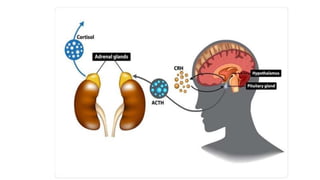
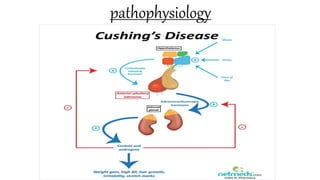
 Under normal physiological conditions (circadian rhythm, where
cortisol levels peak in early morning and late at night), systemic
inflammation (cytokine), or stress (physiological or psychological),
corticotropin-releasing hormone (CRH) is released from the
paraventricular hypothalamic nucleus via the median eminence.
From the median eminence, CRH is transported in the hypophyseal
portal venous system to the pituitary gland, where it binds to the
CRH receptor-1 (CRH-R1) on pituitary corticotroph cells.
CRH binding to CRH-R1 receptors activates adenylate cyclase and
stimulates proopiomelanocortin (POMC) gene expression in the
corticotroph cells.
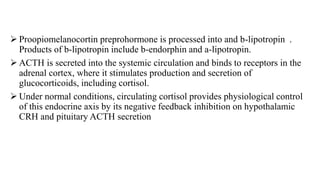
 Proopiomelanocortin preprohormone is processed into and b-lipotropin .
Products of b-lipotropin include b-endorphin and a-lipotropin.
 ACTH is secreted into the systemic circulation and binds to receptors in the
adrenal cortex, where it stimulates production and secretion of
glucocorticoids, including cortisol.
 Under normal conditions, circulating cortisol provides physiological control
of this endocrine axis by its negative feedback inhibition on hypothalamic
CRH and pituitary ACTH secretion
causes
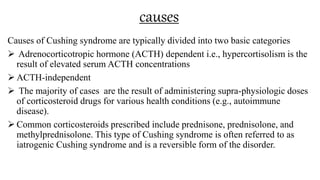
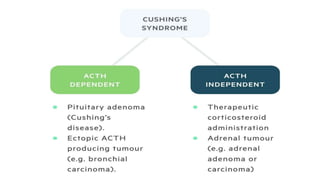
Causes of Cushing syndrome are typically divided into two basic categories
 Adrenocorticotropic hormone (ACTH) dependent i.e., hypercortisolism is the
result of elevated serum ACTH concentrations
 ACTH-independent
 The majority of cases are the result of administering supra-physiologic doses
of corticosteroid drugs for various health conditions (e.g., autoimmune
disease).
 Common corticosteroids prescribed include prednisone, prednisolone, and
methylprednisolone. This type of Cushing syndrome is often referred to as
iatrogenic Cushing syndrome and is a reversible form of the disorder.
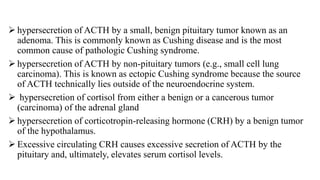
 hypersecretion of ACTH by a small, benign pituitary tumor known as an
adenoma. This is commonly known as Cushing disease and is the most
common cause of pathologic Cushing syndrome.
 hypersecretion of ACTH by non-pituitary tumors (e.g., small cell lung
carcinoma). This is known as ectopic Cushing syndrome because the source
of ACTH technically lies outside of the neuroendocrine system.
 hypersecretion of cortisol from either a benign or a cancerous tumor
(carcinoma) of the adrenal gland
 hypersecretion of corticotropin-releasing hormone (CRH) by a benign tumor
of the hypothalamus.
 Excessive circulating CRH causes excessive secretion of ACTH by the
pituitary and, ultimately, elevates serum cortisol levels.
pathophysiology
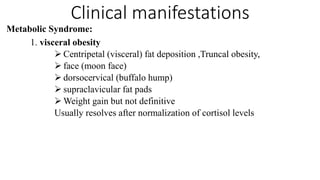
Clinical manifestations
Metabolic Syndrome:
1. visceral obesity
 Centripetal (visceral) fat deposition ,Truncal obesity,
 face (moon face)
 dorsocervical (buffalo hump)
 supraclavicular fat pads
 Weight gain but not definitive
Usually resolves after normalization of cortisol levels
2. protein-wasting symptoms
 skin thinning,
 wide purple striae,
 proximal muscle wasting, due to the protein wasting effect of cortisol
 Skin becomes fragile to minor trauma, leading to frequent bruising,
ulcerations, and infections
 Muscle wasting, especially in the lower limbs leads to atrophy, fatigue,
weakness, and gait disturbance
 Bone wasting caused by hypercortisolism leads to general osteoporosis.
 Trabecular bone, particularly the vertebral body, is the most frequently
affected part, and spinal compression fractures are observed in around half
of patients with CD.
3. Hyperglycemia :
Chronic excessive cortisol secretion leads to muscle, liver, and
adipocyte insulin resistance.
Nearly half of patients with Cushing disease are affected by
diabetes mellitus
4. Dyslipidemia.
nearly half of patients with Cushing disease have lipid
abnormalities
Cardiovascular Disease:
 Arterial Atherosclerosis and Hypertension
 Common features in Cushing syndrome
 Common in nearly 50% of Cushing syndrome
 Arterial and Venous Thrombosis
 caused by lipid and coagulation disturbances
 Hypercoagulability
Opportunistic Infections:
 Increased susceptibility to infection is caused by the direct
immunosuppression effect of hypercortisolemia .
 Extremely high cortisol levels are associated with an increased risk of
serious infections.
 The risk of fungal infections depends on the degree of cortisol excess.
Neuropsychiatric Disorders:
 depression
 irritability
 anxiety
 sleep disturbance
Cognitive Impairments:
 Short-term memory and cognition impairment
 Loss of brain volume, particularly hippocampal atrophy, is induced by
chronic hypercortisolemia
Other Clinical Features:
 Systemic edema - common symptom and is caused by increased
permeability rather than congestive heart failure.
 Renal stones are seen in nearly half of patients
 hirsutism and hypogonadism- excess of adrenocortical androgens
 Most women experience dysmenorrhea, and infertility
 Loss of libido is also frequent in men
Diagnostic evaluation
History collection - drug taking history to exclude
exogeneous glucocorticoid exposure is necessary
Physical examination
Routine Laboratory Analysis- increased neutrophil and
decreased lymphocyte and eosinophil counts; hypokalemia;
metabolic alkalosis; hyperglycemia; and
hypercholesterolemia, and may be useful for the follow-up
of treated patients.
Initial Biochemical Tests for the Screening of CS
24 h urinary free cortisol (UFC; at least two measurements)
late-night salivary and serum cortisol (two measurements)
1-mg overnight dexamethasone suppression test (DST)
 longer low-dose DST (2 mg/d for 48 h)
Other Examination:
Hair cortisol levels
segmental hair cortisol levels
Biochemical Examinations to Diagnose CD:
 Plasma ACTH Levels
 High-Dose Dexamethasone Suppression Test (HDDST)
 CRH Test
 Desmopressin Test
Imaging Studies to Diagnose CD:
 Pituitary Magnetic Resonance Imaging (MRI)
 fluorodeoxyglucose-positron emission tomography
 IPSS
variants
 Cyclic CS (Periodic CS)
Cyclic Cushing's syndrome (CS) is a rare disorder, characterized by repeated episodes
of cortisol excess interspersed by periods of normal cortisol secretion. The so-called
cycles of hypercortisolism can occur regularly or irregularly with intercyclic phases
ranging from days to years
 Hypercortisolic States without CS (“Pseudo-Cushing”)
 Pseudo-Cushing’s syndrome (PCS) constitutes a group of physiological or non-
physiological medical conditions that mimic Cushing’s syndrome (CS) clinical
features along with a mild biochemical hypercortisolaemia which remains under a
physiological feedback hormonal control.
 Physiological conditions such as pregnancy, surgical or emotional stress, severe
illness, intense chronic exercise, and non-physiological as chronic alcoholism,
obesity, metabolic syndrome, poorly controlled diabetes mellitus, major
depression, malnutrition, anorexia nervosa represent a PCS.
treatment
CS treatment includes
 normalization of cortisol hypersecretion,
 reversal of the clinical features associated with CS such as diabetes mellitus,
hypertension, muscle atrophy, enhanced cardiovascular risk, depression,
memory impairment, and decreased QoL,
 prevention of or recovery from concomitant comorbidities while restoring life
expectancy and QoL to those in the general population,
 long-term disease control without tumor recurrence
 reversal of optic chiasm compression in cases of pituitary macro-tumor, if
present.
Pharmacotherapy:
Tumour directed drugs
Cabergoline
Pasireotide
Steroidogenesis Inhibitors
Metyrapone
Ketoconazole
 mitotane
 etomidate
Combination Therapy
Glucocorticoid Receptor Antagonists
 Mifepristone
Surgical management
 Pituitary Tumor excision - by transsphenoidal hypophysectomy
 Adrenalectomy – for primary adrenal hypertrophy
 Radiation therapy – for residual tumor
complications
Diabetes mellitus
Hypertension
Dyslipidemia
Osteoporosis
Electrolyte abnormalities
Prevention and treatment of thromboembolic
disease
Coronary heart disease
Infection
Nursing management
 Decreasing risk for injury
 Decreasing risk for infection
 Preparing the patient for surgery
 Encouraging rest and activity
 Promoting skin integrity
 Improving body image
 Improving thought processes
 Monitoring and managing potential complications
NURSING DIAGNOSIS
 Risk for injury related to weakness
 Risk for infection related to altered protein metabolism and inflammatory
response
 Self-care deficit related to weakness, fatigue, muscle wasting, and altered
sleep patterns Impaired skin integrity related to edema, impaired healing, and
thin and fragile skin
 Disturbed body image related to altered physical appearance, impaired sexual
functioning, and decreased activity level
 Disturbed thought processes related to mood swings, irritability, and
depression

Cushing syndrome

  • 1.
    College of nursing madrasmedical college, Chennai medical surgical nursing cushing syndrome Presented by Edwin jose .l Msc(n) I year
  • 2.
    INTRODUCTION  Cushing syndromeis an endocrine disease with multiple etiologies and is characterized by a constellation of clinical manifestations that result from excessive concentrations of circulating cortisol (i.e., hypercortisolism).  The syndrome is named after Harvey Cushing, an American surgeon who first reported the condition in 1912.
  • 3.
    DEFINITION Cushing syndrome isa clinical condition that results from chronic exposure to excess corticosteroids, particularly glucocorticoids.
  • 4.
    PREVALENCE  The prevalenceis estimated to be nearly 40 per million, and the incidence ranges from 1.2 to 2.4 per million per year, according to several population- based studies  Among adults, CS affects women 3-times more frequently than men, and symptoms commonly appear between the third and sixth decade of life.  It has been reported that CS appears at a younger age and with a more severe clinical presentation in men than in women .  In older adults, a lack of difference in the prevalence of CS between men and women has been reported
  • 5.
    NORMAL PHYSIOLOGY  Undernormal physiological conditions (circadian rhythm, where cortisol levels peak in early morning and late at night), systemic inflammation (cytokine), or stress (physiological or psychological), corticotropin-releasing hormone (CRH) is released from the paraventricular hypothalamic nucleus via the median eminence. From the median eminence, CRH is transported in the hypophyseal portal venous system to the pituitary gland, where it binds to the CRH receptor-1 (CRH-R1) on pituitary corticotroph cells. CRH binding to CRH-R1 receptors activates adenylate cyclase and stimulates proopiomelanocortin (POMC) gene expression in the corticotroph cells.
  • 6.
     Proopiomelanocortin preprohormoneis processed into and b-lipotropin . Products of b-lipotropin include b-endorphin and a-lipotropin.  ACTH is secreted into the systemic circulation and binds to receptors in the adrenal cortex, where it stimulates production and secretion of glucocorticoids, including cortisol.  Under normal conditions, circulating cortisol provides physiological control of this endocrine axis by its negative feedback inhibition on hypothalamic CRH and pituitary ACTH secretion
  • 8.
    causes Causes of Cushingsyndrome are typically divided into two basic categories  Adrenocorticotropic hormone (ACTH) dependent i.e., hypercortisolism is the result of elevated serum ACTH concentrations  ACTH-independent  The majority of cases are the result of administering supra-physiologic doses of corticosteroid drugs for various health conditions (e.g., autoimmune disease).  Common corticosteroids prescribed include prednisone, prednisolone, and methylprednisolone. This type of Cushing syndrome is often referred to as iatrogenic Cushing syndrome and is a reversible form of the disorder.
  • 9.
     hypersecretion ofACTH by a small, benign pituitary tumor known as an adenoma. This is commonly known as Cushing disease and is the most common cause of pathologic Cushing syndrome.  hypersecretion of ACTH by non-pituitary tumors (e.g., small cell lung carcinoma). This is known as ectopic Cushing syndrome because the source of ACTH technically lies outside of the neuroendocrine system.  hypersecretion of cortisol from either a benign or a cancerous tumor (carcinoma) of the adrenal gland  hypersecretion of corticotropin-releasing hormone (CRH) by a benign tumor of the hypothalamus.  Excessive circulating CRH causes excessive secretion of ACTH by the pituitary and, ultimately, elevates serum cortisol levels.
  • 11.
  • 12.
    Clinical manifestations Metabolic Syndrome: 1.visceral obesity  Centripetal (visceral) fat deposition ,Truncal obesity,  face (moon face)  dorsocervical (buffalo hump)  supraclavicular fat pads  Weight gain but not definitive Usually resolves after normalization of cortisol levels
  • 13.
    2. protein-wasting symptoms skin thinning,  wide purple striae,  proximal muscle wasting, due to the protein wasting effect of cortisol  Skin becomes fragile to minor trauma, leading to frequent bruising, ulcerations, and infections  Muscle wasting, especially in the lower limbs leads to atrophy, fatigue, weakness, and gait disturbance  Bone wasting caused by hypercortisolism leads to general osteoporosis.  Trabecular bone, particularly the vertebral body, is the most frequently affected part, and spinal compression fractures are observed in around half of patients with CD.
  • 14.
    3. Hyperglycemia : Chronicexcessive cortisol secretion leads to muscle, liver, and adipocyte insulin resistance. Nearly half of patients with Cushing disease are affected by diabetes mellitus 4. Dyslipidemia. nearly half of patients with Cushing disease have lipid abnormalities
  • 15.
    Cardiovascular Disease:  ArterialAtherosclerosis and Hypertension  Common features in Cushing syndrome  Common in nearly 50% of Cushing syndrome  Arterial and Venous Thrombosis  caused by lipid and coagulation disturbances  Hypercoagulability
  • 16.
    Opportunistic Infections:  Increasedsusceptibility to infection is caused by the direct immunosuppression effect of hypercortisolemia .  Extremely high cortisol levels are associated with an increased risk of serious infections.  The risk of fungal infections depends on the degree of cortisol excess. Neuropsychiatric Disorders:  depression  irritability  anxiety  sleep disturbance
  • 17.
    Cognitive Impairments:  Short-termmemory and cognition impairment  Loss of brain volume, particularly hippocampal atrophy, is induced by chronic hypercortisolemia Other Clinical Features:  Systemic edema - common symptom and is caused by increased permeability rather than congestive heart failure.  Renal stones are seen in nearly half of patients  hirsutism and hypogonadism- excess of adrenocortical androgens  Most women experience dysmenorrhea, and infertility  Loss of libido is also frequent in men
  • 18.
    Diagnostic evaluation History collection- drug taking history to exclude exogeneous glucocorticoid exposure is necessary Physical examination Routine Laboratory Analysis- increased neutrophil and decreased lymphocyte and eosinophil counts; hypokalemia; metabolic alkalosis; hyperglycemia; and hypercholesterolemia, and may be useful for the follow-up of treated patients.
  • 19.
    Initial Biochemical Testsfor the Screening of CS 24 h urinary free cortisol (UFC; at least two measurements) late-night salivary and serum cortisol (two measurements) 1-mg overnight dexamethasone suppression test (DST)  longer low-dose DST (2 mg/d for 48 h) Other Examination: Hair cortisol levels segmental hair cortisol levels
  • 20.
    Biochemical Examinations toDiagnose CD:  Plasma ACTH Levels  High-Dose Dexamethasone Suppression Test (HDDST)  CRH Test  Desmopressin Test Imaging Studies to Diagnose CD:  Pituitary Magnetic Resonance Imaging (MRI)  fluorodeoxyglucose-positron emission tomography  IPSS
  • 21.
    variants  Cyclic CS(Periodic CS) Cyclic Cushing's syndrome (CS) is a rare disorder, characterized by repeated episodes of cortisol excess interspersed by periods of normal cortisol secretion. The so-called cycles of hypercortisolism can occur regularly or irregularly with intercyclic phases ranging from days to years  Hypercortisolic States without CS (“Pseudo-Cushing”)  Pseudo-Cushing’s syndrome (PCS) constitutes a group of physiological or non- physiological medical conditions that mimic Cushing’s syndrome (CS) clinical features along with a mild biochemical hypercortisolaemia which remains under a physiological feedback hormonal control.  Physiological conditions such as pregnancy, surgical or emotional stress, severe illness, intense chronic exercise, and non-physiological as chronic alcoholism, obesity, metabolic syndrome, poorly controlled diabetes mellitus, major depression, malnutrition, anorexia nervosa represent a PCS.
  • 22.
    treatment CS treatment includes normalization of cortisol hypersecretion,  reversal of the clinical features associated with CS such as diabetes mellitus, hypertension, muscle atrophy, enhanced cardiovascular risk, depression, memory impairment, and decreased QoL,  prevention of or recovery from concomitant comorbidities while restoring life expectancy and QoL to those in the general population,  long-term disease control without tumor recurrence  reversal of optic chiasm compression in cases of pituitary macro-tumor, if present.
  • 23.
    Pharmacotherapy: Tumour directed drugs Cabergoline Pasireotide SteroidogenesisInhibitors Metyrapone Ketoconazole  mitotane  etomidate
  • 24.
  • 25.
    Surgical management  PituitaryTumor excision - by transsphenoidal hypophysectomy  Adrenalectomy – for primary adrenal hypertrophy  Radiation therapy – for residual tumor
  • 26.
  • 27.
    Nursing management  Decreasingrisk for injury  Decreasing risk for infection  Preparing the patient for surgery  Encouraging rest and activity  Promoting skin integrity  Improving body image  Improving thought processes  Monitoring and managing potential complications
  • 28.
    NURSING DIAGNOSIS  Riskfor injury related to weakness  Risk for infection related to altered protein metabolism and inflammatory response  Self-care deficit related to weakness, fatigue, muscle wasting, and altered sleep patterns Impaired skin integrity related to edema, impaired healing, and thin and fragile skin  Disturbed body image related to altered physical appearance, impaired sexual functioning, and decreased activity level  Disturbed thought processes related to mood swings, irritability, and depression

Editor's Notes

  • #10 Cushing disease is a specific type of Cushing syndrome. It occurs when a pituitary tumor causes the body to make too much cortisol. Cushing disease is the most common form of endogenous (from the body) Cushing syndrome, and makes up about 70% of Cushing syndrome cases.
  • #14 Trabecular bone, also called cancellous bone, is porous bone composed of trabeculated bone tissue.
  • #18 Edema is caused by either systemic diseases, that is, diseases that affect the various organ systems of the body, or by local conditions involving just the affected extremities.
  • #20 Salivary cortisol is a reliable indicator of plasma free cortisol levels unrelated to the saliva production rate and CBG variability 1mg over night DST- A serum cortisol level above 50 nmol/L (1.8 µg/dL) is considered suggestive of CS, Longer dose DST -The standard format of the test is known as the Liddle test [79]. With a cut-off serum cortisol level of 50 nmol/L (1.8 µg/dL), the test has a sensitivity of approximately 90%, but its specificity is not high
  • #21 Dsmopressin test - After an intravenous injection of 5 microg DDAVP, plasma ACTH levels increased to more than 200% of the basal levels in 10 of 10 patients with Cushing's disease, but remained less than 150% in all of 11 normal subjects, 3 patients with Addison's disease, 5 cases of Cushing's disease in remission, and 3 patients with ectopic ACTH syndrome  Inferior petrosal sinus sampling- Inferior petrosal sinus sampling (IPSS) is an invasive procedure in which adrenocorticotropic hormone (ACTH) levels are sampled from the veins that drain the pituitary gland; these levels are then compared with the ACTH levels in the peripheral blood to determine whether a pituitary tumor (as opposed to an ectopic source of ACTH) is responsible for ACTH-dependent Cushing syndrome. IPSS can also be used to establish on which side of the pituitary gland the tumor is located.
  • #24 Pasireotide- a multiligand somatostatin analog that can bind to SSTRs, Cabergoline - which has a high affinity for dopamine 2 receptors (D2Rs), is a dopamine agonist (DA) reducing tumour size Ketoconazole is an antifungal agent. It inhibits cytochrome P450 enzymes at multiple levels of steroidogenesis, and effectively reduces glucocorticoid and androgen synthesis by inhibiting 11β-hydroxylase and lowers adrenal androgen levels by blocking 17,20-lyase Metyrapone mostly inhibits 11β-hydroxylase and inhibits 18-hydroxylase to a lesser extent, thereby reducing cortisol and aldosterone synthesis Mitotane - oral cytotoxic agent mainly used in the management of adrenocortical carcinoma. It is also an inhibitor of multiple enzymes in the adrenal cortex, including cholesterol side chain cleavage enzyme, 3-b-hydroxysteroid dehydrogenase, 11b-hydroxylase, and aldosterone synthase Etomidate - is an intravenous anesthetic agent that appears to depress CNS function via GABA. Cortisol synthesis is prevented by inhibiting CYP11B1 with 11-beta hydroxylase activity and cytochrome P450scc at high concentrations.
  • #25 Mifepristone - blocks the actions of cortisol at the tissue level without a concomitant reduction in serum cortisol levels. It has a rapid onset of action and can be used to treat acute complications of CS, especially cortisol-induced psychosis