Cushing syndrome
Junior cleks
Dr Nixson Onyanga
INTRODUCTION
• The symptoms and signs of Cushing's syndrome
result directly from chronic exposure to excess
glucocorticoid.
• Establishing the diagnosis is often difficult because
few of the symptoms or signs are pathognomonic
of the syndrome in isolation.
• Obesity, hypertension, and glucose intolerance) are
common in individuals who do not have adrenal
hyperfunction.
Etiology
Iatrogenic Cushing's syndrome
• More than 10 million Americans receive
pharmacologic doses of glucocorticoids each
year.
• Therefore, iatrogenic Cushing's syndrome
must be more common than any other cause
• but is seldom reported.
EPIDEMIOLOGY
• Males had a three times greater incidence of the
ectopic ACTH syndrome 30 years ago.
• Females are three to eight times more likely than
males to develop Cushing's disease.
• Cushing's disease occurs mainly in women aged 25 to
45 years.
• It is unusual in children but still accounts for up to 46
percent of cases of childhood Cushing's syndrome,
occurring mostly after puberty
CLINICAL MANIFESTATIONS
• signs and symptoms most suggestive of the
presence of hypercortisolism include:
proximal muscle weakness.
facial plethora.
wasting of the extremities
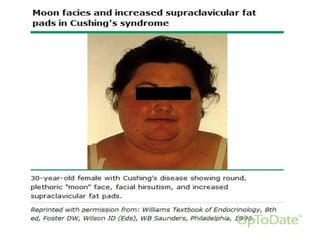
increased fat in the abdomen and face
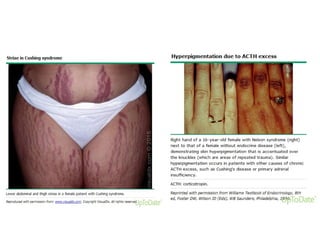
wide purplish striae.
bruising with no obvious trauma
supraclavicular fat pads
Reproductive clinical presentation
• Menstrual irregularities are common in women
with Cushing's syndrome.
• The menstrual abnormalities correlated with
increased serum cortisol and decreased serum
estradiol concentrations.
• The menstrual irregularities appear to be due
to suppression of secretion of gonadotropin-
releasing hormone by hypercortisolemia.
• Androgen excess in affected women can cause
the following symptoms:
– Hirsutism, which is usually mild and limited to the
face but can be generalized.
– Oily facial skin and acne on the face, neck, or
shoulders.
– Increased libido.
– Virilization, including temporal balding, deepening
voice, male body habitus, male escutcheon, and
clitoral hypertrophy,
Dermatological features
• Easy bruisability
• Striae
• Skin atrophy
• Fungal infections
• Hyperpigmentation
Metabolic
• Glucose intolerance — Glucose intolerance is
common in Cushing's syndrome.
• It is primarily due to stimulation of gluconeogenesis by
cortisol and peripheral insulin resistance caused by
obesity.
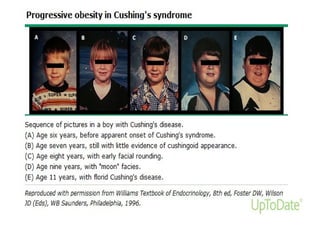
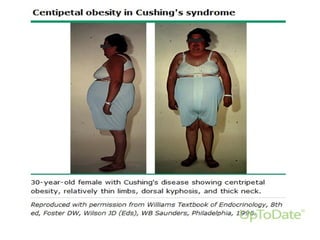
• Progressive obesity — The most common feature of
patients with Cushing's syndrome is progressive, central
(centripetal) obesity
• usually involving the face, neck, trunk, abdomen, and,
internally, spinal canal and mediastinum
Cardiovascular
• Patients with endogenous Cushing's syndrome are
at increased risk of death from cardiovascular
disease, including:
– myocardial infarction
– Stroke
– Thromboembolism
• common cardiovascular problems in patients with
Cushing's syndrome include hypertension and
dyslipidemia.
Thromboembolic events
• The risk is possibly due to glucocorticoid-
induced increases in plasma concentrations of
clotting factors,
• especially factorVIII and von Willebrand factor
complex, and decreases in fibrinolytic activity.
• Elevated serum homocysteine concentrations.
• contribute to the excess risk of
thromboembolism include obesity and surgery
Bone health/musculoskeletal
Proximal muscle wasting and weakness
• Weakness and proximal muscle wasting are
common in Cushing's syndrome, being
induced by the catabolic effects of excess
glucocorticoid on skeletal muscle.
• Hypokalemia, due to decreased renal
conversion of cortisol to cortisone by 11-beta
hydroxysteroid dehydrogenase type II
Bone loss
• Osteoporosis is common in patients with
Cushing's syndrome.
• It is caused by
– decreased intestinal calcium absorption.
– decreased bone formation.
– increased bone resorption.
– decreased renal calcium reabsorption
Neuropsychologic changes and cognition
• A number of neuropsychologic symptoms may
occur, including
– insomnia
– Depression
– memory loss
• Depression
– increased appetite
– weight gain
The most common psychologic symptoms are
• Emotional lability
• Depression (37 to 86 percent of patients)
• Irritability (86 percent)
• Anxiety (up to 80 percent)
• Panic attacks (up to 30 percent)
• Mild paranoia and mania are less common
Infection and immune function
• Glucocorticoids inhibit immune function,
thereby contributing to an increased
frequency of infections.
• There may be thymic atrophy.
• Fall in circulating CD4 cells and decline in
natural killer cell activity.
• glucocorticoids inhibit the synthesis of almost
all cytokines.
DIAGNOSTIC
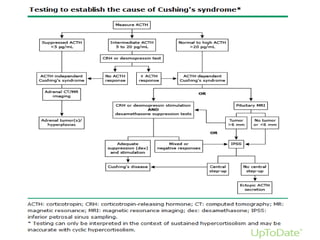
• Normal (CS unlikely): We suggest no further
testing for Cushing's syndrome in patients with
negative results on two different tests (unless
cyclical disease is suspected, which is rare).
• Abnormal (CS confirmed) — The diagnosis
of CS is established when at least two different
first-line tests are unequivocally abnormal, and
physiologic hypercortisolism has been excluded.
General findings consistent with Cushing's
syndrome
• A hypokalaemic metabolic alkalosis may be
seen, along with impaired glucose tolerance.
• Ectopic ACTH secretion (e.g. secondary to
small cell lung cancer) is characteristically
associated with very low potassium levels.
• 24-hour urinary cortisol excretion
• Twenty-four-hour urinary cortisol excretion
provides a direct and reliable practical index
of cortisol secretion.
• Twenty-four hour urinary cortisol excretion is
an integrated measure of the serum free
cortisol concentration.
• Interpretation and limitations — The patient
can be assumed to have CS if basal urinary
cortisol excretion is more than three times the
upper limit of normal.
• The normal value for urine cortisol is 10 to 55
mcg/day
• and one other test is abnormal.
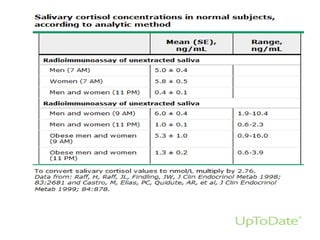
Late-night salivary cortisol
• A late-evening salivary cortisol concentration
can be used to establish the diagnosis of CS.
• it is useful to evaluate at least three samples
from different days.
• The criteria used to interpret salivary cortisol
results differ among studies
Late-night serum cortisol
• is also based upon the fact that the normal
evening nadir in serum cortisol is preserved in
obese and depressed patients but not in those
with CS.
• A late-night serum cortisol >7.5 mcg/dL (207
nmol/L) is used to identify CS.
Low-dose dexamethasone suppression
tests
• The low-dose DSTs are standard screening tests to
differentiate patients with CS of any cause from
patients who do not have CS
• There are two forms of low-dose DST: the 1 mg
"overnight" and the two-day 2 mg test
Overnight 1 mg test
• The overnight test consists of administration of
1 mg of dexamethasone at 11 PM to 12 AM
(midnight).
• Measurement of serum cortisol at 8 AM the
next morning.
• The 2008 Endocrine Society guidelines suggest
a diagnostic cortisol criterion of 1.8 mcg/dL (50
nmol/L).
Standard two-day 2 mg test.
• The two-day 2 mg test
• Administering 0.5 mg of dexamethasone every
six hours for eight doses.
• Measurement of serum (not urinary) cortisol
either two or six hours after the last dose.
• The same criteria for normal suppression (<1.8
mcg/dL [<50 nmol/L]) used as diagnostic.
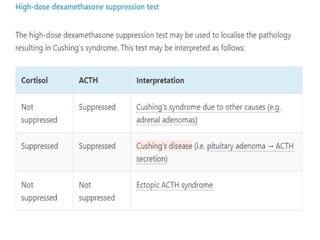
• Petrosal sinus sampling of ACTH may be
needed to differentiate between pituitary and
ectopic ACTH secretion.
An insulin stress test is used to differentiate
between true Cushing's and pseudo-Cushing's.
SPECIAL POPULATIONS
• Pregnancy: We suggest a 24-hour urinary
free cortisol (UFC) test or late-night salivary
cortisol test in pregnant.
• Adrenal incidentaloma: we suggest the 1
mg DST as the first-line test to screen for
hypercortisolism in these patients.
• Cyclic Cushing's: we suggest UFC or late-
night salivary cortisol over the DST
Treatment of Cushing's syndrome
Goals — Ideal therapy of Cushing's syndrome
would achieve the following goals:
• Reverse the clinical manifestations by reducing
cortisol secretion to normal
• Eradicate any tumor threatening the health of
the patient
• Avoid permanent dependence upon medications
• Avoid permanent hormone deficiency
Exogenous Cushing's syndrome:
• The treatment of Cushing's syndrome due to
exogenous therapy is to stop the glucocorticoid.
• Most patients who have taken enough
glucocorticoid for a long enough time to cause
Cushing's syndrome will have a period of
hypothalamic-pituitary adrenal insufficiency
when therapy is discontinued.
• Thus, gradual withdrawal is necessary.
CUSHING'S DISEASE:
• Transsphenoidal surgery :The treatment of
choice for Cushing's disease (ACTH-producing
pituitary tumor)
• Medical therapy: targeting the corticotroph
tumor such as Cabergoline or pasireotide.
• Aggressive corticotroph tumors: the
alkylating agent temozolomide resulted in a partial
response in approximately two-thirds of patients
Pituitary irradiation
– For patients in whom fertility is an important
concern
– in whom a tumor is not found
– who are not cured by transsphenoidal resection of a
tumor,
• pituitary irradiation is one of the next treatment
options;
• it may also be considered as primary therapy for
children under age 18 years.
Adrenalectomy
Bilateral total adrenalectomy with lifelong
daily glucocorticoid and mineralocorticoid
replacement therapy is the final definitive
cure, and may be preferred by some
patients instead of radiation therapy.
ECTOPIC ACTH AND CRH SYNDROMES
• Ectopic ACTH — The optimal therapy of the ectopic
corticotropin (ACTH) syndrome (secretion of ACTH by a
nonpituitary tumor) is surgical excision of the tumor.
• Thereby removing the source of ACTH and curing the
metabolic disorder.
• Nonresectable tumors — For those patients with
nonresectable tumors, the hypercortisolism can be
controlled with adrenal enzyme inhibitors, such
as ketoconazole, metyrapone, and etomidate.
PRIMARY ADRENAL DISEASES
• Adrenal tumors should be removed with
unilateral adrenalectomy while bilateral
adrenalectomy is required for
• bilateral micronodular hyperplasia
• most patients with macronodular adrenal
hyperplasia.
Thanks You
Reference
• UpToDate 2021.
• Oxford handbook of endocrinology.

cushings syndrome topic presentation .pptx

  • 1.
  • 2.
    INTRODUCTION • The symptomsand signs of Cushing's syndrome result directly from chronic exposure to excess glucocorticoid. • Establishing the diagnosis is often difficult because few of the symptoms or signs are pathognomonic of the syndrome in isolation. • Obesity, hypertension, and glucose intolerance) are common in individuals who do not have adrenal hyperfunction.
  • 3.
    Etiology Iatrogenic Cushing's syndrome •More than 10 million Americans receive pharmacologic doses of glucocorticoids each year. • Therefore, iatrogenic Cushing's syndrome must be more common than any other cause • but is seldom reported.
  • 5.
    EPIDEMIOLOGY • Males hada three times greater incidence of the ectopic ACTH syndrome 30 years ago. • Females are three to eight times more likely than males to develop Cushing's disease. • Cushing's disease occurs mainly in women aged 25 to 45 years. • It is unusual in children but still accounts for up to 46 percent of cases of childhood Cushing's syndrome, occurring mostly after puberty
  • 6.
    CLINICAL MANIFESTATIONS • signsand symptoms most suggestive of the presence of hypercortisolism include: proximal muscle weakness. facial plethora. wasting of the extremities increased fat in the abdomen and face wide purplish striae. bruising with no obvious trauma supraclavicular fat pads
  • 7.
    Reproductive clinical presentation •Menstrual irregularities are common in women with Cushing's syndrome. • The menstrual abnormalities correlated with increased serum cortisol and decreased serum estradiol concentrations. • The menstrual irregularities appear to be due to suppression of secretion of gonadotropin- releasing hormone by hypercortisolemia.
  • 8.
    • Androgen excessin affected women can cause the following symptoms: – Hirsutism, which is usually mild and limited to the face but can be generalized. – Oily facial skin and acne on the face, neck, or shoulders. – Increased libido. – Virilization, including temporal balding, deepening voice, male body habitus, male escutcheon, and clitoral hypertrophy,
  • 10.
    Dermatological features • Easybruisability • Striae • Skin atrophy • Fungal infections • Hyperpigmentation
  • 12.
    Metabolic • Glucose intolerance— Glucose intolerance is common in Cushing's syndrome. • It is primarily due to stimulation of gluconeogenesis by cortisol and peripheral insulin resistance caused by obesity. • Progressive obesity — The most common feature of patients with Cushing's syndrome is progressive, central (centripetal) obesity • usually involving the face, neck, trunk, abdomen, and, internally, spinal canal and mediastinum
  • 15.
    Cardiovascular • Patients withendogenous Cushing's syndrome are at increased risk of death from cardiovascular disease, including: – myocardial infarction – Stroke – Thromboembolism • common cardiovascular problems in patients with Cushing's syndrome include hypertension and dyslipidemia.
  • 16.
    Thromboembolic events • Therisk is possibly due to glucocorticoid- induced increases in plasma concentrations of clotting factors, • especially factorVIII and von Willebrand factor complex, and decreases in fibrinolytic activity. • Elevated serum homocysteine concentrations. • contribute to the excess risk of thromboembolism include obesity and surgery
  • 17.
    Bone health/musculoskeletal Proximal musclewasting and weakness • Weakness and proximal muscle wasting are common in Cushing's syndrome, being induced by the catabolic effects of excess glucocorticoid on skeletal muscle. • Hypokalemia, due to decreased renal conversion of cortisol to cortisone by 11-beta hydroxysteroid dehydrogenase type II
  • 18.
    Bone loss • Osteoporosisis common in patients with Cushing's syndrome. • It is caused by – decreased intestinal calcium absorption. – decreased bone formation. – increased bone resorption. – decreased renal calcium reabsorption
  • 19.
    Neuropsychologic changes andcognition • A number of neuropsychologic symptoms may occur, including – insomnia – Depression – memory loss • Depression – increased appetite – weight gain
  • 20.
    The most commonpsychologic symptoms are • Emotional lability • Depression (37 to 86 percent of patients) • Irritability (86 percent) • Anxiety (up to 80 percent) • Panic attacks (up to 30 percent) • Mild paranoia and mania are less common
  • 21.
    Infection and immunefunction • Glucocorticoids inhibit immune function, thereby contributing to an increased frequency of infections. • There may be thymic atrophy. • Fall in circulating CD4 cells and decline in natural killer cell activity. • glucocorticoids inhibit the synthesis of almost all cytokines.
  • 22.
    DIAGNOSTIC • Normal (CSunlikely): We suggest no further testing for Cushing's syndrome in patients with negative results on two different tests (unless cyclical disease is suspected, which is rare). • Abnormal (CS confirmed) — The diagnosis of CS is established when at least two different first-line tests are unequivocally abnormal, and physiologic hypercortisolism has been excluded.
  • 23.
    General findings consistentwith Cushing's syndrome • A hypokalaemic metabolic alkalosis may be seen, along with impaired glucose tolerance. • Ectopic ACTH secretion (e.g. secondary to small cell lung cancer) is characteristically associated with very low potassium levels.
  • 24.
    • 24-hour urinarycortisol excretion • Twenty-four-hour urinary cortisol excretion provides a direct and reliable practical index of cortisol secretion. • Twenty-four hour urinary cortisol excretion is an integrated measure of the serum free cortisol concentration.
  • 25.
    • Interpretation andlimitations — The patient can be assumed to have CS if basal urinary cortisol excretion is more than three times the upper limit of normal. • The normal value for urine cortisol is 10 to 55 mcg/day • and one other test is abnormal.
  • 26.
    Late-night salivary cortisol •A late-evening salivary cortisol concentration can be used to establish the diagnosis of CS. • it is useful to evaluate at least three samples from different days. • The criteria used to interpret salivary cortisol results differ among studies
  • 28.
    Late-night serum cortisol •is also based upon the fact that the normal evening nadir in serum cortisol is preserved in obese and depressed patients but not in those with CS. • A late-night serum cortisol >7.5 mcg/dL (207 nmol/L) is used to identify CS.
  • 29.
    Low-dose dexamethasone suppression tests •The low-dose DSTs are standard screening tests to differentiate patients with CS of any cause from patients who do not have CS • There are two forms of low-dose DST: the 1 mg "overnight" and the two-day 2 mg test
  • 30.
    Overnight 1 mgtest • The overnight test consists of administration of 1 mg of dexamethasone at 11 PM to 12 AM (midnight). • Measurement of serum cortisol at 8 AM the next morning. • The 2008 Endocrine Society guidelines suggest a diagnostic cortisol criterion of 1.8 mcg/dL (50 nmol/L).
  • 31.
    Standard two-day 2mg test. • The two-day 2 mg test • Administering 0.5 mg of dexamethasone every six hours for eight doses. • Measurement of serum (not urinary) cortisol either two or six hours after the last dose. • The same criteria for normal suppression (<1.8 mcg/dL [<50 nmol/L]) used as diagnostic.
  • 33.
    • Petrosal sinussampling of ACTH may be needed to differentiate between pituitary and ectopic ACTH secretion. An insulin stress test is used to differentiate between true Cushing's and pseudo-Cushing's.
  • 34.
    SPECIAL POPULATIONS • Pregnancy:We suggest a 24-hour urinary free cortisol (UFC) test or late-night salivary cortisol test in pregnant. • Adrenal incidentaloma: we suggest the 1 mg DST as the first-line test to screen for hypercortisolism in these patients. • Cyclic Cushing's: we suggest UFC or late- night salivary cortisol over the DST
  • 36.
    Treatment of Cushing'ssyndrome Goals — Ideal therapy of Cushing's syndrome would achieve the following goals: • Reverse the clinical manifestations by reducing cortisol secretion to normal • Eradicate any tumor threatening the health of the patient • Avoid permanent dependence upon medications • Avoid permanent hormone deficiency
  • 37.
    Exogenous Cushing's syndrome: •The treatment of Cushing's syndrome due to exogenous therapy is to stop the glucocorticoid. • Most patients who have taken enough glucocorticoid for a long enough time to cause Cushing's syndrome will have a period of hypothalamic-pituitary adrenal insufficiency when therapy is discontinued. • Thus, gradual withdrawal is necessary.
  • 38.
    CUSHING'S DISEASE: • Transsphenoidalsurgery :The treatment of choice for Cushing's disease (ACTH-producing pituitary tumor) • Medical therapy: targeting the corticotroph tumor such as Cabergoline or pasireotide. • Aggressive corticotroph tumors: the alkylating agent temozolomide resulted in a partial response in approximately two-thirds of patients
  • 39.
    Pituitary irradiation – Forpatients in whom fertility is an important concern – in whom a tumor is not found – who are not cured by transsphenoidal resection of a tumor, • pituitary irradiation is one of the next treatment options; • it may also be considered as primary therapy for children under age 18 years.
  • 40.
    Adrenalectomy Bilateral total adrenalectomywith lifelong daily glucocorticoid and mineralocorticoid replacement therapy is the final definitive cure, and may be preferred by some patients instead of radiation therapy.
  • 41.
    ECTOPIC ACTH ANDCRH SYNDROMES • Ectopic ACTH — The optimal therapy of the ectopic corticotropin (ACTH) syndrome (secretion of ACTH by a nonpituitary tumor) is surgical excision of the tumor. • Thereby removing the source of ACTH and curing the metabolic disorder. • Nonresectable tumors — For those patients with nonresectable tumors, the hypercortisolism can be controlled with adrenal enzyme inhibitors, such as ketoconazole, metyrapone, and etomidate.
  • 42.
    PRIMARY ADRENAL DISEASES •Adrenal tumors should be removed with unilateral adrenalectomy while bilateral adrenalectomy is required for • bilateral micronodular hyperplasia • most patients with macronodular adrenal hyperplasia.
  • 43.
  • 44.
    Reference • UpToDate 2021. •Oxford handbook of endocrinology.

Editor's Notes

  • #5 but the increasing incidence of lung cancer in cigarette-smoking females has narrowed that margin.
  • #15 increase in markers of subclinical atherosclerosis (coronary calcifications and noncalcified plaque volumes) when compared with controls