Hypercortisolism
Introduction
 Cushing’s syndrome (hypercortisolism) is a hormonal
disorder caused by prolonged exposure high levels of
steroid hormones called glucocorticoids.
 Exogenous Cushing’s syndrome: caused by taking excessive
amounts of medications e.g. prednisone, dexamethasone
 for chronic asthma, rheumatoid arthritis, lupus, to
suppress immune system after transplant to prevent
rejection, other inflammatory diseases.
 Endogenous Cushing’s syndrome: excess cortisol produced
by the adrenal glands. This is far rarer, but if left
undiagnosed & untreated it can result in a shorter lifespan.
Pathophysiology
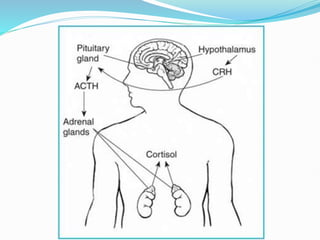
 Normally, the production and release of cortisol follows a precise
chain of events. Corticotropin-releasing hormone (CRH)
released from the hypothalamus causes the pituitary gland to
secrete ACTH, which in turn results in the production of cortisol
from the adrenal glands (located just above the kidneys).
 In healthy people, cortisol begins to rise between 3 and 4 am,
reaches a peak between 7 and 9 am, and then falls for the rest of
the day to the lowest levels when the person is unstressed and
asleep at midnight.
 Cortisol controls its own production and release by switching off
the hormones CRH and ACTH, a form of hormonal regulation
known as “negative feedback”.
 ACTH and cortisol become elevated in response to stress, such as
surgery, trauma, infection or other medical illnesses. i.e. Stress
response
Cortisol performs vital tasks in the body including:
 helping maintain blood pressure and cardiovascular
function
 reducing the immune system’s inflammatory response
 balancing the effects of insulin, which breaks down
glucose for energy
 regulating the metabolism of proteins, carbohydrates,
and fats
 The problem occurs when the negative feedback
system no longer works properly, due to malfunction
of ACTH/ cortisol-releasing glands; or there is an
artificial excess of cortisol in the body.
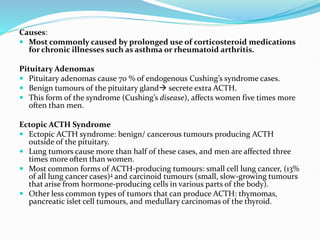
Causes:
 Most commonly caused by prolonged use of corticosteroid medications
for chronic illnesses such as asthma or rheumatoid arthritis.
Pituitary Adenomas
 Pituitary adenomas cause 70 % of endogenous Cushing’s syndrome cases.
 Benign tumours of the pituitary gland secrete extra ACTH.
 This form of the syndrome (Cushing’s disease), affects women five times more
often than men.
Ectopic ACTH Syndrome
 Ectopic ACTH syndrome: benign/ cancerous tumours producing ACTH
outside of the pituitary.
 Lung tumors cause more than half of these cases, and men are affected three
times more often than women.
 Most common forms of ACTH-producing tumours: small cell lung cancer, (13%
of all lung cancer cases)2 and carcinoid tumours (small, slow-growing tumours
that arise from hormone-producing cells in various parts of the body).
 Other less common types of tumors that can produce ACTH: thymomas,
pancreatic islet cell tumours, and medullary carcinomas of the thyroid.
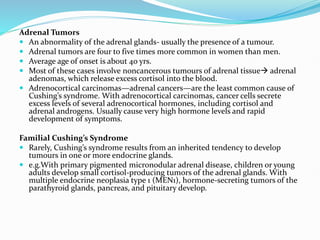
Adrenal Tumors
 An abnormality of the adrenal glands- usually the presence of a tumour.
 Adrenal tumors are four to five times more common in women than men.
 Average age of onset is about 40 yrs.
 Most of these cases involve noncancerous tumours of adrenal tissue adrenal
adenomas, which release excess cortisol into the blood.
 Adrenocortical carcinomas—adrenal cancers—are the least common cause of
Cushing’s syndrome. With adrenocortical carcinomas, cancer cells secrete
excess levels of several adrenocortical hormones, including cortisol and
adrenal androgens. Usually cause very high hormone levels and rapid
development of symptoms.
Familial Cushing’s Syndrome
 Rarely, Cushing’s syndrome results from an inherited tendency to develop
tumours in one or more endocrine glands.
 e.g.With primary pigmented micronodular adrenal disease, children or young
adults develop small cortisol-producing tumors of the adrenal glands. With
multiple endocrine neoplasia type 1 (MEN1), hormone-secreting tumors of the
parathyroid glands, pancreas, and pituitary develop.
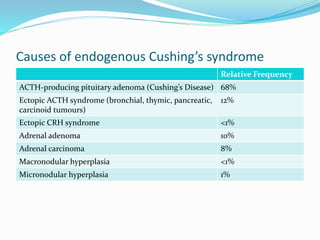
Causes of endogenous Cushing’s syndrome
Relative Frequency
ACTH-producing pituitary adenoma (Cushing’s Disease) 68%
Ectopic ACTH syndrome (bronchial, thymic, pancreatic,
carcinoid tumours)
12%
Ectopic CRH syndrome <1%
Adrenal adenoma 10%
Adrenal carcinoma 8%
Macronodular hyperplasia <1%
Micronodular hyperplasia 1%
Epidemiology
 Cushing’s syndrome is relatively rare; it affects approx.
10-15 of every million people each year. It most
commonly affects adults aged 20 to 50.
 People who are obese and have type 2 diabetes, along
with poorly controlled blood glucose—also called
blood sugar—and high blood pressure, have an
increased risk of developing the disorder.
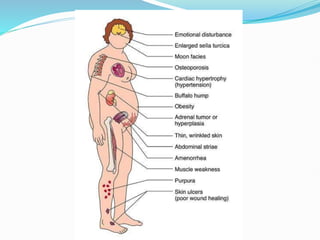
Signs & Symptoms
Most people with Cushing syndrome will have:
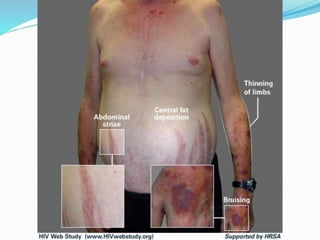
 Upper body obesity (above the waist) and thin arms and legs
 Round, red, full face (moon face)
 Slow growth rate in children
Skin changes that are often seen:
 Acne or skin infections
 Purple marks (1/2 inch or more wide) called striae on the skin of the
abdomen, thighs, and breasts
 Thin skin with easy bruising
Muscle and bone changes include:
 Backache, which occurs with routine activities
 Bone pain or tenderness
 Collection of fat between the shoulders (buffalo hump)
 Thinning of the bones, which leads to rib and spine fractures
 Weak muscles
Women with Cushing syndrome often have:
 Excess hair growth on the face, neck, chest, abdomen, and thighs
 Menstrual cycle becomes irregular or stops
Men may have:
 Decreased fertility
 Decreased or no desire for sex
 Impotence
Other symptoms that may occur with this disease:
 Mental changes, such as depression, anxiety, or changes in behavior
 Fatigue
 Headache
 High blood pressure
 Increased thirst and urination
 *Sometimes other conditions have many of the same signs as Cushing’s syndrome, even
though people with these disorders do not have abnormally elevated cortisol levels. E.g.
polycystic ovary syndrome can cause menstrual disturbances, weight gain beginning in
adolescence, excess hair growth, and impaired insulin action and diabetes. Metabolic
syndrome—a combination of problems that includes excess weight around the waist,
high blood pressure, abnormal levels of cholesterol and triglycerides in the blood, and
insulin resistance—also mimics the symptoms of Cushing’s syndrome.
Diagnosis
 Diagnosis is based on a review of a person’s medical history, a physical
examination, and laboratory tests. X rays of the adrenal or pituitary glands can
be useful in locating tumours.
Tests to Diagnose Cushing’s Syndrome
24-hour urinary free cortisol level:
 Patient’s urine is collected several times over a 24-hour period and tested for
cortisol. Levels higher than 50 to 100 micrograms a day for an adult suggest
Cushing’s syndrome.
Midnight plasma cortisol and late-night salivary cortisol measurements:
 The midnight plasma cortisol test also measures cortisol concentrations in the
blood. Cortisol production is normally suppressed at night, but in Cushing’s
syndrome, this suppression doesn’t occur. If the cortisol level is more than 50
nanomoles per litre (nmol/L), Cushing’s syndrome is suspected. The test
generally requires a 48-hour hospital stay to avoid falsely elevated cortisol
levels due to stress.
Low-dose dexamethasone suppression test (LDDST): Patient is given a low
dose of dexamethasone (a synthetic glucocorticoid) orally every 6 hours for 2
days. Urine is collected before dexamethasone is administered and several
times on each day of the test.
 Cortisol and other glucocorticoids signal the pituitary to release less ACTH, so
the normal response after taking dexamethasone is a drop in blood and urine
cortisol levels. If cortisol levels do not drop, Cushing’s syndrome is suspected.
 NB:The LDDST may not show a drop in cortisol levels in people with
depression, alcoholism, high estrogen levels, acute illness, or stress, falsely
indicating Cushing’s syndrome. On the other hand, drugs such as phenytoin
and phenobarbital may cause cortisol levels to drop, falsely indicating that
Cushing’s is not present in people who actually have the syndrome. For this
reason, physicians usually advise their patients to stop taking these drugs at
least 1 week before the test.
Dexamethasone-corticotropin-releasing hormone (CRH) test: Some people
have high cortisol levels but do not develop the progressive effects of Cushing’s
syndrome (e.g. muscle weakness, fractures, thinning of the skin). These people
may have pseudo-Cushing’s syndrome, a condition sometimes found in people
who have depression or anxiety disorders, drink excess alcohol, have poorly
controlled diabetes, or are severely obese. Pseudo-Cushing’s does not have the
same long-term effects on health as Cushing’s syndrome and does not require
treatment directed at the endocrine glands.
 The dexamethasone-CRH test rapidly distinguishes pseudo-Cushing’s from
mild cases of Cushing’s. This test combines the LDDST and a CRH stimulation
test. In the CRH stimulation test, an injection of CRH causes the pituitary to
secrete ACTH. Pretreatment with dexamethasone prevents CRH from causing
an increase in cortisol in people with pseudo-Cushing’s. Elevations of cortisol
during this test suggest Cushing’s syndrome.
Prognosis
 If untreated, Cushing’s syndrome can be life-
threatening.
 If the cause can be treated, whether it means weaning
the patient off cortisteroids, or surgically removing a
tumour, the patient will fully recover.
Complications
Complications of untreated Cushing's syndrome include:
 Diabetes
 Enlargement of any tumours that are the underlying
cause.
 Fractures due to osteoporosis
 High blood pressure
 Kidney stones
 Serious infections
Treatment
Cushing’s syndrome caused by corticosteroid use:
 Slowly decrease the drug dose (if possible) under medical supervision.
 If you cannot stop taking the medication because of disease, high blood sugar,
high cholesterol levels, and bone thinning or osteoporosis should be closely
monitored.
Cushing’s syndrome caused by a pituitary tumour or tumour that releases
ACTH:
 Surgery to remove the tumour
 Radiation after removal of a pituitary tumour in some cases (curative in 50-
100% of patients with Cushing’s disease)
 You may need hydrocortisone (cortisol) replacement therapy after surgery, and
possibly continued throughout your life
Cushing’s syndrome due to an adrenal tumor or other tumors:
 Surgery to remove the tumour, followed by radiotherapy/ chemotherapy if
required
 If the tumour cannot be removed, medications to help block the release of
cortisol
Prevention
 Patients should be weaned off corticosteroid
medication for their conditions as soon as possible.
 Awareness  early detection.
References
 http://endocrine.niddk.nih.gov/pubs/cushings/cushings.h
tm
 http://www.wrongdiagnosis.com/c/cushings_syndrome/in
tro.htm
 http://www.nlm.nih.gov/medlineplus/ency/article/000410.
htm
 http://www.pituitary.asn.au/ThePituitaryGland/Condition
sIntroduction/Cushingssyndrome.aspx
 http://www.medicinenet.com/cushings_syndrome/article.
htm
 http://www.labtestsonline.org/understanding/conditions/
cushing.html

410270bbbbbbbbbbbbbbbbbbbbbbbbbhhbbbbb1.ppt

  • 1.
  • 2.
    Introduction  Cushing’s syndrome(hypercortisolism) is a hormonal disorder caused by prolonged exposure high levels of steroid hormones called glucocorticoids.  Exogenous Cushing’s syndrome: caused by taking excessive amounts of medications e.g. prednisone, dexamethasone  for chronic asthma, rheumatoid arthritis, lupus, to suppress immune system after transplant to prevent rejection, other inflammatory diseases.  Endogenous Cushing’s syndrome: excess cortisol produced by the adrenal glands. This is far rarer, but if left undiagnosed & untreated it can result in a shorter lifespan.
  • 3.
    Pathophysiology  Normally, theproduction and release of cortisol follows a precise chain of events. Corticotropin-releasing hormone (CRH) released from the hypothalamus causes the pituitary gland to secrete ACTH, which in turn results in the production of cortisol from the adrenal glands (located just above the kidneys).  In healthy people, cortisol begins to rise between 3 and 4 am, reaches a peak between 7 and 9 am, and then falls for the rest of the day to the lowest levels when the person is unstressed and asleep at midnight.  Cortisol controls its own production and release by switching off the hormones CRH and ACTH, a form of hormonal regulation known as “negative feedback”.  ACTH and cortisol become elevated in response to stress, such as surgery, trauma, infection or other medical illnesses. i.e. Stress response
  • 4.
    Cortisol performs vitaltasks in the body including:  helping maintain blood pressure and cardiovascular function  reducing the immune system’s inflammatory response  balancing the effects of insulin, which breaks down glucose for energy  regulating the metabolism of proteins, carbohydrates, and fats  The problem occurs when the negative feedback system no longer works properly, due to malfunction of ACTH/ cortisol-releasing glands; or there is an artificial excess of cortisol in the body.
  • 6.
    Causes:  Most commonlycaused by prolonged use of corticosteroid medications for chronic illnesses such as asthma or rheumatoid arthritis. Pituitary Adenomas  Pituitary adenomas cause 70 % of endogenous Cushing’s syndrome cases.  Benign tumours of the pituitary gland secrete extra ACTH.  This form of the syndrome (Cushing’s disease), affects women five times more often than men. Ectopic ACTH Syndrome  Ectopic ACTH syndrome: benign/ cancerous tumours producing ACTH outside of the pituitary.  Lung tumors cause more than half of these cases, and men are affected three times more often than women.  Most common forms of ACTH-producing tumours: small cell lung cancer, (13% of all lung cancer cases)2 and carcinoid tumours (small, slow-growing tumours that arise from hormone-producing cells in various parts of the body).  Other less common types of tumors that can produce ACTH: thymomas, pancreatic islet cell tumours, and medullary carcinomas of the thyroid.
  • 7.
    Adrenal Tumors  Anabnormality of the adrenal glands- usually the presence of a tumour.  Adrenal tumors are four to five times more common in women than men.  Average age of onset is about 40 yrs.  Most of these cases involve noncancerous tumours of adrenal tissue adrenal adenomas, which release excess cortisol into the blood.  Adrenocortical carcinomas—adrenal cancers—are the least common cause of Cushing’s syndrome. With adrenocortical carcinomas, cancer cells secrete excess levels of several adrenocortical hormones, including cortisol and adrenal androgens. Usually cause very high hormone levels and rapid development of symptoms. Familial Cushing’s Syndrome  Rarely, Cushing’s syndrome results from an inherited tendency to develop tumours in one or more endocrine glands.  e.g.With primary pigmented micronodular adrenal disease, children or young adults develop small cortisol-producing tumors of the adrenal glands. With multiple endocrine neoplasia type 1 (MEN1), hormone-secreting tumors of the parathyroid glands, pancreas, and pituitary develop.
  • 8.
    Causes of endogenousCushing’s syndrome Relative Frequency ACTH-producing pituitary adenoma (Cushing’s Disease) 68% Ectopic ACTH syndrome (bronchial, thymic, pancreatic, carcinoid tumours) 12% Ectopic CRH syndrome <1% Adrenal adenoma 10% Adrenal carcinoma 8% Macronodular hyperplasia <1% Micronodular hyperplasia 1%
  • 9.
    Epidemiology  Cushing’s syndromeis relatively rare; it affects approx. 10-15 of every million people each year. It most commonly affects adults aged 20 to 50.  People who are obese and have type 2 diabetes, along with poorly controlled blood glucose—also called blood sugar—and high blood pressure, have an increased risk of developing the disorder.
  • 10.
    Signs & Symptoms Mostpeople with Cushing syndrome will have:  Upper body obesity (above the waist) and thin arms and legs  Round, red, full face (moon face)  Slow growth rate in children Skin changes that are often seen:  Acne or skin infections  Purple marks (1/2 inch or more wide) called striae on the skin of the abdomen, thighs, and breasts  Thin skin with easy bruising Muscle and bone changes include:  Backache, which occurs with routine activities  Bone pain or tenderness  Collection of fat between the shoulders (buffalo hump)  Thinning of the bones, which leads to rib and spine fractures  Weak muscles
  • 11.
    Women with Cushingsyndrome often have:  Excess hair growth on the face, neck, chest, abdomen, and thighs  Menstrual cycle becomes irregular or stops Men may have:  Decreased fertility  Decreased or no desire for sex  Impotence Other symptoms that may occur with this disease:  Mental changes, such as depression, anxiety, or changes in behavior  Fatigue  Headache  High blood pressure  Increased thirst and urination
  • 12.
     *Sometimes otherconditions have many of the same signs as Cushing’s syndrome, even though people with these disorders do not have abnormally elevated cortisol levels. E.g. polycystic ovary syndrome can cause menstrual disturbances, weight gain beginning in adolescence, excess hair growth, and impaired insulin action and diabetes. Metabolic syndrome—a combination of problems that includes excess weight around the waist, high blood pressure, abnormal levels of cholesterol and triglycerides in the blood, and insulin resistance—also mimics the symptoms of Cushing’s syndrome.
  • 15.
    Diagnosis  Diagnosis isbased on a review of a person’s medical history, a physical examination, and laboratory tests. X rays of the adrenal or pituitary glands can be useful in locating tumours. Tests to Diagnose Cushing’s Syndrome 24-hour urinary free cortisol level:  Patient’s urine is collected several times over a 24-hour period and tested for cortisol. Levels higher than 50 to 100 micrograms a day for an adult suggest Cushing’s syndrome. Midnight plasma cortisol and late-night salivary cortisol measurements:  The midnight plasma cortisol test also measures cortisol concentrations in the blood. Cortisol production is normally suppressed at night, but in Cushing’s syndrome, this suppression doesn’t occur. If the cortisol level is more than 50 nanomoles per litre (nmol/L), Cushing’s syndrome is suspected. The test generally requires a 48-hour hospital stay to avoid falsely elevated cortisol levels due to stress.
  • 16.
    Low-dose dexamethasone suppressiontest (LDDST): Patient is given a low dose of dexamethasone (a synthetic glucocorticoid) orally every 6 hours for 2 days. Urine is collected before dexamethasone is administered and several times on each day of the test.  Cortisol and other glucocorticoids signal the pituitary to release less ACTH, so the normal response after taking dexamethasone is a drop in blood and urine cortisol levels. If cortisol levels do not drop, Cushing’s syndrome is suspected.  NB:The LDDST may not show a drop in cortisol levels in people with depression, alcoholism, high estrogen levels, acute illness, or stress, falsely indicating Cushing’s syndrome. On the other hand, drugs such as phenytoin and phenobarbital may cause cortisol levels to drop, falsely indicating that Cushing’s is not present in people who actually have the syndrome. For this reason, physicians usually advise their patients to stop taking these drugs at least 1 week before the test.
  • 17.
    Dexamethasone-corticotropin-releasing hormone (CRH)test: Some people have high cortisol levels but do not develop the progressive effects of Cushing’s syndrome (e.g. muscle weakness, fractures, thinning of the skin). These people may have pseudo-Cushing’s syndrome, a condition sometimes found in people who have depression or anxiety disorders, drink excess alcohol, have poorly controlled diabetes, or are severely obese. Pseudo-Cushing’s does not have the same long-term effects on health as Cushing’s syndrome and does not require treatment directed at the endocrine glands.  The dexamethasone-CRH test rapidly distinguishes pseudo-Cushing’s from mild cases of Cushing’s. This test combines the LDDST and a CRH stimulation test. In the CRH stimulation test, an injection of CRH causes the pituitary to secrete ACTH. Pretreatment with dexamethasone prevents CRH from causing an increase in cortisol in people with pseudo-Cushing’s. Elevations of cortisol during this test suggest Cushing’s syndrome.
  • 18.
    Prognosis  If untreated,Cushing’s syndrome can be life- threatening.  If the cause can be treated, whether it means weaning the patient off cortisteroids, or surgically removing a tumour, the patient will fully recover.
  • 19.
    Complications Complications of untreatedCushing's syndrome include:  Diabetes  Enlargement of any tumours that are the underlying cause.  Fractures due to osteoporosis  High blood pressure  Kidney stones  Serious infections
  • 20.
    Treatment Cushing’s syndrome causedby corticosteroid use:  Slowly decrease the drug dose (if possible) under medical supervision.  If you cannot stop taking the medication because of disease, high blood sugar, high cholesterol levels, and bone thinning or osteoporosis should be closely monitored. Cushing’s syndrome caused by a pituitary tumour or tumour that releases ACTH:  Surgery to remove the tumour  Radiation after removal of a pituitary tumour in some cases (curative in 50- 100% of patients with Cushing’s disease)  You may need hydrocortisone (cortisol) replacement therapy after surgery, and possibly continued throughout your life Cushing’s syndrome due to an adrenal tumor or other tumors:  Surgery to remove the tumour, followed by radiotherapy/ chemotherapy if required  If the tumour cannot be removed, medications to help block the release of cortisol
  • 21.
    Prevention  Patients shouldbe weaned off corticosteroid medication for their conditions as soon as possible.  Awareness  early detection.
  • 22.
    References  http://endocrine.niddk.nih.gov/pubs/cushings/cushings.h tm  http://www.wrongdiagnosis.com/c/cushings_syndrome/in tro.htm http://www.nlm.nih.gov/medlineplus/ency/article/000410. htm  http://www.pituitary.asn.au/ThePituitaryGland/Condition sIntroduction/Cushingssyndrome.aspx  http://www.medicinenet.com/cushings_syndrome/article. htm  http://www.labtestsonline.org/understanding/conditions/ cushing.html