BY RAJEE RAVINDRAN
RN, RM, MSN
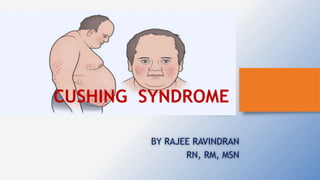
CUSHING SYNDROME
WHAT IS CUSHING SYNDROME ?
Cushing’s syndrome is a cluster of clinical abnormalities
caused by excessive levels of CORTISOL
Adrenal
HyperfunctionHypercortisolism
Dr. Harvey Cushing
ENDOGENOUSEXOGENOUS
ACTH
DEPENDENT
ACTH
INDEPENDENT
CUSHING’S DISEASE
VS
CUSHING’S SYNDROME
Administration of
high dose steroids
Secretion of excess
ACTH
Excess Cortisol
production
PATHOPHYSIOLOGY
CLINICAL MANIFESTATIONS
COMPLICATIONS
COMPLICATIONS
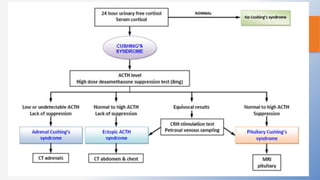
DIAGNOSIS
DIAGNOSIS
MEDICAL MANAGEMENT
Somatostatin Analogs: Pasireotide
Adrenal steroid inhibitors: Metyrapone,
Ketoconazole, Etomidate
Glucocorticoid receptor antagonist:
Mifepristone
Adrenolytic agents: Mitotane
Intramuscular formulation:
Initial dose: 10 mg intramuscularly every 4 weeks (28
days)
Maximum dose: 40 mg intramuscularly every 4 weeks
(28 days), after 4 months of treatment with 10 mg for
patients without normalized 24-hour urinary free cortisol
(UFC) levels after 4 months treatment who tolerated the
10 mg dose
Subcutaneous formulation:
Initial dose: 0.6 mg or 0.9 mg subcutaneously twice
daily.
Maintenance dose: 0.3 to 0.9 mg subcutaneously twice
daily.
Maximum dose: 0.9 mg subcutaneously twice daily
Duration of therapy: Treatment should be continued as
long as benefit is derived.
SURGICAL MANAGEMENT
TRANS SPHENOIDAL HYPOPHYSECTOMY
Surgical removal of the pituitary tumor through
the sphenoid sinus. It has 80% success rate.
ADRENALECTOMY
NURSING MANAGEMENT
NURSING ASSESSMENT
Health history- The history includes information about the patient’s level of activity and
ability to carry out routine and self-care activities.
Physical exam- The skin is observed and assessed for trauma, infection, breakdown,
bruising, and edema.
Mental function- The nurse assesses the patient’s mental function including mood,
responses to questions, awareness of environment, and level of depression.
NURSING MANAGEMENT
Nursing Diagnosis: Risk for injury related to weakness
Goal: Decrease risk of injury
Interventions:
 Provide a protective environment to prevent falls, fractures, and other injuries
to bones and soft tissues.
 Assist the patient who is weak in ambulating to prevent falls or colliding into
furniture.
 Recommend foods high in protein, calcium, and vitamin D to minimize muscle
wasting and osteoporosis; refer to dietitian for assistance.
NURSING MANAGEMENT
Nursing Diagnosis: Risk for infection related to altered protein
metabolism and inflammatory response.
Goal: Decrease risk of infection
Interventions:
 Avoid unnecessary exposure to people with infections.
 Assess frequently for subtle signs of infections (corticosteroids mask
signs of inflammation and infection).
NURSING MANAGEMENT
Nursing Diagnosis: Impaired skin integrity related to edema, impaired
healing, and thin and fragile skin.
Goal: Improve skin integrity.
Interventions:
 Use meticulous skin care to avoid traumatizing fragile skin.
 Avoid adhesive tape, which can tear and irritate the skin.
 Assess skin and bony prominences frequently.
 Encourage and assist patient to change positions frequently.
NURSING MANAGEMENT
Nursing Diagnosis: Disturbed body image related to altered physical
appearance, impaired sexual functioning, and decreased activity level.
Goal: Improve body image
Interventions:
 Discuss the impact that changes have had on patient’s self-concept and
relationships with others. Major physical changes will disappear in time if the
cause of Cushing syndrome can be treated.
 Weight gain and edema may be modified by a low-carbohydrate, low-sodium
diet; a high-protein intake can reduce some bothersome symptoms.
NURSING MANAGEMENT
Nursing Diagnosis: Disturbed thought processes related to mood swings,
irritability, and depression.
Goals: Improve mental function
Interventions:
 Explain to patient and family the cause of emotional instability, and help
them cope with mood swings, irritability, and depression.
 Report any psychotic behavior.
 Encourage patient and family members to verbalize feelings and
concerns.
SUMMARY
 Introduction
 Cushing disease vs Cushing's syndrome
 Related anatomy and physiology
 Clinical manifestations
 Complications
 Diagnosis
 Management
CONCLUSION
It has a multifactorial pathogenesis and contributes to the increased risk for myocardial infarction,
cardiac failure, or stroke, which are the most common causes of death. Neuropsychiatric disorders
can be responsible for suicide. Immune disorders are common; immunosuppression during active
disease causes susceptibility to infections, possibly complicated by sepsis, an important cause of
death, whereas immune rebound after disease remission can exacerbate underlying autoimmune
diseases.
Prompt treatment of cortisol excess and specific treatments of comorbidities are crucial to prevent
serious clinical complications and reduce the mortality associated with Cushing's syndrome.
Cushing's syndrome is a serious endocrine disease caused by chronic, autonomous, and excessive
secretion of cortisol.
EVALUATION
BIBLIOGRAPHY
• Black MJ. Management of clients with adrenal and pituitary disorders. In: Carroll GR, Keene MA, Melander S
(eds.) Medical surgical nursing. 8th ed. Missouri, Elsevier; 2009.p1044-1049
• Chintamani. Nursing assessment and management: Endocrine system. In: Mani m(ed). Medical Surgical
Nursing. Elsevier 2011. P1295-1298
• Polaski LA, Tatro ES. Luckmann’s. Nursing care of clients with Adrenal, pituitary and Gonadal disorders. Core
principles of and practices of Medical surgical Nursing. Philadelphia, Saunders; 1996. P1237-1240
• https://nurseslabs.com/cushings-disease-nursing-care-plan
• https://www.thelancet.com/journals/landia/article/PIIS2213-8587(16)00086-3

Cushing Syndrome

  • 1.
    BY RAJEE RAVINDRAN RN,RM, MSN CUSHING SYNDROME
  • 2.
    WHAT IS CUSHINGSYNDROME ? Cushing’s syndrome is a cluster of clinical abnormalities caused by excessive levels of CORTISOL Adrenal HyperfunctionHypercortisolism Dr. Harvey Cushing
  • 5.
  • 6.
  • 7.
    Administration of high dosesteroids Secretion of excess ACTH Excess Cortisol production PATHOPHYSIOLOGY
  • 9.
  • 10.
  • 11.
  • 12.
  • 13.
  • 14.
  • 16.
    MEDICAL MANAGEMENT Somatostatin Analogs:Pasireotide Adrenal steroid inhibitors: Metyrapone, Ketoconazole, Etomidate Glucocorticoid receptor antagonist: Mifepristone Adrenolytic agents: Mitotane
  • 17.
    Intramuscular formulation: Initial dose:10 mg intramuscularly every 4 weeks (28 days) Maximum dose: 40 mg intramuscularly every 4 weeks (28 days), after 4 months of treatment with 10 mg for patients without normalized 24-hour urinary free cortisol (UFC) levels after 4 months treatment who tolerated the 10 mg dose Subcutaneous formulation: Initial dose: 0.6 mg or 0.9 mg subcutaneously twice daily. Maintenance dose: 0.3 to 0.9 mg subcutaneously twice daily. Maximum dose: 0.9 mg subcutaneously twice daily Duration of therapy: Treatment should be continued as long as benefit is derived.
  • 18.
    SURGICAL MANAGEMENT TRANS SPHENOIDALHYPOPHYSECTOMY Surgical removal of the pituitary tumor through the sphenoid sinus. It has 80% success rate. ADRENALECTOMY
  • 19.
    NURSING MANAGEMENT NURSING ASSESSMENT Healthhistory- The history includes information about the patient’s level of activity and ability to carry out routine and self-care activities. Physical exam- The skin is observed and assessed for trauma, infection, breakdown, bruising, and edema. Mental function- The nurse assesses the patient’s mental function including mood, responses to questions, awareness of environment, and level of depression.
  • 20.
    NURSING MANAGEMENT Nursing Diagnosis:Risk for injury related to weakness Goal: Decrease risk of injury Interventions:  Provide a protective environment to prevent falls, fractures, and other injuries to bones and soft tissues.  Assist the patient who is weak in ambulating to prevent falls or colliding into furniture.  Recommend foods high in protein, calcium, and vitamin D to minimize muscle wasting and osteoporosis; refer to dietitian for assistance.
  • 21.
    NURSING MANAGEMENT Nursing Diagnosis:Risk for infection related to altered protein metabolism and inflammatory response. Goal: Decrease risk of infection Interventions:  Avoid unnecessary exposure to people with infections.  Assess frequently for subtle signs of infections (corticosteroids mask signs of inflammation and infection).
  • 22.
    NURSING MANAGEMENT Nursing Diagnosis:Impaired skin integrity related to edema, impaired healing, and thin and fragile skin. Goal: Improve skin integrity. Interventions:  Use meticulous skin care to avoid traumatizing fragile skin.  Avoid adhesive tape, which can tear and irritate the skin.  Assess skin and bony prominences frequently.  Encourage and assist patient to change positions frequently.
  • 23.
    NURSING MANAGEMENT Nursing Diagnosis:Disturbed body image related to altered physical appearance, impaired sexual functioning, and decreased activity level. Goal: Improve body image Interventions:  Discuss the impact that changes have had on patient’s self-concept and relationships with others. Major physical changes will disappear in time if the cause of Cushing syndrome can be treated.  Weight gain and edema may be modified by a low-carbohydrate, low-sodium diet; a high-protein intake can reduce some bothersome symptoms.
  • 24.
    NURSING MANAGEMENT Nursing Diagnosis:Disturbed thought processes related to mood swings, irritability, and depression. Goals: Improve mental function Interventions:  Explain to patient and family the cause of emotional instability, and help them cope with mood swings, irritability, and depression.  Report any psychotic behavior.  Encourage patient and family members to verbalize feelings and concerns.
  • 25.
    SUMMARY  Introduction  Cushingdisease vs Cushing's syndrome  Related anatomy and physiology  Clinical manifestations  Complications  Diagnosis  Management
  • 26.
    CONCLUSION It has amultifactorial pathogenesis and contributes to the increased risk for myocardial infarction, cardiac failure, or stroke, which are the most common causes of death. Neuropsychiatric disorders can be responsible for suicide. Immune disorders are common; immunosuppression during active disease causes susceptibility to infections, possibly complicated by sepsis, an important cause of death, whereas immune rebound after disease remission can exacerbate underlying autoimmune diseases. Prompt treatment of cortisol excess and specific treatments of comorbidities are crucial to prevent serious clinical complications and reduce the mortality associated with Cushing's syndrome. Cushing's syndrome is a serious endocrine disease caused by chronic, autonomous, and excessive secretion of cortisol.
  • 28.
  • 29.
    BIBLIOGRAPHY • Black MJ.Management of clients with adrenal and pituitary disorders. In: Carroll GR, Keene MA, Melander S (eds.) Medical surgical nursing. 8th ed. Missouri, Elsevier; 2009.p1044-1049 • Chintamani. Nursing assessment and management: Endocrine system. In: Mani m(ed). Medical Surgical Nursing. Elsevier 2011. P1295-1298 • Polaski LA, Tatro ES. Luckmann’s. Nursing care of clients with Adrenal, pituitary and Gonadal disorders. Core principles of and practices of Medical surgical Nursing. Philadelphia, Saunders; 1996. P1237-1240 • https://nurseslabs.com/cushings-disease-nursing-care-plan • https://www.thelancet.com/journals/landia/article/PIIS2213-8587(16)00086-3