CUSHING'S
SYNDROME
COMPILED BY-
MR. ASHISH H. ROY
INTRODUCTION OF
CUSHING SYNDROME
 CUSING IS THE HORMONAL DISORDER CAUSED BY PROLONGED
EXPOSURE OF THE BODIES TISSUES TO HIGH LEVEL OF THE
HORMONE CORTISOL.
 ADRENAL GLANDS LOCATED RIGHT ABOVE THE KIDNEYS
 THEY RELEASE CORTISOL. WHEN THEY RECEIVE A CHEMICAL
MESSAGE FROM PITUITARY GLANDS. IT IS CHARACTERIZED BY
FACIAL AND THORSE (UNEQUAL DISTRIBUTION OF FATS)
HYPERTENSION, STRETCH MARKS ON THE BELLY, WEAKNESS,
OSTEOPOROSIS AND FACIAL HAIR GROWTH IN FEMALES.
 .
DEFINITION
CUSHING'S SYNDROME
 Cushing's syndrome is a condition in which the plasma
cortisol levels are elevated, causing signs and symptoms
of hypercortisolism.
Etiological Factors
 Occurs 10 times more frequently in women than in men.
 Hyperplasia of both adrenal glands caused by overstimulation of
the adrenal cortex by ACTH, usually from a pituitary adenoma or
hyperplasia.
 Adrenal Cushing's syndrome.
 Associated with tumors of the adrenal cortex :adenoma or carcinoma.
 Medication : glucocorticoid administration.
 Excessive corticosteroid medications.
Pathophysiology
 Due to use of corticosteroid medications or due to excessive
corticosteroid production by the adrenal cortex or tumor of the
pituitary gland that
 Produces ACTH and stimulates the adrenal cortex to increase its
hormone secretion(glucocorticoids, mineralocorticoids, and
adrenal androgens).
 Hypernatremia, hypokalemia,wt gain occur
Clinical Manifestations
Manifestations Caused by Excess Glucocorticoids
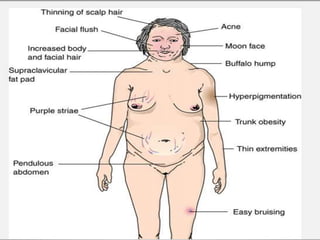
 Weight gain or obesity (belly fat)
 Heavy trunk; thin extremities.
 Buffalo hump (fat pad) in neck and supraclavicular area.
 Rounded face (moon face); plethoric (overly large or abundant), oily.
 Fragile and thin skin, striae (stretch marks) and ecchymosis, acne.
 Muscles wasted because of excessive catabolism.
 Osteoporosis characteristic kyphosis, backache.
 Mental disturbances mood changes, psychosis.
 Increased susceptibility to infections.
 Poor wound healing
 Amenorrhea in females.
Enlarged sella turcica
Manifestations Caused by Excess Mineralocorticoids
 Diabetes
 Hypertension.
 Hypernatremia,
 hypokalemia.
 Weight gain.
 Edema.
 polyuria
Manifestations Caused by Excess Androgens
 Women experience virilism (masculinization).
 Hirsutism : excessive growth of hair on the face and midline of trunk.
 Breasts: atrophy.
 Voice: masculine.
 Loss of libido.
 Males: loss of libido.
Diagnostic Evaluation
 Excessive plasma cortisol levels( assess in case of hypercotisolism
urine of 24 normal value more than 100 mcg/24hr.
 An increase in blood glucose levels and glucose intolerance.
 Decreased serum potassium level.
 Elevated urinary 17-hydroxycorticoids and 17-ketogenic steroids.( it
is measure androgen metabolities in urine and evaluate
adrenocortical and gonadal function so collection of 24 urine)
 Normal value: 6-16mcg/24hr
 Elevation of plasma ACTH in patients with pituitary tumors
 CT scan and MRI detect location of tumor Low plasma ACTH levels with
adrenal tumor.
 Ultrasonography
 X-rays of the skull detect erosion of the sella turcica(covering of
pituitary gland) by a pituitary tumor.
 Overnight DST (steriod), possibly with cortisol urinary excretion
measurement.
 Unsuppressed cortisol level in Cushing's syndrome caused by adrenal
tumors.
 Suppressed cortisol level in Cushing's disease caused by pituitary tumor.
 (In a healthy patient, the administration of dexamethasone will inhibit
corticotropin secretion and will cause cortisol levels to fall below normal).
 .
Management
 Surgical treatment and Radiation therapy.
 Tumor (adrenal or pituitary) is removed or treated with irradiation.
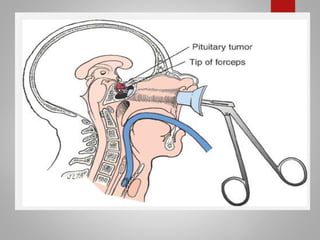
 Transsphenoidal adenomectomy (TSA)or hypophysectomy
(pituitary removal)
 Transfrontal craniotomy may be necessary when pituitary tumor
has enlarged beyond sella turcica
 Hyperplasia of adrenals: bilateral adrenalectomy.
 Replacement Therapy Postoperatively.
Medical Management
 If patients cannot undergo surgery, cortisol synthesis-inhibiting
medications may be used.
 Metyrapone (Metopirone)
 Aminoglutethimide (Cytadren) blocks cholesterol conversion
to pregnenolone, effectively blocking cortisol production.
 Adrenalectomy patients require a lifelong replacement therapy
with the following:
 A glucocorticoid: cortisone (Cortef).
 A mineralocorticoid: fludrocortisone ( Florinef ).
 Potassium replacement is usually required.
Complications
 Possibility of recurrence in patients with adrenal
carcinoma.
 Fractures
 Renal colic.
 Gastric ulcers.
 Pancreatitis.
 Infections.
Nursing Diagnoses with
Nursing INTERVENTIONS
 Impaired Skin Integrity related to altered healing, thin and fragile
skin, and edema.
• Maintaining Skin Integrity
• Assess skin frequently to detect reddened areas, breakdown or
tearing of skin, excoriation, infection, or edema.
• Handle skin and extremities gently to prevent trauma; protect from
falls by use of side rails.
• Avoid use of adhesive tape to reduce risk of trauma to skin on its
removal.
• Encourage patient to turn in bed frequently or to ambulate to
reduce pressure on bony prominences and areas of edema.
• Use meticulous skin care to reduce injury and breakdown.
• Provide foods low in sodium to minimize edema formation.
• Assess intake and output and daily weight to evaluate fluid retention.
 Dressing, Grooming, Toileting Self-Care Deficit related to muscle
wasting, osteoporosis, weakness, and fatigue
 Encouraging Active Participation in Self-Care
 Assist patient with ambulation and hygiene when weak and fatigued.
 Assist patient in planning schedule to permit exercise and rest.
 Encourage patient to rest when fatigued.
 Encourage gradual resumption of activities as the patient gains strength.
 Identify for patient the signs and symptoms indicating excessive exertion.
 Instruct patient in correct body mechanics to avoid pain or injury during
 Use assistive devices during ambulation to prevent falls and fractures.
 Encourage foods high in potassium (bananas, orange juice, tomatoes), and
administer potassium supplement as prescribed to counteract weakness related
hypokalemia.
 Disturbed Body Image related to altered physical appearance and
emotional instability
• Strengthening Body Image
• Encourage the patient to verbalize concerns about illness, changes
appearance, and altered role functions.
• Identify situations that are disturbing to patient and explore with
patient ways to avoid or modify those situations.
Be alert for evidence of depression; in some instances this has
progressed to suicide; alert health care provider of mood changes,
sleep disturbance, change in activity level, change in appetite, or
of interest in visitors or other experiences.
• Refer for counseling, if indicated.
• Explain to patient who has benign adenoma or hyperplasia that,
proper treatment, evidence of masculinization can be reversed.
continued…
 Anxiety related to surgery
• Reducing Anxiety
• Answer questions about surgery and encourage
thorough discussion with health care provider if patient
is not well informed.
• Describe nursing care to expect in postoperative
period.
 Risk for Injury related to surgical procedure
• Providing Postoperative Care
• Provide routine postoperative care for patient with abdominal
surgery or hypophysectomy.
• Monitor closely for infection because glucocorticoid
administration interferes with immune function; maintain aseptic
technique, clean environment, and good hand washing.
• Monitor thyroid function tests and provide hormone
replacement therapy as ordered after hypophysectomy.
• Monitor fluid intake and output and urine specific gravity to
detect DI caused by ADH deficiency after hypophysectomy.
THANKYOU FOR YOUR
ACTIVE LISTENING AND
ATTENTION..
IF ANY QUERY REGARDING THE TOPIC
KINDLY ASK….
THE END.

Cushing's Syndrome

  • 1.
  • 2.
    INTRODUCTION OF CUSHING SYNDROME CUSING IS THE HORMONAL DISORDER CAUSED BY PROLONGED EXPOSURE OF THE BODIES TISSUES TO HIGH LEVEL OF THE HORMONE CORTISOL.  ADRENAL GLANDS LOCATED RIGHT ABOVE THE KIDNEYS  THEY RELEASE CORTISOL. WHEN THEY RECEIVE A CHEMICAL MESSAGE FROM PITUITARY GLANDS. IT IS CHARACTERIZED BY FACIAL AND THORSE (UNEQUAL DISTRIBUTION OF FATS) HYPERTENSION, STRETCH MARKS ON THE BELLY, WEAKNESS, OSTEOPOROSIS AND FACIAL HAIR GROWTH IN FEMALES.  .
  • 3.
    DEFINITION CUSHING'S SYNDROME  Cushing'ssyndrome is a condition in which the plasma cortisol levels are elevated, causing signs and symptoms of hypercortisolism.
  • 4.
    Etiological Factors  Occurs10 times more frequently in women than in men.  Hyperplasia of both adrenal glands caused by overstimulation of the adrenal cortex by ACTH, usually from a pituitary adenoma or hyperplasia.  Adrenal Cushing's syndrome.  Associated with tumors of the adrenal cortex :adenoma or carcinoma.  Medication : glucocorticoid administration.  Excessive corticosteroid medications.
  • 5.
    Pathophysiology  Due touse of corticosteroid medications or due to excessive corticosteroid production by the adrenal cortex or tumor of the pituitary gland that  Produces ACTH and stimulates the adrenal cortex to increase its hormone secretion(glucocorticoids, mineralocorticoids, and adrenal androgens).  Hypernatremia, hypokalemia,wt gain occur
  • 6.
    Clinical Manifestations Manifestations Causedby Excess Glucocorticoids  Weight gain or obesity (belly fat)  Heavy trunk; thin extremities.  Buffalo hump (fat pad) in neck and supraclavicular area.  Rounded face (moon face); plethoric (overly large or abundant), oily.  Fragile and thin skin, striae (stretch marks) and ecchymosis, acne.  Muscles wasted because of excessive catabolism.  Osteoporosis characteristic kyphosis, backache.  Mental disturbances mood changes, psychosis.  Increased susceptibility to infections.  Poor wound healing  Amenorrhea in females.
  • 7.
    Enlarged sella turcica ManifestationsCaused by Excess Mineralocorticoids  Diabetes  Hypertension.  Hypernatremia,  hypokalemia.  Weight gain.  Edema.  polyuria Manifestations Caused by Excess Androgens  Women experience virilism (masculinization).  Hirsutism : excessive growth of hair on the face and midline of trunk.  Breasts: atrophy.  Voice: masculine.  Loss of libido.  Males: loss of libido.
  • 9.
    Diagnostic Evaluation  Excessiveplasma cortisol levels( assess in case of hypercotisolism urine of 24 normal value more than 100 mcg/24hr.  An increase in blood glucose levels and glucose intolerance.  Decreased serum potassium level.  Elevated urinary 17-hydroxycorticoids and 17-ketogenic steroids.( it is measure androgen metabolities in urine and evaluate adrenocortical and gonadal function so collection of 24 urine)  Normal value: 6-16mcg/24hr  Elevation of plasma ACTH in patients with pituitary tumors
  • 10.
     CT scanand MRI detect location of tumor Low plasma ACTH levels with adrenal tumor.  Ultrasonography  X-rays of the skull detect erosion of the sella turcica(covering of pituitary gland) by a pituitary tumor.  Overnight DST (steriod), possibly with cortisol urinary excretion measurement.  Unsuppressed cortisol level in Cushing's syndrome caused by adrenal tumors.  Suppressed cortisol level in Cushing's disease caused by pituitary tumor.  (In a healthy patient, the administration of dexamethasone will inhibit corticotropin secretion and will cause cortisol levels to fall below normal).  .
  • 11.
    Management  Surgical treatmentand Radiation therapy.  Tumor (adrenal or pituitary) is removed or treated with irradiation.  Transsphenoidal adenomectomy (TSA)or hypophysectomy (pituitary removal)  Transfrontal craniotomy may be necessary when pituitary tumor has enlarged beyond sella turcica  Hyperplasia of adrenals: bilateral adrenalectomy.  Replacement Therapy Postoperatively.
  • 13.
    Medical Management  Ifpatients cannot undergo surgery, cortisol synthesis-inhibiting medications may be used.  Metyrapone (Metopirone)  Aminoglutethimide (Cytadren) blocks cholesterol conversion to pregnenolone, effectively blocking cortisol production.  Adrenalectomy patients require a lifelong replacement therapy with the following:  A glucocorticoid: cortisone (Cortef).  A mineralocorticoid: fludrocortisone ( Florinef ).  Potassium replacement is usually required.
  • 14.
    Complications  Possibility ofrecurrence in patients with adrenal carcinoma.  Fractures  Renal colic.  Gastric ulcers.  Pancreatitis.  Infections.
  • 15.
    Nursing Diagnoses with NursingINTERVENTIONS  Impaired Skin Integrity related to altered healing, thin and fragile skin, and edema. • Maintaining Skin Integrity • Assess skin frequently to detect reddened areas, breakdown or tearing of skin, excoriation, infection, or edema. • Handle skin and extremities gently to prevent trauma; protect from falls by use of side rails. • Avoid use of adhesive tape to reduce risk of trauma to skin on its removal. • Encourage patient to turn in bed frequently or to ambulate to reduce pressure on bony prominences and areas of edema. • Use meticulous skin care to reduce injury and breakdown. • Provide foods low in sodium to minimize edema formation. • Assess intake and output and daily weight to evaluate fluid retention.
  • 16.
     Dressing, Grooming,Toileting Self-Care Deficit related to muscle wasting, osteoporosis, weakness, and fatigue  Encouraging Active Participation in Self-Care  Assist patient with ambulation and hygiene when weak and fatigued.  Assist patient in planning schedule to permit exercise and rest.  Encourage patient to rest when fatigued.  Encourage gradual resumption of activities as the patient gains strength.  Identify for patient the signs and symptoms indicating excessive exertion.  Instruct patient in correct body mechanics to avoid pain or injury during  Use assistive devices during ambulation to prevent falls and fractures.  Encourage foods high in potassium (bananas, orange juice, tomatoes), and administer potassium supplement as prescribed to counteract weakness related hypokalemia.
  • 17.
     Disturbed BodyImage related to altered physical appearance and emotional instability • Strengthening Body Image • Encourage the patient to verbalize concerns about illness, changes appearance, and altered role functions. • Identify situations that are disturbing to patient and explore with patient ways to avoid or modify those situations. Be alert for evidence of depression; in some instances this has progressed to suicide; alert health care provider of mood changes, sleep disturbance, change in activity level, change in appetite, or of interest in visitors or other experiences. • Refer for counseling, if indicated. • Explain to patient who has benign adenoma or hyperplasia that, proper treatment, evidence of masculinization can be reversed.
  • 18.
    continued…  Anxiety relatedto surgery • Reducing Anxiety • Answer questions about surgery and encourage thorough discussion with health care provider if patient is not well informed. • Describe nursing care to expect in postoperative period.
  • 19.
     Risk forInjury related to surgical procedure • Providing Postoperative Care • Provide routine postoperative care for patient with abdominal surgery or hypophysectomy. • Monitor closely for infection because glucocorticoid administration interferes with immune function; maintain aseptic technique, clean environment, and good hand washing. • Monitor thyroid function tests and provide hormone replacement therapy as ordered after hypophysectomy. • Monitor fluid intake and output and urine specific gravity to detect DI caused by ADH deficiency after hypophysectomy.
  • 20.
    THANKYOU FOR YOUR ACTIVELISTENING AND ATTENTION.. IF ANY QUERY REGARDING THE TOPIC KINDLY ASK…. THE END.