PRESENTED BY:
ER. SAHIL SHARMA
CIVIL ENGINEERING DEPARTMENT
CURVE SURVEYING
DEFINITION
Curves are regular bends provided
in the lines of communication like
roads, railways etc. and also in
canals to bring about the gradual
change of direction. They are also
used in the vertical plane at all
changes of grade to avoid the
abrupt change of grade at the apex.
Classification of Curves:
(i) Simple
(ii) Compound
(iii) Reverse and
(iv) Deviation
(i) Simple Curve:
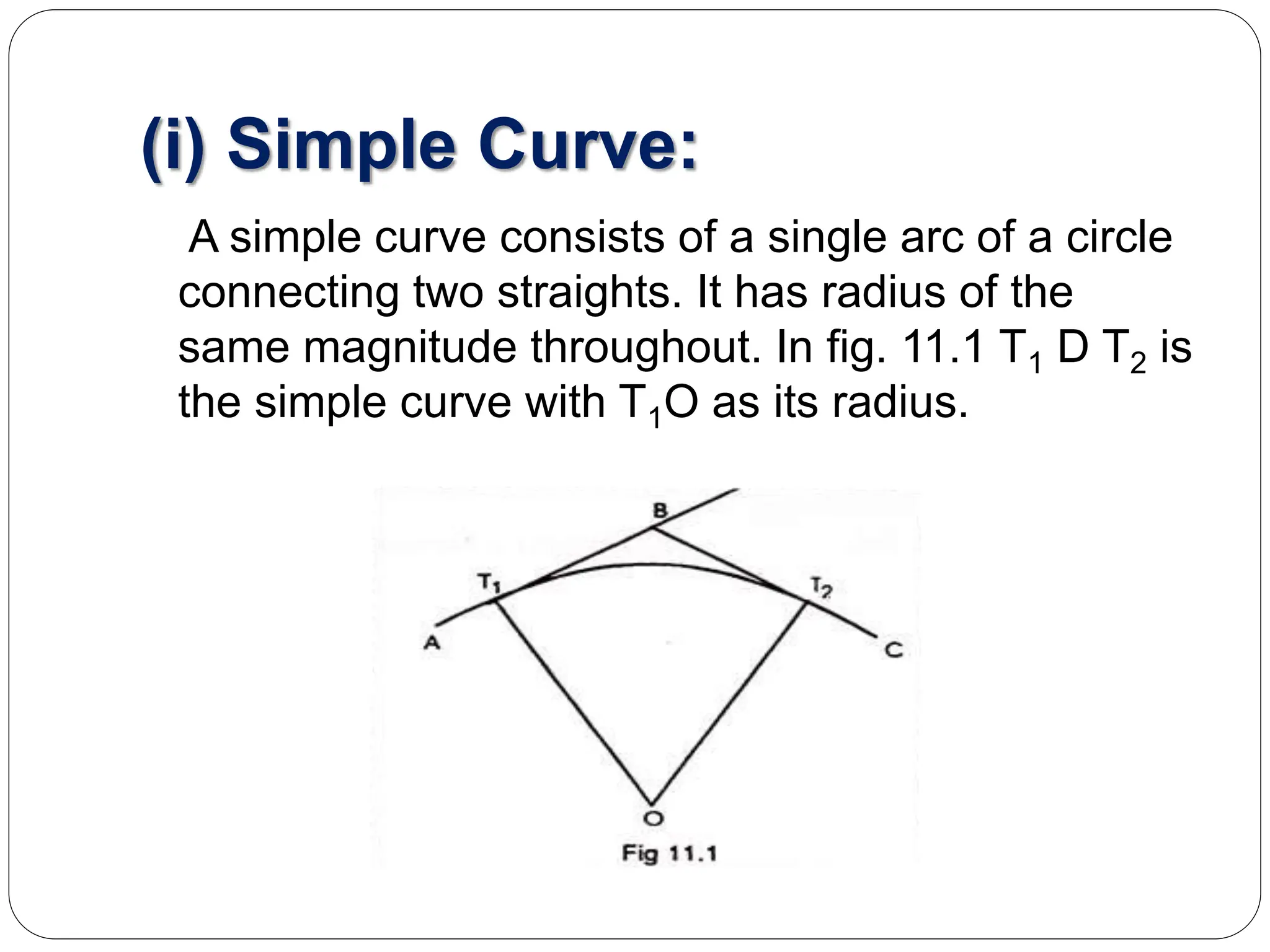
A simple curve consists of a single arc of a circle
connecting two straights. It has radius of the
same magnitude throughout. In fig. 11.1 T1 D T2 is
the simple curve with T1O as its radius.
(ii) Compound Curve:
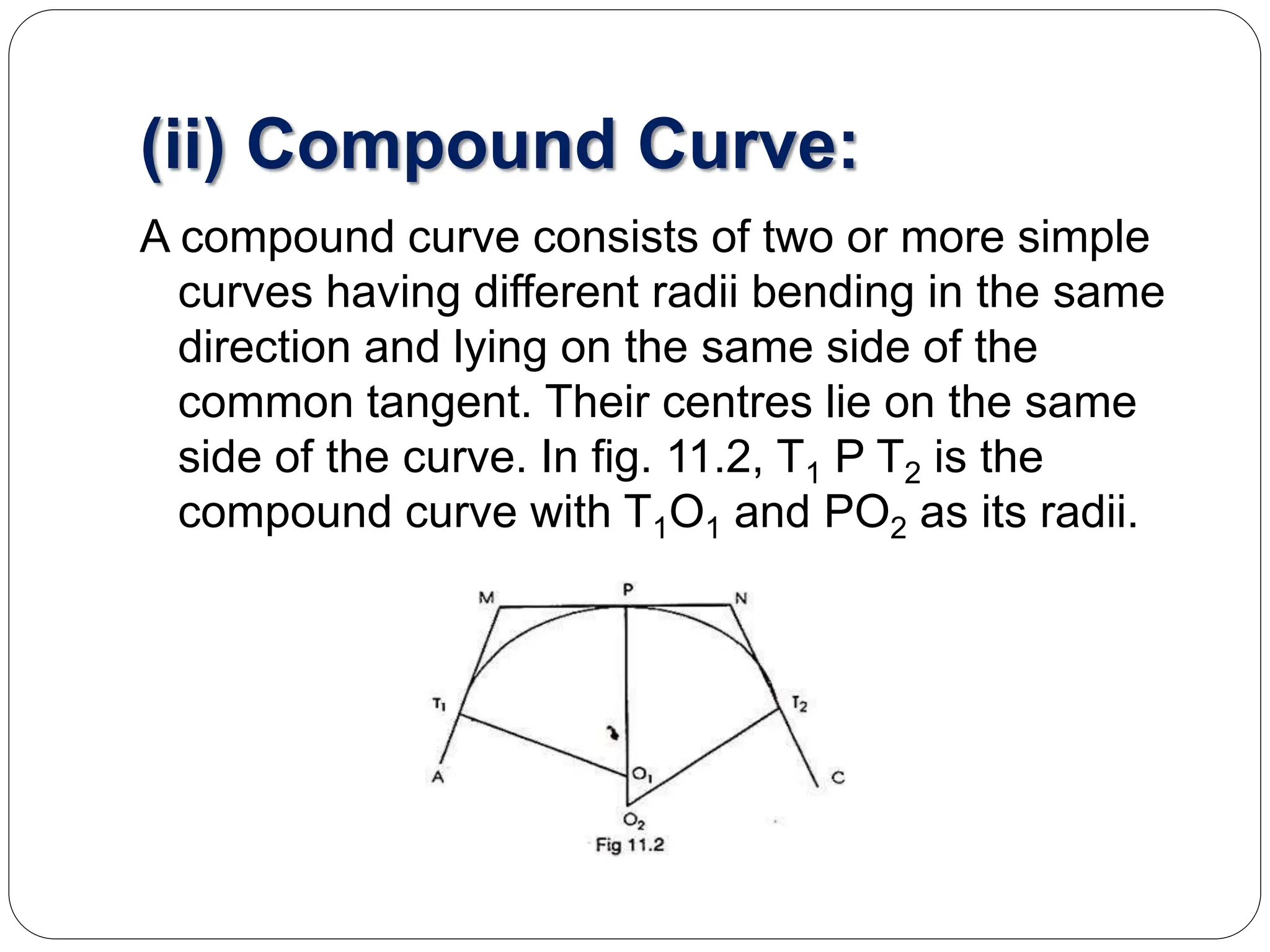
A compound curve consists of two or more simple
curves having different radii bending in the same
direction and lying on the same side of the
common tangent. Their centres lie on the same
side of the curve. In fig. 11.2, T1 P T2 is the
compound curve with T1O1 and PO2 as its radii.
(iii) Reverse (or Serpentine) Curve:
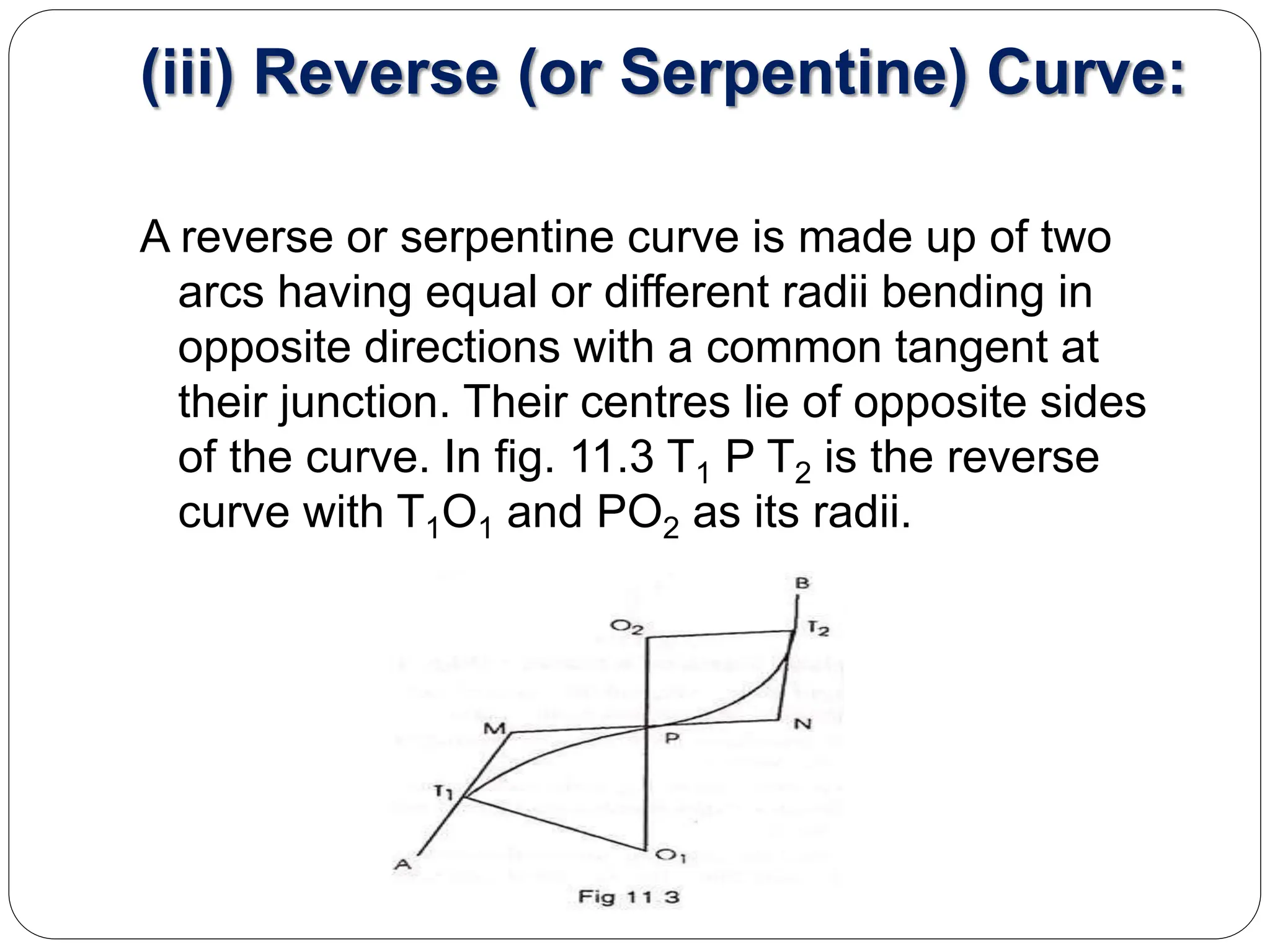
A reverse or serpentine curve is made up of two
arcs having equal or different radii bending in
opposite directions with a common tangent at
their junction. Their centres lie of opposite sides
of the curve. In fig. 11.3 T1 P T2 is the reverse
curve with T1O1 and PO2 as its radii.
(iv) Deviation Curve:
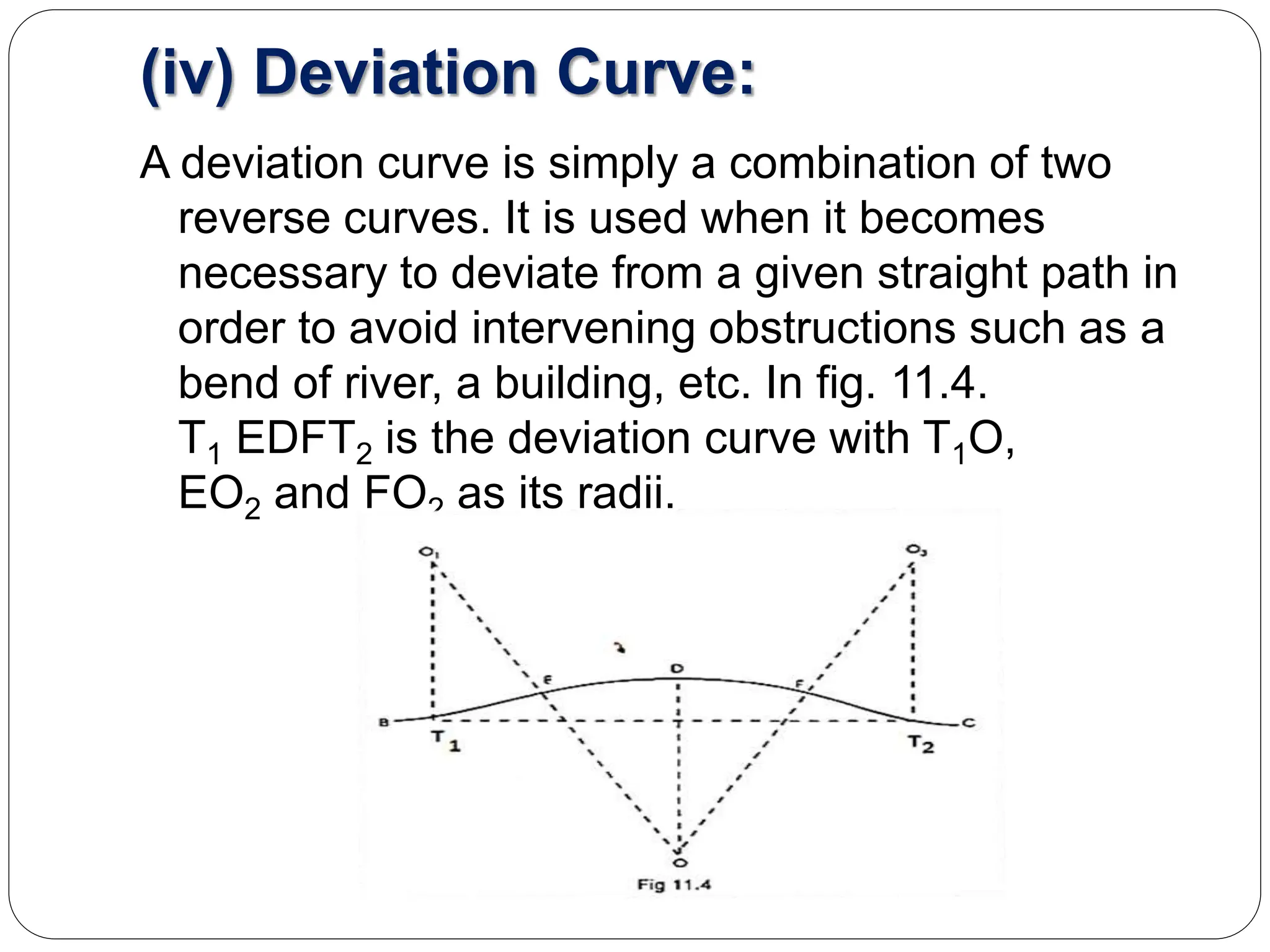
A deviation curve is simply a combination of two
reverse curves. It is used when it becomes
necessary to deviate from a given straight path in
order to avoid intervening obstructions such as a
bend of river, a building, etc. In fig. 11.4.
T1 EDFT2 is the deviation curve with T1O,
EO2 and FO2 as its radii.
TERMINOLOGY USED IN
CURVE
 (i) The two straight lines AB and BC, which
are connected by the curve are called the
tangents or straights to the curve.
 (ii) The points of intersection of the two
straights (B) is called the intersection point or
the vertex.
 (iii) When the curve deflects to the right side
of the progress of survey as in fig. 11.5, it is
termed as right handed curve and when to the
left, it is termed as left handed curve.
 (iv) The lines AB and BC are tangents to the
curves. AB is called the first tangent or the
rear tangent BC is called the second tangent
or the forward tangent.
 (v) The points (T1 and T2) at which the curve
touches the tangents are called the tangent
points. The beginning of the curve (T1) is
called the tangent curve point and the end of
the curve (T2) is called the curve tangent
point.
 (vi) The angle between the tangent lines AB
and BC (ABC) is called the angle of
intersection (I)
 (vii) The angle by which the forward tangent
deflects from the rear tangent is called the
deflection angle (ɸ) of the curve.
 (viii) The distance the two tangent point of
intersection to the tangent point is called the
tangent length (BT and BT ).
 (ix) The line joining the two tangent points
(T1 and T2) is known as the long-chord
 (x) The arc T1FT2 is called the length of the
curve.
 (xi) The mid-point (F) of the arc (T1FT2) in
called summit or apex of the curve.
 (xii) The distance from the point of
intersection to the apex of the curve BF is
called the apex distance.
 (xiii) The distance between the apex of the
curve and the midpoint of the long chord
(EF) is called the versed sine of the curve.
 (xiv) The angle subtended at the centre of
the curve by the arc T1FT2 is known as the
Central angle and is equal to the deflection
angle (ɸ).
Methods of Curve Ranging:
A curve may be set out:
1. By linear methods, where chain
and tape are used.
2. By angular or instrumental
methods, where a theodolite with or
without a chain is used.
LINEAR METHODS OF RANGING
SIMPLE CIRCULAR CURVES
1.Offsets from the long chord
2.Radial offsets from tangents
3.Perpendicular offsets from tangents
4.Successive bisection of arcs
LINEAR METHODS OF RANGING
SIMPLE CIRCULAR CURVES
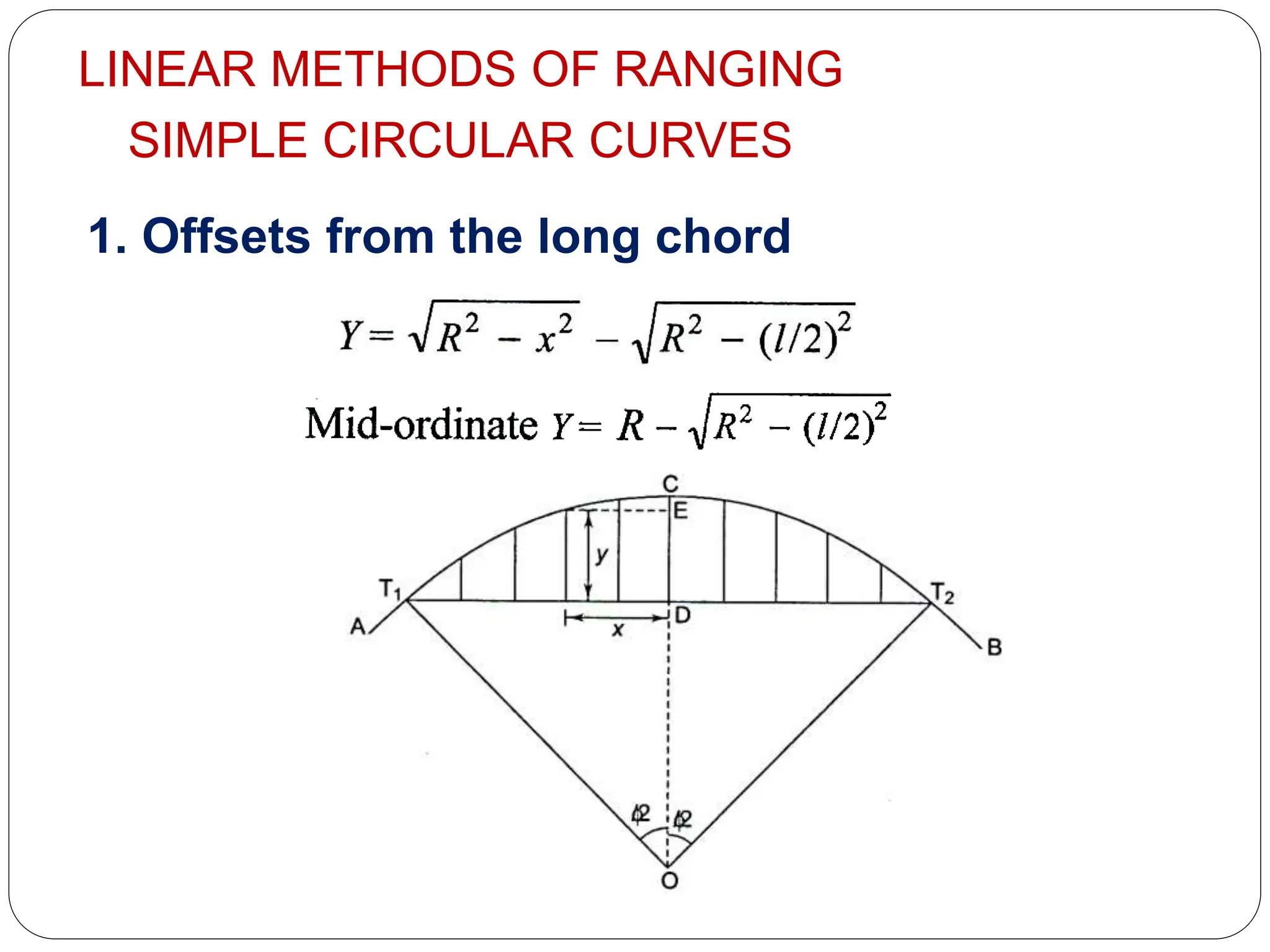
1. Offsets from the long chord
LINEAR METHODS OF RANGING
SIMPLE CIRCULAR CURVES
2. Radial offsets from tangents
LINEAR METHODS OF RANGING
SIMPLE CIRCULAR CURVES
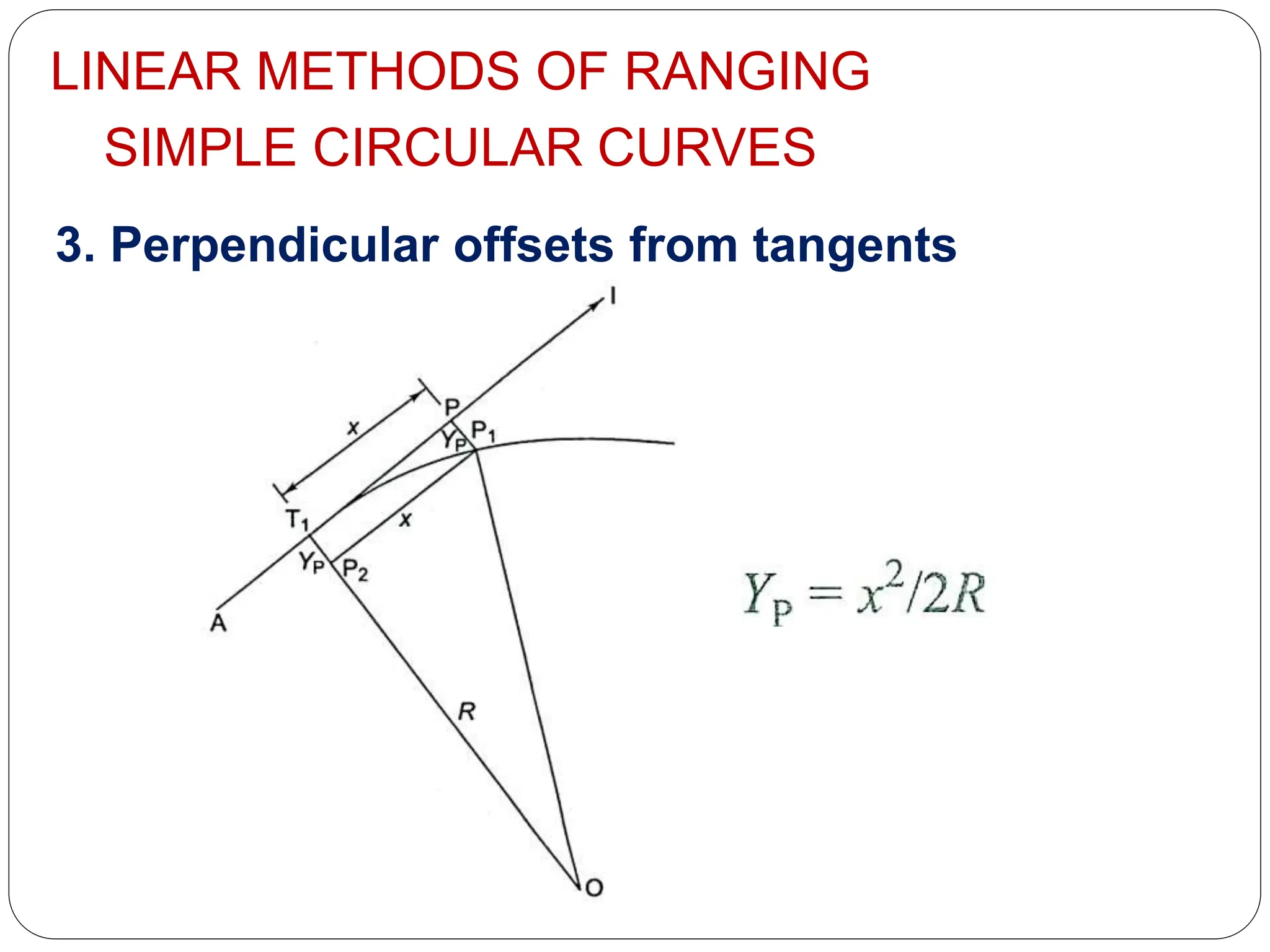
3. Perpendicular offsets from tangents
LINEAR METHODS OF RANGING SIMPLE
CIRCULAR CURVES
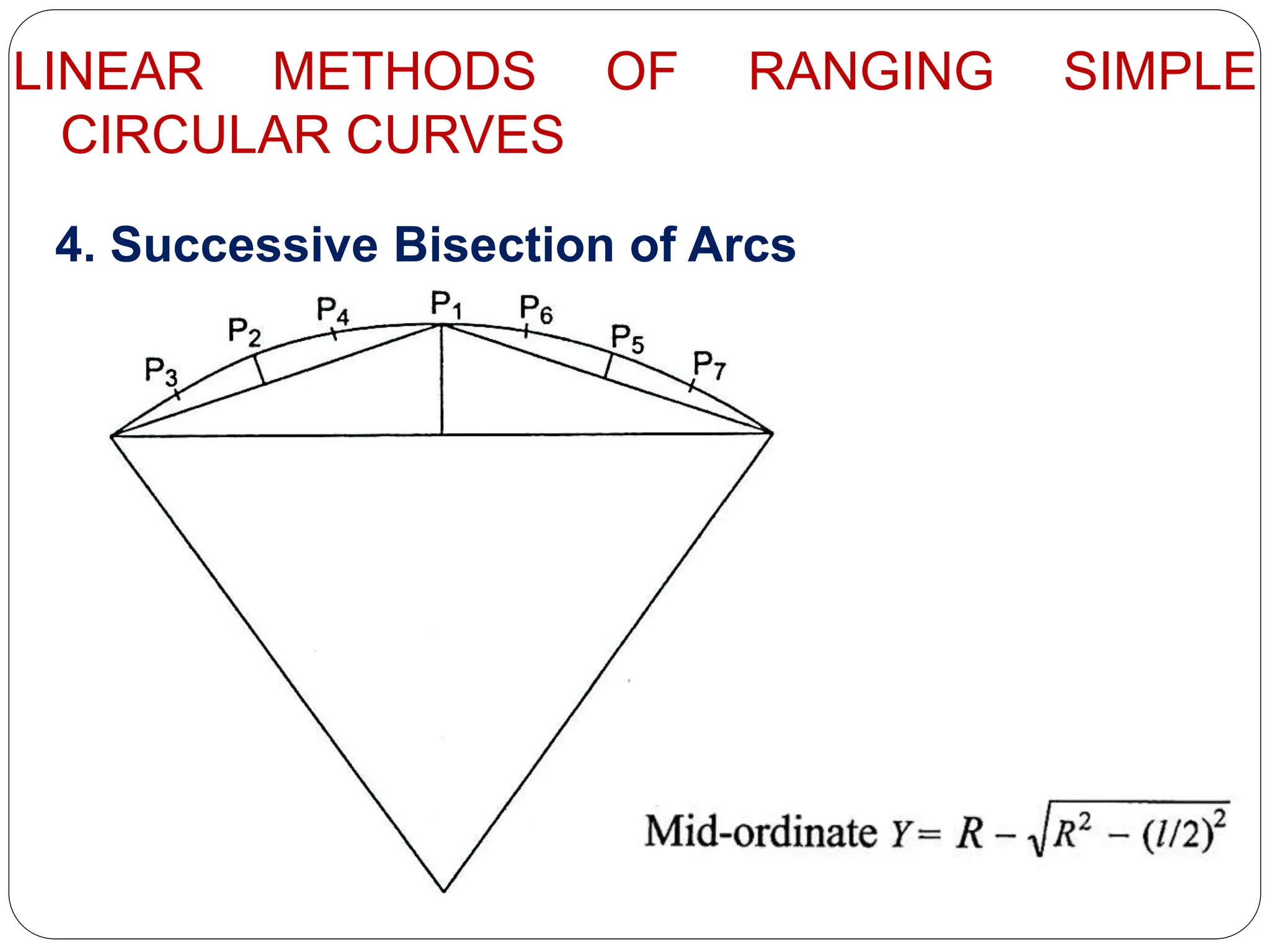
4. Successive Bisection of Arcs
LINEAR METHODS OF RANGING SIMPLE CIRCULAR
CURVES – TUTORIAL
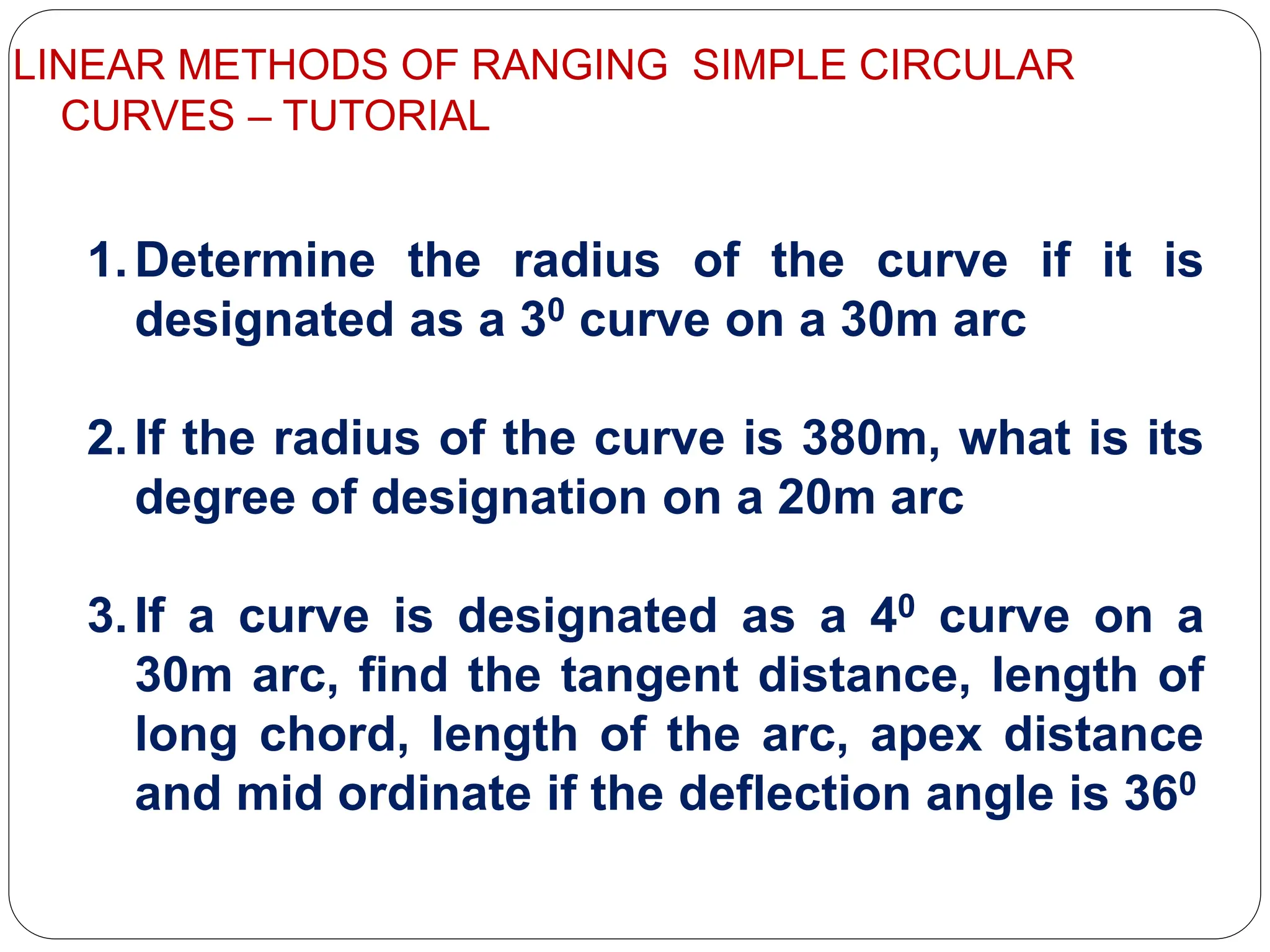
1.Determine the radius of the curve if it is
designated as a 30 curve on a 30m arc
2.If the radius of the curve is 380m, what is its
degree of designation on a 20m arc
3.If a curve is designated as a 40 curve on a
30m arc, find the tangent distance, length of
long chord, length of the arc, apex distance
and mid ordinate if the deflection angle is 360
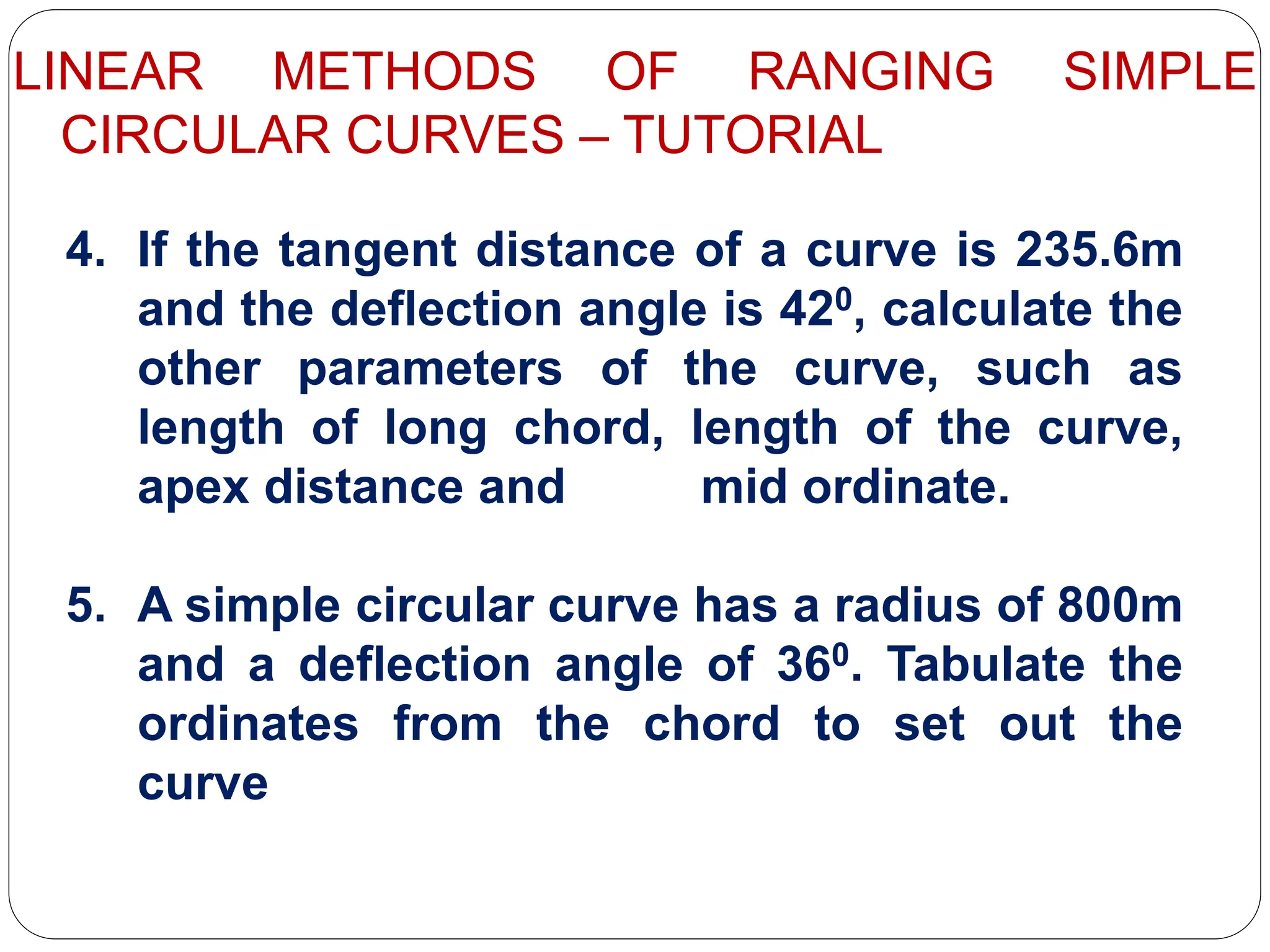
4. If the tangent distance of a curve is 235.6m
and the deflection angle is 420, calculate the
other parameters of the curve, such as
length of long chord, length of the curve,
apex distance and mid ordinate.
5. A simple circular curve has a radius of 800m
and a deflection angle of 360. Tabulate the
ordinates from the chord to set out the
curve
LINEAR METHODS OF RANGING SIMPLE
CIRCULAR CURVES – TUTORIAL
THANK YOU

CURVE SURVEYING. btech civil engineeringpptx

  • 1.
    PRESENTED BY: ER. SAHILSHARMA CIVIL ENGINEERING DEPARTMENT CURVE SURVEYING
  • 2.
    DEFINITION Curves are regularbends provided in the lines of communication like roads, railways etc. and also in canals to bring about the gradual change of direction. They are also used in the vertical plane at all changes of grade to avoid the abrupt change of grade at the apex.
  • 3.
    Classification of Curves: (i)Simple (ii) Compound (iii) Reverse and (iv) Deviation
  • 4.
    (i) Simple Curve: Asimple curve consists of a single arc of a circle connecting two straights. It has radius of the same magnitude throughout. In fig. 11.1 T1 D T2 is the simple curve with T1O as its radius.
  • 5.
    (ii) Compound Curve: Acompound curve consists of two or more simple curves having different radii bending in the same direction and lying on the same side of the common tangent. Their centres lie on the same side of the curve. In fig. 11.2, T1 P T2 is the compound curve with T1O1 and PO2 as its radii.
  • 6.
    (iii) Reverse (orSerpentine) Curve: A reverse or serpentine curve is made up of two arcs having equal or different radii bending in opposite directions with a common tangent at their junction. Their centres lie of opposite sides of the curve. In fig. 11.3 T1 P T2 is the reverse curve with T1O1 and PO2 as its radii.
  • 7.
    (iv) Deviation Curve: Adeviation curve is simply a combination of two reverse curves. It is used when it becomes necessary to deviate from a given straight path in order to avoid intervening obstructions such as a bend of river, a building, etc. In fig. 11.4. T1 EDFT2 is the deviation curve with T1O, EO2 and FO2 as its radii.
  • 8.
  • 9.
     (i) Thetwo straight lines AB and BC, which are connected by the curve are called the tangents or straights to the curve.  (ii) The points of intersection of the two straights (B) is called the intersection point or the vertex.  (iii) When the curve deflects to the right side of the progress of survey as in fig. 11.5, it is termed as right handed curve and when to the left, it is termed as left handed curve.  (iv) The lines AB and BC are tangents to the curves. AB is called the first tangent or the rear tangent BC is called the second tangent or the forward tangent.
  • 10.
     (v) Thepoints (T1 and T2) at which the curve touches the tangents are called the tangent points. The beginning of the curve (T1) is called the tangent curve point and the end of the curve (T2) is called the curve tangent point.  (vi) The angle between the tangent lines AB and BC (ABC) is called the angle of intersection (I)  (vii) The angle by which the forward tangent deflects from the rear tangent is called the deflection angle (ɸ) of the curve.  (viii) The distance the two tangent point of intersection to the tangent point is called the tangent length (BT and BT ).
  • 11.
     (ix) Theline joining the two tangent points (T1 and T2) is known as the long-chord  (x) The arc T1FT2 is called the length of the curve.  (xi) The mid-point (F) of the arc (T1FT2) in called summit or apex of the curve.  (xii) The distance from the point of intersection to the apex of the curve BF is called the apex distance.  (xiii) The distance between the apex of the curve and the midpoint of the long chord (EF) is called the versed sine of the curve.  (xiv) The angle subtended at the centre of the curve by the arc T1FT2 is known as the Central angle and is equal to the deflection angle (ɸ).
  • 14.
    Methods of CurveRanging: A curve may be set out: 1. By linear methods, where chain and tape are used. 2. By angular or instrumental methods, where a theodolite with or without a chain is used.
  • 15.
    LINEAR METHODS OFRANGING SIMPLE CIRCULAR CURVES 1.Offsets from the long chord 2.Radial offsets from tangents 3.Perpendicular offsets from tangents 4.Successive bisection of arcs
  • 16.
    LINEAR METHODS OFRANGING SIMPLE CIRCULAR CURVES 1. Offsets from the long chord
  • 17.
    LINEAR METHODS OFRANGING SIMPLE CIRCULAR CURVES 2. Radial offsets from tangents
  • 18.
    LINEAR METHODS OFRANGING SIMPLE CIRCULAR CURVES 3. Perpendicular offsets from tangents
  • 19.
    LINEAR METHODS OFRANGING SIMPLE CIRCULAR CURVES 4. Successive Bisection of Arcs
  • 20.
    LINEAR METHODS OFRANGING SIMPLE CIRCULAR CURVES – TUTORIAL 1.Determine the radius of the curve if it is designated as a 30 curve on a 30m arc 2.If the radius of the curve is 380m, what is its degree of designation on a 20m arc 3.If a curve is designated as a 40 curve on a 30m arc, find the tangent distance, length of long chord, length of the arc, apex distance and mid ordinate if the deflection angle is 360
  • 21.
    4. If thetangent distance of a curve is 235.6m and the deflection angle is 420, calculate the other parameters of the curve, such as length of long chord, length of the curve, apex distance and mid ordinate. 5. A simple circular curve has a radius of 800m and a deflection angle of 360. Tabulate the ordinates from the chord to set out the curve LINEAR METHODS OF RANGING SIMPLE CIRCULAR CURVES – TUTORIAL
  • 22.