Surveying‐I (130601)
CHAPTER ‐4
CHAPTER  4
CURVES
20 September 2013
Question asked in GTU‐Theory
Question asked in GTU Theory
1) Describe the procedure of setting out of simple
) esc be t e p ocedu e o sett g out o s p e
circular curve by (i) Perpendicular offset from
tangent, and (ii) Rankine’s method of tangential
l
angle.. Dec‐2009
2) Why transition curves are introduced on
h i t l f hi h il ? D
horizontal curves of highways or railways? Dec‐
2009
3) Describe the method of setting a circular curve
by the method of offsets from the long chord.
Dec‐2010
20 September 2013
Question asked in GTU‐Theory
Question asked in GTU Theory
4) Discuss the method of setting out a circular curve
) g
with two theodolite. What are its advantages
and disadvantages over Rankine’s method Dec‐
2010
2010
5) What are the elements of simple circular curve?
Define with figure and give their relationship.
March‐2010
6)  Why are curves provided? State various types of         
curves with sketch
curves with sketch.
7)  Draw the neat sketch of simple circular curve 
showing various elements of it. Dec‐2011
g
20 September 2013
Question asked in GTU‐Theory
Question asked in GTU Theory
8) Enumerate the parts of a compound curve
and describe the relationship between them
Jan‐2013
Jan 2013.
9) What is vertical curve? Explain different types
of vertical curves Jan 2013
of vertical curves. Jan‐2013.
10) Explain following terms (i) Compound curve
(ii) P i f i i (iii) T Di
(ii) Point of intersection (iii) Tangent Distance
(iv) Mid Ordinate May‐2012.
20 September 2013
Lecture outline
Lecture outline
• Introduction
Introduction
• Theory and setting out methods of simple 
circular curve
circular curve
• Elements of compound and Reverse curve.
• Transition curve
• Transition curve
• Types of Transition curve
C bi d
• Combined curve
• Types of vertical curve.
20 September 2013
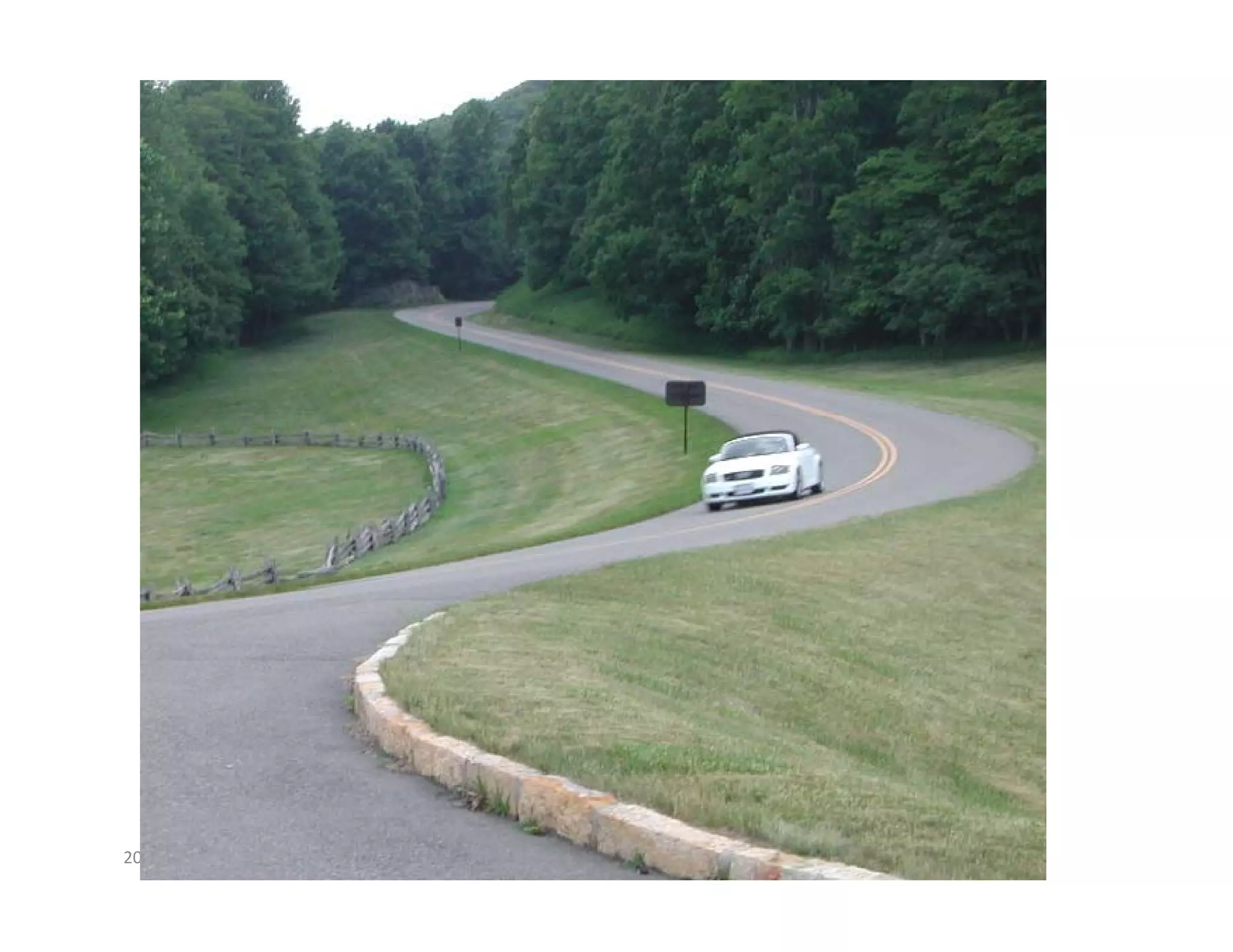
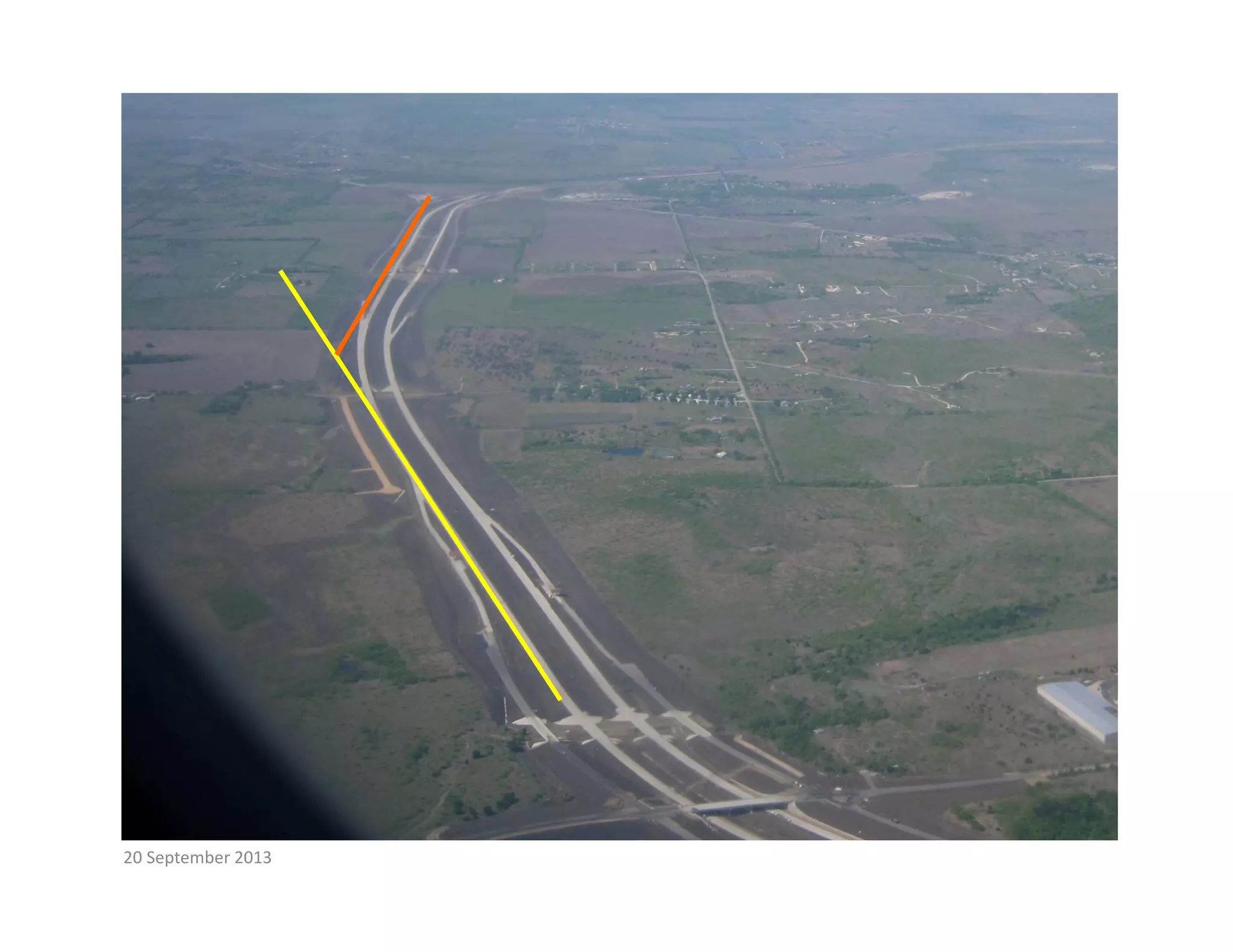
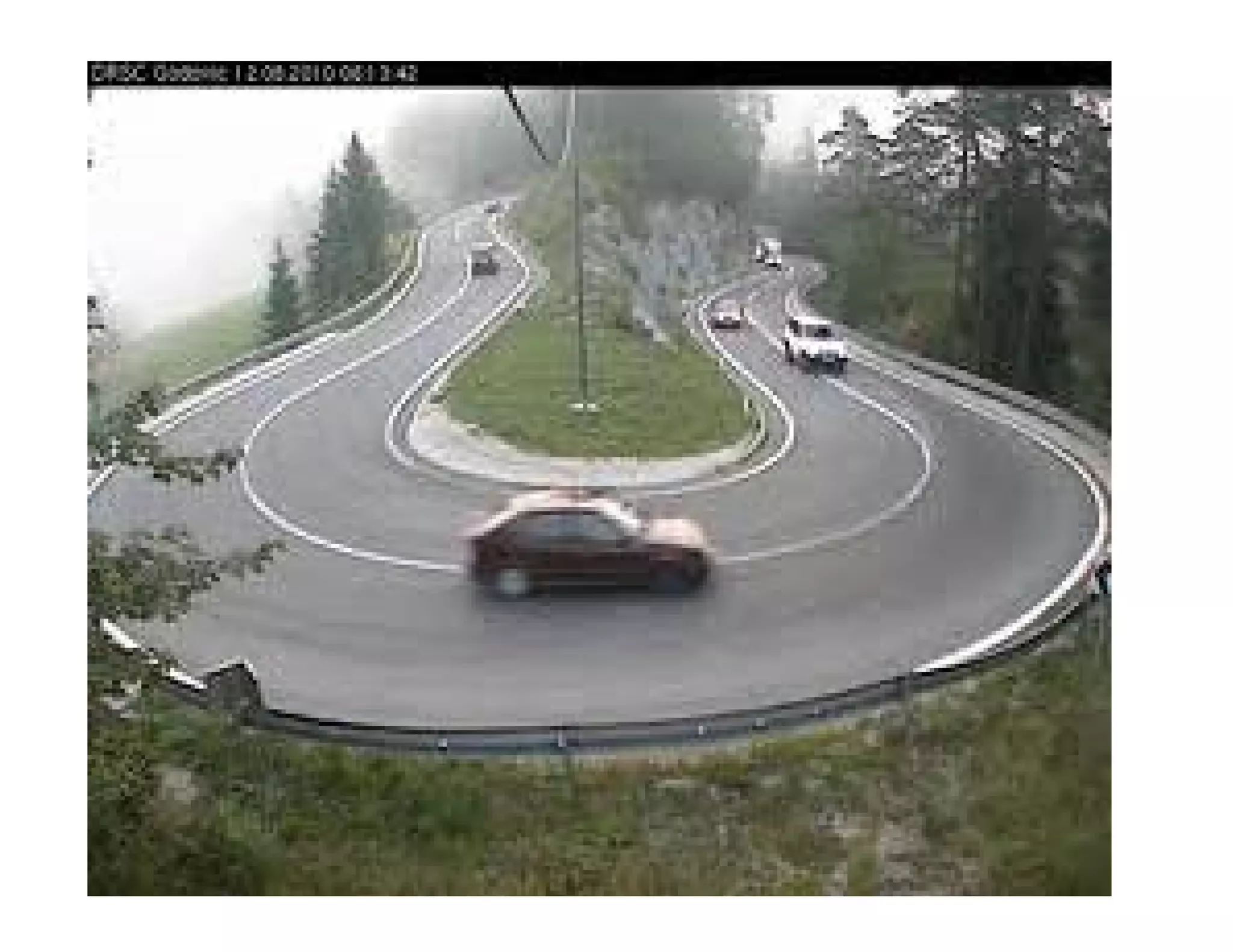
What is curve?
What is curve?
• Why Curve?
Why Curve?
f C
• Use of Curve.
20 September 2013
20 September 2013
20 September 2013
20 September 2013
20 September 2013
Components of Highway Design
Horizontal Alignment
Plan View
Horizontal Alignment
V ti l Ali t
Profile View
Vertical Alignment
20 September 2013
Horizontal Alignment
T d ’ Cl
Today’s Class:
• Components of the horizontal alignment
• Properties of a simple circular curve
20 September 2013
20 September 2013
20 September 2013
20 September 2013
20 September 2013
20 September 2013
20 September 2013
20 September 2013
20 September 2013
20 September 2013
20 September 2013
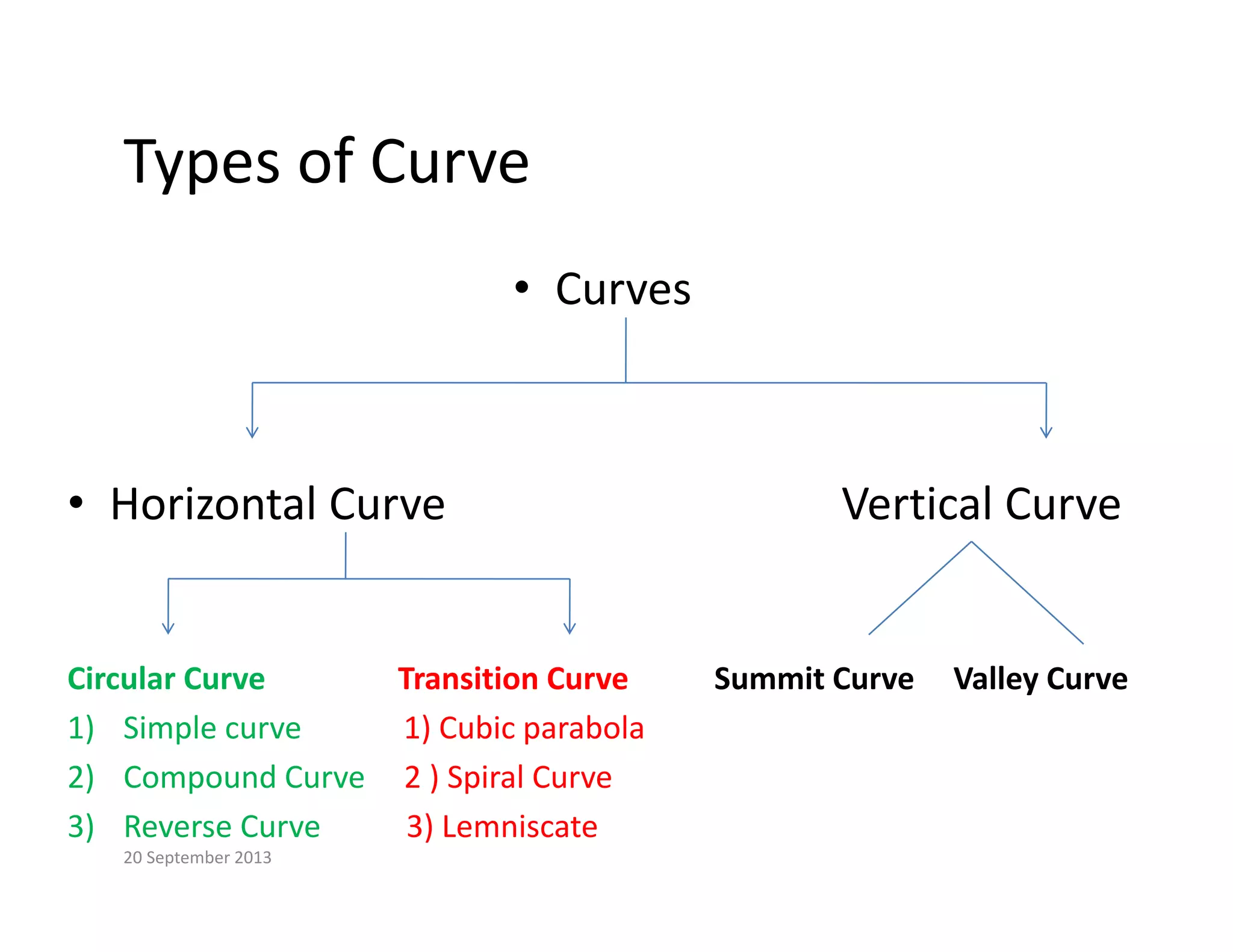
Types of Curve
Types of Curve
• Curves
Curves
• Horizontal Curve Vertical Curve
Circular Curve Transition Curve Summit Curve Valley Curve
1) Simple curve 1) Cubic parabola
2) Compound Curve 2 ) Spiral Curve
3) Reverse Curve 3) Lemniscate
20 September 2013
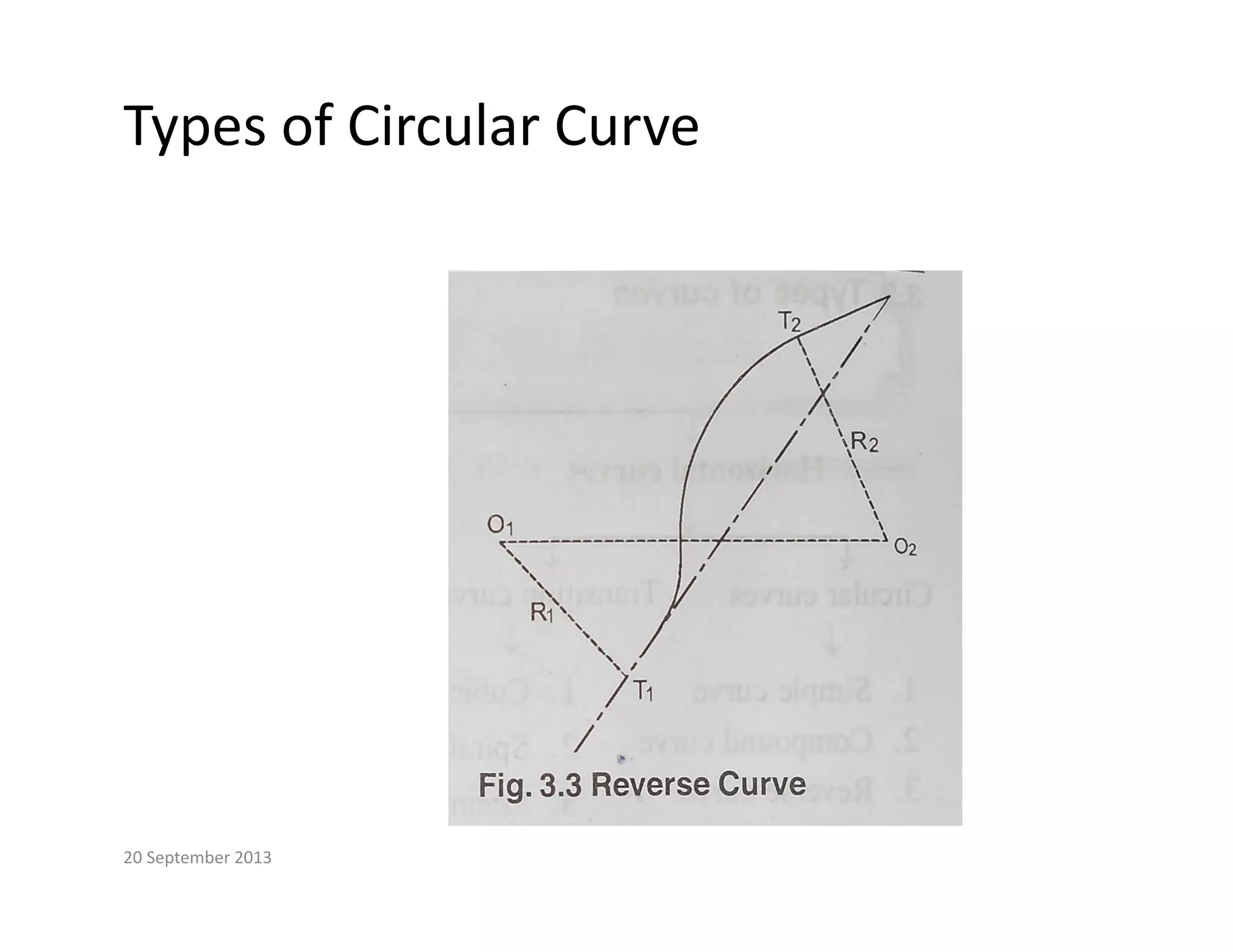
Types of Circular Curve
20 September 2013
Types of Circular Curve
20 September 2013
Types of Circular Curve
20 September 2013
Definition and Notation of Simple Curve
20 September 2013
20 September 2013
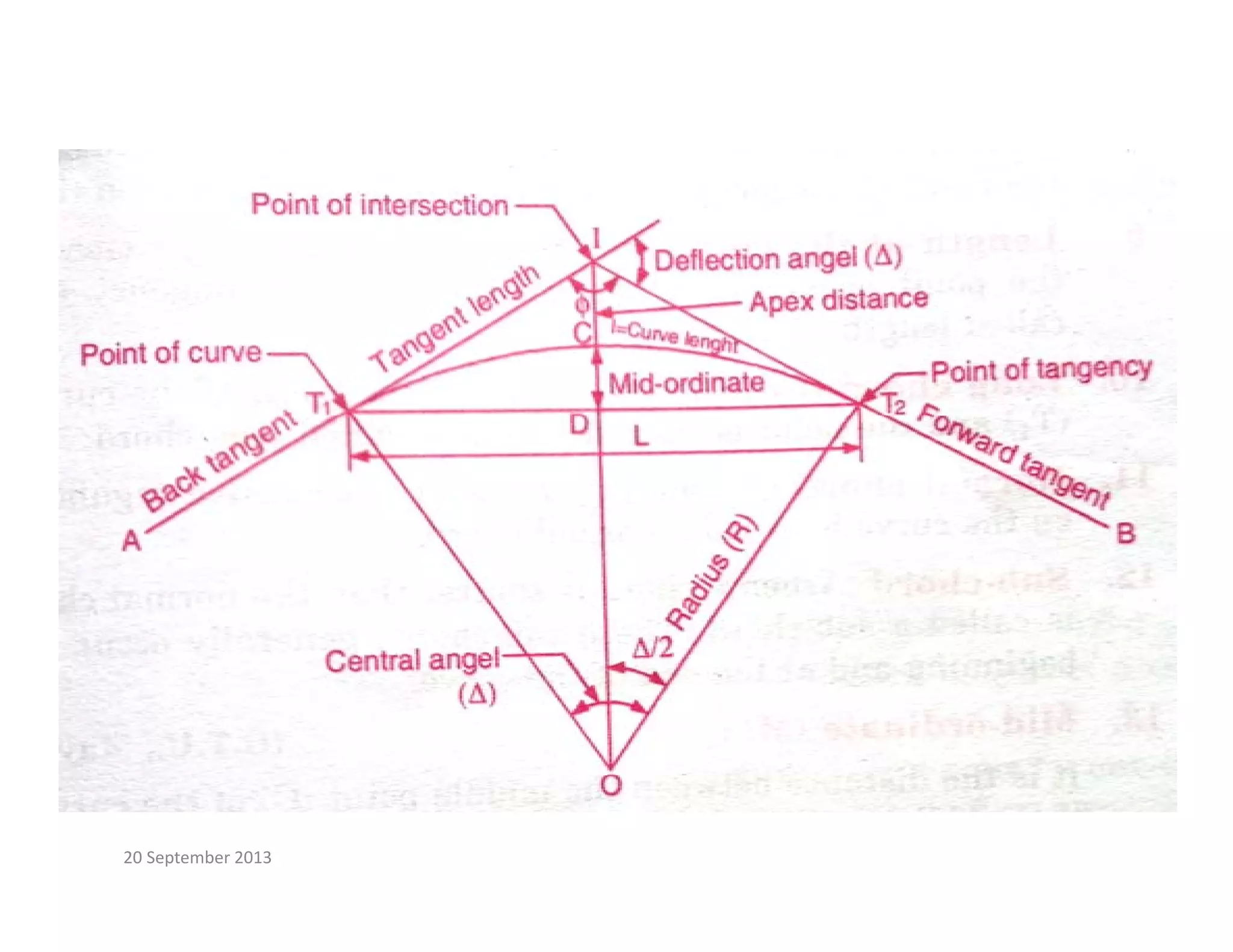
Definition and Notation of Simple Curve
• 1) Back tangent or First Tangent ‐ AT₁
– Pervious to the curve
d d
2) Forward Tangent or Second tangent‐ B T₂
‐ Following the curve.
3) Point of Intersection ( P.I.) or Vertex. (v)
If the tangents AT₁ and BT₂ .are produced they
ill t i i t ll d th i t f
will meet in a point called the point of
intersection
4)Point of curve ( PC ) Beginning Point T of a
4)Point of curve ( P.C.) –Beginning Point T₁ of a
curve. Alignment changes from a tangent to
curve.
20 September 2013
Definition and Notation of Simple Curve
) f
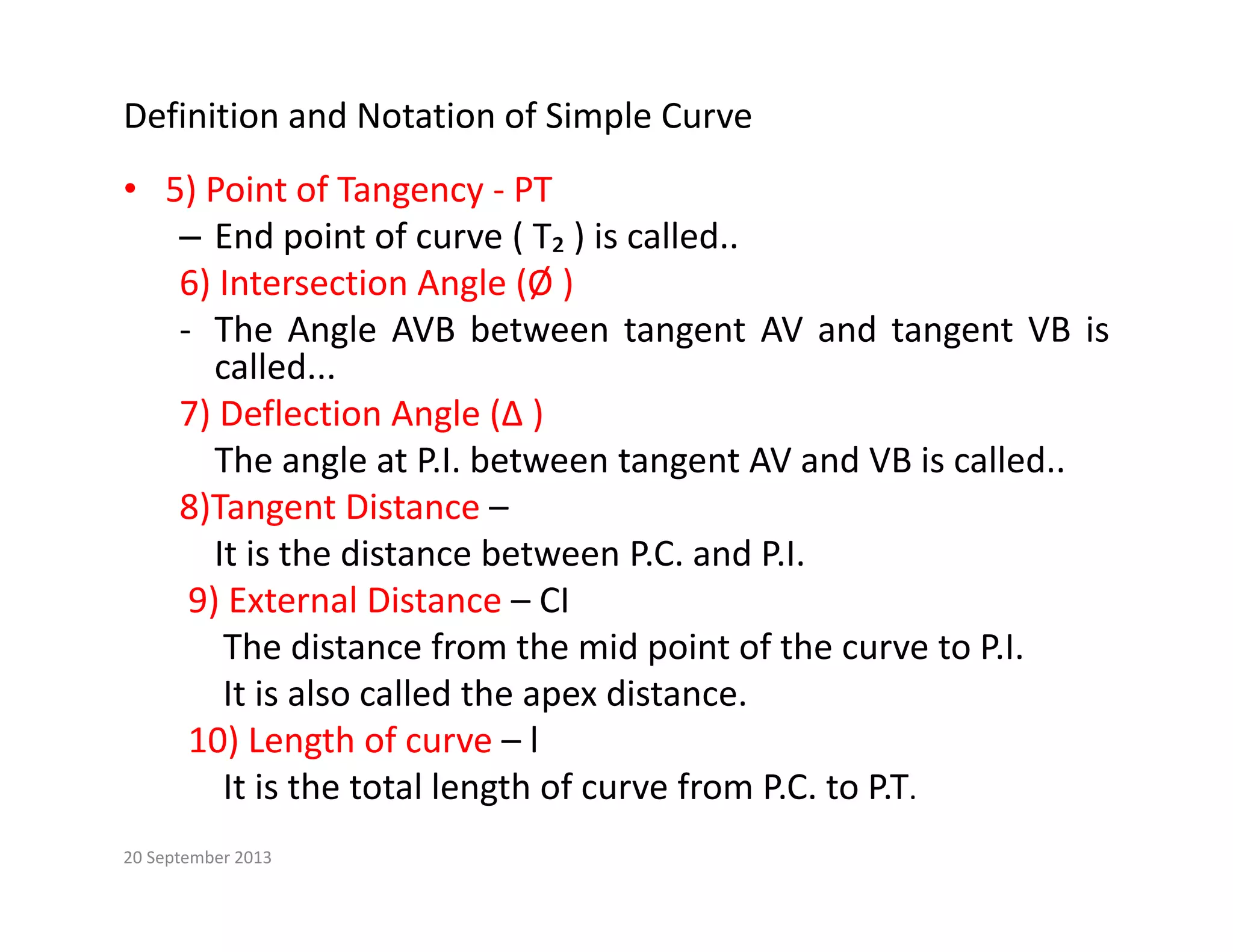
• 5) Point of Tangency ‐ PT
– End point of curve ( T₂ ) is called..
6) Intersection Angle (Ø )
) g (Ø )
‐ The Angle AVB between tangent AV and tangent VB is
called...
7) Deflection Angle (∆ )
The angle at P.I. between tangent AV and VB is called..
8)Tangent Distance –
It is the distance between P.C. and P.I.
9) External Distance – CI
The distance from the mid point of the curve to P.I.
It is also called the apex distance.
10) Length of curve – l
I i h l l h f f PC PT
It is the total length of curve from P.C. to P.T.
20 September 2013
Definition and Notation of Simple Curve
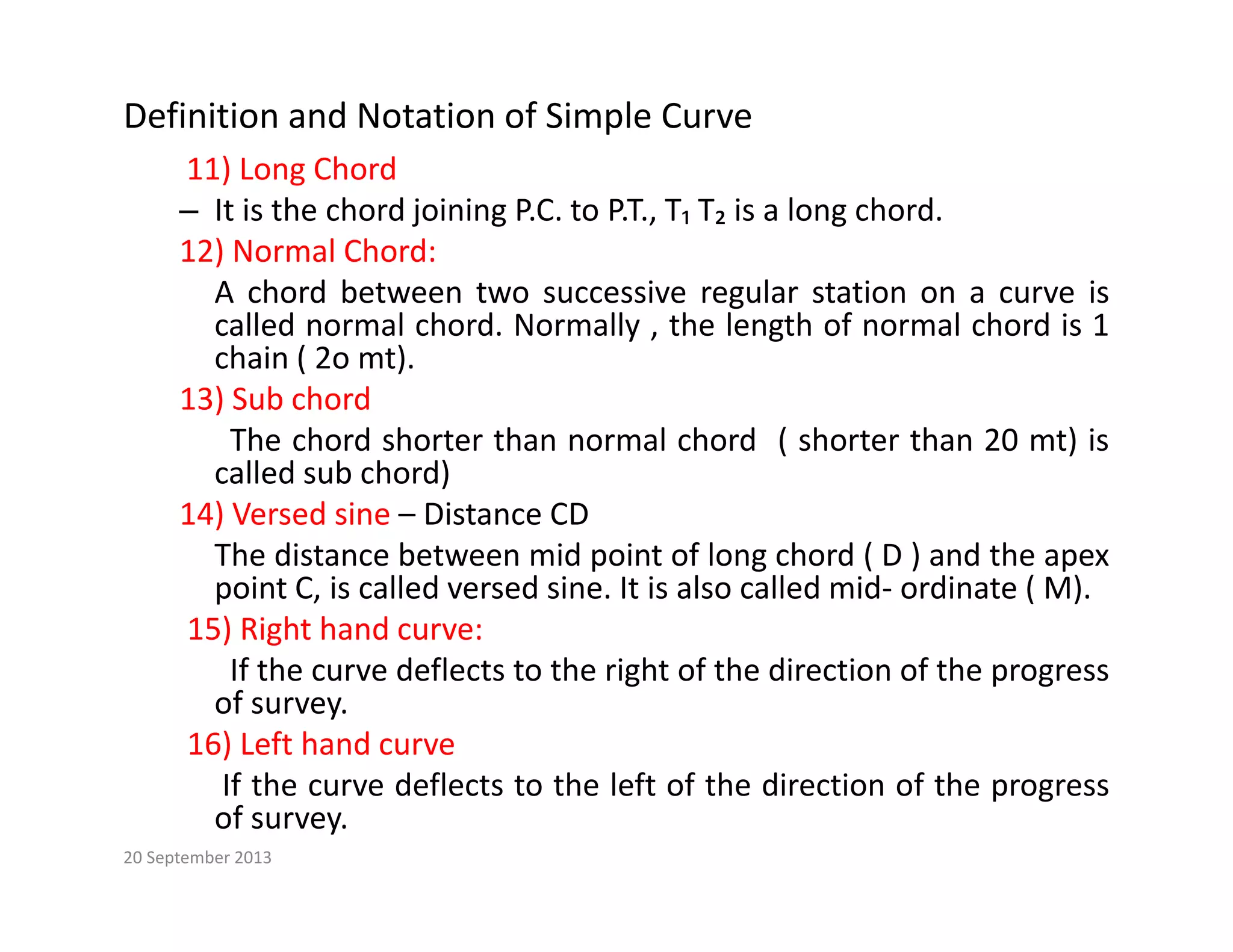
11) Long Chord
11) Long Chord
– It is the chord joining P.C. to P.T., T₁ T₂ is a long chord.
12) Normal Chord:
A chord between two successive regular station on a curve is
called normal chord. Normally , the length of normal chord is 1
chain ( 2o mt).
13) Sub chord
The chord shorter than normal chord ( shorter than 20 mt) is
called sub chord)
14) Versed sine – Distance CD
The distance between mid point of long chord ( D ) and the apex
point C, is called versed sine. It is also called mid‐ ordinate ( M).
15) Right hand curve:
If the curve deflects to the right of the direction of the progress
of survey.
16) Left hand curve
If th d fl t t th l ft f th di ti f th
If the curve deflects to the left of the direction of the progress
of survey.
20 September 2013
Designation of curve
The sharpness of the curve is designated by two 
ways.
ways.
( 1 ) By radius ( R)
( 2) B D f C t ( D )
( 2) By Degree of Curvature ( D ) 
( 1 ) By radius ( R)
Curve is known by the length of its radius‐ R
Curve is known by the length of its radius R
20 September 2013
Designation of curve
( 2) By Degree of Curvature ( D )
Chord Definition Arc Definition     
The Angle subtended at
the centre of curve by a
h d f 30 20 i
The Angle subtended at
the centre of curve by an
chord of 30 or 20 mt. is
called degree of
curvature.
arc of 30 or 20 mt.
length is called degree of
curve.
If an angle subtended at
the centre of curve by a
Used in America, canada,
India etc
20 September 2013
the centre of curve by a
chord of 20 mt is 5° , the
curve is called 5° curve
India etc.
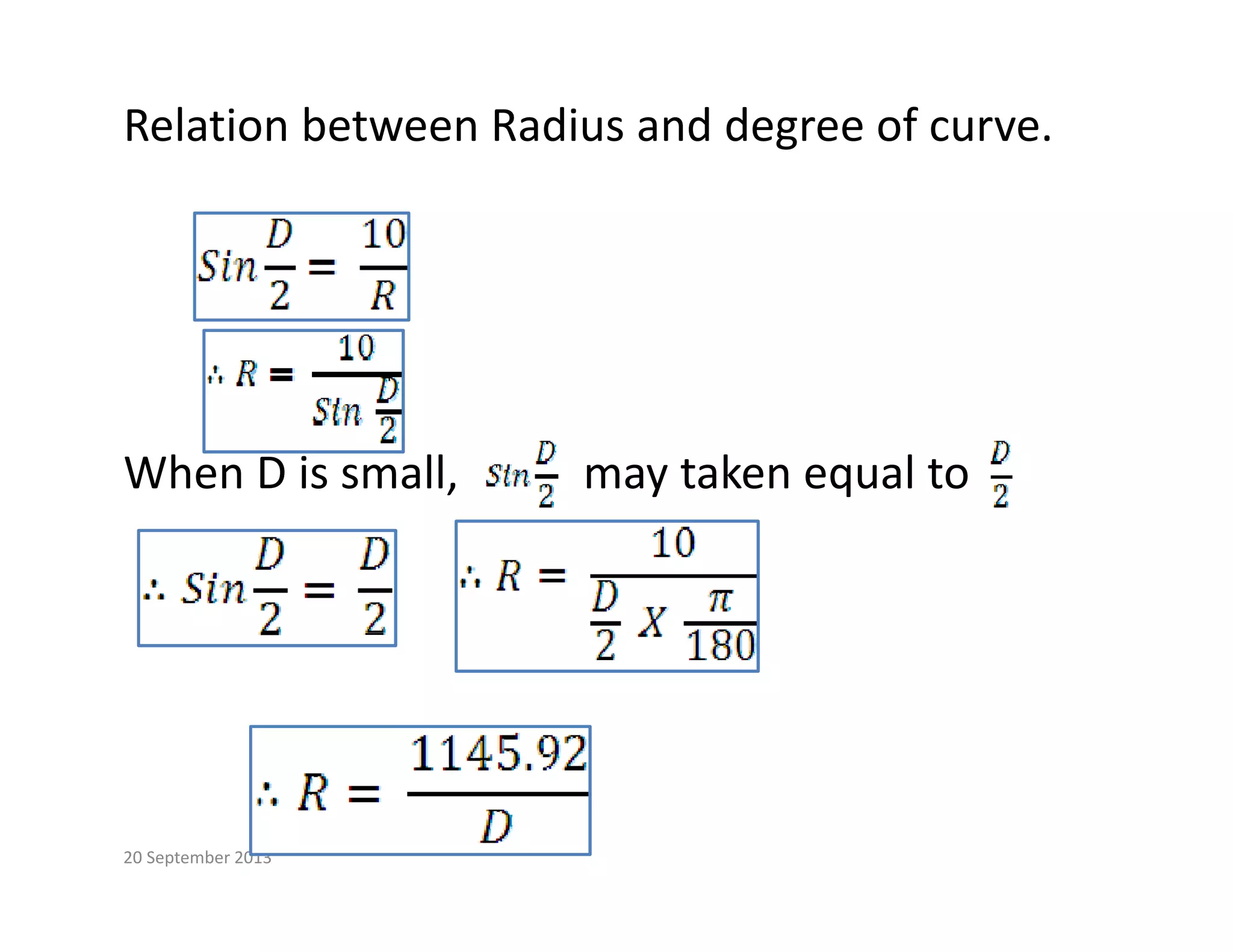
Relation between Radius and degree of curve.
( ) B h d d fi iti
(a) By chord definition
The angle subtended at the centre of curve
by a chord of 20 mt. is called degree of curve.
R = radius of curve.
D = degree of curve.
PQ = 20 mt. = Length of chord.
g
From Triangle PCO 
20 September 2013
Relation between Radius and degree of curve.
When D is small,           may taken equal to
20 September 2013
Relation between Radius and degree of curve.
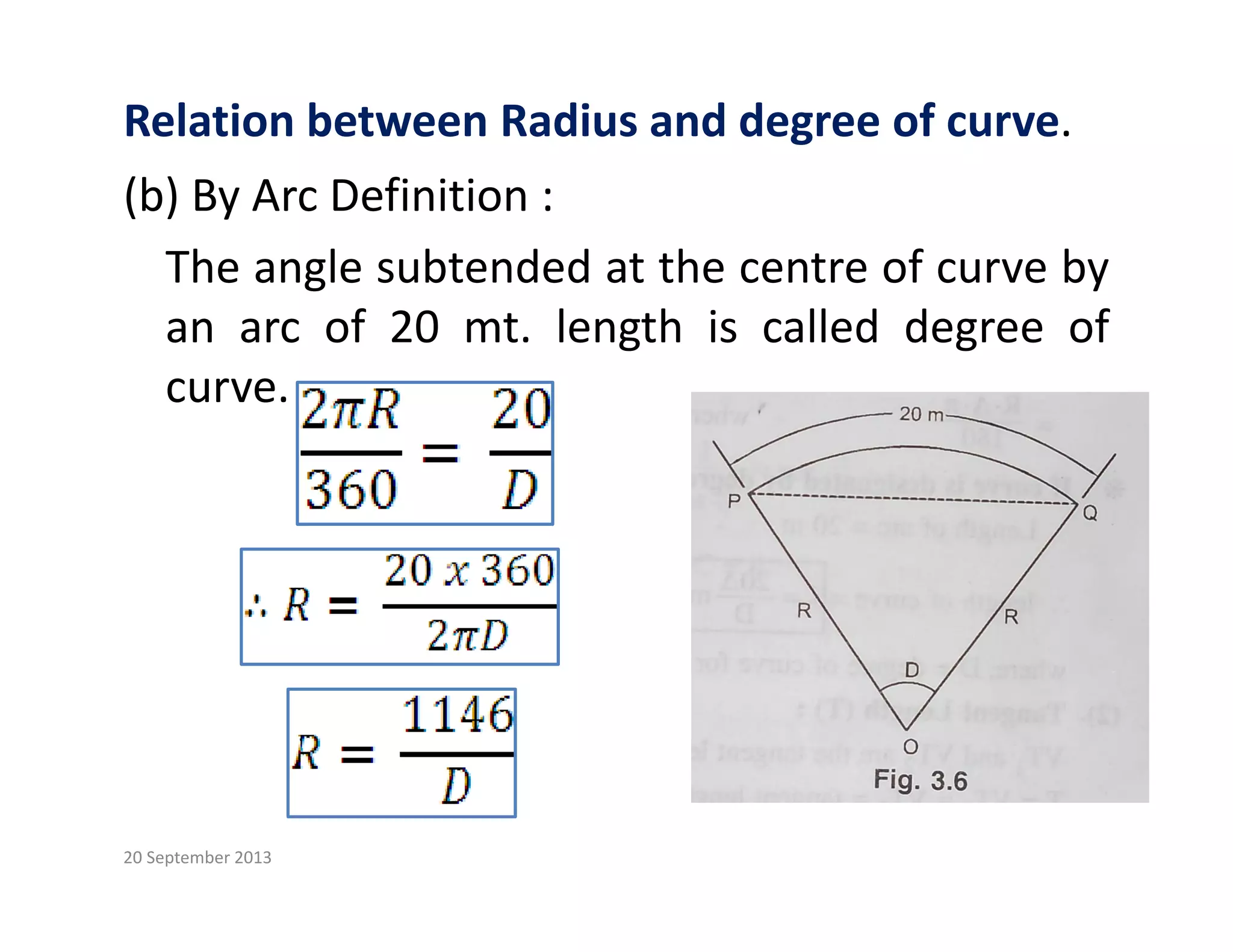
(b) By Arc Definition :
The angle subtended at the centre of curve by
an arc of 20 mt. length is called degree of
curve.
20 September 2013
Elements of Simple circular curve
20 September 2013
Elements of simple circular curve
Elements of simple circular curve
20 September 2013
Elements of Simple circular curve
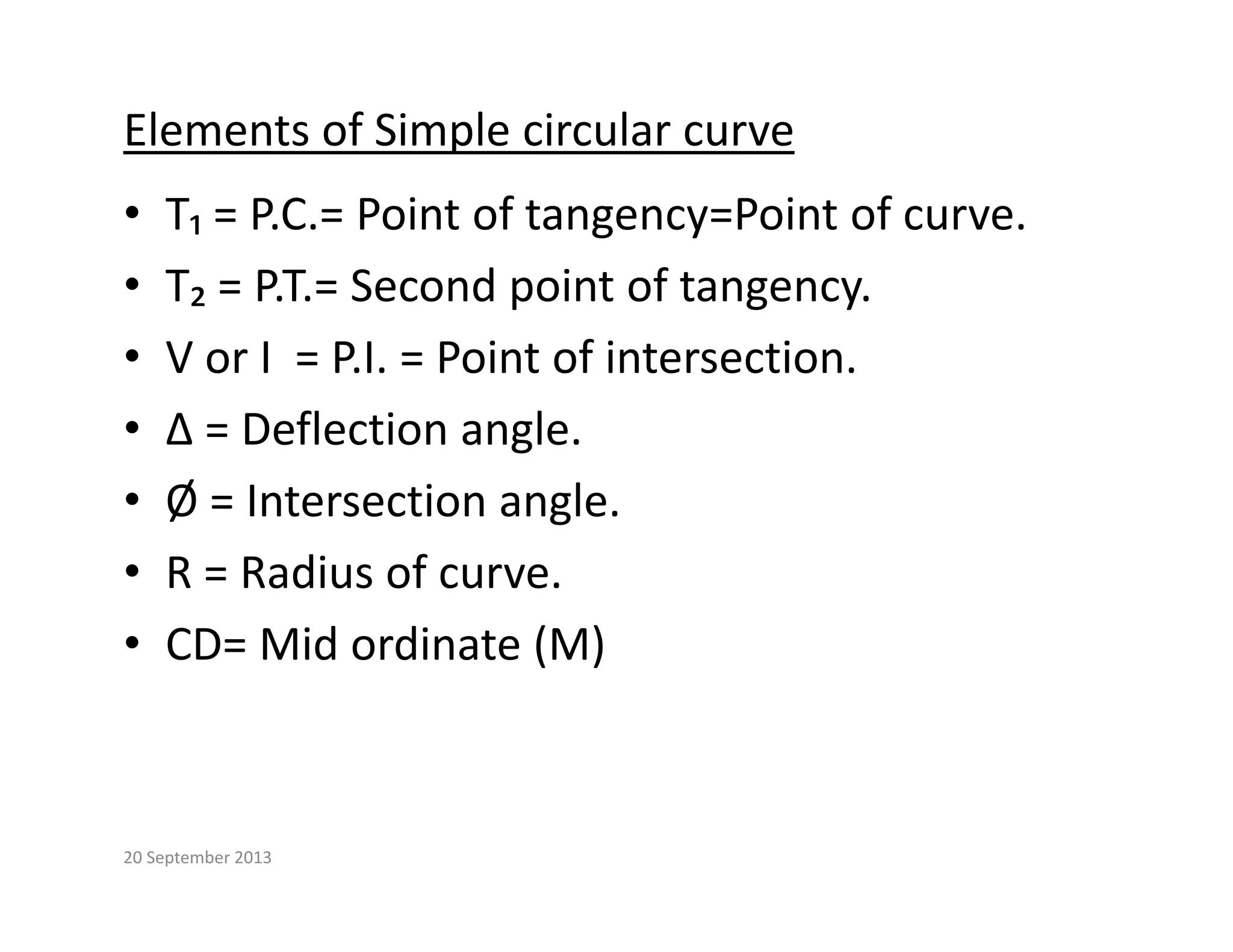
• T₁ = P.C.= Point of tangency=Point of curve.
• T₂ = P.T.= Second point of tangency.
T₂   P.T.  Second point of tangency.
• V or I  = P.I. = Point of intersection.
∆ D fl ti l
• ∆ = Deflection angle.
• Ø = Intersection angle.
• R = Radius of curve.
• CD= Mid ordinate (M)
CD  Mid ordinate (M)
20 September 2013
Example 1
• A circular curve has a radius of 150 mt and 60⁰
deflection angle. What is its degree(i) By arc
definition and 9ii) by chord definition.
• Solution:
• Solution:
(i) By arc definition Assuming chord length 30mt
20 September 2013
Elements of Simple circular curve
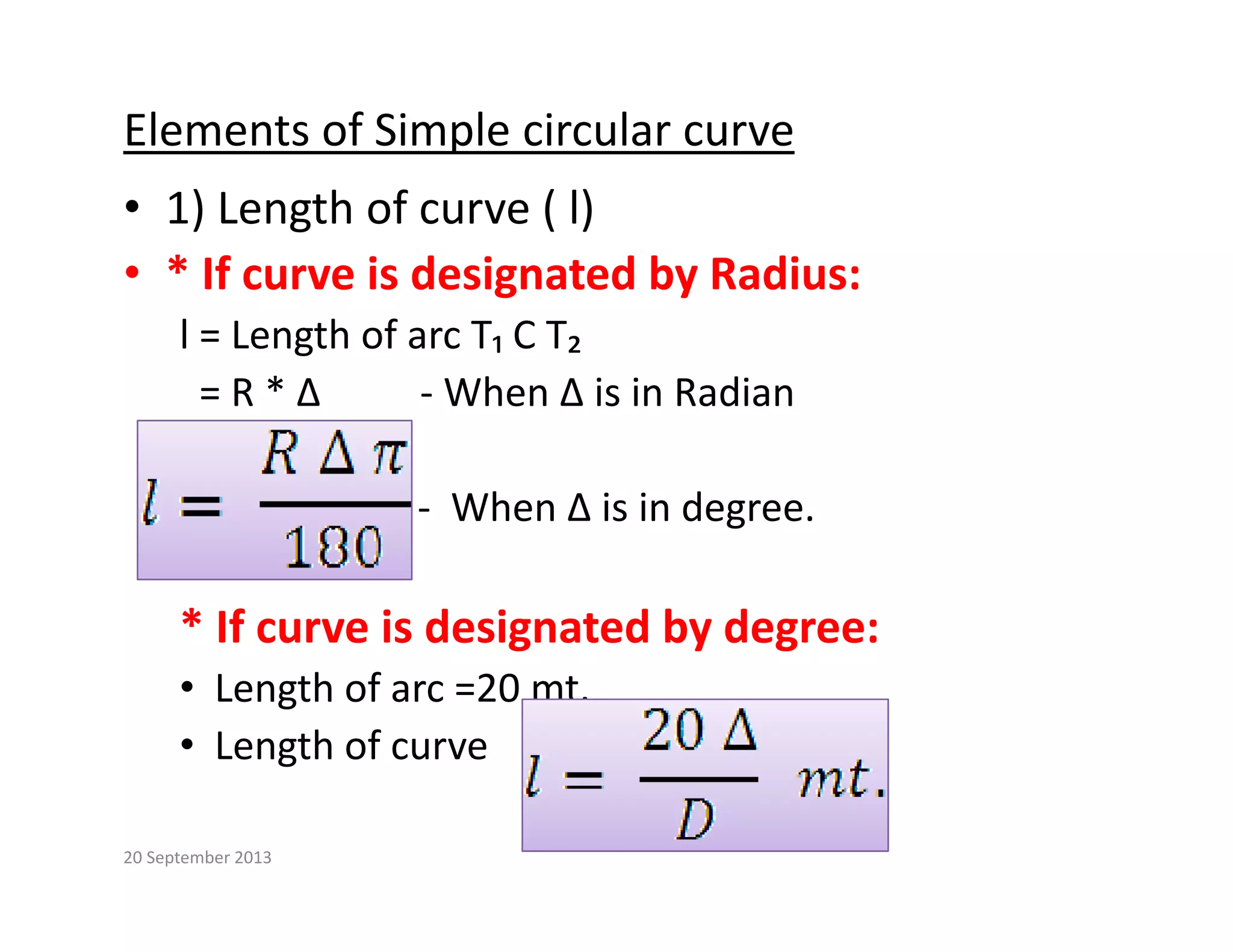
• 1) Length of curve ( l)
• * If curve is designated by Radius:
g y
l = Length of arc T₁ C T₂ 
= R * ∆          ‐ When ∆ is in Radian
‐ When ∆ is in degree.
* If curve is designated by degree:
• Length of arc =20 mt.
• Length of curve  
20 September 2013
Elements of Simple circular curve
2) Tangent length ( T):
• VT and VT are the tangents length Elements
• VT₁ and VT₂ are the tangents length Elements 
of simple circular curve
T VT VT t t l th
• T = VT₁ = VT₂ = tangent length
• From ∆ VT₁O 
20 September 2013
Elements of Simple circular curve
3) Length of chord ( L ):Elements of simple 
circular curve
circular curve
• In the figure T₁ ,T₂ is a long chord.
L th f l h d L T T 2 * (T D)
• Length of long chord =L =T₁T₂ =  2 * (T₁ D).
• From triangle T₁DO,
20 September 2013
Elements of Simple circular curve
4) External Distance ( E ): or Apex 
distanceElements of simple circular curve
• In the figure VC  is an external distance.
• External distance = E= VC= OV –OC Length of
• From triangle VT₁O.
E= OV‐OC   ( OC = R)
20 September 2013
Elements of Simple circular curve
• 5) Mid ordinate ( M ): = Distance – CD
• Also known as versed sine of the curve.
• Mid ordinate =M= CD= OC‐OD
• From ∆T₁DO
From ∆T₁DO 
• M = OC‐ OD
•
20 September 2013
Setting out of single Circular curve
• First step‐ Locate tangent point
• ‐ By tape measurements.
‐Intersection of both tangents point V‐ Point   
of intersection.
‐ Set theodolite at V and measure angle Ø
Ø
‐ Ø ( Measure by theodolite)
‐ Calculate tangent length
‐ Fix point  T₁T₂
20 September 2013
Setting out of single Circular curve
• Chainage of tangents:
• ‐ Point A is the starting point of chain line
• Chainage of point V, B, D are measured from        
point A.
p
• ‐ Chainage of T₁ = Chainage of V‐ T ( Tangent length)
• T Chainage of T + Length of curve (l)
• T₂ =Chainage of T₁ + Length of curve (l)
20 September 2013
Setting out of single Circular curve
N l h d d S b h d
• Normal chord and Sub chord:
• ‐For alignment pegs are driven.
h di b i ll 20
• The distance between two pegs is normally 20m
• Peg station are called main stations.
• The chord joining the tangents point T₁ and the first
main peg station is called First sub chord.
All th h d j i i dj t t ti
• All the chord joining adjacent peg stations are
called full chord or normal chord.
• The length of normal chord is 20 mt
• The length of normal chord is 20 mt.
• The point joining last main peg station and tangent
T₂ is called last sub chord
T₂ is called last sub chord.
20 September 2013
Methods of Setting out of single Circular curve
• Two Methods
• 1) Linear Methods
• 2) Angular Methods.
• 1) Linear Methods
( ) ff d f h l h d
• ‐ (i) By offsets or ordinate from the long chord.
• (ii) By successive bisection of arcs or chords.
• (iii) By offsets from the tangents.
• (iv) By offsets from the chord produced
(iv) By offsets from the chord produced.
20 September 2013
(i) By offsets or ordinate from the long chord.
R = Radius of curve
R = Radius of curve
O0  = Mid ordinate
Ox = Ordinate at distance x
T1, T2 = tangents point
L = Length of long chord.
20 September 2013
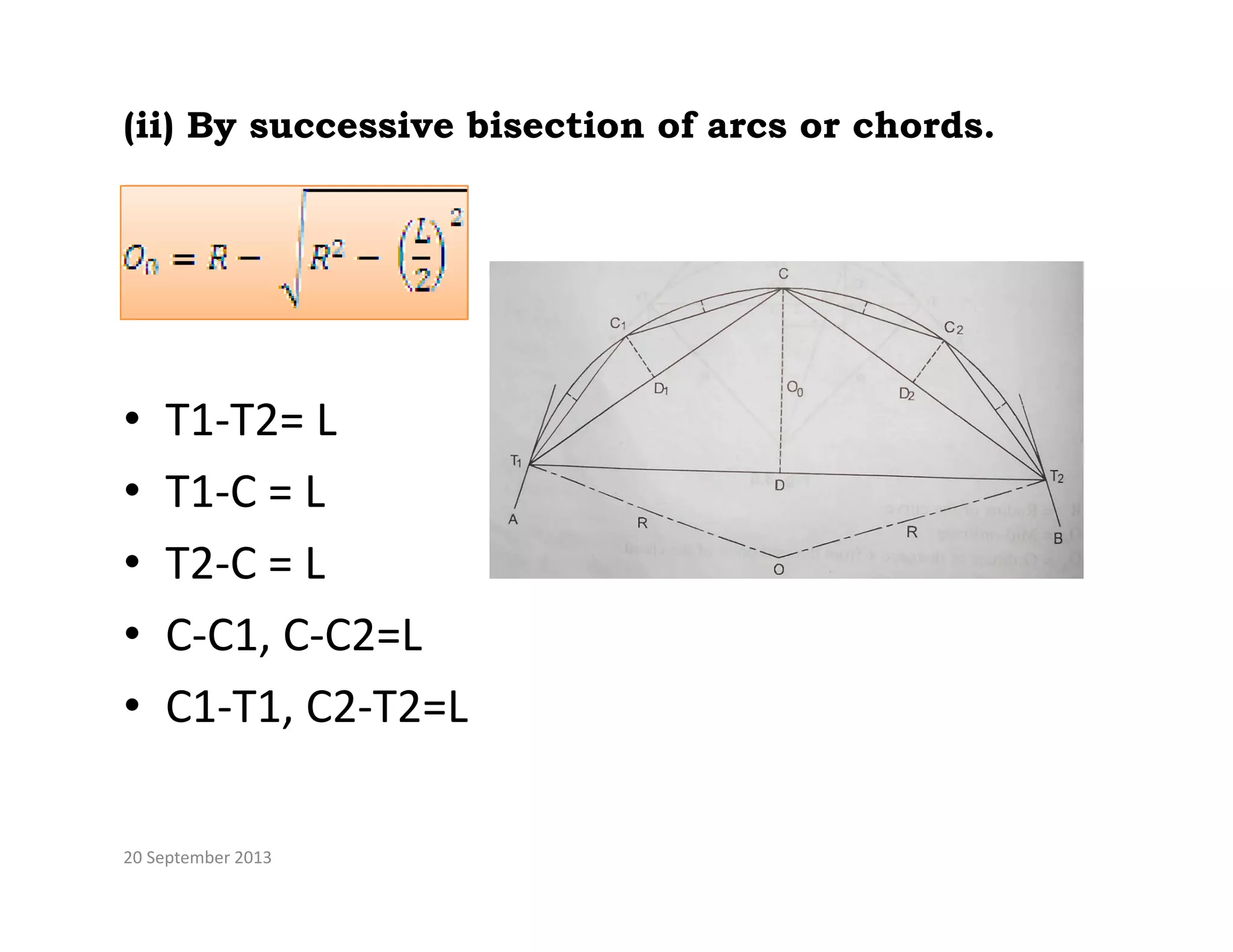
(ii) By successive bisection of arcs or chords.
• T1 T2= L
• T1‐T2= L
• T1‐C = L
• T2‐C = L
• C‐C1, C‐C2=L
,
• C1‐T1, C2‐T2=L
20 September 2013
(iii) By offsets from the tangents.
• Two types
• Radial offset Perpendicular offset
p
20 September 2013
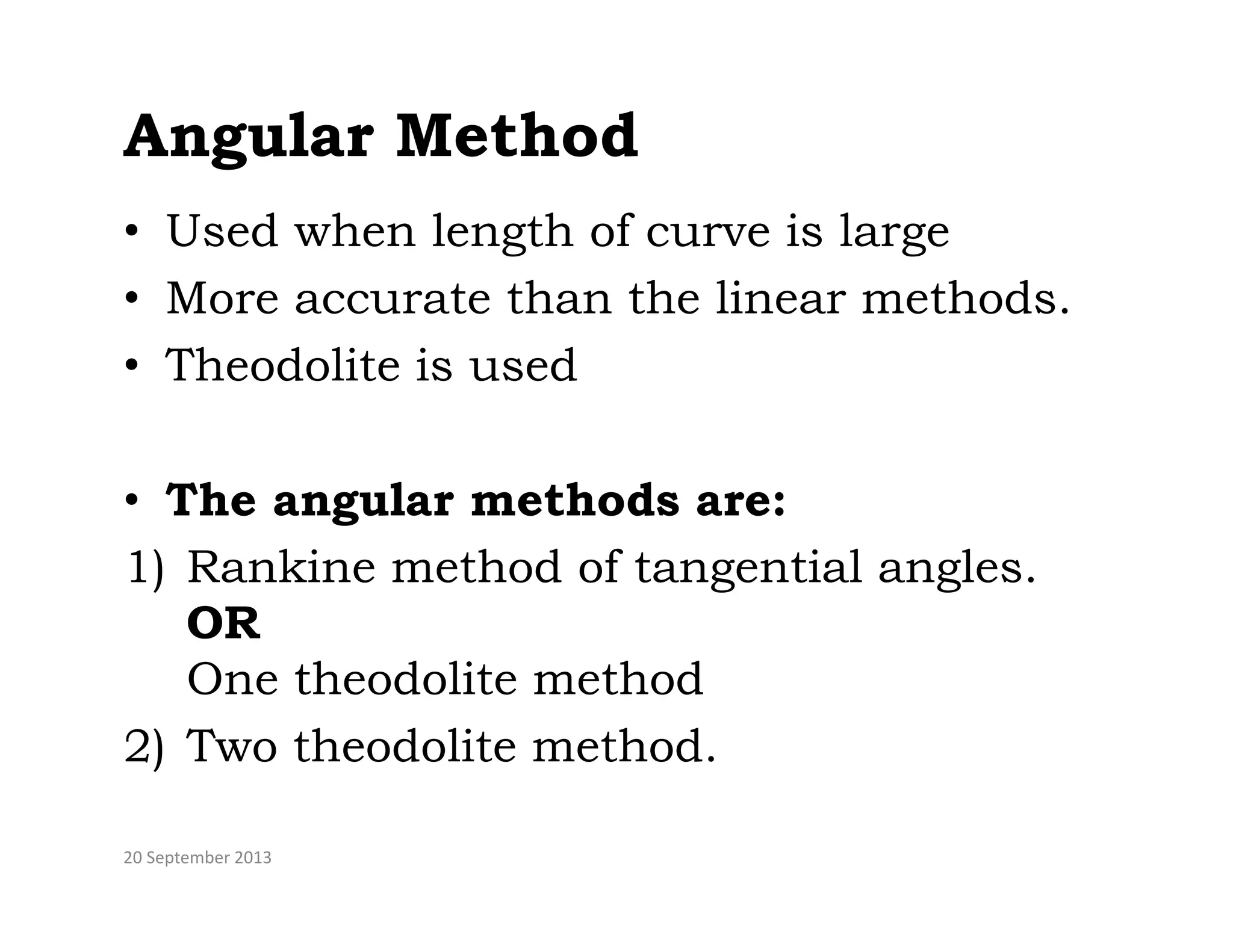
Angular Method
• Used when length of curve is large
• More accurate than the linear methods
• More accurate than the linear methods.
• Theodolite is used
• The angular methods are:
1) Rankine method of tangential angles.
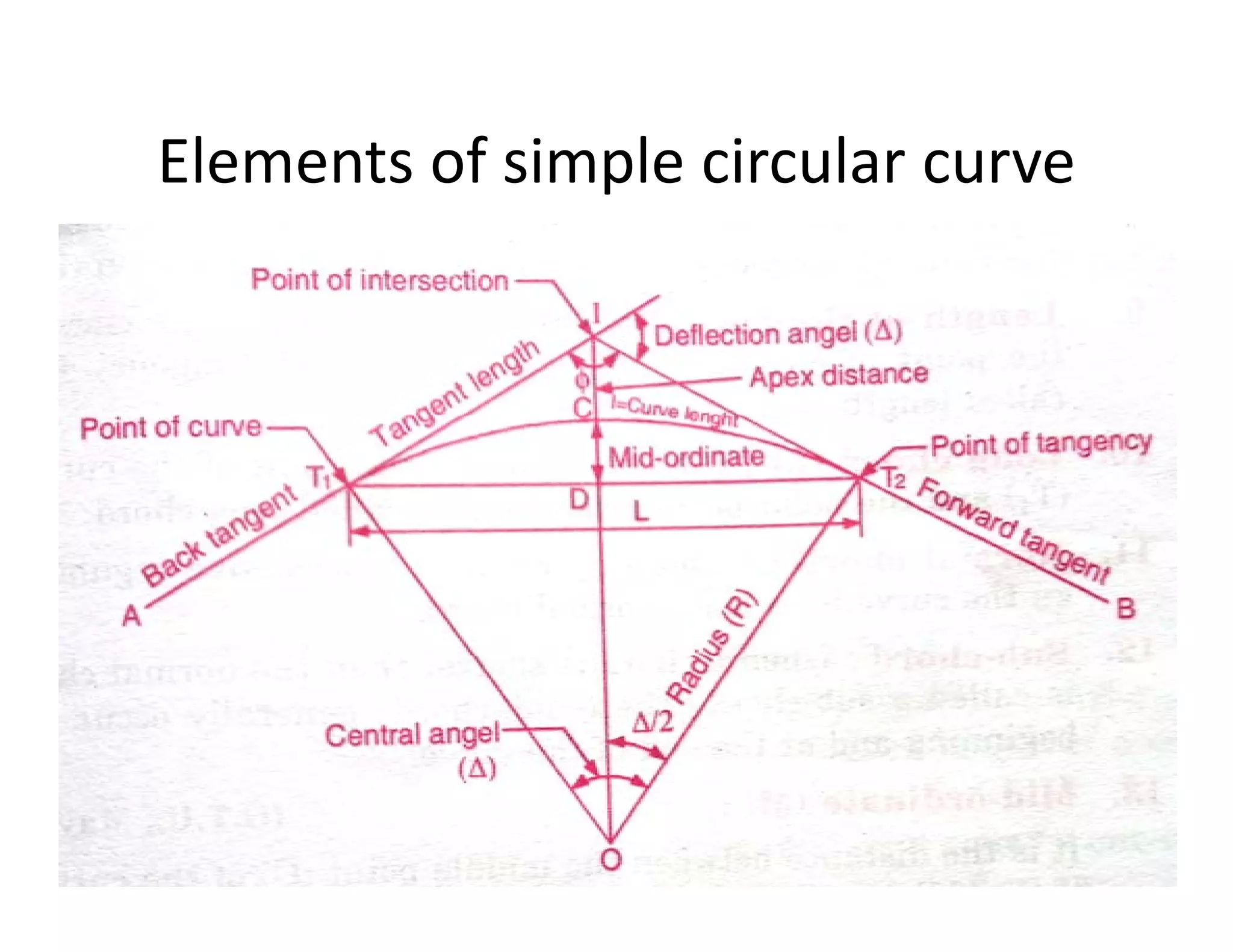
OR
One theodolite method
2) Two theodolite method.
20 September 2013
Obstacles in setting out simple curves
• Case –I -When P.I. is inaccessible
C II Wh P C i i ibl
• Case –II -When P.C. is inaccessible
• Case –III -When P.T. is inaccessible
• Case –IV - When both P.C. and P.T. is
inaccessible.
• Case –V - When obstacles to chaining.
20 September 2013
TRANSITION CURVE
20 September 2013
Requirement of transition curve
• Tangential to straight
M t i l t ti ll
• Meet circular curve tangentially
• At origin curvature should zero.
• Curvature should same at junction of circular 
curve.
• Rate of increase of curvature = rate increase of 
super elevation.
p
• Length of transition curve = full super 
elevation attained
elevation attained.
20 September 2013
Purpose of transition curve
p
• Curvature is increase gradually.
• Medium for gradual introduction of
• Medium for gradual introduction of 
superelevation
• Provide Extra widening gradually
• Provide Extra widening gradually
• Advantages
• Increase comfort to passenger on curve
• Increase comfort to passenger on curve
• Reduce overturning
• Allow higher speed
• Less wear on gear, tyre
20 September 2013
Types of transition curve
• Cubic parabola
• For railway
• ‐ For railway
• Spiral or Clothoid
‐ Ideal transition
‐ Radius α Distance
• Lemniscates
‐ Used for road
‐ Used for road
20 September 2013
Vertical curve
20 September 2013
Length of vertical curve
Length of vertical curve
• Total change of grade
Total change of grade
• Length of vertical curve =‐‐‐‐‐‐‐‐‐‐‐‐‐‐‐‐‐‐‐‐‐‐‐‐‐‐‐‐
• Rate of change of grade
• Rate of change of grade
• g2 – g1
• =     ‐‐‐‐‐‐‐‐‐‐‐‐‐‐‐‐‐‐
• r
• g1, g2  = Grades in %
• r = Rate of change of grade
20 September 2013

curves-33.pdf