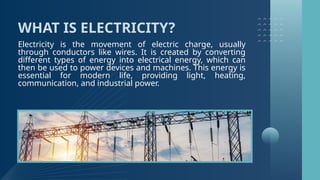
WHAT IS ELECTRICITY?
Electricityis the movement of electric charge, usually
through conductors like wires. It is created by converting
different types of energy into electrical energy, which can
then be used to power devices and machines. This energy is
essential for modern life, providing light, heating,
communication, and industrial power.
3.
HOW
ELECTRICITY IS
GENERATED
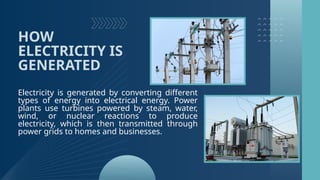
Electricity isgenerated by converting different
types of energy into electrical energy. Power
plants use turbines powered by steam, water,
wind, or nuclear reactions to produce
electricity, which is then transmitted through
power grids to homes and businesses.
4.
HOW ELECTRICITY
IS DISTRIBUTED
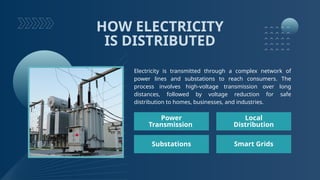
Electricityis transmitted through a complex network of
power lines and substations to reach consumers. The
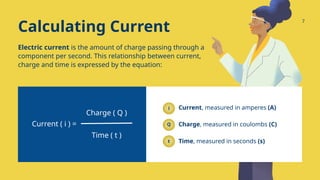
process involves high-voltage transmission over long
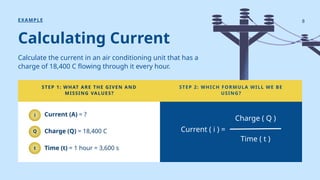
distances, followed by voltage reduction for safe
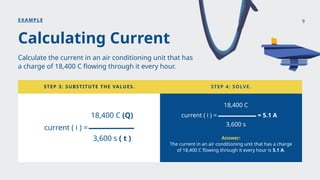
distribution to homes, businesses, and industries.
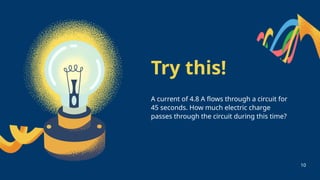
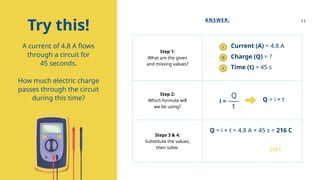
Power
Transmission
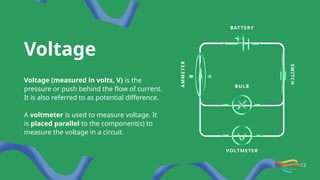
Substations
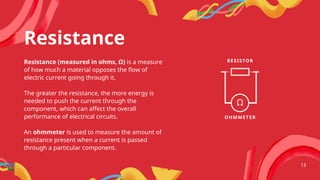
Local
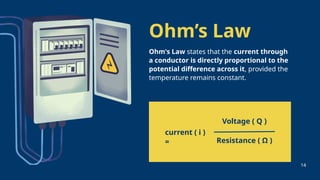
Distribution
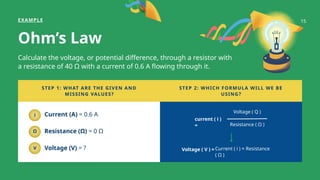
Smart Grids
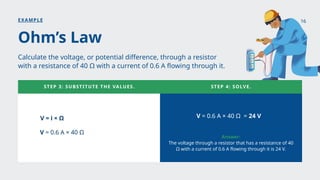
5.
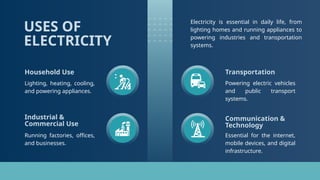
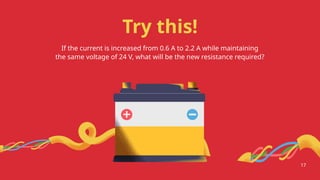
Household Use
Lighting, heating,cooling,
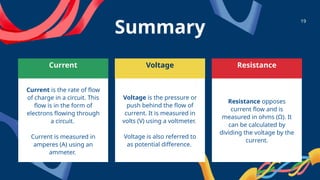
and powering appliances.
Transportation
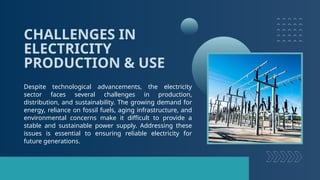
Powering electric vehicles
and public transport
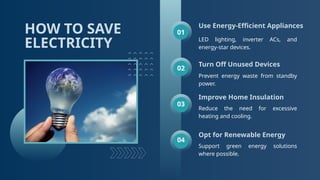
systems.
Industrial &
Commercial Use
Running factories, offices,
and businesses.
Communication &
Technology
Essential for the internet,
mobile devices, and digital
infrastructure.
USES OF
ELECTRICITY
Electricity is essential in daily life, from
lighting homes and running appliances to
powering industries and transportation
systems.
6.
SUSTAINABLE VS. TRADITIONAL
POWERSOURCES
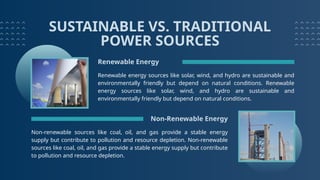
Renewable Energy
Renewable energy sources like solar, wind, and hydro are sustainable and
environmentally friendly but depend on natural conditions. Renewable
energy sources like solar, wind, and hydro are sustainable and
environmentally friendly but depend on natural conditions.
Non-renewable sources like coal, oil, and gas provide a stable energy
supply but contribute to pollution and resource depletion. Non-renewable
sources like coal, oil, and gas provide a stable energy supply but contribute
to pollution and resource depletion.
Non-Renewable Energy
7.
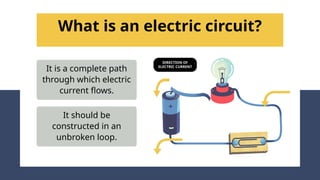
What is anelectric circuit?
DIRECTION OF
ELECTRIC CURRENT
It is a complete path
through which electric
current flows.
It should be
constructed in an
unbroken loop.
8.
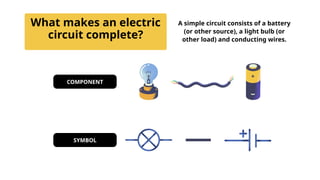
What makes anelectric
circuit complete?
A simple circuit consists of a battery
(or other source), a light bulb (or
other load) and conducting wires.
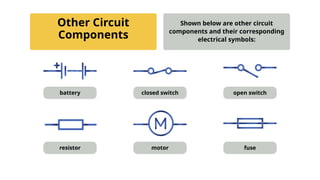
COMPONENT
SYMBOL
9.
Other Circuit
Components
Shown beloware other circuit
components and their corresponding
electrical symbols:
battery closed switch open switch
resistor motor fuse
10.
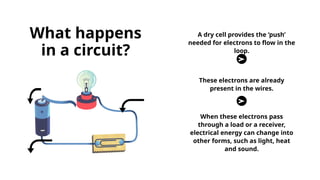
When these electronspass
through a load or a receiver,
electrical energy can change into
other forms, such as light, heat
and sound.
A dry cell provides the ‘push’
needed for electrons to flow in the
loop.
These electrons are already
present in the wires.
What happens
in a circuit?
11.
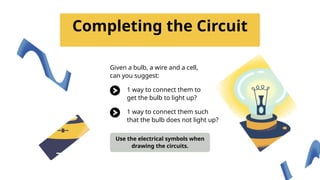
Completing the Circuit
Usethe electrical symbols when
drawing the circuits.
1 way to connect them to
get the bulb to light up?
Given a bulb, a wire and a cell,
can you suggest:
1 way to connect them such
that the bulb does not light up?
12.
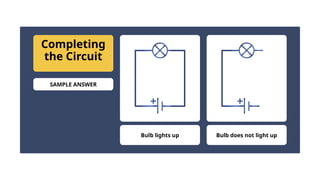
Bulb lights upBulb does not light up
Completing
the Circuit
SAMPLE ANSWER
13.
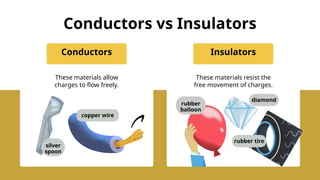
Conductors vs Insulators
Thesematerials allow
charges to flow freely.
These materials resist the
free movement of charges.
Conductors Insulators
silver
spoon
copper wire
rubber
balloon
rubber tire
diamond
14.
WITH THE HELPOF YOUR TEACHER OR CARER,
test whether your suggestions and drawings
will make the bulb light using actual batteries,
a small lightbulb, and wires.
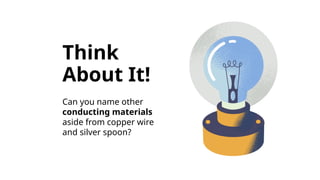
Think
About It!
Can you name other
conducting materials
aside from copper wire
and silver spoon?
15.
Electric circuits playa crucial role
in our daily lives.
It allows specific
devices to
produce heat
and sound.
It allows
light bulbs
to light up.
It helps trains
move and makes
travelling to work
or school easier.
It enables the
cooling system of
a refrigerator to
work.
What can electric
circuits do?
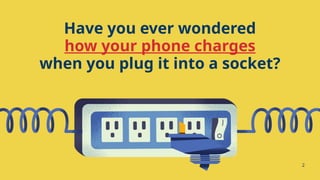
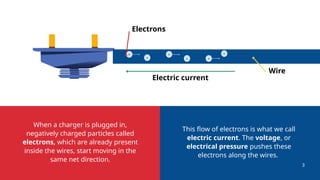
Have you everwondered
how your phone charges
when you plug it into a socket?
2
18.
e
Electrons
Wire
When a chargeris plugged in,
negatively charged particles called
electrons, which are already present
inside the wires, start moving in the
same net direction.
This flow of electrons is what we call
electric current. The voltage, or
electrical pressure pushes these
electrons along the wires.
e
e
e e
e
Electric current
3
19.
Electrons
Wire
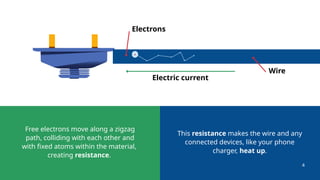
Free electrons movealong a zigzag
path, colliding with each other and
with fixed atoms within the material,
creating resistance.
This resistance makes the wire and any
connected devices, like your phone
charger, heat up.
e
Electric current
4
20.
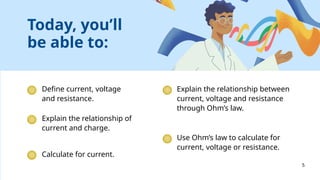
Define current, voltage
andresistance.
Today, you’ll
be able to:
Explain the relationship of
current and charge.
Calculate for current.
Explain the relationship between
current, voltage and resistance
through Ohm’s law.
Use Ohm’s law to calculate for
current, voltage or resistance.
5
21.
BULB
Current
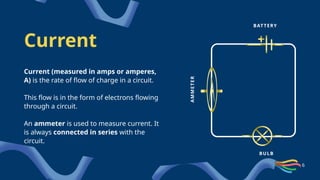
Current (measured inamps or amperes,
A) is the rate of flow of charge in a circuit.
This flow is in the form of electrons flowing
through a circuit.
An ammeter is used to measure current. It
is always connected in series with the
circuit.
BATTERY
A
M
M
E
T
E
R
6
22.
Calculating Current
Electric currentis the amount of charge passing through a
component per second. This relationship between current,
charge and time is expressed by the equation:
i
Q
t
Current, measured in amperes (A)
Charge, measured in coulombs (C)
Time, measured in seconds (s)
Current ( i ) =
Charge ( Q )
Time ( t )
7
23.
Calculating Current
Calculate thecurrent in an air conditioning unit that has a
charge of 18,400 C flowing through it every hour.
i
Q
t
Current (A) = ?
Charge (Q) = 18,400 C
Time (t) = 1 hour = 3,600 s
STEP 1: WHAT ARE THE GIVEN AND
MISSING VALUES?
STEP 2: WHICH FORMULA WILL WE BE
USING?
Current ( i ) =
Charge ( Q )
Time ( t )
EXAMPLE 8
24.
Calculating Current
Calculate thecurrent in an air conditioning unit that has
a charge of 18,400 C flowing through it every hour.
STEP 3: SUBSTITUTE THE VALUES. STEP 4: SOLVE.
current ( i ) =
18,400 C
3,600 s
EXAMPLE
= 5.1 A
current ( i ) =
18,400 C (Q)
3,600 s ( t ) Answer:
The current in an air conditioning unit that has a charge
of 18,400 C flowing through it every hour is 5.1 A.
9
25.
Try this!
A currentof 4.8 A flows through a circuit for
45 seconds. How much electric charge
passes through the circuit during this time?
10
26.
Step 1:
What arethe given
and missing values?
Step 2:
Which formula will
we be using?
Steps 3 & 4:
Substitute the values,
then solve.
Try this!
A current of 4.8 A flows
through a circuit for
45 seconds.
How much electric charge
passes through the circuit
during this time?
ANSWER:
i
Q
t
Current (A) = 4.8 A
Charge (Q) = ?
Time (t) = 45 s
i =
t
Q
Q = i × t
Q = i × t = 4.8 A × 45 s = 216 C
The electric charge that passes
through the circuit is 216 C.
11
27.
BULB
Voltage
Voltage (measured involts, V) is the
pressure or push behind the flow of current.
It is also referred to as potential difference.
A voltmeter is used to measure voltage. It
is placed parallel to the component(s) to
measure the voltage in a circuit.
BATTERY
A
M
M
E
T
E
R
S
W
I
TC
H
VOLTMETER
12
28.
Resistance
Resistance (measured inohms, Ω) is a measure
of how much a material opposes the flow of
electric current going through it.
The greater the resistance, the more energy is
needed to push the current through the
component, which can affect the overall
performance of electrical circuits.
An ohmmeter is used to measure the amount of
resistance present when a current is passed
through a particular component.
RESISTOR
OHMMETER
Ω
13
29.
Ohm’s Law
Ohm's Lawstates that the current through
a conductor is directly proportional to the
potential difference across it, provided the
temperature remains constant.
current ( i )
=
Voltage ( Q )
Resistance ( Ω )
14
30.
Ohm’s Law
Calculate thevoltage, or potential difference, through a resistor with
a resistance of 40 Ω with a current of 0.6 A flowing through it.
i
Ω
V
Current (A) = 0.6 A
Resistance (Ω) = 0 Ω
Voltage (V) = ?
STEP 1: WHAT ARE THE GIVEN AND
MISSING VALUES?
STEP 2: WHICH FORMULA WILL WE BE
USING?
EXAMPLE
current ( i )
=
Voltage ( Q )
Resistance ( Ω )
Voltage ( V ) = Current ( i ) × Resistance
( Ω )
15
31.
Ohm’s Law
Calculate thevoltage, or potential difference, through a resistor
with a resistance of 40 Ω with a current of 0.6 A flowing through it.
STEP 3: SUBSTITUTE THE VALUES. STEP 4: SOLVE.
EXAMPLE
Answer:
The voltage through a resistor that has a resistance of 40
Ω with a current of 0.6 A flowing through it is 24 V.
V = i × Ω
V = 0.6 A × 40 Ω
V = 0.6 A × 40 Ω = 24 V
16
32.
Try this!
If thecurrent is increased from 0.6 A to 2.2 A while maintaining
the same voltage of 24 V, what will be the new resistance required?
17
33.
Step 1:
What arethe given
and missing values?
Step 2:
Which formula will
we be using?
Steps 3 & 4:
Substitute the values,
then solve.
Try this!
If the current is increased
from 0.6 A to 2.2 A while
maintaining the same
voltage of 24 V, what will
be the new resistance
required?
ANSWER:
i
V
Ω
Current (A) = 2.2 A
Voltage (V) = 24 V
Resistance (Ω) = ?
i =
Ω
V
The new resistance required will be 10.9 Ω.
Ω =
i
V
Ω =
i
V
=
2.2 A
24 V
= 10.9 Ω.
18
34.
Summary
Current Voltage Resistance
Currentis the rate of flow
of charge in a circuit. This
flow is in the form of
electrons flowing through
a circuit.
Current is measured in
amperes (A) using an
ammeter.
Voltage is the pressure or
push behind the flow of
current. It is measured in
volts (V) using a voltmeter.
Voltage is also referred to
as potential difference.
Resistance opposes
current flow and is
measured in ohms (Ω). It
can be calculated by
dividing the voltage by the
current.
19
35.
First Challenge!
Notice howthe current curve drops as the resistance increases. Using the
graph, find the current at 40 Ω and at 80 Ω. Then work out the percentage
decrease between these two points. What does this tell you about how current
and resistance are connected?
20
36.
CHALLENGES IN
ELECTRICITY
PRODUCTION &USE
Despite technological advancements, the electricity
sector faces several challenges in production,
distribution, and sustainability. The growing demand for
energy, reliance on fossil fuels, aging infrastructure, and
environmental concerns make it difficult to provide a
stable and sustainable power supply. Addressing these
issues is essential to ensuring reliable electricity for
future generations.
37.
INNOVATIONS
& TRENDS IN
ENERGY
Thefuture of electricity is focused on
smart technology, renewable
integration, and efficiency
improvements. Innovations in energy
storage, AI-driven grids, and
decentralized energy systems will
shape how we produce and consume
electricity.
38.
HOW TO SAVE
ELECTRICITY
UseEnergy-Efficient Appliances
Turn Off Unused Devices
Improve Home Insulation
Reduce the need for excessive
heating and cooling.
Opt for Renewable Energy
Support green energy solutions
where possible.
01
02
03
04
Prevent energy waste from standby
power.
LED lighting, inverter ACs, and
energy-star devices.








![Electric current, potential difference and reietance [Autosaved] [Autosaved]....](https://cdn.slidesharecdn.com/ss_thumbnails/electriccurrentpotentialdifferenceandreietanceautosavedautosaved-230603173933-3538dcc3-thumbnail.jpg?width=640&height=640&fit=bounds)


