   Define; voltage, electromotive force (EMF),
    potential difference (PD), charge and current.

   Determine the relationship between charge
    and current.

   Outline the application of DC to x-ray tubes.
   Potential difference defines, the work done on a unit
    positive charge between two points thus moving it
    from one point to the other.
   Unit measured : Volts
   Symbol : V
   1 volt of potential difference exists between two
    points if one joule of work is performed in moving
    one coulomb of positive charge from one point to the
    other. I.e. V=joules/coulombs
   An example of potential difference in everyday life
    takes shape in the battery.
   The battery creates a potential difference in the wire
    due to its "electromotive force". This enables the
    charge to travel from the battery to device.
   Definition: the potential difference between
    the terminals of a source of electrical energy,
    tends to give rise to an electric current.

   Unit: V (volts)
   Symbol : E or ℰ
   ℰ=W/q ( work / unit of charge)
   Definition: A measure of the difference in
     electric potential between two points in
     space, a material, or an electric circuit,
     expressed in volts.
    Symbol: V
    To calculate Voltage we can use two
     formulas. These are as follows;
1.    Ohm’s law : states that voltage = current x
      resistance (V = I x R )
2.    Power law equation : states that voltage =
      power / current (V=P/I)
   Definition: charge is one of the basic properties of the
    elementary particles of matter giving rise to all electric and
    magnetic forces and interactions.ie. It is a physical property
    of matter that causes it to experience a force when near other
    electrically charged matter.
   Symbol: Q
   Unit: coulombs ( c )
   A common example of electrical charge is lightning. Lightning
    is formed when super charged particles in the air collectively
    become attracted to the earths surface. The movement of
    these particles is so violent that enormous amounts of light,
    heat and sound energy are given off resulting in lightning
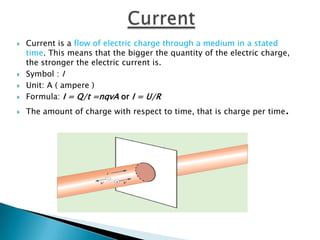
   Current is a flow of electric charge through a medium in a stated
    time. This means that the bigger the quantity of the electric charge,
    the stronger the electric current is.
   Symbol : I
   Unit: A ( ampere )
   Formula: I = Q/t =nqvA or I = U/R
   The amount of charge with respect to time, that is charge per time.
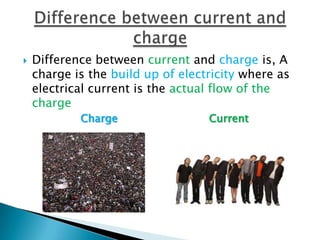
   Difference between current and charge is, A
    charge is the build up of electricity where as
    electrical current is the actual flow of the
    charge
            Charge                 Current
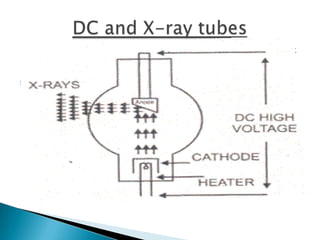
   An X-ray tube is a vacuum tube that produces
    X-rays.
   In order to operate X-ray tubes, a DC voltage
    of a few kilovolts to as much as 100 kV is
    applied between the anodes and the cathode,
    So that there are electrons being generated to
    struck the atoms of the anode.
 Theseparticles will then pass
  through the patient and….

Dc electrical current power point prentation v2.0

  • 2.
    Define; voltage, electromotive force (EMF), potential difference (PD), charge and current.  Determine the relationship between charge and current.  Outline the application of DC to x-ray tubes.
  • 3.
    Potential difference defines, the work done on a unit positive charge between two points thus moving it from one point to the other.  Unit measured : Volts  Symbol : V  1 volt of potential difference exists between two points if one joule of work is performed in moving one coulomb of positive charge from one point to the other. I.e. V=joules/coulombs  An example of potential difference in everyday life takes shape in the battery.  The battery creates a potential difference in the wire due to its "electromotive force". This enables the charge to travel from the battery to device.
  • 4.
    Definition: the potential difference between the terminals of a source of electrical energy, tends to give rise to an electric current.  Unit: V (volts)  Symbol : E or ℰ  ℰ=W/q ( work / unit of charge)
  • 5.
    Definition: A measure of the difference in electric potential between two points in space, a material, or an electric circuit, expressed in volts.  Symbol: V  To calculate Voltage we can use two formulas. These are as follows; 1. Ohm’s law : states that voltage = current x resistance (V = I x R ) 2. Power law equation : states that voltage = power / current (V=P/I)
  • 6.
    Definition: charge is one of the basic properties of the elementary particles of matter giving rise to all electric and magnetic forces and interactions.ie. It is a physical property of matter that causes it to experience a force when near other electrically charged matter.  Symbol: Q  Unit: coulombs ( c )  A common example of electrical charge is lightning. Lightning is formed when super charged particles in the air collectively become attracted to the earths surface. The movement of these particles is so violent that enormous amounts of light, heat and sound energy are given off resulting in lightning
  • 7.
    Current is a flow of electric charge through a medium in a stated time. This means that the bigger the quantity of the electric charge, the stronger the electric current is.  Symbol : I  Unit: A ( ampere )  Formula: I = Q/t =nqvA or I = U/R  The amount of charge with respect to time, that is charge per time.
  • 8.
    Difference between current and charge is, A charge is the build up of electricity where as electrical current is the actual flow of the charge Charge Current
  • 9.
    An X-ray tube is a vacuum tube that produces X-rays.  In order to operate X-ray tubes, a DC voltage of a few kilovolts to as much as 100 kV is applied between the anodes and the cathode, So that there are electrons being generated to struck the atoms of the anode.
  • 10.
     Theseparticles willthen pass through the patient and….