Crafting
the Curriculum
Crafting?
Why did they
have to use
crafting
instead of
creating or
developing?
Introduction
A Teacher is a
Curriculum…
1. Designer
2. Implementer
3. Evaluator
Crafting a
Curriculum is like
writing a lesson
plan.
Generally,
Curriculum can be
organized
Horizontally
or vertically
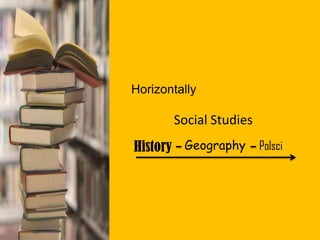
Horizontally
Social Studies
History Geography Polsci
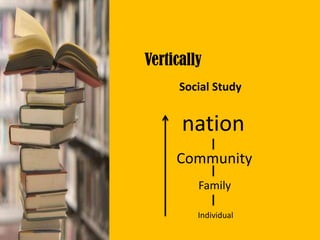
Vertically
Social Study
Community
Family
nation
Individual
Curriculum may also follow the
following structures:
1. Subject-Centered
Design Model
Subject Centered Design Model
 Focus: Content
 Correspond to textbooks
 Believers: Henry Morrison
William Harris
 Division of School Hours to
different subjects
1. Subject Centered Design Model
a.Subject Design
2 what questions?
 Oldest
 Most familiar
 Easy to deliver
 Drawback? Compartmentalized
Learning
b. Discipline Design
 related to subject design
focus: Academic Discipline, where
discipline refers to specific knowledge
learned through a method
Used in college but not in
elementary and high school
C. Correlation design
Comes from a core,
correlated curriculum design
that links separate subject
designs in order to reduce the
fragmentation
D. Broad field design/interdisciplinary
Variation of the subject centered
design
To prevent compartmentalization
Also called HOLLISTIC
CURRICULUM
Draws around themes and
integration
2. Learner Centered Design
-strong in the elementary
level
a. Child-centered design
b. Experience-centered design
c. Humanistic Design
A. Child centered design
Influenced by John Dewey, Rouseau ,
Pestallozi and Froebel
Anchored on the needs and
interests of students
Learning by doing
There is student interaction to teacher
and environment
Child + environment = LEARNING
B. Experience- Centered Design
Similar to Child-centered
Interests and needs cant be pre-
planned
Experiences- starting point
of curriculum
There is learner
empowerment
Activities emphasis- Touching,
feeling, imagining,
constructing, relating and
others.
Key lead Personalities: Carl Rogers
and Abraham Maslow
Maslow’s Theory of Self Actualization
Self Actualization can be achieved
later in life but the process must
begin in school.
Carl Rogers Self-Directed Learning
Ultimate Objective of Learning?
Development of self
C. Humanistic Design
3. PROBLEM -CENTERED
DESIGN
Draws on Social Problems,
needs, interest and abilities of
learners
a.Life Situations Design
b.Core Design
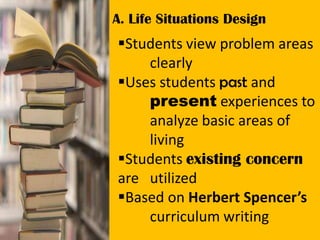
A. Life Situations Design
Students view problem areas
clearly
Uses students past and
present experiences to
analyze basic areas of
living
Students existing concern
are utilized
Based on Herbert Spencer’s
curriculum writing
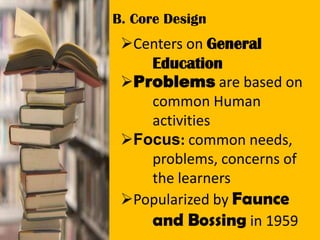
B. Core Design
Centers on General
Education
Problems are based on
common Human
activities
Focus: common needs,
problems, concerns of
the learners
Popularized by Faunce
and Bossing in 1959
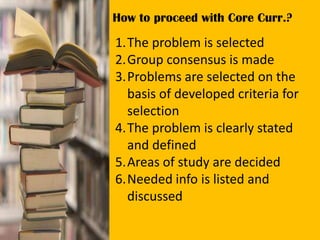
How to proceed with Core Curr.?
1.The problem is selected
2.Group consensus is made
3.Problems are selected on the
basis of developed criteria for
selection
4.The problem is clearly stated
and defined
5.Areas of study are decided
6.Needed info is listed and
discussed
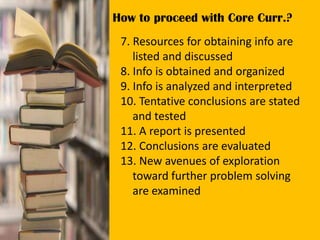
How to proceed with Core Curr.?
7. Resources for obtaining info are
listed and discussed
8. Info is obtained and organized
9. Info is analyzed and interpreted
10. Tentative conclusions are stated
and tested
11. A report is presented
12. Conclusions are evaluated
13. New avenues of exploration
toward further problem solving
are examined
Curdev final
Curdev final
Curdev final
Curdev final
Curdev final

Curdev final

  • 1.
  • 2.
    Crafting? Why did they haveto use crafting instead of creating or developing?
  • 3.
    Introduction A Teacher isa Curriculum… 1. Designer 2. Implementer 3. Evaluator
  • 4.
    Crafting a Curriculum islike writing a lesson plan.
  • 5.
  • 6.
  • 7.
  • 8.
    Curriculum may alsofollow the following structures: 1. Subject-Centered Design Model
  • 9.
    Subject Centered DesignModel  Focus: Content  Correspond to textbooks  Believers: Henry Morrison William Harris  Division of School Hours to different subjects
  • 10.
    1. Subject CenteredDesign Model a.Subject Design 2 what questions?  Oldest  Most familiar  Easy to deliver  Drawback? Compartmentalized Learning
  • 11.
    b. Discipline Design related to subject design focus: Academic Discipline, where discipline refers to specific knowledge learned through a method Used in college but not in elementary and high school
  • 12.
    C. Correlation design Comesfrom a core, correlated curriculum design that links separate subject designs in order to reduce the fragmentation
  • 13.
    D. Broad fielddesign/interdisciplinary Variation of the subject centered design To prevent compartmentalization Also called HOLLISTIC CURRICULUM Draws around themes and integration
  • 14.
    2. Learner CenteredDesign -strong in the elementary level a. Child-centered design b. Experience-centered design c. Humanistic Design
  • 15.
    A. Child centereddesign Influenced by John Dewey, Rouseau , Pestallozi and Froebel Anchored on the needs and interests of students Learning by doing There is student interaction to teacher and environment Child + environment = LEARNING
  • 16.
    B. Experience- CenteredDesign Similar to Child-centered Interests and needs cant be pre- planned Experiences- starting point of curriculum There is learner empowerment Activities emphasis- Touching, feeling, imagining, constructing, relating and others.
  • 17.
    Key lead Personalities:Carl Rogers and Abraham Maslow Maslow’s Theory of Self Actualization Self Actualization can be achieved later in life but the process must begin in school. Carl Rogers Self-Directed Learning Ultimate Objective of Learning? Development of self C. Humanistic Design
  • 18.
    3. PROBLEM -CENTERED DESIGN Drawson Social Problems, needs, interest and abilities of learners a.Life Situations Design b.Core Design
  • 19.
    A. Life SituationsDesign Students view problem areas clearly Uses students past and present experiences to analyze basic areas of living Students existing concern are utilized Based on Herbert Spencer’s curriculum writing
  • 20.
    B. Core Design Centerson General Education Problems are based on common Human activities Focus: common needs, problems, concerns of the learners Popularized by Faunce and Bossing in 1959
  • 21.
    How to proceedwith Core Curr.? 1.The problem is selected 2.Group consensus is made 3.Problems are selected on the basis of developed criteria for selection 4.The problem is clearly stated and defined 5.Areas of study are decided 6.Needed info is listed and discussed
  • 22.
    How to proceedwith Core Curr.? 7. Resources for obtaining info are listed and discussed 8. Info is obtained and organized 9. Info is analyzed and interpreted 10. Tentative conclusions are stated and tested 11. A report is presented 12. Conclusions are evaluated 13. New avenues of exploration toward further problem solving are examined