
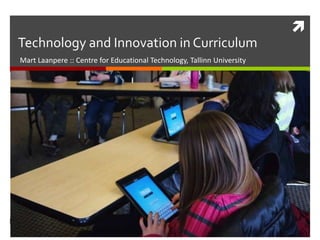
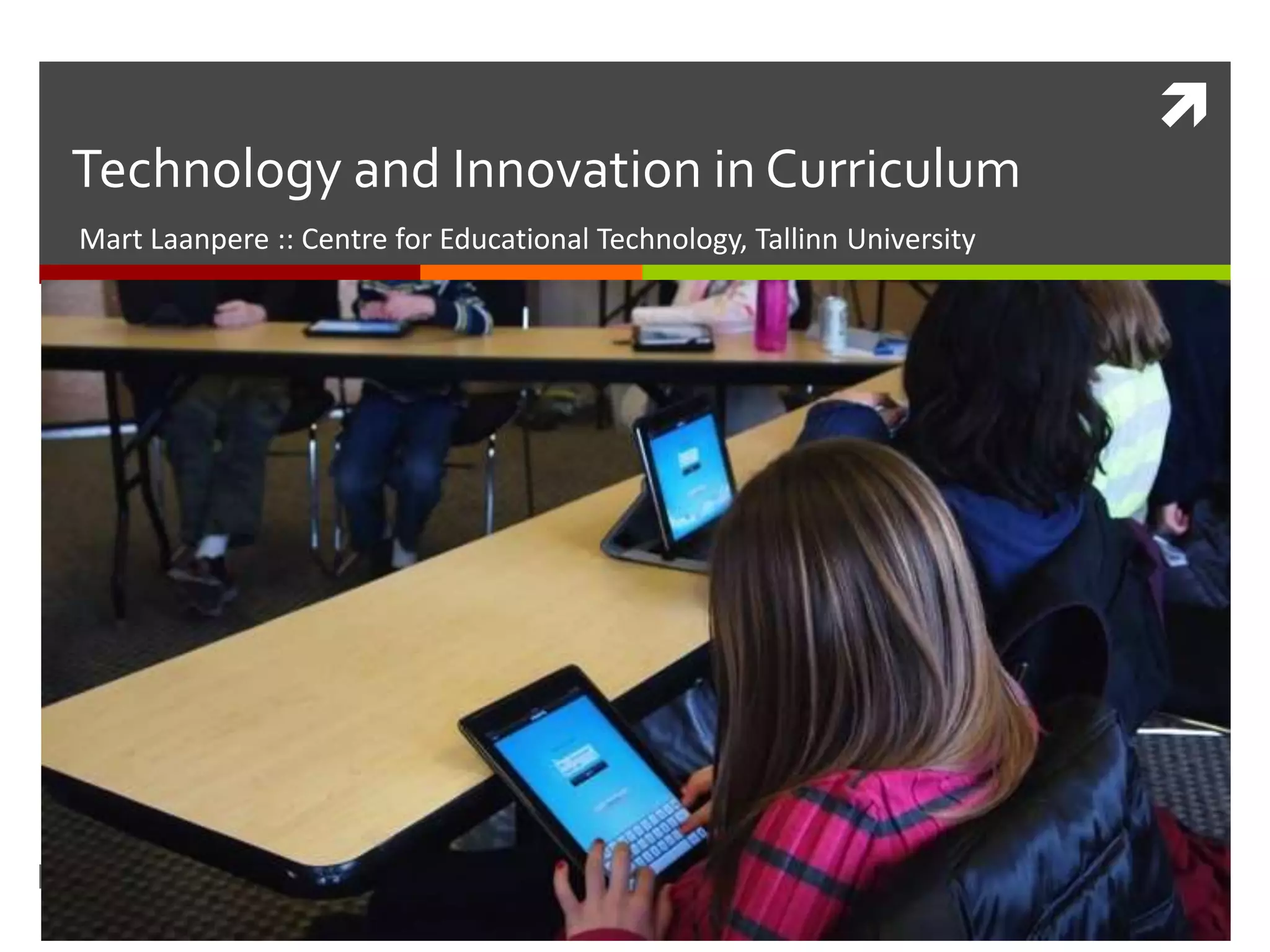
Technology and Innovation in Curriculum
Mart Laanpere :: Centre for Educational Technology, Tallinn University
The concept of innovation
 New way of doing things in economy, e.g. the introduction of new
goods, new methods of production, the opening of new markets, the
conquest of new sources of supply and the carrying out of a new
organization of any industry (Shumpeter, 1939)
 An innovation is the implementation of a new or significantly
improved product (good or service), or process, a new marketing
method, or a new organizational method in business practices,
workplace organization or external relations. (OECD, 1997)
 Types of innovation:
 Product innovation (e.g.iPod)
 Process innovation (e.g. IKEA furniture)
 Organisational innovation (e.g. Wikipedia)
 Market innovation (e.g. social media marketing)
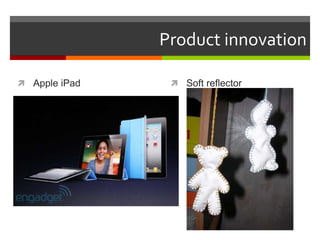
Product innovation
 Apple iPad  Soft reflector
Process innovation
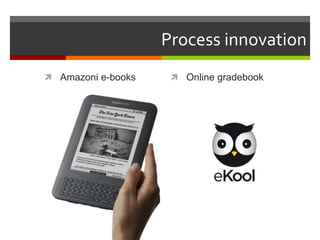
 Amazoni e-books  Online gradebook
Organisational innovation
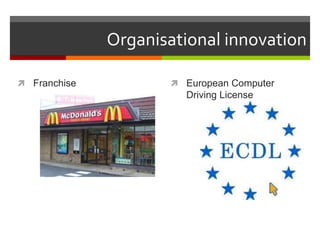
 Franchise  European Computer
Driving License
Marketing innovation
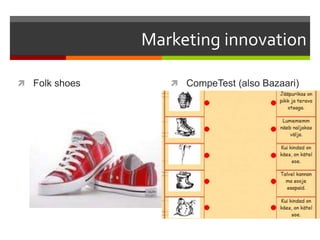
 Folk shoes  CompeTest (also Bazaari)
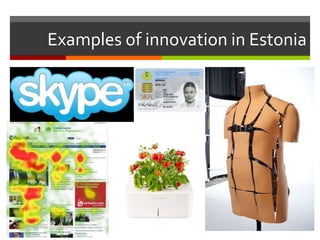
Examples of innovation in Estonia
Boosting innovation in IT industry
 Incubators
 Start-ups
 Hackatons (Garage48)
 Innovation vouchers from EAS agency
Innovation in school
 Club of Rome, ‘No Limits to Learning’ (1979): innovative
learning instead of repetitive learning
 Example: it is a fact that printing the Sunday Times on paper
“costs” 40 hectares of forest
 Repetitive learning: remember the fact, there will be test
 Innovative learning: discuss, what are you going to do about it?
 The main features of innovative learning:
 Anticipatory learning: encouraging solidarity in time
 Participatory learning: creating solidarity in space
 The main objectives: autonomy and integration
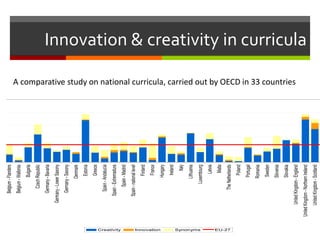
Innovation & creativity in curricula
A comparative study on national curricula, carried out by OECD in 33 countries
Technology & innovation in curriculum
 T&I: one of the 8 cross-curricular themes in the new
national curriculum in Estonia (2011)
 Each student in grades 7-9 and 10-12 should:
 Be able to think and act innovatively while using new
technologies for problem-solving and coping with rapid
changes in living, learning and working environments
 Participate at least once during three years in a
collaborative project, where new technologies are used
for innovation that meets the needs of an external client:
e.g. a company, local municipality, university
Sample project scenario
 Social media marketing campaign to promote own school
 Client: school administration
 Goal: to increase awareness of recent curriculum change and eventually
enrolment of students from other municipalities
 Outcomes: a Web page and Facebook group dedicated to new curriculum
will be integrated with the school Web site, social media campaign with
games & prizes will be planned, conducted and evaluated
 Description: a team of 4 students will study techniques and best practices of
internet marketing, mentored by the teachers of informatics and economics,
as well as an external mentor; participatory design methods will be applied
in developing the curriculum Web site and integrating it with school Web
site; the other half of the team will work on social media marketing
The other sample scenarios
 Search engine optimisation and multilingual Web site for local
company producing log houses
 Designing and piloting GPS-geocaching game for local
ecotourism accommodation provider
 The survey on barriers to inclusion in local decision-making,
followed by both high- and low-tech inclusion campaign
 Producing a Wiki-based robotics textbook for the robotics lab at
the technical university
Action research onT&I design
 A 20-hrs teacher training course was developed and piloted
with 12 teachers in one of the schools in Tallinn
 Hands-on, experiential learning; unleashing the creativity
 Teachers created in pairs projects using a simple technology: QR
codes
 Feedback from teachers helped us to improve the course
 35 trainers from all regions were then trained to deliver this
course
QR-projects made by teachers
 QR herbarium: leaves, flowers and seeds of trees around
schoolhouse
 QR art exhibition
 QR dictionary (English)
 QR monument trail
Pilot Project: Digital NatureTrails
 Funded by NordPlus (Nordic Council of Ministers) 2013-15
 Two schools involved: Kolga school in Estonia and Mouhijärvi
school in Finland (Norwegian school dropped out)
 Students are going to create four trails marked in the nature
with QR codes or geotags, each project team has a client with
specific expectations (museum, ecotouristic farm,
environmental education centre, own school)
 Estonian and Finnish student groups visit each other and try out
the trails, help to improve them
http://digitrails.wordpress.com
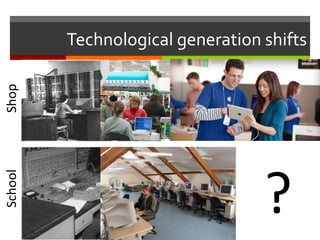
Technological generation shifts
ShopSchool
?
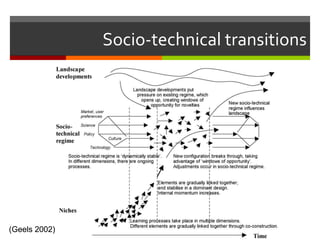
Socio-technical transitions
(Geels 2002)(Geels 2002)
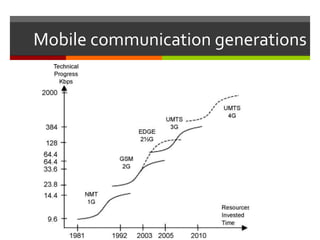
Mobile communication generations
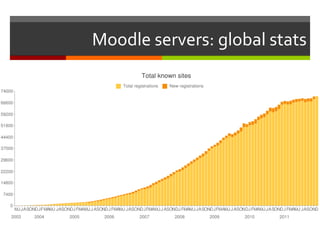
Moodle servers: global stats
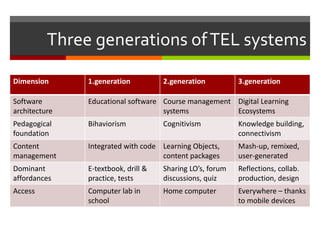
Three generations ofTEL systems
Dimension 1.generation 2.generation 3.generation
Software
architecture
Educational software Course management
systems
Digital Learning
Ecosystems
Pedagogical
foundation
Bihaviorism Cognitivism Knowledge building,
connectivism
Content
management
Integrated with code Learning Objects,
content packages
Mash-up, remixed,
user-generated
Dominant
affordances
E-textbook, drill &
practice, tests
Sharing LO’s, forum
discussions, quiz
Reflections, collab.
production, design
Access Computer lab in
school
Home computer Everywhere – thanks
to mobile devices
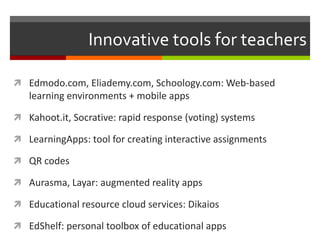
Innovative tools for teachers
 Edmodo.com, Eliademy.com, Schoology.com: Web-based
learning environments + mobile apps
 Kahoot.it, Socrative: rapid response (voting) systems
 LearningApps: tool for creating interactive assignments
 QR codes
 Aurasma, Layar: augmented reality apps
 Educational resource cloud services: Dikaios
 EdShelf: personal toolbox of educational apps
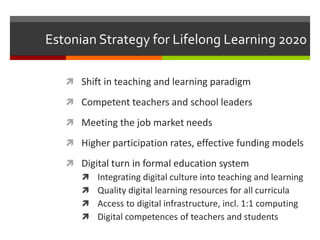
Estonian Strategy for Lifelong Learning 2020
 Shift in teaching and learning paradigm
 Competent teachers and school leaders
 Meeting the job market needs
 Higher participation rates, effective funding models
 Digital turn in formal education system
 Integrating digital culture into teaching and learning
 Quality digital learning resources for all curricula
 Access to digital infrastructure, incl. 1:1 computing
 Digital competences of teachers and students
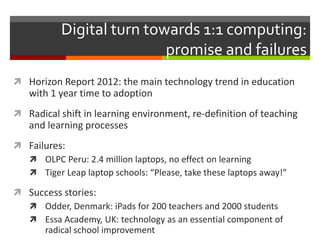
Digital turn towards 1:1 computing:
promise and failures
 Horizon Report 2012: the main technology trend in education
with 1 year time to adoption
 Radical shift in learning environment, re-definition of teaching
and learning processes
 Failures:
 OLPC Peru: 2.4 million laptops, no effect on learning
 Tiger Leap laptop schools: “Please, take these laptops away!”
 Success stories:
 Odder, Denmark: iPads for 200 teachers and 2000 students
 Essa Academy, UK: technology as an essential component of
radical school improvement
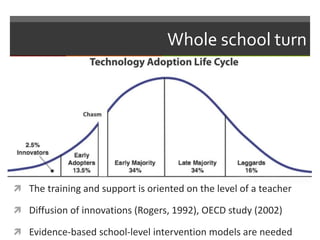
Whole school turn
 The training and support is oriented on the level of a teacher
 Diffusion of innovations (Rogers, 1992), OECD study (2002)
 Evidence-based school-level intervention models are needed
Questions?
Trialogical learning
 Monological learning: teacher talks, pupil listens
 Socratic method: dialogical learning
 Trialogical learning (Paavola et al): where learners
are collaboratively inquiring, developing,
transforming, or creating shared objects of activity
(such as conceptual artefacts, practices, products)
in a systematic fashion
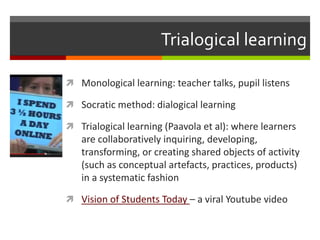
 Vision of Students Today – a viral Youtube video
Innovation exercise
 E-textbook of the future:
 E-book (e-pub)?
 Mobile app?
 Online course?
 Standardised content package?
 A bundle of Web links?
 Think outside the box and propose a concept for
innovative e-textbook of the future, that is:
 Usable on all personal smart devices
 Allowing remixing, adaptations, annotations
 Creative learning tool
QR code exercise
 Innovative pedagogical scenarios from LEARNMIX
project (re-conceptualizing e-textbook):
 Flipped classroom: learn from video tutorial, then groupwork
 Project-based learning: outcome-focused teamwork
 Problem-based learning: solving, then designing problems
 Inquiry-based learning: hypothesis, data collection & analysis
 Game-based learning: fun, competition, learning, rewards
 Create a trialogical learning scenario in line with one of the above
involving QR codes (you can use ITEC scenario template)

Technology and Innovation in Curriculum

  • 1.
     Technology and Innovationin Curriculum Mart Laanpere :: Centre for Educational Technology, Tallinn University
  • 2.
    The concept ofinnovation  New way of doing things in economy, e.g. the introduction of new goods, new methods of production, the opening of new markets, the conquest of new sources of supply and the carrying out of a new organization of any industry (Shumpeter, 1939)  An innovation is the implementation of a new or significantly improved product (good or service), or process, a new marketing method, or a new organizational method in business practices, workplace organization or external relations. (OECD, 1997)  Types of innovation:  Product innovation (e.g.iPod)  Process innovation (e.g. IKEA furniture)  Organisational innovation (e.g. Wikipedia)  Market innovation (e.g. social media marketing)
  • 3.
    Product innovation  AppleiPad  Soft reflector
  • 4.
    Process innovation  Amazonie-books  Online gradebook
  • 5.
    Organisational innovation  Franchise European Computer Driving License
  • 6.
    Marketing innovation  Folkshoes  CompeTest (also Bazaari)
  • 8.
  • 9.
    Boosting innovation inIT industry  Incubators  Start-ups  Hackatons (Garage48)  Innovation vouchers from EAS agency
  • 10.
    Innovation in school Club of Rome, ‘No Limits to Learning’ (1979): innovative learning instead of repetitive learning  Example: it is a fact that printing the Sunday Times on paper “costs” 40 hectares of forest  Repetitive learning: remember the fact, there will be test  Innovative learning: discuss, what are you going to do about it?  The main features of innovative learning:  Anticipatory learning: encouraging solidarity in time  Participatory learning: creating solidarity in space  The main objectives: autonomy and integration
  • 11.
    Innovation & creativityin curricula A comparative study on national curricula, carried out by OECD in 33 countries
  • 12.
    Technology & innovationin curriculum  T&I: one of the 8 cross-curricular themes in the new national curriculum in Estonia (2011)  Each student in grades 7-9 and 10-12 should:  Be able to think and act innovatively while using new technologies for problem-solving and coping with rapid changes in living, learning and working environments  Participate at least once during three years in a collaborative project, where new technologies are used for innovation that meets the needs of an external client: e.g. a company, local municipality, university
  • 13.
    Sample project scenario Social media marketing campaign to promote own school  Client: school administration  Goal: to increase awareness of recent curriculum change and eventually enrolment of students from other municipalities  Outcomes: a Web page and Facebook group dedicated to new curriculum will be integrated with the school Web site, social media campaign with games & prizes will be planned, conducted and evaluated  Description: a team of 4 students will study techniques and best practices of internet marketing, mentored by the teachers of informatics and economics, as well as an external mentor; participatory design methods will be applied in developing the curriculum Web site and integrating it with school Web site; the other half of the team will work on social media marketing
  • 14.
    The other samplescenarios  Search engine optimisation and multilingual Web site for local company producing log houses  Designing and piloting GPS-geocaching game for local ecotourism accommodation provider  The survey on barriers to inclusion in local decision-making, followed by both high- and low-tech inclusion campaign  Producing a Wiki-based robotics textbook for the robotics lab at the technical university
  • 15.
    Action research onT&Idesign  A 20-hrs teacher training course was developed and piloted with 12 teachers in one of the schools in Tallinn  Hands-on, experiential learning; unleashing the creativity  Teachers created in pairs projects using a simple technology: QR codes  Feedback from teachers helped us to improve the course  35 trainers from all regions were then trained to deliver this course
  • 16.
    QR-projects made byteachers  QR herbarium: leaves, flowers and seeds of trees around schoolhouse  QR art exhibition  QR dictionary (English)  QR monument trail
  • 17.
    Pilot Project: DigitalNatureTrails  Funded by NordPlus (Nordic Council of Ministers) 2013-15  Two schools involved: Kolga school in Estonia and Mouhijärvi school in Finland (Norwegian school dropped out)  Students are going to create four trails marked in the nature with QR codes or geotags, each project team has a client with specific expectations (museum, ecotouristic farm, environmental education centre, own school)  Estonian and Finnish student groups visit each other and try out the trails, help to improve them http://digitrails.wordpress.com
  • 18.
  • 19.
  • 20.
  • 21.
  • 22.
    Three generations ofTELsystems Dimension 1.generation 2.generation 3.generation Software architecture Educational software Course management systems Digital Learning Ecosystems Pedagogical foundation Bihaviorism Cognitivism Knowledge building, connectivism Content management Integrated with code Learning Objects, content packages Mash-up, remixed, user-generated Dominant affordances E-textbook, drill & practice, tests Sharing LO’s, forum discussions, quiz Reflections, collab. production, design Access Computer lab in school Home computer Everywhere – thanks to mobile devices
  • 23.
    Innovative tools forteachers  Edmodo.com, Eliademy.com, Schoology.com: Web-based learning environments + mobile apps  Kahoot.it, Socrative: rapid response (voting) systems  LearningApps: tool for creating interactive assignments  QR codes  Aurasma, Layar: augmented reality apps  Educational resource cloud services: Dikaios  EdShelf: personal toolbox of educational apps
  • 24.
    Estonian Strategy forLifelong Learning 2020  Shift in teaching and learning paradigm  Competent teachers and school leaders  Meeting the job market needs  Higher participation rates, effective funding models  Digital turn in formal education system  Integrating digital culture into teaching and learning  Quality digital learning resources for all curricula  Access to digital infrastructure, incl. 1:1 computing  Digital competences of teachers and students
  • 25.
    Digital turn towards1:1 computing: promise and failures  Horizon Report 2012: the main technology trend in education with 1 year time to adoption  Radical shift in learning environment, re-definition of teaching and learning processes  Failures:  OLPC Peru: 2.4 million laptops, no effect on learning  Tiger Leap laptop schools: “Please, take these laptops away!”  Success stories:  Odder, Denmark: iPads for 200 teachers and 2000 students  Essa Academy, UK: technology as an essential component of radical school improvement
  • 26.
    Whole school turn The training and support is oriented on the level of a teacher  Diffusion of innovations (Rogers, 1992), OECD study (2002)  Evidence-based school-level intervention models are needed
  • 27.
  • 28.
    Trialogical learning  Monologicallearning: teacher talks, pupil listens  Socratic method: dialogical learning  Trialogical learning (Paavola et al): where learners are collaboratively inquiring, developing, transforming, or creating shared objects of activity (such as conceptual artefacts, practices, products) in a systematic fashion  Vision of Students Today – a viral Youtube video
  • 29.
    Innovation exercise  E-textbookof the future:  E-book (e-pub)?  Mobile app?  Online course?  Standardised content package?  A bundle of Web links?  Think outside the box and propose a concept for innovative e-textbook of the future, that is:  Usable on all personal smart devices  Allowing remixing, adaptations, annotations  Creative learning tool
  • 30.
    QR code exercise Innovative pedagogical scenarios from LEARNMIX project (re-conceptualizing e-textbook):  Flipped classroom: learn from video tutorial, then groupwork  Project-based learning: outcome-focused teamwork  Problem-based learning: solving, then designing problems  Inquiry-based learning: hypothesis, data collection & analysis  Game-based learning: fun, competition, learning, rewards  Create a trialogical learning scenario in line with one of the above involving QR codes (you can use ITEC scenario template)