Crafting the Curriculum
TOPICS
•
•
•
•
•
•
•

Elements/Components of the curriculum (Fatimay)
School Purpose (Sharifa-Aina and May Therese)
Curriculum Organization (Irene Ayza)
Curriculum Approaches (Annabelle)
Curriculum Models/Types (Reagan)
Dimension and Principles of curriculum design (Lena)
Curriculum Development System (Rowena)
Learning Objectives
• Present and critique the different models for
curriculum making
• Explain the role of curriculum and the school
• Discuss the principles and approaches of
curriculum design
• Discuss the nature and purpose of Curriculum
Development System (CDS)
PREAMBLE
• We, the sovereign Filipino people, imploring
the aid of Almighty God, in order to build a
just and humane society, and establish a
Government that shall embody our ideals and
aspirations, promote the common good,
conserve and develop our patrimony, and
secure to ourselves and our posterity, the
blessings of independence and democracy
under the rule of law and a regime of truth,
justice, freedom, love, equality, and peace, do
ordain and promulgate this Constitution.
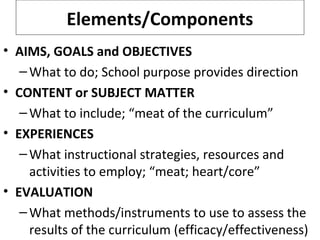
Elements/Components
• AIMS, GOALS and OBJECTIVES
– What to do; School purpose provides direction
• CONTENT or SUBJECT MATTER
– What to include; “meat of the curriculum”
• EXPERIENCES
– What instructional strategies, resources and
activities to employ; “meat; heart/core”
• EVALUATION
– What methods/instruments to use to assess the
results of the curriculum (efficacy/effectiveness)
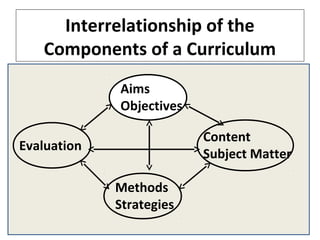
Interrelationship of the
Components of a Curriculum
Aims
Objectives
Content
Subject Matter

Evaluation
Methods
Strategies
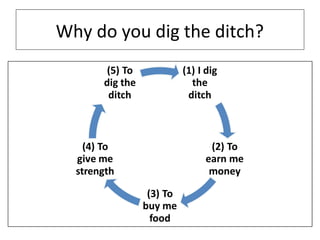
Why do you dig the ditch?
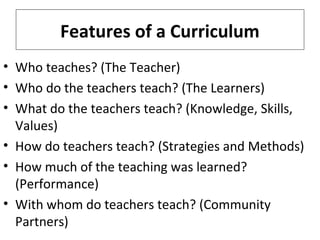
Features of a Curriculum
• Who teaches? (The Teacher)
• Who do the teachers teach? (The Learners)
• What do the teachers teach? (Knowledge, Skills,
Values)
• How do teachers teach? (Strategies and Methods)
• How much of the teaching was learned?
(Performance)
• With whom do teachers teach? (Community
Partners)
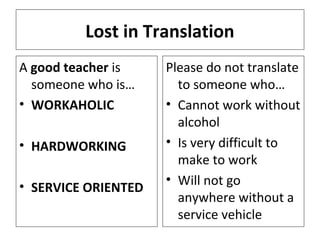
Lost in Translation
A good teacher is
someone who is…
• WORKAHOLIC
• HARDWORKING
• SERVICE ORIENTED

Please do not translate
to someone who…
• Cannot work without
alcohol
• Is very difficult to
make to work
• Will not go
anywhere without a
service vehicle
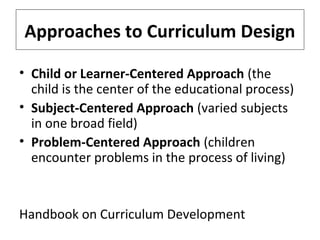
Approaches to Curriculum Design
• Child or Learner-Centered Approach (the
child is the center of the educational process)
• Subject-Centered Approach (varied subjects
in one broad field)
• Problem-Centered Approach (children
encounter problems in the process of living)

Handbook on Curriculum Development
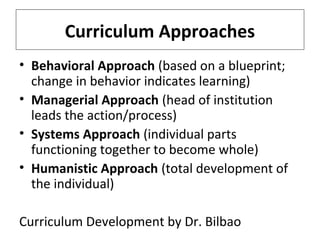
Curriculum Approaches
• Behavioral Approach (based on a blueprint;
change in behavior indicates learning)
• Managerial Approach (head of institution
leads the action/process)
• Systems Approach (individual parts
functioning together to become whole)
• Humanistic Approach (total development of
the individual)
Curriculum Development by Dr. Bilbao
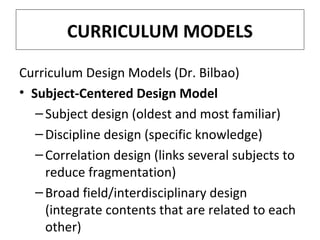
CURRICULUM MODELS
Curriculum Design Models (Dr. Bilbao)
• Subject-Centered Design Model
– Subject design (oldest and most familiar)
– Discipline design (specific knowledge)
– Correlation design (links several subjects to
reduce fragmentation)
– Broad field/interdisciplinary design
(integrate contents that are related to each
other)
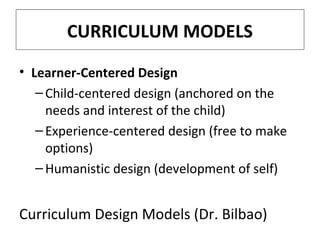
CURRICULUM MODELS
• Learner-Centered Design
– Child-centered design (anchored on the
needs and interest of the child)
– Experience-centered design (free to make
options)
– Humanistic design (development of self)

Curriculum Design Models (Dr. Bilbao)
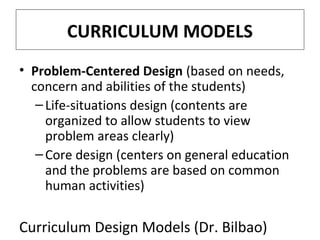
CURRICULUM MODELS
• Problem-Centered Design (based on needs,
concern and abilities of the students)
– Life-situations design (contents are
organized to allow students to view
problem areas clearly)
– Core design (centers on general education
and the problems are based on common
human activities)

Curriculum Design Models (Dr. Bilbao)
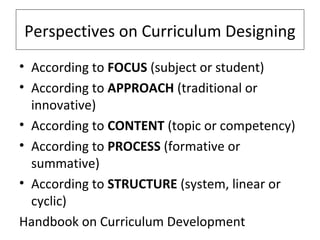
Perspectives on Curriculum Designing
• According to FOCUS (subject or student)
• According to APPROACH (traditional or
innovative)
• According to CONTENT (topic or competency)
• According to PROCESS (formative or
summative)
• According to STRUCTURE (system, linear or
cyclic)
Handbook on Curriculum Development
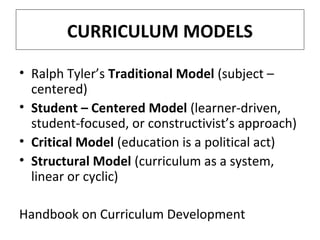
CURRICULUM MODELS
• Ralph Tyler’s Traditional Model (subject –
centered)
• Student – Centered Model (learner-driven,
student-focused, or constructivist’s approach)
• Critical Model (education is a political act)
• Structural Model (curriculum as a system,
linear or cyclic)
Handbook on Curriculum Development
What’s the relationship?
• Two Indians were walking down the street. The
smaller Indian is the son of the bigger Indian but the
bigger Indian is not the father of the smaller Indian.
• A prisoner had no visitor for quite a long time. One
day, a young man came to visit him. The warden
ask the prisoner who the visitor was. The prisoner
said “Brothers and sisters I have none, but that
man’s father is my father’s son”.
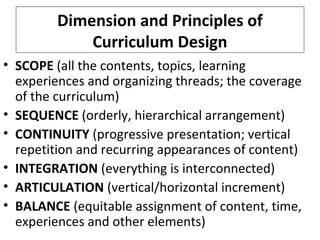
Dimension and Principles of
Curriculum Design
• SCOPE (all the contents, topics, learning
experiences and organizing threads; the coverage
of the curriculum)
• SEQUENCE (orderly, hierarchical arrangement)
• CONTINUITY (progressive presentation; vertical
repetition and recurring appearances of content)
• INTEGRATION (everything is interconnected)
• ARTICULATION (vertical/horizontal increment)
• BALANCE (equitable assignment of content, time,
experiences and other elements)
Curriculum Development System
• An integrated, coherent and comprehensive
program for continually updating and
improving curriculum and instruction in a
school so that it can better attain its purpose.
• A system is the integration of separate but
interdependent and interacting parts into an
organic whole which meant to accomplish a
certain purpose or perform a specific function.
Crafting the curriculum

Crafting the curriculum

  • 1.
  • 2.
    TOPICS • • • • • • • Elements/Components of thecurriculum (Fatimay) School Purpose (Sharifa-Aina and May Therese) Curriculum Organization (Irene Ayza) Curriculum Approaches (Annabelle) Curriculum Models/Types (Reagan) Dimension and Principles of curriculum design (Lena) Curriculum Development System (Rowena)
  • 3.
    Learning Objectives • Presentand critique the different models for curriculum making • Explain the role of curriculum and the school • Discuss the principles and approaches of curriculum design • Discuss the nature and purpose of Curriculum Development System (CDS)
  • 4.
    PREAMBLE • We, thesovereign Filipino people, imploring the aid of Almighty God, in order to build a just and humane society, and establish a Government that shall embody our ideals and aspirations, promote the common good, conserve and develop our patrimony, and secure to ourselves and our posterity, the blessings of independence and democracy under the rule of law and a regime of truth, justice, freedom, love, equality, and peace, do ordain and promulgate this Constitution.
  • 7.
    Elements/Components • AIMS, GOALSand OBJECTIVES – What to do; School purpose provides direction • CONTENT or SUBJECT MATTER – What to include; “meat of the curriculum” • EXPERIENCES – What instructional strategies, resources and activities to employ; “meat; heart/core” • EVALUATION – What methods/instruments to use to assess the results of the curriculum (efficacy/effectiveness)
  • 8.
    Interrelationship of the Componentsof a Curriculum Aims Objectives Content Subject Matter Evaluation Methods Strategies
  • 9.
    Why do youdig the ditch?
  • 10.
    Features of aCurriculum • Who teaches? (The Teacher) • Who do the teachers teach? (The Learners) • What do the teachers teach? (Knowledge, Skills, Values) • How do teachers teach? (Strategies and Methods) • How much of the teaching was learned? (Performance) • With whom do teachers teach? (Community Partners)
  • 11.
    Lost in Translation Agood teacher is someone who is… • WORKAHOLIC • HARDWORKING • SERVICE ORIENTED Please do not translate to someone who… • Cannot work without alcohol • Is very difficult to make to work • Will not go anywhere without a service vehicle
  • 12.
    Approaches to CurriculumDesign • Child or Learner-Centered Approach (the child is the center of the educational process) • Subject-Centered Approach (varied subjects in one broad field) • Problem-Centered Approach (children encounter problems in the process of living) Handbook on Curriculum Development
  • 13.
    Curriculum Approaches • BehavioralApproach (based on a blueprint; change in behavior indicates learning) • Managerial Approach (head of institution leads the action/process) • Systems Approach (individual parts functioning together to become whole) • Humanistic Approach (total development of the individual) Curriculum Development by Dr. Bilbao
  • 14.
    CURRICULUM MODELS Curriculum DesignModels (Dr. Bilbao) • Subject-Centered Design Model – Subject design (oldest and most familiar) – Discipline design (specific knowledge) – Correlation design (links several subjects to reduce fragmentation) – Broad field/interdisciplinary design (integrate contents that are related to each other)
  • 15.
    CURRICULUM MODELS • Learner-CenteredDesign – Child-centered design (anchored on the needs and interest of the child) – Experience-centered design (free to make options) – Humanistic design (development of self) Curriculum Design Models (Dr. Bilbao)
  • 16.
    CURRICULUM MODELS • Problem-CenteredDesign (based on needs, concern and abilities of the students) – Life-situations design (contents are organized to allow students to view problem areas clearly) – Core design (centers on general education and the problems are based on common human activities) Curriculum Design Models (Dr. Bilbao)
  • 17.
    Perspectives on CurriculumDesigning • According to FOCUS (subject or student) • According to APPROACH (traditional or innovative) • According to CONTENT (topic or competency) • According to PROCESS (formative or summative) • According to STRUCTURE (system, linear or cyclic) Handbook on Curriculum Development
  • 18.
    CURRICULUM MODELS • RalphTyler’s Traditional Model (subject – centered) • Student – Centered Model (learner-driven, student-focused, or constructivist’s approach) • Critical Model (education is a political act) • Structural Model (curriculum as a system, linear or cyclic) Handbook on Curriculum Development
  • 20.
    What’s the relationship? •Two Indians were walking down the street. The smaller Indian is the son of the bigger Indian but the bigger Indian is not the father of the smaller Indian. • A prisoner had no visitor for quite a long time. One day, a young man came to visit him. The warden ask the prisoner who the visitor was. The prisoner said “Brothers and sisters I have none, but that man’s father is my father’s son”.
  • 21.
    Dimension and Principlesof Curriculum Design • SCOPE (all the contents, topics, learning experiences and organizing threads; the coverage of the curriculum) • SEQUENCE (orderly, hierarchical arrangement) • CONTINUITY (progressive presentation; vertical repetition and recurring appearances of content) • INTEGRATION (everything is interconnected) • ARTICULATION (vertical/horizontal increment) • BALANCE (equitable assignment of content, time, experiences and other elements)
  • 22.
    Curriculum Development System •An integrated, coherent and comprehensive program for continually updating and improving curriculum and instruction in a school so that it can better attain its purpose. • A system is the integration of separate but interdependent and interacting parts into an organic whole which meant to accomplish a certain purpose or perform a specific function.

Editor's Notes

  • #5 We, the sovereign Filipino people, imploring the aid of Divine Providence, in order to establish a government that shall embody our ideals, promote the general welfare, conserve and develop the patrimony of our Nation, and secure to ourselves and our posterity the blessings of democracy under a regime of justice, peace, liberty, and equality, do ordain and promulgate this Constitution.