Process Design
 Stresses those procedure that allow students
to analyze reality and construct framework
 Process of knowledge acquisition
 Hermeneutic composition
 Motivates student to unravel the processes
Learner-centered Design
 Early 1990s stated that students are the
program’s emphasis
 These design realized more often at the
elementary level than in the secondary
 Teacher as coach
 The focus is on both students and the teacher
 Learner evaluate their own learning
Child-Centered design
 Proponents of this design believe that student
must be enthusiastic
 Should be centered on students’ lives, needs,
and interests.
 Organized around human impulses: to
socialize, construct,inquire,,
experiment,create
 This design is often attributed to the influence
of John Dewey, Rouseau, Pestalozzi, and
Froebel
Experienced-Centered Design
 Closely look like child-centered design
 Believes that the interest and needs of
learners cannot pre-planned
 Build inspiring learning environment in
which student can explore
 Students are authorized to shape their
own learning
Romantic(radical) Design
 Students must learn ways of engaging in a
critique of knowledge
 Learning is reflective, it is not externally
imposed by someone in power
 Students must accept accountability
 Present day of radicals were influenced by
Freire’s teaching
Humanistic Design
 Gained prominence in the 1960s and 70s
 Abraham Maslow and Carl Roger
 Stresses the whole person and the
integration,thinking, feeling and doing
 It consider the cognitive, affective , and
psychomotor
 Stressess the development of positive self-
concept and interpersonal skill
 Allow students to experience learning with
emotion, imagination, and wonder
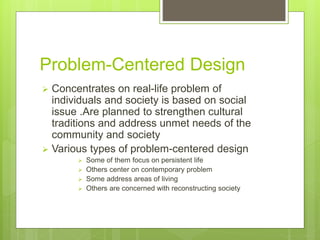
Problem-Centered Design
 Concentrates on real-life problem of
individuals and society is based on social
issue .Are planned to strengthen cultural
traditions and address unmet needs of the
community and society
 Various types of problem-centered design
 Some of them focus on persistent life
 Others center on contemporary problem
 Some address areas of living
 Others are concerned with reconstructing society
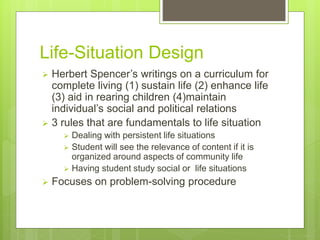
Life-Situation Design
 Herbert Spencer’s writings on a curriculum for
complete living (1) sustain life (2) enhance life
(3) aid in rearing children (4)maintain
individual’s social and political relations
 3 rules that are fundamentals to life situation
 Dealing with persistent life situations
 Student will see the relevance of content if it is
organized around aspects of community life
 Having student study social or life situations
 Focuses on problem-solving procedure
Reconstructionist Design
 Believe the purpose of curriculum is to reconstruct
society and advance social justice
 This design appeared in the 1920s and 30s
 Harold Rugg believed that school should engage
children in critical analysis of society
 Theodore Brameld stated that, school should help
students develop into social beings dedicated to
the common good
 To involve students in critical examinations of the
local, national, and Int’l

Process design

  • 1.
    Process Design  Stressesthose procedure that allow students to analyze reality and construct framework  Process of knowledge acquisition  Hermeneutic composition  Motivates student to unravel the processes
  • 2.
    Learner-centered Design  Early1990s stated that students are the program’s emphasis  These design realized more often at the elementary level than in the secondary  Teacher as coach  The focus is on both students and the teacher  Learner evaluate their own learning
  • 3.
    Child-Centered design  Proponentsof this design believe that student must be enthusiastic  Should be centered on students’ lives, needs, and interests.  Organized around human impulses: to socialize, construct,inquire,, experiment,create  This design is often attributed to the influence of John Dewey, Rouseau, Pestalozzi, and Froebel
  • 4.
    Experienced-Centered Design  Closelylook like child-centered design  Believes that the interest and needs of learners cannot pre-planned  Build inspiring learning environment in which student can explore  Students are authorized to shape their own learning
  • 5.
    Romantic(radical) Design  Studentsmust learn ways of engaging in a critique of knowledge  Learning is reflective, it is not externally imposed by someone in power  Students must accept accountability  Present day of radicals were influenced by Freire’s teaching
  • 6.
    Humanistic Design  Gainedprominence in the 1960s and 70s  Abraham Maslow and Carl Roger  Stresses the whole person and the integration,thinking, feeling and doing  It consider the cognitive, affective , and psychomotor  Stressess the development of positive self- concept and interpersonal skill  Allow students to experience learning with emotion, imagination, and wonder
  • 7.
    Problem-Centered Design  Concentrateson real-life problem of individuals and society is based on social issue .Are planned to strengthen cultural traditions and address unmet needs of the community and society  Various types of problem-centered design  Some of them focus on persistent life  Others center on contemporary problem  Some address areas of living  Others are concerned with reconstructing society
  • 8.
    Life-Situation Design  HerbertSpencer’s writings on a curriculum for complete living (1) sustain life (2) enhance life (3) aid in rearing children (4)maintain individual’s social and political relations  3 rules that are fundamentals to life situation  Dealing with persistent life situations  Student will see the relevance of content if it is organized around aspects of community life  Having student study social or life situations  Focuses on problem-solving procedure
  • 9.
    Reconstructionist Design  Believethe purpose of curriculum is to reconstruct society and advance social justice  This design appeared in the 1920s and 30s  Harold Rugg believed that school should engage children in critical analysis of society  Theodore Brameld stated that, school should help students develop into social beings dedicated to the common good  To involve students in critical examinations of the local, national, and Int’l