Module 5
Addressing the Future:
Curriculum Innovations
Lesson 1
Curriculum Innovations:
Local and Global Trends
What is “Innovation”?
According to The Merriam-Webster Thesaurus:
Essential Question

What are the things
that you would like to
Change and
Transform in your
life?
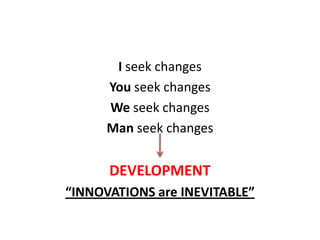
I seek changes
You seek changes
We seek changes
Man seek changes

DEVELOPMENT
“INNOVATIONS are INEVITABLE”
With the demand brought about by the
fast changing society, it is most likely that
changes will occur.
In curriculum, changes and modifications
are being introduced to keep pace with the
changing world.
There is no stopping to innovations. In
local or national setting, there are
innovations that have been introduced.
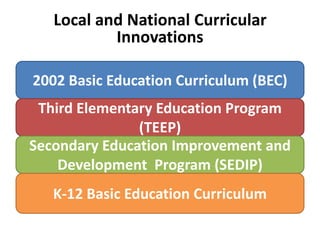
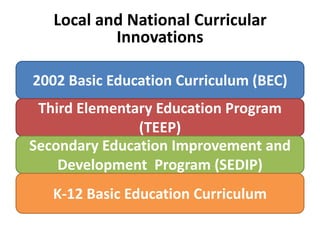
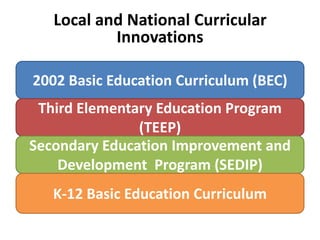
Local and National Curricular
Innovations
2002 Basic Education Curriculum (BEC)
Third Elementary Education Program
(TEEP)
Secondary Education Improvement and
Development Program (SEDIP)

K-12 Basic Education Curriculum
2002 Basic Education Curriculum (BEC)
VISION
The Department of Education, envisions
every learner to be functionally literate,
equipped with life skills, appreciative of arts
and sports and imbued with the desirable
values of a person who is makabayan,
makatao, makakalikasan and maka-Diyos.
2002 Basic Education Curriculum (BEC)
MISSION
To provide quality basic education that is
equitably accessible to all and lays the
foundation for lifelong learning and service
for the common good.
2002 Basic Education Curriculum (BEC)

PARAMETERS OF THE BASIC
EDUCATION CURRICULUM
1.
2.
3.
4.
5.

Objectives
Content
Materials
Teaching-Learning Process
Evaluation
2002 Basic Education Curriculum (BEC)
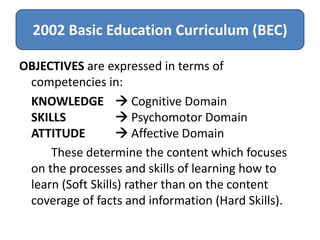
OBJECTIVES are expressed in terms of
competencies in:
KNOWLEDGE  Cognitive Domain
SKILLS
 Psychomotor Domain
ATTITUDE
 Affective Domain
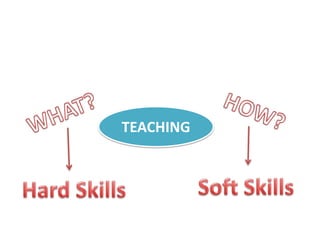
These determine the content which focuses
on the processes and skills of learning how to
learn (Soft Skills) rather than on the content
coverage of facts and information (Hard Skills).
TEACHING
2002 Basic Education Curriculum (BEC)
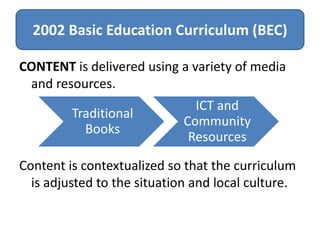
CONTENT is delivered using a variety of media
and resources.
Traditional
Books

ICT and
Community
Resources

Content is contextualized so that the curriculum
is adjusted to the situation and local culture.
2002 Basic Education Curriculum (BEC)
MATERIALS The use of multi-sensory materials is
encouraged in teaching. The use of local or
community resources as well as technologydriven support materials are utilized in the
learning environment.
2002 Basic Education Curriculum (BEC)
TEACHING-LEARNING PROCESS considers the
learners as active partners rather than objects
of teaching.
The learners are constructors of meaning,
while teachers act as facilitators, enablers, and
managers of learning.
2002 Basic Education Curriculum (BEC)
EVALUATION is encouraged to schools. This will
allow schools to make adjustments with
regard to:

Objective Content Materials Teachinglearning process
In order to achieve learning outcomes.
2002 Basic Education Curriculum (BEC)

SALIENT FEATURES OF THE
CURRICULUM
2002 Basic Education Curriculum (BEC)
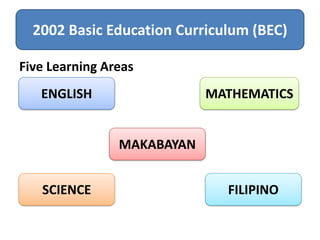
Five Learning Areas
ENGLISH

MATHEMATICS

MAKABAYAN

SCIENCE

FILIPINO
2002 Basic Education Curriculum (BEC)
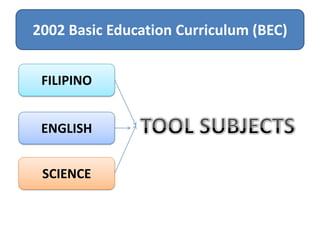
FILIPINO
ENGLISH
SCIENCE
2002 Basic Education Curriculum (BEC)

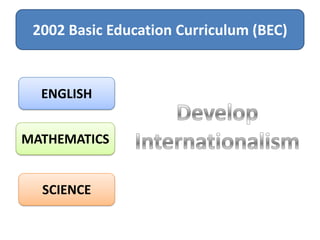
ENGLISH

MATHEMATICS

SCIENCE
2002 Basic Education Curriculum (BEC)

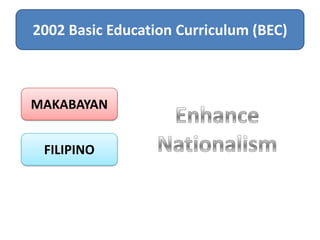
MAKABAYAN
FILIPINO
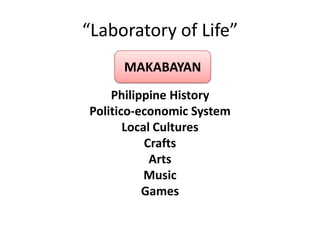
“Laboratory of Life”
MAKABAYAN
Philippine History
Politico-economic System
Local Cultures
Crafts
Arts
Music
Games
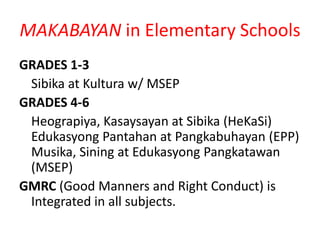
MAKABAYAN in Elementary Schools
GRADES 1-3
Sibika at Kultura w/ MSEP
GRADES 4-6
Heograpiya, Kasaysayan at Sibika (HeKaSi)
Edukasyong Pantahan at Pangkabuhayan (EPP)
Musika, Sining at Edukasyong Pangkatawan
(MSEP)
GMRC (Good Manners and Right Conduct) is
Integrated in all subjects.
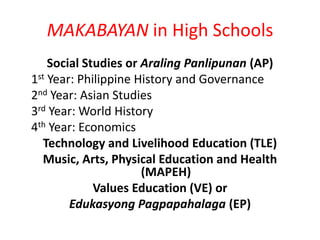
MAKABAYAN in High Schools
Social Studies or Araling Panlipunan (AP)
1st Year: Philippine History and Governance
2nd Year: Asian Studies
3rd Year: World History
4th Year: Economics
Technology and Livelihood Education (TLE)
Music, Arts, Physical Education and Health
(MAPEH)
Values Education (VE) or
Edukasyong Pagpapahalaga (EP)
2002 Basic Education Curriculum (BEC)

INTEGRATIVE TEACHING AS MODE
OF INSTRUCTIONAL DELIVERY
2002 Basic Education Curriculum (BEC)
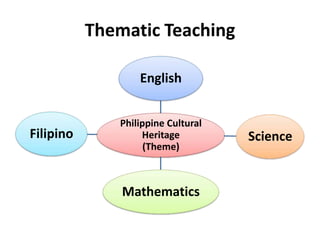
THEMATIC TEACHING requires organization of
themes around ideas.
The theme provides focus and help learners
see the meaningful connections across subject
areas.
Thematic Teaching
English

Filipino

Philippine Cultural
Heritage
(Theme)

Mathematics

Science
2002 Basic Education Curriculum (BEC)
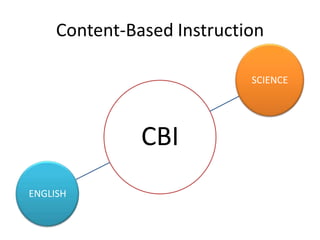
CONTENT-BASED INSTRUCTION (CBI) is the
integration of content of learning with
language teaching. The language curriculum is
centered on the academic needs and interests
of the learners, thus CBI crosses the barriers
between language and subject matter
content.
Content-Based Instruction
SCIENCE

CBI
ENGLISH
2002 Basic Education Curriculum (BEC)
FOCUSING INQUIRY is an interdisciplinary
approach that uses questions to organize
learning.
Contents and concepts are given less importance
than the process of conducting an investigation
and communicating what was learned to others.
Instructional process is built around inquiry,
where teachers guide the students to discover
answer to questions.
2002 Basic Education Curriculum (BEC)
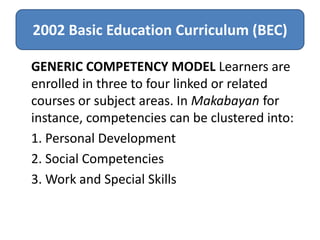
GENERIC COMPETENCY MODEL Learners are
enrolled in three to four linked or related
courses or subject areas. In Makabayan for
instance, competencies can be clustered into:
1. Personal Development
2. Social Competencies
3. Work and Special Skills
Local and National Curricular
Innovations
2002 Basic Education Curriculum (BEC)
Third Elementary Education Program
(TEEP)
Secondary Education Improvement and
Development Program (SEDIP)

K-12 Basic Education Curriculum
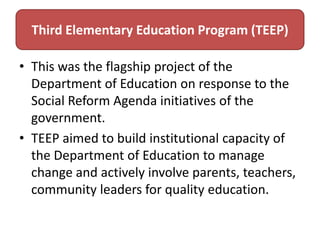
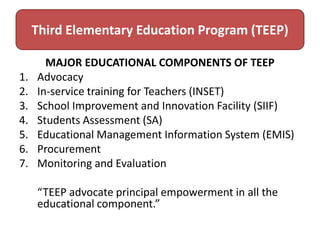
Third Elementary Education Program (TEEP)
• This was the flagship project of the
Department of Education on response to the
Social Reform Agenda initiatives of the
government.
• TEEP aimed to build institutional capacity of
the Department of Education to manage
change and actively involve parents, teachers,
community leaders for quality education.
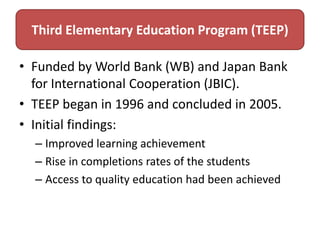
Third Elementary Education Program (TEEP)
• Funded by World Bank (WB) and Japan Bank
for International Cooperation (JBIC).
• TEEP began in 1996 and concluded in 2005.
• Initial findings:
– Improved learning achievement
– Rise in completions rates of the students
– Access to quality education had been achieved
Third Elementary Education Program (TEEP)
1.
2.
3.
4.
5.
6.
7.

MAJOR EDUCATIONAL COMPONENTS OF TEEP
Advocacy
In-service training for Teachers (INSET)
School Improvement and Innovation Facility (SIIF)
Students Assessment (SA)
Educational Management Information System (EMIS)
Procurement
Monitoring and Evaluation

“TEEP advocate principal empowerment in all the
educational component.”
Local and National Curricular
Innovations
2002 Basic Education Curriculum (BEC)
Third Elementary Education Program
(TEEP)
Secondary Education Improvement and
Development Program (SEDIP)

K-12 Basic Education Curriculum
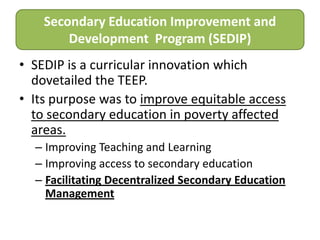
Secondary Education Improvement and
Development Program (SEDIP)
• SEDIP is a curricular innovation which
dovetailed the TEEP.
• Its purpose was to improve equitable access
to secondary education in poverty affected
areas.
– Improving Teaching and Learning
– Improving access to secondary education
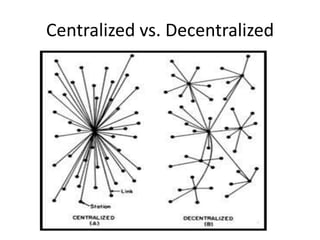
– Facilitating Decentralized Secondary Education
Management
Centralized vs. Decentralized
Secondary Education Improvement and
Development Program (SEDIP)
• The SEDIP innovations started in 2000 and
ended in 2006.
• Initial Results:
– Showed gains
– Best practices have been replicated in other
divisions which were not participants in the
project.
Local and National Curricular
Innovations
2002 Basic Education Curriculum (BEC)
Third Elementary Education Program
(TEEP)
Secondary Education Improvement and
Development Program (SEDIP)

K-12 Basic Education Curriculum
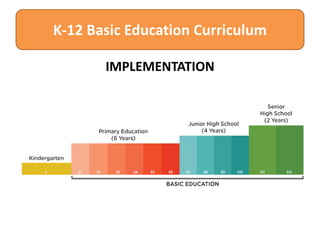
The K to 12 Program covers Kindergarten and
12 years of basic education (six years of
primary education, four years of Junior High
School, and two years of Senior High School
[SHS]) to provide sufficient time for mastery
of concepts and skills, develop lifelong
learners, and prepare graduates for tertiary
education, middle-level skills development,
employment, and entrepreneurship.
K-12 Basic Education Curriculum
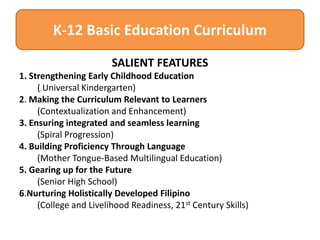
SALIENT FEATURES
1. Strengthening Early Childhood Education
( Universal Kindergarten)
2. Making the Curriculum Relevant to Learners
(Contextualization and Enhancement)
3. Ensuring integrated and seamless learning
(Spiral Progression)
4. Building Proficiency Through Language
(Mother Tongue-Based Multilingual Education)
5. Gearing up for the Future
(Senior High School)
6.Nurturing Holistically Developed Filipino
(College and Livelihood Readiness, 21st Century Skills)
K-12 Basic Education Curriculum
IMPLEMENTATION
K-12 Basic Education Curriculum

The Enhanced Basic Education Act of 2013, or
Republic Act No. 10533, was signed on May
15, 2013
Thank You
for Listening!