A NumPy-compatible Library for GPU
Shohei Hido
VP of Research
Preferred Networks
Preferred Networks: An AI Startup in Japan
● Founded: March 2014 (120 engineers and researchers)
● Major news
● $100+M investment from Toyota for autonomous driving
● 2nd place at Amazon Robotics Challenge 2016
● Fastest ImageNet training on GPU cluster (15 minutes using 1,024 GPUs)
2
Deep learning research Industrial applications
Manufacturing
Automotive
Healthcare
Key takeaways
● CuPy is an open-source NumPy for NVIDIA GPU
● Python users can easily write CPU/GPU-agnostic code
● Existing NumPy code can be accelerated thanks to GPU and CUDA libraries
● What is CuPy
● Example: CPU/GPU agnostic implementation of k-means
● Introduction to CuPy
● Recent updates & conclusion
CuPy: A NumPy-Compatible Library for NVIDIA GPU
● NumPy is extensively used in Python but GPU is not supported
● GPU is getting faster and more important for scientific computing
import numpy as np
x_cpu = np.random.rand(10)
W_cpu = np.random.rand(10, 5)
y_cpu = np.dot(x_cpu, W_cpu)
import cupy as cp
x_gpu = cp.random.rand(10)
W_gpu = cp.random.rand(10, 5)
y_gpu = cp.dot(x_gpu, W_gpu)
y_gpu = cp.asarray(y_cpu)
y_cpu = cp.asnumpy(y_gpu)
for xp in [numpy, cupy]:
x = xp.random.rand(10)
W = xp.random.rand(10, 5)
y = xp.dot(x, W)
CPU/GPU-agnostic
NVIDIA GPUCPU
CuPy is actively developed (1,600+ github stars, 11,000+ commits)
Ryosuke Okuta
CTO
Preferred
Networks
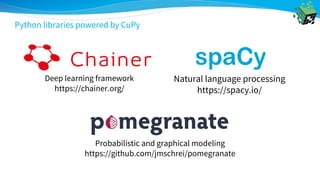
Deep learning framework
https://chainer.org/
Probabilistic and graphical modeling
https://github.com/jmschrei/pomegranate
Natural language processing
https://spacy.io/
Python libraries powered by CuPy
Reputation (1/2): Travis Oliphant, creator of NumPy and SciPy
Reputation (2/2): Stephan Merity of Salesforce Research (MetaMind)
Our mission: make CuPy the default tool for GPU computation in Python
https://anaconda.org/anaconda/cupy/
● CuPy is now available on Anaconda in collaboration w/ Anaconda team
● You can install cupy with “$ conda install cupy” on Linux 64-bit
● We are working on Windows version
Don’t have GPU for CuPy? Google Colaboratory gives you one (for free!)
…
● What is CuPy
● Example: CPU/GPU agnostic implementation of k-means
● Introduction to CuPy
● Recent updates & conclusion
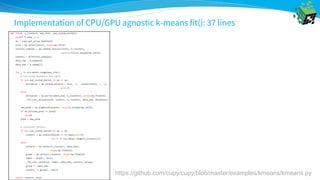
Implementation of CPU/GPU agnostic k-means fit(): 37 lines
https://github.com/cupy/cupy/blob/master/examples/kmeans/kmeans.py
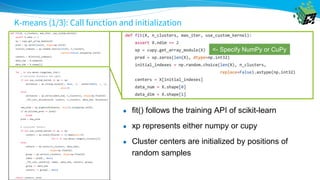
K-means (1/3): Call function and initialization
● fit() follows the training API of scikit-learn
● xp represents either numpy or cupy
● Cluster centers are initialized by positions of
random samples
<- Specify NumPy or CuPy
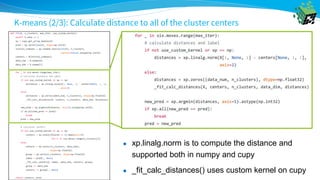
K-means (2/3): Calculate distance to all of the cluster centers
● xp.linalg.norm is to compute the distance and
supported both in numpy and cupy
● _fit_calc_distances() uses custom kernel on cupy
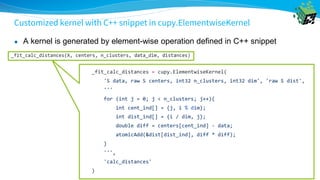
Customized kernel with C++ snippet in cupy.ElementwiseKernel
● A kernel is generated by element-wise operation defined in C++ snippet
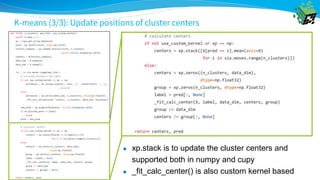
K-means (3/3): Update positions of cluster centers
● xp.stack is to update the cluster centers and
supported both in numpy and cupy
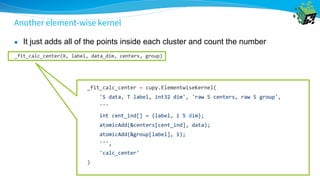
● _fit_calc_center() is also custom kernel based
Another element-wise kernel
● It just adds all of the points inside each cluster and count the number
● What is CuPy
● Example: CPU/GPU agnostic implementation of k-means
● Introduction to CuPy
● Recent updates & conclusion
Performance comparison with NumPy
● CuPy is faster than NumPy even in simple manipulation of large matrix
Benchmark code
Size CuPy [ms] NumPy [ms]
10^4 0.58 0.03
10^5 0.97 0.20
10^6 1.84 2.00
10^7 12.48 55.55
10^8 84.73 517.17
Benchmark result
6x faster
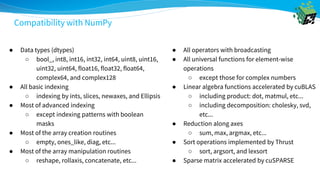
● Data types (dtypes)
○ bool_, int8, int16, int32, int64, uint8, uint16,
uint32, uint64, float16, float32, float64,
complex64, and complex128
● All basic indexing
○ indexing by ints, slices, newaxes, and Ellipsis
● Most of advanced indexing
○ except indexing patterns with boolean
masks
● Most of the array creation routines
○ empty, ones_like, diag, etc...
● Most of the array manipulation routines
○ reshape, rollaxis, concatenate, etc...
● All operators with broadcasting
● All universal functions for element-wise
operations
○ except those for complex numbers
● Linear algebra functions accelerated by cuBLAS
○ including product: dot, matmul, etc...
○ including decomposition: cholesky, svd,
etc...
● Reduction along axes
○ sum, max, argmax, etc...
● Sort operations implemented by Thrust
○ sort, argsort, and lexsort
● Sparse matrix accelerated by cuSPARSE
Compatibility with NumPy
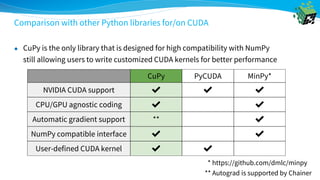
Comparison with other Python libraries for/on CUDA
● CuPy is the only library that is designed for high compatibility with NumPy
still allowing users to write customized CUDA kernels for better performance
CuPy PyCUDA MinPy*
NVIDIA CUDA support ✔ ✔ ✔
CPU/GPU agnostic coding ✔ ✔
Automatic gradient support ** ✔
NumPy compatible interface ✔ ✔
User-defined CUDA kernel ✔ ✔
* https://github.com/dmlc/minpy
** Autograd is supported by Chainer
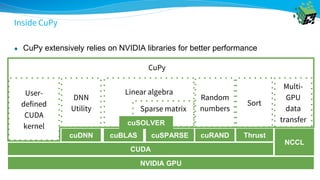
Inside CuPy
● CuPy extensively relies on NVIDIA libraries for better performance
Linear algebra
NVIDIA GPU
CUDA
cuDNN cuBLAS cuRANDcuSPARSE
NCCL
Thrust
Sparse matrix
DNN
Utility
Random
numbers
cuSOLVER
User-
defined
CUDA
kernel
Multi-
GPU
data
transfer
Sort
CuPy
Looks very easy?
● CUDA and its libraries are not designed for Python nor NumPy
━ CuPy is not just a wrapper of CUDA libraries for Python
━ CuPy is a fast numerical computation library on GPU with NumPy-compatible API
● NumPy specification is not documented
━ We have carefully investigated some unexpected behaviors of NumPy
━ CuPy tries to replicate NumPy’s behavior as much as possible
● NumPy’s behaviors vary between different versions
━ e.g, NumPy v1.14 changed the output format of __str__
• `[ 0. 1.]` -> `[0. 1.]` (no space)
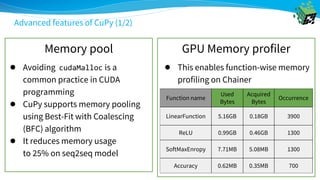
Advanced features of CuPy (1/2)
Memory pool GPU Memory profiler
Function name
Used
Bytes
Acquired
Bytes
Occurrence
LinearFunction 5.16GB 0.18GB 3900
ReLU 0.99GB 0.46GB 1300
SoftMaxEnropy 7.71MB 5.08MB 1300
Accuracy 0.62MB 0.35MB 700
● This enables function-wise memory
profiling on Chainer
● Avoiding cudaMalloc is a
common practice in CUDA
programming
● CuPy supports memory pooling
using Best-Fit with Coalescing
(BFC) algorithm
● It reduces memory usage
to 25% on seq2seq model
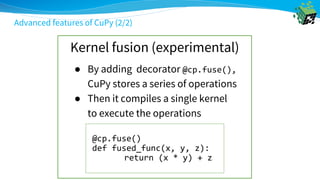
Advanced features of CuPy (2/2)
Kernel fusion (experimental)
@cp.fuse()
def fused_func(x, y, z):
return (x * y) + z
● By adding decorator @cp.fuse(),
CuPy stores a series of operations
● Then it compiles a single kernel
to execute the operations
● What is CuPy
● Example: CPU/GPU agnostic implementation of k-means
● Introduction to CuPy
● Recent updates & conclusion
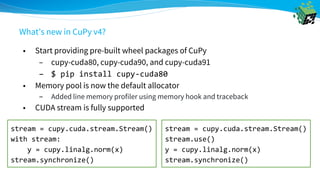
• Start providing pre-built wheel packages of CuPy
– cupy-cuda80, cupy-cuda90, and cupy-cuda91
– $ pip install cupy-cuda80
• Memory pool is now the default allocator
– Added line memory profiler using memory hook and traceback
• CUDA stream is fully supported
stream = cupy.cuda.stream.Stream()
with stream:
y = cupy.linalg.norm(x)
stream.synchronize()
stream = cupy.cuda.stream.Stream()
stream.use()
y = cupy.linalg.norm(x)
stream.synchronize()
What’s new in CuPy v4?
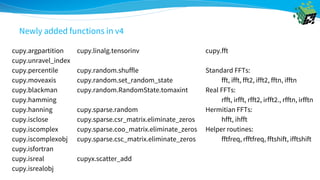
cupy.argpartition
cupy.unravel_index
cupy.percentile
cupy.moveaxis
cupy.blackman
cupy.hamming
cupy.hanning
cupy.isclose
cupy.iscomplex
cupy.iscomplexobj
cupy.isfortran
cupy.isreal
cupy.isrealobj
cupy.linalg.tensorinv
cupy.random.shuffle
cupy.random.set_random_state
cupy.random.RandomState.tomaxint
cupy.sparse.random
cupy.sparse.csr_matrix.eliminate_zeros
cupy.sparse.coo_matrix.eliminate_zeros
cupy.sparse.csc_matrix.eliminate_zeros
cupyx.scatter_add
cupy.fft
Standard FFTs:
fft, ifft, fft2, ifft2, fftn, ifftn
Real FFTs:
rfft, irfft, rfft2, irfft2., rfftn, irfftn
Hermitian FFTs:
hfft, ihfft
Helper routines:
fftfreq, rfftfreq, fftshift, ifftshift
Newly added functions in v4
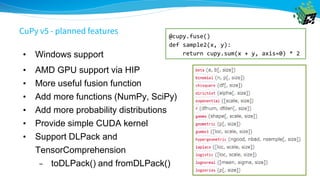
• Windows support
• AMD GPU support via HIP
• More useful fusion function
• Add more functions (NumPy, SciPy)
• Add more probability distributions
• Provide simple CUDA kernel
• Support DLPack and
TensorComprehension
– toDLPack() and fromDLPack()
@cupy.fuse()
def sample2(x, y):
return cupy.sum(x + y, axis=0) * 2
CuPy v5 - planned features
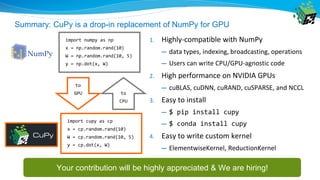
Summary: CuPy is a drop-in replacement of NumPy for GPU
1. Highly-compatible with NumPy
━ data types, indexing, broadcasting, operations
━ Users can write CPU/GPU-agnostic code
2. High performance on NVIDIA GPUs
━ cuBLAS, cuDNN, cuRAND, cuSPARSE, and NCCL
3. Easy to install
━ $ pip install cupy
━ $ conda install cupy
4. Easy to write custom kernel
━ ElementwiseKernel, ReductionKernel
import numpy as np
x = np.random.rand(10)
W = np.random.rand(10, 5)
y = np.dot(x, W)
import cupy as cp
x = cp.random.rand(10)
W = cp.random.rand(10, 5)
y = cp.dot(x, W)
to
GPU to
CPU
Your contribution will be highly appreciated & We are hiring!

CuPy: A NumPy-compatible Library for GPU

  • 1.
    A NumPy-compatible Libraryfor GPU Shohei Hido VP of Research Preferred Networks
  • 2.
    Preferred Networks: AnAI Startup in Japan ● Founded: March 2014 (120 engineers and researchers) ● Major news ● $100+M investment from Toyota for autonomous driving ● 2nd place at Amazon Robotics Challenge 2016 ● Fastest ImageNet training on GPU cluster (15 minutes using 1,024 GPUs) 2 Deep learning research Industrial applications Manufacturing Automotive Healthcare
  • 3.
    Key takeaways ● CuPyis an open-source NumPy for NVIDIA GPU ● Python users can easily write CPU/GPU-agnostic code ● Existing NumPy code can be accelerated thanks to GPU and CUDA libraries
  • 4.
    ● What isCuPy ● Example: CPU/GPU agnostic implementation of k-means ● Introduction to CuPy ● Recent updates & conclusion
  • 5.
    CuPy: A NumPy-CompatibleLibrary for NVIDIA GPU ● NumPy is extensively used in Python but GPU is not supported ● GPU is getting faster and more important for scientific computing import numpy as np x_cpu = np.random.rand(10) W_cpu = np.random.rand(10, 5) y_cpu = np.dot(x_cpu, W_cpu) import cupy as cp x_gpu = cp.random.rand(10) W_gpu = cp.random.rand(10, 5) y_gpu = cp.dot(x_gpu, W_gpu) y_gpu = cp.asarray(y_cpu) y_cpu = cp.asnumpy(y_gpu) for xp in [numpy, cupy]: x = xp.random.rand(10) W = xp.random.rand(10, 5) y = xp.dot(x, W) CPU/GPU-agnostic NVIDIA GPUCPU
  • 6.
    CuPy is activelydeveloped (1,600+ github stars, 11,000+ commits) Ryosuke Okuta CTO Preferred Networks
  • 7.
    Deep learning framework https://chainer.org/ Probabilisticand graphical modeling https://github.com/jmschrei/pomegranate Natural language processing https://spacy.io/ Python libraries powered by CuPy
  • 8.
    Reputation (1/2): TravisOliphant, creator of NumPy and SciPy
  • 9.
    Reputation (2/2): StephanMerity of Salesforce Research (MetaMind)
  • 10.
    Our mission: makeCuPy the default tool for GPU computation in Python https://anaconda.org/anaconda/cupy/ ● CuPy is now available on Anaconda in collaboration w/ Anaconda team ● You can install cupy with “$ conda install cupy” on Linux 64-bit ● We are working on Windows version
  • 11.
    Don’t have GPUfor CuPy? Google Colaboratory gives you one (for free!) …
  • 12.
    ● What isCuPy ● Example: CPU/GPU agnostic implementation of k-means ● Introduction to CuPy ● Recent updates & conclusion
  • 13.
    Implementation of CPU/GPUagnostic k-means fit(): 37 lines https://github.com/cupy/cupy/blob/master/examples/kmeans/kmeans.py
  • 14.
    K-means (1/3): Callfunction and initialization ● fit() follows the training API of scikit-learn ● xp represents either numpy or cupy ● Cluster centers are initialized by positions of random samples <- Specify NumPy or CuPy
  • 15.
    K-means (2/3): Calculatedistance to all of the cluster centers ● xp.linalg.norm is to compute the distance and supported both in numpy and cupy ● _fit_calc_distances() uses custom kernel on cupy
  • 16.
    Customized kernel withC++ snippet in cupy.ElementwiseKernel ● A kernel is generated by element-wise operation defined in C++ snippet
  • 17.
    K-means (3/3): Updatepositions of cluster centers ● xp.stack is to update the cluster centers and supported both in numpy and cupy ● _fit_calc_center() is also custom kernel based
  • 18.
    Another element-wise kernel ●It just adds all of the points inside each cluster and count the number
  • 19.
    ● What isCuPy ● Example: CPU/GPU agnostic implementation of k-means ● Introduction to CuPy ● Recent updates & conclusion
  • 20.
    Performance comparison withNumPy ● CuPy is faster than NumPy even in simple manipulation of large matrix Benchmark code Size CuPy [ms] NumPy [ms] 10^4 0.58 0.03 10^5 0.97 0.20 10^6 1.84 2.00 10^7 12.48 55.55 10^8 84.73 517.17 Benchmark result 6x faster
  • 21.
    ● Data types(dtypes) ○ bool_, int8, int16, int32, int64, uint8, uint16, uint32, uint64, float16, float32, float64, complex64, and complex128 ● All basic indexing ○ indexing by ints, slices, newaxes, and Ellipsis ● Most of advanced indexing ○ except indexing patterns with boolean masks ● Most of the array creation routines ○ empty, ones_like, diag, etc... ● Most of the array manipulation routines ○ reshape, rollaxis, concatenate, etc... ● All operators with broadcasting ● All universal functions for element-wise operations ○ except those for complex numbers ● Linear algebra functions accelerated by cuBLAS ○ including product: dot, matmul, etc... ○ including decomposition: cholesky, svd, etc... ● Reduction along axes ○ sum, max, argmax, etc... ● Sort operations implemented by Thrust ○ sort, argsort, and lexsort ● Sparse matrix accelerated by cuSPARSE Compatibility with NumPy
  • 22.
    Comparison with otherPython libraries for/on CUDA ● CuPy is the only library that is designed for high compatibility with NumPy still allowing users to write customized CUDA kernels for better performance CuPy PyCUDA MinPy* NVIDIA CUDA support ✔ ✔ ✔ CPU/GPU agnostic coding ✔ ✔ Automatic gradient support ** ✔ NumPy compatible interface ✔ ✔ User-defined CUDA kernel ✔ ✔ * https://github.com/dmlc/minpy ** Autograd is supported by Chainer
  • 23.
    Inside CuPy ● CuPyextensively relies on NVIDIA libraries for better performance Linear algebra NVIDIA GPU CUDA cuDNN cuBLAS cuRANDcuSPARSE NCCL Thrust Sparse matrix DNN Utility Random numbers cuSOLVER User- defined CUDA kernel Multi- GPU data transfer Sort CuPy
  • 24.
    Looks very easy? ●CUDA and its libraries are not designed for Python nor NumPy ━ CuPy is not just a wrapper of CUDA libraries for Python ━ CuPy is a fast numerical computation library on GPU with NumPy-compatible API ● NumPy specification is not documented ━ We have carefully investigated some unexpected behaviors of NumPy ━ CuPy tries to replicate NumPy’s behavior as much as possible ● NumPy’s behaviors vary between different versions ━ e.g, NumPy v1.14 changed the output format of __str__ • `[ 0. 1.]` -> `[0. 1.]` (no space)
  • 25.
    Advanced features ofCuPy (1/2) Memory pool GPU Memory profiler Function name Used Bytes Acquired Bytes Occurrence LinearFunction 5.16GB 0.18GB 3900 ReLU 0.99GB 0.46GB 1300 SoftMaxEnropy 7.71MB 5.08MB 1300 Accuracy 0.62MB 0.35MB 700 ● This enables function-wise memory profiling on Chainer ● Avoiding cudaMalloc is a common practice in CUDA programming ● CuPy supports memory pooling using Best-Fit with Coalescing (BFC) algorithm ● It reduces memory usage to 25% on seq2seq model
  • 26.
    Advanced features ofCuPy (2/2) Kernel fusion (experimental) @cp.fuse() def fused_func(x, y, z): return (x * y) + z ● By adding decorator @cp.fuse(), CuPy stores a series of operations ● Then it compiles a single kernel to execute the operations
  • 27.
    ● What isCuPy ● Example: CPU/GPU agnostic implementation of k-means ● Introduction to CuPy ● Recent updates & conclusion
  • 28.
    • Start providingpre-built wheel packages of CuPy – cupy-cuda80, cupy-cuda90, and cupy-cuda91 – $ pip install cupy-cuda80 • Memory pool is now the default allocator – Added line memory profiler using memory hook and traceback • CUDA stream is fully supported stream = cupy.cuda.stream.Stream() with stream: y = cupy.linalg.norm(x) stream.synchronize() stream = cupy.cuda.stream.Stream() stream.use() y = cupy.linalg.norm(x) stream.synchronize() What’s new in CuPy v4?
  • 29.
  • 30.
    • Windows support •AMD GPU support via HIP • More useful fusion function • Add more functions (NumPy, SciPy) • Add more probability distributions • Provide simple CUDA kernel • Support DLPack and TensorComprehension – toDLPack() and fromDLPack() @cupy.fuse() def sample2(x, y): return cupy.sum(x + y, axis=0) * 2 CuPy v5 - planned features
  • 31.
    Summary: CuPy isa drop-in replacement of NumPy for GPU 1. Highly-compatible with NumPy ━ data types, indexing, broadcasting, operations ━ Users can write CPU/GPU-agnostic code 2. High performance on NVIDIA GPUs ━ cuBLAS, cuDNN, cuRAND, cuSPARSE, and NCCL 3. Easy to install ━ $ pip install cupy ━ $ conda install cupy 4. Easy to write custom kernel ━ ElementwiseKernel, ReductionKernel import numpy as np x = np.random.rand(10) W = np.random.rand(10, 5) y = np.dot(x, W) import cupy as cp x = cp.random.rand(10) W = cp.random.rand(10, 5) y = cp.dot(x, W) to GPU to CPU Your contribution will be highly appreciated & We are hiring!