PYTHON FOR MACHINE
LEARNING
Dr. Amanpreet Kaur​
Associate Professor,
Chitkara University,
Punjab
CONTENTS TO BE STUDIED
• Introduction to Python Programming
• Python for Machine Learning
• Python Libraries used in Machine Learning
• NumPy
• NumPy Questions
• References
PYTHON FOR MACHINE
LEARNING (ML)
• A Python framework is an interface or tool that allows developers to
build ML models easily.
• without getting into the depth of the underlying algorithms.
• Python libraries are specific files containing pre-written code that can be
imported into your code base by using Python’s import feature.
• This increases your code reusability.
3
PYTHON FOR MACHINE
LEARNING (ML)
• A Python framework can be a collection of libraries intended to build a
model (e.g., machine learning) easily,
• without having to know the details of the underlying algorithms.
• An ML developer, however, must at least know how the algorithms work in
order to know what results to expect, as well as how to validate them.
4
FEATURES OF PYTHON
PROGRAMMING
• Used in Various Domains ( Artificial Intelligence, Machine Learning, Deep
Learning )
• Python is Object Oriented
• Python is Open source
• Shift from one system to another
5
INSTALLATION OF ANACONDA
• Visit Anaconda.com/downloads
• Select Windows
• Download the .exe installer
• Open and run the .exe installer
• Open the Anaconda Prompt and run some Python code
6
Figure- 1 Anaconda Distribution [1]
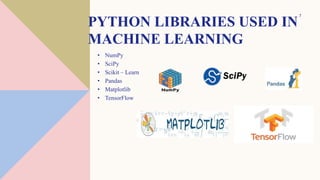
PYTHON LIBRARIES USED IN
MACHINE LEARNING
• NumPy
• SciPy
• Scikit – Learn
• Pandas
• Matplotlib
• TensorFlow
7
NUMPY
• NumPy is a well known general-purpose array-processing package.
• An extensive collection of high complexity mathematical functions make
NumPy powerful to process large multi-dimensional arrays and matrices.
• NumPy is very useful for handling linear algebra, Fourier transforms, and
random numbers.
• Define arbitrary data types and easily integrate with most databases.
• NumPy can also serve as an efficient multi-dimensional container for any
generic data that is in any datatype.
8
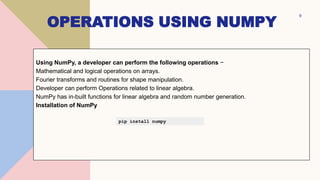
OPERATIONS USING NUMPY
9
Using NumPy, a developer can perform the following operations −
Mathematical and logical operations on arrays.
Fourier transforms and routines for shape manipulation.
Developer can perform Operations related to linear algebra.
NumPy has in-built functions for linear algebra and random number generation.
Installation of NumPy
pip install numpy
10
• Object defined in NumPy is an N-dimensional array type called ndarray.
• It describes the collection of items of the same type.
• Items in the collection can be accessed using a zero-based index.
• Every item in an ndarray takes the same size of block in the memory.
• Each element in ndarray is an object of data-type object (called dtype).
• Any item extracted from ndarray object (by slicing) is represented by a Python object of one of
array scalar types.
Figure-1.2 Relationship between ndarray, data type object (dtype) and array scalar type [6]
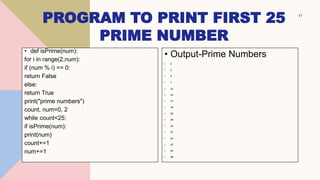
PROGRAM TO PRINT FIRST 25
PRIME NUMBER
11
• def isPrime(num):
for i in range(2,num):
if (num % i) == 0:
return False
else:
return True
print("prime numbers")
count, num=0, 2
while count<25:
if isPrime(num):
print(num)
count+=1
num+=1
• Output-Prime Numbers
• 2
• 3
• 5
• 7
• 11
• 13
• 17
• 19
• 23
• 29
• 31
• 37
• 41
• 47
• 53
• 59
NUMPY(ONE DIMENSIONAL) 12
# this is one dimensional array
import numpy as np
a = np.arange(24)
#Function return the number of
dimensions of an array.
a.ndim
# now reshape it
b = a.reshape(2,4,3)
b #print b
# b is having three dimensions
Result-
$python main.py
[[[ 0 1 2]
[ 3 4 5]
[ 6 7 8]
[ 9 10 11]]
[[12 13 14]
[15 16 17]
[18 19 20]
[21 22 23]]]
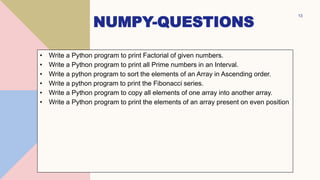
NUMPY-QUESTIONS
13
• Write a Python program to print Factorial of given numbers.
• Write a Python program to print all Prime numbers in an Interval.
• Write a python program to sort the elements of an Array in Ascending order.
• Write a python program to print the Fibonacci series.
• Write a Python program to copy all elements of one array into another array.
• Write a Python program to print the elements of an array present on even position
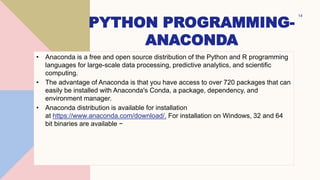
PYTHON PROGRAMMING-
ANACONDA
14
• Anaconda is a free and open source distribution of the Python and R programming
languages for large-scale data processing, predictive analytics, and scientific
computing.
• The advantage of Anaconda is that you have access to over 720 packages that can
easily be installed with Anaconda's Conda, a package, dependency, and
environment manager.
• Anaconda distribution is available for installation
at https://www.anaconda.com/download/. For installation on Windows, 32 and 64
bit binaries are available −
PYTHON PROGRAMMING
15
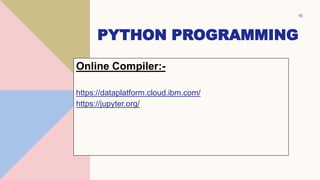
Online Compiler:-
https://dataplatform.cloud.ibm.com/
https://jupyter.org/
PYTHON PROGRAMMING
16
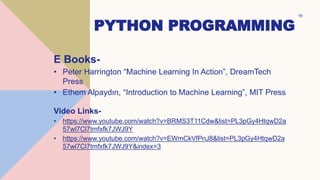
E Books-
• Peter Harrington “Machine Learning In Action”, DreamTech
Press
• Ethem Alpaydın, “Introduction to Machine Learning”, MIT Press
Video Links-
• https://www.youtube.com/watch?v=BRMS3T11Cdw&list=PL3pGy4HtqwD2a
57wl7Cl7tmfxfk7JWJ9Y
• https://www.youtube.com/watch?v=EWmCkVfPnJ8&list=PL3pGy4HtqwD2a
57wl7Cl7tmfxfk7JWJ9Y&index=3
THANK YOU
aman_preet_k@yahoo.co.in

Python for ML.pptx

  • 1.
    PYTHON FOR MACHINE LEARNING Dr.Amanpreet Kaur​ Associate Professor, Chitkara University, Punjab
  • 2.
    CONTENTS TO BESTUDIED • Introduction to Python Programming • Python for Machine Learning • Python Libraries used in Machine Learning • NumPy • NumPy Questions • References
  • 3.
    PYTHON FOR MACHINE LEARNING(ML) • A Python framework is an interface or tool that allows developers to build ML models easily. • without getting into the depth of the underlying algorithms. • Python libraries are specific files containing pre-written code that can be imported into your code base by using Python’s import feature. • This increases your code reusability. 3
  • 4.
    PYTHON FOR MACHINE LEARNING(ML) • A Python framework can be a collection of libraries intended to build a model (e.g., machine learning) easily, • without having to know the details of the underlying algorithms. • An ML developer, however, must at least know how the algorithms work in order to know what results to expect, as well as how to validate them. 4
  • 5.
    FEATURES OF PYTHON PROGRAMMING •Used in Various Domains ( Artificial Intelligence, Machine Learning, Deep Learning ) • Python is Object Oriented • Python is Open source • Shift from one system to another 5
  • 6.
    INSTALLATION OF ANACONDA •Visit Anaconda.com/downloads • Select Windows • Download the .exe installer • Open and run the .exe installer • Open the Anaconda Prompt and run some Python code 6 Figure- 1 Anaconda Distribution [1]
  • 7.
    PYTHON LIBRARIES USEDIN MACHINE LEARNING • NumPy • SciPy • Scikit – Learn • Pandas • Matplotlib • TensorFlow 7
  • 8.
    NUMPY • NumPy isa well known general-purpose array-processing package. • An extensive collection of high complexity mathematical functions make NumPy powerful to process large multi-dimensional arrays and matrices. • NumPy is very useful for handling linear algebra, Fourier transforms, and random numbers. • Define arbitrary data types and easily integrate with most databases. • NumPy can also serve as an efficient multi-dimensional container for any generic data that is in any datatype. 8
  • 9.
    OPERATIONS USING NUMPY 9 UsingNumPy, a developer can perform the following operations − Mathematical and logical operations on arrays. Fourier transforms and routines for shape manipulation. Developer can perform Operations related to linear algebra. NumPy has in-built functions for linear algebra and random number generation. Installation of NumPy pip install numpy
  • 10.
    10 • Object definedin NumPy is an N-dimensional array type called ndarray. • It describes the collection of items of the same type. • Items in the collection can be accessed using a zero-based index. • Every item in an ndarray takes the same size of block in the memory. • Each element in ndarray is an object of data-type object (called dtype). • Any item extracted from ndarray object (by slicing) is represented by a Python object of one of array scalar types. Figure-1.2 Relationship between ndarray, data type object (dtype) and array scalar type [6]
  • 11.
    PROGRAM TO PRINTFIRST 25 PRIME NUMBER 11 • def isPrime(num): for i in range(2,num): if (num % i) == 0: return False else: return True print("prime numbers") count, num=0, 2 while count<25: if isPrime(num): print(num) count+=1 num+=1 • Output-Prime Numbers • 2 • 3 • 5 • 7 • 11 • 13 • 17 • 19 • 23 • 29 • 31 • 37 • 41 • 47 • 53 • 59
  • 12.
    NUMPY(ONE DIMENSIONAL) 12 #this is one dimensional array import numpy as np a = np.arange(24) #Function return the number of dimensions of an array. a.ndim # now reshape it b = a.reshape(2,4,3) b #print b # b is having three dimensions Result- $python main.py [[[ 0 1 2] [ 3 4 5] [ 6 7 8] [ 9 10 11]] [[12 13 14] [15 16 17] [18 19 20] [21 22 23]]]
  • 13.
    NUMPY-QUESTIONS 13 • Write aPython program to print Factorial of given numbers. • Write a Python program to print all Prime numbers in an Interval. • Write a python program to sort the elements of an Array in Ascending order. • Write a python program to print the Fibonacci series. • Write a Python program to copy all elements of one array into another array. • Write a Python program to print the elements of an array present on even position
  • 14.
    PYTHON PROGRAMMING- ANACONDA 14 • Anacondais a free and open source distribution of the Python and R programming languages for large-scale data processing, predictive analytics, and scientific computing. • The advantage of Anaconda is that you have access to over 720 packages that can easily be installed with Anaconda's Conda, a package, dependency, and environment manager. • Anaconda distribution is available for installation at https://www.anaconda.com/download/. For installation on Windows, 32 and 64 bit binaries are available −
  • 15.
  • 16.
    PYTHON PROGRAMMING 16 E Books- •Peter Harrington “Machine Learning In Action”, DreamTech Press • Ethem Alpaydın, “Introduction to Machine Learning”, MIT Press Video Links- • https://www.youtube.com/watch?v=BRMS3T11Cdw&list=PL3pGy4HtqwD2a 57wl7Cl7tmfxfk7JWJ9Y • https://www.youtube.com/watch?v=EWmCkVfPnJ8&list=PL3pGy4HtqwD2a 57wl7Cl7tmfxfk7JWJ9Y&index=3
  • 17.