Seminar
On
Blue Gene
Submitted By:
Rabindra Raj Sah
Content
 What is Blue Gene
 Why the name “Blue Gene”?
 History
 Results
 Blue Gene Projects
 References
What is Blue Gene
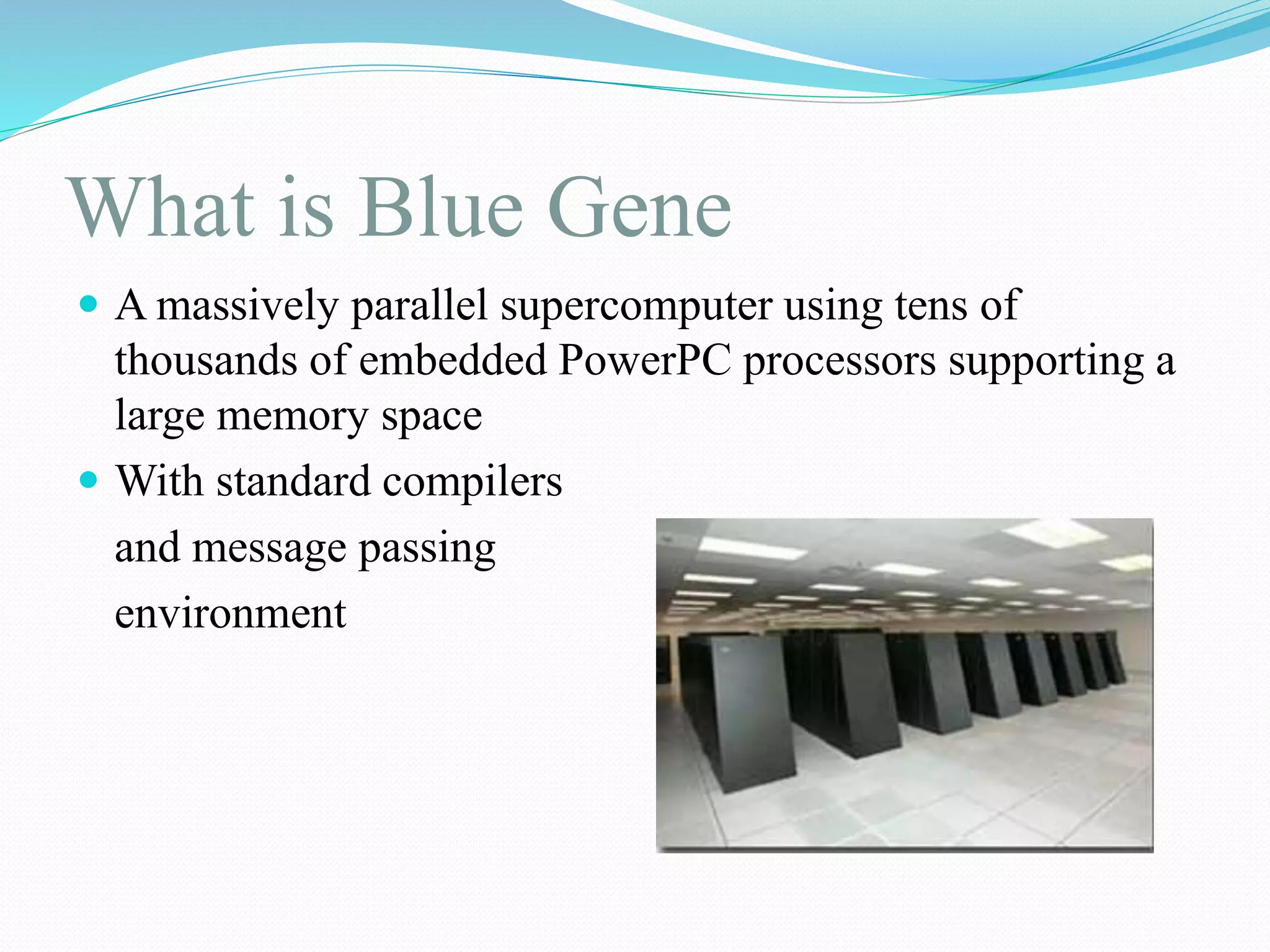
 A massively parallel supercomputer using tens of
thousands of embedded PowerPC processors supporting a
large memory space
 With standard compilers
and message passing
environment
Why the name “Blue Gene”?
 “Blue”: The corporate color of IBM
 “Gene”: The intended use of the Blue Gene clusters –
Computational biology, specifically, protein folding
History
 Dec1999, IBM Research announced $100M US effort to build
a Petaflop scale supercomputer.
 Two goals of The Blue Gene project :
 Massively parallel machine architecture and software
 Bio-Molecular Simulation – advance orders of magnitude
 November 2001, Partnership with Lawrence Livermore
National Laboratory (LLNL)
 Trading the speed of processors for lower power consumption. Blue
Gene/L used low frequency and low power embedded PowerPC cores
with floating point accelerators. While the performance of each chip
was relatively low, the system could achieve better performance to
energy ratio, for applications that could use larger numbers of nodes.
 Dual processors per node with two working modes: co-processor mode
where one processor handles computation and the other handles
communication; and virtual-node mode, where both processors are
available to run user code, but the processors share both the
computation and the communication load.
 System-on-a-chip design. All node components were embedded on one
chip, with the exception of 512 MB external DRAM.
 A large number of nodes (scalable in increments of 1024 up to at least
65,536) Three-dimensional torus interconnect with auxiliary
networks for global communications (broadcast and reductions), I/O,
and management .
MAJOR FEATURES
Results
 Linpack Top 500 Supercomputers
Blue Gene Projects
 Four Blue Gene projects :
 BlueGene/L
 BlueGene/C
 BlueGene/P
 BlueGene/Q
Blue Gene/L
 The first computer in the Blue Gene series
 IBM first announced the Blue Gene/L
project, Sept. 29, 2004
 Final configuration was launched in
October 2005
Blue Gene/L - Unsurpassed Performance
 Designed to deliver the most performance per kilowatt
of power consumed
 Theoretical peak performance of 360 TFLOPS
 Final Configuration (Oct. ‘05) scores over 280
TFLOPS sustained on the Linpack benchmark.
 Nov 14, ‘06, at Supercomputing 2006, Blue Gene/L
was awarded the winning prize in all HPC Challenge
Classes of awards.
Blue Gene/L Architecture
 Can be scaled up to 65,536 compute or I/O nodes,
with 131,072 processors
 Each node is a single ASIC with associated DRAM
memory chips
 Each ASIC has 2 700 MHz IBM PowerPC processors
 PowerPC processors
 Low-frequency, low-power embedded processors,
superior to today's high-frequency, high-power
microprocessors by a factor of 2 or more
Blue Gene/L Architecture contd…
 Double-pipeline-double-precision Floating Point Unit
 A cache sub-system with built-in DRAM controller
 Node CPUs are not cache coherent with one another
 FPUs and CPUs are designed for low power consumption
 Using transistors with low leakage current
 Local clock gating
 Putting the FPU or CPU/FPU pair to sleep
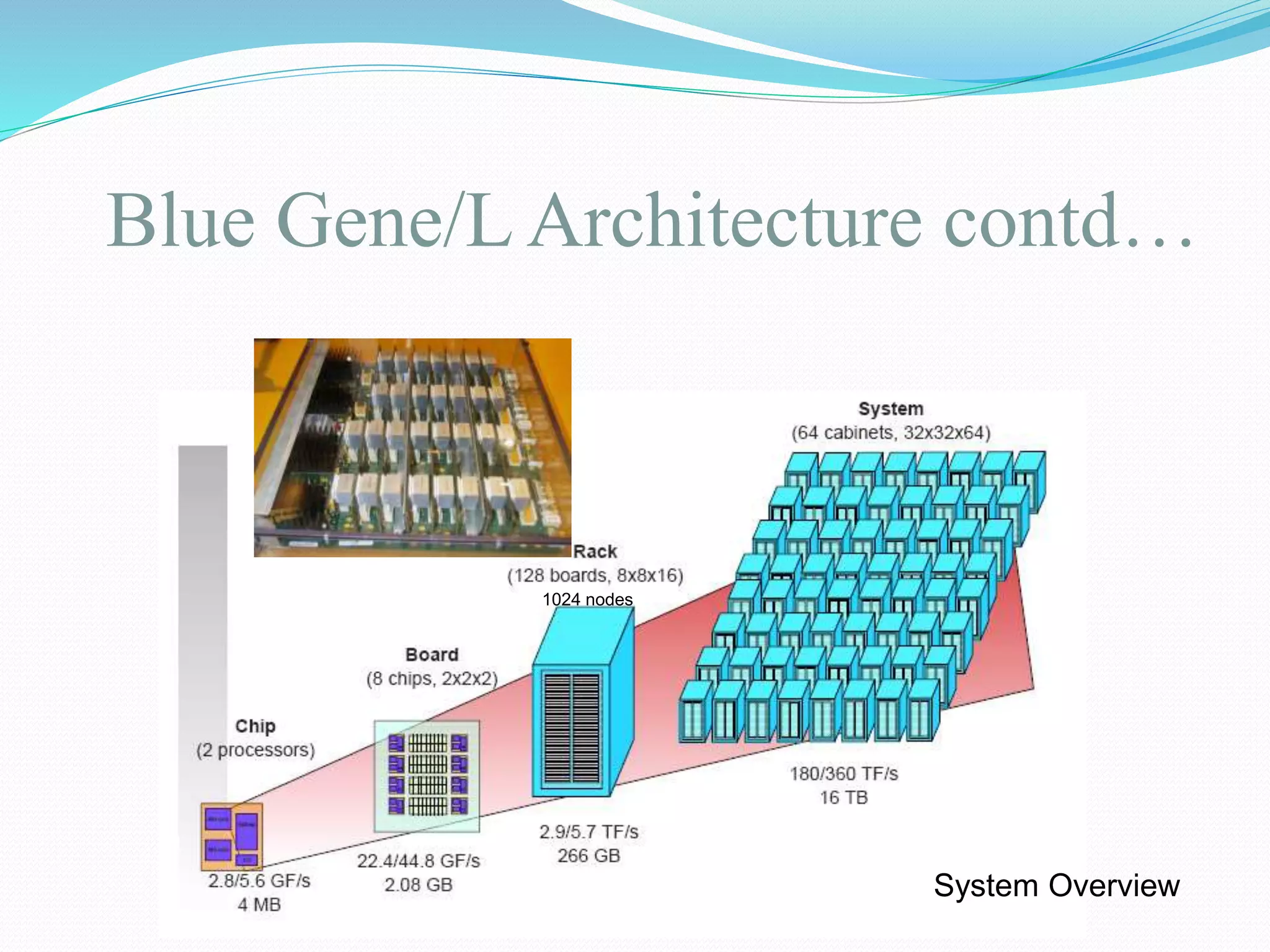
Blue Gene/L Architecture contd…
1024 nodes
System Overview
Blue Gene/L Architecture contd…
 1 rack holds 1024 nodes or 2048 processors
 Nodes optimized for low power consumption
 ASIC based on System-on-a-chip technology
 Large numbers of low-power system-on-a-chip technology allows
it to outperform commodity clusters while saving on power
 Aggressive packaging of processors, memory and interconnect
 Power Efficient & Space Efficient
 Allows for latencies and bandwidths that are significantly better
than those for nodes typically used in ASC scale supercomputers
Blue Gene/L Networks
 Each node is attached to 3 main parallel communication
networks
 3D Torus network - peer-2-peer between compute nodes
 Collective network – collective & global communication
 Ethernet network - I/O and management (such as access to
any node for configuration, booting and diagnostics )
Blue Gene/L System Software
 System software supports efficient execution of parallel
applications
 Compiler support for DFPU (C, C++, Fortran)
 Compute nodes use a minimal operating system called
“BlueGene/L compute node kernel”
 A lightweight, single-user operating system
 Supports execution of a single dual-threaded application compute
process
 Kernel provides a single and static virtual address space to one
running compute process
 Because of single-process nature, no context switching required
Blue Gene/L System Software contd…
 To allow multiple programs to run concurrently
 Blue Gene/L system can be partitioned into electronically isolated
sets of nodes
 The number of nodes in a partition must be a positive integer
power of 2
 To run program – reserve this partition
 No other program can use till partition is done with current
program
 With so many nodes, component failures are inevitable. The system
is able to electrically isolate faulty hardware to allow the machine
to continue to run
Blue Gene/L System Software contd…
 Parallel Programming model
 Message Passing – supported through an implementation of
MPI
 Only a subset of POSIX calls are supported
 Green threads are also used to simulate local concurrency
References
 www.google.com
 www.wikipedia.com
 www.studymafia.org
 Thank You for watching my presentation!!!
 Have you any question?

blue gene ppt

  • 1.
  • 2.
    Content  What isBlue Gene  Why the name “Blue Gene”?  History  Results  Blue Gene Projects  References
  • 3.
    What is BlueGene  A massively parallel supercomputer using tens of thousands of embedded PowerPC processors supporting a large memory space  With standard compilers and message passing environment
  • 4.
    Why the name“Blue Gene”?  “Blue”: The corporate color of IBM  “Gene”: The intended use of the Blue Gene clusters – Computational biology, specifically, protein folding
  • 5.
    History  Dec1999, IBMResearch announced $100M US effort to build a Petaflop scale supercomputer.  Two goals of The Blue Gene project :  Massively parallel machine architecture and software  Bio-Molecular Simulation – advance orders of magnitude  November 2001, Partnership with Lawrence Livermore National Laboratory (LLNL)
  • 6.
     Trading thespeed of processors for lower power consumption. Blue Gene/L used low frequency and low power embedded PowerPC cores with floating point accelerators. While the performance of each chip was relatively low, the system could achieve better performance to energy ratio, for applications that could use larger numbers of nodes.  Dual processors per node with two working modes: co-processor mode where one processor handles computation and the other handles communication; and virtual-node mode, where both processors are available to run user code, but the processors share both the computation and the communication load.  System-on-a-chip design. All node components were embedded on one chip, with the exception of 512 MB external DRAM.  A large number of nodes (scalable in increments of 1024 up to at least 65,536) Three-dimensional torus interconnect with auxiliary networks for global communications (broadcast and reductions), I/O, and management . MAJOR FEATURES
  • 7.
    Results  Linpack Top500 Supercomputers
  • 8.
    Blue Gene Projects Four Blue Gene projects :  BlueGene/L  BlueGene/C  BlueGene/P  BlueGene/Q
  • 9.
    Blue Gene/L  Thefirst computer in the Blue Gene series  IBM first announced the Blue Gene/L project, Sept. 29, 2004  Final configuration was launched in October 2005
  • 10.
    Blue Gene/L -Unsurpassed Performance  Designed to deliver the most performance per kilowatt of power consumed  Theoretical peak performance of 360 TFLOPS  Final Configuration (Oct. ‘05) scores over 280 TFLOPS sustained on the Linpack benchmark.  Nov 14, ‘06, at Supercomputing 2006, Blue Gene/L was awarded the winning prize in all HPC Challenge Classes of awards.
  • 11.
    Blue Gene/L Architecture Can be scaled up to 65,536 compute or I/O nodes, with 131,072 processors  Each node is a single ASIC with associated DRAM memory chips  Each ASIC has 2 700 MHz IBM PowerPC processors  PowerPC processors  Low-frequency, low-power embedded processors, superior to today's high-frequency, high-power microprocessors by a factor of 2 or more
  • 12.
    Blue Gene/L Architecturecontd…  Double-pipeline-double-precision Floating Point Unit  A cache sub-system with built-in DRAM controller  Node CPUs are not cache coherent with one another  FPUs and CPUs are designed for low power consumption  Using transistors with low leakage current  Local clock gating  Putting the FPU or CPU/FPU pair to sleep
  • 13.
    Blue Gene/L Architecturecontd… 1024 nodes System Overview
  • 14.
    Blue Gene/L Architecturecontd…  1 rack holds 1024 nodes or 2048 processors  Nodes optimized for low power consumption  ASIC based on System-on-a-chip technology  Large numbers of low-power system-on-a-chip technology allows it to outperform commodity clusters while saving on power  Aggressive packaging of processors, memory and interconnect  Power Efficient & Space Efficient  Allows for latencies and bandwidths that are significantly better than those for nodes typically used in ASC scale supercomputers
  • 15.
    Blue Gene/L Networks Each node is attached to 3 main parallel communication networks  3D Torus network - peer-2-peer between compute nodes  Collective network – collective & global communication  Ethernet network - I/O and management (such as access to any node for configuration, booting and diagnostics )
  • 16.
    Blue Gene/L SystemSoftware  System software supports efficient execution of parallel applications  Compiler support for DFPU (C, C++, Fortran)  Compute nodes use a minimal operating system called “BlueGene/L compute node kernel”  A lightweight, single-user operating system  Supports execution of a single dual-threaded application compute process  Kernel provides a single and static virtual address space to one running compute process  Because of single-process nature, no context switching required
  • 17.
    Blue Gene/L SystemSoftware contd…  To allow multiple programs to run concurrently  Blue Gene/L system can be partitioned into electronically isolated sets of nodes  The number of nodes in a partition must be a positive integer power of 2  To run program – reserve this partition  No other program can use till partition is done with current program  With so many nodes, component failures are inevitable. The system is able to electrically isolate faulty hardware to allow the machine to continue to run
  • 18.
    Blue Gene/L SystemSoftware contd…  Parallel Programming model  Message Passing – supported through an implementation of MPI  Only a subset of POSIX calls are supported  Green threads are also used to simulate local concurrency
  • 19.
  • 20.
     Thank Youfor watching my presentation!!!  Have you any question?

Editor's Notes