Peter Andreas Entschev
Senior System Software Engineer – NVIDIA
EuroPython, 10 July 2019
Distributed Multi-GPU Computing with
Dask, CuPy and RAPIDS
2
Outline
• Interoperability / Flexibility
• Acceleration (Scaling Up)
• Distribution (Scaling Out)
3
Clustering
from sklearn.cluster import DBSCAN
dbscan = DBSCAN(eps = 0.3, min_samples = 5)
dbscan.fit(X)
y_hat = dbscan.predict(X)
Find Clusters
from sklearn.datasets import make_moons
import pandas
X, y = make_moons(n_samples=int(1e2),
noise=0.05, random_state=0)
X = pandas.DataFrame({'fea%d'%i: X[:, i]
for i in range(X.shape[1])})
Code Example
4
GPU-Accelerated Clustering
from cuml import DBSCAN
dbscan = DBSCAN(eps = 0.3, min_samples = 5)
dbscan.fit(X)
y_hat = dbscan.predict(X)
Find Clusters
from sklearn.datasets import make_moons
import cudf
X, y = make_moons(n_samples=int(1e2),
noise=0.05, random_state=0)
X = cudf.DataFrame({'fea%d'%i: X[:, i]
for i in range(X.shape[1])})
Code Example
5
What is RAPIDS?
• Suite of open source, end-to-end data science tools
• Built on CUDA
• Unifying framework for GPU data science
• Pandas-like API for data preparation
• Scikit-learn-like API for machine learning
New GPU-Accelerated Data Science Pipeline
6
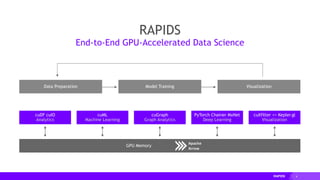
cuDF cuIO
Analytics
GPU Memory
Data Preparation VisualizationModel Training
cuML
Machine Learning
cuGraph
Graph Analytics
PyTorch Chainer MxNet
Deep Learning
cuXfilter <> Kepler.gl
Visualization
RAPIDS
End-to-End GPU-Accelerated Data Science
7
Learning from Apache Arrow
From Apache Arrow Home Page - https://arrow.apache.org/
8
Data
preparation /
wrangling
cuDF
ML model
training
cuML VISUALIZE
Dataset
exploration
DATA PREDICTIONS
Data Science Workflow with RAPIDS
Open Source, GPU-Accelerated ML Built on CUDA
9
Ecosystem Partners
10
ML Technology Stack
Python
Cython
cuML Algorithms
cuML Prims
CUDA Libraries
CUDA
Dask cuML
Dask cuDF
cuDF
CuPy
Numpy
Thrust
Cub
nvGraph
cuBLAS
cuRand
cuSolver
cuSparse
CUTLASS
11
High-Level APIs
Data Parallelism
Model Parallelism
CUDA/C++
Multi-Node / Multi-GPU Communication
ML Primitives
Python
Dask Multi-GPU ML
Host 2
GPU1 GPU3
GPU2 GPU4
Host 1
GPU1 GPU3
GPU2 GPU4
ML Algorithms
12
UMAP
Dimensionality reduction technique now on GPU
https://ai.googleblog.com/2019/03/exploring-neural-networks.html
Uniform Manifold Approximation and Projection (UMAP) is a dimension reduction technique that can be
used for visualization similarly to t-SNE, but also for general non-linear dimension reduction.
• Fast
• General purpose dimension reduction
• Scales beyond what most t-SNE packages can
manage
• Often preserves global structure better than
t-SNE
• Supports a wide variety of distance functions
• Supports adding new points to an existing
embedding via the standard scikit-learn
transform method
• Supports supervised and semi-supervised
dimension reduction
• Has solid theoretical foundations in manifold
learning
https://arxiv.org/pdf/1802.03426.pdf
13
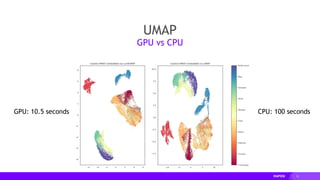
UMAP
GPU vs CPU
GPU: 10.5 seconds CPU: 100 seconds
14
Dask
What is Dask and why does RAPIDS use it for scaling out?
• Distributed compute scheduler built to scale
Python
• Scales workloads from laptops to
supercomputer clusters
• Extremely modular: disjoint scheduling,
compute, data transfer and out-of-core
handling
• Multiple workers per node allow easier one-
worker-per-GPU model
15
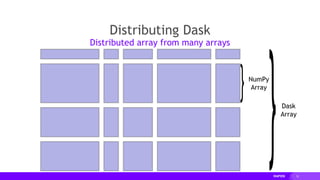
Distributing Dask
Distributed array from many arrays
NumPy
Array
Dask
Array
16
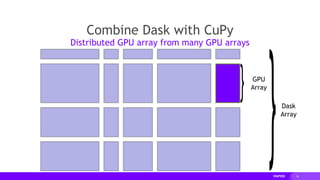
Combine Dask with CuPy
Distributed GPU array from many GPU arrays
GPU
Array
Dask
Array
17
NumPy Array Function (NEP-18)
Interoperability of NumPy-like Libraries
• Function dispatch mechanism
• Allows using NumPy as a high-level API
• NumPy-like arrays need only to implement
__array_function__
18
Dask SVD Example
Interoperability of NumPy-like Libraries
In [1]: import dask, dask.array
...: import numpy
In [2]: x = numpy.random.random((1000000, 1000))
...: dx = dask.array.from_array(x, chunks=(10000, 1000), asarray=False)
In [3]: u, s, v = numpy.linalg.svd(dx)
In [4]: %%time
...: u, s, v = dask.compute(u, s, v)
CPU times: user 39min 4s, sys: 47min 31s, total: 1h 26min 35s
Wall time: 1min 21s
19
Dask+CuPy SVD Example
Interoperability of NumPy-like Libraries
In [1]: import dask, dask.array
...: import numpy
...: import cupy
In [2]: x = cupy.random.random((1000000, 1000))
...: dx = dask.array.from_array(x, chunks=(10000, 1000), asarray=False)
In [3]: u, s, v = numpy.linalg.svd(dx)
In [4]: %%time
...: u, s, v = dask.compute(u, s, v)
CPU times: user 34.5 s, sys: 17.6 s, total: 52.1 s
Wall time: 41 s
20
NumPy Array Function (NEP-18)
Protocol Limitations
• Universal functions – __array_ufunc__ already addresses those
• numpy.array() and numpy.asarray() – will require their own protocol
• Dispatch for methods of any kind – e.g., numpy.random.RandomState()
21
uarray
Alternative to __array_function__
• Generic multiple-dispatch mechanism
• Intended to address shortcomings of NEP-18
• https://uarray.readthedocs.io/
22
uarray
CuPy Example
In [1]: import uarray as ua
...: import unumpy as np
...: import unumpy.cupy_backend as cupy_backend
In [2]: with ua.set_backend(cupy_backend):
...: a = np.ones((2, 2))
...: print(np.sum(a))
...: print(type(a))
...: print(type(np.sum(a)))
4.0
<class 'cupy.core.core.ndarray’>
<class 'cupy.core.core.ndarray'>
23
uarray
Dask+CuPy Example
In [1]: import uarray as ua
...: import unumpy as np
...: import unumpy.cupy_backend as cupy_backend
...: import unumpy.dask_backend as dask_backend
In [2]: with ua.set_backend(cupy_backend), ua.set_backend(dask_backend):
...: a = np.ones((2, 2))
...: print(np.sum(a).compute())
...: print(type(a))
...: print(type(np.sum(a).compute()))
4.0
<class 'dask.array.core.Array’>
<class 'numpy.float64’> # currently
<class 'cupy.core.core.ndarray’> # expected – Dask will need to support
uarray for this to work!
24
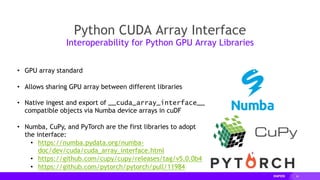
Python CUDA Array Interface
Interoperability for Python GPU Array Libraries
• GPU array standard
• Allows sharing GPU array between different libraries
• Native ingest and export of __cuda_array_interface__
compatible objects via Numba device arrays in cuDF
• Numba, CuPy, and PyTorch are the first libraries to adopt
the interface:
• https://numba.pydata.org/numba-
doc/dev/cuda/cuda_array_interface.html
• https://github.com/cupy/cupy/releases/tag/v5.0.0b4
• https://github.com/pytorch/pytorch/pull/11984
25
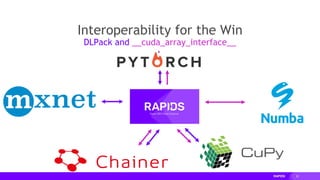
Interoperability for the Win
DLPack and __cuda_array_interface__
26
Challenges: Communication
OpenUCX
• TCP sockets are slow!
• UCX provides uniform access to transports (TCP,
InfiniBand, shared memory, NVLink)
• Python bindings for UCX (ucx-py) in the works
https://github.com/rapidsai/ucx-py
• Will provide best communication performance, to Dask
according to available hardware on nodes/cluster
27
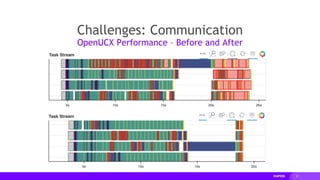
Challenges: Communication
OpenUCX Performance – Before and After
28
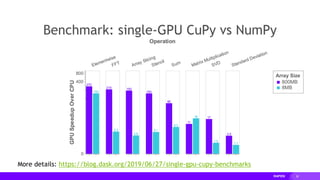
Benchmark: single-GPU CuPy vs NumPy
More details: https://blog.dask.org/2019/06/27/single-gpu-cupy-benchmarks
29
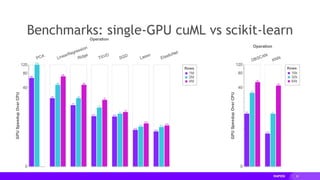
Benchmarks: single-GPU cuML vs scikit-learn
30
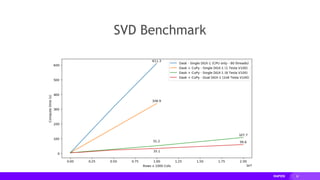
SVD Benchmark
31
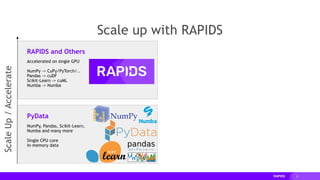
Scale up with RAPIDS
Accelerated on single GPU
NumPy -> CuPy/PyTorch/..
Pandas -> cuDF
Scikit-Learn -> cuML
Numba -> Numba
RAPIDS and Others
NumPy, Pandas, Scikit-Learn,
Numba and many more
Single CPU core
In-memory data
PyData
ScaleUp/Accelerate
32
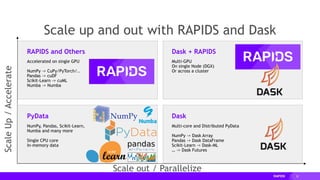
Scale up and out with RAPIDS and Dask
Accelerated on single GPU
NumPy -> CuPy/PyTorch/..
Pandas -> cuDF
Scikit-Learn -> cuML
Numba -> Numba
RAPIDS and Others
Multi-GPU
On single Node (DGX)
Or across a cluster
Dask + RAPIDS
ScaleUp/Accelerate
Scale out / Parallelize
NumPy, Pandas, Scikit-Learn,
Numba and many more
Single CPU core
In-memory data
PyData
Multi-core and Distributed PyData
NumPy -> Dask Array
Pandas -> Dask DataFrame
Scikit-Learn -> Dask-ML
… -> Dask Futures
Dask
33
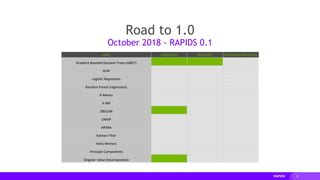
Road to 1.0
October 2018 - RAPIDS 0.1
cuML Single-GPU Multi-GPU Multi-Node-Multi-GPU
Gradient Boosted Decision Trees (GBDT)
GLM
Logistic Regression
Random Forest (regression)
K-Means
K-NN
DBSCAN
UMAP
ARIMA
Kalman Filter
Holts-Winters
Principal Components
Singular Value Decomposition
34
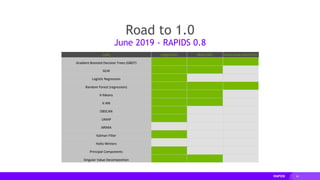
Road to 1.0
June 2019 - RAPIDS 0.8
cuML Single-GPU Multi-GPU Multi-Node-Multi-GPU
Gradient Boosted Decision Trees (GBDT)
GLM
Logistic Regression
Random Forest (regression)
K-Means
K-NN
DBSCAN
UMAP
ARIMA
Kalman Filter
Holts-Winters
Principal Components
Singular Value Decomposition
35
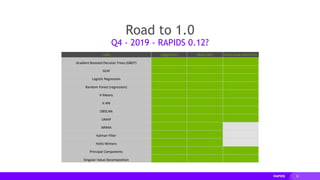
Road to 1.0
Q4 - 2019 - RAPIDS 0.12?
cuML Single-GPU Multi-GPU Multi-Node-Multi-GPU
Gradient Boosted Decision Trees (GBDT)
GLM
Logistic Regression
Random Forest (regression)
K-Means
K-NN
DBSCAN
UMAP
ARIMA
Kalman Filter
Holts-Winters
Principal Components
Singular Value Decomposition
36
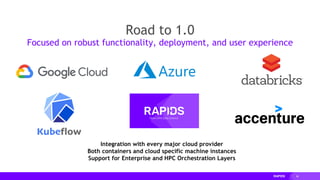
Road to 1.0
Focused on robust functionality, deployment, and user experience
Integration with every major cloud provider
Both containers and cloud specific machine instances
Support for Enterprise and HPC Orchestration Layers
37
• https://ngc.nvidia.com/registry/nvidia-
rapidsai-rapidsai
• https://hub.docker.com/r/rapidsai/rapidsai/
• https://github.com/rapidsai
• https://anaconda.org/rapidsai/
RAPIDS
How do I get the software?
38
Additional Reading Material
• Python, Performance and GPUs (Matthew Rocklin):
https://towardsdatascience.com/python-performance-and-gpus-1be860ffd58d?ncid=so-twi-n2-
96487&linkId=100000006881312
• NEP-18: A Dispatch Mechanism for NumPy’s high level array functions (Stephan Hoyer, et al.):
https://www.numpy.org/neps/nep-0018-array-function-protocol.html
• uarray update: API changes, overhead and comparison to __array_function__ (Hameer Abbasi):
https://labs.quansight.org/blog/2019/07/uarray-update-api-changes-overhead-and-
comparison-to-__array_function__/
THANK YOU
Peter Andreas Entschev
pentschev@nvidia.com
@PeterEntschev

Distributed Multi-GPU Computing with Dask, CuPy and RAPIDS

  • 1.
    Peter Andreas Entschev SeniorSystem Software Engineer – NVIDIA EuroPython, 10 July 2019 Distributed Multi-GPU Computing with Dask, CuPy and RAPIDS
  • 2.
    2 Outline • Interoperability /Flexibility • Acceleration (Scaling Up) • Distribution (Scaling Out)
  • 3.
    3 Clustering from sklearn.cluster importDBSCAN dbscan = DBSCAN(eps = 0.3, min_samples = 5) dbscan.fit(X) y_hat = dbscan.predict(X) Find Clusters from sklearn.datasets import make_moons import pandas X, y = make_moons(n_samples=int(1e2), noise=0.05, random_state=0) X = pandas.DataFrame({'fea%d'%i: X[:, i] for i in range(X.shape[1])}) Code Example
  • 4.
    4 GPU-Accelerated Clustering from cumlimport DBSCAN dbscan = DBSCAN(eps = 0.3, min_samples = 5) dbscan.fit(X) y_hat = dbscan.predict(X) Find Clusters from sklearn.datasets import make_moons import cudf X, y = make_moons(n_samples=int(1e2), noise=0.05, random_state=0) X = cudf.DataFrame({'fea%d'%i: X[:, i] for i in range(X.shape[1])}) Code Example
  • 5.
    5 What is RAPIDS? •Suite of open source, end-to-end data science tools • Built on CUDA • Unifying framework for GPU data science • Pandas-like API for data preparation • Scikit-learn-like API for machine learning New GPU-Accelerated Data Science Pipeline
  • 6.
    6 cuDF cuIO Analytics GPU Memory DataPreparation VisualizationModel Training cuML Machine Learning cuGraph Graph Analytics PyTorch Chainer MxNet Deep Learning cuXfilter <> Kepler.gl Visualization RAPIDS End-to-End GPU-Accelerated Data Science
  • 7.
    7 Learning from ApacheArrow From Apache Arrow Home Page - https://arrow.apache.org/
  • 8.
    8 Data preparation / wrangling cuDF ML model training cuMLVISUALIZE Dataset exploration DATA PREDICTIONS Data Science Workflow with RAPIDS Open Source, GPU-Accelerated ML Built on CUDA
  • 9.
  • 10.
    10 ML Technology Stack Python Cython cuMLAlgorithms cuML Prims CUDA Libraries CUDA Dask cuML Dask cuDF cuDF CuPy Numpy Thrust Cub nvGraph cuBLAS cuRand cuSolver cuSparse CUTLASS
  • 11.
    11 High-Level APIs Data Parallelism ModelParallelism CUDA/C++ Multi-Node / Multi-GPU Communication ML Primitives Python Dask Multi-GPU ML Host 2 GPU1 GPU3 GPU2 GPU4 Host 1 GPU1 GPU3 GPU2 GPU4 ML Algorithms
  • 12.
    12 UMAP Dimensionality reduction techniquenow on GPU https://ai.googleblog.com/2019/03/exploring-neural-networks.html Uniform Manifold Approximation and Projection (UMAP) is a dimension reduction technique that can be used for visualization similarly to t-SNE, but also for general non-linear dimension reduction. • Fast • General purpose dimension reduction • Scales beyond what most t-SNE packages can manage • Often preserves global structure better than t-SNE • Supports a wide variety of distance functions • Supports adding new points to an existing embedding via the standard scikit-learn transform method • Supports supervised and semi-supervised dimension reduction • Has solid theoretical foundations in manifold learning https://arxiv.org/pdf/1802.03426.pdf
  • 13.
    13 UMAP GPU vs CPU GPU:10.5 seconds CPU: 100 seconds
  • 14.
    14 Dask What is Daskand why does RAPIDS use it for scaling out? • Distributed compute scheduler built to scale Python • Scales workloads from laptops to supercomputer clusters • Extremely modular: disjoint scheduling, compute, data transfer and out-of-core handling • Multiple workers per node allow easier one- worker-per-GPU model
  • 15.
    15 Distributing Dask Distributed arrayfrom many arrays NumPy Array Dask Array
  • 16.
    16 Combine Dask withCuPy Distributed GPU array from many GPU arrays GPU Array Dask Array
  • 17.
    17 NumPy Array Function(NEP-18) Interoperability of NumPy-like Libraries • Function dispatch mechanism • Allows using NumPy as a high-level API • NumPy-like arrays need only to implement __array_function__
  • 18.
    18 Dask SVD Example Interoperabilityof NumPy-like Libraries In [1]: import dask, dask.array ...: import numpy In [2]: x = numpy.random.random((1000000, 1000)) ...: dx = dask.array.from_array(x, chunks=(10000, 1000), asarray=False) In [3]: u, s, v = numpy.linalg.svd(dx) In [4]: %%time ...: u, s, v = dask.compute(u, s, v) CPU times: user 39min 4s, sys: 47min 31s, total: 1h 26min 35s Wall time: 1min 21s
  • 19.
    19 Dask+CuPy SVD Example Interoperabilityof NumPy-like Libraries In [1]: import dask, dask.array ...: import numpy ...: import cupy In [2]: x = cupy.random.random((1000000, 1000)) ...: dx = dask.array.from_array(x, chunks=(10000, 1000), asarray=False) In [3]: u, s, v = numpy.linalg.svd(dx) In [4]: %%time ...: u, s, v = dask.compute(u, s, v) CPU times: user 34.5 s, sys: 17.6 s, total: 52.1 s Wall time: 41 s
  • 20.
    20 NumPy Array Function(NEP-18) Protocol Limitations • Universal functions – __array_ufunc__ already addresses those • numpy.array() and numpy.asarray() – will require their own protocol • Dispatch for methods of any kind – e.g., numpy.random.RandomState()
  • 21.
    21 uarray Alternative to __array_function__ •Generic multiple-dispatch mechanism • Intended to address shortcomings of NEP-18 • https://uarray.readthedocs.io/
  • 22.
    22 uarray CuPy Example In [1]:import uarray as ua ...: import unumpy as np ...: import unumpy.cupy_backend as cupy_backend In [2]: with ua.set_backend(cupy_backend): ...: a = np.ones((2, 2)) ...: print(np.sum(a)) ...: print(type(a)) ...: print(type(np.sum(a))) 4.0 <class 'cupy.core.core.ndarray’> <class 'cupy.core.core.ndarray'>
  • 23.
    23 uarray Dask+CuPy Example In [1]:import uarray as ua ...: import unumpy as np ...: import unumpy.cupy_backend as cupy_backend ...: import unumpy.dask_backend as dask_backend In [2]: with ua.set_backend(cupy_backend), ua.set_backend(dask_backend): ...: a = np.ones((2, 2)) ...: print(np.sum(a).compute()) ...: print(type(a)) ...: print(type(np.sum(a).compute())) 4.0 <class 'dask.array.core.Array’> <class 'numpy.float64’> # currently <class 'cupy.core.core.ndarray’> # expected – Dask will need to support uarray for this to work!
  • 24.
    24 Python CUDA ArrayInterface Interoperability for Python GPU Array Libraries • GPU array standard • Allows sharing GPU array between different libraries • Native ingest and export of __cuda_array_interface__ compatible objects via Numba device arrays in cuDF • Numba, CuPy, and PyTorch are the first libraries to adopt the interface: • https://numba.pydata.org/numba- doc/dev/cuda/cuda_array_interface.html • https://github.com/cupy/cupy/releases/tag/v5.0.0b4 • https://github.com/pytorch/pytorch/pull/11984
  • 25.
    25 Interoperability for theWin DLPack and __cuda_array_interface__
  • 26.
    26 Challenges: Communication OpenUCX • TCPsockets are slow! • UCX provides uniform access to transports (TCP, InfiniBand, shared memory, NVLink) • Python bindings for UCX (ucx-py) in the works https://github.com/rapidsai/ucx-py • Will provide best communication performance, to Dask according to available hardware on nodes/cluster
  • 27.
  • 28.
    28 Benchmark: single-GPU CuPyvs NumPy More details: https://blog.dask.org/2019/06/27/single-gpu-cupy-benchmarks
  • 29.
  • 30.
  • 31.
    31 Scale up withRAPIDS Accelerated on single GPU NumPy -> CuPy/PyTorch/.. Pandas -> cuDF Scikit-Learn -> cuML Numba -> Numba RAPIDS and Others NumPy, Pandas, Scikit-Learn, Numba and many more Single CPU core In-memory data PyData ScaleUp/Accelerate
  • 32.
    32 Scale up andout with RAPIDS and Dask Accelerated on single GPU NumPy -> CuPy/PyTorch/.. Pandas -> cuDF Scikit-Learn -> cuML Numba -> Numba RAPIDS and Others Multi-GPU On single Node (DGX) Or across a cluster Dask + RAPIDS ScaleUp/Accelerate Scale out / Parallelize NumPy, Pandas, Scikit-Learn, Numba and many more Single CPU core In-memory data PyData Multi-core and Distributed PyData NumPy -> Dask Array Pandas -> Dask DataFrame Scikit-Learn -> Dask-ML … -> Dask Futures Dask
  • 33.
    33 Road to 1.0 October2018 - RAPIDS 0.1 cuML Single-GPU Multi-GPU Multi-Node-Multi-GPU Gradient Boosted Decision Trees (GBDT) GLM Logistic Regression Random Forest (regression) K-Means K-NN DBSCAN UMAP ARIMA Kalman Filter Holts-Winters Principal Components Singular Value Decomposition
  • 34.
    34 Road to 1.0 June2019 - RAPIDS 0.8 cuML Single-GPU Multi-GPU Multi-Node-Multi-GPU Gradient Boosted Decision Trees (GBDT) GLM Logistic Regression Random Forest (regression) K-Means K-NN DBSCAN UMAP ARIMA Kalman Filter Holts-Winters Principal Components Singular Value Decomposition
  • 35.
    35 Road to 1.0 Q4- 2019 - RAPIDS 0.12? cuML Single-GPU Multi-GPU Multi-Node-Multi-GPU Gradient Boosted Decision Trees (GBDT) GLM Logistic Regression Random Forest (regression) K-Means K-NN DBSCAN UMAP ARIMA Kalman Filter Holts-Winters Principal Components Singular Value Decomposition
  • 36.
    36 Road to 1.0 Focusedon robust functionality, deployment, and user experience Integration with every major cloud provider Both containers and cloud specific machine instances Support for Enterprise and HPC Orchestration Layers
  • 37.
    37 • https://ngc.nvidia.com/registry/nvidia- rapidsai-rapidsai • https://hub.docker.com/r/rapidsai/rapidsai/ •https://github.com/rapidsai • https://anaconda.org/rapidsai/ RAPIDS How do I get the software?
  • 38.
    38 Additional Reading Material •Python, Performance and GPUs (Matthew Rocklin): https://towardsdatascience.com/python-performance-and-gpus-1be860ffd58d?ncid=so-twi-n2- 96487&linkId=100000006881312 • NEP-18: A Dispatch Mechanism for NumPy’s high level array functions (Stephan Hoyer, et al.): https://www.numpy.org/neps/nep-0018-array-function-protocol.html • uarray update: API changes, overhead and comparison to __array_function__ (Hameer Abbasi): https://labs.quansight.org/blog/2019/07/uarray-update-api-changes-overhead-and- comparison-to-__array_function__/
  • 39.
    THANK YOU Peter AndreasEntschev pentschev@nvidia.com @PeterEntschev