Numba: An array-oriented
   Python compiler
  SIAM Conference on Computational
       Science and Engineering
          Travis E. Oliphant

           February 25, 2012
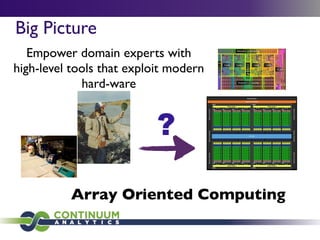
Big Picture
   Empower domain experts with
high-level tools that exploit modern
             hard-ware


                           ?

          Array Oriented Computing
Software Stack Future?
         Plateaus of Code re-use + DSLs
   SQL                                R
            TDPL                                Matlab


                    Python


             OBJC      Julia     C
  FORTRAN                                 C++


                     LLVM
Motivation
• Python is great for rapid development and
  high-level thinking-in-code
• It is slow for interior loops because lack of
  type information leads to a lot of indirection
  and “extra” code.
Motivation
• NumPy users have had a lot of type
  information for a long time --- but only
  currently have one-size fits all pre-
  compiled, vectorized loops.
• Idea is to use this type information to
  allow compilation of arbitrary
  expressions involving NumPy arrays
Current approaches
• Cython
• Weave
• Write fast-code in C/C++/Fortran and “wrap” with
 - SWIG or Cython
 - f2py or fwrap
 - hand-written

 Numba philosophy : don’t wrap or rewrite
 --- just decorate
Simple API	

• jit --- provide type information (fastest to call)
• autojit --- detects input types, infers output, generates
 code if needed, and dispatches (a little more
 expensive to call)

     @jit('void(double[:,:], double, double)')
     #@autojit
     def numba_update(u, dx2, dy2):
         nx, ny = u.shape
         for i in xrange(1,nx-1):
             for j in xrange(1, ny-1):
                 u[i,j] = ((u[i+1,j] + u[i-1,j]) * dy2 +
                           (u[i,j+1] + u[i,j-1]) * dx2) / (2*(dx2+dy2))
~150x speed-up       Real-time image
                 processing in Python (50
                     fps Mandelbrot)
Image Processing                                  ~1500x speed-up


   @jit('void(f8[:,:],f8[:,:],f8[:,:])')
   def filter(image, filt, output):
       M, N = image.shape
       m, n = filt.shape
       for i in range(m//2, M-m//2):
           for j in range(n//2, N-n//2):
               result = 0.0
               for k in range(m):
                   for l in range(n):
                       result += image[i+k-m//2,j+l-n//2]*filt[k, l]
               output[i,j] = result
NumPy + Mamba = Numba
 Python Function                         Machine Code


                       LLVM-PY

                   LLVM Library
       ISPC   OpenCL     OpenMP   CUDA      CLANG


    Intel     AMD        Nvidia     Apple       ARM
Example
@jit(‘f8(f8)’)
def sinc(x):
    if x==0.0:
        return 1.0
    else:
        return sin(x*pi)/(pi*x)


         Numba
Compiler Overview

                  C++
                                      x86

                   C
                           LLVM IR    ARM
                Fortran

                                      PTX
                 Python


     Numba turns Python into a “compiled
      language” (but much more flexible)
Compile NumPy array expressions

  import numbapro
  from numba import autojit

  @autojit
  def formula(a, b, c):
      a[1:,1:] = a[1:,1:] + b[1:,:-1] + c[1:,:-1]

  @autojit
  def express(m1, m2):
      m2[1:-1:2,0,...,::2] = (m1[1:-1:2,...,::2] *
                               m1[-2:1:-2,...,::2])
      return m2
Fast vectorize
 NumPy’s ufuncs take “kernels” and
apply the kernel element-by-element
          over entire arrays
                                      Write kernels in
from numbapro import vectorize
from math import sin
                                         Python!
@vectorize([‘f8(f8)’, ‘f4(f4)’])
def sinc(x):
   if x==0.0:
        return 1.0
    else:
        return sin(x*pi)/(pi*x)
Updated Laplace Example
    https://github.com/teoliphant/speed.git
      Version        Time         Speed Up
       NumPy          3.19            1.0
       Numba          2.32           1.38
     Vect. Numba      2.33           1.37
       Cython         2.38           1.34
        Weave         2.47           1.29
      Numexpr         2.62           1.22
    Fortran Loops     2.30           1.39
     Vect. Fortran    1.50           2.13
Many Advanced Features
• Extension classes (jit a class)
• Struct support (NumPy arrays can be structs)
• SSA --- can refer to local variables as different types
• Typed lists and typed dictionaries coming
• pointer support
• calling ctypes and CFFI functions natively
• pycc (create stand-alone dynamic library and executable)
• pycc --python (create static extension module for Python)
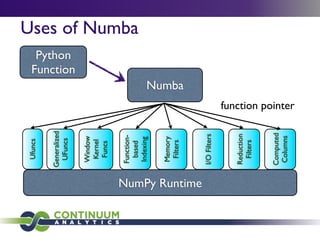
Ufuncs


                Generalized
                 UFuncs
                                                          Python
                                                         Function
                 Window
                 Kernel
                  Funcs

                 Function-
                                                                    Uses of Numba


                   based
                 Indexing


                 Memory
                  Filters
                                                 Numba


NumPy Runtime
                I/O Filters


                Reduction
                 Filters


                Computed
                Columns
                              function pointer
Status
• Main team sponsored by Continuum Analytics and
    composed of:
    - Travis Oliphant (NumPy, SciPy)
    - Jon Riehl (Mython, PyFront, Basil, ...)
    - Mark Florrison (minivect, Cython)
    - Siu Kwan Lam (pymothoa, llvmpy)
•   Rapid progress this year
•   Version 0.6 released first of February
•   Version 0.7 next week                             numba.pydata.org
•   Version 0.8 first of April
•   Stable API (jit, autojit) easy to use
•   Full Python support by 1.0 at end of summer
•   Should be able to write equivalent of NumPy and
    SciPy with Numba
Introducing NumbaPro

                              • Create parallel-for loops
                              • Parallel execution of
                                  ufuncs
  fast development and fast   •   Run ufuncs on the GPU
  execution!                  •   Write CUDA directly in
                                  Python!
Python and NumPy compiled to
                             •    Free for Academics
     Parallel Architectures
     (GPUs and multi-core
           machines)
Create parallel-for loops

 import numbapro # import first to make prange available
 from numba import autojit, prange

 @autojit
 def parallel_sum2d(a):
     sum = 0.0
     for i in prange(a.shape[0]):
          for j in range(a.shape[1]):
              sum += a[i,j]
Ufuncs in parallel (multi-core or GPU)
   from numbapro import vectorize
   from math import sin

   @vectorize([‘f8(f8)’, ‘f4(f4)’], target=‘gpu’)
   def sinc(x):
      if x==0.0:
           return 1.0
       else:
           return sin(x*pi)/(pi*x)

   @vectorize([‘f8(f8)’, ‘f4(f4)’], target=‘parallel’)
   def sinc2(x):
      if x==0.0:
           return 1.0
       else:
           return sin(x*pi)/(pi*x)
Introducing CUDA-Python
from numbapro import cuda
from numba import autojit

@autojit(target=‘gpu’)
def array_scale(src, dst, scale):
    tid = cuda.threadIdx.x
    blkid = cuda.blockIdx.x
    blkdim = cuda.blockDim.x              CUDA Development
    i = tid + blkid * blkdim

    if i >= n:                            using Python syntax!
        return

    dst[i] = src[i] * scale

src = np.arange(N, dtype=np.float)
dst = np.empty_like(src)

array_scale[grid, block](src, dst, 5.0)
Example: Matrix multiply
@cuda.jit(argtypes=[f4[:,:], f4[:,:], f4[:,:]])
def cu_square_matrix_mul(A, B, C):
    sA = cuda.shared.array(shape=(tpb, tpb),
dtype=f4)
    sB = cuda.shared.array(shape=(tpb, tpb),
dtype=f4)                                           bpg = 50
                                                    tpb = 32
    tx   =    cuda.threadIdx.x                      n = bpg * tpb
    ty   =    cuda.threadIdx.y
    bx   =    cuda.blockIdx.x                       A = np.array(np.random.random((n, n)),
    by   =    cuda.blockIdx.y                       dtype=np.float32)
    bw   =    cuda.blockDim.x
    bh   =    cuda.blockDim.y
                                                    B = np.array(np.random.random((n, n)),
                                                    dtype=np.float32)
    x = tx + bx * bw                                C = np.empty_like(A)
    y = ty + by * bh
                                                    stream = cuda.stream()
    acc = 0.                                        with stream.auto_synchronize():
    for i in range(bpg):                                dA = cuda.to_device(A, stream)
        if x < n and y < n:                             dB = cuda.to_device(B, stream)
             sA[ty, tx] = A[y, tx + i * tpb]
             sB[ty, tx] = B[ty + i * tpb, x]
                                                        dC = cuda.to_device(C, stream)
                                                        cu_square_matrix_mul[(bpg, bpg),
             cuda.syncthreads()                     (tpb, tpb), stream](dA, dB, dC)
                                                        dC.to_host(stream)
             if x < n and y < n:
                 for j in range(tpb):
                     acc += sA[ty, j] * sB[j, tx]

             cuda.syncthreads()

    if x < n and y < n:
        C[y, x] = acc
Early Performance Results
     core     GeForce GTX
     i7       560 Ti
                            Already about 6x
                              faster on the
                                  GPU.
Example: Black-Scholes
@cuda.jit(argtypes=(double,), restype=double, device=True, inline=True)
def cnd_cuda(d):
                                                                      @cuda.jit(argtypes=(double[:], double[:],
    A1 = 0.31938153
                                                                      double[:],
    A2 = -0.356563782
                                                                                           double[:], double[:],
    A3 = 1.781477937
                                                                      double, double))
    A4 = -1.821255978
                                                                      def black_scholes_cuda(callResult, putResult,
    A5 = 1.330274429
                                                                      S, X, T, R, V):
    RSQRT2PI = 0.39894228040143267793994605993438
                                                                          # S = stockPrice
    K = 1.0 / (1.0 + 0.2316419 * math.fabs(d))
                                                                          # X = optionStrike
    ret_val = (RSQRT2PI * math.exp(-0.5 * d * d) *
                                                                          # T = optionYears
                (K * (A1 + K * (A2 + K * (A3 + K * (A4 + K * A5))))))
                                                                          # R = Riskfree
    if d > 0:
                                                                          # V = Volatility
         ret_val = 1.0 - ret_val
                                                                          i = cuda.threadIdx.x + cuda.blockIdx.x *
    return ret_val
                                                                      cuda.blockDim.x
 blockdim = 1024, 1                                                       if i >= S.shape[0]:
 griddim = int(math.ceil(float(OPT_N)/blockdim[0])), 1                         return
 stream = cuda.stream()                                                   sqrtT = math.sqrt(T[i])
 d_callResult = cuda.to_device(callResultNumbapro,                        d1 = (math.log(S[i] / X[i]) +
 stream)                                                                          (R + 0.5 * V * V) * T[i]) / (V *
 d_putResult = cuda.to_device(putResultNumbapro,                      sqrtT)
 stream)                                                                  d2 = d1 - V * sqrtT
 d_stockPrice = cuda.to_device(stockPrice, stream)                        cndd1 = cnd_cuda(d1)
 d_optionStrike = cuda.to_device(optionStrike, stream)                    cndd2 = cnd_cuda(d2)
 d_optionYears = cuda.to_device(optionYears, stream)
 for i in range(iterations):                                              expRT = math.exp((-1. * R) * T[i])
     black_scholes_cuda[griddim, blockdim, stream](                       callResult[i] = (S[i] * cndd1 - X[i] *
           d_callResult, d_putResult, d_stockPrice,                   expRT * cndd2)
 d_optionStrike,                                                          putResult[i] = (X[i] * expRT * (1.0 -
           d_optionYears, RISKFREE, VOLATILITY)                       cndd2) -
     d_callResult.to_host(stream)                                                                  S[i] * (1.0 -
     d_putResult.to_host(stream)                                                                 cndd1))
     stream.synchronize()
Black-Scholes: Results
       core         GeForce GTX
       i7           560 Ti
                                     Already
                                    about 6x
                                  faster on the
                                      GPU
NumFOCUS
       www.numfocus.org
      501(c)3 Public Charity
NumFOCUS Mission


• Sponsor development of high-level languages and
  libraries for science
• Foster teaching of array-oriented and higher-order
  computational approaches and applied
  computational science
• Promote the use of open code in science and
  encourage reproducible and accessible research
NumFOCUS Activities

 • Sponsor sprints and conferences
 • Provide scholarships and grants
 • Provide bounties and prizes for code development
 • Pay for freely-available documentation and basic
   course development
 • Equipment grants
 • Sponsor BootCamps
 • Raise funds from industries using open source
   high-level languages

Numba: Array-oriented Python Compiler for NumPy

  • 1.
    Numba: An array-oriented Python compiler SIAM Conference on Computational Science and Engineering Travis E. Oliphant February 25, 2012
  • 2.
    Big Picture Empower domain experts with high-level tools that exploit modern hard-ware ? Array Oriented Computing
  • 3.
    Software Stack Future? Plateaus of Code re-use + DSLs SQL R TDPL Matlab Python OBJC Julia C FORTRAN C++ LLVM
  • 4.
    Motivation • Python isgreat for rapid development and high-level thinking-in-code • It is slow for interior loops because lack of type information leads to a lot of indirection and “extra” code.
  • 5.
    Motivation • NumPy usershave had a lot of type information for a long time --- but only currently have one-size fits all pre- compiled, vectorized loops. • Idea is to use this type information to allow compilation of arbitrary expressions involving NumPy arrays
  • 6.
    Current approaches • Cython •Weave • Write fast-code in C/C++/Fortran and “wrap” with - SWIG or Cython - f2py or fwrap - hand-written Numba philosophy : don’t wrap or rewrite --- just decorate
  • 7.
    Simple API • jit--- provide type information (fastest to call) • autojit --- detects input types, infers output, generates code if needed, and dispatches (a little more expensive to call) @jit('void(double[:,:], double, double)') #@autojit def numba_update(u, dx2, dy2): nx, ny = u.shape for i in xrange(1,nx-1): for j in xrange(1, ny-1): u[i,j] = ((u[i+1,j] + u[i-1,j]) * dy2 + (u[i,j+1] + u[i,j-1]) * dx2) / (2*(dx2+dy2))
  • 8.
    ~150x speed-up Real-time image processing in Python (50 fps Mandelbrot)
  • 9.
    Image Processing ~1500x speed-up @jit('void(f8[:,:],f8[:,:],f8[:,:])') def filter(image, filt, output): M, N = image.shape m, n = filt.shape for i in range(m//2, M-m//2): for j in range(n//2, N-n//2): result = 0.0 for k in range(m): for l in range(n): result += image[i+k-m//2,j+l-n//2]*filt[k, l] output[i,j] = result
  • 10.
    NumPy + Mamba= Numba Python Function Machine Code LLVM-PY LLVM Library ISPC OpenCL OpenMP CUDA CLANG Intel AMD Nvidia Apple ARM
  • 11.
    Example @jit(‘f8(f8)’) def sinc(x): if x==0.0: return 1.0 else: return sin(x*pi)/(pi*x) Numba
  • 12.
    Compiler Overview C++ x86 C LLVM IR ARM Fortran PTX Python Numba turns Python into a “compiled language” (but much more flexible)
  • 13.
    Compile NumPy arrayexpressions import numbapro from numba import autojit @autojit def formula(a, b, c): a[1:,1:] = a[1:,1:] + b[1:,:-1] + c[1:,:-1] @autojit def express(m1, m2): m2[1:-1:2,0,...,::2] = (m1[1:-1:2,...,::2] * m1[-2:1:-2,...,::2]) return m2
  • 14.
    Fast vectorize NumPy’sufuncs take “kernels” and apply the kernel element-by-element over entire arrays Write kernels in from numbapro import vectorize from math import sin Python! @vectorize([‘f8(f8)’, ‘f4(f4)’]) def sinc(x): if x==0.0: return 1.0 else: return sin(x*pi)/(pi*x)
  • 15.
    Updated Laplace Example https://github.com/teoliphant/speed.git Version Time Speed Up NumPy 3.19 1.0 Numba 2.32 1.38 Vect. Numba 2.33 1.37 Cython 2.38 1.34 Weave 2.47 1.29 Numexpr 2.62 1.22 Fortran Loops 2.30 1.39 Vect. Fortran 1.50 2.13
  • 16.
    Many Advanced Features •Extension classes (jit a class) • Struct support (NumPy arrays can be structs) • SSA --- can refer to local variables as different types • Typed lists and typed dictionaries coming • pointer support • calling ctypes and CFFI functions natively • pycc (create stand-alone dynamic library and executable) • pycc --python (create static extension module for Python)
  • 17.
    Ufuncs Generalized UFuncs Python Function Window Kernel Funcs Function- Uses of Numba based Indexing Memory Filters Numba NumPy Runtime I/O Filters Reduction Filters Computed Columns function pointer
  • 18.
    Status • Main teamsponsored by Continuum Analytics and composed of: - Travis Oliphant (NumPy, SciPy) - Jon Riehl (Mython, PyFront, Basil, ...) - Mark Florrison (minivect, Cython) - Siu Kwan Lam (pymothoa, llvmpy) • Rapid progress this year • Version 0.6 released first of February • Version 0.7 next week numba.pydata.org • Version 0.8 first of April • Stable API (jit, autojit) easy to use • Full Python support by 1.0 at end of summer • Should be able to write equivalent of NumPy and SciPy with Numba
  • 19.
    Introducing NumbaPro • Create parallel-for loops • Parallel execution of ufuncs fast development and fast • Run ufuncs on the GPU execution! • Write CUDA directly in Python! Python and NumPy compiled to • Free for Academics Parallel Architectures (GPUs and multi-core machines)
  • 20.
    Create parallel-for loops import numbapro # import first to make prange available from numba import autojit, prange @autojit def parallel_sum2d(a): sum = 0.0 for i in prange(a.shape[0]): for j in range(a.shape[1]): sum += a[i,j]
  • 21.
    Ufuncs in parallel(multi-core or GPU) from numbapro import vectorize from math import sin @vectorize([‘f8(f8)’, ‘f4(f4)’], target=‘gpu’) def sinc(x): if x==0.0: return 1.0 else: return sin(x*pi)/(pi*x) @vectorize([‘f8(f8)’, ‘f4(f4)’], target=‘parallel’) def sinc2(x): if x==0.0: return 1.0 else: return sin(x*pi)/(pi*x)
  • 22.
    Introducing CUDA-Python from numbaproimport cuda from numba import autojit @autojit(target=‘gpu’) def array_scale(src, dst, scale): tid = cuda.threadIdx.x blkid = cuda.blockIdx.x blkdim = cuda.blockDim.x CUDA Development i = tid + blkid * blkdim if i >= n: using Python syntax! return dst[i] = src[i] * scale src = np.arange(N, dtype=np.float) dst = np.empty_like(src) array_scale[grid, block](src, dst, 5.0)
  • 23.
    Example: Matrix multiply @cuda.jit(argtypes=[f4[:,:],f4[:,:], f4[:,:]]) def cu_square_matrix_mul(A, B, C): sA = cuda.shared.array(shape=(tpb, tpb), dtype=f4) sB = cuda.shared.array(shape=(tpb, tpb), dtype=f4) bpg = 50 tpb = 32 tx = cuda.threadIdx.x n = bpg * tpb ty = cuda.threadIdx.y bx = cuda.blockIdx.x A = np.array(np.random.random((n, n)), by = cuda.blockIdx.y dtype=np.float32) bw = cuda.blockDim.x bh = cuda.blockDim.y B = np.array(np.random.random((n, n)), dtype=np.float32) x = tx + bx * bw C = np.empty_like(A) y = ty + by * bh stream = cuda.stream() acc = 0. with stream.auto_synchronize(): for i in range(bpg): dA = cuda.to_device(A, stream) if x < n and y < n: dB = cuda.to_device(B, stream) sA[ty, tx] = A[y, tx + i * tpb] sB[ty, tx] = B[ty + i * tpb, x] dC = cuda.to_device(C, stream) cu_square_matrix_mul[(bpg, bpg), cuda.syncthreads() (tpb, tpb), stream](dA, dB, dC) dC.to_host(stream) if x < n and y < n: for j in range(tpb): acc += sA[ty, j] * sB[j, tx] cuda.syncthreads() if x < n and y < n: C[y, x] = acc
  • 24.
    Early Performance Results core GeForce GTX i7 560 Ti Already about 6x faster on the GPU.
  • 25.
    Example: Black-Scholes @cuda.jit(argtypes=(double,), restype=double,device=True, inline=True) def cnd_cuda(d): @cuda.jit(argtypes=(double[:], double[:], A1 = 0.31938153 double[:], A2 = -0.356563782 double[:], double[:], A3 = 1.781477937 double, double)) A4 = -1.821255978 def black_scholes_cuda(callResult, putResult, A5 = 1.330274429 S, X, T, R, V): RSQRT2PI = 0.39894228040143267793994605993438 # S = stockPrice K = 1.0 / (1.0 + 0.2316419 * math.fabs(d)) # X = optionStrike ret_val = (RSQRT2PI * math.exp(-0.5 * d * d) * # T = optionYears (K * (A1 + K * (A2 + K * (A3 + K * (A4 + K * A5)))))) # R = Riskfree if d > 0: # V = Volatility ret_val = 1.0 - ret_val i = cuda.threadIdx.x + cuda.blockIdx.x * return ret_val cuda.blockDim.x blockdim = 1024, 1 if i >= S.shape[0]: griddim = int(math.ceil(float(OPT_N)/blockdim[0])), 1 return stream = cuda.stream() sqrtT = math.sqrt(T[i]) d_callResult = cuda.to_device(callResultNumbapro, d1 = (math.log(S[i] / X[i]) + stream) (R + 0.5 * V * V) * T[i]) / (V * d_putResult = cuda.to_device(putResultNumbapro, sqrtT) stream) d2 = d1 - V * sqrtT d_stockPrice = cuda.to_device(stockPrice, stream) cndd1 = cnd_cuda(d1) d_optionStrike = cuda.to_device(optionStrike, stream) cndd2 = cnd_cuda(d2) d_optionYears = cuda.to_device(optionYears, stream) for i in range(iterations): expRT = math.exp((-1. * R) * T[i]) black_scholes_cuda[griddim, blockdim, stream]( callResult[i] = (S[i] * cndd1 - X[i] * d_callResult, d_putResult, d_stockPrice, expRT * cndd2) d_optionStrike, putResult[i] = (X[i] * expRT * (1.0 - d_optionYears, RISKFREE, VOLATILITY) cndd2) - d_callResult.to_host(stream) S[i] * (1.0 - d_putResult.to_host(stream) cndd1)) stream.synchronize()
  • 26.
    Black-Scholes: Results core GeForce GTX i7 560 Ti Already about 6x faster on the GPU
  • 27.
    NumFOCUS www.numfocus.org 501(c)3 Public Charity
  • 28.
    NumFOCUS Mission • Sponsordevelopment of high-level languages and libraries for science • Foster teaching of array-oriented and higher-order computational approaches and applied computational science • Promote the use of open code in science and encourage reproducible and accessible research
  • 29.
    NumFOCUS Activities •Sponsor sprints and conferences • Provide scholarships and grants • Provide bounties and prizes for code development • Pay for freely-available documentation and basic course development • Equipment grants • Sponsor BootCamps • Raise funds from industries using open source high-level languages