Continuum Analytics: What
we are doing and why
Travis Oliphant, PhD
Continuum Analytics, Inc
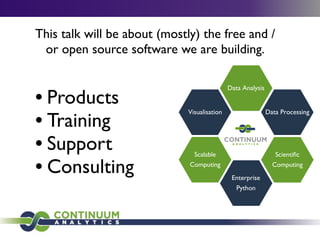
This talk will be about (mostly) the free and /
or open source software we are building.
Enterprise
Python
Scientific
Computing
Data Processing
Data Analysis
Visualisation
Scalable
Computing
• Products
• Training
• Support
• Consulting
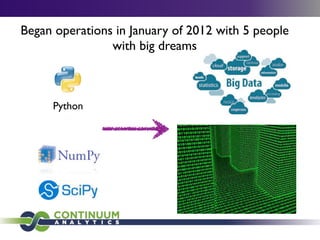
Began operations in January of 2012 with 5 people
with big dreams
Python
We are big backers of NumFOCUS and
organizers of PyData
Spyder
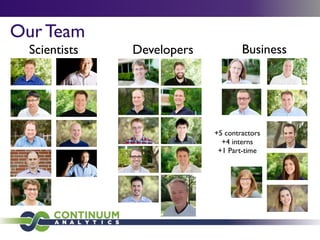
Our Team
Scientists Developers
+5 contractors
+4 interns
+1 Part-time
Business
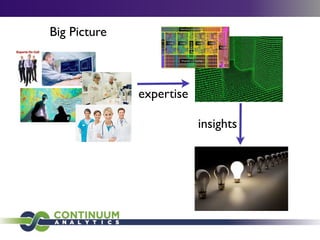
Big Picture
expertise
insights
NumPy and SciPy are quite successful
Thanks to large and diverse community around it
(Matplotlib, IPython, SymPy, Pandas, etc.)
I estimate 1.5 million to 2 million users
Only incremental improvements possible with
these projects at this point.
Thus, we needed to start new projects...
Related Open Source Projects
Blaze: High-performance Python library for modern
vector computing, distributed and streaming data
Numba:Vectorizing Python compiler for multicore
and GPU, using LLVM
Bokeh: Interactive, grammar-based visualization
system for large datasets
Common Thread: High-level, expressive language for
domain experts; innovative compilers & runtimes
for efficient, powerful data transformation
Conda and Anaconda
• Cross-platform package management
• Multiple environments allows you to have multiple
versions of packages installed in system
• Easy app-deployment
• Taming open-source
Free for all users
Enterprise
support available!
Why Conda?
• Linux users stopped complaining about Python
deployment
• I made major mistakes in management of NumPy/SciPy:
• too much in SciPy (SciPy as distribution) --- scikits model is much
better (tighter libraries developed by smaller teams)
• gave in to community desire for binary ABI compatibility in
NumPy motivated by difficulty of reproducing Python install
• Need for a cross-platform way to install major Python
extensions (many with dependencies on large C or C++
libraries
• Python can’t be ubiquitous if people struggle to just get
it and then manage it.
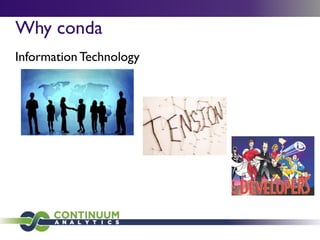
Why conda
Information Technology
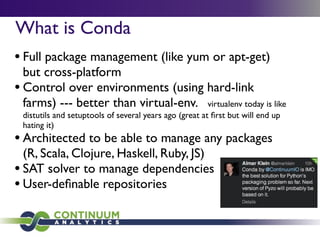
What is Conda
• Full package management (like yum or apt-get)
but cross-platform
• Control over environments (using hard-link
farms) --- better than virtual-env. virtualenv today is like
distutils and setuptools of several years ago (great at first but will end up
hating it)
• Architected to be able to manage any packages
(R, Scala, Clojure, Haskell, Ruby, JS)
• SAT solver to manage dependencies
• User-definable repositories
New Features and Binstar
• Build command from recipe --- many recipes here: https://
github.com/ContinuumIO/conda-recipes
• Upload recipes to Binstar (last mile in binary package
hosting and deployment for any language).
• “binstar in beta” is the beta code
• Personal conda repositories --- https://conda.binstar.org/
travis
• Free Continuum Anaconda repo will be on binstar.org
• Private packages and behind-the-firewall satellites available
• *Free build queue on Linux (Mac and Windows coming
soon) for hosted conda recipes
Demo
create Python 3 environment with IPython and scipy
create new recipe from PyPI (yunomi)
Packaging and Distribution Solved
• conda and binstar solve most of the problems that
we have seen people encounter in managing
Python installations (especially in large-scale
institutions).
• they are supported solutions that can remove the
technology pain of managing Python
• some problems, though, are people
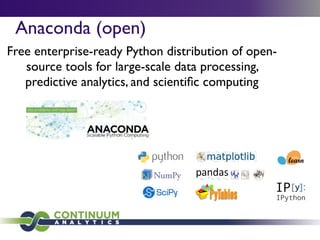
Anaconda (open)
Free enterprise-ready Python distribution of open-
source tools for large-scale data processing,
predictive analytics, and scientific computing
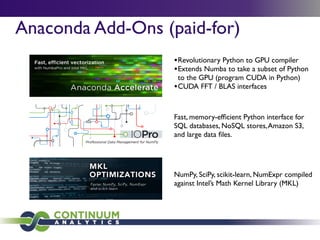
Anaconda Add-Ons (paid-for)
•Revolutionary Python to GPU compiler
•Extends Numba to take a subset of Python
to the GPU (program CUDA in Python)
•CUDA FFT / BLAS interfaces
Fast, memory-efficient Python interface for
SQL databases, NoSQL stores,Amazon S3,
and large data files.
NumPy, SciPy, scikit-learn, NumExpr compiled
against Intel’s Math Kernel Library (MKL)
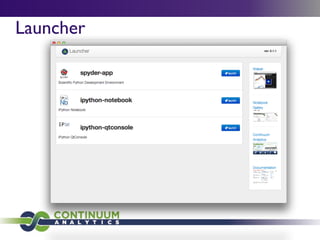
Launcher
Why Numba?
•Python is too slow for loops
•Most people are not learning C/C++/Fortran today
•Cython is an improvment (but still verbose and
needs C-compiler)
•NVIDIA using LLVM for the GPU
•Many people working with large typed-containers
(NumPy arrays)
•We want to take high-level, tarray-oriented
expressions and compile it to fast code
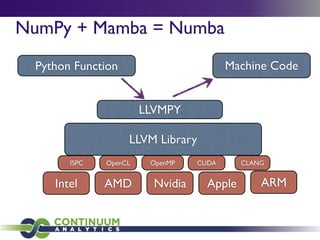
NumPy + Mamba = Numba
LLVM Library
Intel Nvidia AppleAMD
OpenCLISPC CUDA CLANGOpenMP
LLVMPY
Python Function Machine Code
ARM
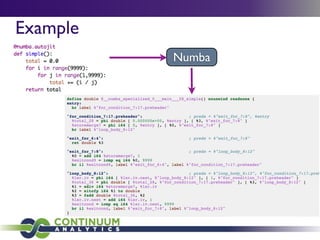
Example
Numba
Numba
@jit('void(f8[:,:],f8[:,:],f8[:,:])')
def filter(image, filt, output):
M, N = image.shape
m, n = filt.shape
for i in range(m//2, M-m//2):
for j in range(n//2, N-n//2):
result = 0.0
for k in range(m):
for l in range(n):
result += image[i+k-m//2,j+l-n//2]*filt[k, l]
output[i,j] = result
~1500x speed-up
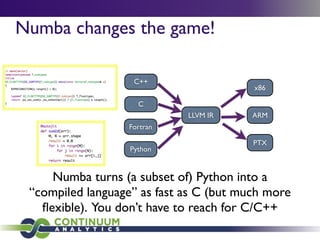
Numba changes the game!
LLVM IR
x86
C++
ARM
PTX
C
Fortran
Python
Numba turns (a subset of) Python into a
“compiled language” as fast as C (but much more
flexible). You don’t have to reach for C/C++
Laplace Example
@jit('void(double[:,:], double, double)')
def numba_update(u, dx2, dy2):
nx, ny = u.shape
for i in xrange(1,nx-1):
for j in xrange(1, ny-1):
u[i,j] = ((u[i+1,j] + u[i-1,j]) * dy2 +
(u[i,j+1] + u[i,j-1]) * dx2) / (2*(dx2+dy2))
Adapted from http://www.scipy.org/PerformancePython
originally by Prabhu Ramachandran
@jit('void(double[:,:], double, double)')
def numbavec_update(u, dx2, dy2):
u[1:-1,1:-1] = ((u[2:,1:-1]+u[:-2,1:-1])*dy2 +
(u[1:-1,2:] + u[1:-1,:-2])*dx2) / (2*(dx2+dy2))
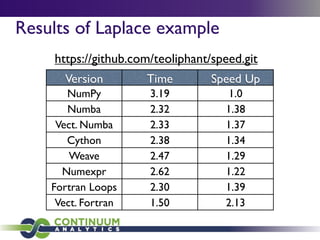
Results of Laplace example
Version Time Speed Up
NumPy 3.19 1.0
Numba 2.32 1.38
Vect. Numba 2.33 1.37
Cython 2.38 1.34
Weave 2.47 1.29
Numexpr 2.62 1.22
Fortran Loops 2.30 1.39
Vect. Fortran 1.50 2.13
https://github.com/teoliphant/speed.git
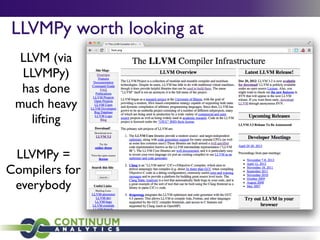
LLVMPy worth looking at
LLVM (via
LLVMPy)
has done
much heavy
lifting
LLVMPy =
Compilers for
everybody
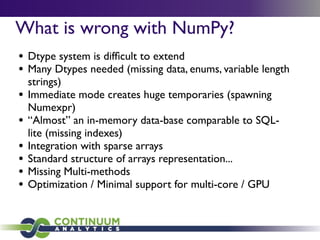
What is wrong with NumPy?
• Dtype system is difficult to extend
• Many Dtypes needed (missing data, enums, variable length
strings)
• Immediate mode creates huge temporaries (spawning
Numexpr)
• “Almost” an in-memory data-base comparable to SQL-
lite (missing indexes)
• Integration with sparse arrays
• Standard structure of arrays representation...
• Missing Multi-methods
• Optimization / Minimal support for multi-core / GPU
Now What?
After watching NumPy and SciPy get used all over
Wall Street and by many scientists / engineers in
industry --- what would we do differently?
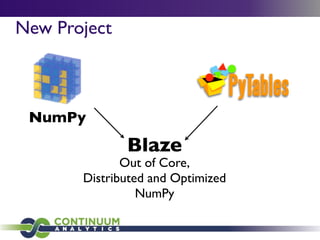
New Project
Blaze
NumPy
Out of Core,
Distributed and Optimized
NumPy
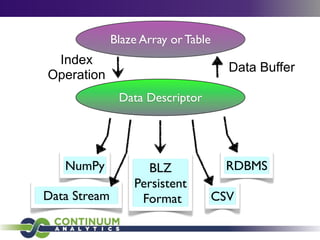
Blaze Array or Table
Data Descriptor
Data Buffer
Index
Operation
NumPy BLZ
Persistent
Format
RDBMS
CSVData Stream
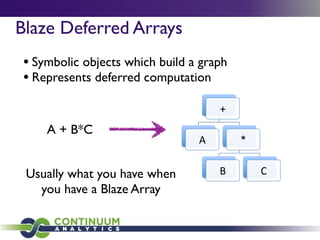
Blaze Deferred Arrays
+"
A" *"
B" C"
A + B*C
• Symbolic objects which build a graph
• Represents deferred computation
Usually what you have when
you have a Blaze Array
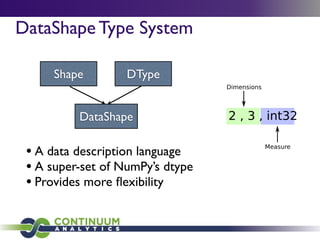
DataShape Type System



• A data description language
• A super-set of NumPy’s dtype
• Provides more flexibility
Shape DType
DataShape
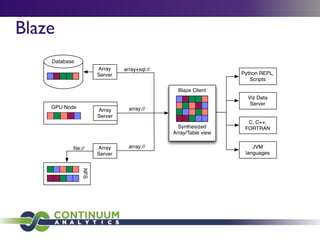
Blaze
Database
GPU Node
Array
Server
NFS
Array
Server
Array
Server
Blaze Client
Synthesized
Array/Table view
array+sql://
array://
file:// array://
Python REPL,
Scripts
Viz Data
Server
C, C++,
FORTRAN
JVM
languages
Progress
• Basic calculations work out-of-core (via Numba and
LLVM)
• Hard dependency on dynd and dynd-python (a dynamic
C++-only multi-dimensional library like NumPy but with
many improvements)
• Persistent arrays from BLZ
• Basic array-server functionality for layering over CSV
files
• 0.2 release in 1-2 weeks. 0.3 within a month after that
(first usable release)
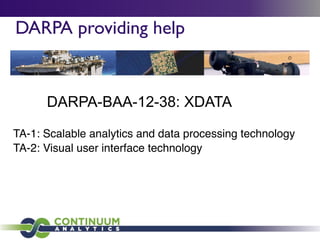
DARPA providing help
DARPA-BAA-12-38: XDATA
TA-1: Scalable analytics and data processing technology	
  
TA-2: Visual user interface technology
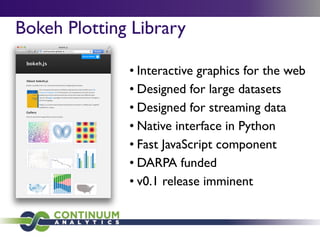
Bokeh Plotting Library
• Interactive graphics for the web
• Designed for large datasets
• Designed for streaming data
• Native interface in Python
• Fast JavaScript component
• DARPA funded
• v0.1 release imminent
Reasons for Bokeh
1. Plotting must happen near the data too
2. Quick iteration is essential => interactive visualization
3. Interactive visualization on remote-data => use the browser
4. Almost all web plotting libraries are either:
1. Designed for javascript programmers
2. Designed to output static graphs
5. We designed Bokeh to be dynamic graphing in the web for
Python programmers
6. Will include “Abstract” or “synthetic” rendering (working on
Hadoop and Spark compatibility)
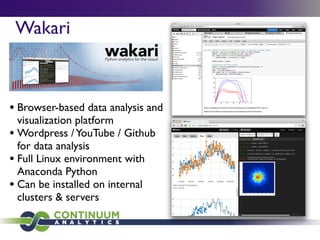
Wakari
• Browser-based data analysis and
visualization platform
• Wordpress /YouTube / Github
for data analysis
• Full Linux environment with
Anaconda Python
• Can be installed on internal
clusters & servers
Why Wakari?
• Data is too big to fit on your desktop
• You need compute power but don’t have easy access to a
large cluster (cloud is sitting there with lots of power)
• Configuration of software on a new system stinks
(especially a cluster).
• Collaborative Data Analytics --- you want to build a
complex technical workflow and then share it with others
easily (without requiring they do painful configuration to
see your results)
• IPython Notebook is awesome --- let’s share it (but we
also need the dependencies and data).
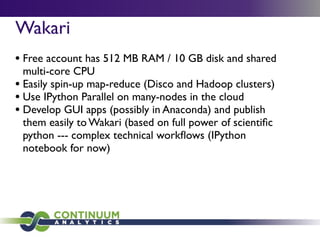
Wakari
• Free account has 512 MB RAM / 10 GB disk and shared
multi-core CPU
• Easily spin-up map-reduce (Disco and Hadoop clusters)
• Use IPython Parallel on many-nodes in the cloud
• Develop GUI apps (possibly in Anaconda) and publish
them easily to Wakari (based on full power of scientific
python --- complex technical workflows (IPython
notebook for now)
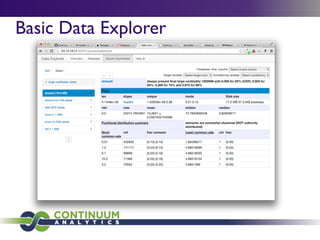
Basic Data Explorer
Continuum Data Explorer (CDX)
• Open Source
• Goal is interactivity
• Combination of IPython REPL, Bokeh, and tables
• Tight integration between GUI elements and REPL
• Current features
- Namespace viewer (mapped to IPython namespace)
- DataTable widget with group-by, computed columns, advanced-
filters
- Interactive Plots connected to tables
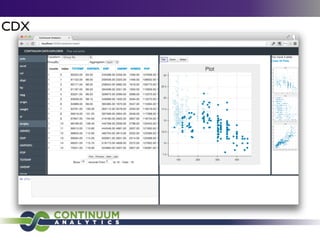
CDX
Conclusion
Projects circle around giving tools to experts
(occasional programmers or domain
experts) to enable them to move their
expertise to the data to get insights --- keep
data where it is and move high-level but
performant code)
Join us or ask how we can help you!

PyData Boston 2013

  • 1.
    Continuum Analytics: What weare doing and why Travis Oliphant, PhD Continuum Analytics, Inc
  • 2.
    This talk willbe about (mostly) the free and / or open source software we are building. Enterprise Python Scientific Computing Data Processing Data Analysis Visualisation Scalable Computing • Products • Training • Support • Consulting
  • 3.
    Began operations inJanuary of 2012 with 5 people with big dreams Python
  • 4.
    We are bigbackers of NumFOCUS and organizers of PyData Spyder
  • 5.
    Our Team Scientists Developers +5contractors +4 interns +1 Part-time Business
  • 6.
  • 7.
    NumPy and SciPyare quite successful Thanks to large and diverse community around it (Matplotlib, IPython, SymPy, Pandas, etc.) I estimate 1.5 million to 2 million users Only incremental improvements possible with these projects at this point. Thus, we needed to start new projects...
  • 8.
    Related Open SourceProjects Blaze: High-performance Python library for modern vector computing, distributed and streaming data Numba:Vectorizing Python compiler for multicore and GPU, using LLVM Bokeh: Interactive, grammar-based visualization system for large datasets Common Thread: High-level, expressive language for domain experts; innovative compilers & runtimes for efficient, powerful data transformation
  • 9.
    Conda and Anaconda •Cross-platform package management • Multiple environments allows you to have multiple versions of packages installed in system • Easy app-deployment • Taming open-source Free for all users Enterprise support available!
  • 10.
    Why Conda? • Linuxusers stopped complaining about Python deployment • I made major mistakes in management of NumPy/SciPy: • too much in SciPy (SciPy as distribution) --- scikits model is much better (tighter libraries developed by smaller teams) • gave in to community desire for binary ABI compatibility in NumPy motivated by difficulty of reproducing Python install • Need for a cross-platform way to install major Python extensions (many with dependencies on large C or C++ libraries • Python can’t be ubiquitous if people struggle to just get it and then manage it.
  • 11.
  • 12.
    What is Conda •Full package management (like yum or apt-get) but cross-platform • Control over environments (using hard-link farms) --- better than virtual-env. virtualenv today is like distutils and setuptools of several years ago (great at first but will end up hating it) • Architected to be able to manage any packages (R, Scala, Clojure, Haskell, Ruby, JS) • SAT solver to manage dependencies • User-definable repositories
  • 13.
    New Features andBinstar • Build command from recipe --- many recipes here: https:// github.com/ContinuumIO/conda-recipes • Upload recipes to Binstar (last mile in binary package hosting and deployment for any language). • “binstar in beta” is the beta code • Personal conda repositories --- https://conda.binstar.org/ travis • Free Continuum Anaconda repo will be on binstar.org • Private packages and behind-the-firewall satellites available • *Free build queue on Linux (Mac and Windows coming soon) for hosted conda recipes
  • 14.
    Demo create Python 3environment with IPython and scipy create new recipe from PyPI (yunomi)
  • 15.
    Packaging and DistributionSolved • conda and binstar solve most of the problems that we have seen people encounter in managing Python installations (especially in large-scale institutions). • they are supported solutions that can remove the technology pain of managing Python • some problems, though, are people
  • 16.
    Anaconda (open) Free enterprise-readyPython distribution of open- source tools for large-scale data processing, predictive analytics, and scientific computing
  • 17.
    Anaconda Add-Ons (paid-for) •RevolutionaryPython to GPU compiler •Extends Numba to take a subset of Python to the GPU (program CUDA in Python) •CUDA FFT / BLAS interfaces Fast, memory-efficient Python interface for SQL databases, NoSQL stores,Amazon S3, and large data files. NumPy, SciPy, scikit-learn, NumExpr compiled against Intel’s Math Kernel Library (MKL)
  • 18.
  • 19.
    Why Numba? •Python istoo slow for loops •Most people are not learning C/C++/Fortran today •Cython is an improvment (but still verbose and needs C-compiler) •NVIDIA using LLVM for the GPU •Many people working with large typed-containers (NumPy arrays) •We want to take high-level, tarray-oriented expressions and compile it to fast code
  • 20.
    NumPy + Mamba= Numba LLVM Library Intel Nvidia AppleAMD OpenCLISPC CUDA CLANGOpenMP LLVMPY Python Function Machine Code ARM
  • 21.
  • 22.
    Numba @jit('void(f8[:,:],f8[:,:],f8[:,:])') def filter(image, filt,output): M, N = image.shape m, n = filt.shape for i in range(m//2, M-m//2): for j in range(n//2, N-n//2): result = 0.0 for k in range(m): for l in range(n): result += image[i+k-m//2,j+l-n//2]*filt[k, l] output[i,j] = result ~1500x speed-up
  • 23.
    Numba changes thegame! LLVM IR x86 C++ ARM PTX C Fortran Python Numba turns (a subset of) Python into a “compiled language” as fast as C (but much more flexible). You don’t have to reach for C/C++
  • 24.
    Laplace Example @jit('void(double[:,:], double,double)') def numba_update(u, dx2, dy2): nx, ny = u.shape for i in xrange(1,nx-1): for j in xrange(1, ny-1): u[i,j] = ((u[i+1,j] + u[i-1,j]) * dy2 + (u[i,j+1] + u[i,j-1]) * dx2) / (2*(dx2+dy2)) Adapted from http://www.scipy.org/PerformancePython originally by Prabhu Ramachandran @jit('void(double[:,:], double, double)') def numbavec_update(u, dx2, dy2): u[1:-1,1:-1] = ((u[2:,1:-1]+u[:-2,1:-1])*dy2 + (u[1:-1,2:] + u[1:-1,:-2])*dx2) / (2*(dx2+dy2))
  • 25.
    Results of Laplaceexample Version Time Speed Up NumPy 3.19 1.0 Numba 2.32 1.38 Vect. Numba 2.33 1.37 Cython 2.38 1.34 Weave 2.47 1.29 Numexpr 2.62 1.22 Fortran Loops 2.30 1.39 Vect. Fortran 1.50 2.13 https://github.com/teoliphant/speed.git
  • 26.
    LLVMPy worth lookingat LLVM (via LLVMPy) has done much heavy lifting LLVMPy = Compilers for everybody
  • 27.
    What is wrongwith NumPy? • Dtype system is difficult to extend • Many Dtypes needed (missing data, enums, variable length strings) • Immediate mode creates huge temporaries (spawning Numexpr) • “Almost” an in-memory data-base comparable to SQL- lite (missing indexes) • Integration with sparse arrays • Standard structure of arrays representation... • Missing Multi-methods • Optimization / Minimal support for multi-core / GPU
  • 28.
    Now What? After watchingNumPy and SciPy get used all over Wall Street and by many scientists / engineers in industry --- what would we do differently?
  • 29.
    New Project Blaze NumPy Out ofCore, Distributed and Optimized NumPy
  • 30.
    Blaze Array orTable Data Descriptor Data Buffer Index Operation NumPy BLZ Persistent Format RDBMS CSVData Stream
  • 31.
    Blaze Deferred Arrays +" A"*" B" C" A + B*C • Symbolic objects which build a graph • Represents deferred computation Usually what you have when you have a Blaze Array
  • 32.
    DataShape Type System    •A data description language • A super-set of NumPy’s dtype • Provides more flexibility Shape DType DataShape
  • 33.
    Blaze Database GPU Node Array Server NFS Array Server Array Server Blaze Client Synthesized Array/Tableview array+sql:// array:// file:// array:// Python REPL, Scripts Viz Data Server C, C++, FORTRAN JVM languages
  • 34.
    Progress • Basic calculationswork out-of-core (via Numba and LLVM) • Hard dependency on dynd and dynd-python (a dynamic C++-only multi-dimensional library like NumPy but with many improvements) • Persistent arrays from BLZ • Basic array-server functionality for layering over CSV files • 0.2 release in 1-2 weeks. 0.3 within a month after that (first usable release)
  • 35.
    DARPA providing help DARPA-BAA-12-38:XDATA TA-1: Scalable analytics and data processing technology   TA-2: Visual user interface technology
  • 36.
    Bokeh Plotting Library •Interactive graphics for the web • Designed for large datasets • Designed for streaming data • Native interface in Python • Fast JavaScript component • DARPA funded • v0.1 release imminent
  • 37.
    Reasons for Bokeh 1.Plotting must happen near the data too 2. Quick iteration is essential => interactive visualization 3. Interactive visualization on remote-data => use the browser 4. Almost all web plotting libraries are either: 1. Designed for javascript programmers 2. Designed to output static graphs 5. We designed Bokeh to be dynamic graphing in the web for Python programmers 6. Will include “Abstract” or “synthetic” rendering (working on Hadoop and Spark compatibility)
  • 38.
    Wakari • Browser-based dataanalysis and visualization platform • Wordpress /YouTube / Github for data analysis • Full Linux environment with Anaconda Python • Can be installed on internal clusters & servers
  • 39.
    Why Wakari? • Datais too big to fit on your desktop • You need compute power but don’t have easy access to a large cluster (cloud is sitting there with lots of power) • Configuration of software on a new system stinks (especially a cluster). • Collaborative Data Analytics --- you want to build a complex technical workflow and then share it with others easily (without requiring they do painful configuration to see your results) • IPython Notebook is awesome --- let’s share it (but we also need the dependencies and data).
  • 40.
    Wakari • Free accounthas 512 MB RAM / 10 GB disk and shared multi-core CPU • Easily spin-up map-reduce (Disco and Hadoop clusters) • Use IPython Parallel on many-nodes in the cloud • Develop GUI apps (possibly in Anaconda) and publish them easily to Wakari (based on full power of scientific python --- complex technical workflows (IPython notebook for now)
  • 41.
  • 42.
    Continuum Data Explorer(CDX) • Open Source • Goal is interactivity • Combination of IPython REPL, Bokeh, and tables • Tight integration between GUI elements and REPL • Current features - Namespace viewer (mapped to IPython namespace) - DataTable widget with group-by, computed columns, advanced- filters - Interactive Plots connected to tables
  • 43.
  • 44.
    Conclusion Projects circle aroundgiving tools to experts (occasional programmers or domain experts) to enable them to move their expertise to the data to get insights --- keep data where it is and move high-level but performant code) Join us or ask how we can help you!