



Culture Part 2


重要なテキストは青で
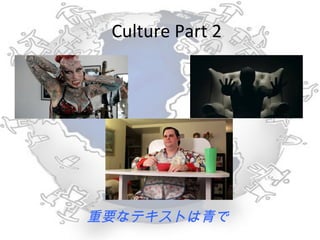
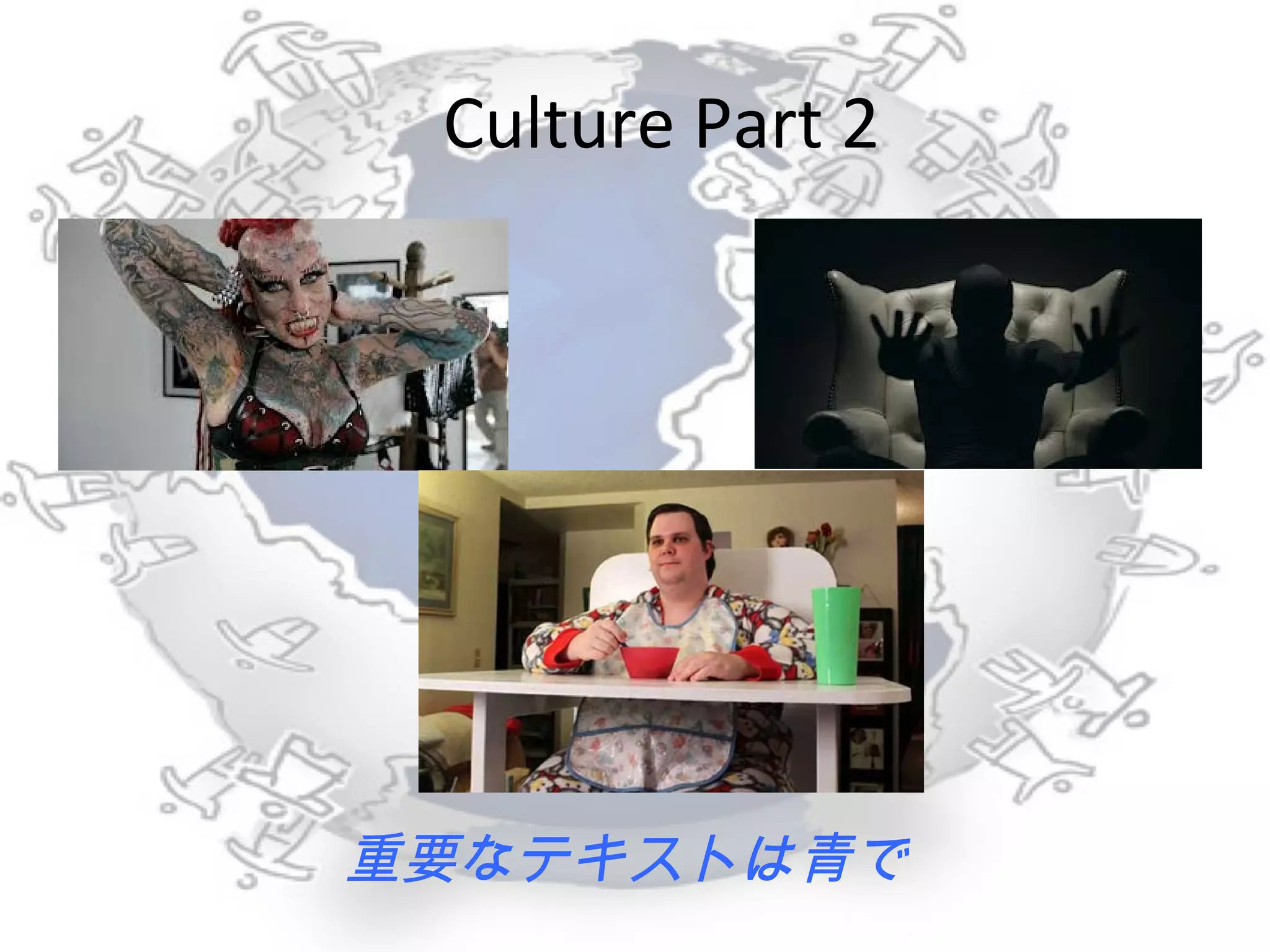
Paraphilic Infantalism
Many Cultural Worlds: Subcultures
        and Countercultures
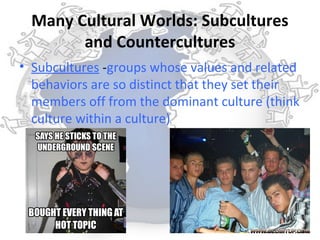
• Subcultures -groups whose values and related
  behaviors are so distinct that they set their
  members off from the dominant culture (think
  culture within a culture)
Happy goth kid dance…
Many Cultural Worlds: Subcultures
      and Countercultures
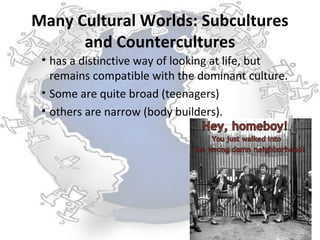
 • has a distinctive way of looking at life, but
   remains compatible with the dominant culture.
 • Some are quite broad (teenagers)
 • others are narrow (body builders).
Vampires?
Many Cultural Worlds: Subcultures
       and Countercultures
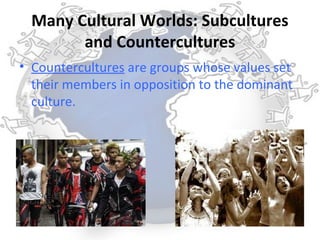
• Countercultures are groups whose values set
  their members in opposition to the dominant
  culture.
Many Cultural Worlds: Subcultures
        and Countercultures
      • While usually associated with negative
        behavior, some countercultures are not.
• Countercultures are often perceived as a threat by
  the dominant culture because they challenge the
  culture’s values
• dominant culture will move against a particular
  counterculture in order to affirm its own core values.

• For example, the Mormons in the 1800s challenged
  the dominant culture’s core value of monogamy.
Values in U.S. Society
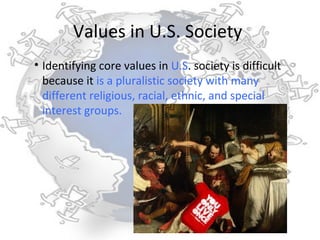
• Identifying core values in U.S. society is difficult
  because it is a pluralistic society with many
  different religious, racial, ethnic, and special
  interest groups.
Values in U.S. Society
Sociologist Robin Williams identified ten core values:

•achievement and success (especially, doing better
than others)
•individualism (success due to individual effort)
•activity and work
•efficiency and practicality
•science and technology (using science to control
nature)
•freedom
•democracy;
•equality (especially of opportunity)
•racism
•group superiority. (Contradiction???)
Values in U.S. Society
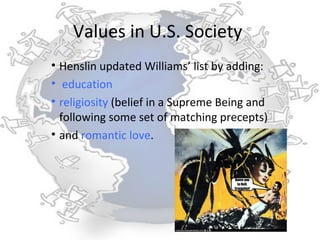
• Henslin updated Williams’ list by adding:
• education
• religiosity (belief in a Supreme Being and
  following some set of matching precepts)
• and romantic love.
Values in U.S. Society
• Self-fulfillment is expressed through the human
  potential movement and on the popularity of self-help
  books and talk shows.
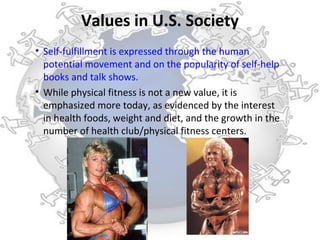
• While physical fitness is not a new value, it is
  emphasized more today, as evidenced by the interest
  in health foods, weight and diet, and the growth in the
  number of health club/physical fitness centers.
Values in U.S. Society
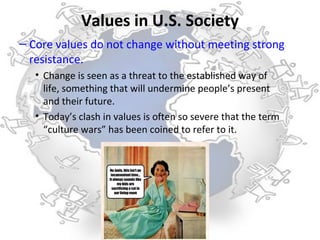
– Core values do not change without meeting strong
  resistance.
   • Change is seen as a threat to the established way of
     life, something that will undermine people’s present
     and their future.
   • Today’s clash in values is often so severe that the term
     “culture wars” has been coined to refer to it.
Values in U.S. Society


– Ideal culture refers to the ideal values and norms
  of a people.
– What people actually do usually falls short of this
  ideal, and sociologists refer to the norms and
  values that people actually follow as real culture.
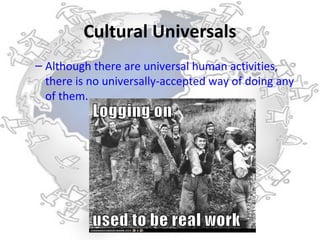
Cultural Universals
– Although there are universal human activities,
  there is no universally-accepted way of doing any
  of them.
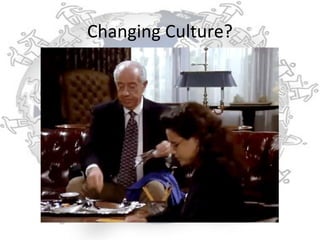
Changing Culture?
Cultural Universals
• Anthropologist George Murdock concluded
  that all human groups have certain cultural
  universals: customs about courtship, cooking,
  marriage, funerals, games, laws, music, myths,
  incest taboos, and toilet training are present
  in all cultures
Culture Universals…(language and violent
            image disclaimer)
Cultural Universals
• Even so, the specific customs differ from one group to
  another.
• For example: there is no universal form of the family,
• no universal way of disposing of the dead
• no universal method of toilet training from one culture
  to another.
• Even incest is defined differently from group to group.
Cultural Universals
• Sociobiologists argue that, as a result of natural
  selection, the basic cause of human behavior is
  biology.
Technology in the Global Village
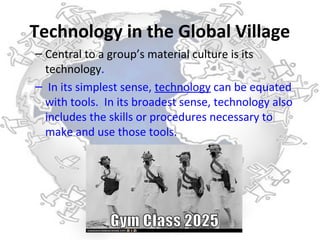
– Central to a group’s material culture is its
  technology.
– In its simplest sense, technology can be equated
  with tools. In its broadest sense, technology also
  includes the skills or procedures necessary to
  make and use those tools.
Technology in the Global Village
  • The emerging technologies of an era that make a major
    impact on human life are referred to as new
    technologies.
  • The printing press and the computer are both examples
    of new technologies.
  • The sociological significance of technology is that it sets
    the framework for the nonmaterial culture
  • This influences the way people think and how they
    relate to one another.
Technology Loop
Technology in the Global Village
• Not all parts of culture change at the same pace;
• Cultural lag- William Ogburn’s term for situations
  where the material culture changes first and the
  nonmaterial culture lags behind.
Technology in the Global Village
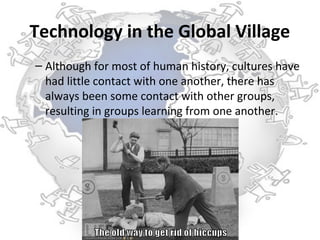
– Although for most of human history, cultures have
  had little contact with one another, there has
  always been some contact with other groups,
  resulting in groups learning from one another.
Technology in the Global Village
  • This transmission of cultural characteristics is
    cultural diffusion;
  • it is more likely to produce changes in material
    culture than the nonmaterial culture.
  • Cultural diffusion occurs more rapidly today,
    given the technology.
Technology in the Global Village

Culture part 2 ss

  • 1.
  • 2.
  • 3.
    Many Cultural Worlds:Subcultures and Countercultures • Subcultures -groups whose values and related behaviors are so distinct that they set their members off from the dominant culture (think culture within a culture)
  • 4.
  • 5.
    Many Cultural Worlds:Subcultures and Countercultures • has a distinctive way of looking at life, but remains compatible with the dominant culture. • Some are quite broad (teenagers) • others are narrow (body builders).
  • 6.
  • 7.
    Many Cultural Worlds:Subcultures and Countercultures • Countercultures are groups whose values set their members in opposition to the dominant culture.
  • 8.
    Many Cultural Worlds:Subcultures and Countercultures • While usually associated with negative behavior, some countercultures are not. • Countercultures are often perceived as a threat by the dominant culture because they challenge the culture’s values • dominant culture will move against a particular counterculture in order to affirm its own core values. • For example, the Mormons in the 1800s challenged the dominant culture’s core value of monogamy.
  • 9.
    Values in U.S.Society • Identifying core values in U.S. society is difficult because it is a pluralistic society with many different religious, racial, ethnic, and special interest groups.
  • 10.
    Values in U.S.Society Sociologist Robin Williams identified ten core values: •achievement and success (especially, doing better than others) •individualism (success due to individual effort) •activity and work •efficiency and practicality •science and technology (using science to control nature) •freedom •democracy; •equality (especially of opportunity) •racism •group superiority. (Contradiction???)
  • 11.
    Values in U.S.Society • Henslin updated Williams’ list by adding: • education • religiosity (belief in a Supreme Being and following some set of matching precepts) • and romantic love.
  • 12.
    Values in U.S.Society • Self-fulfillment is expressed through the human potential movement and on the popularity of self-help books and talk shows. • While physical fitness is not a new value, it is emphasized more today, as evidenced by the interest in health foods, weight and diet, and the growth in the number of health club/physical fitness centers.
  • 13.
    Values in U.S.Society – Core values do not change without meeting strong resistance. • Change is seen as a threat to the established way of life, something that will undermine people’s present and their future. • Today’s clash in values is often so severe that the term “culture wars” has been coined to refer to it.
  • 14.
    Values in U.S.Society – Ideal culture refers to the ideal values and norms of a people. – What people actually do usually falls short of this ideal, and sociologists refer to the norms and values that people actually follow as real culture.
  • 15.
    Cultural Universals – Althoughthere are universal human activities, there is no universally-accepted way of doing any of them.
  • 16.
  • 17.
    Cultural Universals • AnthropologistGeorge Murdock concluded that all human groups have certain cultural universals: customs about courtship, cooking, marriage, funerals, games, laws, music, myths, incest taboos, and toilet training are present in all cultures
  • 18.
    Culture Universals…(language andviolent image disclaimer)
  • 19.
    Cultural Universals • Evenso, the specific customs differ from one group to another. • For example: there is no universal form of the family, • no universal way of disposing of the dead • no universal method of toilet training from one culture to another. • Even incest is defined differently from group to group.
  • 20.
    Cultural Universals • Sociobiologistsargue that, as a result of natural selection, the basic cause of human behavior is biology.
  • 21.
    Technology in theGlobal Village – Central to a group’s material culture is its technology. – In its simplest sense, technology can be equated with tools. In its broadest sense, technology also includes the skills or procedures necessary to make and use those tools.
  • 22.
    Technology in theGlobal Village • The emerging technologies of an era that make a major impact on human life are referred to as new technologies. • The printing press and the computer are both examples of new technologies. • The sociological significance of technology is that it sets the framework for the nonmaterial culture • This influences the way people think and how they relate to one another.
  • 23.
  • 24.
    Technology in theGlobal Village • Not all parts of culture change at the same pace; • Cultural lag- William Ogburn’s term for situations where the material culture changes first and the nonmaterial culture lags behind.
  • 25.
    Technology in theGlobal Village – Although for most of human history, cultures have had little contact with one another, there has always been some contact with other groups, resulting in groups learning from one another.
  • 26.
    Technology in theGlobal Village • This transmission of cultural characteristics is cultural diffusion; • it is more likely to produce changes in material culture than the nonmaterial culture. • Cultural diffusion occurs more rapidly today, given the technology.
  • 27.
    Technology in theGlobal Village