What Is Abnormality?What Is Abnormality?
Abnormal Psych: Intro ($h!t’s about to get weird)
• Learning Goals:
– Students should be able to answer the following:
1: How should we draw the line between normality and disorder?
2: What perspectives can help us understand psychological disorders?
2
Rating Student Evidence
4.0
Expert
I can successfully answer level 3 AND critically debate
if labeling disorders has a potential dangerous effect
on self-fulfilling prophecy.
★ 3.0 ★
Proficient
I can identify the layout of the DSM, and different axes
of the DSM AND discuss the pros and cons of labeling
disorders.
2.0
Developing
I can identify the layout of the DSM, different axes of
the DSM, but need more time to review how this
impacts the classification of disorders.
1.0
Beginning
I need more prompting and/or support to identify the
concepts stated in level 2.
Fact of Falsehood
• 1. In some cultures, depression and schizophrenia are nonexistent.
• 2. The more contact people have with individuals with disorders, the less
accepting their attitudes are.
• 3.About 30 percent of psychologically disordered people are dangerous;
that is, they are more likely than other people to commit a crime.
• 4.Research indicates that in the United States there are more prison
inmates with severe mental disorders than there are psychiatric inpatients
in all the country’s hospitals.
• 5.Identical twins who have been raised separately sometimes develop
similar phobias.
• 6. Dissociative identity disorder is a type of schizophrenia.
• 7. In North America, today’s young adults are three times more likely than
their grandparents to report having suffered depression.
• 8. White Americans commit suicide nearly twice as often as Black
Americans do.
• 9. There is strong evidence for a genetic predisposition to schizophrenia.
• 10 Twenty-six percent of adult Americans suffer from a diagnosable
mental disorder in a given year. 3
The
study
of
abnormal
thoughts,
feelings
and
behaviors
P s y c h o p a t h o l o g y
Early Theories
• Abnormal behavior was evil
spirits trying to get out.
• Trephining was often used.
• Another theory was to make
the body extremely
uncomfortable
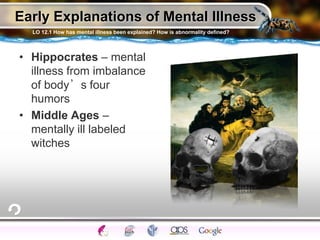
Early Explanations of Mental Illness
• Hippocrates – mental
illness from imbalance
of body’s four
humors
• Middle Ages –
mentally ill labeled
witches
LO 12.1 How has mental illness been explained? How is abnormality defined?
Some people still think mental illness is
demonology
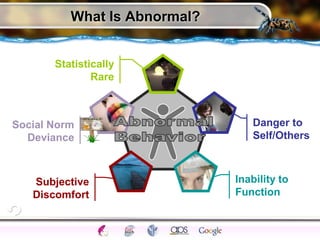
What Is Abnormal?
Inability to
Function
Statistically
Rare
Social Norm
Deviance
Danger to
Self/Others
Subjective
Discomfort
Perspectives and Disorders
Psychological School/Perspective Cause of the Disorder
Psychoanalytic/Psychodynamic Internal, unconscious drives
Humanistic Failure to strive to one’s potential or
being out of touch with one’s feelings.
Behavioral Reinforcement history, the
environment.
Cognitive Irrational, dysfunctional thoughts or
ways of thinking.
Sociocultural Dysfunctional Society
Biomedical/Neuroscience Organic problems, biochemical
imbalances, genetic predispositions.
What is a psychological disorder?
• Behavior patterns or mental processes that cause
serious personal suffering or interfere with a
person‟s ability to cope with everyday life.
• Three main components:
– Deviant (being different)
– Distressful (causes worry, pain or stress)
– Dysfunctional (impairing life functioning)
• About 1 in 7 adults in the United States have
experienced a psychological disorder. 26% in the
last year.
*Note: Not all deviant behavior is considered a
disorder, as sometimes it is just a cultural,
situational or generational norm. (e.g. killing in war,
dressing differently, praying loudly etc…)
10
Case Study: The Three D‟s: ADHD
• ADHD
• A psychological disorder marked by the appearance by
age 7 of one or more of three key symptoms: extreme
inattention, hyperactivity, and impulsivity
• 4% of children, though 10% are being medicated for it
• Diagnosed 2-3 times more in boys than girls
• Correlated to watching more TV before age 7
• Brain appears to be about three years behind on thinning
of cortex and pruning
• Medications help, but benefits may disappear after three
years
• FDA just approved an EEG brain wave method for
diagnosing ADHD
11
ADHD Setting the Record Straight
Biopsychosocial Approach to Explaining Disorders
13
Section 1: Test Your Knowledge
Is this a psychological disorder? Why or Why Not?
During most of her life, Mary has been inclined to keep to
herself. She has few friends but no close friends. Her
feelings are easily hurt, and she seldom participates in any
social activities. As a child, she did nearly average work in
school but never took part in school activities. She
eventually dropped out of school and got a job. She rarely
talks with the other employees and prefers to eat her lunch
alone. She prefers to keep to herself and quietly talks to
herself, even when customers are around. At times she
refuses to eat certain foods for fear of being poisoned. Most
of the time Mary refuses to attend to her personal hygiene
and prefers to be left alone quietly muttering to herself. She
leaves the house only for food and work.
14
1: How should we draw the line between normality and disorder?
2: What perspectives can help us understand psychological disorders?
15
Rating Student Evidence
4.0
Expert
I can teach someone else about, the definitions of
normality and disorders as well as psychological
perspectives on disorders. In addition to 3.0 , I can
demonstrate applications and inferences beyond what
was taught
3.0
Proficient
I can explain, the definitions of normality and disorders
as well as psychological perspectives on disorders with
no major errors or omissions.
2.0
Developing
I can identify terms associated, the definitions of
normality and disorders as well as psychological
perspectives on disorders, but need to review this
concept more.
1.0
Beginning
I need more prompting and/or support to identify the
concepts stated in 2.0
Abnormal Psych: Classification and
Labeling• Learning Goals:
– Students should be able to answer the following:
3: How and why do clinicians classify psychological disorders?
4: Why do some psychologists criticize the use of diagnostic labels?
16
Rating Student Evidence
4.0
Expert
I can successfully answer level 3 AND critically debate
if labeling disorders has a potential dangerous effect
on self-fulfilling prophecy.
★ 3.0 ★
Proficient
I can identify the layout of the DSM, and different axes
of the DSM AND discuss the pros and cons of labeling
disorders.
2.0
Developing
I can identify the layout of the DSM, different axes of
the DSM, but need more time to review how this
impacts the classification of disorders.
1.0
Beginning
I need more prompting and/or support to identify the
concepts stated in 2.0
How do psychologists explain disorders?
• The Medical Model (Pinel):
– Mental illness is a sickness
(psychopathology)
• Noticed people would become crazy
due to syphilis
• Dorothea Dix advocates for humane
treatment in mental hospitals in
America
– Under the medical model, we seek
to:
• Diagnosis
• Understand the Symptoms
• Provide Treatment
• And use psychiatric hospitals only
when necessary
Trephination -boring
holes in the skull to
remove evil forces
17
How do Psychologists classify disorders?
• Diagnostic and Statistical Manual of Mental Disorders (DSM-IV-TR)-1994,
Revised 2000
• Published by the American Psychiatric Association (APA)
• Closely follows World Heath Organization's International Classification of
Diseases (ICD)
• The DSM is revised every few years (DSM-V was published in 2013)
– Contains over 400 disorder categories
– DSM III included homosexuality as a disorder (1973), the DSM-IV does
not.
• Critics say the DSM is too broad and anyone can be classified with a
disorder. People can be diagnosed falsely with diagnostic labels.
• Goals of the DSM:
1. Identify and classify disorders
2. Determine prevalence (not treatment)
18
Two Major Disorder
Classifications in the DSM
Neurotic Disorders
• Distressing but one can
still function in society
and act rationally.
Psychotic Disorders
• Person loses contact
with reality,
experiences distorted
perceptions.
John Wayne Gacy
Group-think Share…. Neurotic or Psychotic and why?
1.
2.
3.
4.
5. 6.
Layout of DSM Disorder Profiles
I. Disorder Name
II. Diagnostic features (this is complete description
of the disorder)
III. Associated features ( these are the features that
accompany the disorder)
IV. Development and Course (this is how the
disorder can develop and how it could possibly
affect the life course)
V. Differential Diagnosis (other possible names or
similar disorders)
DSM-IV-TR Psychological Profile Overview
Are Psychosocial or Environmental Problems (school or housing
issues) also present?Axis IV
What is the Global Assessment of the person’s functioning?
(0-100 Point Scale)Axis V
Is a General Medical Condition (diabetes, hypertension or
arthritis etc) also present?Axis III
Is a Personality Disorder or Mental Retardation present?
Axis II
Is a Clinical Syndrome (cognitive, anxiety, mood disorders [16
syndromes]) present?Axis I
22
DSM & Reliability
• If two different
psychologists interview the
same patient, will they come
up with the same diagnosis
according to the DSM?
• 83% of opinions agreed in
one study based on criteria
in the DSM (It supposedly
has high validity and
reliability)
23
Is There Danger in Labeling People?
What would you diagnose
these people with?
24
Is There Danger in Labeling People?
• The Rosenhan Study (1973)
– Faked a disorder to get into a mental institution
– After arriving into the institution, the
„pseudopatient‟ stopped being symptomatic
– On average it took 19 days before
„pseudopatients‟ were released, even though they
were not experiencing symptoms
– Conclusion: Labeling causes Doctors to see
people as „insane‟ even when they are „sane‟
25
Is There Danger in Labeling People?
26
Is There Danger in Labeling People?
• Pros of Labeling
– Communicate disorders
– Discern Treatment
– Comprehend underlying
causes
• Cons of Labeling
– Leads to self-fulfilling
prophecy for both patient
and others
– Creates a stigma that follows
a person
Operational Defiant Disorder
27
Section 2: Test Your Knowledge
• A man is feeling depressed about his inability to support his family after
losing his job. The fact that the patient is currently unemployed is coded
on which axis in the Diagnostic and Statistical Manual of Mental Disorders
(DSM-IV-TR)?
(A) Axis I
(B) Axis II
(C) Axis III
(D) Axis IV
(E) Axis V
• The medical model views mental illness as:
(A) A character defect
(B) A disease or illness
(C) An interaction of biological, cognitive, behavioral, social and cultural factors
(D) Normal behavior in an abnormal context
(E) Maladaptive contingencies of reinforcement
28
3: How and why do clinicians classify psychological disorders?
4: Why do some psychologists criticize the use of diagnostic labels?
29
Rating Student Evidence
4.0
Expert
I can successfully answer level 3 AND critically debate if
labeling disorders has a potential dangerous effect on
self-fulfilling prophecy.
★ 3.0 ★
Proficient
I can identify the layout of the DSM, and different axes
of the DSM AND discuss the pros and cons of labeling
disorders.
2.0
Developing
I can identify the layout of the DSM, different axes of the
DSM, but need more time to review how this impacts
the classification of disorders.
1.0
Beginning
I need more prompting and/or support to identify the
concepts stated in 2.0
Section 2: Product Assessment
• In groups of 3 to 4 people, you are to create a
poster for a new disorder using the “Layout of
DSM Disorder Profiles” (I-Name, II-Diagnostic, III-
Associated Features, IV-Development, V-
Differential Diagnosis)
• A rationale as to why a disorder profile is needed
for this disorder (included the three D’s from the
prior lesson)
• An illustration to go along with this disorder
• Example: Senioritis
30
Abnormal Psych: Anxiety Disorders
• Learning Goals:
– Students should be able to answer the following:
5: What are anxiety disorders, and how do they differ from ordinary worries and
fears?
6: What produces the thoughts and feelings that mark anxiety disorders?
31
Rating Student Evidence
4.0
Expert
I can satisfy all the requirements of level 3.0
and debate the legitimacy of the proposed
causes of anxiety disorders.
★ 3.0 ★
Proficient
I can identify, describe and explain causes of
specific anxiety disorders.
2.0
Developing
I can identify and describe some of the
specific anxiety disorders.
1.0
Beginning
I need more prompting and/or support to
identify the concepts stated in 2.0
Anxiety Disorders
• Anxiety: General State of dread or
uneasiness that occurs in response
to a vague or imagined danger.
• Also, nervousness, inability to relax,
concern about losing control
• Physical Symptoms caused by over
active sympathetic nervous system:
– Trembling, Sweating, Rapid Heart
Rate, Shortness of Breath, Increased
Blood Pressure, Flushed Face,
Feelings of Light-headedness
32
Generalized Anxiety Disorder (GAD)
• Excessive or unrealistic
worry about life
circumstances lasting for
at least six months
– Financial Issues, Work,
Relationships
• Hard to Treat and
Diagnosis
• Effects more Women and
Blacks
33
Generalized Anxiety Disorder (GAD)
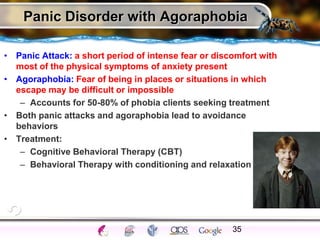
Panic Disorder with Agoraphobia
• Panic Attack: a short period of intense fear or discomfort with
most of the physical symptoms of anxiety present
• Agoraphobia: Fear of being in places or situations in which
escape may be difficult or impossible
– Accounts for 50-80% of phobia clients seeking treatment
• Both panic attacks and agoraphobia lead to avoidance
behaviors
• Treatment:
– Cognitive Behavioral Therapy (CBT)
– Behavioral Therapy with conditioning and relaxation
35
Phobias- “Fear Disorder”
• Social Phobia
– Fear of social situations in which one might be exposed to the
close scrutiny of others and might be humiliated or embarrassed
– Examples: Public speaking, eating in public or dating
• Simple Phobia (most common)
– Happens in women 2-1
– Animal, Situational, Injection
– Irrational fear of a particular object or situation
36
Phobias- “Pickles”
Obsessive-Compulsive Disorder
• Obsessions: Unwanted thoughts, ideas
or mental images that occur over and
over again
• Compulsions: Repetitive ritual
behaviors involving checking or
cleaning (helps to reduce anxiety from
obsessions)
• 55% of OCD clients obsess over dirt or
contamination
• May be caused by frontal lobe glucose
metabolism or wired into brain
38
A PET scan of the brain of a
person with Obsessive-
Compulsive Disorder
(OCD). High metabolic
activity (red) in the frontal
lobe areas are involved with
directing attention.
Obsessive-Compulsive Disorder
39
The Hoarding Debate…
Post Traumatic Stress Disorder
• Intense, persistent feelings of anxiety that are caused by a
traumatic experience
• Added to the DSM after the Vietnam War
• Previously called “shell shock” and “battle fatigue”
• Events that lead to PTSD:
– Rape, Child Abuse, Assault, Severe Accidents, Natural Disasters,
War
– Lower than average cortisol levels may predispose people to PTSD
• Symptoms:
– Flashbacks & Nightmares
– Tension & Aggression
– Avoidance Behavior & Substance Abuse
• Treatments:
– Prolonged CBT
– Virtual Therapy- reliving the event
– EMDR
41
Post Traumatic Stress Disorder
42
What Causes Anxiety Disorders?
• Psychoanalytic Perspective: Repressed
unconscious urges from childhood
• Biological Perspective: Too much or too little
of certain neurotransmitters or brain
abnormality; sensitive amygdala
• Behavioral (Learning) Perspective:
Conditioned through classical conditioning
or operant conditioning to experience
anxiety
43
5: What are anxiety disorders, and how do they differ from ordinary worries and
fears?
6: What produces the thoughts and feelings that mark anxiety disorders?
Mr. Burnes 44
Rating Student Evidence
4.0
Expert
I can satisfy all the requirements of level 3.0 and debate
the legitimacy of the proposed causes of anxiety
disorders.
★ 3.0 ★
Proficient
I can identify, describe and explain causes of specific
anxiety disorders.
2.0
Developing
I can identify and describe some of the specific anxiety
disorders.
1.0
Beginning
I need more prompting and/or support to identify the
concepts stated in 2.0
Check Your Understanding: Anxiety Disorders
• Which of the following is NOT considered an
anxiety disorder?
A) Ben, who goes home several times a day to check to
see if the stove is off.
B) Denise, who is terrorified of eating in public.
C) Mary, who worries excessively about an upcoming
job interview weeks before it happens.
D) Kent, a solider who has experienced sudden
blindness after seeing his buddies killed in war.
E) Sara, who without reason, starts to hyperventalate
and cry, while complaining that she thinks she will
die.
45
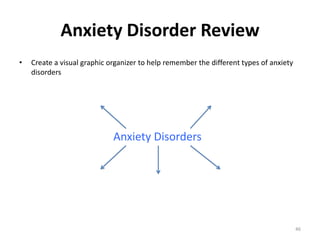
Anxiety Disorder Review
• Create a visual graphic organizer to help remember the different types of anxiety
disorders
46
Anxiety Disorders
Abnormal Psych: Somatoform and
Dissociative Disorders• Learning Goals:
– Students should be able to answer the following:
7: What are somatoform disorders?
8: What are dissociative disorders, and why are they controversial?
47
Rating Student Evidence
4.0
Expert
I can satisfy level 3.0 and evaluate claims made
by some researchers that dissociative or
somatoform disorders are not true disorders.
★ 3.0 ★
Proficient
I can identify somatoform and dissociative
disorders, there symptoms and explain the
possible causes of both types of disorders.
2.0
Developing
I can identify somatoform and dissociative
disorders.
1.0
Beginning
I need more prompting and/or support to
identify the concepts stated in 2.0
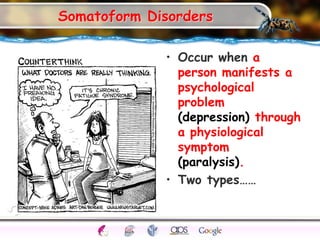
Somatoform Disorders
• Occur when a
person manifests a
psychological
problem
(depression) through
a physiological
symptom
(paralysis).
• Two types……
Somatoform Disorders
• Type I: Conversion Disorder
– People experience a loss or change of physical
functioning
– No medical explanation
– Examples: Sudden blindness, paralysis, glove
anesthesia
– Not faking it!
– Women twice as likely to be diagnosed
• Type II: Hypochondriasis
– Unrealistic Preoccupation with serious disease
– Will visit multiple doctors to be treated
– Affects men and women equally
– Caused by suppressed emotions that emerge as
physical symptoms
49
Somatoform Disorders
50
Somatoform Disorders
51
Dissociative Disorders
• Disruptions in conscious awareness
and sense of identity (memory issues)
• Explained by having unacceptable
urges or protection from anxiety
(psychoanalytic)
• Three Types
52
Psychogenic Amnesia
• Also called
“Dissociative Amnesia”
• A person cannot
remember things with
no physiological basis
for the disruption in
memory.
• Retrograde Amnesia
• NOT organic amnesia.
• Organic amnesia can be
retrograde or
anterograde.
Psychogenic Amnesia
Dissociative Fugue
• People with
psychogenic amnesia
that find
themselves in an
unfamiliar
environment.
Dissociative Identity Disorder
• Used to be known as
Multiple Personality
Disorder.
• A person has several
rather than one
integrated
personality.
• People with DID
commonly have a
history of childhood
abuse or trauma.
DID
– Considered extremely rare
– The personalities alternate, with the
original personality typically denying
awareness of the other(s)
– Skeptics question whether DID is a
genuine disorder or an extension of our
normal capacity for personality shifts.
57
DID- The faces of Eve
58
DID Kim Noble
59
DID Paula‟s Struggle
60
7: What are somatoform disorders?
8: What are dissociative disorders, and why are they controversial?
61
Rating Student Evidence
4.0
Expert
I can satisfy level 3.0 and evaluate claims made by some
researchers that dissociative or somatoform disorders
are not true disorders.
★ 3.0 ★
Proficient
I can identify somatoform and dissociative disorders,
their symptoms and explain the possible causes of both
types of disorders.
2.0
Developing
I can identify somatoform and dissociative disorders.
1.0
Beginning
I need more prompting and/or support to identify the
concepts stated in 2.0
Abnormal Psych: Mood Disorders
• Learning Goals:
– Students should be able to answer the following:
9: What are mood disorders, and what forms do they take?
10: What causes mood disorders, and what might explain the Western world’s rising
incidence of depression among youth and young adults?
62
Rating Student Evidence
4.0
Expert
I can satisfy all the requirements of level 3.0
and analyze why mood disorders seem to
affect some people and not others.
★ 3.0 ★
Proficient
I can identify the symptoms associated with
specific mood disorders and explain how
mood disorders develop from biological and
psychological perspectives.
2.0
Developing
I can identify certain mood disorders.
1.0
Beginning
I need more prompting and/or support to
identify the concepts stated in 2.0
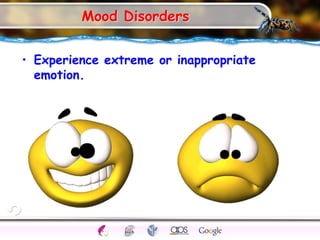
Mood Disorders
• Experience extreme or inappropriate
emotion.
Major Depression
• A.K.A. unipolar
depression
• Unhappy for at
least two weeks
with no apparent
cause.
• Depression is the
common cold of
psychological
disorders.
Major Depressive Episode
65
Major Depressive Episode
• Neurotransmitters involved: Serotonin and Norepinephrine
• Five of the following symptoms must be present for diagnosis:
1. depressed mood most of the day
2. loss of interest or pleasure
3. significant weight loss or gain due to appetite
4. sleeping more than normal
5. speeding up/slowing down of physical and emotional reactions
6. Fatigue
7. feelings of worthlessness
8. inability to concentrate
9. recurrent thoughts of death or suicide
10. May last for periods of months or more
66
Dysthymic Disorder
• Suffering from
mild depression
every day for
at least two
years.
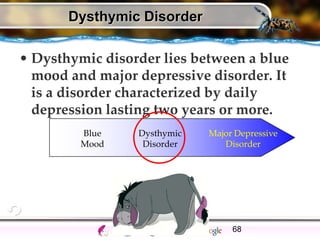
Dysthymic Disorder
• Dysthymic disorder lies between a blue
mood and major depressive disorder. It
is a disorder characterized by daily
depression lasting two years or more.
68
Major Depressive
Disorder
Blue
Mood
Dysthymic
Disorder
Dysthymic Disorder Case Study: Eeyore
Bipolar Disorder
• Involves periods of
depression and manic
episodes.
• Manic episodes involve
feelings of high energy
(but they tend to differ
a lot…some get
confident and some get
irritable).
• Engage in risky behavior
during the manic
episode.
Bipolar Disorder
• May hear voices and experience
hallucinations, Delusions of superior abilities
– Example Behaviors: Spending sprees, quitting
jobs to pursue wild dreams, making bad decisions
• Mania:
– Inflated Self-Esteem
– Inability to Sit or Sleep
– Pressure to keep talking (push of speech)
– Racing Thoughts
– Difficulty Concentrating
– Overly Optimistic
71
72
Mania can resemble schizophrenia or a crack high
73
Creativity and Bipolar Disorder
Bipolar Disorder: Subtypes
• Bipolar I (most extreme) disorder is
characterized by the presence of one or more
manic or mixed episodes. Depressive episodes
usually occur too.
• Bipolar II (less extreme)disorder is
characterized by highs that are never more
severe than hypomania (less severe mania)
together with major depressive episodes.
• Cyclothymic disorder (least extreme) refers to
frequent episodes of hypomania and mild
depression occurring over at least a 2-year
period.
74
Bipolar Disorder an in-depth explanation
75
Famous People with Bipolar
77
Explaining Mood Disorders
Since depression is so prevalent worldwide,
investigators want to develop a theory of
depression that will suggest ways to treat it.
Lewinsohn et al., (1985, 1995) note that a theory
of depression should explain the following:
• Behavioral and cognitive changes
• Common causes of depression
78
Theory of Depression
Gender differences
79
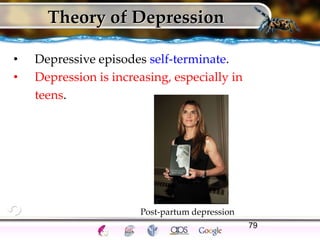
Theory of Depression
• Depressive episodes self-terminate.
• Depression is increasing, especially in
teens.
Post-partum depression
Suicide Statistics
• 1 million people worldwide/year
• White Americans are twice as likely than
Black Americans to kill themselves
• Women are more likely to attempt, Men
are more likely to succeed
• Suicide rates have doubled in the last 40
years among teens
• Who is likely to commit suicide?
– The Rich
– Single/divorced/widowed
– White
– Nonreligious
– Teens & Elderly
80
81
Biological Perspective
Genetic Influences: Mood disorders run in
families. The rate of depression is higher in
identical (50%) than fraternal twins (20%).
Linkage analysis and association
studies link possible genes and
dispositions for depression.
JerryIrwinPhotography
82
The Depressed Brain
PET scans show that brain energy consumption
rises and falls with manic and depressive
episodes.
CourtesyofLewisBaxteranMichaelE.
Phelps,UCLASchoolofMedicine
83
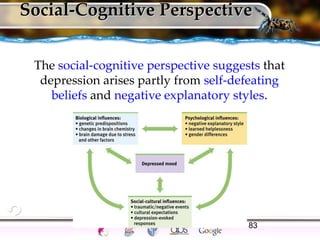
Social-Cognitive Perspective
The social-cognitive perspective suggests that
depression arises partly from self-defeating
beliefs and negative explanatory styles.
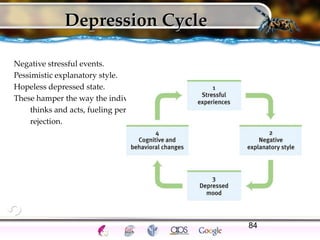
84
Depression Cycle
Negative stressful events.
Pessimistic explanatory style.
Hopeless depressed state.
These hamper the way the individual
thinks and acts, fueling personal
rejection.
85
Example
Explanatory style plays a major role in becoming depressed.
9: What are mood disorders, and what forms do they take?
10: What causes mood disorders, and what might explain the Western world’s
rising incidence of depression among youth and young adults?
86
Rating Student Evidence
4.0
Expert
I can satisfy all the requirements of level 3.0 and analyze
why mood disorders seem to affect some people and not
others.
★ 3.0 ★
Proficient
I can identify the symptoms associated with specific
mood disorders and explain how mood disorders
develop from biological and psychological perspectives.
2.0
Developing
I can identify certain mood disorders.
1.0
Beginning
I need more prompting and/or support to identify the
concepts stated in 2.0
Section 5: Test Your Knowledge
Which of the following is NOT true regarding depression?
A. Depression is more common in females than males.
B. Most depressive episodes appear not to be preceded by any
particular factor or event
C. Most depressive episodes last less than 3 months
D. Most people recover from depression without professional therapy.
The risk of major depression and bipolar disorder dramatically
increases if you:
A. have suffered a debilitating injury
B. have an adoptive parent with the disorder
C. have a parent or sibling with the disorder
D. have a life-threatening illness
E. have above-average intelligence
87
Schizophrenia• Learning Goals:
– Students should be able to answer the following:
11: What patterns of thinking, perceiving, feeling, and behaving characterize
schizophrenia?
12: What causes schizophrenia?
88
Rating Student Evidence
4.0
Expert
I can satisfy all the requirements of level 3.0 and
analyze why persons with schizophrenia display
different symptoms based on their subtypes.
★ 3.0 ★
Proficient
I can identify the specific feature of schizophrenia
and its subtypes and discuss the theories that seek
to explain how schizophrenia is contracted.
2.0
Developing
I can identify the specific feature of schizophrenia
and its subtypes.
1.0
Beginning
I need more prompting and/or support to identify
the concepts stated in 2.0
Schizophrenia Overview
• 1 in 100 people develop schizophrenia "split
mind”
• One of the most serious disorders of
psychology
• 2 million in the United States, 24 million
worldwide
• Characterized by loss of contact with reality
• May appear suddenly or gradually
• Usually appears in males during adolescents
and females during 20‟s.
• Breakdown in selective attention
89
Schizophrenia Experience
90
Schizophrenia Overview
• Disorganized Thinking
– Fragmented speech (word salad)
– Delusions (false beliefs)
– Inability to filter selective attention
• Disturbed Perceptions
– Hallucinations (mostly auditory sensation
errors)
– Described as a dream happening while awake
• Inappropriate Emotions and Actions
– Wrong or no emotions (flat affect)
– Senseless or weird acts (playing with hair)
91
Schizophrenia Overview
92
Schizophrenia Overview
93
Positive and Negative Symptoms
• Schizophrenics have present
inappropriate symptoms
(hallucinations, disorganized
thinking, deluded ways) that are
not present in normal individuals
(positive symptoms).
• Schizophrenics also have an
absence of appropriate symptoms
(apathy, expressionless faces,
rigid bodies) that are present in
normal individuals (negative
symptoms).
94
Positive or
Negative
Symptom?
Schizophrenia Subtypes
95
Paranoid Schizophrenia
96
Possible Causes of Schizophrenia
• DOPAMINE
– Too much of it!
– Leads to hallucinations
• UNUSUAL BRAIN ACTIVITY
– Low frontal lobe activity
– Misfiring neurons
– Increased activity in the core (thalamus and amygdala)
• MATERNAL VIRUS
– Flu virus during first term of pregnancy
– Babies born in the winter months increased risk
• GENETICS
– 1 in 10 if family member has it
– 1 in 2 if identical twin has it
– Not the sole cause of the disorder
• PSYCHOANALYTIC VIEW
– Id is overwhelmed and out of control
– Family members are pushy and overly critical
97
98
99
The Schizophrenia Switch
Early Warning Signs of Schizophrenia
100 100
Birth complications, oxygen deprivation and low-birth
weight.
2.
Short attention span and poor muscle coordination.3.
Poor peer relations and solo play.6.
Emotional unpredictability.5.
Disruptive and withdrawn behavior.4.
A mother’s long lasting schizophrenia.1.
11: What patterns of thinking, perceiving, feeling, and behaving characterize
schizophrenia?
12: What causes schizophrenia?
101
Rating Student Evidence
4.0
Expert
I can satisfy all the requirements of level 3.0 and
analyze why persons with schizophrenia display
different symptoms based on their subtypes.
★ 3.0 ★
Proficient
I can identify the specific feature of schizophrenia
and its subtypes and discuss the theories that seek
to explain how schizophrenia is contracted.
2.0
Developing
I can identify the specific feature of schizophrenia
and its subtypes.
1.0
Beginning
I need more prompting and/or support to identify
the concepts stated in 2.0
Check Your Understanding: Schizophrenia
• The _____ type of schizophreneia is characted
by delusions.
A) Rediudal
B) Catatonic
C) Paranoid
D) Undifferentiated
E) Disorganized
102
Check Your Understanding: Schizophrenia
• Most of the drugs that are useful in the
treatment of schizophrenia are know to
correct ____ activity in the brain.
A) Norepinephrine
B) Epinephrine
C) Serotonin
D) GABA
E) Dopamine
103
Abnormal Psych: Personality Disorders and Stats on
Disorders
• Learning Goals:
– Students should be able to answer the following:
13: What characteristics typical of personality disorders?
14: How many people suffer or have suffered from a psychological disorder?
104
Rating Student Evidence
4.0
Expert
I can satisfy all the requirements of level 3.0 and
debate whether personality disorders might add
negative labels to individuals.
★ 3.0 ★
Proficient
I can identify specific personality disorders and
explain how they differ from Axis I disorders.
2.0
Developing
I can identify personality disorder clusters and some
of their subtypes.
1.0
Beginning
I need more prompting and/or support to identify
the concepts stated in 2.0
Labeling a Person Criminally Insane
• “Insanity” labels
raise moral and ethical
questions about how
society should treat
people who have
disorders and have
committed crimes.
• See article: Insanity
Defense
Una-bomber
105
Personality Disorders- Axis II
• Patterns of inflexible traits that disrupt social life or work and/or
distress the affected individual impairing their social functioning.
• Hard to estimate because people rarely seek treatment (don‟t think
they have a problem)
• Cluster A: Odd/Eccentric Behaviors
– Schizoid (78/22)- Loner
– Paranoid (67/33)- Untrusting
– Schizotypal (55/45)- Very Odd
• Cluster B: Dramatic/Impulsive Behavior
– Narcissistic (70/30) – Better than Everyone
– Borderline (38/62) – Unstable
– Histrionic (15/85)- Center of Attention
– Antisocial (82/18)- No Remorse
• Cluster C: Fearful/Anxiety Behaviors
– Avoidant (50/50) - Timid, Shy
– Dependent (31/69) – Stage Five Clinger “needy”
– Obsessive-Compulsive (50/50) – My way or the highway- Perfectionistic
106
Antisocial Personality Disorder
• AKA: Sociopath or Psychopath
– Typically a male, Begins before age 15
– Lies, steals, fights, sexually uninhibited
– Don't care about others rights or
feelings (even family)
• Biological Origins of ASPD
– No one gene (although twins studies
support genetics)
– Reduced arousal in autonomic nervous
system
– Reduced activity in frontal lobe gives
way to impulsivity
• Environmental Origins of ASPD
– Family instability
– Poverty
– Conditioning and Abuse
107
Ted Bundy
Serial Killer convicted
of killing several
people including
Florida State Chi
Omega Sorority girls
in 1978
Rates of Psychological Disorders
108
13: What characteristics typical of personality disorders?
14: How many people suffer or have suffered from a psychological disorder?
109
Rating Student Evidence
4.0
Expert
I can satisfy all the requirements of level 3.0 and debate
whether personality disorders might add negative labels
to individuals.
★ 3.0 ★
Proficient
I can identify specific personality disorders and explain
how they differ from Axis I disorders.
2.0
Developing
I can identify personality disorder clusters and some of
their subtypes.
1.0
Beginning
I need more prompting and/or support to identify the
concepts stated in 2.0

Aguiar ap abnormal

  • 1.
    What Is Abnormality?WhatIs Abnormality?
  • 2.
    Abnormal Psych: Intro($h!t’s about to get weird) • Learning Goals: – Students should be able to answer the following: 1: How should we draw the line between normality and disorder? 2: What perspectives can help us understand psychological disorders? 2 Rating Student Evidence 4.0 Expert I can successfully answer level 3 AND critically debate if labeling disorders has a potential dangerous effect on self-fulfilling prophecy. ★ 3.0 ★ Proficient I can identify the layout of the DSM, and different axes of the DSM AND discuss the pros and cons of labeling disorders. 2.0 Developing I can identify the layout of the DSM, different axes of the DSM, but need more time to review how this impacts the classification of disorders. 1.0 Beginning I need more prompting and/or support to identify the concepts stated in level 2.
  • 3.
    Fact of Falsehood •1. In some cultures, depression and schizophrenia are nonexistent. • 2. The more contact people have with individuals with disorders, the less accepting their attitudes are. • 3.About 30 percent of psychologically disordered people are dangerous; that is, they are more likely than other people to commit a crime. • 4.Research indicates that in the United States there are more prison inmates with severe mental disorders than there are psychiatric inpatients in all the country’s hospitals. • 5.Identical twins who have been raised separately sometimes develop similar phobias. • 6. Dissociative identity disorder is a type of schizophrenia. • 7. In North America, today’s young adults are three times more likely than their grandparents to report having suffered depression. • 8. White Americans commit suicide nearly twice as often as Black Americans do. • 9. There is strong evidence for a genetic predisposition to schizophrenia. • 10 Twenty-six percent of adult Americans suffer from a diagnosable mental disorder in a given year. 3
  • 4.
  • 5.
    Early Theories • Abnormalbehavior was evil spirits trying to get out. • Trephining was often used. • Another theory was to make the body extremely uncomfortable
  • 6.
    Early Explanations ofMental Illness • Hippocrates – mental illness from imbalance of body’s four humors • Middle Ages – mentally ill labeled witches LO 12.1 How has mental illness been explained? How is abnormality defined?
  • 7.
    Some people stillthink mental illness is demonology
  • 8.
    What Is Abnormal? Inabilityto Function Statistically Rare Social Norm Deviance Danger to Self/Others Subjective Discomfort
  • 9.
    Perspectives and Disorders PsychologicalSchool/Perspective Cause of the Disorder Psychoanalytic/Psychodynamic Internal, unconscious drives Humanistic Failure to strive to one’s potential or being out of touch with one’s feelings. Behavioral Reinforcement history, the environment. Cognitive Irrational, dysfunctional thoughts or ways of thinking. Sociocultural Dysfunctional Society Biomedical/Neuroscience Organic problems, biochemical imbalances, genetic predispositions.
  • 10.
    What is apsychological disorder? • Behavior patterns or mental processes that cause serious personal suffering or interfere with a person‟s ability to cope with everyday life. • Three main components: – Deviant (being different) – Distressful (causes worry, pain or stress) – Dysfunctional (impairing life functioning) • About 1 in 7 adults in the United States have experienced a psychological disorder. 26% in the last year. *Note: Not all deviant behavior is considered a disorder, as sometimes it is just a cultural, situational or generational norm. (e.g. killing in war, dressing differently, praying loudly etc…) 10
  • 11.
    Case Study: TheThree D‟s: ADHD • ADHD • A psychological disorder marked by the appearance by age 7 of one or more of three key symptoms: extreme inattention, hyperactivity, and impulsivity • 4% of children, though 10% are being medicated for it • Diagnosed 2-3 times more in boys than girls • Correlated to watching more TV before age 7 • Brain appears to be about three years behind on thinning of cortex and pruning • Medications help, but benefits may disappear after three years • FDA just approved an EEG brain wave method for diagnosing ADHD 11
  • 12.
    ADHD Setting theRecord Straight
  • 13.
    Biopsychosocial Approach toExplaining Disorders 13
  • 14.
    Section 1: TestYour Knowledge Is this a psychological disorder? Why or Why Not? During most of her life, Mary has been inclined to keep to herself. She has few friends but no close friends. Her feelings are easily hurt, and she seldom participates in any social activities. As a child, she did nearly average work in school but never took part in school activities. She eventually dropped out of school and got a job. She rarely talks with the other employees and prefers to eat her lunch alone. She prefers to keep to herself and quietly talks to herself, even when customers are around. At times she refuses to eat certain foods for fear of being poisoned. Most of the time Mary refuses to attend to her personal hygiene and prefers to be left alone quietly muttering to herself. She leaves the house only for food and work. 14
  • 15.
    1: How shouldwe draw the line between normality and disorder? 2: What perspectives can help us understand psychological disorders? 15 Rating Student Evidence 4.0 Expert I can teach someone else about, the definitions of normality and disorders as well as psychological perspectives on disorders. In addition to 3.0 , I can demonstrate applications and inferences beyond what was taught 3.0 Proficient I can explain, the definitions of normality and disorders as well as psychological perspectives on disorders with no major errors or omissions. 2.0 Developing I can identify terms associated, the definitions of normality and disorders as well as psychological perspectives on disorders, but need to review this concept more. 1.0 Beginning I need more prompting and/or support to identify the concepts stated in 2.0
  • 16.
    Abnormal Psych: Classificationand Labeling• Learning Goals: – Students should be able to answer the following: 3: How and why do clinicians classify psychological disorders? 4: Why do some psychologists criticize the use of diagnostic labels? 16 Rating Student Evidence 4.0 Expert I can successfully answer level 3 AND critically debate if labeling disorders has a potential dangerous effect on self-fulfilling prophecy. ★ 3.0 ★ Proficient I can identify the layout of the DSM, and different axes of the DSM AND discuss the pros and cons of labeling disorders. 2.0 Developing I can identify the layout of the DSM, different axes of the DSM, but need more time to review how this impacts the classification of disorders. 1.0 Beginning I need more prompting and/or support to identify the concepts stated in 2.0
  • 17.
    How do psychologistsexplain disorders? • The Medical Model (Pinel): – Mental illness is a sickness (psychopathology) • Noticed people would become crazy due to syphilis • Dorothea Dix advocates for humane treatment in mental hospitals in America – Under the medical model, we seek to: • Diagnosis • Understand the Symptoms • Provide Treatment • And use psychiatric hospitals only when necessary Trephination -boring holes in the skull to remove evil forces 17
  • 18.
    How do Psychologistsclassify disorders? • Diagnostic and Statistical Manual of Mental Disorders (DSM-IV-TR)-1994, Revised 2000 • Published by the American Psychiatric Association (APA) • Closely follows World Heath Organization's International Classification of Diseases (ICD) • The DSM is revised every few years (DSM-V was published in 2013) – Contains over 400 disorder categories – DSM III included homosexuality as a disorder (1973), the DSM-IV does not. • Critics say the DSM is too broad and anyone can be classified with a disorder. People can be diagnosed falsely with diagnostic labels. • Goals of the DSM: 1. Identify and classify disorders 2. Determine prevalence (not treatment) 18
  • 19.
    Two Major Disorder Classificationsin the DSM Neurotic Disorders • Distressing but one can still function in society and act rationally. Psychotic Disorders • Person loses contact with reality, experiences distorted perceptions. John Wayne Gacy
  • 20.
    Group-think Share…. Neuroticor Psychotic and why? 1. 2. 3. 4. 5. 6.
  • 21.
    Layout of DSMDisorder Profiles I. Disorder Name II. Diagnostic features (this is complete description of the disorder) III. Associated features ( these are the features that accompany the disorder) IV. Development and Course (this is how the disorder can develop and how it could possibly affect the life course) V. Differential Diagnosis (other possible names or similar disorders)
  • 22.
    DSM-IV-TR Psychological ProfileOverview Are Psychosocial or Environmental Problems (school or housing issues) also present?Axis IV What is the Global Assessment of the person’s functioning? (0-100 Point Scale)Axis V Is a General Medical Condition (diabetes, hypertension or arthritis etc) also present?Axis III Is a Personality Disorder or Mental Retardation present? Axis II Is a Clinical Syndrome (cognitive, anxiety, mood disorders [16 syndromes]) present?Axis I 22
  • 23.
    DSM & Reliability •If two different psychologists interview the same patient, will they come up with the same diagnosis according to the DSM? • 83% of opinions agreed in one study based on criteria in the DSM (It supposedly has high validity and reliability) 23
  • 24.
    Is There Dangerin Labeling People? What would you diagnose these people with? 24
  • 25.
    Is There Dangerin Labeling People? • The Rosenhan Study (1973) – Faked a disorder to get into a mental institution – After arriving into the institution, the „pseudopatient‟ stopped being symptomatic – On average it took 19 days before „pseudopatients‟ were released, even though they were not experiencing symptoms – Conclusion: Labeling causes Doctors to see people as „insane‟ even when they are „sane‟ 25
  • 26.
    Is There Dangerin Labeling People? 26
  • 27.
    Is There Dangerin Labeling People? • Pros of Labeling – Communicate disorders – Discern Treatment – Comprehend underlying causes • Cons of Labeling – Leads to self-fulfilling prophecy for both patient and others – Creates a stigma that follows a person Operational Defiant Disorder 27
  • 28.
    Section 2: TestYour Knowledge • A man is feeling depressed about his inability to support his family after losing his job. The fact that the patient is currently unemployed is coded on which axis in the Diagnostic and Statistical Manual of Mental Disorders (DSM-IV-TR)? (A) Axis I (B) Axis II (C) Axis III (D) Axis IV (E) Axis V • The medical model views mental illness as: (A) A character defect (B) A disease or illness (C) An interaction of biological, cognitive, behavioral, social and cultural factors (D) Normal behavior in an abnormal context (E) Maladaptive contingencies of reinforcement 28
  • 29.
    3: How andwhy do clinicians classify psychological disorders? 4: Why do some psychologists criticize the use of diagnostic labels? 29 Rating Student Evidence 4.0 Expert I can successfully answer level 3 AND critically debate if labeling disorders has a potential dangerous effect on self-fulfilling prophecy. ★ 3.0 ★ Proficient I can identify the layout of the DSM, and different axes of the DSM AND discuss the pros and cons of labeling disorders. 2.0 Developing I can identify the layout of the DSM, different axes of the DSM, but need more time to review how this impacts the classification of disorders. 1.0 Beginning I need more prompting and/or support to identify the concepts stated in 2.0
  • 30.
    Section 2: ProductAssessment • In groups of 3 to 4 people, you are to create a poster for a new disorder using the “Layout of DSM Disorder Profiles” (I-Name, II-Diagnostic, III- Associated Features, IV-Development, V- Differential Diagnosis) • A rationale as to why a disorder profile is needed for this disorder (included the three D’s from the prior lesson) • An illustration to go along with this disorder • Example: Senioritis 30
  • 31.
    Abnormal Psych: AnxietyDisorders • Learning Goals: – Students should be able to answer the following: 5: What are anxiety disorders, and how do they differ from ordinary worries and fears? 6: What produces the thoughts and feelings that mark anxiety disorders? 31 Rating Student Evidence 4.0 Expert I can satisfy all the requirements of level 3.0 and debate the legitimacy of the proposed causes of anxiety disorders. ★ 3.0 ★ Proficient I can identify, describe and explain causes of specific anxiety disorders. 2.0 Developing I can identify and describe some of the specific anxiety disorders. 1.0 Beginning I need more prompting and/or support to identify the concepts stated in 2.0
  • 32.
    Anxiety Disorders • Anxiety:General State of dread or uneasiness that occurs in response to a vague or imagined danger. • Also, nervousness, inability to relax, concern about losing control • Physical Symptoms caused by over active sympathetic nervous system: – Trembling, Sweating, Rapid Heart Rate, Shortness of Breath, Increased Blood Pressure, Flushed Face, Feelings of Light-headedness 32
  • 33.
    Generalized Anxiety Disorder(GAD) • Excessive or unrealistic worry about life circumstances lasting for at least six months – Financial Issues, Work, Relationships • Hard to Treat and Diagnosis • Effects more Women and Blacks 33
  • 34.
  • 35.
    Panic Disorder withAgoraphobia • Panic Attack: a short period of intense fear or discomfort with most of the physical symptoms of anxiety present • Agoraphobia: Fear of being in places or situations in which escape may be difficult or impossible – Accounts for 50-80% of phobia clients seeking treatment • Both panic attacks and agoraphobia lead to avoidance behaviors • Treatment: – Cognitive Behavioral Therapy (CBT) – Behavioral Therapy with conditioning and relaxation 35
  • 36.
    Phobias- “Fear Disorder” •Social Phobia – Fear of social situations in which one might be exposed to the close scrutiny of others and might be humiliated or embarrassed – Examples: Public speaking, eating in public or dating • Simple Phobia (most common) – Happens in women 2-1 – Animal, Situational, Injection – Irrational fear of a particular object or situation 36
  • 37.
  • 38.
    Obsessive-Compulsive Disorder • Obsessions:Unwanted thoughts, ideas or mental images that occur over and over again • Compulsions: Repetitive ritual behaviors involving checking or cleaning (helps to reduce anxiety from obsessions) • 55% of OCD clients obsess over dirt or contamination • May be caused by frontal lobe glucose metabolism or wired into brain 38 A PET scan of the brain of a person with Obsessive- Compulsive Disorder (OCD). High metabolic activity (red) in the frontal lobe areas are involved with directing attention.
  • 39.
  • 40.
  • 41.
    Post Traumatic StressDisorder • Intense, persistent feelings of anxiety that are caused by a traumatic experience • Added to the DSM after the Vietnam War • Previously called “shell shock” and “battle fatigue” • Events that lead to PTSD: – Rape, Child Abuse, Assault, Severe Accidents, Natural Disasters, War – Lower than average cortisol levels may predispose people to PTSD • Symptoms: – Flashbacks & Nightmares – Tension & Aggression – Avoidance Behavior & Substance Abuse • Treatments: – Prolonged CBT – Virtual Therapy- reliving the event – EMDR 41
  • 42.
  • 43.
    What Causes AnxietyDisorders? • Psychoanalytic Perspective: Repressed unconscious urges from childhood • Biological Perspective: Too much or too little of certain neurotransmitters or brain abnormality; sensitive amygdala • Behavioral (Learning) Perspective: Conditioned through classical conditioning or operant conditioning to experience anxiety 43
  • 44.
    5: What areanxiety disorders, and how do they differ from ordinary worries and fears? 6: What produces the thoughts and feelings that mark anxiety disorders? Mr. Burnes 44 Rating Student Evidence 4.0 Expert I can satisfy all the requirements of level 3.0 and debate the legitimacy of the proposed causes of anxiety disorders. ★ 3.0 ★ Proficient I can identify, describe and explain causes of specific anxiety disorders. 2.0 Developing I can identify and describe some of the specific anxiety disorders. 1.0 Beginning I need more prompting and/or support to identify the concepts stated in 2.0
  • 45.
    Check Your Understanding:Anxiety Disorders • Which of the following is NOT considered an anxiety disorder? A) Ben, who goes home several times a day to check to see if the stove is off. B) Denise, who is terrorified of eating in public. C) Mary, who worries excessively about an upcoming job interview weeks before it happens. D) Kent, a solider who has experienced sudden blindness after seeing his buddies killed in war. E) Sara, who without reason, starts to hyperventalate and cry, while complaining that she thinks she will die. 45
  • 46.
    Anxiety Disorder Review •Create a visual graphic organizer to help remember the different types of anxiety disorders 46 Anxiety Disorders
  • 47.
    Abnormal Psych: Somatoformand Dissociative Disorders• Learning Goals: – Students should be able to answer the following: 7: What are somatoform disorders? 8: What are dissociative disorders, and why are they controversial? 47 Rating Student Evidence 4.0 Expert I can satisfy level 3.0 and evaluate claims made by some researchers that dissociative or somatoform disorders are not true disorders. ★ 3.0 ★ Proficient I can identify somatoform and dissociative disorders, there symptoms and explain the possible causes of both types of disorders. 2.0 Developing I can identify somatoform and dissociative disorders. 1.0 Beginning I need more prompting and/or support to identify the concepts stated in 2.0
  • 48.
    Somatoform Disorders • Occurwhen a person manifests a psychological problem (depression) through a physiological symptom (paralysis). • Two types……
  • 49.
    Somatoform Disorders • TypeI: Conversion Disorder – People experience a loss or change of physical functioning – No medical explanation – Examples: Sudden blindness, paralysis, glove anesthesia – Not faking it! – Women twice as likely to be diagnosed • Type II: Hypochondriasis – Unrealistic Preoccupation with serious disease – Will visit multiple doctors to be treated – Affects men and women equally – Caused by suppressed emotions that emerge as physical symptoms 49
  • 50.
  • 51.
  • 52.
    Dissociative Disorders • Disruptionsin conscious awareness and sense of identity (memory issues) • Explained by having unacceptable urges or protection from anxiety (psychoanalytic) • Three Types 52
  • 53.
    Psychogenic Amnesia • Alsocalled “Dissociative Amnesia” • A person cannot remember things with no physiological basis for the disruption in memory. • Retrograde Amnesia • NOT organic amnesia. • Organic amnesia can be retrograde or anterograde.
  • 54.
  • 55.
    Dissociative Fugue • Peoplewith psychogenic amnesia that find themselves in an unfamiliar environment.
  • 56.
    Dissociative Identity Disorder •Used to be known as Multiple Personality Disorder. • A person has several rather than one integrated personality. • People with DID commonly have a history of childhood abuse or trauma.
  • 57.
    DID – Considered extremelyrare – The personalities alternate, with the original personality typically denying awareness of the other(s) – Skeptics question whether DID is a genuine disorder or an extension of our normal capacity for personality shifts. 57
  • 58.
    DID- The facesof Eve 58
  • 59.
  • 60.
  • 61.
    7: What aresomatoform disorders? 8: What are dissociative disorders, and why are they controversial? 61 Rating Student Evidence 4.0 Expert I can satisfy level 3.0 and evaluate claims made by some researchers that dissociative or somatoform disorders are not true disorders. ★ 3.0 ★ Proficient I can identify somatoform and dissociative disorders, their symptoms and explain the possible causes of both types of disorders. 2.0 Developing I can identify somatoform and dissociative disorders. 1.0 Beginning I need more prompting and/or support to identify the concepts stated in 2.0
  • 62.
    Abnormal Psych: MoodDisorders • Learning Goals: – Students should be able to answer the following: 9: What are mood disorders, and what forms do they take? 10: What causes mood disorders, and what might explain the Western world’s rising incidence of depression among youth and young adults? 62 Rating Student Evidence 4.0 Expert I can satisfy all the requirements of level 3.0 and analyze why mood disorders seem to affect some people and not others. ★ 3.0 ★ Proficient I can identify the symptoms associated with specific mood disorders and explain how mood disorders develop from biological and psychological perspectives. 2.0 Developing I can identify certain mood disorders. 1.0 Beginning I need more prompting and/or support to identify the concepts stated in 2.0
  • 63.
    Mood Disorders • Experienceextreme or inappropriate emotion.
  • 64.
    Major Depression • A.K.A.unipolar depression • Unhappy for at least two weeks with no apparent cause. • Depression is the common cold of psychological disorders.
  • 65.
  • 66.
    Major Depressive Episode •Neurotransmitters involved: Serotonin and Norepinephrine • Five of the following symptoms must be present for diagnosis: 1. depressed mood most of the day 2. loss of interest or pleasure 3. significant weight loss or gain due to appetite 4. sleeping more than normal 5. speeding up/slowing down of physical and emotional reactions 6. Fatigue 7. feelings of worthlessness 8. inability to concentrate 9. recurrent thoughts of death or suicide 10. May last for periods of months or more 66
  • 67.
    Dysthymic Disorder • Sufferingfrom mild depression every day for at least two years.
  • 68.
    Dysthymic Disorder • Dysthymicdisorder lies between a blue mood and major depressive disorder. It is a disorder characterized by daily depression lasting two years or more. 68 Major Depressive Disorder Blue Mood Dysthymic Disorder
  • 69.
  • 70.
    Bipolar Disorder • Involvesperiods of depression and manic episodes. • Manic episodes involve feelings of high energy (but they tend to differ a lot…some get confident and some get irritable). • Engage in risky behavior during the manic episode.
  • 71.
    Bipolar Disorder • Mayhear voices and experience hallucinations, Delusions of superior abilities – Example Behaviors: Spending sprees, quitting jobs to pursue wild dreams, making bad decisions • Mania: – Inflated Self-Esteem – Inability to Sit or Sleep – Pressure to keep talking (push of speech) – Racing Thoughts – Difficulty Concentrating – Overly Optimistic 71
  • 72.
    72 Mania can resembleschizophrenia or a crack high
  • 73.
  • 74.
    Bipolar Disorder: Subtypes •Bipolar I (most extreme) disorder is characterized by the presence of one or more manic or mixed episodes. Depressive episodes usually occur too. • Bipolar II (less extreme)disorder is characterized by highs that are never more severe than hypomania (less severe mania) together with major depressive episodes. • Cyclothymic disorder (least extreme) refers to frequent episodes of hypomania and mild depression occurring over at least a 2-year period. 74
  • 75.
    Bipolar Disorder anin-depth explanation 75
  • 76.
  • 77.
    77 Explaining Mood Disorders Sincedepression is so prevalent worldwide, investigators want to develop a theory of depression that will suggest ways to treat it. Lewinsohn et al., (1985, 1995) note that a theory of depression should explain the following: • Behavioral and cognitive changes • Common causes of depression
  • 78.
  • 79.
    79 Theory of Depression •Depressive episodes self-terminate. • Depression is increasing, especially in teens. Post-partum depression
  • 80.
    Suicide Statistics • 1million people worldwide/year • White Americans are twice as likely than Black Americans to kill themselves • Women are more likely to attempt, Men are more likely to succeed • Suicide rates have doubled in the last 40 years among teens • Who is likely to commit suicide? – The Rich – Single/divorced/widowed – White – Nonreligious – Teens & Elderly 80
  • 81.
    81 Biological Perspective Genetic Influences:Mood disorders run in families. The rate of depression is higher in identical (50%) than fraternal twins (20%). Linkage analysis and association studies link possible genes and dispositions for depression. JerryIrwinPhotography
  • 82.
    82 The Depressed Brain PETscans show that brain energy consumption rises and falls with manic and depressive episodes. CourtesyofLewisBaxteranMichaelE. Phelps,UCLASchoolofMedicine
  • 83.
    83 Social-Cognitive Perspective The social-cognitiveperspective suggests that depression arises partly from self-defeating beliefs and negative explanatory styles.
  • 84.
    84 Depression Cycle Negative stressfulevents. Pessimistic explanatory style. Hopeless depressed state. These hamper the way the individual thinks and acts, fueling personal rejection.
  • 85.
    85 Example Explanatory style playsa major role in becoming depressed.
  • 86.
    9: What aremood disorders, and what forms do they take? 10: What causes mood disorders, and what might explain the Western world’s rising incidence of depression among youth and young adults? 86 Rating Student Evidence 4.0 Expert I can satisfy all the requirements of level 3.0 and analyze why mood disorders seem to affect some people and not others. ★ 3.0 ★ Proficient I can identify the symptoms associated with specific mood disorders and explain how mood disorders develop from biological and psychological perspectives. 2.0 Developing I can identify certain mood disorders. 1.0 Beginning I need more prompting and/or support to identify the concepts stated in 2.0
  • 87.
    Section 5: TestYour Knowledge Which of the following is NOT true regarding depression? A. Depression is more common in females than males. B. Most depressive episodes appear not to be preceded by any particular factor or event C. Most depressive episodes last less than 3 months D. Most people recover from depression without professional therapy. The risk of major depression and bipolar disorder dramatically increases if you: A. have suffered a debilitating injury B. have an adoptive parent with the disorder C. have a parent or sibling with the disorder D. have a life-threatening illness E. have above-average intelligence 87
  • 88.
    Schizophrenia• Learning Goals: –Students should be able to answer the following: 11: What patterns of thinking, perceiving, feeling, and behaving characterize schizophrenia? 12: What causes schizophrenia? 88 Rating Student Evidence 4.0 Expert I can satisfy all the requirements of level 3.0 and analyze why persons with schizophrenia display different symptoms based on their subtypes. ★ 3.0 ★ Proficient I can identify the specific feature of schizophrenia and its subtypes and discuss the theories that seek to explain how schizophrenia is contracted. 2.0 Developing I can identify the specific feature of schizophrenia and its subtypes. 1.0 Beginning I need more prompting and/or support to identify the concepts stated in 2.0
  • 89.
    Schizophrenia Overview • 1in 100 people develop schizophrenia "split mind” • One of the most serious disorders of psychology • 2 million in the United States, 24 million worldwide • Characterized by loss of contact with reality • May appear suddenly or gradually • Usually appears in males during adolescents and females during 20‟s. • Breakdown in selective attention 89
  • 90.
  • 91.
    Schizophrenia Overview • DisorganizedThinking – Fragmented speech (word salad) – Delusions (false beliefs) – Inability to filter selective attention • Disturbed Perceptions – Hallucinations (mostly auditory sensation errors) – Described as a dream happening while awake • Inappropriate Emotions and Actions – Wrong or no emotions (flat affect) – Senseless or weird acts (playing with hair) 91
  • 92.
  • 93.
  • 94.
    Positive and NegativeSymptoms • Schizophrenics have present inappropriate symptoms (hallucinations, disorganized thinking, deluded ways) that are not present in normal individuals (positive symptoms). • Schizophrenics also have an absence of appropriate symptoms (apathy, expressionless faces, rigid bodies) that are present in normal individuals (negative symptoms). 94 Positive or Negative Symptom?
  • 95.
  • 96.
  • 97.
    Possible Causes ofSchizophrenia • DOPAMINE – Too much of it! – Leads to hallucinations • UNUSUAL BRAIN ACTIVITY – Low frontal lobe activity – Misfiring neurons – Increased activity in the core (thalamus and amygdala) • MATERNAL VIRUS – Flu virus during first term of pregnancy – Babies born in the winter months increased risk • GENETICS – 1 in 10 if family member has it – 1 in 2 if identical twin has it – Not the sole cause of the disorder • PSYCHOANALYTIC VIEW – Id is overwhelmed and out of control – Family members are pushy and overly critical 97
  • 98.
  • 99.
  • 100.
    Early Warning Signsof Schizophrenia 100 100 Birth complications, oxygen deprivation and low-birth weight. 2. Short attention span and poor muscle coordination.3. Poor peer relations and solo play.6. Emotional unpredictability.5. Disruptive and withdrawn behavior.4. A mother’s long lasting schizophrenia.1.
  • 101.
    11: What patternsof thinking, perceiving, feeling, and behaving characterize schizophrenia? 12: What causes schizophrenia? 101 Rating Student Evidence 4.0 Expert I can satisfy all the requirements of level 3.0 and analyze why persons with schizophrenia display different symptoms based on their subtypes. ★ 3.0 ★ Proficient I can identify the specific feature of schizophrenia and its subtypes and discuss the theories that seek to explain how schizophrenia is contracted. 2.0 Developing I can identify the specific feature of schizophrenia and its subtypes. 1.0 Beginning I need more prompting and/or support to identify the concepts stated in 2.0
  • 102.
    Check Your Understanding:Schizophrenia • The _____ type of schizophreneia is characted by delusions. A) Rediudal B) Catatonic C) Paranoid D) Undifferentiated E) Disorganized 102
  • 103.
    Check Your Understanding:Schizophrenia • Most of the drugs that are useful in the treatment of schizophrenia are know to correct ____ activity in the brain. A) Norepinephrine B) Epinephrine C) Serotonin D) GABA E) Dopamine 103
  • 104.
    Abnormal Psych: PersonalityDisorders and Stats on Disorders • Learning Goals: – Students should be able to answer the following: 13: What characteristics typical of personality disorders? 14: How many people suffer or have suffered from a psychological disorder? 104 Rating Student Evidence 4.0 Expert I can satisfy all the requirements of level 3.0 and debate whether personality disorders might add negative labels to individuals. ★ 3.0 ★ Proficient I can identify specific personality disorders and explain how they differ from Axis I disorders. 2.0 Developing I can identify personality disorder clusters and some of their subtypes. 1.0 Beginning I need more prompting and/or support to identify the concepts stated in 2.0
  • 105.
    Labeling a PersonCriminally Insane • “Insanity” labels raise moral and ethical questions about how society should treat people who have disorders and have committed crimes. • See article: Insanity Defense Una-bomber 105
  • 106.
    Personality Disorders- AxisII • Patterns of inflexible traits that disrupt social life or work and/or distress the affected individual impairing their social functioning. • Hard to estimate because people rarely seek treatment (don‟t think they have a problem) • Cluster A: Odd/Eccentric Behaviors – Schizoid (78/22)- Loner – Paranoid (67/33)- Untrusting – Schizotypal (55/45)- Very Odd • Cluster B: Dramatic/Impulsive Behavior – Narcissistic (70/30) – Better than Everyone – Borderline (38/62) – Unstable – Histrionic (15/85)- Center of Attention – Antisocial (82/18)- No Remorse • Cluster C: Fearful/Anxiety Behaviors – Avoidant (50/50) - Timid, Shy – Dependent (31/69) – Stage Five Clinger “needy” – Obsessive-Compulsive (50/50) – My way or the highway- Perfectionistic 106
  • 107.
    Antisocial Personality Disorder •AKA: Sociopath or Psychopath – Typically a male, Begins before age 15 – Lies, steals, fights, sexually uninhibited – Don't care about others rights or feelings (even family) • Biological Origins of ASPD – No one gene (although twins studies support genetics) – Reduced arousal in autonomic nervous system – Reduced activity in frontal lobe gives way to impulsivity • Environmental Origins of ASPD – Family instability – Poverty – Conditioning and Abuse 107 Ted Bundy Serial Killer convicted of killing several people including Florida State Chi Omega Sorority girls in 1978
  • 108.
  • 109.
    13: What characteristicstypical of personality disorders? 14: How many people suffer or have suffered from a psychological disorder? 109 Rating Student Evidence 4.0 Expert I can satisfy all the requirements of level 3.0 and debate whether personality disorders might add negative labels to individuals. ★ 3.0 ★ Proficient I can identify specific personality disorders and explain how they differ from Axis I disorders. 2.0 Developing I can identify personality disorder clusters and some of their subtypes. 1.0 Beginning I need more prompting and/or support to identify the concepts stated in 2.0