3 Culture
Chapter Outline Culture and Society Development of Culture Around the World Elements of Culture Culture and the Dominant Ideology Cultural Variation Social Policy and Culture:  Bilingualism
Culture and Society Culture  is the totality of learned, socially transmitted customs, knowledge, material objects, and behavior.  Culture includes the ideas, values, customs, and artifacts of groups of people. Sociologically, culture does not refer to fine arts or intellectual taste.
Development of Culture Around the World All societies have developed certain common practices and beliefs. Cultural universals change over time and from one society to another. Cultural Universals
Development of Culture Around the World Murdoch (1945) --Athletic Sports --Cooking --Funeral Ceremonies --Medicine --Sexual Restrictions among others... Cultural Universals, some examples
Development of Culture Around the World The process of introducing a new idea or object to culture. Innovation may take the form of either discovery or invention. Innovations
Development of Culture Around the World Globalization  consists of cultural expressions and practices that cross national borders and have an effect on the traditions and customs of the societies exposed to them. Globalization is rapidly escalating throughout the world today. Globalization, Diffusion, and Technology
Development of Culture Around the World Diffusion  is the process by which a cultural item spreads from group to group or society to society. Diffusion can occur through a variety of means, including: --Exploration   --mass media influence --Military conquest  --tourism --Missionary work   --the Internet Globalization, Diffusion, and Technology
Development of Culture Around the World Technology  can be defined as using the material resources of the environment to satisfy human needs and desires (Nolan and Lenski 1999). Technology accelerates the diffusion of scientific innovations. Technology transmits culture. Globalization, Diffusion, and Technology
Development of Culture Around the World Material culture  refers to the physical or technological aspects of our daily lives, including: --food --houses --factories --raw materials Globalization, Diffusion, and Technology
Development of Culture Around the World Nonmaterial Culture  refers to ways of using material objects as well as to: --customs   --beliefs    --government    --patterns of communication  --philosophies  Globalization, Diffusion, and Technology
Development of Culture Around the World Culture Lag  refers to a period of maladjustment when the nonmaterial culture is still struggling to adapt to new material conditions. Globalization, Diffusion, and Technology
Elements of Culture Language  is an abstract system of word meanings and symbols for all aspects of culture.  It includes speech, written characters, numerals, symbols, and gestures and expressions of nonverbal communication. Language
Elements of Culture Sapir-Whorf Hypothesis --Language precedes thought. --Language is not a given. --Language is culturally determined. Language
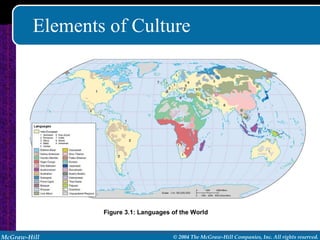
Elements of Culture Figure 3.1: Languages of the World
Elements of Culture Nonverbal Communication --Nonverbal communication is the use of gestures, facial expressions, and other visual images to communicate. --Nonverbal communication is not the same in all cultures. --Nonverbal communication is learned. Language
Elements of Culture Norms  are established standards of behavior maintained by a society. Types of Norms --Formal norms --Informal norms --Mores --Folkways Acceptance of Norms Norms
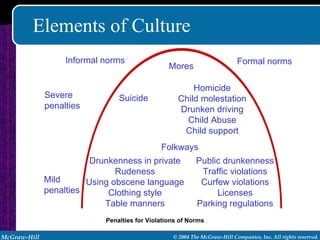
Elements of Culture Penalties for Violations of Norms Mores Formal norms Informal norms Severe penalties Suicide Homicide Child molestation Drunken driving Child Abuse Child support Public drunkenness Traffic violations Curfew violations Licenses Parking regulations Drunkenness in private Rudeness Using obscene language Clothing style Table manners Folkways Mild penalties
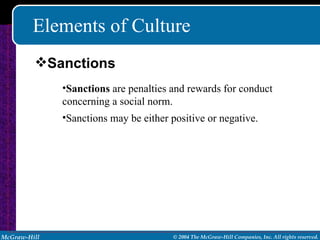
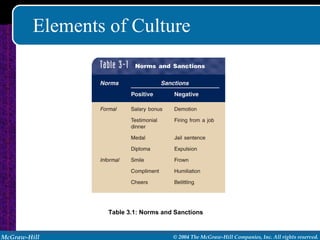
Elements of Culture Sanctions  are penalties and rewards for conduct concerning a social norm. Sanctions may be either positive or negative. Sanctions
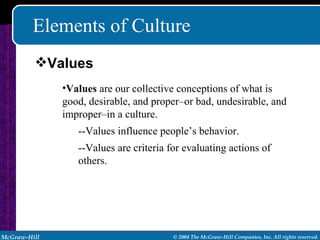
Elements of Culture Values  are our collective conceptions of what is good, desirable, and proper–or bad, undesirable, and improper–in a culture. --Values influence people’s behavior. --Values are criteria for evaluating actions of others. Values
Elements of Culture Table 3.1: Norms and Sanctions
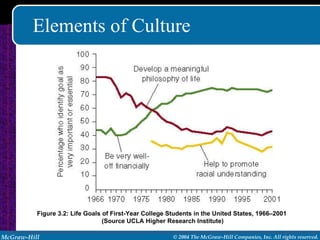
Elements of Culture Figure 3.2: Life Goals of First-Year College Students in the United States, 1966–2001  (Source UCLA Higher Research Institute)
Culture and the Dominant Ideology Dominant Ideology  describes the set of cultural beliefs and practices that help to maintain powerful social, economic, and political interests. Dominant groups control wealth and property. Dominant groups control the means of producing beliefs about reality through: --religion --education --the media Dominant Ideology
Cultural Variation Subcultures A  subculture  is a segment of society that shares a distinctive pattern of mores, folkways, and values that differs from the larger society. A subculture is a culture existing within a larger, dominant culture. Aspects of Cultural Variation
Cultural Variation Countercultures A  counterculture  is created when a subculture conspicuously and deliberately opposes certain aspects of the larger culture. Examples of countercultures: --hippies --militia groups Aspects of Cultural Variation
Cultural Variation Culture Shock Culture shock  is experienced if one feels disoriented, uncertain, out of place, or fearful when immersed in an unfamiliar culture. Aspects of Cultural Variation
Cultural Variation Ethnocentrism  is the tendency to assume that one’s own culture and way of life are superior to all others. Cultural relativism  views people’s behaviors from the perspective of their own culture. Xenocentrism  is an extension of cultural relativism; it is the belief that the products, styles, or ideas of one’s society are inferior to those that originate elsewhere. Attitudes Toward Cultural Variation
Social Policy and Culture The Issue:  Bilingualism refers to the use of two or more languages in a particular setting, such as the workplace or schoolroom. Thus, a program of bilingual education may instruct children in their native language while gradually introducing them to the language of the host society. Bilingualism
Social Policy and Culture The Setting:  Languages know no political boundaries. Minority languages are common in many nations. Schools throughout the world must deal with incoming students speaking many languages.  Do bilingual programs in the United States help these children to learn English? It is difficult to reach firm conclusions because bilingual program in general vary so widely in their approach. Bilingualism
Social Policy and Culture Sociological Insights:  For a long time, people in the United States demanded conformity to a single language. This demand coincides with the functionalist view that language serves to unify members of a society. Recent decades have seen challenges to this pattern of forced obedience to our dominant ideology. The perspective of conflict theory also helps us understand some of the attacks on bilingual programs. Bilingualism
Social Policy and Culture Policy Initiatives:  Bilingualism has policy implications largely in two areas–efforts to maintain language purity and programs to enhance bilingual education. Nations vary dramatically in their tolerance for a variety of languages. In many nations, language dominance is a regional issue. Policymakers in the United States have been somewhat ambivalent in dealing with the issue of bilingualism. Bilingualism
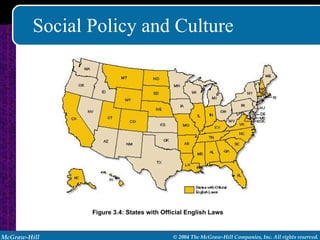
Social Policy and Culture Figure 3.4: States with Official English Laws

Chapter03

  • 1.
  • 2.
  • 3.
    Chapter Outline Cultureand Society Development of Culture Around the World Elements of Culture Culture and the Dominant Ideology Cultural Variation Social Policy and Culture: Bilingualism
  • 4.
    Culture and SocietyCulture is the totality of learned, socially transmitted customs, knowledge, material objects, and behavior. Culture includes the ideas, values, customs, and artifacts of groups of people. Sociologically, culture does not refer to fine arts or intellectual taste.
  • 5.
    Development of CultureAround the World All societies have developed certain common practices and beliefs. Cultural universals change over time and from one society to another. Cultural Universals
  • 6.
    Development of CultureAround the World Murdoch (1945) --Athletic Sports --Cooking --Funeral Ceremonies --Medicine --Sexual Restrictions among others... Cultural Universals, some examples
  • 7.
    Development of CultureAround the World The process of introducing a new idea or object to culture. Innovation may take the form of either discovery or invention. Innovations
  • 8.
    Development of CultureAround the World Globalization consists of cultural expressions and practices that cross national borders and have an effect on the traditions and customs of the societies exposed to them. Globalization is rapidly escalating throughout the world today. Globalization, Diffusion, and Technology
  • 9.
    Development of CultureAround the World Diffusion is the process by which a cultural item spreads from group to group or society to society. Diffusion can occur through a variety of means, including: --Exploration --mass media influence --Military conquest --tourism --Missionary work --the Internet Globalization, Diffusion, and Technology
  • 10.
    Development of CultureAround the World Technology can be defined as using the material resources of the environment to satisfy human needs and desires (Nolan and Lenski 1999). Technology accelerates the diffusion of scientific innovations. Technology transmits culture. Globalization, Diffusion, and Technology
  • 11.
    Development of CultureAround the World Material culture refers to the physical or technological aspects of our daily lives, including: --food --houses --factories --raw materials Globalization, Diffusion, and Technology
  • 12.
    Development of CultureAround the World Nonmaterial Culture refers to ways of using material objects as well as to: --customs --beliefs --government --patterns of communication --philosophies Globalization, Diffusion, and Technology
  • 13.
    Development of CultureAround the World Culture Lag refers to a period of maladjustment when the nonmaterial culture is still struggling to adapt to new material conditions. Globalization, Diffusion, and Technology
  • 14.
    Elements of CultureLanguage is an abstract system of word meanings and symbols for all aspects of culture. It includes speech, written characters, numerals, symbols, and gestures and expressions of nonverbal communication. Language
  • 15.
    Elements of CultureSapir-Whorf Hypothesis --Language precedes thought. --Language is not a given. --Language is culturally determined. Language
  • 16.
    Elements of CultureFigure 3.1: Languages of the World
  • 17.
    Elements of CultureNonverbal Communication --Nonverbal communication is the use of gestures, facial expressions, and other visual images to communicate. --Nonverbal communication is not the same in all cultures. --Nonverbal communication is learned. Language
  • 18.
    Elements of CultureNorms are established standards of behavior maintained by a society. Types of Norms --Formal norms --Informal norms --Mores --Folkways Acceptance of Norms Norms
  • 19.
    Elements of CulturePenalties for Violations of Norms Mores Formal norms Informal norms Severe penalties Suicide Homicide Child molestation Drunken driving Child Abuse Child support Public drunkenness Traffic violations Curfew violations Licenses Parking regulations Drunkenness in private Rudeness Using obscene language Clothing style Table manners Folkways Mild penalties
  • 20.
    Elements of CultureSanctions are penalties and rewards for conduct concerning a social norm. Sanctions may be either positive or negative. Sanctions
  • 21.
    Elements of CultureValues are our collective conceptions of what is good, desirable, and proper–or bad, undesirable, and improper–in a culture. --Values influence people’s behavior. --Values are criteria for evaluating actions of others. Values
  • 22.
    Elements of CultureTable 3.1: Norms and Sanctions
  • 23.
    Elements of CultureFigure 3.2: Life Goals of First-Year College Students in the United States, 1966–2001 (Source UCLA Higher Research Institute)
  • 24.
    Culture and theDominant Ideology Dominant Ideology describes the set of cultural beliefs and practices that help to maintain powerful social, economic, and political interests. Dominant groups control wealth and property. Dominant groups control the means of producing beliefs about reality through: --religion --education --the media Dominant Ideology
  • 25.
    Cultural Variation SubculturesA subculture is a segment of society that shares a distinctive pattern of mores, folkways, and values that differs from the larger society. A subculture is a culture existing within a larger, dominant culture. Aspects of Cultural Variation
  • 26.
    Cultural Variation CounterculturesA counterculture is created when a subculture conspicuously and deliberately opposes certain aspects of the larger culture. Examples of countercultures: --hippies --militia groups Aspects of Cultural Variation
  • 27.
    Cultural Variation CultureShock Culture shock is experienced if one feels disoriented, uncertain, out of place, or fearful when immersed in an unfamiliar culture. Aspects of Cultural Variation
  • 28.
    Cultural Variation Ethnocentrism is the tendency to assume that one’s own culture and way of life are superior to all others. Cultural relativism views people’s behaviors from the perspective of their own culture. Xenocentrism is an extension of cultural relativism; it is the belief that the products, styles, or ideas of one’s society are inferior to those that originate elsewhere. Attitudes Toward Cultural Variation
  • 29.
    Social Policy andCulture The Issue: Bilingualism refers to the use of two or more languages in a particular setting, such as the workplace or schoolroom. Thus, a program of bilingual education may instruct children in their native language while gradually introducing them to the language of the host society. Bilingualism
  • 30.
    Social Policy andCulture The Setting: Languages know no political boundaries. Minority languages are common in many nations. Schools throughout the world must deal with incoming students speaking many languages. Do bilingual programs in the United States help these children to learn English? It is difficult to reach firm conclusions because bilingual program in general vary so widely in their approach. Bilingualism
  • 31.
    Social Policy andCulture Sociological Insights: For a long time, people in the United States demanded conformity to a single language. This demand coincides with the functionalist view that language serves to unify members of a society. Recent decades have seen challenges to this pattern of forced obedience to our dominant ideology. The perspective of conflict theory also helps us understand some of the attacks on bilingual programs. Bilingualism
  • 32.
    Social Policy andCulture Policy Initiatives: Bilingualism has policy implications largely in two areas–efforts to maintain language purity and programs to enhance bilingual education. Nations vary dramatically in their tolerance for a variety of languages. In many nations, language dominance is a regional issue. Policymakers in the United States have been somewhat ambivalent in dealing with the issue of bilingualism. Bilingualism
  • 33.
    Social Policy andCulture Figure 3.4: States with Official English Laws