POST- PARTUM HAEMORRHAGE
(PPH)
GOALS
1. To recognise various degrees of obstetric

haemorrhage
2. To understand and be able to identify causes
of obstetric haemorrhage
3. To be competent in the management of PPH
DEFINITION
 1° PPH
 BLOOD LOSS FROM THE GENITAL TRACT IN EXCESS OF
500 ML IN THE FIRST 24 HOURS OF DELIVERY
 2° PPH
 EXCESSIVE BLEEDING FROM THE GENITAL TRACT AFTER
THE FIRST 24 HOURS POST PARTUM UNTIL 6 WEEKS
AFTER DELIVERY.
MAJOR CAUSE OF DEATH….
 PPH is still the largest cause of maternal death
 Over the last 6 report PPH account for 25% of all maternal
death.
PROBLEMS…
 50% associated with substandard care
 4 main factors involved;
1. Home deliveries (46.7%)
2. Delay in recognized PPH
3. Delay in resuscitating the mother
4. Delay in transportation to GH
CAUSES OF 1°PPH
A. UTERINE ATONY (TONE)
B. RETAINED PLACENTA (TISSUE)
C. TRAUMA
D. COAGULATION DEFECT (THROMBIN)
CAUSES OF 2° PPH
A.RETAINED POC
B.ENDOMETRITIS
C.PLACENTAL SITE TROPHOBLASTIC TUMOUR
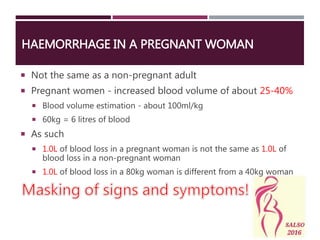
HAEMORRHAGE IN A PREGNANT WOMAN
 Not the same as a non-pregnant adult
 Pregnant women - increased blood volume of about 25-40%
 Blood volume estimation - about 100ml/kg
 60kg = 6 litres of blood
 As such
 1.0L of blood loss in a pregnant woman is not the same as 1.0L of
blood loss in a non-pregnant woman
 1.0L of blood loss in a 80kg woman is different from a 40kg woman
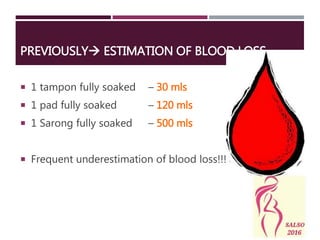
PREVIOUSLY ESTIMATION OF BLOOD LOSS
 1 tampon fully soaked – 30 mls
 1 pad fully soaked – 120 mls
 1 Sarong fully soaked – 500 mls
 Frequent underestimation of blood loss!!!
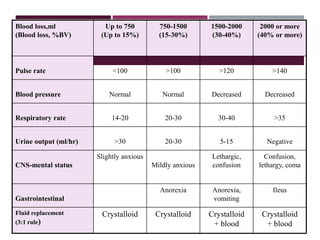
BLOOD LOSS VS VITAL SIGNS…..
Blood loss,ml
(Blood loss, %BV)
Up to 750
(Up to 15%)
750-1500
(15-30%)
1500-2000
(30-40%)
2000 or more
(40% or more)
Pulse rate <100 >100 >120 >140
Blood pressure Normal Normal Decreased Decreased
Respiratory rate 14-20 20-30 30-40 >35
Urine output (ml/hr) >30 20-30 5-15 Negative
CNS-mental status
Slightly anxious
Mildly anxious
Lethargic,
confusion
Confusion,
lethargy, coma
Gastrointestinal
Anorexia Anorexia,
vomiting
Ileus
Fluid replacement
(3:1 rule)
Crystalloid Crystalloid Crystalloid
+ blood
Crystalloid
+ blood
MANAGEMENT
I. RECOGNISE PPH
II. CALL FOR HELP (RED ALERT)
 O & G SPECIALIST
 ANAESTHETIST
 SISTER ON CALL
 BLOOD BANK/HAEMATOLOGIST
III. RESUSCITATION !
IV. IDENTIFY AND TREAT SPECIFIC CAUSE
V. DOCUMENTATION
** MUST BE DONE SIMULTANEOUSLY**
1.RESUSCITATION…
RESUSCITATION
 DONE SIMULTANEOUSLY
 ASSESS VITAL SIGNS AND CONSCIOUS LEVEL (IF
UNCONSCIOUS, FOLLOW BLS)
 2 X 14/16 G CANNULA
RESUSCITATION
 TAKE 20 ML OF BLOOD FOR
 GXM 4 UNITS PC
 FBC
 COAGULATION SCREENING
 ELECTROLYTES
 INFUSE FLUIDS (CRYSTALLOID- HM OR N/S)
 1L in 15 mins then
 1L in 30 mins then
 1L in 6 hours
 INFUSE COLLOIDS (GELAGUNDIN)
 MAINTAIN CIRCULATORY VOLUME WHILE WAITING FOR
BLOOD
 BLOOD
 To Increase oxygen delivery
 IN DIRE STATES, USE GROUP SPECIFIC BLOOD OR
UNMATCHED OR O RH –VE or RH +VE BLOOD
RESUSCITATION
 RUNNERS – SN/ HO/ MO
 CONSIDER CENTRAL LINES
 CBD FOR HOURLY MONITORING
 OXYGEN
RESUSCITATION
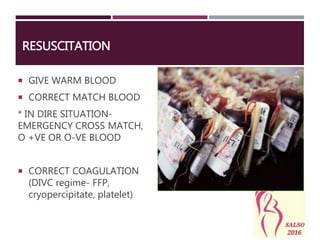
 GIVE WARM BLOOD
 CORRECT MATCH BLOOD
* IN DIRE SITUATION-
EMERGENCY CROSS MATCH,
O +VE OR O-VE BLOOD
 CORRECT COAGULATION
(DIVC regime- FFP,
cryopercipitate, platelet)
HOW TO KNOW WHETHER OUR RESUSCITATION IS
ADEQUATE?
 Adequate end organ perfussion
1. MAP
2. CVP- 2-8mmHg
3. Urine Output > 1ml/kg/H
RESUSCITATION
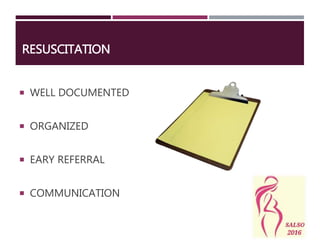
 WELL DOCUMENTED
 ORGANIZED
 EARY REFERRAL
 COMMUNICATION
2. IDENTIFY CAUSE…..
UTERINE ATONY
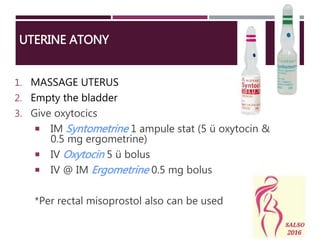
1. MASSAGE UTERUS
2. Empty the bladder
3. Give oxytocics
 IM Syntometrine 1 ampule stat (5 ü oxytocin &
0.5 mg ergometrine)
 IV Oxytocin 5 ü bolus
 IV @ IM Ergometrine 0.5 mg bolus
*Per rectal misoprostol also can be used
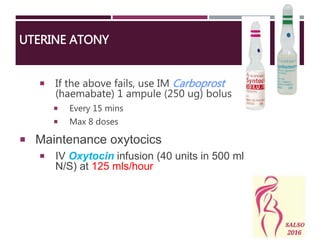
 If the above fails, use IM Carboprost
(haemabate) 1 ampule (250 ug) bolus
 Every 15 mins
 Max 8 doses
 Maintenance oxytocics
 IV Oxytocin infusion (40 units in 500 ml
N/S) at 125 mls/hour
UTERINE ATONY
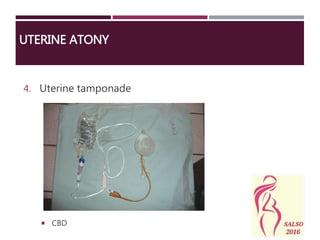
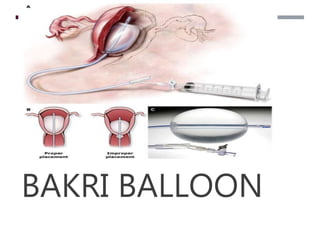
4. Uterine tamponade
UTERINE ATONY
 CBD
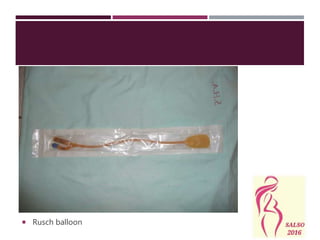
 Rusch balloon
****AVAILABLE IN DISTRICT*****
BAKRI BALLOON
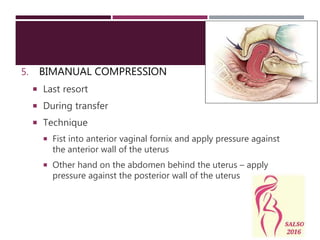
5. BIMANUAL COMPRESSION
 Last resort
 During transfer
 Technique
 Fist into anterior vaginal fornix and apply pressure against
the anterior wall of the uterus
 Other hand on the abdomen behind the uterus – apply
pressure against the posterior wall of the uterus
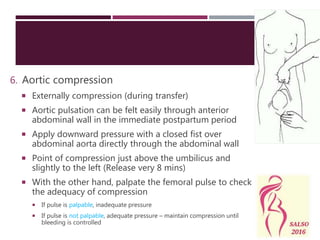
6. Aortic compression
 Externally compression (during transfer)
 Aortic pulsation can be felt easily through anterior
abdominal wall in the immediate postpartum period
 Apply downward pressure with a closed fist over
abdominal aorta directly through the abdominal wall
 Point of compression just above the umbilicus and
slightly to the left (Release very 8 mins)
 With the other hand, palpate the femoral pulse to check
the adequacy of compression
 If pulse is palpable, inadequate pressure
 If pulse is not palpable, adequate pressure – maintain compression until
bleeding is controlled
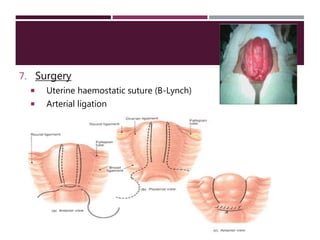
7. Surgery
 Uterine haemostatic suture (B-Lynch)
 Arterial ligation
 Hysterectomy
TISSUE
 Check for any retained tissue
 Check the completeness of placenta
 If retained tissue  MRP
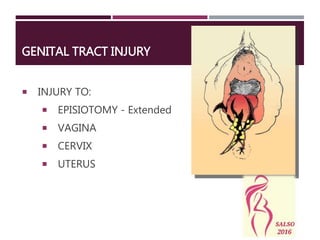
GENITAL TRACT INJURY
 INJURY TO:
 EPISIOTOMY - Extended
 VAGINA
 CERVIX
 UTERUS
GENITAL TRACT INJURY
 Examination – best under anaesthesia in OT
 In clinics
 If facilities available, repair immediately
 If not, refer hospital
 If profuse bleeding:
 Repair immediately
 Pack vagina with tampon/long gauze and transfer to
hospital immediately
 Ensure 2 large-bore IV line with fluid resuscitation
UTERINE RUPTURE
 HIGH INDEX OF SUSPICION
 Previous scar
 Grandmultipara
 Obstructed labour
 All previous scar (i.e. previous CS) – hospital delivery
unless patient presented in late 1st stage or in 2nd
stage of labour
UTERINE RUPTURE
 WHAT ARE THE SIGNS?
 Maternal tachycardia & hypotension
 Per vaginal bleeding @ haematuria
 Scar tenderness
 Decrease @ absent uterine contraction
 Fetal bradycardia/decelerations
4. THROMBIN
 Coagulation defects
 A rare cause of PPH
 Unlikely to respond to the measures previously described
 E.g.
 HELLP syndrome
 DIVC (e.g. due to pre-eclampsia, AFE, sepsis, abruption, prolonged IUD)
 Idiopathic thrombocytopenic purpura
 Thrombotic thrombocytopenic purpura
 Von Willebrand’s disease
 Hemophilia
 Don’t forget, severe haemorrhage can also cause DIVC
 Management – treat the underlying disease process and correcting
the coagulation defect
1 GOLDEN
HOUR
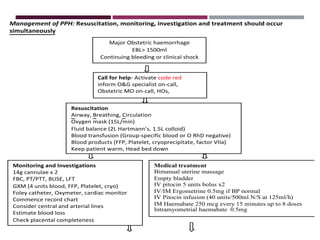
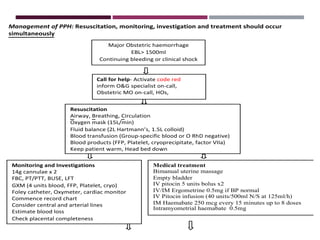
Management of PPH: Resuscitation, monitoring, investigation and treatment should occur
simultaneously
Major Obstetric haemorrhage
EBL> 1500ml
Continuing bleeding or clinical shock
Call for help- Activate code red
inform O&G specialist on-call,
Obstetric MO on-call, HOs,
anaesthetic MO
Resuscitation
Airway, Breathing, Circulation
Oxygen mask (15L/min)
Fluid balance (2L Hartmann’s, 1.5L colloid)
Blood transfusion (Group-specific blood or O RhD negative)
Blood products (FFP, Platelet, cryoprecipitate, factor VIIa)
Keep patient warm, Head bed down
Monitoring and Investigations
14g cannulae x 2
FBC, PT/PTT, BUSE, LFT
GXM (4 units blood, FFP, Platelet, cryo)
Foley catheter, Oxymeter, cardiac monitor
Commence record chart
Consider central and arterial lines
Estimate blood loss
Check placental completeness
Medical treatment
Bimanual uterine massage
Empty bladder
IV pitocin 5 units bolus x2
IV/IM Ergometrine 0.5mg if BP normal
IV Pitocin infusion (40 units/500ml N/S at 125ml/h)
IM Haemabate 250 mcg every 15 minutes up to 8 doses
Intramyometrial haemabate 0.5mg
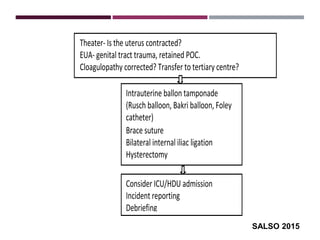
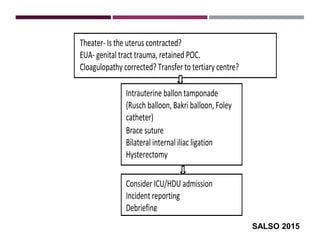
Theater- Is the uterus contracted?
EUA- genital tract trauma, retained POC.
Cloagulopathy corrected? Transfer to tertiary centre?
Intrauterine ballon tamponade
(Rusch balloon, Bakri balloon, Foley
catheter)
Brace suture
Bilateral internal iliac ligation
Hysterectomy
Consider ICU/HDU admission
Incident reporting
Debriefing
SALSO 2015
“PPH BOX”
 SYRINGES, BRANULA
 INVESTIGATION FORM
 GUIDELINES AND PROTOCOL FOR PPH MANAGEMENT
 MONITORING CHART
 OXYTOCIC DRUG
 CBD,BALLOON
 STABILIZING AND
INITIAL
RESUSCITATION
MUST BE DONE FIRST
1 GOLDEN HOUR
 IN DH DECISION FOR
REFERRAL MUST BE
MADE EARLY
 DURING
TRANSPORTATION
 MONITORING
 RESUSCITATION
 TEMPORARY
MEASURE
 COMMUNICATION
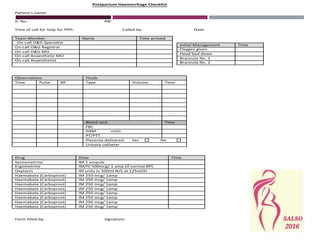
DOCUMENTATION…
Postpartum Haemorrhage Checklist
Patient’s name:
IC No: RN:
Time of call for help for PPH: Called by: Date:
Team Member Name Time arrived
On-call O&G Specialist
On-call O&G Registrar
On-call O&G MO
On-call Anaesthetic MO
On-call Anaesthetist
Observations Fluids
Time Pulse BP Type Volume Time
Blood sent Time
FBC
GXM units
PT/PTT
Placenta delivered Yes No
Urinary catheter
Drug Dose TIme
Syntometrine IM 1 ampule
Ergometrine IM/IV 500mcg/ 1 amp (if normal BP)
Oxytocin 40 units in 500ml N/S at 125ml/H
Haemabate (Carboprost) IM 250 mcg/ 1amp
Form filled by: Signature:
Initial Management Time
Oxygen given
Head bed down
Brannula No. 1
Brannula No. 2
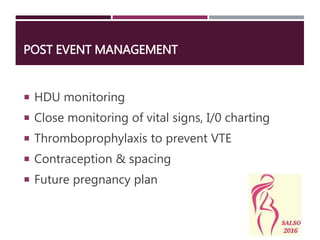
POST EVENT MANAGEMENT
 HDU monitoring
 Close monitoring of vital signs, I/0 charting
 Thromboprophylaxis to prevent VTE
 Contraception & spacing
 Future pregnancy plan
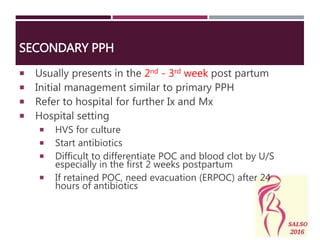
SECONDARY PPH…
SECONDARY PPH
 Usually presents in the 2nd - 3rd week post partum
 Initial management similar to primary PPH
 Refer to hospital for further Ix and Mx
 Hospital setting
 HVS for culture
 Start antibiotics
 Difficult to differentiate POC and blood clot by U/S
especially in the first 2 weeks postpartum
 If retained POC, need evacuation (ERPOC) after 24
hours of antibiotics
SUMMARY….
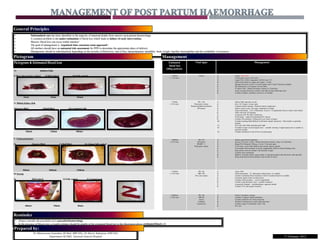
• Substandard care has been identified in the majority of maternal deaths from massive post partum haemorrhage.
• A common problem is the under-estimation of blood loss which leads to failure of early intervention.
• Massive blood loss can occur within minutes!
• The goal of management is ‘organized time conscious team approach’.
• All mothers should have an antenatal risk assessment for PPH to determine the appropriate place of delivery.
• Management should be individualized depending on the severity of blood loss, rate of loss, haemodynamic instability, body weight, baseline haemoglobin and the availability of resources.
• Active interventions in the “golden hour” is critical
Dr Muniswaran Ganeshan (M.Med, MRCOG), Dr Harris Suharjono (FRCOG)
Department Of O&G, Sarawak General Hospital
(
• Always consider the possibility of a concealed haemorrhage.
• In the presence of blood clots, a rough estimate should be double of the estimated blood lost in the illustration above (estimated blood x 2)
General Principles
Pictogram
Prepared by:
Reminder
Pictogram & Estimated Blood loss
A) Sanitary Pads
i) More then quarter soaked ii) Half soaked iii) Fully soaked
20mls 50mls 100mls
B) 500mls Kidney dish
i)Quarter filled ii)Half filled iii) Completely full
100mls 250mls 500mls
C ) Linen protectors
d) Quarter filled ii) Half filled iii) Almost fully soaked
500mls 1000mls 1500mls
D) Sarong
d) Half soaked ii) Fully soaked E) Vaginal pack
400mls 700mls 80mls
Estimated
blood loss
(60kg patient)
Vital signs Management
> 500mls
(< 15% loss)
Normal 1) Initiate “Red Alert”
2) 2 Intravenous access (14G /16G)
3) Urgent FBC, GXM, Coagulation, BUSE/Creat, LFT
4) Inform blood bank for urgent cross match – 4 units
5) Massage the uterus! Atony? Cervical/Vaginal tears? Check if placenta complete.
6) IM syntometrine or IV pitocin 5iu slow bolus
7) IV pitocin 40iu / 500mls Hartmanns solution at 125mls/hour
8) Assess on going blood loss, monitor vital signs & treat underlying cause.
9) In district hospital: ambulance and driver on standby!
>750mls
(<35% loss)
PR> 100
Weak pulse volume
Reduced peripheral perfusion
BP normal
1) Inform O&G specialist on-call
2) Give 15L Oxygen via face mask
3) Continue uterine massage / bimanual uterine compression
4) Staff to record events, vital signs, medications & fluids.
5) Fluid resuscitation – 2.0L of Hartmanns & up to 1.5L gelafundin/voluven (infuse warm fluids).
6) CBD, with strict I/O charting.
7) Continuous BP, PR, SPO2 monitoring.
8) If still atonic – repeat IM syntometrine/IV pitocin
9) Consider IM carboprost 250mcg stat or per rectal cervagem
10) Consider inserting Bakri Balloon if still atonic despite uterotonics. Then transfer to specialist
hospital.
11) EUA only after O&G specialist green light
12) If unable to repair cervical/vaginal tears – consider inserting 2 vaginal packs prior to transfer to
specialist hospital
13) Consider transfusion if rate of loss is not decreasing
>1000mls
(<35% loss)
PR>110
BP normal
PR/SBP > 1
Weak pulse volume
1) Initiate urgent blood transfusion
2) Increase IV pitocin to 80iu / 500mls Hartmanns Solution, infuse at 125mls/hour.
3) Repeat IM Carboprost 250mcg x 4 every 15 minutes apart.
4) If still atonic, insert Bakri Balloon then transfer patient urgently
5) Can consider blood products & correct coagulopathy based on clinical findings alone
6) Keep patient warm & continue with facemask oxygen.
7) Continue close monitoring
8) Stabilize if possible before urgent transfer to specialist hospital after discussion with specialist.
9) Bring along blood & blood products and escorted by doctor
>1500mls
(> 35% loss)
PR>120
SBP<100
Poor urine output
1) Assess ABC
2) Fluid resuscitation – 2L Hartmanns solution then 1.5L colloids
3) Consider unmatched blood transfusion ASAP if matched blood not available.
4) Uterotonic agents if have not been given.
5) Transfuse blood products – correct coagulopathy
6) Transfer using the fastest route…(consider medevac)
7) In specialist hospitals – multidisciplinary approach needed
8) Consider EUA and surgical measures.
2000mls
(> 40% loss)
PR>140
SPB<80
Anuria
Confused
Unconscious
1) Inform Consultant in charge
2) Consider O negative blood transfusion.
3) Consider intubation for airway protection
4) Decide for hysterectomy sooner rather then later.
5) Consider usage of recombinant factor VIIa
6) ICU care
Management
1st February 2012
Management of PPH: Resuscitation, monitoring, investigation and treatment should occur
simultaneously
Major Obstetric haemorrhage
EBL> 1500ml
Continuing bleeding or clinical shock
Call for help- Activate code red
inform O&G specialist on-call,
Obstetric MO on-call, HOs,
anaesthetic MO
Resuscitation
Airway, Breathing, Circulation
Oxygen mask (15L/min)
Fluid balance (2L Hartmann’s, 1.5L colloid)
Blood transfusion (Group-specific blood or O RhD negative)
Blood products (FFP, Platelet, cryoprecipitate, factor VIIa)
Keep patient warm, Head bed down
Monitoring and Investigations
14g cannulae x 2
FBC, PT/PTT, BUSE, LFT
GXM (4 units blood, FFP, Platelet, cryo)
Foley catheter, Oxymeter, cardiac monitor
Commence record chart
Consider central and arterial lines
Estimate blood loss
Check placental completeness
Medical treatment
Bimanual uterine massage
Empty bladder
IV pitocin 5 units bolus x2
IV/IM Ergometrine 0.5mg if BP normal
IV Pitocin infusion (40 units/500ml N/S at 125ml/h)
IM Haemabate 250 mcg every 15 minutes up to 8 doses
Intramyometrial haemabate 0.5mg
Theater- Is the uterus contracted?
EUA- genital tract trauma, retained POC.
Cloagulopathy corrected? Transfer to tertiary centre?
Intrauterine ballon tamponade
(Rusch balloon, Bakri balloon, Foley
catheter)
Brace suture
Bilateral internal iliac ligation
Hysterectomy
Consider ICU/HDU admission
Incident reporting
Debriefing
SALSO 2015
Pph 2016

Pph 2016

  • 1.
  • 2.
    GOALS 1. To recognisevarious degrees of obstetric haemorrhage 2. To understand and be able to identify causes of obstetric haemorrhage 3. To be competent in the management of PPH
  • 3.
    DEFINITION  1° PPH BLOOD LOSS FROM THE GENITAL TRACT IN EXCESS OF 500 ML IN THE FIRST 24 HOURS OF DELIVERY  2° PPH  EXCESSIVE BLEEDING FROM THE GENITAL TRACT AFTER THE FIRST 24 HOURS POST PARTUM UNTIL 6 WEEKS AFTER DELIVERY.
  • 4.
    MAJOR CAUSE OFDEATH….  PPH is still the largest cause of maternal death  Over the last 6 report PPH account for 25% of all maternal death.
  • 5.
    PROBLEMS…  50% associatedwith substandard care  4 main factors involved; 1. Home deliveries (46.7%) 2. Delay in recognized PPH 3. Delay in resuscitating the mother 4. Delay in transportation to GH
  • 7.
    CAUSES OF 1°PPH A.UTERINE ATONY (TONE) B. RETAINED PLACENTA (TISSUE) C. TRAUMA D. COAGULATION DEFECT (THROMBIN)
  • 8.
    CAUSES OF 2°PPH A.RETAINED POC B.ENDOMETRITIS C.PLACENTAL SITE TROPHOBLASTIC TUMOUR
  • 9.
    HAEMORRHAGE IN APREGNANT WOMAN  Not the same as a non-pregnant adult  Pregnant women - increased blood volume of about 25-40%  Blood volume estimation - about 100ml/kg  60kg = 6 litres of blood  As such  1.0L of blood loss in a pregnant woman is not the same as 1.0L of blood loss in a non-pregnant woman  1.0L of blood loss in a 80kg woman is different from a 40kg woman
  • 10.
    PREVIOUSLY ESTIMATION OFBLOOD LOSS  1 tampon fully soaked – 30 mls  1 pad fully soaked – 120 mls  1 Sarong fully soaked – 500 mls  Frequent underestimation of blood loss!!!
  • 11.
    BLOOD LOSS VSVITAL SIGNS…..
  • 12.
    Blood loss,ml (Blood loss,%BV) Up to 750 (Up to 15%) 750-1500 (15-30%) 1500-2000 (30-40%) 2000 or more (40% or more) Pulse rate <100 >100 >120 >140 Blood pressure Normal Normal Decreased Decreased Respiratory rate 14-20 20-30 30-40 >35 Urine output (ml/hr) >30 20-30 5-15 Negative CNS-mental status Slightly anxious Mildly anxious Lethargic, confusion Confusion, lethargy, coma Gastrointestinal Anorexia Anorexia, vomiting Ileus Fluid replacement (3:1 rule) Crystalloid Crystalloid Crystalloid + blood Crystalloid + blood
  • 13.
    MANAGEMENT I. RECOGNISE PPH II.CALL FOR HELP (RED ALERT)  O & G SPECIALIST  ANAESTHETIST  SISTER ON CALL  BLOOD BANK/HAEMATOLOGIST III. RESUSCITATION ! IV. IDENTIFY AND TREAT SPECIFIC CAUSE V. DOCUMENTATION ** MUST BE DONE SIMULTANEOUSLY**
  • 14.
  • 15.
    RESUSCITATION  DONE SIMULTANEOUSLY ASSESS VITAL SIGNS AND CONSCIOUS LEVEL (IF UNCONSCIOUS, FOLLOW BLS)  2 X 14/16 G CANNULA
  • 16.
    RESUSCITATION  TAKE 20ML OF BLOOD FOR  GXM 4 UNITS PC  FBC  COAGULATION SCREENING  ELECTROLYTES
  • 17.
     INFUSE FLUIDS(CRYSTALLOID- HM OR N/S)  1L in 15 mins then  1L in 30 mins then  1L in 6 hours  INFUSE COLLOIDS (GELAGUNDIN)  MAINTAIN CIRCULATORY VOLUME WHILE WAITING FOR BLOOD  BLOOD  To Increase oxygen delivery  IN DIRE STATES, USE GROUP SPECIFIC BLOOD OR UNMATCHED OR O RH –VE or RH +VE BLOOD
  • 18.
    RESUSCITATION  RUNNERS –SN/ HO/ MO  CONSIDER CENTRAL LINES  CBD FOR HOURLY MONITORING  OXYGEN
  • 19.
    RESUSCITATION  GIVE WARMBLOOD  CORRECT MATCH BLOOD * IN DIRE SITUATION- EMERGENCY CROSS MATCH, O +VE OR O-VE BLOOD  CORRECT COAGULATION (DIVC regime- FFP, cryopercipitate, platelet)
  • 20.
    HOW TO KNOWWHETHER OUR RESUSCITATION IS ADEQUATE?  Adequate end organ perfussion 1. MAP 2. CVP- 2-8mmHg 3. Urine Output > 1ml/kg/H
  • 21.
    RESUSCITATION  WELL DOCUMENTED ORGANIZED  EARY REFERRAL  COMMUNICATION
  • 22.
  • 23.
    UTERINE ATONY 1. MASSAGEUTERUS 2. Empty the bladder 3. Give oxytocics  IM Syntometrine 1 ampule stat (5 ü oxytocin & 0.5 mg ergometrine)  IV Oxytocin 5 ü bolus  IV @ IM Ergometrine 0.5 mg bolus *Per rectal misoprostol also can be used
  • 24.
     If theabove fails, use IM Carboprost (haemabate) 1 ampule (250 ug) bolus  Every 15 mins  Max 8 doses  Maintenance oxytocics  IV Oxytocin infusion (40 units in 500 ml N/S) at 125 mls/hour UTERINE ATONY
  • 25.
  • 26.
  • 27.
  • 28.
    5. BIMANUAL COMPRESSION Last resort  During transfer  Technique  Fist into anterior vaginal fornix and apply pressure against the anterior wall of the uterus  Other hand on the abdomen behind the uterus – apply pressure against the posterior wall of the uterus
  • 29.
    6. Aortic compression Externally compression (during transfer)  Aortic pulsation can be felt easily through anterior abdominal wall in the immediate postpartum period  Apply downward pressure with a closed fist over abdominal aorta directly through the abdominal wall  Point of compression just above the umbilicus and slightly to the left (Release very 8 mins)  With the other hand, palpate the femoral pulse to check the adequacy of compression  If pulse is palpable, inadequate pressure  If pulse is not palpable, adequate pressure – maintain compression until bleeding is controlled
  • 30.
    7. Surgery  Uterinehaemostatic suture (B-Lynch)  Arterial ligation  Hysterectomy
  • 31.
    TISSUE  Check forany retained tissue  Check the completeness of placenta  If retained tissue  MRP
  • 32.
    GENITAL TRACT INJURY INJURY TO:  EPISIOTOMY - Extended  VAGINA  CERVIX  UTERUS
  • 33.
    GENITAL TRACT INJURY Examination – best under anaesthesia in OT  In clinics  If facilities available, repair immediately  If not, refer hospital  If profuse bleeding:  Repair immediately  Pack vagina with tampon/long gauze and transfer to hospital immediately  Ensure 2 large-bore IV line with fluid resuscitation
  • 34.
    UTERINE RUPTURE  HIGHINDEX OF SUSPICION  Previous scar  Grandmultipara  Obstructed labour  All previous scar (i.e. previous CS) – hospital delivery unless patient presented in late 1st stage or in 2nd stage of labour
  • 35.
    UTERINE RUPTURE  WHATARE THE SIGNS?  Maternal tachycardia & hypotension  Per vaginal bleeding @ haematuria  Scar tenderness  Decrease @ absent uterine contraction  Fetal bradycardia/decelerations
  • 36.
    4. THROMBIN  Coagulationdefects  A rare cause of PPH  Unlikely to respond to the measures previously described  E.g.  HELLP syndrome  DIVC (e.g. due to pre-eclampsia, AFE, sepsis, abruption, prolonged IUD)  Idiopathic thrombocytopenic purpura  Thrombotic thrombocytopenic purpura  Von Willebrand’s disease  Hemophilia  Don’t forget, severe haemorrhage can also cause DIVC  Management – treat the underlying disease process and correcting the coagulation defect
  • 37.
  • 38.
    Management of PPH:Resuscitation, monitoring, investigation and treatment should occur simultaneously Major Obstetric haemorrhage EBL> 1500ml Continuing bleeding or clinical shock Call for help- Activate code red inform O&G specialist on-call, Obstetric MO on-call, HOs, anaesthetic MO Resuscitation Airway, Breathing, Circulation Oxygen mask (15L/min) Fluid balance (2L Hartmann’s, 1.5L colloid) Blood transfusion (Group-specific blood or O RhD negative) Blood products (FFP, Platelet, cryoprecipitate, factor VIIa) Keep patient warm, Head bed down Monitoring and Investigations 14g cannulae x 2 FBC, PT/PTT, BUSE, LFT GXM (4 units blood, FFP, Platelet, cryo) Foley catheter, Oxymeter, cardiac monitor Commence record chart Consider central and arterial lines Estimate blood loss Check placental completeness Medical treatment Bimanual uterine massage Empty bladder IV pitocin 5 units bolus x2 IV/IM Ergometrine 0.5mg if BP normal IV Pitocin infusion (40 units/500ml N/S at 125ml/h) IM Haemabate 250 mcg every 15 minutes up to 8 doses Intramyometrial haemabate 0.5mg
  • 39.
    Theater- Is theuterus contracted? EUA- genital tract trauma, retained POC. Cloagulopathy corrected? Transfer to tertiary centre? Intrauterine ballon tamponade (Rusch balloon, Bakri balloon, Foley catheter) Brace suture Bilateral internal iliac ligation Hysterectomy Consider ICU/HDU admission Incident reporting Debriefing SALSO 2015
  • 40.
    “PPH BOX”  SYRINGES,BRANULA  INVESTIGATION FORM  GUIDELINES AND PROTOCOL FOR PPH MANAGEMENT  MONITORING CHART  OXYTOCIC DRUG  CBD,BALLOON
  • 41.
     STABILIZING AND INITIAL RESUSCITATION MUSTBE DONE FIRST 1 GOLDEN HOUR  IN DH DECISION FOR REFERRAL MUST BE MADE EARLY
  • 42.
     DURING TRANSPORTATION  MONITORING RESUSCITATION  TEMPORARY MEASURE  COMMUNICATION
  • 43.
  • 44.
    Postpartum Haemorrhage Checklist Patient’sname: IC No: RN: Time of call for help for PPH: Called by: Date: Team Member Name Time arrived On-call O&G Specialist On-call O&G Registrar On-call O&G MO On-call Anaesthetic MO On-call Anaesthetist Observations Fluids Time Pulse BP Type Volume Time Blood sent Time FBC GXM units PT/PTT Placenta delivered Yes No Urinary catheter Drug Dose TIme Syntometrine IM 1 ampule Ergometrine IM/IV 500mcg/ 1 amp (if normal BP) Oxytocin 40 units in 500ml N/S at 125ml/H Haemabate (Carboprost) IM 250 mcg/ 1amp Haemabate (Carboprost) IM 250 mcg/ 1amp Haemabate (Carboprost) IM 250 mcg/ 1amp Haemabate (Carboprost) IM 250 mcg/ 1amp Haemabate (Carboprost) IM 250 mcg/ 1amp Haemabate (Carboprost) IM 250 mcg/ 1amp Haemabate (Carboprost) IM 250 mcg/ 1amp Haemabate (Carboprost) IM 250 mcg/ 1amp Form filled by: Signature: Initial Management Time Oxygen given Head bed down Brannula No. 1 Brannula No. 2
  • 45.
    POST EVENT MANAGEMENT HDU monitoring  Close monitoring of vital signs, I/0 charting  Thromboprophylaxis to prevent VTE  Contraception & spacing  Future pregnancy plan
  • 46.
  • 47.
    SECONDARY PPH  Usuallypresents in the 2nd - 3rd week post partum  Initial management similar to primary PPH  Refer to hospital for further Ix and Mx  Hospital setting  HVS for culture  Start antibiotics  Difficult to differentiate POC and blood clot by U/S especially in the first 2 weeks postpartum  If retained POC, need evacuation (ERPOC) after 24 hours of antibiotics
  • 48.
  • 49.
    • Substandard carehas been identified in the majority of maternal deaths from massive post partum haemorrhage. • A common problem is the under-estimation of blood loss which leads to failure of early intervention. • Massive blood loss can occur within minutes! • The goal of management is ‘organized time conscious team approach’. • All mothers should have an antenatal risk assessment for PPH to determine the appropriate place of delivery. • Management should be individualized depending on the severity of blood loss, rate of loss, haemodynamic instability, body weight, baseline haemoglobin and the availability of resources. • Active interventions in the “golden hour” is critical Dr Muniswaran Ganeshan (M.Med, MRCOG), Dr Harris Suharjono (FRCOG) Department Of O&G, Sarawak General Hospital ( • Always consider the possibility of a concealed haemorrhage. • In the presence of blood clots, a rough estimate should be double of the estimated blood lost in the illustration above (estimated blood x 2) General Principles Pictogram Prepared by: Reminder Pictogram & Estimated Blood loss A) Sanitary Pads i) More then quarter soaked ii) Half soaked iii) Fully soaked 20mls 50mls 100mls B) 500mls Kidney dish i)Quarter filled ii)Half filled iii) Completely full 100mls 250mls 500mls C ) Linen protectors d) Quarter filled ii) Half filled iii) Almost fully soaked 500mls 1000mls 1500mls D) Sarong d) Half soaked ii) Fully soaked E) Vaginal pack 400mls 700mls 80mls Estimated blood loss (60kg patient) Vital signs Management > 500mls (< 15% loss) Normal 1) Initiate “Red Alert” 2) 2 Intravenous access (14G /16G) 3) Urgent FBC, GXM, Coagulation, BUSE/Creat, LFT 4) Inform blood bank for urgent cross match – 4 units 5) Massage the uterus! Atony? Cervical/Vaginal tears? Check if placenta complete. 6) IM syntometrine or IV pitocin 5iu slow bolus 7) IV pitocin 40iu / 500mls Hartmanns solution at 125mls/hour 8) Assess on going blood loss, monitor vital signs & treat underlying cause. 9) In district hospital: ambulance and driver on standby! >750mls (<35% loss) PR> 100 Weak pulse volume Reduced peripheral perfusion BP normal 1) Inform O&G specialist on-call 2) Give 15L Oxygen via face mask 3) Continue uterine massage / bimanual uterine compression 4) Staff to record events, vital signs, medications & fluids. 5) Fluid resuscitation – 2.0L of Hartmanns & up to 1.5L gelafundin/voluven (infuse warm fluids). 6) CBD, with strict I/O charting. 7) Continuous BP, PR, SPO2 monitoring. 8) If still atonic – repeat IM syntometrine/IV pitocin 9) Consider IM carboprost 250mcg stat or per rectal cervagem 10) Consider inserting Bakri Balloon if still atonic despite uterotonics. Then transfer to specialist hospital. 11) EUA only after O&G specialist green light 12) If unable to repair cervical/vaginal tears – consider inserting 2 vaginal packs prior to transfer to specialist hospital 13) Consider transfusion if rate of loss is not decreasing >1000mls (<35% loss) PR>110 BP normal PR/SBP > 1 Weak pulse volume 1) Initiate urgent blood transfusion 2) Increase IV pitocin to 80iu / 500mls Hartmanns Solution, infuse at 125mls/hour. 3) Repeat IM Carboprost 250mcg x 4 every 15 minutes apart. 4) If still atonic, insert Bakri Balloon then transfer patient urgently 5) Can consider blood products & correct coagulopathy based on clinical findings alone 6) Keep patient warm & continue with facemask oxygen. 7) Continue close monitoring 8) Stabilize if possible before urgent transfer to specialist hospital after discussion with specialist. 9) Bring along blood & blood products and escorted by doctor >1500mls (> 35% loss) PR>120 SBP<100 Poor urine output 1) Assess ABC 2) Fluid resuscitation – 2L Hartmanns solution then 1.5L colloids 3) Consider unmatched blood transfusion ASAP if matched blood not available. 4) Uterotonic agents if have not been given. 5) Transfuse blood products – correct coagulopathy 6) Transfer using the fastest route…(consider medevac) 7) In specialist hospitals – multidisciplinary approach needed 8) Consider EUA and surgical measures. 2000mls (> 40% loss) PR>140 SPB<80 Anuria Confused Unconscious 1) Inform Consultant in charge 2) Consider O negative blood transfusion. 3) Consider intubation for airway protection 4) Decide for hysterectomy sooner rather then later. 5) Consider usage of recombinant factor VIIa 6) ICU care Management 1st February 2012
  • 50.
    Management of PPH:Resuscitation, monitoring, investigation and treatment should occur simultaneously Major Obstetric haemorrhage EBL> 1500ml Continuing bleeding or clinical shock Call for help- Activate code red inform O&G specialist on-call, Obstetric MO on-call, HOs, anaesthetic MO Resuscitation Airway, Breathing, Circulation Oxygen mask (15L/min) Fluid balance (2L Hartmann’s, 1.5L colloid) Blood transfusion (Group-specific blood or O RhD negative) Blood products (FFP, Platelet, cryoprecipitate, factor VIIa) Keep patient warm, Head bed down Monitoring and Investigations 14g cannulae x 2 FBC, PT/PTT, BUSE, LFT GXM (4 units blood, FFP, Platelet, cryo) Foley catheter, Oxymeter, cardiac monitor Commence record chart Consider central and arterial lines Estimate blood loss Check placental completeness Medical treatment Bimanual uterine massage Empty bladder IV pitocin 5 units bolus x2 IV/IM Ergometrine 0.5mg if BP normal IV Pitocin infusion (40 units/500ml N/S at 125ml/h) IM Haemabate 250 mcg every 15 minutes up to 8 doses Intramyometrial haemabate 0.5mg
  • 51.
    Theater- Is theuterus contracted? EUA- genital tract trauma, retained POC. Cloagulopathy corrected? Transfer to tertiary centre? Intrauterine ballon tamponade (Rusch balloon, Bakri balloon, Foley catheter) Brace suture Bilateral internal iliac ligation Hysterectomy Consider ICU/HDU admission Incident reporting Debriefing SALSO 2015