

Dr. Rafi Rozan
Consultant Specialist OBGYN
Associate Professor
Fellow REI
Obstetrician & Gynecologist (DM)
Comprehensive Family Medicine (Masters)
Mastology & Cosmetic Gynecology.
Medical Technology
Biophysical Profile
Don't judge each day by the harvest you reap
but by the seeds that you plant.
-Robert Louis Stevenson
OUTLINE
• Introduction to BPP
• Indications
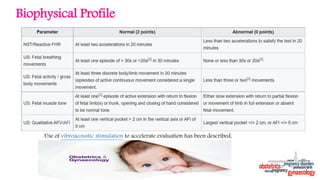
• Physiologic Basis of Biophysical Profile
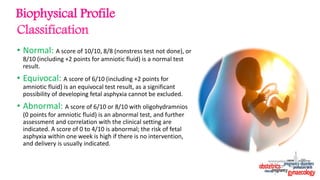
• Determining the Biophysical Profile Score
• Alternatives – Modified BPP
• Interpretation
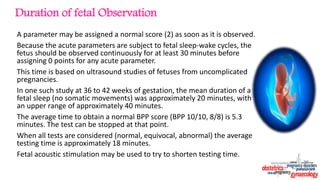
• Factors Potentially Affecting the Scores
• Testing Schedule
• Evidence of Efficacy
• Recommendations
The fetal biophysical profile (BPP) is a noninvasive, easily learned and
performed antepartum test for evaluating fetal well-being.
Ultrasound is used to assess four discrete biophysical parameters.
A separate nonstress test of the fetal heart rate can also be performed as a
component of the BPP.
Each of the four ultrasound parameters and the nonstress test are assigned a
score of either 0 or 2 points (there is no 1 point), depending upon whether
specific criteria are met.
A total score ≥8 is a strong indicator that fetal oxygen levels and acid-base
status are normal and the fetal brain is well perfused and oxygenated, whereas
a score ≤4 can be a sign of fetal compromise.
Ideally, identification of a compromised fetus will make it possible for the
provider to perform interventions that prevent adverse fetal/neonatal
sequelae.
Biophysical Profile
The five biophysical parameters were chosen based upon their ease of
measurement and the ability to evaluate them objectively using universally
available equipment.
Other fetal biophysical activities (eg, sucking, eye movements, swallowing,
micturition) might serve equally well as markers of fetal health but are not
included in the BPP because measurement is more difficult and may be
subjective.
Biophysical Profile
INDICATIONS
Antepartum fetal surveillance with
tests such as the biophysical profile
for pregnancies is indicated in
pregnancies at increased risk of
antepartum fetal demise.
Specific conditions and clinical
settings that may be indications for
antenatal fetal assessment is
ultimately based on the clinical
judgment of the provider.
PHYSIOLOGIC BASIS OF THE
BIOPHYSICAL PROFILE
All fetal biophysical activities are regulated
by discrete centers in the brain that are
sensitive to both local factors and feedback
from peripheral sensors.
The degree of fall in oxygen concentration
necessary to abolish a given central
nervous system regulatory center output
and thereby reduce fetal oxygen
requirements varies by center.
The two most oxygen-sensitive centers are:
(1) The cardioregulatory neurons, which control the coupling of fetal movement and heart
rate acceleration.
(2) The fetal breathing center neurons, which control fetal breathing movements.
The centers regulating fetal breathing and fetal heart rate (FHR) accelerations can be affected
by mild hypoxemia, fetal movement has a higher threshold before being affected by
hypoxemia, and the fetal tone center has the highest threshold.
Thus, these fetal biophysical activities respond to hypoxemia in a predictable, physiologically
based cascade: loss of fetal breathing movements and FHR accelerations, followed by
decreased fetal movement, and finally loss of fetal tone. This sequence is informative clinically
since it allows for estimation of both the presence and severity of hypoxemia.
PHYSIOLOGIC BASIS OF THE
BIOPHYSICAL PROFILE
The BPP with a nonstress test assesses five discrete biophysical parameters that
reflect central nervous system regulatory output and thus indirectly reflect the
integrity of the regulatory center.
Four of these parameters reflect acute fetal status: fetal breathing movements,
generalized fetal movements, fetal tone, and FHR accelerations in response to fetal
movements (nonstress test).
When most of the acute parameters are present, the brain’s regulatory center is
likely to be intact, and pathologic conditions, such as hypoxemia leading to
acidemia, can be reliably excluded.
PHYSIOLOGIC BASIS OF THE
BIOPHYSICAL PROFILE
When most of the acute parameters are absent, the reason for the absent
biophysical activity needs to be assessed.
- A deep stage of normal quiet sleep is a benign etiology, although it is unusual to
observe the absence of two or more acute parameters as a consequence of quiet
sleep alone.
- Transplacental passage of drugs that cause general suppression of the brain, such as
sedatives and opiates, is another benign etiology.
-The more acute parameters that are absent (ie, the lower the BPP score), the less
likely the change is due to a sleep state.
-The longer the absence of acute parameters, the more likely the cause is pathologic.
Extending the observation period to encompass the usual duration of sleep state cycles
(20 to 60 minutes) minimizes the possibility of misdiagnosis of pathologic versus
physiologic fetal conditions.
Amniotic fluid
volume
This is a nonacute parameter since decreases in amniotic fluid volume in
response to chronic uteroplacental vascular insufficiency generally occur
gradually.
Fetal urine is the predominant source of amniotic fluid after approximately
16 weeks of gestation.
Fetal urine production is primarily dependent upon renal perfusion, which in
turn reflects selective distribution of cardiac output.
The fetus responds to sustained hypoxemia by selective redistribution of its
cardiac output, with preferential flow directed to the brain, heart, adrenals,
and placenta at the expense of all other organ systems.
This protective mechanism is initiated by specialized chemoreceptors in the
aortic arch and carotid arteries.
Hypoxemia-induced reflex redistribution of cardiac output away from
the kidneys results in diminished fetal urine production, ultimately
leading to oligohydramnios and then anhydramnios.
Theoretically, a decrease in fetal swallowing, which removes amniotic
fluid, could compensate for the decrease in urine production, but fetal
swallowing is a vegetative reflex that is very resistant to the effects of
hypoxemia.
The time for development of oligohydramnios is usually relatively long.
On average, it takes approximately 15 days for a fetus to progress from
normal to reduced amniotic fluid volume (in the absence of membrane
rupture) and 23 days to develop severe oligohydramnios.
However, acute changes in amniotic fluid volume and rapid
deterioration of the BPP score have been reported
Amniotic fluid
volume
DETERMINING THE BIOPHYSICAL PROFILE SCORE
Assigning points — The composite BPP score is derived from five fetal parameters:
four acute parameters (heart rate accelerations in response to movement
[nonstress test], breathing movement, body and limb movement, tone) and one
chronic parameter (amniotic fluid volume).
Each of these five parameters has been evaluated independently with the
normal characteristic defined.
The scoring method used for each parameter is binary (ie, the parameter is
either normal or abnormal; gradations of abnormality are not used).
A normal parameter is assigned a score of 2 and an abnormal parameter is
assigned a score of 0.
The maximum score is 10/10 and the minimum score is 0/10.
Pathologic conditions that should not be confused with normal fetal
activity include the following:
•Monotonous picket-fence breathing or
gasping should not be considered normal
breathing movements
•Seizures should not be counted as normal
fetal limb movements
•Sinusoidal fetal heart rate (FHR) on the
nonstress test should not be confused with
normal long-term variability
DETERMINING THE BIOPHYSICAL PROFILE SCORE
Biophysical Profile
The score of a BPP is termed Manning's score
Criteria for the biophysical profile test
1. Nonstress test: 2 points if reactive, defined as at least 2 episodes of FHR accelerations of at
least 15 bpm and at least 15 seconds duration from onset to return associated with fetal
movement (Category 1).
2. Fetal breathing movements: 2 points if one or more episodes of rhythmic breathing
movements of ≥30 seconds within a 30-minute observation period.
3. Fetal tone: 2 points if one or more episodes of extension of a fetal extremity
or fetal spine with return to flexion.
4. Amniotic fluid volume: 2 points if a single deepest vertical pocket ≥2 cm is present.
The horizontal dimension should be at least 1 cm.
5. Fetal movement: 2 points if three or more discrete body or limb movements within 30 minutes
of observation. An episode of active continuous movement is counted as one movement.
Zero points are assigned for any criteria not met.
Classification
• Normal: A score of 10/10, 8/8 (nonstress test not done), or
8/10 (including +2 points for amniotic fluid) is a normal test
result.
• Equivocal: A score of 6/10 (including +2 points for
amniotic fluid) is an equivocal test result, as a significant
possibility of developing fetal asphyxia cannot be excluded.
• Abnormal: A score of 6/10 or 8/10 with oligohydramnios
(0 points for amniotic fluid) is an abnormal test, and further
assessment and correlation with the clinical setting are
indicated. A score of 0 to 4/10 is abnormal; the risk of fetal
asphyxia within one week is high if there is no intervention,
and delivery is usually indicated.
Biophysical Profile
Biophysical Profile
Use of vibroacoustic stimulation to accelerate evaluation has been described.
TESTING SCHEDULE
• Initiation — Testing should begin as soon as
an increased risk of fetal demise is identified
and delivery for perinatal benefit would be
considered if test results are abnormal. This
may be as early as 24 weeks of gestation.
• Guyana 28 Weeks
Gestational age – The minimum gestational age for initiating biophysical
testing should reflect the lower limit that intervention with delivery would be
considered.
A parameter may be assigned a normal score (2) as soon as it is observed.
Because the acute parameters are subject to fetal sleep-wake cycles, the
fetus should be observed continuously for at least 30 minutes before
assigning 0 points for any acute parameter.
This time is based on ultrasound studies of fetuses from uncomplicated
pregnancies.
In one such study at 36 to 42 weeks of gestation, the mean duration of a
fetal sleep (no somatic movements) was approximately 20 minutes, with
an upper range of approximately 40 minutes.
The average time to obtain a normal BPP score (BPP 10/10, 8/8) is 5.3
minutes. The test can be stopped at that point.
When all tests are considered (normal, equivocal, abnormal) the average
testing time is approximately 18 minutes.
Fetal acoustic stimulation may be used to try to shorten testing time.
Duration of fetal Observation
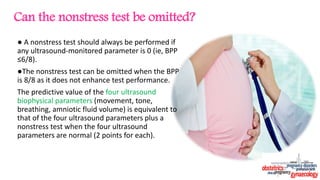
Can the nonstress test be omitted?
● A nonstress test should always be performed if
any ultrasound-monitored parameter is 0 (ie, BPP
≤6/8).
●The nonstress test can be omitted when the BPP
is 8/8 as it does not enhance test performance.
The predictive value of the four ultrasound
biophysical parameters (movement, tone,
breathing, amniotic fluid volume) is equivalent to
that of the four ultrasound parameters plus a
nonstress test when the four ultrasound
parameters are normal (2 points for each).
Modified biophysical profile
The modified BPP was developed to simplify the examination and
reduce the time necessary to complete testing by focusing on those
components of the BPP that are most predictive of outcome:
1. Nonstress test
2. Amniotic fluid volume.
ALTERNATIVES
Assessment of both the nonstress test and amniotic fluid volume appears
to be as reliable a predictor of long-term fetal well-being as the full BPP.
The rate of stillbirth within one week of a normal modified BPP is the same
as with the full BPP: 0.8 per 1000 women tested.
Approximately 90 percent of pregnancies that undergo a modified BPP will have
a normal result, the remainder will need to proceed to a full biophysical
evaluation.
INTERPRETATION
10/10, 8/8, or 8/10 with normal amniotic fluid —
10/10 – Normal
8/8 (nonstress test omitted) – Normal
8/10 (-2 points for either fetal movement, tone, or breathing but not amniotic
fluid) is a Normal test result.
The risk of fetal death within one week if the fetus is not delivered is low (0.4 to
0.6/1000 births).
A BPP score of 8/10 by any combination of parameters is as reliable as a score of
10/10 for the prediction of fetal well-being, as long as no points are deducted for
amniotic fluid volume.
A normal score is predictive of the absence of fetal compromise in the setting of
high-risk factors, such as diabetes mellitus, hypertension, or fetal growth
restriction.
Before term, a normal score provides reassurance that the benefits of continued
intrauterine maturation far outweigh the very small risk of fetal demise.
Fetal death after a normal BPP is often due to an acute and unpredictable insult
such as sudden cord prolapse, large fetomaternal hemorrhage, or abruption.
6/10 with normal amniotic fluid — 6/10 (-4 points for two of fetal
movement, tone, breathing, but +2 points for amniotic fluid) is an
equivocal test result because a significant possibility of developing
fetal asphyxia cannot be excluded.
The test is repeated within 24 hours to see if one of the absent
acute variables returns to normal or, if the patient is at or near term,
delivery is a reasonable option.
6/10 or 8/10 with oligohydramnios — 6/10 or 8/10 with 0 points
for amniotic fluid is an abnormal test, as the risk of fetal asphyxia
within one week is 89/1000 with expectant management.
These scores should be interpreted within the context of gestational
age.
INTERPRETATION
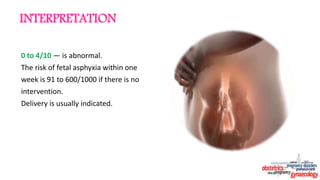
0 to 4/10 — is abnormal.
The risk of fetal asphyxia within one
week is 91 to 600/1000 if there is no
intervention.
Delivery is usually indicated.
INTERPRETATION
ROUTEOFDELIVERYAFTER
ALOWBIOPHYSICALPROFILESCORE
The route of delivery is an obstetric decision based on
multiple variables including presentation, cervical
findings, and maternal and fetal condition.
In the absence of an obstetric contraindication,
induction of labor with continuous intrapartum fetal
heart monitoring is a reasonable option for most
patients, regardless of BPP score.
The positive predictive value of a low BPP score for
intrapartum fetal compromise (eg, a nonreassuring fetal
heart tracing, neonatal acidemia, or other markers of
neonatal morbidity at the time of delivery) is
approximately 50 percent, with a negative predictive
value greater than 99.9 percent.
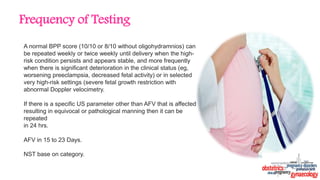
Frequency of Testing
A normal BPP score (10/10 or 8/10 without oligohydramnios) can
be repeated weekly or twice weekly until delivery when the high-
risk condition persists and appears stable, and more frequently
when there is significant deterioration in the clinical status (eg,
worsening preeclampsia, decreased fetal activity) or in selected
very high-risk settings (severe fetal growth restriction with
abnormal Doppler velocimetry.
If there is a specific US parameter other than AFV that is affected
resulting in equivocal or pathological manning then it can be
repeated
in 24 hrs.
AFV in 15 to 23 Days.
NST base on category.
In observational studies, use of the BPP score as part of the
management of high-risk obstetric patients has been associated
with a significant reduction in perinatal mortality.
Performance
Antenatal corticosteroids: Administration of antenatal corticosteroids can be
associated with transient fetal heart rate and behavioral changes, but these
changes typically return to baseline by day 4 after treatment. The most consistent
change is a decrease in FHR variability on days 2 and 3 after administration.
Fetal breathing and body movements are also commonly reduced, which may
result in a lower BPP score or nonreactive nonstress test.
FACTORS POTENTIALLY AFFECTING THE SCORE
Subclinical infection – The effect of subclinical infection on test results
is controversial. Although intraamniotic infection in a patient with
preterm prelabor rupture of membranes may be associated with a low
BPP score in the absence of hypoxemia, most studies have found that
the BPP score is an insensitive method for detecting subclinical
infection.
Preterm labor – Preterm labor may be associated with absence of fetal
breathing movements, but absence of fetal breathing movements is not a good
predictor of preterm delivery within 48 hours or seven days .
FACTORS POTENTIALLY AFFECTING THE SCORE
Fasting – There are sparse data on the effect of fasting on fetal biophysical
activities. A study that performed a BPP one hour after a meal and 10 to 12 hours
after abstaining from food and drink in 30 patients with uncomplicated pregnancies
reported scores were ≥8/10 for all postprandial BPPs, but two fasting BPPs were
4/10 and 6/10; both increased to 10/10 after the mother ate a meal. Point reductions
during fasting were primarily due to nonreactive nonstress tests and inadequate
fetal breathing movements.
Mild maternal anemia – does not appear to affect fetal biophysical activities
REFERENCES
• Kim SY, Khandelwal M, Gaughan JP, et al. Is the intrapartum biophysical profile useful? Obstet Gynecol 2003; 102:471.
• Sassoon DA, Castro LC, Davis JL, et al. The biophysical profile in labor. Obstet Gynecol 1990; 76:360.
• Cohn HE, Sacks EJ, Heymann MA, Rudolph AM. Cardiovascular responses to hypoxemia and acidemia in fetal lambs. Am J Obstet Gynecol 1974; 120:817.
• Nicolaides KH, Peters MT, Vyas S, et al. Relation of rate of urine production to oxygen tension in small-for-gestational-age fetuses. Am J Obstet Gynecol 1990;
162:387.
• Sherer DM, Dayal AK, Schwartz BM, et al. Acute oligohydramnios and deteriorating fetal biophysical profile associated with severe preeclampsia. J Matern
Fetal Med 1999; 8:193.
• Manning FA, Platt LD, Sipos L. Antepartum fetal evaluation: development of a fetal biophysical profile. Am J Obstet Gynecol 1980; 136:787.
• Patrick JE, Dalton KJ, Dawes GS. Breathing patterns before death in fetal lambs. Am J Obstet Gynecol 1976; 125:73.
• Manning FA, Martin CB Jr, Murata Y, et al. Breathing movements before death in the primate fetus (Macaca mulatta). Am J Obstet Gynecol 1979; 135:71.
• Romero R, Chervenak FA, Berkowitz RL, Hobbins JC. Intrauterine fetal tachypnea. Am J Obstet Gynecol 1982; 144:356.
• Pillai M, James D. Behavioural states in normal mature human fetuses. Arch Dis Child 1990; 65:39.
• Manning FA, Baskett TF, Morrison I, Lange I. Fetal biophysical profile scoring: a prospective study in 1,184 high-risk patients. Am J Obstet Gynecol 1981;
140:289.
• Simpson L, Khati NJ, Deshmukh SP, et al. ACR Appropriateness Criteria Assessment of Fetal Well-Being. J Am Coll Radiol 2016; 13:1483.
• Manning FA, Morrison I, Lange IR, et al. Fetal biophysical profile scoring: selective use of the nonstress test. Am J Obstet Gynecol 1987; 156:709.
• Zafman KB, Bruck E, Rebarber A, et al. Antenatal Testing for Women With Preexisting Medical Conditions Using Only the Ultrasonographic Portion of the
Biophysical Profile. Obstet Gynecol 2018; 132:1033.
• Nageotte MP, Towers CV, Asrat T, Freeman RK. Perinatal outcome with the modified biophysical profile. Am J Obstet Gynecol 1994; 170:1672.
Biophysical Profile

Biophysical Profile

  • 1.
    Dr. Rafi Rozan ConsultantSpecialist OBGYN Associate Professor Fellow REI Obstetrician & Gynecologist (DM) Comprehensive Family Medicine (Masters) Mastology & Cosmetic Gynecology. Medical Technology Biophysical Profile
  • 2.
    Don't judge eachday by the harvest you reap but by the seeds that you plant. -Robert Louis Stevenson
  • 3.
    OUTLINE • Introduction toBPP • Indications • Physiologic Basis of Biophysical Profile • Determining the Biophysical Profile Score • Alternatives – Modified BPP • Interpretation • Factors Potentially Affecting the Scores • Testing Schedule • Evidence of Efficacy • Recommendations
  • 4.
    The fetal biophysicalprofile (BPP) is a noninvasive, easily learned and performed antepartum test for evaluating fetal well-being. Ultrasound is used to assess four discrete biophysical parameters. A separate nonstress test of the fetal heart rate can also be performed as a component of the BPP. Each of the four ultrasound parameters and the nonstress test are assigned a score of either 0 or 2 points (there is no 1 point), depending upon whether specific criteria are met. A total score ≥8 is a strong indicator that fetal oxygen levels and acid-base status are normal and the fetal brain is well perfused and oxygenated, whereas a score ≤4 can be a sign of fetal compromise. Ideally, identification of a compromised fetus will make it possible for the provider to perform interventions that prevent adverse fetal/neonatal sequelae. Biophysical Profile
  • 5.
    The five biophysicalparameters were chosen based upon their ease of measurement and the ability to evaluate them objectively using universally available equipment. Other fetal biophysical activities (eg, sucking, eye movements, swallowing, micturition) might serve equally well as markers of fetal health but are not included in the BPP because measurement is more difficult and may be subjective. Biophysical Profile
  • 6.
    INDICATIONS Antepartum fetal surveillancewith tests such as the biophysical profile for pregnancies is indicated in pregnancies at increased risk of antepartum fetal demise. Specific conditions and clinical settings that may be indications for antenatal fetal assessment is ultimately based on the clinical judgment of the provider.
  • 7.
    PHYSIOLOGIC BASIS OFTHE BIOPHYSICAL PROFILE All fetal biophysical activities are regulated by discrete centers in the brain that are sensitive to both local factors and feedback from peripheral sensors. The degree of fall in oxygen concentration necessary to abolish a given central nervous system regulatory center output and thereby reduce fetal oxygen requirements varies by center.
  • 8.
    The two mostoxygen-sensitive centers are: (1) The cardioregulatory neurons, which control the coupling of fetal movement and heart rate acceleration. (2) The fetal breathing center neurons, which control fetal breathing movements. The centers regulating fetal breathing and fetal heart rate (FHR) accelerations can be affected by mild hypoxemia, fetal movement has a higher threshold before being affected by hypoxemia, and the fetal tone center has the highest threshold. Thus, these fetal biophysical activities respond to hypoxemia in a predictable, physiologically based cascade: loss of fetal breathing movements and FHR accelerations, followed by decreased fetal movement, and finally loss of fetal tone. This sequence is informative clinically since it allows for estimation of both the presence and severity of hypoxemia. PHYSIOLOGIC BASIS OF THE BIOPHYSICAL PROFILE
  • 9.
    The BPP witha nonstress test assesses five discrete biophysical parameters that reflect central nervous system regulatory output and thus indirectly reflect the integrity of the regulatory center. Four of these parameters reflect acute fetal status: fetal breathing movements, generalized fetal movements, fetal tone, and FHR accelerations in response to fetal movements (nonstress test). When most of the acute parameters are present, the brain’s regulatory center is likely to be intact, and pathologic conditions, such as hypoxemia leading to acidemia, can be reliably excluded. PHYSIOLOGIC BASIS OF THE BIOPHYSICAL PROFILE
  • 10.
    When most ofthe acute parameters are absent, the reason for the absent biophysical activity needs to be assessed. - A deep stage of normal quiet sleep is a benign etiology, although it is unusual to observe the absence of two or more acute parameters as a consequence of quiet sleep alone. - Transplacental passage of drugs that cause general suppression of the brain, such as sedatives and opiates, is another benign etiology. -The more acute parameters that are absent (ie, the lower the BPP score), the less likely the change is due to a sleep state. -The longer the absence of acute parameters, the more likely the cause is pathologic. Extending the observation period to encompass the usual duration of sleep state cycles (20 to 60 minutes) minimizes the possibility of misdiagnosis of pathologic versus physiologic fetal conditions.
  • 11.
    Amniotic fluid volume This isa nonacute parameter since decreases in amniotic fluid volume in response to chronic uteroplacental vascular insufficiency generally occur gradually. Fetal urine is the predominant source of amniotic fluid after approximately 16 weeks of gestation. Fetal urine production is primarily dependent upon renal perfusion, which in turn reflects selective distribution of cardiac output. The fetus responds to sustained hypoxemia by selective redistribution of its cardiac output, with preferential flow directed to the brain, heart, adrenals, and placenta at the expense of all other organ systems. This protective mechanism is initiated by specialized chemoreceptors in the aortic arch and carotid arteries.
  • 12.
    Hypoxemia-induced reflex redistributionof cardiac output away from the kidneys results in diminished fetal urine production, ultimately leading to oligohydramnios and then anhydramnios. Theoretically, a decrease in fetal swallowing, which removes amniotic fluid, could compensate for the decrease in urine production, but fetal swallowing is a vegetative reflex that is very resistant to the effects of hypoxemia. The time for development of oligohydramnios is usually relatively long. On average, it takes approximately 15 days for a fetus to progress from normal to reduced amniotic fluid volume (in the absence of membrane rupture) and 23 days to develop severe oligohydramnios. However, acute changes in amniotic fluid volume and rapid deterioration of the BPP score have been reported Amniotic fluid volume
  • 13.
    DETERMINING THE BIOPHYSICALPROFILE SCORE Assigning points — The composite BPP score is derived from five fetal parameters: four acute parameters (heart rate accelerations in response to movement [nonstress test], breathing movement, body and limb movement, tone) and one chronic parameter (amniotic fluid volume). Each of these five parameters has been evaluated independently with the normal characteristic defined. The scoring method used for each parameter is binary (ie, the parameter is either normal or abnormal; gradations of abnormality are not used). A normal parameter is assigned a score of 2 and an abnormal parameter is assigned a score of 0. The maximum score is 10/10 and the minimum score is 0/10.
  • 14.
    Pathologic conditions thatshould not be confused with normal fetal activity include the following: •Monotonous picket-fence breathing or gasping should not be considered normal breathing movements •Seizures should not be counted as normal fetal limb movements •Sinusoidal fetal heart rate (FHR) on the nonstress test should not be confused with normal long-term variability DETERMINING THE BIOPHYSICAL PROFILE SCORE
  • 15.
    Biophysical Profile The scoreof a BPP is termed Manning's score Criteria for the biophysical profile test 1. Nonstress test: 2 points if reactive, defined as at least 2 episodes of FHR accelerations of at least 15 bpm and at least 15 seconds duration from onset to return associated with fetal movement (Category 1). 2. Fetal breathing movements: 2 points if one or more episodes of rhythmic breathing movements of ≥30 seconds within a 30-minute observation period. 3. Fetal tone: 2 points if one or more episodes of extension of a fetal extremity or fetal spine with return to flexion. 4. Amniotic fluid volume: 2 points if a single deepest vertical pocket ≥2 cm is present. The horizontal dimension should be at least 1 cm. 5. Fetal movement: 2 points if three or more discrete body or limb movements within 30 minutes of observation. An episode of active continuous movement is counted as one movement. Zero points are assigned for any criteria not met.
  • 16.
    Classification • Normal: Ascore of 10/10, 8/8 (nonstress test not done), or 8/10 (including +2 points for amniotic fluid) is a normal test result. • Equivocal: A score of 6/10 (including +2 points for amniotic fluid) is an equivocal test result, as a significant possibility of developing fetal asphyxia cannot be excluded. • Abnormal: A score of 6/10 or 8/10 with oligohydramnios (0 points for amniotic fluid) is an abnormal test, and further assessment and correlation with the clinical setting are indicated. A score of 0 to 4/10 is abnormal; the risk of fetal asphyxia within one week is high if there is no intervention, and delivery is usually indicated. Biophysical Profile
  • 17.
    Biophysical Profile Use ofvibroacoustic stimulation to accelerate evaluation has been described.
  • 18.
    TESTING SCHEDULE • Initiation— Testing should begin as soon as an increased risk of fetal demise is identified and delivery for perinatal benefit would be considered if test results are abnormal. This may be as early as 24 weeks of gestation. • Guyana 28 Weeks Gestational age – The minimum gestational age for initiating biophysical testing should reflect the lower limit that intervention with delivery would be considered.
  • 19.
    A parameter maybe assigned a normal score (2) as soon as it is observed. Because the acute parameters are subject to fetal sleep-wake cycles, the fetus should be observed continuously for at least 30 minutes before assigning 0 points for any acute parameter. This time is based on ultrasound studies of fetuses from uncomplicated pregnancies. In one such study at 36 to 42 weeks of gestation, the mean duration of a fetal sleep (no somatic movements) was approximately 20 minutes, with an upper range of approximately 40 minutes. The average time to obtain a normal BPP score (BPP 10/10, 8/8) is 5.3 minutes. The test can be stopped at that point. When all tests are considered (normal, equivocal, abnormal) the average testing time is approximately 18 minutes. Fetal acoustic stimulation may be used to try to shorten testing time. Duration of fetal Observation
  • 20.
    Can the nonstresstest be omitted? ● A nonstress test should always be performed if any ultrasound-monitored parameter is 0 (ie, BPP ≤6/8). ●The nonstress test can be omitted when the BPP is 8/8 as it does not enhance test performance. The predictive value of the four ultrasound biophysical parameters (movement, tone, breathing, amniotic fluid volume) is equivalent to that of the four ultrasound parameters plus a nonstress test when the four ultrasound parameters are normal (2 points for each).
  • 21.
    Modified biophysical profile Themodified BPP was developed to simplify the examination and reduce the time necessary to complete testing by focusing on those components of the BPP that are most predictive of outcome: 1. Nonstress test 2. Amniotic fluid volume. ALTERNATIVES Assessment of both the nonstress test and amniotic fluid volume appears to be as reliable a predictor of long-term fetal well-being as the full BPP. The rate of stillbirth within one week of a normal modified BPP is the same as with the full BPP: 0.8 per 1000 women tested. Approximately 90 percent of pregnancies that undergo a modified BPP will have a normal result, the remainder will need to proceed to a full biophysical evaluation.
  • 22.
    INTERPRETATION 10/10, 8/8, or8/10 with normal amniotic fluid — 10/10 – Normal 8/8 (nonstress test omitted) – Normal 8/10 (-2 points for either fetal movement, tone, or breathing but not amniotic fluid) is a Normal test result. The risk of fetal death within one week if the fetus is not delivered is low (0.4 to 0.6/1000 births). A BPP score of 8/10 by any combination of parameters is as reliable as a score of 10/10 for the prediction of fetal well-being, as long as no points are deducted for amniotic fluid volume. A normal score is predictive of the absence of fetal compromise in the setting of high-risk factors, such as diabetes mellitus, hypertension, or fetal growth restriction. Before term, a normal score provides reassurance that the benefits of continued intrauterine maturation far outweigh the very small risk of fetal demise. Fetal death after a normal BPP is often due to an acute and unpredictable insult such as sudden cord prolapse, large fetomaternal hemorrhage, or abruption.
  • 23.
    6/10 with normalamniotic fluid — 6/10 (-4 points for two of fetal movement, tone, breathing, but +2 points for amniotic fluid) is an equivocal test result because a significant possibility of developing fetal asphyxia cannot be excluded. The test is repeated within 24 hours to see if one of the absent acute variables returns to normal or, if the patient is at or near term, delivery is a reasonable option. 6/10 or 8/10 with oligohydramnios — 6/10 or 8/10 with 0 points for amniotic fluid is an abnormal test, as the risk of fetal asphyxia within one week is 89/1000 with expectant management. These scores should be interpreted within the context of gestational age. INTERPRETATION
  • 24.
    0 to 4/10— is abnormal. The risk of fetal asphyxia within one week is 91 to 600/1000 if there is no intervention. Delivery is usually indicated. INTERPRETATION
  • 25.
    ROUTEOFDELIVERYAFTER ALOWBIOPHYSICALPROFILESCORE The route ofdelivery is an obstetric decision based on multiple variables including presentation, cervical findings, and maternal and fetal condition. In the absence of an obstetric contraindication, induction of labor with continuous intrapartum fetal heart monitoring is a reasonable option for most patients, regardless of BPP score. The positive predictive value of a low BPP score for intrapartum fetal compromise (eg, a nonreassuring fetal heart tracing, neonatal acidemia, or other markers of neonatal morbidity at the time of delivery) is approximately 50 percent, with a negative predictive value greater than 99.9 percent.
  • 26.
    Frequency of Testing Anormal BPP score (10/10 or 8/10 without oligohydramnios) can be repeated weekly or twice weekly until delivery when the high- risk condition persists and appears stable, and more frequently when there is significant deterioration in the clinical status (eg, worsening preeclampsia, decreased fetal activity) or in selected very high-risk settings (severe fetal growth restriction with abnormal Doppler velocimetry. If there is a specific US parameter other than AFV that is affected resulting in equivocal or pathological manning then it can be repeated in 24 hrs. AFV in 15 to 23 Days. NST base on category.
  • 27.
    In observational studies,use of the BPP score as part of the management of high-risk obstetric patients has been associated with a significant reduction in perinatal mortality. Performance
  • 28.
    Antenatal corticosteroids: Administrationof antenatal corticosteroids can be associated with transient fetal heart rate and behavioral changes, but these changes typically return to baseline by day 4 after treatment. The most consistent change is a decrease in FHR variability on days 2 and 3 after administration. Fetal breathing and body movements are also commonly reduced, which may result in a lower BPP score or nonreactive nonstress test. FACTORS POTENTIALLY AFFECTING THE SCORE Subclinical infection – The effect of subclinical infection on test results is controversial. Although intraamniotic infection in a patient with preterm prelabor rupture of membranes may be associated with a low BPP score in the absence of hypoxemia, most studies have found that the BPP score is an insensitive method for detecting subclinical infection. Preterm labor – Preterm labor may be associated with absence of fetal breathing movements, but absence of fetal breathing movements is not a good predictor of preterm delivery within 48 hours or seven days .
  • 29.
    FACTORS POTENTIALLY AFFECTINGTHE SCORE Fasting – There are sparse data on the effect of fasting on fetal biophysical activities. A study that performed a BPP one hour after a meal and 10 to 12 hours after abstaining from food and drink in 30 patients with uncomplicated pregnancies reported scores were ≥8/10 for all postprandial BPPs, but two fasting BPPs were 4/10 and 6/10; both increased to 10/10 after the mother ate a meal. Point reductions during fasting were primarily due to nonreactive nonstress tests and inadequate fetal breathing movements. Mild maternal anemia – does not appear to affect fetal biophysical activities
  • 30.
    REFERENCES • Kim SY,Khandelwal M, Gaughan JP, et al. Is the intrapartum biophysical profile useful? Obstet Gynecol 2003; 102:471. • Sassoon DA, Castro LC, Davis JL, et al. The biophysical profile in labor. Obstet Gynecol 1990; 76:360. • Cohn HE, Sacks EJ, Heymann MA, Rudolph AM. Cardiovascular responses to hypoxemia and acidemia in fetal lambs. Am J Obstet Gynecol 1974; 120:817. • Nicolaides KH, Peters MT, Vyas S, et al. Relation of rate of urine production to oxygen tension in small-for-gestational-age fetuses. Am J Obstet Gynecol 1990; 162:387. • Sherer DM, Dayal AK, Schwartz BM, et al. Acute oligohydramnios and deteriorating fetal biophysical profile associated with severe preeclampsia. J Matern Fetal Med 1999; 8:193. • Manning FA, Platt LD, Sipos L. Antepartum fetal evaluation: development of a fetal biophysical profile. Am J Obstet Gynecol 1980; 136:787. • Patrick JE, Dalton KJ, Dawes GS. Breathing patterns before death in fetal lambs. Am J Obstet Gynecol 1976; 125:73. • Manning FA, Martin CB Jr, Murata Y, et al. Breathing movements before death in the primate fetus (Macaca mulatta). Am J Obstet Gynecol 1979; 135:71. • Romero R, Chervenak FA, Berkowitz RL, Hobbins JC. Intrauterine fetal tachypnea. Am J Obstet Gynecol 1982; 144:356. • Pillai M, James D. Behavioural states in normal mature human fetuses. Arch Dis Child 1990; 65:39. • Manning FA, Baskett TF, Morrison I, Lange I. Fetal biophysical profile scoring: a prospective study in 1,184 high-risk patients. Am J Obstet Gynecol 1981; 140:289. • Simpson L, Khati NJ, Deshmukh SP, et al. ACR Appropriateness Criteria Assessment of Fetal Well-Being. J Am Coll Radiol 2016; 13:1483. • Manning FA, Morrison I, Lange IR, et al. Fetal biophysical profile scoring: selective use of the nonstress test. Am J Obstet Gynecol 1987; 156:709. • Zafman KB, Bruck E, Rebarber A, et al. Antenatal Testing for Women With Preexisting Medical Conditions Using Only the Ultrasonographic Portion of the Biophysical Profile. Obstet Gynecol 2018; 132:1033. • Nageotte MP, Towers CV, Asrat T, Freeman RK. Perinatal outcome with the modified biophysical profile. Am J Obstet Gynecol 1994; 170:1672.

Editor's Notes

  • #18 Vibroacoustic stimulation (VAS), sometimes referred to as fetal vibroacoustic stimulation or fetal acoustic stimulation test (FAST), is the application of a vibratory sound stimulus to the abdomen of a pregnant woman to induce FHR (fetal heart rate) accelerations. The presence of FHR accelerations reliably predicts the absence of fetal metabolic acidemia. Vibroacoustic stimulation is typically used during a nonstress test (NST).
  • #23 Interpretation of the BPP is based on the author's extensive published and unpublished experience. However, a change in maternal condition affects this balance. For example, the decision to intervene in a patient with worsening preeclampsia or unstable lie and prelabor rupture of membranes may depend less on the BPP score and more on maternal and fetal risk from continuing the pregnancy. Similarly, the presence of a favorable cervix may prompt delivery despite a normal BPP score when the fetus is at term.
  • #29 These findings should be considered within the total clinical scenario when considering delivery because of a nonreassuring fetal evaluation (nonstress test or BPP) after corticosteroid administration. The behavioral changes may reflect a physiologic response of the brain to glucocorticoids. Alternatively, they may be a consequence of a transient increase in fetal vascular resistance and blood pressure. Fetal blood flow velocity waveform patterns in the umbilical artery, middle cerebral artery, and ductus venosus do not appear to be affected.
  • #30 It is difficult to draw any conclusion about the effect of fasting on the BPP score in the clinical setting, given the small size of this study and the absence of indications for antepartum fetal assessment. Some clinicians give the patient juice or another type of food/drink if a BPP shows inadequate breathing or the nonstress test is nonreactive. However, a meta-analysis found that maternal glucose administration did not significantly decrease the incidence of nonreactive test results related to quiet fetal sleep