SHOULDER DYSTOCIA
GOALS
1. To learn how to diagnose & manage shoulder
dystocia
2. Steps to prevent fetal asphyxia while avoiding
physical injury
3. Documentation & risk management to reduce
obstetric litigation
DEFINITION
 Shoulder dystocia is the impaction of the
anterior shoulder against the symphysis pubis
after the head has been delivered
 Occurs when the breadth of the shoulder is
greater than the biparietal diameter of the
head.
 Shoulder dystocia remains one of the most dreaded
obstetric complications and one that is often
unanticipated.
 It is one of the primary causes of perinatal mortality
and morbidity, maternal morbidity and a costly source
of litigation.
 One must be prepared for the possibility of shoulder
dystocia in all deliveries, and have a prepared plan of
management.
 1:500 deliveries
 Predisposing factors includes large babies, maternal
diabetes, prolonged pregnancy, short stature,
instrumental deliveries, previous shoulder dystocia
 Up to 10 minutes to dislodge shoulder
 Call for experienced staff and assistants stat
OBSTETRIC EMERGENCIES!!
**However, most cases occur
without risk factors. Therefore, all
clinicians need to be prepared
for unexpected shoulder dystocia
at all deliveries **
EARLY DETECTION
 “Head bobbing": the head coming down towards the
introitus with pushing, but retracting back between
contraction
 “Turtle sign at delivery": The delivered head becomes
tightly pulled back against the perineum
COMPLICATIONS
MATERNAL
 Perineal trauma
 Uterine atony
 Uterine rupture
 PPH
FETUS
 Brachial plexus injury
 Clavicle or humerus
fracture
 Neurological deficit /
HIE
 Death
H- Call for HELP!!!
E- Episiotomy
L- Leg in Mc Robert’s Position
P- Suprapubic pressure
E- Enter Wood’s screw manouevere
R- Removal of posterior arm
R- Roll over
R- Repeat all method
Shoulder Dystocia: The
drill
McRobert’s position
Suprapubic pressure
•Hyperflex the hips
•Abduct the hips
Flex the knees
Preferably done with
2 assistant, each at
both sides of the
patient
The direction of
pushing should be
in the direction of
where the baby is
facing
COCKSCREW Maneuvreanal.
Deliver The Posterior Arm
Flex the forearm at the
elbow if the forearm is
extended.
Deliver the arm by
sweeping it across the
chest and face.
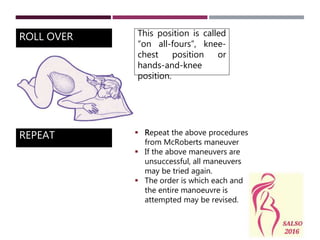
ROLL OVER This position is called
“on all-fours”, knee-
chest position or
hands-and-knee
position.
REPEAT  Repeat the above procedures
from McRoberts maneuver
 If the above maneuvers are
unsuccessful, all maneuvers
may be tried again.
 The order is which each and
the entire manoeuvre is
attempted may be revised.
IF ALL PROCEDURES FAIL…….
 Symphysiotomy – cutting the symphysis pubis to
allow delivery of the anterior shoulder
 Clavicular fracture (@cleidotomy) – allows further
adduction of the fetal shoulder, reducing the
diameter of the shoulders, thus allowing delivery
 Zavanelli maneuvre – push the baby’s head back into
the uterus and proceed with Em. caesarean
POST DELIVERY
 Watch-out for complications
 Counseling for both patient and partner
 Documentation
- Accurate & comprehensive
- Important to document which fetal shoulder was anterior
Shoulder dystocia 2016

Shoulder dystocia 2016

  • 1.
  • 2.
    GOALS 1. To learnhow to diagnose & manage shoulder dystocia 2. Steps to prevent fetal asphyxia while avoiding physical injury 3. Documentation & risk management to reduce obstetric litigation
  • 3.
    DEFINITION  Shoulder dystociais the impaction of the anterior shoulder against the symphysis pubis after the head has been delivered  Occurs when the breadth of the shoulder is greater than the biparietal diameter of the head.
  • 4.
     Shoulder dystociaremains one of the most dreaded obstetric complications and one that is often unanticipated.  It is one of the primary causes of perinatal mortality and morbidity, maternal morbidity and a costly source of litigation.  One must be prepared for the possibility of shoulder dystocia in all deliveries, and have a prepared plan of management.
  • 6.
     1:500 deliveries Predisposing factors includes large babies, maternal diabetes, prolonged pregnancy, short stature, instrumental deliveries, previous shoulder dystocia  Up to 10 minutes to dislodge shoulder  Call for experienced staff and assistants stat OBSTETRIC EMERGENCIES!!
  • 7.
    **However, most casesoccur without risk factors. Therefore, all clinicians need to be prepared for unexpected shoulder dystocia at all deliveries **
  • 8.
    EARLY DETECTION  “Headbobbing": the head coming down towards the introitus with pushing, but retracting back between contraction  “Turtle sign at delivery": The delivered head becomes tightly pulled back against the perineum
  • 9.
    COMPLICATIONS MATERNAL  Perineal trauma Uterine atony  Uterine rupture  PPH FETUS  Brachial plexus injury  Clavicle or humerus fracture  Neurological deficit / HIE  Death
  • 10.
    H- Call forHELP!!! E- Episiotomy L- Leg in Mc Robert’s Position P- Suprapubic pressure E- Enter Wood’s screw manouevere R- Removal of posterior arm R- Roll over R- Repeat all method Shoulder Dystocia: The drill
  • 11.
    McRobert’s position Suprapubic pressure •Hyperflexthe hips •Abduct the hips Flex the knees Preferably done with 2 assistant, each at both sides of the patient The direction of pushing should be in the direction of where the baby is facing
  • 12.
  • 13.
    Deliver The PosteriorArm Flex the forearm at the elbow if the forearm is extended. Deliver the arm by sweeping it across the chest and face.
  • 14.
    ROLL OVER Thisposition is called “on all-fours”, knee- chest position or hands-and-knee position. REPEAT  Repeat the above procedures from McRoberts maneuver  If the above maneuvers are unsuccessful, all maneuvers may be tried again.  The order is which each and the entire manoeuvre is attempted may be revised.
  • 15.
    IF ALL PROCEDURESFAIL…….  Symphysiotomy – cutting the symphysis pubis to allow delivery of the anterior shoulder  Clavicular fracture (@cleidotomy) – allows further adduction of the fetal shoulder, reducing the diameter of the shoulders, thus allowing delivery  Zavanelli maneuvre – push the baby’s head back into the uterus and proceed with Em. caesarean
  • 16.
    POST DELIVERY  Watch-outfor complications  Counseling for both patient and partner  Documentation - Accurate & comprehensive - Important to document which fetal shoulder was anterior