CSS 3 – Overview
                                What is new in CSS 3?


Nikolay Kostov
Technical Trainer
http://nikolay.it
Telerik Software Academy
academy.telerik.com
Table of Contents
1.   What is CSS 3?
2.   Selectors
3.   Fonts
4.   Colors
5.   Backgrounds
6.   Borders
7.   Box Model
8.   Animations

                                          2
What is CSS 3?
What is CSS 3?
 Cascading Style Sheets level 3 is the most
 recent iteration of CSS
 It is divided into several separate
 documents called "modules"
 CSS 3 has not been approved as a
 specification, but there are already a lot of
 properties that are supported in various
 browsers.
 The earliest CSS 3 drafts were published in
 June 1999
                                                 4
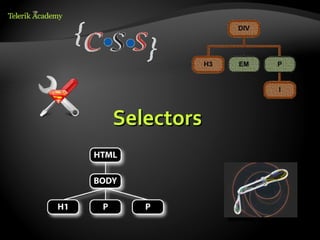
Selectors
Attribute Selectors
 E[foo^="bar"]

  An E element whose "foo" attribute value
   begins exactly with the string "bar"
  Example: a[src^="https://"]
 E[foo$="bar"]

  An E element whose "foo" attribute value ends
   exactly with the string "bar"
 E[foo*="bar"]

  An E element whose "foo" attribute value
   contains the substring "bar"
                                                   6
Attribute Selectors
      Live Demo
Structural Pseudo-classes
 :root

  The root of the document
 E:nth-child(n)

  An E element, the n-th child of its parent
 E:nth-last-child(n)

  An E element, the n-th child of its parent,
   counting from the last on
 E:nth-of-type(n)

  An E element, the n-th sibling of its type
                                                 8
Structural Pseudo-classes (2)
 E:nth-last-of-type(n)

  An E element, the n-th sibling of its type,
   counting from the last one
 E:last-child

  An E element, last child of its parent
 E:first-of-type

  An E element, first sibling of its type
 E:last-of-type

  An E element, last sibling of its type
                                                 9
Structural Pseudo-classes (3)
 E:only-child

   An E element, only child of its parent
 E:only-of-type

   An E element, only sibling of its type
 E:empty

   An E element that has no children (including
    text nodes)
 More detailed descriptions:

http://www.w3.org/TR/css3-selectors/#structural-pseudos
                                                          10
Structural Selectors
      Live Demo
The UI Element States
                            Pseudo-classes
 E:enabled

  A user interface element E which is enabled
 E:disabled

  A user interface element E which is disabled
 E:checked

  A user interface element E which is checked (for
   instance a radio-button or checkbox)
  Currently supported only in Opera!
                                                      12
UI Selectors
  Live Demo
Other CSS 3 Selectors
 E:target

  An E element being the target of the referring
   URI
 E:not(s)

  An E element that does not match simple
   selector
E   ~ F
  An F element preceded by an E element


                                                    14
Other CSS 3 Selectors
       Live Demo
Fonts
Font Embeds
   Use @font-face to declare font
   Point to font file on server
   Call font with font-family
   Currently not supported in IE
   Use font embedding instead of images
    @font-face {
           font-family: SketchRockwell;
           src: url('SketchRockwell-Bold.ttf');
    }
    .my_CSS3_class {
           font-family: SketchRockwell;
           font-size: 3.2em;                        17
    }
Text Shadow
 Applies shadow to text
 Syntax: text-shadow: <horizontal-
    distance> <vertical-distance>
    <blur-radius> <shadow-color>;
   Do not alter the size of a box


    text-shadow: 2px 2px 7px #000000;


                                                  18
Text Overflow
 Specifies what should happen when text
 overflows the containing element
 Syntax:   text-overflow: <value>;
 Possible values:

   ellipsis - Display ellipses to represent clipped
    text
   clip - Default value, clips text


 Currently not supported in Firefox and IE

                                                       19
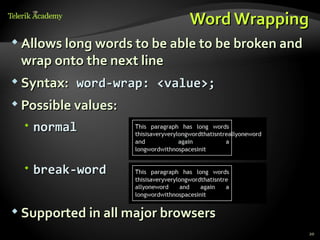
Word Wrapping
 Allows long words to be able to be broken and
 wrap onto the next line
 Syntax:   word-wrap: <value>;
 Possible values:

   normal


   break-word


 Supported in all major browsers

                                                  20
CSS 3 Fonts
  Live Demo
Colors
Opacity
 Sets the opacity level for an element

 Syntax:    opacity: <value>;
 Value from 0.0 (fully transparent) to 1.0

 The opacity is supported in all major browsers.

 Note: IE8 and earlier supports an alternative,
    the filter property: filter: Alpha(opacity=50).
   Example:
               <img src="img.jpg" style= "
               opacity: 0.4;
               filter: alpha(opacity=40)" />
                                                      23
RGBA Colors
 Standard RGB colors with an opacity value for
 the color (alpha channel)
 Syntax:
        rgba(<red>, <green>,
 <blue>, <alpha>)
 The range for red, green and blue is between
 integers 0 and 255
 The range for the alpha channel is between 0.0
 and 1.0
 Example: rgba(255,   0, 0, 0.5)

                                                  24
HSL Colors
 Hue is a degree on the color wheel

   0 (or 360) is red, 120 is green, 240 is blue
 Saturation is a percentage value

   100% is the full color
 Lightness is also a percentage

   0% is dark (black)
   100% is light (white)
   50% is the average

                                                    25
HSLA Colors
 HSLA allows a fourth value, which sets the

 Opacity (via the Alpha channel) of the element.
 As RGBA is to RGB, HSLA is to HSL

 Supported in IE9+, Firefox 3+, Chrome, Safari,

 and in Opera 10+
 Example:

   hsla(0, 100%, 50%, 0.5)
   Result:

                                                   26
CSS 3 Colors
  Live Demo
Backgrounds
Gradient Backgrounds
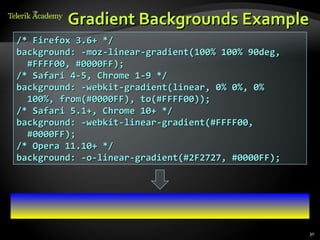
 Gradients are smooth transitions between two

 or more specified colors
 Use of CSS gradients can replace images and

 reduce download time
 Create a more flexible layout, and look better

 while zooming
 Supported in all major browsers via different

 keywords
 This is still an experimental feature

                                                   29
Gradient Backgrounds Example
/* Firefox 3.6+ */
background: -moz-linear-gradient(100% 100% 90deg,
  #FFFF00, #0000FF);
/* Safari 4-5, Chrome 1-9 */
background: -webkit-gradient(linear, 0% 0%, 0%
  100%, from(#0000FF), to(#FFFF00));
/* Safari 5.1+, Chrome 10+ */
background: -webkit-linear-gradient(#FFFF00,
  #0000FF);
/* Opera 11.10+ */
background: -o-linear-gradient(#2F2727, #0000FF);


                                                    30
Multiple Backgrounds
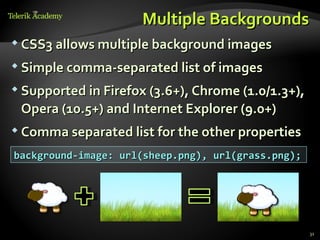
 CSS3 allows multiple background images

 Simple comma-separated list of images

 Supported in Firefox (3.6+), Chrome (1.0/1.3+),

 Opera (10.5+) and Internet Explorer (9.0+)
 Comma separated list for the other properties

background-image: url(sheep.png), url(grass.png);


                                                    31
Backgrounds
  Live Demo
Borders
Border color
 Allows you to create cool colored borders

 Only Firefox supports this type of coloring

border: 8px solid #000;
-moz-border-bottom-colors: #555 #666 #777 #888
#999 #aaa #bbb #ccc;
-moz-border-top-colors: #555 #666 #777 #888 #999
#aaa #bbb #ccc;
-moz-border-left-colors: #555 #666 #777 #888 #999
#aaa #bbb #ccc;
-moz-border-right-colors: #555 #666 #777 #888
#999 #aaa #bbb #ccc;


                                                    34
Border radius
 Allows web developers to easily utilize rounder
 corners in their design elements
 Widespread browser support

 Syntax:

border-*-*-radius: [<length>|<%>][<length>|<%>]?
 Example:

-moz-border-radius: 15px;
border-radius: 15px;
background-color: #FF00FF;


                                                    35
Box shadow
 Allows to easily implement multiple drop

 shadows (outer or inner) on box elements
 Specifying values for color, size, blur and offset

 Example:

-moz-box-shadow: 10px 10px 5px #888;
-webkit-box-shadow: 10px 10px 5px #888;
box-shadow: 10px 10px 5px #888;


                                                       36
Borders
Live Demo
Box Model
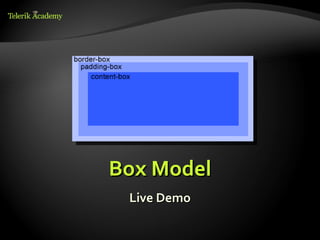
CSS3 box-sizing
 Determine whether you want an element to

 render it's borders and padding within its
 specified width, or outside of it.
 Possible values:

   box-sizing: content-box (default)
    box width: 288 pixels + 10 pixels padding and 1
    pixel border on each side = 300 pixels
   box-sizing: border-box
    box width: 300 pixels, including padding and
    borders
                                                      39
CSS3 box-sizing (Example)
 Example: Box with total width of 300 px

 (including paddings and borders)
  width: 300px;
  border: 1px solid black;
  padding: 5px;

  /* Firefox */
  -moz-box-sizing: border-box;
  /* WebKit */
  -webkit-box-sizing: border-box;
  /* Opera 9.5+, Google Chrome */
  box-sizing: border-box;

                                            40
CSS 3 Flexible Box Model
 The flexible box model determines the way

 boxes are distributed inside other boxes and
 the way they share the available space.
 New values for "display" property:

   flexbox
   inline-flexbox
 This box model is still under development

 Still not supported in major browsers


                                                41
CSS 3 Box Model Properties
 flex-direction

   Specifies how flexbox items are placed
 flex-order

   May be used to change the ordering of the
    elements. Elements are sorted by this value.
 flex-pack

   Defines the flexibility of packing spaces
 flex-align

   Changes the way free space is allocated
                                                   42
CSS 3 flex-direction
 The flex-direction property specifies how

 flexbox items are placed in the flexbox.
 Possible values:

   lr – Displays elements from left to right
   rl – Displays elements from right to left
   tb – Displays elements from top to bottom
   bt – Displays elements from bottom to top
   inline and inline-reverse
   block and block-reverse
                                                43
Box Model
 Live Demo
Animations
Animations
 Works in all webkit browsers

 Example:

  @keyframes resize {
        0% {...}
        50% {...}
        100% {...}
  }
  #box {
        animation-name: resize;
        animation-duration: 1s;
        animation-iteration-count: 4;
        animation-direction: alternate;
  animation-timing-function: ease-in-out;
  }
                                              46
Transitions
 Add an effect when changing from one style to
 another
 Different timing functions:

   ease, ease-in, ease-out, ease-in-out, linear
 Example:

  #id_of_element {
       -webkit-transition: all 1s ease-in-out;
       -moz-transition: all 1s ease-in-out;
       -o-transition: all 1s ease-in-out;
       -ms-transition: all 1s ease-in-out;
  transition: all 1s ease-in-out;
  }
                                                   47
2D Transformations
 2D transforms are widely supported

 Skew – skew element

   transform: skew(35deg);
 Scale – scale element

   transform: scale(1,0.5);
 Rotate – rotates element

   transform: rotate(45deg);
 Translate – moves element

   transform: translate(10px, 20px);
                                           48
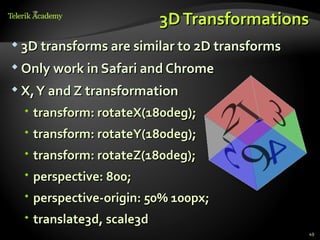
3D Transformations
 3D transforms are similar to 2D transforms

 Only work in Safari and Chrome

 X, Y and Z transformation

   transform: rotateX(180deg);
   transform: rotateY(180deg);
   transform: rotateZ(180deg);
   perspective: 800;
   perspective-origin: 50% 100px;
   translate3d, scale3d
                                               49
Animations
  Live Demo
CSS 3


http://html5course.telerik.com
Exercises
1.   Using your knowledge of CSS 3 style, the given
     HTML code and approximate the end result (shown
     in the image below:
     <div id="example_form">
       <h1>Example form</h1>
       Your name:
       <input value="Mark DuBois"/>
       Your email:
       <input value="Mark@...." />
       <input value="Subscribe"
          type="submit" />
     </div>

                                                       52
Exercises (2)
1.    Using CSS3 make a rotating 3D
      Rubik Cube.
2.    Using CSS3 make a text that is
      pulsing, i.e. gets bigger, then smaller, etc. while
      blinking with different colors.
3.    Using CSS3 make a text bouncing around the screen
      (the browser).
      Hint: the text should change its position


                                                            53
Exercises (3)
1.   Using CSS3 make a landscape with a lake/sea with ships
     moving in it.


                                                              54

CSS 3

  • 1.
    CSS 3 –Overview What is new in CSS 3? Nikolay Kostov Technical Trainer http://nikolay.it Telerik Software Academy academy.telerik.com
  • 2.
    Table of Contents 1. What is CSS 3? 2. Selectors 3. Fonts 4. Colors 5. Backgrounds 6. Borders 7. Box Model 8. Animations 2
  • 3.
  • 4.
    What is CSS3?  Cascading Style Sheets level 3 is the most recent iteration of CSS  It is divided into several separate documents called "modules"  CSS 3 has not been approved as a specification, but there are already a lot of properties that are supported in various browsers.  The earliest CSS 3 drafts were published in June 1999 4
  • 5.
  • 6.
    Attribute Selectors  E[foo^="bar"]  An E element whose "foo" attribute value begins exactly with the string "bar"  Example: a[src^="https://"]  E[foo$="bar"]  An E element whose "foo" attribute value ends exactly with the string "bar"  E[foo*="bar"]  An E element whose "foo" attribute value contains the substring "bar" 6
  • 7.
  • 8.
    Structural Pseudo-classes  :root  The root of the document  E:nth-child(n)  An E element, the n-th child of its parent  E:nth-last-child(n)  An E element, the n-th child of its parent, counting from the last on  E:nth-of-type(n)  An E element, the n-th sibling of its type 8
  • 9.
    Structural Pseudo-classes (2) E:nth-last-of-type(n)  An E element, the n-th sibling of its type, counting from the last one  E:last-child  An E element, last child of its parent  E:first-of-type  An E element, first sibling of its type  E:last-of-type  An E element, last sibling of its type 9
  • 10.
    Structural Pseudo-classes (3) E:only-child  An E element, only child of its parent  E:only-of-type  An E element, only sibling of its type  E:empty  An E element that has no children (including text nodes)  More detailed descriptions: http://www.w3.org/TR/css3-selectors/#structural-pseudos 10
  • 11.
  • 12.
    The UI ElementStates Pseudo-classes  E:enabled  A user interface element E which is enabled  E:disabled  A user interface element E which is disabled  E:checked  A user interface element E which is checked (for instance a radio-button or checkbox)  Currently supported only in Opera! 12
  • 13.
    UI Selectors Live Demo
  • 14.
    Other CSS 3Selectors  E:target  An E element being the target of the referring URI  E:not(s)  An E element that does not match simple selector E ~ F  An F element preceded by an E element 14
  • 15.
    Other CSS 3Selectors Live Demo
  • 16.
  • 17.
    Font Embeds  Use @font-face to declare font  Point to font file on server  Call font with font-family  Currently not supported in IE  Use font embedding instead of images @font-face { font-family: SketchRockwell; src: url('SketchRockwell-Bold.ttf'); } .my_CSS3_class { font-family: SketchRockwell; font-size: 3.2em; 17 }
  • 18.
    Text Shadow  Appliesshadow to text  Syntax: text-shadow: <horizontal- distance> <vertical-distance> <blur-radius> <shadow-color>;  Do not alter the size of a box text-shadow: 2px 2px 7px #000000; 18
  • 19.
    Text Overflow  Specifieswhat should happen when text overflows the containing element  Syntax: text-overflow: <value>;  Possible values:  ellipsis - Display ellipses to represent clipped text  clip - Default value, clips text  Currently not supported in Firefox and IE 19
  • 20.
    Word Wrapping  Allowslong words to be able to be broken and wrap onto the next line  Syntax: word-wrap: <value>;  Possible values:  normal  break-word  Supported in all major browsers 20
  • 21.
    CSS 3 Fonts Live Demo
  • 22.
  • 23.
    Opacity  Sets theopacity level for an element  Syntax: opacity: <value>;  Value from 0.0 (fully transparent) to 1.0  The opacity is supported in all major browsers.  Note: IE8 and earlier supports an alternative, the filter property: filter: Alpha(opacity=50).  Example: <img src="img.jpg" style= " opacity: 0.4; filter: alpha(opacity=40)" /> 23
  • 24.
    RGBA Colors  StandardRGB colors with an opacity value for the color (alpha channel)  Syntax: rgba(<red>, <green>, <blue>, <alpha>)  The range for red, green and blue is between integers 0 and 255  The range for the alpha channel is between 0.0 and 1.0  Example: rgba(255, 0, 0, 0.5) 24
  • 25.
    HSL Colors  Hueis a degree on the color wheel  0 (or 360) is red, 120 is green, 240 is blue  Saturation is a percentage value  100% is the full color  Lightness is also a percentage  0% is dark (black)  100% is light (white)  50% is the average 25
  • 26.
    HSLA Colors  HSLAallows a fourth value, which sets the Opacity (via the Alpha channel) of the element.  As RGBA is to RGB, HSLA is to HSL  Supported in IE9+, Firefox 3+, Chrome, Safari, and in Opera 10+  Example:  hsla(0, 100%, 50%, 0.5)  Result: 26
  • 27.
    CSS 3 Colors Live Demo
  • 28.
  • 29.
    Gradient Backgrounds  Gradientsare smooth transitions between two or more specified colors  Use of CSS gradients can replace images and reduce download time  Create a more flexible layout, and look better while zooming  Supported in all major browsers via different keywords  This is still an experimental feature 29
  • 30.
    Gradient Backgrounds Example /*Firefox 3.6+ */ background: -moz-linear-gradient(100% 100% 90deg, #FFFF00, #0000FF); /* Safari 4-5, Chrome 1-9 */ background: -webkit-gradient(linear, 0% 0%, 0% 100%, from(#0000FF), to(#FFFF00)); /* Safari 5.1+, Chrome 10+ */ background: -webkit-linear-gradient(#FFFF00, #0000FF); /* Opera 11.10+ */ background: -o-linear-gradient(#2F2727, #0000FF); 30
  • 31.
    Multiple Backgrounds  CSS3allows multiple background images  Simple comma-separated list of images  Supported in Firefox (3.6+), Chrome (1.0/1.3+), Opera (10.5+) and Internet Explorer (9.0+)  Comma separated list for the other properties background-image: url(sheep.png), url(grass.png); 31
  • 32.
  • 33.
  • 34.
    Border color  Allowsyou to create cool colored borders  Only Firefox supports this type of coloring border: 8px solid #000; -moz-border-bottom-colors: #555 #666 #777 #888 #999 #aaa #bbb #ccc; -moz-border-top-colors: #555 #666 #777 #888 #999 #aaa #bbb #ccc; -moz-border-left-colors: #555 #666 #777 #888 #999 #aaa #bbb #ccc; -moz-border-right-colors: #555 #666 #777 #888 #999 #aaa #bbb #ccc; 34
  • 35.
    Border radius  Allowsweb developers to easily utilize rounder corners in their design elements  Widespread browser support  Syntax: border-*-*-radius: [<length>|<%>][<length>|<%>]?  Example: -moz-border-radius: 15px; border-radius: 15px; background-color: #FF00FF; 35
  • 36.
    Box shadow  Allowsto easily implement multiple drop shadows (outer or inner) on box elements  Specifying values for color, size, blur and offset  Example: -moz-box-shadow: 10px 10px 5px #888; -webkit-box-shadow: 10px 10px 5px #888; box-shadow: 10px 10px 5px #888; 36
  • 37.
  • 38.
  • 39.
    CSS3 box-sizing  Determinewhether you want an element to render it's borders and padding within its specified width, or outside of it.  Possible values:  box-sizing: content-box (default) box width: 288 pixels + 10 pixels padding and 1 pixel border on each side = 300 pixels  box-sizing: border-box box width: 300 pixels, including padding and borders 39
  • 40.
    CSS3 box-sizing (Example) Example: Box with total width of 300 px (including paddings and borders) width: 300px; border: 1px solid black; padding: 5px; /* Firefox */ -moz-box-sizing: border-box; /* WebKit */ -webkit-box-sizing: border-box; /* Opera 9.5+, Google Chrome */ box-sizing: border-box; 40
  • 41.
    CSS 3 FlexibleBox Model  The flexible box model determines the way boxes are distributed inside other boxes and the way they share the available space.  New values for "display" property:  flexbox  inline-flexbox  This box model is still under development  Still not supported in major browsers 41
  • 42.
    CSS 3 BoxModel Properties  flex-direction  Specifies how flexbox items are placed  flex-order  May be used to change the ordering of the elements. Elements are sorted by this value.  flex-pack  Defines the flexibility of packing spaces  flex-align  Changes the way free space is allocated 42
  • 43.
    CSS 3 flex-direction The flex-direction property specifies how flexbox items are placed in the flexbox.  Possible values:  lr – Displays elements from left to right  rl – Displays elements from right to left  tb – Displays elements from top to bottom  bt – Displays elements from bottom to top  inline and inline-reverse  block and block-reverse 43
  • 44.
  • 45.
  • 46.
    Animations  Works inall webkit browsers  Example: @keyframes resize { 0% {...} 50% {...} 100% {...} } #box { animation-name: resize; animation-duration: 1s; animation-iteration-count: 4; animation-direction: alternate; animation-timing-function: ease-in-out; } 46
  • 47.
    Transitions  Add aneffect when changing from one style to another  Different timing functions:  ease, ease-in, ease-out, ease-in-out, linear  Example: #id_of_element { -webkit-transition: all 1s ease-in-out; -moz-transition: all 1s ease-in-out; -o-transition: all 1s ease-in-out; -ms-transition: all 1s ease-in-out; transition: all 1s ease-in-out; } 47
  • 48.
    2D Transformations  2Dtransforms are widely supported  Skew – skew element  transform: skew(35deg);  Scale – scale element  transform: scale(1,0.5);  Rotate – rotates element  transform: rotate(45deg);  Translate – moves element  transform: translate(10px, 20px); 48
  • 49.
    3D Transformations  3Dtransforms are similar to 2D transforms  Only work in Safari and Chrome  X, Y and Z transformation  transform: rotateX(180deg);  transform: rotateY(180deg);  transform: rotateZ(180deg);  perspective: 800;  perspective-origin: 50% 100px;  translate3d, scale3d 49
  • 50.
  • 51.
  • 52.
    Exercises 1. Using your knowledge of CSS 3 style, the given HTML code and approximate the end result (shown in the image below: <div id="example_form"> <h1>Example form</h1> Your name: <input value="Mark DuBois"/> Your email: <input value="Mark@...." /> <input value="Subscribe" type="submit" /> </div> 52
  • 53.
    Exercises (2) 1. Using CSS3 make a rotating 3D Rubik Cube. 2. Using CSS3 make a text that is pulsing, i.e. gets bigger, then smaller, etc. while blinking with different colors. 3. Using CSS3 make a text bouncing around the screen (the browser).  Hint: the text should change its position 53
  • 54.
    Exercises (3) 1. Using CSS3 make a landscape with a lake/sea with ships moving in it. 54