Corporate Social Responsibility
• Concepts, key issues, context
• Key CSR drivers
• Implications for enterprise
• Implications for development
Main Concepts of CSR
Social Contract (Donaldson, 1982; Donaldson and Dunfee,
1999) – There is a tacit social contract between the firm and
society; the contract bestows certain rights in exchange for
certain responsibilities.
Stakeholder Theory (Freeman, 1984) – A stakeholder is “any group
or individual who can affect or is affected by the achievement of an
organisation’s purpose.” Argues that it is in the company’s strategic
interest to respect the interests of all its stakeholders.
CSR (Carrol, 1979)
Firms have responsibilities to societies including economic, legal,
ethical and discretionary (or philanthropic).
- See also DeGeorge (1999) on the “Myth of the Amoral Firm”
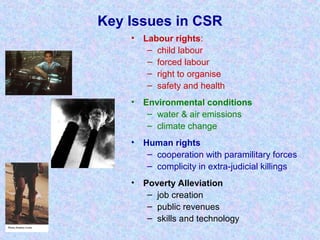
Key Issues in CSR
• Labour rights:
– child labour
– forced labour
– right to organise
– safety and health
• Environmental conditions
– water & air emissions
– climate change
• Human rights
– cooperation with paramilitary forces
– complicity in extra-judicial killings
• Poverty Alleviation
– job creation
– public revenues
– skills and technology
Context Globally
• Liberalisation of markets – reduction of the
regulatory approach
• Emergence of global giants, consolidation of
market share
• Development of the ‘embedded firm’ and the
global value chain
– Development of supplier networks in developing
countries
Key drivers of CSR
Around the world
• NGO Activism
• Responsible investment
• Litigation
• Gov & IGO initiatives
Developing Countries
• Foreign customers
• Domestic consumers
• FDI
• Government & IGO
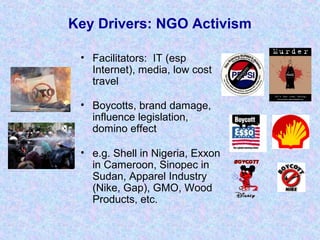
Key Drivers: NGO Activism
• Facilitators: IT (esp
Internet), media, low cost
travel
• Boycotts, brand damage,
influence legislation,
domino effect
• e.g. Shell in Nigeria, Exxon
in Cameroon, Sinopec in
Sudan, Apparel Industry
(Nike, Gap), GMO, Wood
Products, etc.
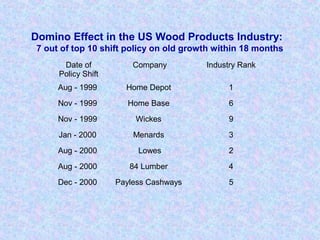
Domino Effect in the US Wood Products Industry:
7 out of top 10 shift policy on old growth within 18 months
Date of
Policy Shift
Company Industry Rank
Aug - 1999 Home Depot 1
Nov - 1999 Home Base 6
Nov - 1999 Wickes 9
Jan - 2000 Menards 3
Aug - 2000 Lowes 2
Aug - 2000 84 Lumber 4
Dec - 2000 Payless Cashways 5
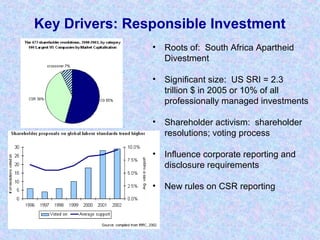
Key Drivers: Responsible Investment
• Roots of: South Africa Apartheid
Divestment
• Significant size: US SRI = 2.3
trillion $ in 2005 or 10% of all
professionally managed investments
• Shareholder activism: shareholder
resolutions; voting process
• Influence corporate reporting and
disclosure requirements
• New rules on CSR reporting
Signatories will
1 …incorporate ESG issues into investment analysis and
decision-making processes.
2 …be active owners and incorporate ESG issues into our
ownership policies and practices.
3 …seek appropriate disclosure on ESG issues by the entities in
which we invest.
4 …promote acceptance and implementation of the Principles
within the investment industry.
5 …work together to enhance our effectiveness in implementing
the Principles.
6 …each report on our activities and progress towards
implementing the Principles.
Principles for Responsible Investment
www.unpri.org
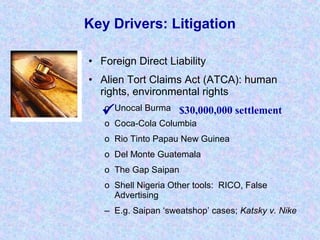
• Foreign Direct Liability
• Alien Tort Claims Act (ATCA): human
rights, environmental rights
o Unocal Burma
o Coca-Cola Columbia
o Rio Tinto Papau New Guinea
o Del Monte Guatemala
o The Gap Saipan
o Shell Nigeria Other tools: RICO, False
Advertising
– E.g. Saipan ‘sweatshop’ cases; Katsky v. Nike
Key Drivers: Litigation
 $30,000,000 settlement
United Nations Initiatives
• UN Global Compact
• UN Principles for Responsible Investment
• UNEP Equator Principles
• ILO Tripartite Declaration of Principles
concerning Multinational Enterprises and
Social Policy (MNE Declaration)
• UNHCHR Business and Human Rights
• UNODC Anti-corruption
• UNCTAD Corporate Responsibility
Reporting, World Investment Report
Implications for Enterprises:
CSR Management
How do companies address socio-environmental &
legal compliance issues?
• Policies - Code of Conduct
• Systems - Compliance Management
• Reporting - Accounting and Reporting
CSR Management:
Systems approach
Sustainable business development does not come
about of its own accord. Rather, commitment to
sustainability demands that corporate processes
be reliably controlled and that everyone's actions -
in finance as much as in environmental and social
areas - be coordinated. Prerequisites for this are
binding guidelines, unambiguous corporate
goals and a clear organizational structure.
- Deutsche Telekom
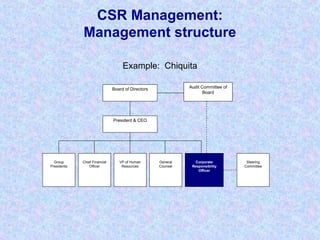
CSR Management:
Management structure
Example: Chiquita
Board of Directors
President & CEO
Group
Presidents
Chief Financial
Officer
VP of Human
Resources
General
Counsel
Corporate
Responsibility
Officer
Steering
Committee
Audit Committee of
Board
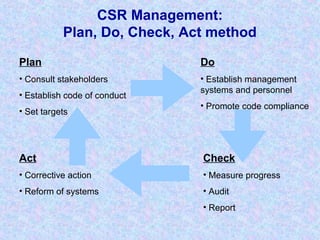
CSR Management:
Plan, Do, Check, Act method
Plan
• Consult stakeholders
• Establish code of conduct
• Set targets
Do
• Establish management
systems and personnel
• Promote code compliance
Check
• Measure progress
• Audit
• Report
Act
• Corrective action
• Reform of systems
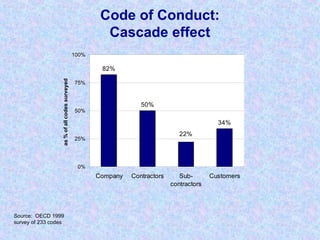
Code of Conduct:
Cascade effect
82%
50%
34%
22%
0%
25%
50%
75%
100%
Company Contractors Sub-
contractors
Customers
as%ofallcodessurveyed
Source: OECD 1999
survey of 233 codes
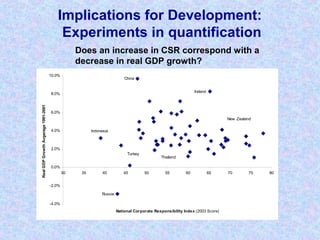
Implications for Development:
Experiments in quantification
Does an increase in CSR correspond with a
decrease in real GDP growth?
-4.0%
-2.0%
0.0%
2.0%
4.0%
6.0%
8.0%
10.0%
30 35 40 45 50 55 60 65 70 75 80
National Corporate Responsibility Index (2003 Score)
RealGDPGrowthAvgerage1991-2001
China
Turkey
New Zealand
Thailand
Russia
Ireland
Indonesia
Thank you

social

  • 1.
    Corporate Social Responsibility •Concepts, key issues, context • Key CSR drivers • Implications for enterprise • Implications for development
  • 2.
    Main Concepts ofCSR Social Contract (Donaldson, 1982; Donaldson and Dunfee, 1999) – There is a tacit social contract between the firm and society; the contract bestows certain rights in exchange for certain responsibilities. Stakeholder Theory (Freeman, 1984) – A stakeholder is “any group or individual who can affect or is affected by the achievement of an organisation’s purpose.” Argues that it is in the company’s strategic interest to respect the interests of all its stakeholders. CSR (Carrol, 1979) Firms have responsibilities to societies including economic, legal, ethical and discretionary (or philanthropic). - See also DeGeorge (1999) on the “Myth of the Amoral Firm”
  • 3.
    Key Issues inCSR • Labour rights: – child labour – forced labour – right to organise – safety and health • Environmental conditions – water & air emissions – climate change • Human rights – cooperation with paramilitary forces – complicity in extra-judicial killings • Poverty Alleviation – job creation – public revenues – skills and technology
  • 4.
    Context Globally • Liberalisationof markets – reduction of the regulatory approach • Emergence of global giants, consolidation of market share • Development of the ‘embedded firm’ and the global value chain – Development of supplier networks in developing countries
  • 5.
    Key drivers ofCSR Around the world • NGO Activism • Responsible investment • Litigation • Gov & IGO initiatives Developing Countries • Foreign customers • Domestic consumers • FDI • Government & IGO
  • 6.
    Key Drivers: NGOActivism • Facilitators: IT (esp Internet), media, low cost travel • Boycotts, brand damage, influence legislation, domino effect • e.g. Shell in Nigeria, Exxon in Cameroon, Sinopec in Sudan, Apparel Industry (Nike, Gap), GMO, Wood Products, etc.
  • 7.
    Domino Effect inthe US Wood Products Industry: 7 out of top 10 shift policy on old growth within 18 months Date of Policy Shift Company Industry Rank Aug - 1999 Home Depot 1 Nov - 1999 Home Base 6 Nov - 1999 Wickes 9 Jan - 2000 Menards 3 Aug - 2000 Lowes 2 Aug - 2000 84 Lumber 4 Dec - 2000 Payless Cashways 5
  • 8.
    Key Drivers: ResponsibleInvestment • Roots of: South Africa Apartheid Divestment • Significant size: US SRI = 2.3 trillion $ in 2005 or 10% of all professionally managed investments • Shareholder activism: shareholder resolutions; voting process • Influence corporate reporting and disclosure requirements • New rules on CSR reporting
  • 9.
    Signatories will 1 …incorporateESG issues into investment analysis and decision-making processes. 2 …be active owners and incorporate ESG issues into our ownership policies and practices. 3 …seek appropriate disclosure on ESG issues by the entities in which we invest. 4 …promote acceptance and implementation of the Principles within the investment industry. 5 …work together to enhance our effectiveness in implementing the Principles. 6 …each report on our activities and progress towards implementing the Principles. Principles for Responsible Investment www.unpri.org
  • 10.
    • Foreign DirectLiability • Alien Tort Claims Act (ATCA): human rights, environmental rights o Unocal Burma o Coca-Cola Columbia o Rio Tinto Papau New Guinea o Del Monte Guatemala o The Gap Saipan o Shell Nigeria Other tools: RICO, False Advertising – E.g. Saipan ‘sweatshop’ cases; Katsky v. Nike Key Drivers: Litigation  $30,000,000 settlement
  • 11.
    United Nations Initiatives •UN Global Compact • UN Principles for Responsible Investment • UNEP Equator Principles • ILO Tripartite Declaration of Principles concerning Multinational Enterprises and Social Policy (MNE Declaration) • UNHCHR Business and Human Rights • UNODC Anti-corruption • UNCTAD Corporate Responsibility Reporting, World Investment Report
  • 12.
    Implications for Enterprises: CSRManagement How do companies address socio-environmental & legal compliance issues? • Policies - Code of Conduct • Systems - Compliance Management • Reporting - Accounting and Reporting
  • 13.
    CSR Management: Systems approach Sustainablebusiness development does not come about of its own accord. Rather, commitment to sustainability demands that corporate processes be reliably controlled and that everyone's actions - in finance as much as in environmental and social areas - be coordinated. Prerequisites for this are binding guidelines, unambiguous corporate goals and a clear organizational structure. - Deutsche Telekom
  • 14.
    CSR Management: Management structure Example:Chiquita Board of Directors President & CEO Group Presidents Chief Financial Officer VP of Human Resources General Counsel Corporate Responsibility Officer Steering Committee Audit Committee of Board
  • 15.
    CSR Management: Plan, Do,Check, Act method Plan • Consult stakeholders • Establish code of conduct • Set targets Do • Establish management systems and personnel • Promote code compliance Check • Measure progress • Audit • Report Act • Corrective action • Reform of systems
  • 16.
    Code of Conduct: Cascadeeffect 82% 50% 34% 22% 0% 25% 50% 75% 100% Company Contractors Sub- contractors Customers as%ofallcodessurveyed Source: OECD 1999 survey of 233 codes
  • 17.
    Implications for Development: Experimentsin quantification Does an increase in CSR correspond with a decrease in real GDP growth? -4.0% -2.0% 0.0% 2.0% 4.0% 6.0% 8.0% 10.0% 30 35 40 45 50 55 60 65 70 75 80 National Corporate Responsibility Index (2003 Score) RealGDPGrowthAvgerage1991-2001 China Turkey New Zealand Thailand Russia Ireland Indonesia
  • 18.