Developing a Media
Relations Strategy –
Putting Square Pegs in Square
Holes
Bolaji Okusaga
Managing Director, The Quadrant Company
Introduction
   Media Relations involves the strategic deployment of the
    media in telling the organizational story.
   It seeks the dissemination of the organization’s objective
    to an audience outside the organization's immediate
    reach.
   And involve the transmitting of messages via the mass
    media.
   Media relation therefore stands on a tripod: the
    Organization (Sender), the Media (Transmitter) and the
    Target Audience (Receiver).
Media Relations: An Art or a
Science?
   There is little doubt that the media is an all-pervasive
    and key part of modern society and communications.
   However, is media relations an art or science? And if it
    is both, as most practitioners believe, how can we
    achieve desirable results?
   Developing and integrating media relations strategies
    into overall communications plans are important skills for
    all communicators.
   Also challenging is the process of actually translating
    media strategies into reality, of building professional
    relationships with members of the media and, perhaps
    most important, achieving a recognition of the
    organization and its media relations officers as credible
    sources of information.
Is it an Art?
   Media Relation can be said to be an art because it
    engages the creativity of the PR practitioner in the work
    process.

   Creative Media relations, considers the following:
    - What groups of stakeholders do we want to appeal
         to and how?
     - What impressions do you want each of the
        stakeholder to have?
      - What media is most practical to use in terms of
         access and affordability?
      - What messages are most appealing to each
         stakeholder group?
The Art of Media Relations
   Media relations is essentially the art of
    engagement.
   Engagement here operates at two levels:
       - Media Operators Engagement
        This involves relating with Media Operators via Press
         Releases, Media Tours and Press Conferences
       - End-user or Audience Engagement
         This involves answering questions raised on publications
         about your organization in the media and gauging their
         reaction against the your objective
Is it a Science?

   Media Relations is a science because it involves
    systemic planning and measurement.
   Effective Media Relations often depends on designing
    and implementing a well-thought-out plan.
   It involves Audience targeting, media segmentation and
    media measurement in the attainment of its goals
   The plan often includes description of what you want to
    convey to whom and how you plan to convey it.
   A media plan for instance specifies what media methods
    can be used and when.
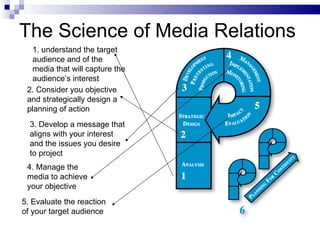
The Science of Media Relations
   1. understand the target
   audience and of the
   media that will capture the
   audience’s interest
 2. Consider you objective
 and strategically design a
 planning of action
  3. Develop a message that
  aligns with your interest
  and the issues you desire
  to project
 4. Manage the
 media to achieve
 your objective
5. Evaluate the reaction
of your target audience
Managing the Media
The 5 C’s of Effective Media Relations
•  Credibility – Ability to deal honestly (Not losing sight of the
                Truth)
•    Candor – Ability to acknowledge errors
•    Clarity – Ability to keep it simple
•    Compassion – Ability to listen to others, understand their
                    position and be polite in responding
•    Commitment – Ability to keep the issue in focus and
                     avoid distraction
Choosing a Media team
 - Who is the Chief Spokesperson?
  - Who makes the Press Calls?
  - Who sends the releases?
A good media team must have:
     1. A COORDINATOR
      2. A WRITER
     3. A SPOKESPERSON.
The Media Coordinator
   The media coordinator must be someone who is
    personable, can succinctly articulate the issues, and is
    willing to spend a great deal of time on the telephone.
   This person makes sure press releases go out on time,
    keeps media lists updated, makes press calls, and works
    actively behind the scenes during events.
   The media coordinator should be well-known behind the
    camera as the organization's spokesperson is in front of
    it. One person handling press calls can cultivate
    important relationships with assignment desk personnel,
    news producers, and camera people.
The Spokesperson
   The spokesperson must be articulate, a good listener,
    have camera presence, be well-informed about issues,
    be able to think quickly on his/her feet, have credibility,
    be able to develop a good rapport with a reporter, and be
    intuitive enough to know when a reporter is not friendly.
   He / She must be able to think through each question
    that are likely to be asked, and consider carefully the
    possible responses.
   He / She must always be ready to revise and refine the
    organization’s position as defined by the media
    environment
The Writer
   The writer creates the substance for all your press
    events.
   He / She must have a clear, concise, effective writing
    skill. Because someone is articulate does not mean
    he/she can write.
   Must be a good editor and always ensure that he/she
    "tighten up" news material.
   He/ She must have a good understanding of the
    organization because everything that is written and
    released must reflect accurately the position of the
    organization.
Agenda Setting
   Agenda-setting refers to the power of the media in
    defining the focus of its target as to what is important in
    the public domain
   Agenda-setting is the creation of public awareness and
    concern of salient issues by the news media.
   The theory of agenda-setting is based on two
    assumptions:
    (1) the press and the media do not reflect reality; they filter and
       shape it;
    2) media concentration on a few issues and subjects leads the
       public to perceive those issues as more important than other
       issues.
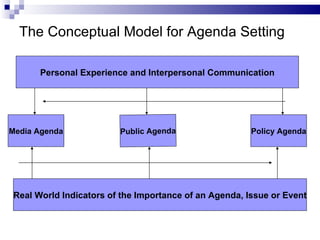
The Conceptual Model for Agenda Setting

      Personal Experience and Interpersonal Communication


Media Agenda            Public Agenda                  Policy Agenda


Real World Indicators of the Importance of an Agenda, Issue or Event
Why Set an Agenda?
 To influence a thought process
 To shape opinion
 To gain empathy
 To compel action
Segmenting the Media
   The media operates at varying levels of interests
    as there are various kinds of individuals,
    belonging to different professions, sharing
    different social or religious views and opinions
    and engaging in different kinds of past times.
   The strategy starts with an understanding of
    your organization's position in all of the disparate
    interests that are available within your industry
    and social setting.
The How of Segmentation
   Segmentation involves a demographic, professional,
    ethical and psychographic parameter:
      - The Conservative Media
        Conservative Political and Economic Inclination, as seen from
       its editorial stance
        - The Liberal Media
       Liberal Political and Economic Inclination, as seen from
       its editorial stance
        - The Specialist Media
         This targets specific Industries and Professions
        - The Lifestyle Media
         This engages in lifestyle and popular culture reporting and are usually
        referred to as tabloids. Traditionally, tabloids are    distinguished
        by sensationalism of approach and content rather        than      by
        straightforward reportage of newsworthy events.
Tools and Tricks
   The Press Kit
   The Media Contact List
   The Press Release
   Media Calls and Tours
   The Press Conference
   Media Monitoring
   The Tear-sheet
   Audience Response Research

Media relations strategy

  • 1.
    Developing a Media RelationsStrategy – Putting Square Pegs in Square Holes Bolaji Okusaga Managing Director, The Quadrant Company
  • 2.
    Introduction  Media Relations involves the strategic deployment of the media in telling the organizational story.  It seeks the dissemination of the organization’s objective to an audience outside the organization's immediate reach.  And involve the transmitting of messages via the mass media.  Media relation therefore stands on a tripod: the Organization (Sender), the Media (Transmitter) and the Target Audience (Receiver).
  • 3.
    Media Relations: AnArt or a Science?  There is little doubt that the media is an all-pervasive and key part of modern society and communications.  However, is media relations an art or science? And if it is both, as most practitioners believe, how can we achieve desirable results?  Developing and integrating media relations strategies into overall communications plans are important skills for all communicators.  Also challenging is the process of actually translating media strategies into reality, of building professional relationships with members of the media and, perhaps most important, achieving a recognition of the organization and its media relations officers as credible sources of information.
  • 4.
    Is it anArt?  Media Relation can be said to be an art because it engages the creativity of the PR practitioner in the work process.  Creative Media relations, considers the following: - What groups of stakeholders do we want to appeal to and how? - What impressions do you want each of the stakeholder to have? - What media is most practical to use in terms of access and affordability? - What messages are most appealing to each stakeholder group?
  • 5.
    The Art ofMedia Relations  Media relations is essentially the art of engagement.  Engagement here operates at two levels: - Media Operators Engagement This involves relating with Media Operators via Press Releases, Media Tours and Press Conferences - End-user or Audience Engagement This involves answering questions raised on publications about your organization in the media and gauging their reaction against the your objective
  • 6.
    Is it aScience?  Media Relations is a science because it involves systemic planning and measurement.  Effective Media Relations often depends on designing and implementing a well-thought-out plan.  It involves Audience targeting, media segmentation and media measurement in the attainment of its goals  The plan often includes description of what you want to convey to whom and how you plan to convey it.  A media plan for instance specifies what media methods can be used and when.
  • 7.
    The Science ofMedia Relations 1. understand the target audience and of the media that will capture the audience’s interest 2. Consider you objective and strategically design a planning of action 3. Develop a message that aligns with your interest and the issues you desire to project 4. Manage the media to achieve your objective 5. Evaluate the reaction of your target audience
  • 8.
    Managing the Media The5 C’s of Effective Media Relations • Credibility – Ability to deal honestly (Not losing sight of the Truth) • Candor – Ability to acknowledge errors • Clarity – Ability to keep it simple • Compassion – Ability to listen to others, understand their position and be polite in responding • Commitment – Ability to keep the issue in focus and avoid distraction
  • 9.
    Choosing a Mediateam - Who is the Chief Spokesperson? - Who makes the Press Calls? - Who sends the releases? A good media team must have: 1. A COORDINATOR 2. A WRITER 3. A SPOKESPERSON.
  • 10.
    The Media Coordinator  The media coordinator must be someone who is personable, can succinctly articulate the issues, and is willing to spend a great deal of time on the telephone.  This person makes sure press releases go out on time, keeps media lists updated, makes press calls, and works actively behind the scenes during events.  The media coordinator should be well-known behind the camera as the organization's spokesperson is in front of it. One person handling press calls can cultivate important relationships with assignment desk personnel, news producers, and camera people.
  • 11.
    The Spokesperson  The spokesperson must be articulate, a good listener, have camera presence, be well-informed about issues, be able to think quickly on his/her feet, have credibility, be able to develop a good rapport with a reporter, and be intuitive enough to know when a reporter is not friendly.  He / She must be able to think through each question that are likely to be asked, and consider carefully the possible responses.  He / She must always be ready to revise and refine the organization’s position as defined by the media environment
  • 12.
    The Writer  The writer creates the substance for all your press events.  He / She must have a clear, concise, effective writing skill. Because someone is articulate does not mean he/she can write.  Must be a good editor and always ensure that he/she "tighten up" news material.  He/ She must have a good understanding of the organization because everything that is written and released must reflect accurately the position of the organization.
  • 13.
    Agenda Setting  Agenda-setting refers to the power of the media in defining the focus of its target as to what is important in the public domain  Agenda-setting is the creation of public awareness and concern of salient issues by the news media.  The theory of agenda-setting is based on two assumptions: (1) the press and the media do not reflect reality; they filter and shape it; 2) media concentration on a few issues and subjects leads the public to perceive those issues as more important than other issues.
  • 14.
    The Conceptual Modelfor Agenda Setting Personal Experience and Interpersonal Communication Media Agenda Public Agenda Policy Agenda Real World Indicators of the Importance of an Agenda, Issue or Event
  • 15.
    Why Set anAgenda?  To influence a thought process  To shape opinion  To gain empathy  To compel action
  • 16.
    Segmenting the Media  The media operates at varying levels of interests as there are various kinds of individuals, belonging to different professions, sharing different social or religious views and opinions and engaging in different kinds of past times.  The strategy starts with an understanding of your organization's position in all of the disparate interests that are available within your industry and social setting.
  • 17.
    The How ofSegmentation  Segmentation involves a demographic, professional, ethical and psychographic parameter: - The Conservative Media Conservative Political and Economic Inclination, as seen from its editorial stance - The Liberal Media Liberal Political and Economic Inclination, as seen from its editorial stance - The Specialist Media This targets specific Industries and Professions - The Lifestyle Media This engages in lifestyle and popular culture reporting and are usually referred to as tabloids. Traditionally, tabloids are distinguished by sensationalism of approach and content rather than by straightforward reportage of newsworthy events.
  • 18.
    Tools and Tricks  The Press Kit  The Media Contact List  The Press Release  Media Calls and Tours  The Press Conference  Media Monitoring  The Tear-sheet  Audience Response Research