Chapter 2 (Part 2):
Bayesian Decision Theory
Prof. Dr. Mostafa Gadal-Haqq
Faculty of Computer & Information Sciences
Computer Science Department
AIN SHAMS UNIVERSITY
CSC446 : Pattern Recognition
(Study DHS-Chapter 2: Sec 2.4-2.6)
ASU-CSC446 : Pattern Recognition. Prof. Dr. Mostafa Gadal-Haqq slide - 1
2.4 Classifiers Using Discriminant Functions
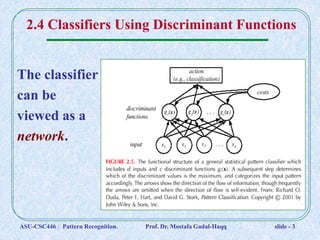
• Classifier Representation
– A classifier can be represent in terms of
discriminant functions gi(x) ; i = 1, 2, …, c.
– The classifier assigns a feature vector x to class
i according to the value of g(x) .
– the discriminant functions gi(x) divide the feature
space into c decision regions Ri ; i = 1, 2,…, c .
x  Ri if gi(x) > gj(x) j  i
ASU-CSC446 : Pattern Recognition. Prof. Dr. Mostafa Gadal-Haqq slide - 2
2.4 Classifiers Using Discriminant Functions
The classifier
can be
viewed as a
network.
ASU-CSC446 : Pattern Recognition. Prof. Dr. Mostafa Gadal-Haqq slide - 3
2.4 Classifiers Using Discriminant Functions
• Properties of g(x)
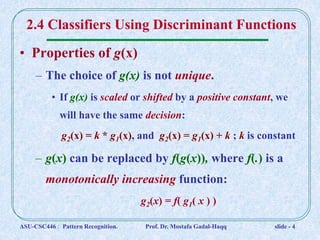
– The choice of g(x) is not unique.
• If g(x) is scaled or shifted by a positive constant, we
will have the same decision:
g2(x) = k * g1(x), and g2(x) = g1(x) + k ; k is constant
– g(x) can be replaced by f(g(x)), where f(.) is a
monotonically increasing function:
g2(x) = f( g1( x ) )
ASU-CSC446 : Pattern Recognition. Prof. Dr. Mostafa Gadal-Haqq slide - 4
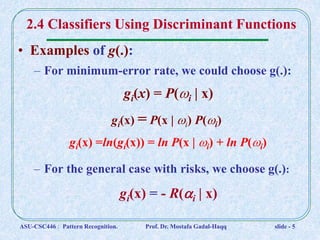
• Examples of g(.):
– For minimum-error rate, we could choose g(.):
gi(x) = P(i | x)
gi(x) = P(x | i) P(i)
gi(x) =ln(gi(x)) = ln P(x | i) + ln P(i)
– For the general case with risks, we choose g(.):
gi(x) = - R(i | x)
2.4 Classifiers Using Discriminant Functions
ASU-CSC446 : Pattern Recognition. Prof. Dr. Mostafa Gadal-Haqq slide - 5
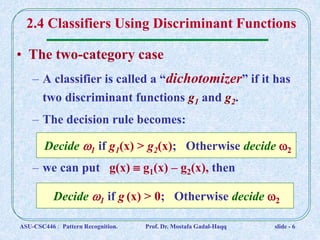
• The two-category case
– A classifier is called a “dichotomizer” if it has
two discriminant functions g1 and g2.
– The decision rule becomes:
– we can put g(x)  g1(x) – g2(x), then
2.4 Classifiers Using Discriminant Functions
Decide 1 if g1(x) > g2(x); Otherwise decide 2
Decide 1 if g (x) > 0; Otherwise decide 2
ASU-CSC446 : Pattern Recognition. Prof. Dr. Mostafa Gadal-Haqq slide - 6
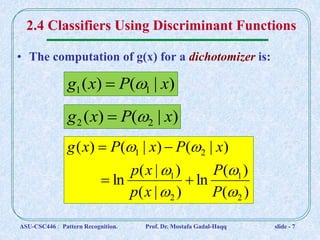
• The computation of g(x) for a dichotomizer is:
)|()( 11 xPxg 
2.4 Classifiers Using Discriminant Functions
)(
)(
ln
)|(
)|(
ln
)|()|()(
2
1
2
1
21





P
P
xp
xp
xPxPxg


)|()( 22 xPxg 
ASU-CSC446 : Pattern Recognition. Prof. Dr. Mostafa Gadal-Haqq slide - 7
2.4 Classifiers Using Discriminant Functions
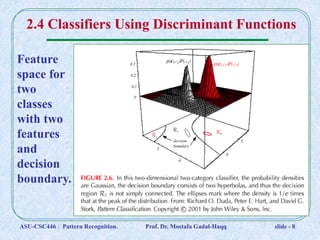
Feature
space for
two
classes
with two
features
and
decision
boundary.
ASU-CSC446 : Pattern Recognition. Prof. Dr. Mostafa Gadal-Haqq slide - 8
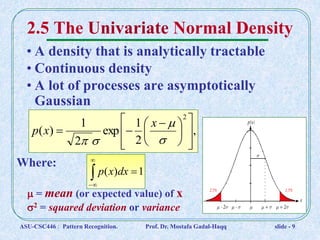
2.5 The Univariate Normal Density
• A density that is analytically tractable
• Continuous density
• A lot of processes are asymptotically
Gaussian
Where:
 = mean (or expected value) of x
2 = squared deviation or variance
,
2
1
exp
2
1
)(
2













 




x
xp



1)( dxxp
ASU-CSC446 : Pattern Recognition. Prof. Dr. Mostafa Gadal-Haqq slide - 9
2.5 The Normal Density
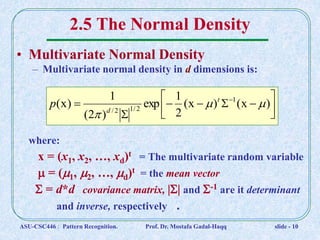
• Multivariate Normal Density
– Multivariate normal density in d dimensions is:
where:
x = (x1, x2, …, xd)t = The multivariate random variable
 = (1, 2, …, d)t = the mean vector
 = d*d covariance matrix, || and -1 are it determinant
and inverse, respectively .






 
)x()x(
2
1
exp
)2(
1
)x( 1
2/12/


t
d
p
ASU-CSC446 : Pattern Recognition. Prof. Dr. Mostafa Gadal-Haqq slide - 10
2.6 Discriminant Functions for the Normal Density
• The minimum-error-rate the discriminant functions:
gi(x) = ln p(x | i) + ln P(i)
• if the densities p(x|ωi) are multivariate normal, i.e.,
if p(x|ωi) ~ N(µi,Σi).
• In this case,
• Let us consider a number of special cases:
ASU-CSC446 : Pattern Recognition. Prof. Dr. Mostafa Gadal-Haqq slide - 11
2.6 Discriminant Functions for the Normal Density
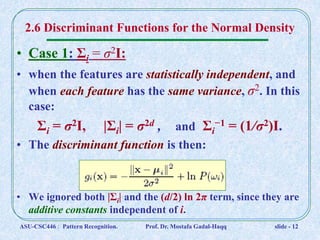
• Case 1: Σi = σ2I:
• when the features are statistically independent, and
when each feature has the same variance, σ2. In this
case:
Σi = σ2I, |Σi| = σ2d , and Σi
−1 = (1/σ2)I.
• The discriminant function is then:
• We ignored both |Σi| and the (d/2) ln 2π term, since they are
additive constants independent of i.
ASU-CSC446 : Pattern Recognition. Prof. Dr. Mostafa Gadal-Haqq slide - 12
2.6 Discriminant Functions for the Normal Density
• where ||·|| is the Euclidean norm, that is,
||x − µi||2 = (x − µi)t (x − µi)
• Expansion ||x − µi
2|| yields
• Can be written as a linear discriminant functions:
• Where: and
ASU-CSC446 : Pattern Recognition. Prof. Dr. Mostafa Gadal-Haqq slide - 13
2.6 Discriminant Functions for the Normal Density
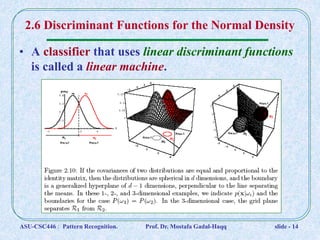
• A classifier that uses linear discriminant functions
is called a linear machine.
ASU-CSC446 : Pattern Recognition. Prof. Dr. Mostafa Gadal-Haqq slide - 14
2.6 Discriminant Functions for the Normal Density
• Reading:
– Case 2: Σi = Σ :
• the covariance matrices for all classes are
identical.
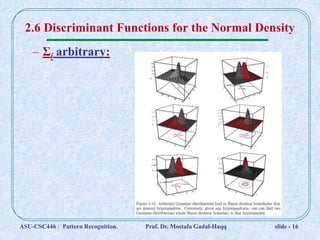
– Case 3: Σi = arbitrary:
• the general multivariate normal case, the
covariance matrices are different for each
category.
ASU-CSC446 : Pattern Recognition. Prof. Dr. Mostafa Gadal-Haqq slide - 15
2.6 Discriminant Functions for the Normal Density
– Σi arbitrary:
ASU-CSC446 : Pattern Recognition. Prof. Dr. Mostafa Gadal-Haqq slide - 16
2.6 Discriminant Functions for the Normal Density
• Numerical Example: (Two features, Two classes)







6
3
1







6
3
1








2
3
2







20
02/1
1







20
02
2







2/10
021
1







2/10
02/11
2
• using: P(w1)=P(w2)=0.5,
• The decision boundary g(x) = g1(x) - g2(x) =0
w1
w2
x2 - 3.514 + 1.125 x1 - 0.1875 x1
2=0
ASU-CSC446 : Pattern Recognition. Prof. Dr. Mostafa Gadal-Haqq slide - 17
Home Work (1)
• Write a report on Section 2.9: Bayesian Decision
theory - Discrete features.
• 2.9.1: Independent binary features
• Example 3: Bayesian Decisions for 3D binary Data
• Problem Exercises:
– Derive the decision boundary equation in the
previous example (slide #17).
ASU-CSC446 : Pattern Recognition. Prof. Dr. Mostafa Gadal-Haqq slide - 18

CSC446: Pattern Recognition (LN5)

  • 1.
    Chapter 2 (Part2): Bayesian Decision Theory Prof. Dr. Mostafa Gadal-Haqq Faculty of Computer & Information Sciences Computer Science Department AIN SHAMS UNIVERSITY CSC446 : Pattern Recognition (Study DHS-Chapter 2: Sec 2.4-2.6) ASU-CSC446 : Pattern Recognition. Prof. Dr. Mostafa Gadal-Haqq slide - 1
  • 2.
    2.4 Classifiers UsingDiscriminant Functions • Classifier Representation – A classifier can be represent in terms of discriminant functions gi(x) ; i = 1, 2, …, c. – The classifier assigns a feature vector x to class i according to the value of g(x) . – the discriminant functions gi(x) divide the feature space into c decision regions Ri ; i = 1, 2,…, c . x  Ri if gi(x) > gj(x) j  i ASU-CSC446 : Pattern Recognition. Prof. Dr. Mostafa Gadal-Haqq slide - 2
  • 3.
    2.4 Classifiers UsingDiscriminant Functions The classifier can be viewed as a network. ASU-CSC446 : Pattern Recognition. Prof. Dr. Mostafa Gadal-Haqq slide - 3
  • 4.
    2.4 Classifiers UsingDiscriminant Functions • Properties of g(x) – The choice of g(x) is not unique. • If g(x) is scaled or shifted by a positive constant, we will have the same decision: g2(x) = k * g1(x), and g2(x) = g1(x) + k ; k is constant – g(x) can be replaced by f(g(x)), where f(.) is a monotonically increasing function: g2(x) = f( g1( x ) ) ASU-CSC446 : Pattern Recognition. Prof. Dr. Mostafa Gadal-Haqq slide - 4
  • 5.
    • Examples ofg(.): – For minimum-error rate, we could choose g(.): gi(x) = P(i | x) gi(x) = P(x | i) P(i) gi(x) =ln(gi(x)) = ln P(x | i) + ln P(i) – For the general case with risks, we choose g(.): gi(x) = - R(i | x) 2.4 Classifiers Using Discriminant Functions ASU-CSC446 : Pattern Recognition. Prof. Dr. Mostafa Gadal-Haqq slide - 5
  • 6.
    • The two-categorycase – A classifier is called a “dichotomizer” if it has two discriminant functions g1 and g2. – The decision rule becomes: – we can put g(x)  g1(x) – g2(x), then 2.4 Classifiers Using Discriminant Functions Decide 1 if g1(x) > g2(x); Otherwise decide 2 Decide 1 if g (x) > 0; Otherwise decide 2 ASU-CSC446 : Pattern Recognition. Prof. Dr. Mostafa Gadal-Haqq slide - 6
  • 7.
    • The computationof g(x) for a dichotomizer is: )|()( 11 xPxg  2.4 Classifiers Using Discriminant Functions )( )( ln )|( )|( ln )|()|()( 2 1 2 1 21      P P xp xp xPxPxg   )|()( 22 xPxg  ASU-CSC446 : Pattern Recognition. Prof. Dr. Mostafa Gadal-Haqq slide - 7
  • 8.
    2.4 Classifiers UsingDiscriminant Functions Feature space for two classes with two features and decision boundary. ASU-CSC446 : Pattern Recognition. Prof. Dr. Mostafa Gadal-Haqq slide - 8
  • 9.
    2.5 The UnivariateNormal Density • A density that is analytically tractable • Continuous density • A lot of processes are asymptotically Gaussian Where:  = mean (or expected value) of x 2 = squared deviation or variance , 2 1 exp 2 1 )( 2                    x xp    1)( dxxp ASU-CSC446 : Pattern Recognition. Prof. Dr. Mostafa Gadal-Haqq slide - 9
  • 10.
    2.5 The NormalDensity • Multivariate Normal Density – Multivariate normal density in d dimensions is: where: x = (x1, x2, …, xd)t = The multivariate random variable  = (1, 2, …, d)t = the mean vector  = d*d covariance matrix, || and -1 are it determinant and inverse, respectively .         )x()x( 2 1 exp )2( 1 )x( 1 2/12/   t d p ASU-CSC446 : Pattern Recognition. Prof. Dr. Mostafa Gadal-Haqq slide - 10
  • 11.
    2.6 Discriminant Functionsfor the Normal Density • The minimum-error-rate the discriminant functions: gi(x) = ln p(x | i) + ln P(i) • if the densities p(x|ωi) are multivariate normal, i.e., if p(x|ωi) ~ N(µi,Σi). • In this case, • Let us consider a number of special cases: ASU-CSC446 : Pattern Recognition. Prof. Dr. Mostafa Gadal-Haqq slide - 11
  • 12.
    2.6 Discriminant Functionsfor the Normal Density • Case 1: Σi = σ2I: • when the features are statistically independent, and when each feature has the same variance, σ2. In this case: Σi = σ2I, |Σi| = σ2d , and Σi −1 = (1/σ2)I. • The discriminant function is then: • We ignored both |Σi| and the (d/2) ln 2π term, since they are additive constants independent of i. ASU-CSC446 : Pattern Recognition. Prof. Dr. Mostafa Gadal-Haqq slide - 12
  • 13.
    2.6 Discriminant Functionsfor the Normal Density • where ||·|| is the Euclidean norm, that is, ||x − µi||2 = (x − µi)t (x − µi) • Expansion ||x − µi 2|| yields • Can be written as a linear discriminant functions: • Where: and ASU-CSC446 : Pattern Recognition. Prof. Dr. Mostafa Gadal-Haqq slide - 13
  • 14.
    2.6 Discriminant Functionsfor the Normal Density • A classifier that uses linear discriminant functions is called a linear machine. ASU-CSC446 : Pattern Recognition. Prof. Dr. Mostafa Gadal-Haqq slide - 14
  • 15.
    2.6 Discriminant Functionsfor the Normal Density • Reading: – Case 2: Σi = Σ : • the covariance matrices for all classes are identical. – Case 3: Σi = arbitrary: • the general multivariate normal case, the covariance matrices are different for each category. ASU-CSC446 : Pattern Recognition. Prof. Dr. Mostafa Gadal-Haqq slide - 15
  • 16.
    2.6 Discriminant Functionsfor the Normal Density – Σi arbitrary: ASU-CSC446 : Pattern Recognition. Prof. Dr. Mostafa Gadal-Haqq slide - 16
  • 17.
    2.6 Discriminant Functionsfor the Normal Density • Numerical Example: (Two features, Two classes)        6 3 1        6 3 1         2 3 2        20 02/1 1        20 02 2        2/10 021 1        2/10 02/11 2 • using: P(w1)=P(w2)=0.5, • The decision boundary g(x) = g1(x) - g2(x) =0 w1 w2 x2 - 3.514 + 1.125 x1 - 0.1875 x1 2=0 ASU-CSC446 : Pattern Recognition. Prof. Dr. Mostafa Gadal-Haqq slide - 17
  • 18.
    Home Work (1) •Write a report on Section 2.9: Bayesian Decision theory - Discrete features. • 2.9.1: Independent binary features • Example 3: Bayesian Decisions for 3D binary Data • Problem Exercises: – Derive the decision boundary equation in the previous example (slide #17). ASU-CSC446 : Pattern Recognition. Prof. Dr. Mostafa Gadal-Haqq slide - 18