

Bayesian Classification
MD. Zul Kawsar
1
Content
 Introduction
 Why We Use
 Example
 Advantage & Disadvantage
 Conclusion
2
3
Bayesian Classification: Why?
 A statistical classifier: performs probabilistic prediction, i.e., predicts class
membership probabilities
 Foundation: Based on Bayes’ Theorem.
 Performance: A simple Bayesian classifier, naïve Bayesian classifier, has
comparable performance with decision tree and selected neural network
classifiers
 Incremental: Each training example can incrementally increase/decrease the
probability that a hypothesis is correct — prior knowledge can be combined with
observed data
 Standard: Even when Bayesian methods are computationally intractable, they can
provide a standard of optimal decision making against which other methods can
be measured
4
Bayesian Theorem: Basics
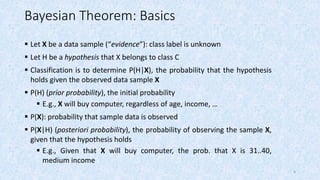
 Let X be a data sample (“evidence”): class label is unknown
 Let H be a hypothesis that X belongs to class C
 Classification is to determine P(H|X), the probability that the hypothesis
holds given the observed data sample X
 P(H) (prior probability), the initial probability
 E.g., X will buy computer, regardless of age, income, …
 P(X): probability that sample data is observed
 P(X|H) (posteriori probability), the probability of observing the sample X,
given that the hypothesis holds
 E.g., Given that X will buy computer, the prob. that X is 31..40,
medium income
5
Bayesian Theorem Cont..
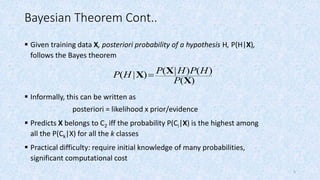
 Given training data X, posteriori probability of a hypothesis H, P(H|X),
follows the Bayes theorem
 Informally, this can be written as
posteriori = likelihood x prior/evidence
 Predicts X belongs to C2 iff the probability P(Ci|X) is the highest among
all the P(Ck|X) for all the k classes
 Practical difficulty: require initial knowledge of many probabilities,
significant computational cost
)(
)()|()|(
X
XX
P
HPHPHP 
6
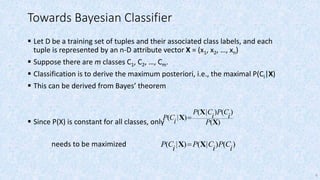
Towards Bayesian Classifier
 Let D be a training set of tuples and their associated class labels, and each
tuple is represented by an n-D attribute vector X = (x1, x2, …, xn)
 Suppose there are m classes C1, C2, …, Cm.
 Classification is to derive the maximum posteriori, i.e., the maximal P(Ci|X)
 This can be derived from Bayes’ theorem
 Since P(X) is constant for all classes, only
needs to be maximized
)(
)()|(
)|(
X
X
X
P
i
CP
i
CP
i
CP 
)()|()|(
i
CP
i
CP
i
CP XX 
7
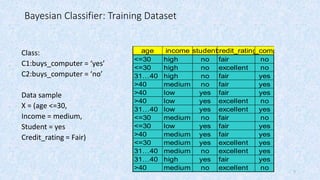
Bayesian Classifier: Training Dataset
Class:
C1:buys_computer = ‘yes’
C2:buys_computer = ‘no’
Data sample
X = (age <=30,
Income = medium,
Student = yes
Credit_rating = Fair)
age income studentcredit_ratingbuys_computer
<=30 high no fair no
<=30 high no excellent no
31…40 high no fair yes
>40 medium no fair yes
>40 low yes fair yes
>40 low yes excellent no
31…40 low yes excellent yes
<=30 medium no fair no
<=30 low yes fair yes
>40 medium yes fair yes
<=30 medium yes excellent yes
31…40 medium no excellent yes
31…40 high yes fair yes
>40 medium no excellent no
8
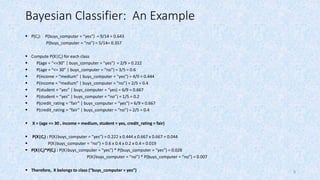
Bayesian Classifier: An Example
 P(Ci): P(buys_computer = “yes”) = 9/14 = 0.643
P(buys_computer = “no”) = 5/14= 0.357
 Compute P(X|Ci) for each class
 P(age = “<=30” | buys_computer = “yes”) = 2/9 = 0.222
 P(age = “<= 30” | buys_computer = “no”) = 3/5 = 0.6
 P(income = “medium” | buys_computer = “yes”) = 4/9 = 0.444
 P(income = “medium” | buys_computer = “no”) = 2/5 = 0.4
 P(student = “yes” | buys_computer = “yes) = 6/9 = 0.667
 P(student = “yes” | buys_computer = “no”) = 1/5 = 0.2
 P(credit_rating = “fair” | buys_computer = “yes”) = 6/9 = 0.667
 P(credit_rating = “fair” | buys_computer = “no”) = 2/5 = 0.4
 X = (age <= 30 , income = medium, student = yes, credit_rating = fair)
 P(X|Ci) : P(X|buys_computer = “yes”) = 0.222 x 0.444 x 0.667 x 0.667 = 0.044
 P(X|buys_computer = “no”) = 0.6 x 0.4 x 0.2 x 0.4 = 0.019
 P(X|Ci)*P(Ci) : P(X|buys_computer = “yes”) * P(buys_computer = “yes”) = 0.028
P(X|buys_computer = “no”) * P(buys_computer = “no”) = 0.007
 Therefore, X belongs to class (“buys_computer = yes”)
9
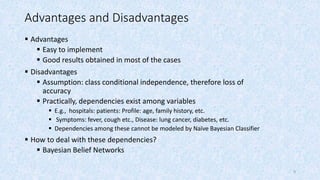
Advantages and Disadvantages
 Advantages
 Easy to implement
 Good results obtained in most of the cases
 Disadvantages
 Assumption: class conditional independence, therefore loss of
accuracy
 Practically, dependencies exist among variables
 E.g., hospitals: patients: Profile: age, family history, etc.
 Symptoms: fever, cough etc., Disease: lung cancer, diabetes, etc.
 Dependencies among these cannot be modeled by Naïve Bayesian Classifier
 How to deal with these dependencies?
 Bayesian Belief Networks
Conclusion
 It is one of the oldest formal classification algorithms, and yet even in
its simplest form it is often surprisingly effective.
 It is widely used in areas such as text classification and spam filtering.
 It tremendously appealing because of its simplicity, elegance, and
robustness.
10
Thank You
11

Bayesian classification

  • 1.
  • 2.
    Content  Introduction  WhyWe Use  Example  Advantage & Disadvantage  Conclusion 2
  • 3.
    3 Bayesian Classification: Why? A statistical classifier: performs probabilistic prediction, i.e., predicts class membership probabilities  Foundation: Based on Bayes’ Theorem.  Performance: A simple Bayesian classifier, naïve Bayesian classifier, has comparable performance with decision tree and selected neural network classifiers  Incremental: Each training example can incrementally increase/decrease the probability that a hypothesis is correct — prior knowledge can be combined with observed data  Standard: Even when Bayesian methods are computationally intractable, they can provide a standard of optimal decision making against which other methods can be measured
  • 4.
    4 Bayesian Theorem: Basics Let X be a data sample (“evidence”): class label is unknown  Let H be a hypothesis that X belongs to class C  Classification is to determine P(H|X), the probability that the hypothesis holds given the observed data sample X  P(H) (prior probability), the initial probability  E.g., X will buy computer, regardless of age, income, …  P(X): probability that sample data is observed  P(X|H) (posteriori probability), the probability of observing the sample X, given that the hypothesis holds  E.g., Given that X will buy computer, the prob. that X is 31..40, medium income
  • 5.
    5 Bayesian Theorem Cont.. Given training data X, posteriori probability of a hypothesis H, P(H|X), follows the Bayes theorem  Informally, this can be written as posteriori = likelihood x prior/evidence  Predicts X belongs to C2 iff the probability P(Ci|X) is the highest among all the P(Ck|X) for all the k classes  Practical difficulty: require initial knowledge of many probabilities, significant computational cost )( )()|()|( X XX P HPHPHP 
  • 6.
    6 Towards Bayesian Classifier Let D be a training set of tuples and their associated class labels, and each tuple is represented by an n-D attribute vector X = (x1, x2, …, xn)  Suppose there are m classes C1, C2, …, Cm.  Classification is to derive the maximum posteriori, i.e., the maximal P(Ci|X)  This can be derived from Bayes’ theorem  Since P(X) is constant for all classes, only needs to be maximized )( )()|( )|( X X X P i CP i CP i CP  )()|()|( i CP i CP i CP XX 
  • 7.
    7 Bayesian Classifier: TrainingDataset Class: C1:buys_computer = ‘yes’ C2:buys_computer = ‘no’ Data sample X = (age <=30, Income = medium, Student = yes Credit_rating = Fair) age income studentcredit_ratingbuys_computer <=30 high no fair no <=30 high no excellent no 31…40 high no fair yes >40 medium no fair yes >40 low yes fair yes >40 low yes excellent no 31…40 low yes excellent yes <=30 medium no fair no <=30 low yes fair yes >40 medium yes fair yes <=30 medium yes excellent yes 31…40 medium no excellent yes 31…40 high yes fair yes >40 medium no excellent no
  • 8.
    8 Bayesian Classifier: AnExample  P(Ci): P(buys_computer = “yes”) = 9/14 = 0.643 P(buys_computer = “no”) = 5/14= 0.357  Compute P(X|Ci) for each class  P(age = “<=30” | buys_computer = “yes”) = 2/9 = 0.222  P(age = “<= 30” | buys_computer = “no”) = 3/5 = 0.6  P(income = “medium” | buys_computer = “yes”) = 4/9 = 0.444  P(income = “medium” | buys_computer = “no”) = 2/5 = 0.4  P(student = “yes” | buys_computer = “yes) = 6/9 = 0.667  P(student = “yes” | buys_computer = “no”) = 1/5 = 0.2  P(credit_rating = “fair” | buys_computer = “yes”) = 6/9 = 0.667  P(credit_rating = “fair” | buys_computer = “no”) = 2/5 = 0.4  X = (age <= 30 , income = medium, student = yes, credit_rating = fair)  P(X|Ci) : P(X|buys_computer = “yes”) = 0.222 x 0.444 x 0.667 x 0.667 = 0.044  P(X|buys_computer = “no”) = 0.6 x 0.4 x 0.2 x 0.4 = 0.019  P(X|Ci)*P(Ci) : P(X|buys_computer = “yes”) * P(buys_computer = “yes”) = 0.028 P(X|buys_computer = “no”) * P(buys_computer = “no”) = 0.007  Therefore, X belongs to class (“buys_computer = yes”)
  • 9.
    9 Advantages and Disadvantages Advantages  Easy to implement  Good results obtained in most of the cases  Disadvantages  Assumption: class conditional independence, therefore loss of accuracy  Practically, dependencies exist among variables  E.g., hospitals: patients: Profile: age, family history, etc.  Symptoms: fever, cough etc., Disease: lung cancer, diabetes, etc.  Dependencies among these cannot be modeled by Naïve Bayesian Classifier  How to deal with these dependencies?  Bayesian Belief Networks
  • 10.
    Conclusion  It isone of the oldest formal classification algorithms, and yet even in its simplest form it is often surprisingly effective.  It is widely used in areas such as text classification and spam filtering.  It tremendously appealing because of its simplicity, elegance, and robustness. 10
  • 11.