1
BDIGITAL: After Work Knowledge Program
Practical approach to machine learning techniques for
classification and anomaly detection
Xavier Rafael-Palou
xrafael@bdigital.org
(12/12/2014)
2
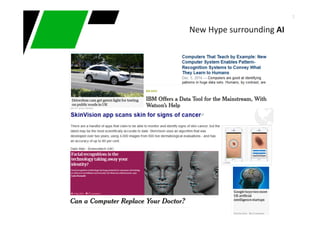
New Hype surrounding AI
3
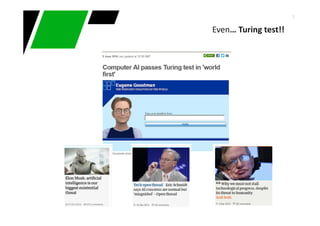
Even… Turing test!!
4
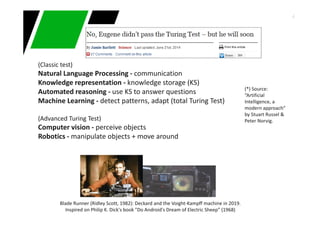
(Classic test)
Natural Language Processing - communication
Knowledge representation - knowledge storage (KS)
Automated reasoning - use KS to answer questions
Machine Learning - detect patterns, adapt (total Turing Test)
(Advanced Turing Test)
Computer vision - perceive objects
Robotics - manipulate objects + move around
Blade Runner (Ridley Scott, 1982): Deckard and the Voight-Kampff machine in 2019.
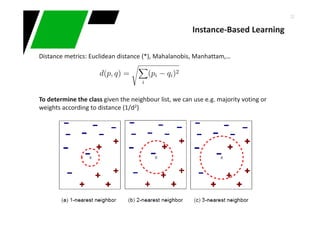
Inspired on Philip K. Dick's book "Do Android's Dream of Electric Sheep” (1968)
(*) Source:
“Artificial
Intelligence, a
modern approach“
by Stuart Russel &
Peter Norvig.
5
Agenda
1. Introduction (15 min)
2. Basic Techniques (45 min)
3. Guides & Tips Building a Classifier (15)
4. Practice:
- Environment(15 min)
- Examples & exercises (60 min)
6. References
6
Introduction
Classification, Anomaly detection but also clustering, regression are examples of
Machine Learning (ML) tasks.
ML is a subfield of Artificial Intelligence to :
- Give computers the ability to learn without being explicitly programmed. (Arthur
Samuel, 1959)
- Give computer program ability to learn from experience E with respect to some task
T and some performance measure P, if its performance on T, as measured by P,
improves with experience E. (Tom Mitchell, 1998)
Data mining (DM) overlaps in many ways with Machine Learning:
- DM uses many ML methods, but often with a slightly different goal of discovering
previously unknown knowledge.
-While ML aims to perform accurately on new, unseen examples/tasks after having
experienced a learning data set.
7
Main ML tasks:
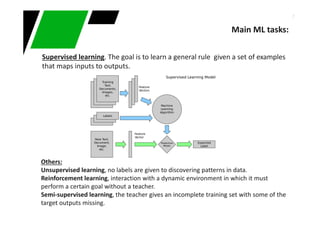
Supervised learning. The goal is to learn a general rule given a set of examples
that maps inputs to outputs.
Others:
Unsupervised learning, no labels are given to discovering patterns in data.
Reinforcement learning, interaction with a dynamic environment in which it must
perform a certain goal without a teacher.
Semi-supervised learning, the teacher gives an incomplete training set with some of the
target outputs missing.
8
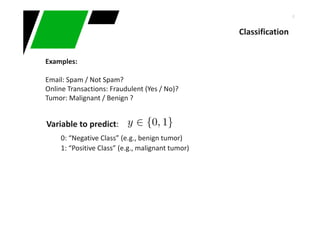
Examples:
Email: Spam / Not Spam?
Online Transactions: Fraudulent (Yes / No)?
Tumor: Malignant / Benign ?
0: “Negative Class” (e.g., benign tumor)
1: “Positive Class” (e.g., malignant tumor)
Classification
Variable to predict:
9
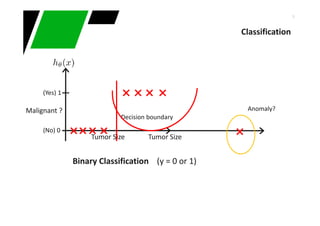
Tumor SizeTumor Size
(Yes) 1
(No) 0
Binary Classification (y = 0 or 1)
Anomaly?
Decision boundary
Classification
Malignant ?
10
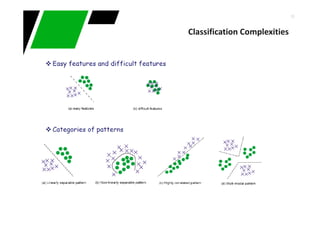
Classification Complexities
11
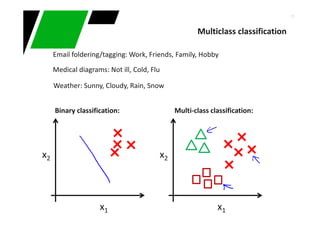
x1
x2
x1
x2
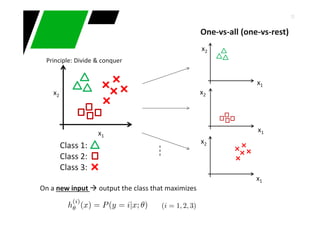
Binary classification: Multi-class classification:
Multiclass classification
Email foldering/tagging: Work, Friends, Family, Hobby
Medical diagrams: Not ill, Cold, Flu
Weather: Sunny, Cloudy, Rain, Snow
12
x1
x2
One-vs-all (one-vs-rest)
Class 1:
Class 2:
Class 3:
x1
x2
x1
x2
x1
x2
On a new input output the class that maximizes
Principle: Divide & conquer
13
Agenda
1. Introduction
2. Basic Techniques
3. Guides & Tips Building a Classifier
4. Practice:
- Environment
- Examples & exercises
6. References
14
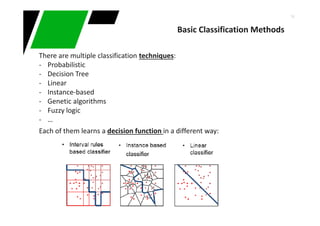
There are multiple classification techniques:
- Probabilistic
- Decision Tree
- Linear
- Instance-based
- Genetic algorithms
- Fuzzy logic
- …
Each of them learns a decision function in a different way:
Basic Classification Methods
15
Probabilistic classifiers
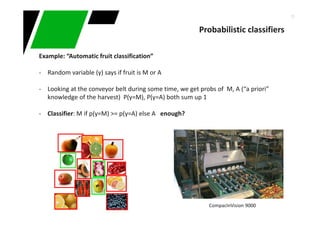
Example: “Automatic fruit classification”
- Random variable (y) says if fruit is M or A
- Looking at the conveyor belt during some time, we get probs of M, A (“a priori”
knowledge of the harvest) P(y=M), P(y=A) both sum up 1
- Classifier: M if p(y=M) >= p(y=A) else A enough?
CompacInVision 9000
16
- We add new random variable x to the system for a better performance
x = size degree of the fruit [1,2,3…]
- So, we get probs of p(x) too
- Since x depends on the type of fruit, we get densities of x depending on the type of
fruit:
p(x| y=A) , p(x | y=M) “conditional probability densities”
How size affects our attitude regarding the type of fruit in question?
- p(y=A | x) = (p(x| y=A) P(y=A)) / p(x)
- P(y=M | x) = (p(x| y=M) P(y=M)) /p(x)
Naive Bayes: A if p(y=A | x) >= p(y=M | x) else M (probs “a posteriori”)
Probabilistic classifiers
17
Pros:
- Simple to implement
- Fast to compute (e.g. fits in map & reduce paradigm)
- works surprisingly well
- Compatible with missing data
- Used in text mining Multinomial Naive Bayes
Cons:
- Unrealistic hypothesis: All features equally important and independent of another
given a class
- Dependencies among features (i.e. recall all have same power)
- Zero probs holds a veto over other ones
- Requires process all data
Probabilistic classifiers
18
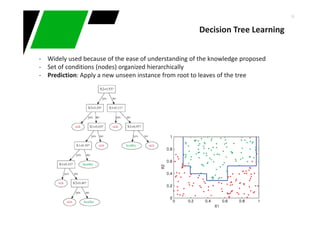
- Widely used because of the ease of understanding of the knowledge proposed
- Set of conditions (nodes) organized hierarchically
- Prediction: Apply a new unseen instance from root to leaves of the tree
Decision Tree Learning
19
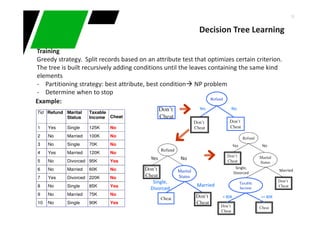
Tid Refund Marital
Status
Taxable
Income Cheat
1 Yes Single 125K No
2 No Married 100K No
3 No Single 70K No
4 Yes Married 120K No
5 No Divorced 95K Yes
6 No Married 60K No
7 Yes Divorced 220K No
8 No Single 85K Yes
9 No Married 75K No
10 No Single 90K Yes
10
Training
Greedy strategy. Split records based on an attribute test that optimizes certain criterion.
The tree is built recursively adding conditions until the leaves containing the same kind
elements
- Partitioning strategy: best attribute, best condition NP problem
- Determine when to stop
Don’t
Cheat
Refund
Don’t
Cheat
Don’t
Cheat
Yes No
Refund
Don’t
Cheat
Yes No
Marital
Status
Don’t
Cheat
Cheat
Single,
Divorced
Married
Taxable
Income
Don’t
Cheat
< 80K >= 80K
Refund
Don’t
Cheat
Yes No
Marital
Status
Don’t
Cheat
Cheat
Single,
Divorced
Married
Example:
Decision Tree Learning
20
Partitioning strategy : Preferred aattribute's that generate disjoint sets (homogeneity)
Strategy examples :
∑−=
j
tjptGINI 2
)]|([1)(
Non-homogeneous,
High degree of impurity
Homogeneous,
Low degree of impurity
p( j | t) is the relative frequency of class j at node t
)|(max1)( tjPtError
j
−=
Decision Tree Learning
Measures homogeneity of a node. Used in CART, SLIQ, SPRINT






−= ∑
=
k
i
i
split
iEntropy
n
n
pEntropyGAIN 1
)()(
Measures misclassification error made by a node
Choose split that achieves most homogeneity reduction (e.g. ID3, C4.5)
21
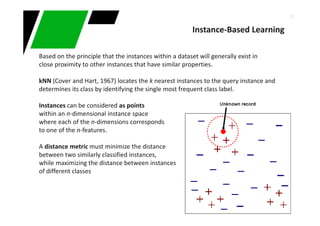
Based on the principle that the instances within a dataset will generally exist in
close proximity to other instances that have similar properties.
kNN (Cover and Hart, 1967) locates the k nearest instances to the query instance and
determines its class by identifying the single most frequent class label.
Instances can be considered as points
within an n-dimensional instance space
where each of the n-dimensions corresponds
to one of the n-features.
A distance metric must minimize the distance
between two similarly classified instances,
while maximizing the distance between instances
of different classes
Instance-Based Learning
22
Distance metrics: Euclidean distance (*), Mahalanobis, Manhattam,…
To determine the class given the neighbour list, we can use e.g. majority voting or
weights according to distance (1/d2)
Instance-Based Learning
23
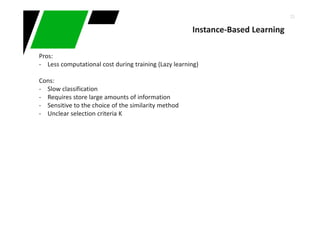
Pros:
- Less computational cost during training (Lazy learning)
Cons:
- Slow classification
- Requires store large amounts of information
- Sensitive to the choice of the similarity method
- Unclear selection criteria K
Instance-Based Learning
24
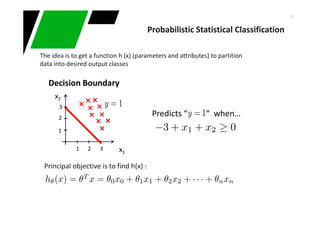
x1
Decision Boundary
1 2 3
1
2
3
Predicts “ “ when…
The idea is to get a function h (x) (parameters and attributes) to partition
data into desired output classes
x2
Probabilistic Statistical Classification
Principal objective is to find h(x) :
25
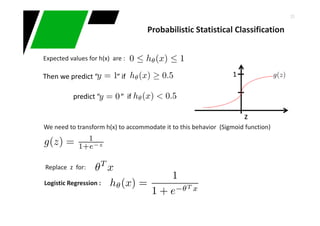
Then we predict “ “ if
predict “ “ if
z
1
Expected values for h(x) are :
We need to transform h(x) to accommodate it to this behavior (Sigmoid function)
Logistic Regression :
Replace z for:
Probabilistic Statistical Classification
26
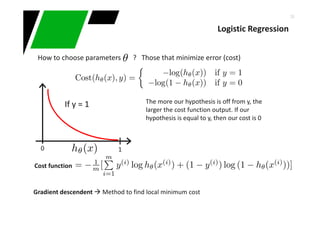
How to choose parameters ? Those that minimize error (cost)
If y = 1
10
Cost function
The more our hypothesis is off from y, the
larger the cost function output. If our
hypothesis is equal to y, then our cost is 0
Logistic Regression
Gradient descendent Method to find local minimum cost
27
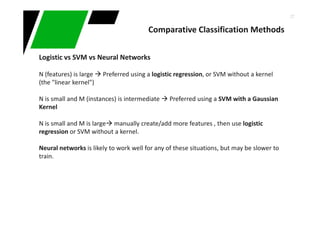
Logistic vs SVM vs Neural Networks
N (features) is large Preferred using a logistic regression, or SVM without a kernel
(the "linear kernel")
N is small and M (instances) is intermediate Preferred using a SVM with a Gaussian
Kernel
N is small and M is large manually create/add more features , then use logistic
regression or SVM without a kernel.
Neural networks is likely to work well for any of these situations, but may be slower to
train.
Comparative Classification Methods
28
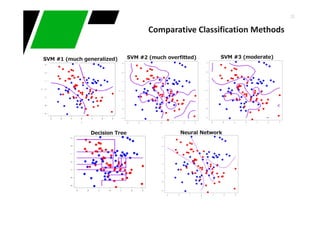
Comparative Classification Methods
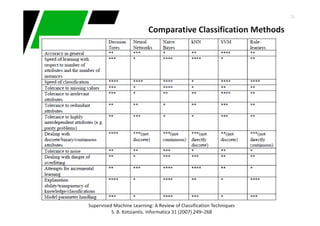
29
Supervised Machine Learning: A Review of Classification Techniques
S. B. Kotsiantis. Informatica 31 (2007) 249–268
Comparative Classification Methods
30
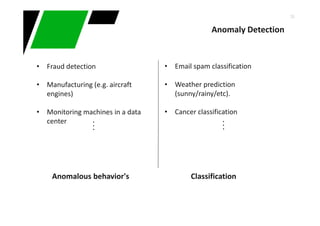
Anomaly Detection
Anomalous behavior's Classification
• Fraud detection
• Manufacturing (e.g. aircraft
engines)
• Monitoring machines in a data
center
• Email spam classification
• Weather prediction
(sunny/rainy/etc).
• Cancer classification
31
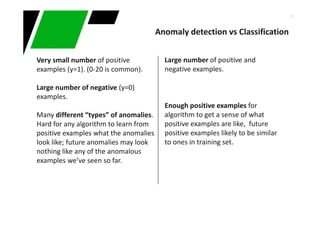
Anomaly detection vs Classification
Very small number of positive
examples (y=1). (0-20 is common).
Large number of negative (y=0)
examples.
Many different “types” of anomalies.
Hard for any algorithm to learn from
positive examples what the anomalies
look like; future anomalies may look
nothing like any of the anomalous
examples we’ve seen so far.
Large number of positive and
negative examples.
Enough positive examples for
algorithm to get a sense of what
positive examples are like, future
positive examples likely to be similar
to ones in training set.
32
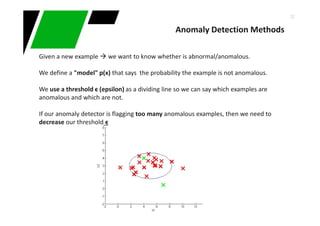
Given a new example we want to know whether is abnormal/anomalous.
We define a "model" p(x) that says the probability the example is not anomalous.
We use a threshold ϵ (epsilon) as a dividing line so we can say which examples are
anomalous and which are not.
If our anomaly detector is flagging too many anomalous examples, then we need to
decrease our threshold ϵ
Anomaly Detection Methods
33
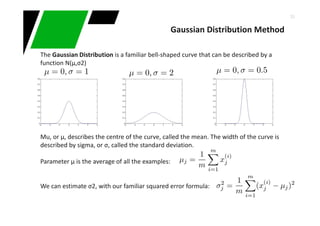
The Gaussian Distribution is a familiar bell-shaped curve that can be described by a
function N(μ,σ2)
Mu, or μ, describes the centre of the curve, called the mean. The width of the curve is
described by sigma, or σ, called the standard deviation.
Parameter μ is the average of all the examples:
We can estimate σ2, with our familiar squared error formula:
Gaussian Distribution Method
34
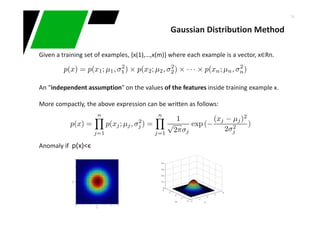
Given a training set of examples, {x(1),…,x(m)} where each example is a vector, x∈Rn.
An "independent assumption" on the values of the features inside training example x.
More compactly, the above expression can be written as follows:
Anomaly if p(x)<ϵ
Gaussian Distribution Method
35
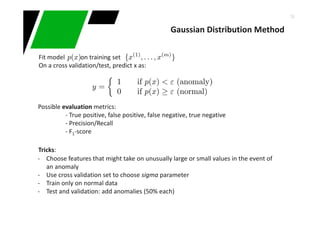
Fit model on training set
On a cross validation/test, predict x as:
Possible evaluation metrics:
- True positive, false positive, false negative, true negative
- Precision/Recall
- F1-score
Tricks:
- Choose features that might take on unusually large or small values in the event of
an anomaly
- Use cross validation set to choose sigma parameter
- Train only on normal data
- Test and validation: add anomalies (50% each)
Gaussian Distribution Method
36
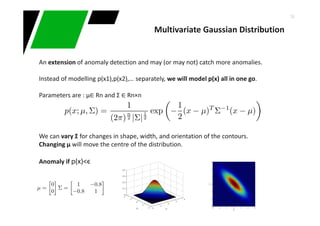
An extension of anomaly detection and may (or may not) catch more anomalies.
Instead of modelling p(x1),p(x2),… separately, we will model p(x) all in one go.
Parameters are : μ∈ Rn and Σ ∈ Rn×n
We can vary Σ for changes in shape, width, and orientation of the contours.
Changing μ will move the centre of the distribution.
Anomaly if p(x)<ϵ
Multivariate Gaussian Distribution
37
One-class SVM
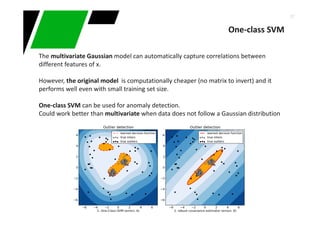
The multivariate Gaussian model can automatically capture correlations between
different features of x.
However, the original model is computationally cheaper (no matrix to invert) and it
performs well even with small training set size.
One-class SVM can be used for anomaly detection.
Could work better than multivariate when data does not follow a Gaussian distribution
38
Agenda
1. Introduction
2. Basic Techniques
3. Guides & Tips Building a Classifier
4. Practice:
- Environment
- Examples & exercises
6. References
39
If classification performance is not what we expected, What to work on?
- Get more training examples?
- Try smaller sets of features?
- Try getting additional features?
- Try changing model?
- Try decreasing regularization?
- Try increasing regularization?
Guides & Tips Building Classifiers
40
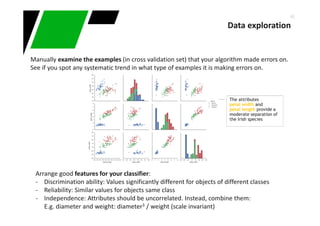
The attributes
petal width and
petal length provide a
moderate separation of
the Irish species
Data exploration
Manually examine the examples (in cross validation set) that your algorithm made errors on.
See if you spot any systematic trend in what type of examples it is making errors on.
Arrange good features for your classifier:
- Discrimination ability: Values significantly different for objects of different classes
- Reliability: Similar values for objects same class
- Independence: Attributes should be uncorrelated. Instead, combine them:
E.g. diameter and weight: diameter3 / weight (scale invariant)
41
Bias-Variance Trade-Off
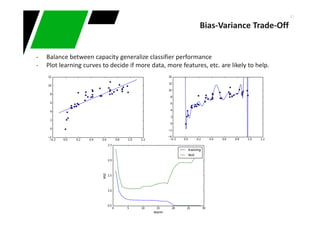
- Balance between capacity generalize classifier performance
- Plot learning curves to decide if more data, more features, etc. are likely to help.
42
Start with a simple algorithm that you can implement quickly.
Implement and test it on your cross-validation data.
Split data in 3 different sets: Training + Validation + Test
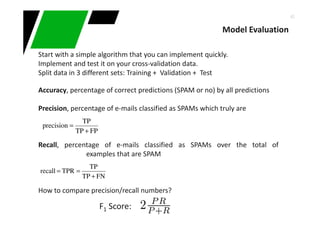
Accuracy, percentage of correct predictions (SPAM or no) by all predictions
Precision, percentage of e-mails classified as SPAMs which truly are
Recall, percentage of e-mails classified as SPAMs over the total of
examples that are SPAM
How to compare precision/recall numbers?
FNTP
TP
TPRrecall
+
==
FPTP
TP
precision
+
=
Model Evaluation
F1 Score:
43
Agenda
1. Introduction
2. Basic Techniques
3. Guides & Tips Building a Classifier
4. Practice:
- Environment
- Examples & exercises
6. References
44
Practice: Environment
0) Python:
Language interpreted dynamically-typed nature
Download:
- Python already installed:
pip install ipython or only dependencies "ipython[notebook]“
- Otherwise:
Anaconda (http://continuum.io/downloads) is a completely free Python distribution
(including for commercial use and redistribution). It includes over 195 of the most
popular python packages for science, math, engineering, data analysis.
$ Conda info
$ conda install <packageName>
$ conda update <packageName>
45
Practice: Environment
1) Ipython:
Ipython provides a rich architecture for interactive computing with:
- Powerful interactive shells (terminal and Qt-based).
- A browser-based notebook with support for code, text, mathematical expressions,
inline plots and other rich media.
- Support for interactive data visualization and use of GUI toolkits.
- Flexible, embeddable interpreters to load into your own projects.
- Easy to use, high performance tools for parallel computing.
Start console Ipython –pylab
46
Practice: Environment
2) Notebook
Web-based interactive computational environment where to combine code execution,
text, mathematics, plots and rich media into a single document
Start notebook server ipython notebook
(http://127.0.0.1:8888)
Open an existing notebook ipython notebook <name.ipynb>
The notebook consists of a sequence of cells.
A cell is a multi-line text input field, and its contents can be executed by commands or
clicking either “Play” button, or Cell | Run in the menu bar.
Commands:
Shift-Enter Runs cell and goes to next
Ctrl-Enter Runs cell & stays in same cell
Esc and Enter Command mode and edit mode
Tab auto-complete
47
Practice: Environment
3) Numpy + scipy
Numpy offers a specific data structure for high-performance numerical computing:
the multidimensional array
- Data is stored in contiguous block of memoryin Ram. This makes more efficient
Use of cpu cycles and cache
- Array operations implemented internally with C loops rather than python.
Numpy has all standard array functions, linear algebra, and fancy indexing.
Numpy+scipy docs: http://docs.scipy.org
4) Matplotlib
Graphical library to plot and visualize your data
5) Scikit-Learn
Librería para machine learning
48
Agenda
1. Introduction
2. Basic Techniques
3. Guides & Tips Building a Classifier
4. Practice:
- Environment
- Examples & exercises
6. References
49
Practice: Exercises
- An introduction to machine learning with Python and scikit-learn (repo and overview)
by Hannes Schulz and Andreas Mueller.
- PyCon 2014 Scikit-learn Tutorial (Ipython and machine learning) by Jake VanderPlas
50
Agenda
1. Introduction
2. Basic Techniques
3. Guides & Tips Building a Classifier
4. Practice:
- Environment
- Examples & exercises
6. References
51
References
- Data mining. Practical Machine Learning Tools and Techniques. I. Frank, et al
- Introduction to Machine learning with Ipython. LxMLS 2014. A. Mueller
- Ipython and machine learning. PyCon ’14
- Introduction to Machine learning. Coursera 2014. A. Ng
- scikit-learn. http://scikit-learn.org (see especially the narrative documentation)
- Matplotlib. http://matplotlib.org (see especially the gallery section)
- Ipython. http://ipython.org (also check out http://nbviewer.ipython.org)
- Anaconda. https://store.continuum.io/cshop/anaconda/
- Notebook. http://ipython.org/ipython-doc/stable/notebook/index.html
52
Thanks a lot!!
xrafael@bdigital.org

Introduction to conventional machine learning techniques

  • 1.
    1 BDIGITAL: After WorkKnowledge Program Practical approach to machine learning techniques for classification and anomaly detection Xavier Rafael-Palou xrafael@bdigital.org (12/12/2014)
  • 2.
  • 3.
  • 4.
    4 (Classic test) Natural LanguageProcessing - communication Knowledge representation - knowledge storage (KS) Automated reasoning - use KS to answer questions Machine Learning - detect patterns, adapt (total Turing Test) (Advanced Turing Test) Computer vision - perceive objects Robotics - manipulate objects + move around Blade Runner (Ridley Scott, 1982): Deckard and the Voight-Kampff machine in 2019. Inspired on Philip K. Dick's book "Do Android's Dream of Electric Sheep” (1968) (*) Source: “Artificial Intelligence, a modern approach“ by Stuart Russel & Peter Norvig.
  • 5.
    5 Agenda 1. Introduction (15min) 2. Basic Techniques (45 min) 3. Guides & Tips Building a Classifier (15) 4. Practice: - Environment(15 min) - Examples & exercises (60 min) 6. References
  • 6.
    6 Introduction Classification, Anomaly detectionbut also clustering, regression are examples of Machine Learning (ML) tasks. ML is a subfield of Artificial Intelligence to : - Give computers the ability to learn without being explicitly programmed. (Arthur Samuel, 1959) - Give computer program ability to learn from experience E with respect to some task T and some performance measure P, if its performance on T, as measured by P, improves with experience E. (Tom Mitchell, 1998) Data mining (DM) overlaps in many ways with Machine Learning: - DM uses many ML methods, but often with a slightly different goal of discovering previously unknown knowledge. -While ML aims to perform accurately on new, unseen examples/tasks after having experienced a learning data set.
  • 7.
    7 Main ML tasks: Supervisedlearning. The goal is to learn a general rule given a set of examples that maps inputs to outputs. Others: Unsupervised learning, no labels are given to discovering patterns in data. Reinforcement learning, interaction with a dynamic environment in which it must perform a certain goal without a teacher. Semi-supervised learning, the teacher gives an incomplete training set with some of the target outputs missing.
  • 8.
    8 Examples: Email: Spam /Not Spam? Online Transactions: Fraudulent (Yes / No)? Tumor: Malignant / Benign ? 0: “Negative Class” (e.g., benign tumor) 1: “Positive Class” (e.g., malignant tumor) Classification Variable to predict:
  • 9.
    9 Tumor SizeTumor Size (Yes)1 (No) 0 Binary Classification (y = 0 or 1) Anomaly? Decision boundary Classification Malignant ?
  • 10.
  • 11.
    11 x1 x2 x1 x2 Binary classification: Multi-classclassification: Multiclass classification Email foldering/tagging: Work, Friends, Family, Hobby Medical diagrams: Not ill, Cold, Flu Weather: Sunny, Cloudy, Rain, Snow
  • 12.
    12 x1 x2 One-vs-all (one-vs-rest) Class 1: Class2: Class 3: x1 x2 x1 x2 x1 x2 On a new input output the class that maximizes Principle: Divide & conquer
  • 13.
    13 Agenda 1. Introduction 2. BasicTechniques 3. Guides & Tips Building a Classifier 4. Practice: - Environment - Examples & exercises 6. References
  • 14.
    14 There are multipleclassification techniques: - Probabilistic - Decision Tree - Linear - Instance-based - Genetic algorithms - Fuzzy logic - … Each of them learns a decision function in a different way: Basic Classification Methods
  • 15.
    15 Probabilistic classifiers Example: “Automaticfruit classification” - Random variable (y) says if fruit is M or A - Looking at the conveyor belt during some time, we get probs of M, A (“a priori” knowledge of the harvest) P(y=M), P(y=A) both sum up 1 - Classifier: M if p(y=M) >= p(y=A) else A enough? CompacInVision 9000
  • 16.
    16 - We addnew random variable x to the system for a better performance x = size degree of the fruit [1,2,3…] - So, we get probs of p(x) too - Since x depends on the type of fruit, we get densities of x depending on the type of fruit: p(x| y=A) , p(x | y=M) “conditional probability densities” How size affects our attitude regarding the type of fruit in question? - p(y=A | x) = (p(x| y=A) P(y=A)) / p(x) - P(y=M | x) = (p(x| y=M) P(y=M)) /p(x) Naive Bayes: A if p(y=A | x) >= p(y=M | x) else M (probs “a posteriori”) Probabilistic classifiers
  • 17.
    17 Pros: - Simple toimplement - Fast to compute (e.g. fits in map & reduce paradigm) - works surprisingly well - Compatible with missing data - Used in text mining Multinomial Naive Bayes Cons: - Unrealistic hypothesis: All features equally important and independent of another given a class - Dependencies among features (i.e. recall all have same power) - Zero probs holds a veto over other ones - Requires process all data Probabilistic classifiers
  • 18.
    18 - Widely usedbecause of the ease of understanding of the knowledge proposed - Set of conditions (nodes) organized hierarchically - Prediction: Apply a new unseen instance from root to leaves of the tree Decision Tree Learning
  • 19.
    19 Tid Refund Marital Status Taxable IncomeCheat 1 Yes Single 125K No 2 No Married 100K No 3 No Single 70K No 4 Yes Married 120K No 5 No Divorced 95K Yes 6 No Married 60K No 7 Yes Divorced 220K No 8 No Single 85K Yes 9 No Married 75K No 10 No Single 90K Yes 10 Training Greedy strategy. Split records based on an attribute test that optimizes certain criterion. The tree is built recursively adding conditions until the leaves containing the same kind elements - Partitioning strategy: best attribute, best condition NP problem - Determine when to stop Don’t Cheat Refund Don’t Cheat Don’t Cheat Yes No Refund Don’t Cheat Yes No Marital Status Don’t Cheat Cheat Single, Divorced Married Taxable Income Don’t Cheat < 80K >= 80K Refund Don’t Cheat Yes No Marital Status Don’t Cheat Cheat Single, Divorced Married Example: Decision Tree Learning
  • 20.
    20 Partitioning strategy :Preferred aattribute's that generate disjoint sets (homogeneity) Strategy examples : ∑−= j tjptGINI 2 )]|([1)( Non-homogeneous, High degree of impurity Homogeneous, Low degree of impurity p( j | t) is the relative frequency of class j at node t )|(max1)( tjPtError j −= Decision Tree Learning Measures homogeneity of a node. Used in CART, SLIQ, SPRINT       −= ∑ = k i i split iEntropy n n pEntropyGAIN 1 )()( Measures misclassification error made by a node Choose split that achieves most homogeneity reduction (e.g. ID3, C4.5)
  • 21.
    21 Based on theprinciple that the instances within a dataset will generally exist in close proximity to other instances that have similar properties. kNN (Cover and Hart, 1967) locates the k nearest instances to the query instance and determines its class by identifying the single most frequent class label. Instances can be considered as points within an n-dimensional instance space where each of the n-dimensions corresponds to one of the n-features. A distance metric must minimize the distance between two similarly classified instances, while maximizing the distance between instances of different classes Instance-Based Learning
  • 22.
    22 Distance metrics: Euclideandistance (*), Mahalanobis, Manhattam,… To determine the class given the neighbour list, we can use e.g. majority voting or weights according to distance (1/d2) Instance-Based Learning
  • 23.
    23 Pros: - Less computationalcost during training (Lazy learning) Cons: - Slow classification - Requires store large amounts of information - Sensitive to the choice of the similarity method - Unclear selection criteria K Instance-Based Learning
  • 24.
    24 x1 Decision Boundary 1 23 1 2 3 Predicts “ “ when… The idea is to get a function h (x) (parameters and attributes) to partition data into desired output classes x2 Probabilistic Statistical Classification Principal objective is to find h(x) :
  • 25.
    25 Then we predict“ “ if predict “ “ if z 1 Expected values for h(x) are : We need to transform h(x) to accommodate it to this behavior (Sigmoid function) Logistic Regression : Replace z for: Probabilistic Statistical Classification
  • 26.
    26 How to chooseparameters ? Those that minimize error (cost) If y = 1 10 Cost function The more our hypothesis is off from y, the larger the cost function output. If our hypothesis is equal to y, then our cost is 0 Logistic Regression Gradient descendent Method to find local minimum cost
  • 27.
    27 Logistic vs SVMvs Neural Networks N (features) is large Preferred using a logistic regression, or SVM without a kernel (the "linear kernel") N is small and M (instances) is intermediate Preferred using a SVM with a Gaussian Kernel N is small and M is large manually create/add more features , then use logistic regression or SVM without a kernel. Neural networks is likely to work well for any of these situations, but may be slower to train. Comparative Classification Methods
  • 28.
  • 29.
    29 Supervised Machine Learning:A Review of Classification Techniques S. B. Kotsiantis. Informatica 31 (2007) 249–268 Comparative Classification Methods
  • 30.
    30 Anomaly Detection Anomalous behavior'sClassification • Fraud detection • Manufacturing (e.g. aircraft engines) • Monitoring machines in a data center • Email spam classification • Weather prediction (sunny/rainy/etc). • Cancer classification
  • 31.
    31 Anomaly detection vsClassification Very small number of positive examples (y=1). (0-20 is common). Large number of negative (y=0) examples. Many different “types” of anomalies. Hard for any algorithm to learn from positive examples what the anomalies look like; future anomalies may look nothing like any of the anomalous examples we’ve seen so far. Large number of positive and negative examples. Enough positive examples for algorithm to get a sense of what positive examples are like, future positive examples likely to be similar to ones in training set.
  • 32.
    32 Given a newexample we want to know whether is abnormal/anomalous. We define a "model" p(x) that says the probability the example is not anomalous. We use a threshold ϵ (epsilon) as a dividing line so we can say which examples are anomalous and which are not. If our anomaly detector is flagging too many anomalous examples, then we need to decrease our threshold ϵ Anomaly Detection Methods
  • 33.
    33 The Gaussian Distributionis a familiar bell-shaped curve that can be described by a function N(μ,σ2) Mu, or μ, describes the centre of the curve, called the mean. The width of the curve is described by sigma, or σ, called the standard deviation. Parameter μ is the average of all the examples: We can estimate σ2, with our familiar squared error formula: Gaussian Distribution Method
  • 34.
    34 Given a trainingset of examples, {x(1),…,x(m)} where each example is a vector, x∈Rn. An "independent assumption" on the values of the features inside training example x. More compactly, the above expression can be written as follows: Anomaly if p(x)<ϵ Gaussian Distribution Method
  • 35.
    35 Fit model ontraining set On a cross validation/test, predict x as: Possible evaluation metrics: - True positive, false positive, false negative, true negative - Precision/Recall - F1-score Tricks: - Choose features that might take on unusually large or small values in the event of an anomaly - Use cross validation set to choose sigma parameter - Train only on normal data - Test and validation: add anomalies (50% each) Gaussian Distribution Method
  • 36.
    36 An extension ofanomaly detection and may (or may not) catch more anomalies. Instead of modelling p(x1),p(x2),… separately, we will model p(x) all in one go. Parameters are : μ∈ Rn and Σ ∈ Rn×n We can vary Σ for changes in shape, width, and orientation of the contours. Changing μ will move the centre of the distribution. Anomaly if p(x)<ϵ Multivariate Gaussian Distribution
  • 37.
    37 One-class SVM The multivariateGaussian model can automatically capture correlations between different features of x. However, the original model is computationally cheaper (no matrix to invert) and it performs well even with small training set size. One-class SVM can be used for anomaly detection. Could work better than multivariate when data does not follow a Gaussian distribution
  • 38.
    38 Agenda 1. Introduction 2. BasicTechniques 3. Guides & Tips Building a Classifier 4. Practice: - Environment - Examples & exercises 6. References
  • 39.
    39 If classification performanceis not what we expected, What to work on? - Get more training examples? - Try smaller sets of features? - Try getting additional features? - Try changing model? - Try decreasing regularization? - Try increasing regularization? Guides & Tips Building Classifiers
  • 40.
    40 The attributes petal widthand petal length provide a moderate separation of the Irish species Data exploration Manually examine the examples (in cross validation set) that your algorithm made errors on. See if you spot any systematic trend in what type of examples it is making errors on. Arrange good features for your classifier: - Discrimination ability: Values significantly different for objects of different classes - Reliability: Similar values for objects same class - Independence: Attributes should be uncorrelated. Instead, combine them: E.g. diameter and weight: diameter3 / weight (scale invariant)
  • 41.
    41 Bias-Variance Trade-Off - Balancebetween capacity generalize classifier performance - Plot learning curves to decide if more data, more features, etc. are likely to help.
  • 42.
    42 Start with asimple algorithm that you can implement quickly. Implement and test it on your cross-validation data. Split data in 3 different sets: Training + Validation + Test Accuracy, percentage of correct predictions (SPAM or no) by all predictions Precision, percentage of e-mails classified as SPAMs which truly are Recall, percentage of e-mails classified as SPAMs over the total of examples that are SPAM How to compare precision/recall numbers? FNTP TP TPRrecall + == FPTP TP precision + = Model Evaluation F1 Score:
  • 43.
    43 Agenda 1. Introduction 2. BasicTechniques 3. Guides & Tips Building a Classifier 4. Practice: - Environment - Examples & exercises 6. References
  • 44.
    44 Practice: Environment 0) Python: Languageinterpreted dynamically-typed nature Download: - Python already installed: pip install ipython or only dependencies "ipython[notebook]“ - Otherwise: Anaconda (http://continuum.io/downloads) is a completely free Python distribution (including for commercial use and redistribution). It includes over 195 of the most popular python packages for science, math, engineering, data analysis. $ Conda info $ conda install <packageName> $ conda update <packageName>
  • 45.
    45 Practice: Environment 1) Ipython: Ipythonprovides a rich architecture for interactive computing with: - Powerful interactive shells (terminal and Qt-based). - A browser-based notebook with support for code, text, mathematical expressions, inline plots and other rich media. - Support for interactive data visualization and use of GUI toolkits. - Flexible, embeddable interpreters to load into your own projects. - Easy to use, high performance tools for parallel computing. Start console Ipython –pylab
  • 46.
    46 Practice: Environment 2) Notebook Web-basedinteractive computational environment where to combine code execution, text, mathematics, plots and rich media into a single document Start notebook server ipython notebook (http://127.0.0.1:8888) Open an existing notebook ipython notebook <name.ipynb> The notebook consists of a sequence of cells. A cell is a multi-line text input field, and its contents can be executed by commands or clicking either “Play” button, or Cell | Run in the menu bar. Commands: Shift-Enter Runs cell and goes to next Ctrl-Enter Runs cell & stays in same cell Esc and Enter Command mode and edit mode Tab auto-complete
  • 47.
    47 Practice: Environment 3) Numpy+ scipy Numpy offers a specific data structure for high-performance numerical computing: the multidimensional array - Data is stored in contiguous block of memoryin Ram. This makes more efficient Use of cpu cycles and cache - Array operations implemented internally with C loops rather than python. Numpy has all standard array functions, linear algebra, and fancy indexing. Numpy+scipy docs: http://docs.scipy.org 4) Matplotlib Graphical library to plot and visualize your data 5) Scikit-Learn Librería para machine learning
  • 48.
    48 Agenda 1. Introduction 2. BasicTechniques 3. Guides & Tips Building a Classifier 4. Practice: - Environment - Examples & exercises 6. References
  • 49.
    49 Practice: Exercises - Anintroduction to machine learning with Python and scikit-learn (repo and overview) by Hannes Schulz and Andreas Mueller. - PyCon 2014 Scikit-learn Tutorial (Ipython and machine learning) by Jake VanderPlas
  • 50.
    50 Agenda 1. Introduction 2. BasicTechniques 3. Guides & Tips Building a Classifier 4. Practice: - Environment - Examples & exercises 6. References
  • 51.
    51 References - Data mining.Practical Machine Learning Tools and Techniques. I. Frank, et al - Introduction to Machine learning with Ipython. LxMLS 2014. A. Mueller - Ipython and machine learning. PyCon ’14 - Introduction to Machine learning. Coursera 2014. A. Ng - scikit-learn. http://scikit-learn.org (see especially the narrative documentation) - Matplotlib. http://matplotlib.org (see especially the gallery section) - Ipython. http://ipython.org (also check out http://nbviewer.ipython.org) - Anaconda. https://store.continuum.io/cshop/anaconda/ - Notebook. http://ipython.org/ipython-doc/stable/notebook/index.html
  • 52.