CHAPTER 02
MODEL BUILDING THROUGH
REGRESSION
CSC445: Neural Networks
Prof. Dr. Mostafa Gadal-Haqq M. Mostafa
Computer Science Department
Faculty of Computer & Information Sciences
AIN SHAMS UNIVERSITY
(most of the figures in this presentation are copyrighted to Pearson Education, Inc.)
ASU-CSC445: Neural Networks Prof. Dr. Mostafa Gadal-Haqq
 Introduction
 Supervised Learning vs. Regression
 Linear Regression Model
 Maximum a Posteriori Estimation (MAP)
 Computer Experiment
 The Minimum-Description-Length Principle
 Finite Sample Size Consideration
2
Model Building Through Regression
ASU-CSC445: Neural Networks Prof. Dr. Mostafa Gadal-Haqq
Introduction
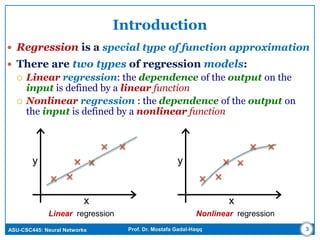
 Regression is a special type of function approximation
 There are two types of regression models:
 Linear regression: the dependence of the output on the
input is defined by a linear function
 Nonlinear regression : the dependence of the output on
the input is defined by a nonlinear function
3
y
x
y
x
Linear regression Nonlinear regression
ASU-CSC445: Neural Networks Prof. Dr. Mostafa Gadal-Haqq 4
Supervised Learning vs. Regression
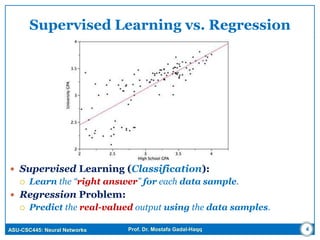
 Supervised Learning (Classification):
 Learn the “right answer” for each data sample.
 Regression Problem:
 Predict the real-valued output using the data samples.
ASU-CSC445: Neural Networks Prof. Dr. Mostafa Gadal-Haqq
Introduction
 In regression we do the following:
 One of the random variables is considered to be of
particular interest and is referred to as a dependant
variable, or response (The output).
 The remaining random variables are called
independent variables, or regressor (The input).
 The dependence of the response on the regressors
includes an additive error term.
5
ASU-CSC445: Neural Networks Prof. Dr. Mostafa Gadal-Haqq
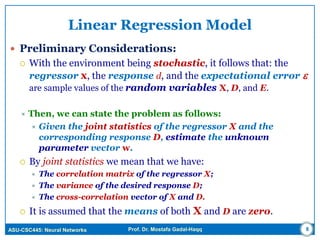
Linear Regression Model
 Linear Regression (One variable)
 The parameter vector w = [ w0 w1 ] is fixed but unknown;
stationary environment.
bay  x
6
y
x
Linear regression
01 x wwy 
a = slope
b = intercept
ASU-CSC445: Neural Networks Prof. Dr. Mostafa Gadal-Haqq
Linear Regression Model
 Linear Regression (Multiple variables)
 The parameter vector w is
fixed but unknown;
stationary environment.
Figure 2.1(a) Unknown stationary stochastic environment.
(b) Linear regression model of the environment.



M
j
jjxwd
1

 xwT
d
7
T
Mxxx ],...,,[ 21x
ASU-CSC445: Neural Networks Prof. Dr. Mostafa Gadal-Haqq 8
Linear Regression Model
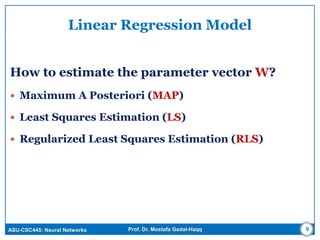
 Preliminary Considerations:
 With the environment being stochastic, it follows that: the
regressor x, the response d, and the expectational error 
are sample values of the random variables X, D, and E.
 Then, we can state the problem as follows:
 Given the joint statistics of the regressor X and the
corresponding response D, estimate the unknown
parameter vector w.
 By joint statistics we mean that we have:
 The correlation matrix of the regressor X;
 The variance of the desired response D;
 The cross-correlation vector of X and D.
 It is assumed that the means of both X and D are zero.
ASU-CSC445: Neural Networks Prof. Dr. Mostafa Gadal-Haqq 9
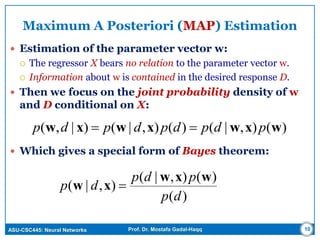
Linear Regression Model
How to estimate the parameter vector W?
 Maximum A Posteriori (MAP)
 Least Squares Estimation (LS)
 Regularized Least Squares Estimation (RLS)
ASU-CSC445: Neural Networks Prof. Dr. Mostafa Gadal-Haqq 10
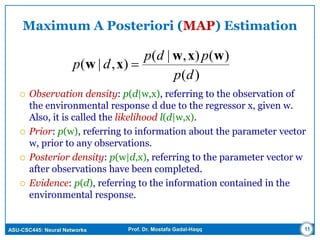
Maximum A Posteriori (MAP) Estimation
 Estimation of the parameter vector w:
 The regressor X bears no relation to the parameter vector w.
 Information about w is contained in the desired response D.
 Then we focus on the joint probability density of w
and D conditional on X:
 Which gives a special form of Bayes theorem:
)(),|()(),|()|,( wxwxwxw pdpdpdpdp 
)(
)(),|(
),|(
dp
pdp
dp
wxw
xw 
ASU-CSC445: Neural Networks Prof. Dr. Mostafa Gadal-Haqq 11
Maximum A Posteriori (MAP) Estimation
 Observation density: p(d|w,x), referring to the observation of
the environmental response d due to the regressor x, given w.
Also, it is called the likelihood l(d|w,x).
 Prior: p(w), referring to information about the parameter vector
w, prior to any observations.
 Posterior density: p(w|d,x), referring to the parameter vector w
after observations have been completed.
 Evidence: p(d), referring to the information contained in the
environmental response.
)(
)(),|(
),|(
dp
pdp
dp
wxw
xw 
ASU-CSC445: Neural Networks Prof. Dr. Mostafa Gadal-Haqq 12
Maximum A Posteriori (MAP) Estimation
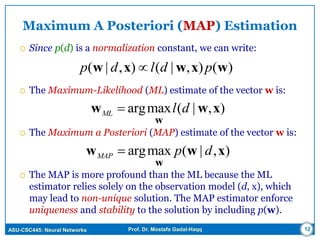
 Since p(d) is a normalization constant, we can write:
 The Maximum-Likelihood (ML) estimate of the vector w is:
 The Maximum a Posteriori (MAP) estimate of the vector w is:
 The MAP is more profound than the ML because the ML
estimator relies solely on the observation model (d, x), which
may lead to non-unique solution. The MAP estimator enforce
uniqueness and stability to the solution by including p(w).
)(),|(),|( wxwxw pdldp 
),|(maxarg xww
w
dlML 
),|(maxarg xww
w
dpMAP 
ASU-CSC445: Neural Networks Prof. Dr. Mostafa Gadal-Haqq 13
Maximum A Posteriori (MAP) Estimation
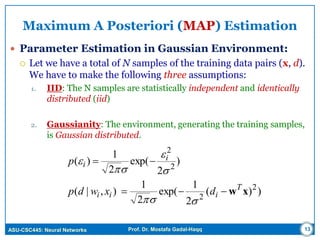
 Parameter Estimation in Gaussian Environment:
 Let we have a total of N samples of the training data pairs (x, d).
We have to make the following three assumptions:
1. IID: The N samples are statistically independent and identically
distributed (iid)
2. Gaussianity: The environment, generating the training samples,
is Gaussian distributed.
))(
2
1
exp(
2
1
),|(
)
2
exp(
2
1
)(
2
2
2
2
xwT
iii
i
i
dxwdp
p







ASU-CSC445: Neural Networks Prof. Dr. Mostafa Gadal-Haqq 14
Maximum A Posteriori (MAP) Estimation
 Parameter Estimation in Gaussian Environment:
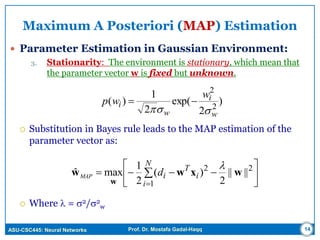
3. Stationarity: The environment is stationary, which mean that
the parameter vector w is fixed but unknown.
 Substitution in Bayes rule leads to the MAP estimation of the
parameter vector as:
 Where  = 2/2
w






 

N
i
i
T
idMAP
1
22
||||
2
)(
2
1
maxˆ wxww
w

)
2
exp(
2
1
)( 2
2
w
i
w
i
w
wp


ASU-CSC445: Neural Networks Prof. Dr. Mostafa Gadal-Haqq 15
Maximum A Posteriori (MAP) Estimation
 Parameter Estimation in Gaussian Environment:
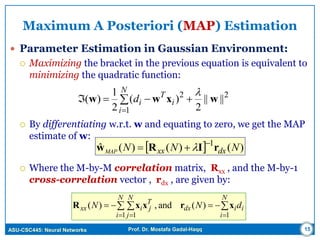
 Maximizing the bracket in the previous equation is equivalent to
minimizing the quadratic function:
 By differentiating w.r.t. w and equating to zero, we get the MAP
estimate of w:
 Where the M-by-M correlation matrix, Rxx , and the M-by-1
cross-correlation vector , rdx , are given by:



N
i
i
T
id
1
22
||||
2
)(
2
1
)( wxww

  )()()(ˆ 1
NNN dxxxMAP rIRw 
 
 
 

N
i
iidx
N
i
N
j
T
jixx dNN
11 1
)(and,)( xrxxR
ASU-CSC445: Neural Networks Prof. Dr. Mostafa Gadal-Haqq 16
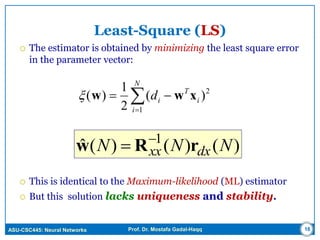
Least-Square (LS)
 The estimator is obtained by minimizing the least square error
in the parameter vector:
 This is identical to the Maximum-likelihood (ML) estimator
 But this solution lacks uniqueness and stability.


N
i
i
T
id
1
2
)(
2
1
)( xww
)()()(ˆ 1
NNN dxxx rRw 

ASU-CSC445: Neural Networks Prof. Dr. Mostafa Gadal-Haqq 17
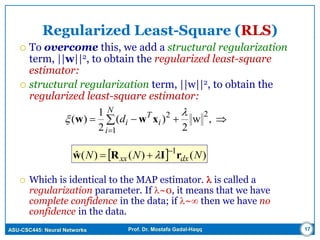
Regularized Least-Square (RLS)
 To overcome this, we add a structural regularization
term, ||w||2, to obtain the regularized least-square
estimator:
 structural regularization term, ||w||2, to obtain the
regularized least-square estimator:
 Which is identical to the MAP estimator.  is called a
regularization parameter. If ~0, it means that we have
complete confidence in the data; if ~ then we have no
confidence in the data.
  )()()(ˆ 1
NNN dxxx rIRw 
 
,w
2
)(
2
1
)(
2
1
2
 



N
i
i
T
id xww
ASU-CSC445: Neural Networks Prof. Dr. Mostafa Gadal-Haqq
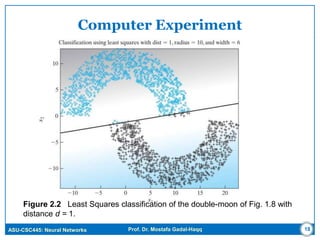
Computer Experiment
18
Figure 2.2 Least Squares classification of the double-moon of Fig. 1.8 with
distance d = 1.
ASU-CSC445: Neural Networks Prof. Dr. Mostafa Gadal-Haqq
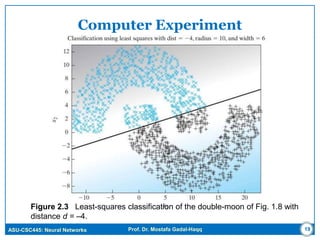
Computer Experiment
19
Figure 2.3 Least-squares classification of the double-moon of Fig. 1.8 with
distance d = –4.
•Problems:
•2.1, 2.2
•Computer Experiment
•2.8, 2.10
Homework 2
20
The Least Mean Square
Algorithm
Next Time
21

Neural Networks: Model Building Through Linear Regression

  • 1.
    CHAPTER 02 MODEL BUILDINGTHROUGH REGRESSION CSC445: Neural Networks Prof. Dr. Mostafa Gadal-Haqq M. Mostafa Computer Science Department Faculty of Computer & Information Sciences AIN SHAMS UNIVERSITY (most of the figures in this presentation are copyrighted to Pearson Education, Inc.)
  • 2.
    ASU-CSC445: Neural NetworksProf. Dr. Mostafa Gadal-Haqq  Introduction  Supervised Learning vs. Regression  Linear Regression Model  Maximum a Posteriori Estimation (MAP)  Computer Experiment  The Minimum-Description-Length Principle  Finite Sample Size Consideration 2 Model Building Through Regression
  • 3.
    ASU-CSC445: Neural NetworksProf. Dr. Mostafa Gadal-Haqq Introduction  Regression is a special type of function approximation  There are two types of regression models:  Linear regression: the dependence of the output on the input is defined by a linear function  Nonlinear regression : the dependence of the output on the input is defined by a nonlinear function 3 y x y x Linear regression Nonlinear regression
  • 4.
    ASU-CSC445: Neural NetworksProf. Dr. Mostafa Gadal-Haqq 4 Supervised Learning vs. Regression  Supervised Learning (Classification):  Learn the “right answer” for each data sample.  Regression Problem:  Predict the real-valued output using the data samples.
  • 5.
    ASU-CSC445: Neural NetworksProf. Dr. Mostafa Gadal-Haqq Introduction  In regression we do the following:  One of the random variables is considered to be of particular interest and is referred to as a dependant variable, or response (The output).  The remaining random variables are called independent variables, or regressor (The input).  The dependence of the response on the regressors includes an additive error term. 5
  • 6.
    ASU-CSC445: Neural NetworksProf. Dr. Mostafa Gadal-Haqq Linear Regression Model  Linear Regression (One variable)  The parameter vector w = [ w0 w1 ] is fixed but unknown; stationary environment. bay  x 6 y x Linear regression 01 x wwy  a = slope b = intercept
  • 7.
    ASU-CSC445: Neural NetworksProf. Dr. Mostafa Gadal-Haqq Linear Regression Model  Linear Regression (Multiple variables)  The parameter vector w is fixed but unknown; stationary environment. Figure 2.1(a) Unknown stationary stochastic environment. (b) Linear regression model of the environment.    M j jjxwd 1   xwT d 7 T Mxxx ],...,,[ 21x
  • 8.
    ASU-CSC445: Neural NetworksProf. Dr. Mostafa Gadal-Haqq 8 Linear Regression Model  Preliminary Considerations:  With the environment being stochastic, it follows that: the regressor x, the response d, and the expectational error  are sample values of the random variables X, D, and E.  Then, we can state the problem as follows:  Given the joint statistics of the regressor X and the corresponding response D, estimate the unknown parameter vector w.  By joint statistics we mean that we have:  The correlation matrix of the regressor X;  The variance of the desired response D;  The cross-correlation vector of X and D.  It is assumed that the means of both X and D are zero.
  • 9.
    ASU-CSC445: Neural NetworksProf. Dr. Mostafa Gadal-Haqq 9 Linear Regression Model How to estimate the parameter vector W?  Maximum A Posteriori (MAP)  Least Squares Estimation (LS)  Regularized Least Squares Estimation (RLS)
  • 10.
    ASU-CSC445: Neural NetworksProf. Dr. Mostafa Gadal-Haqq 10 Maximum A Posteriori (MAP) Estimation  Estimation of the parameter vector w:  The regressor X bears no relation to the parameter vector w.  Information about w is contained in the desired response D.  Then we focus on the joint probability density of w and D conditional on X:  Which gives a special form of Bayes theorem: )(),|()(),|()|,( wxwxwxw pdpdpdpdp  )( )(),|( ),|( dp pdp dp wxw xw 
  • 11.
    ASU-CSC445: Neural NetworksProf. Dr. Mostafa Gadal-Haqq 11 Maximum A Posteriori (MAP) Estimation  Observation density: p(d|w,x), referring to the observation of the environmental response d due to the regressor x, given w. Also, it is called the likelihood l(d|w,x).  Prior: p(w), referring to information about the parameter vector w, prior to any observations.  Posterior density: p(w|d,x), referring to the parameter vector w after observations have been completed.  Evidence: p(d), referring to the information contained in the environmental response. )( )(),|( ),|( dp pdp dp wxw xw 
  • 12.
    ASU-CSC445: Neural NetworksProf. Dr. Mostafa Gadal-Haqq 12 Maximum A Posteriori (MAP) Estimation  Since p(d) is a normalization constant, we can write:  The Maximum-Likelihood (ML) estimate of the vector w is:  The Maximum a Posteriori (MAP) estimate of the vector w is:  The MAP is more profound than the ML because the ML estimator relies solely on the observation model (d, x), which may lead to non-unique solution. The MAP estimator enforce uniqueness and stability to the solution by including p(w). )(),|(),|( wxwxw pdldp  ),|(maxarg xww w dlML  ),|(maxarg xww w dpMAP 
  • 13.
    ASU-CSC445: Neural NetworksProf. Dr. Mostafa Gadal-Haqq 13 Maximum A Posteriori (MAP) Estimation  Parameter Estimation in Gaussian Environment:  Let we have a total of N samples of the training data pairs (x, d). We have to make the following three assumptions: 1. IID: The N samples are statistically independent and identically distributed (iid) 2. Gaussianity: The environment, generating the training samples, is Gaussian distributed. ))( 2 1 exp( 2 1 ),|( ) 2 exp( 2 1 )( 2 2 2 2 xwT iii i i dxwdp p       
  • 14.
    ASU-CSC445: Neural NetworksProf. Dr. Mostafa Gadal-Haqq 14 Maximum A Posteriori (MAP) Estimation  Parameter Estimation in Gaussian Environment: 3. Stationarity: The environment is stationary, which mean that the parameter vector w is fixed but unknown.  Substitution in Bayes rule leads to the MAP estimation of the parameter vector as:  Where  = 2/2 w          N i i T idMAP 1 22 |||| 2 )( 2 1 maxˆ wxww w  ) 2 exp( 2 1 )( 2 2 w i w i w wp  
  • 15.
    ASU-CSC445: Neural NetworksProf. Dr. Mostafa Gadal-Haqq 15 Maximum A Posteriori (MAP) Estimation  Parameter Estimation in Gaussian Environment:  Maximizing the bracket in the previous equation is equivalent to minimizing the quadratic function:  By differentiating w.r.t. w and equating to zero, we get the MAP estimate of w:  Where the M-by-M correlation matrix, Rxx , and the M-by-1 cross-correlation vector , rdx , are given by:    N i i T id 1 22 |||| 2 )( 2 1 )( wxww    )()()(ˆ 1 NNN dxxxMAP rIRw         N i iidx N i N j T jixx dNN 11 1 )(and,)( xrxxR
  • 16.
    ASU-CSC445: Neural NetworksProf. Dr. Mostafa Gadal-Haqq 16 Least-Square (LS)  The estimator is obtained by minimizing the least square error in the parameter vector:  This is identical to the Maximum-likelihood (ML) estimator  But this solution lacks uniqueness and stability.   N i i T id 1 2 )( 2 1 )( xww )()()(ˆ 1 NNN dxxx rRw  
  • 17.
    ASU-CSC445: Neural NetworksProf. Dr. Mostafa Gadal-Haqq 17 Regularized Least-Square (RLS)  To overcome this, we add a structural regularization term, ||w||2, to obtain the regularized least-square estimator:  structural regularization term, ||w||2, to obtain the regularized least-square estimator:  Which is identical to the MAP estimator.  is called a regularization parameter. If ~0, it means that we have complete confidence in the data; if ~ then we have no confidence in the data.   )()()(ˆ 1 NNN dxxx rIRw    ,w 2 )( 2 1 )( 2 1 2      N i i T id xww
  • 18.
    ASU-CSC445: Neural NetworksProf. Dr. Mostafa Gadal-Haqq Computer Experiment 18 Figure 2.2 Least Squares classification of the double-moon of Fig. 1.8 with distance d = 1.
  • 19.
    ASU-CSC445: Neural NetworksProf. Dr. Mostafa Gadal-Haqq Computer Experiment 19 Figure 2.3 Least-squares classification of the double-moon of Fig. 1.8 with distance d = –4.
  • 20.
  • 21.
    The Least MeanSquare Algorithm Next Time 21