Course Calendar
Class DATE Contents
1 Sep. 26 Course information & Course overview
2 Oct. 4 Bayes Estimation
3 〃 11 Classical Bayes Estimation - Kalman Filter -
4 〃 18 Simulation-based Bayesian Methods
5 〃 25 Modern Bayesian Estimation :Particle Filter
6 Nov. 1 HMM(Hidden Markov Model)
Nov. 8 No Class
7 〃 15 Bayesian Decision
8 〃 29 Non parametric Approaches
9 Dec. 6 PCA(Principal Component Analysis)
10 〃 13 ICA(Independent Component Analysis)
11 〃 20 Applications of PCA and ICA
12 〃 27 Clustering, k-means et al.
13 Jan. 17 Other Topics 1 Kernel machine.
14 〃 22(Tue) Other Topics 2
Lecture Plan
Bayes Decision
1. Introduction
1.1 Pattern Recognition-
1.2 An Example Classification/Decision Theory
2. Bayes Decision Theory
2.1 Decision using Posterior Probability
2.2 Decision by Minimizing Risk
3. Discriminate Function
4. Gaussian Case
1. Introduction
3
1.1 Pattern Recognition
The second part of this course is concerned about Pattern Recognition.
Pattern recognitions (Machine Learning) want to give very high skills
for sensing and taking actions as humans do according to what they
observe.
Definitions of Pattern Recognition appeared in books
“The assignment of a physical object or event to one of several pre-
specified categories”
by Duda et al.[1]
“The science that concerns the description or classification
(recognition) of measurements”
by Schalkoff (Wiley Online Library)
Fish-Sorting Process
Sea bass 鱸
Salmon 鮭
R.O. Duda, P.E. Hart, and D. G. Stork,
“Pattern Classification”, John Wiley & Sons, 2nd edition, 2004
 
 
1
2
.
:
:feature vector in 2-d feature space
:
: action
"Correct dicision " should be an appropriate function of data
eg
x lightness
x width
x


 
  
 
x
x
x
1.2 An Example (Duda, Hart, & Stork 2004)
5
Automatic Fish-Sorting Process
action 1
belt conveyer
action 2
Typical pattern Recognition issues:
■ Classification ■ Regression
■ Clustering ■ Dimension Reduction
(Visualization)
Pattern Recognition System
data
Measurement
Preprocessing
Dimension
Reduction
Feature
Selection
Recognition
Classification
Model
change
Evaluation
analysis
results
PCA (ICA)
Clustering Cross-
ValidationPDF estimation
PDF: Probability Density Function
7
Classification/ Decision Theory
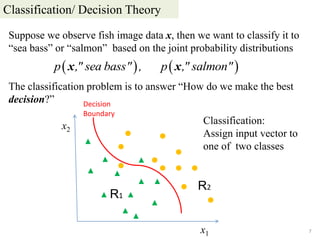
Suppose we observe fish image data x, then we want to classify it to
“sea bass” or “salmon” based on the joint probability distributions
The classification problem is to answer “How do we make the best
decision?”
   p ," sea bass" , p ," salmon"x x
x1
x2
Decision
Boundary
Classification:
Assign input vector to
one of two classes
R2
R1
Framework: - Two Category case (fish sorting example) -
■ State of nature (Class) ω (discrete random variable)
■ Prior Probability
■ Class-conditioned Probability (Likelihood)
Measurement x : brightness of fish (scalar continuous variable)
Class-conditional probability density function for each class:
1
2
: sea bass
: salmon
 
 


2. Bayes’ Decision Theory
   
   
1 2
1 2
,
where 1
P P
P P
 
  
   
   
1 1
2 2
PDF for given that the state of nature is
p x x
p x x
 
 


9
Fig. 1 Class-conditioned probabilities
10
2.1 Decision Using Posterior Probability
■ Posterior Probabilities
■ Decision Rule (1) Minimizing error probability
■ Decision Rule (2) Likelihood ratio
   
 
   
 
the probability of being given that has been measuredDefine
Bayes rule derives
j
j j
j
xjP x
p x P
P x
p x
 
 



   
   
1 21
2 1 2
if >
if <
P x P x
P x P x
 
  
Decide
 
 
 
 
11 1
2 22
if
p x P
Pp x
 
 


Decide
independent of
observation x
(1)
(2)
(3)
11
Fig. 2 Decision
(a) Posterior Probabilities
(b) Likelihood ratio
12
Probability of Error
■ Error probability for a measurement x by decision
■ Average probability of error
   
 
        
               2 1 2 2 1 1
1 2 1 2
if we decide ( )2 1 1
if we decide ( )1 2 2
:
P x P x P x P P x P
P x x R
P x x R
P error xEx
p x dx p x dx dx dx
P error x p x dx
P error x
P error
     
 
 
 


 


     
R R R R
(4)
(5)
Fig. 3 P(error)
13
2.2 Decision by Minimizing Risk
■ Alternate Bayes Decision based on risk which defines “how much
costly each action is ?”
Suppose we observe x then take action according to make a decision
(ωi) if the true state of nature is ωj , we introduce the loss function
■ Example of loss function
From a medical image we want to classify (determine) whether it
contains cancer tissues or not.
 i j  
i
1 2
1 2
cancer, normal,
cancer, normal
 
 
 
 
cancer normal
cancer 0 1
normal 100 0
 i j  
1
2
1 2
(6)
Loss Function
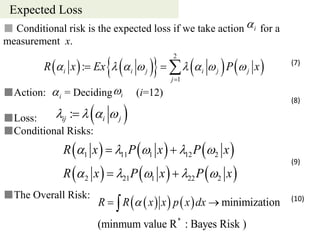
Expected Loss
■ Conditional risk is the expected loss if we take action for a
measurement x.
■Action: = Deciding (i=12)
■Loss:
■Conditional Risks:
■The Overall Risk:
        
2
1
:i i j i j j
j
R x Ex P x       

  
i
i i
 :ij i j   
     
     
1 11 1 12 2
2 21 1 22 2
R x P x P x
R x P x P x
    
    
 
 
    
*
minimization
(minmum value R : Bayes Risk )
R R x x p x dx 
(7)
(8)
(9)
(10)
15
Minimum Risk Decision Rule (1)
   
   
1 21
2 1 2
if <
if >
R x R x
R x R x
 
  
Decide
   
       
1 2
21 11 1 12 22 2
Here , <
>
R x R x
P x P x
 
       
Minimum Risk Decision Rule (2)
 
 
 
 
 
 
1
1 12 22 2
21 11 12
2
if
Otherwise decide
threshold
P x P
PP x

   
  




Decide
(11)
(12)
(13)
16
Fig. 4 Likelihood ratio
17
Minimum error probability decision
=Minimizing the risk with zero-one loss function
Zero-One Loss Function:
 
 
 
 
1 2
12
Likekihood ratio decision rule (13) becomes
minimum error decision
P x P
PP x
 




Zero-One Loss Function:
 
0 if 0 1
,
1 if 1 0
i j ij
i j
i j
   
  
       
(14)
(15)
General Framework:
■ Finite set of states of nature (c Classes) :
■ Actions :
■ Loss:
■ Measurement:
 1 2, , c  
Generalization
: d-dimensional vector (feature vector)x
 1 2, , a  
     : 1,..., 1,...,ij i j i a j c     
19
3. Discriminant Function
19
Classifiers represented by discriminant functions : gi(x) i=1,…c
max gi(x)
g1(x) g2(x) gc(x)
x2
…
 where arg max
i
j
j
i g

 x
   Classifier minimizing the conditional risk: =i ig x R x
       
     
Minimizing error probability: =
Alternate function: =ln ln
i i i i
i i i
g x P x p x P
g x p x P
  
 


xdx1 …input
discriminant
fnctions
Classifier
Network structure
action
2020
■ Single discriminant function:
Two-category case
 
 
   
1
2
1 2
if 0
if 0
gives the decision boundary
g x
g x
g x g x





Decide
4.Gaussian Case:
   
     
     1
Multivariate Gaussian: ,
=ln ln
1 1
ln2 ln ln
2 2 2
i i i
i i i
T
i i i i i
p
g x p x P
d
x x P

 
 


      
x  
   
(17 )
(18)
(16)     1 2=g x g x g x
21
       
 
1
1 1 1
1 1
= ln2 ln ln
2 2 2
1 1 1
ln ln
2 2 2
T
i i i i i i
T T T
i i i i i i i i
d
g x x x P
x x x P
 


  
     
     
   
      
  0= T
i i i ig x x  T
x W x
 1
0
1 1
ln ln
2 2
T
i i i i i iP 
      
Case (i=1,2)
Boundary is given by a linear line
i   1 2General Case
Boundary is quadratic curves
 
decision
boundary
decision
boundary
(19)
(20)
1 11
where ,
2
i i i i i 
  W   
22
References:
1) R.O. Duda, P.E. Hart, and D. G. Stork, “Pattern Classification”,
John Wiley & Sons, 2nd edition, 2004
2) C. M. Bishop, “Pattern Recognition and Machine Learning”,
Springer, 2006
3) E. Alpaydin, Introduction to Machine Learning, MIT Press, 2009
4) A. Huvarinen et. al., ”Independent Component Analysis”
Wiley-Interscience 2001
Another action : Rejection
No classification for lower degree of conviction case
What next ?
In the discussions so far all of the relevant probabilities are known,
but this assumption will not be assured.
Fukunaga’s definition of Pattern Recognition:
“A problem of estimating density functions in a high–dimensional
space and dividing the space into the regions of categories or
classes”
23
 
 
   
 
 
     
1
/2 1/2
1
1 1 1
, exp
22
is d-dimensional random vector
:
: :
: Determinant of
T
d
T
d
x x
x x x
E x
Cov x E x x
  


 
 
      
 

   
  
Appendix:
Multivariable Gaussian Density Distribution
2012 mdsp pr07 bayes decision

2012 mdsp pr07 bayes decision

  • 1.
    Course Calendar Class DATEContents 1 Sep. 26 Course information & Course overview 2 Oct. 4 Bayes Estimation 3 〃 11 Classical Bayes Estimation - Kalman Filter - 4 〃 18 Simulation-based Bayesian Methods 5 〃 25 Modern Bayesian Estimation :Particle Filter 6 Nov. 1 HMM(Hidden Markov Model) Nov. 8 No Class 7 〃 15 Bayesian Decision 8 〃 29 Non parametric Approaches 9 Dec. 6 PCA(Principal Component Analysis) 10 〃 13 ICA(Independent Component Analysis) 11 〃 20 Applications of PCA and ICA 12 〃 27 Clustering, k-means et al. 13 Jan. 17 Other Topics 1 Kernel machine. 14 〃 22(Tue) Other Topics 2
  • 2.
    Lecture Plan Bayes Decision 1.Introduction 1.1 Pattern Recognition- 1.2 An Example Classification/Decision Theory 2. Bayes Decision Theory 2.1 Decision using Posterior Probability 2.2 Decision by Minimizing Risk 3. Discriminate Function 4. Gaussian Case
  • 3.
    1. Introduction 3 1.1 PatternRecognition The second part of this course is concerned about Pattern Recognition. Pattern recognitions (Machine Learning) want to give very high skills for sensing and taking actions as humans do according to what they observe. Definitions of Pattern Recognition appeared in books “The assignment of a physical object or event to one of several pre- specified categories” by Duda et al.[1] “The science that concerns the description or classification (recognition) of measurements” by Schalkoff (Wiley Online Library)
  • 4.
    Fish-Sorting Process Sea bass鱸 Salmon 鮭 R.O. Duda, P.E. Hart, and D. G. Stork, “Pattern Classification”, John Wiley & Sons, 2nd edition, 2004
  • 5.
        1 2 . : :featurevector in 2-d feature space : : action "Correct dicision " should be an appropriate function of data eg x lightness x width x          x x x 1.2 An Example (Duda, Hart, & Stork 2004) 5 Automatic Fish-Sorting Process action 1 belt conveyer action 2
  • 6.
    Typical pattern Recognitionissues: ■ Classification ■ Regression ■ Clustering ■ Dimension Reduction (Visualization) Pattern Recognition System data Measurement Preprocessing Dimension Reduction Feature Selection Recognition Classification Model change Evaluation analysis results PCA (ICA) Clustering Cross- ValidationPDF estimation PDF: Probability Density Function
  • 7.
    7 Classification/ Decision Theory Supposewe observe fish image data x, then we want to classify it to “sea bass” or “salmon” based on the joint probability distributions The classification problem is to answer “How do we make the best decision?”    p ," sea bass" , p ," salmon"x x x1 x2 Decision Boundary Classification: Assign input vector to one of two classes R2 R1
  • 8.
    Framework: - TwoCategory case (fish sorting example) - ■ State of nature (Class) ω (discrete random variable) ■ Prior Probability ■ Class-conditioned Probability (Likelihood) Measurement x : brightness of fish (scalar continuous variable) Class-conditional probability density function for each class: 1 2 : sea bass : salmon       2. Bayes’ Decision Theory         1 2 1 2 , where 1 P P P P              1 1 2 2 PDF for given that the state of nature is PDF for given that the state of nature is p x x p x x      
  • 9.
  • 10.
    10 2.1 Decision UsingPosterior Probability ■ Posterior Probabilities ■ Decision Rule (1) Minimizing error probability ■ Decision Rule (2) Likelihood ratio             the probability of being given that has been measuredDefine Bayes rule derives j j j j xjP x p x P P x p x                1 21 2 1 2 if > if < P x P x P x P x      Decide         11 1 2 22 if p x P Pp x       Decide independent of observation x (1) (2) (3)
  • 11.
    11 Fig. 2 Decision (a)Posterior Probabilities (b) Likelihood ratio
  • 12.
    12 Probability of Error ■Error probability for a measurement x by decision ■ Average probability of error                               2 1 2 2 1 1 1 2 1 2 if we decide ( )2 1 1 if we decide ( )1 2 2 : P x P x P x P P x P P x x R P x x R P error xEx p x dx p x dx dx dx P error x p x dx P error x P error                         R R R R (4) (5) Fig. 3 P(error)
  • 13.
    13 2.2 Decision byMinimizing Risk ■ Alternate Bayes Decision based on risk which defines “how much costly each action is ?” Suppose we observe x then take action according to make a decision (ωi) if the true state of nature is ωj , we introduce the loss function ■ Example of loss function From a medical image we want to classify (determine) whether it contains cancer tissues or not.  i j   i 1 2 1 2 cancer, normal, cancer, normal         cancer normal cancer 0 1 normal 100 0  i j   1 2 1 2 (6) Loss Function
  • 14.
    Expected Loss ■ Conditionalrisk is the expected loss if we take action for a measurement x. ■Action: = Deciding (i=12) ■Loss: ■Conditional Risks: ■The Overall Risk:          2 1 :i i j i j j j R x Ex P x            i i i  :ij i j                1 11 1 12 2 2 21 1 22 2 R x P x P x R x P x P x                    * minimization (minmum value R : Bayes Risk ) R R x x p x dx  (7) (8) (9) (10)
  • 15.
    15 Minimum Risk DecisionRule (1)         1 21 2 1 2 if < if > R x R x R x R x      Decide             1 2 21 11 1 12 22 2 Here , < > R x R x P x P x           Minimum Risk Decision Rule (2)             1 1 12 22 2 21 11 12 2 if Otherwise decide threshold P x P PP x             Decide (11) (12) (13)
  • 16.
  • 17.
    17 Minimum error probabilitydecision =Minimizing the risk with zero-one loss function Zero-One Loss Function:         1 2 12 Likekihood ratio decision rule (13) becomes minimum error decision P x P PP x       Zero-One Loss Function:   0 if 0 1 , 1 if 1 0 i j ij i j i j                (14) (15)
  • 18.
    General Framework: ■ Finiteset of states of nature (c Classes) : ■ Actions : ■ Loss: ■ Measurement:  1 2, , c   Generalization : d-dimensional vector (feature vector)x  1 2, , a        : 1,..., 1,...,ij i j i a j c     
  • 19.
    19 3. Discriminant Function 19 Classifiersrepresented by discriminant functions : gi(x) i=1,…c max gi(x) g1(x) g2(x) gc(x) x2 …  where arg max i j j i g   x    Classifier minimizing the conditional risk: =i ig x R x               Minimizing error probability: = Alternate function: =ln ln i i i i i i i g x P x p x P g x p x P        xdx1 …input discriminant fnctions Classifier Network structure action
  • 20.
    2020 ■ Single discriminantfunction: Two-category case         1 2 1 2 if 0 if 0 gives the decision boundary g x g x g x g x      Decide 4.Gaussian Case:                1 Multivariate Gaussian: , =ln ln 1 1 ln2 ln ln 2 2 2 i i i i i i T i i i i i p g x p x P d x x P               x       (17 ) (18) (16)     1 2=g x g x g x
  • 21.
    21          1 1 1 1 1 1 = ln2 ln ln 2 2 2 1 1 1 ln ln 2 2 2 T i i i i i i T T T i i i i i i i i d g x x x P x x x P                                 0= T i i i ig x x  T x W x  1 0 1 1 ln ln 2 2 T i i i i i iP         Case (i=1,2) Boundary is given by a linear line i   1 2General Case Boundary is quadratic curves   decision boundary decision boundary (19) (20) 1 11 where , 2 i i i i i    W   
  • 22.
    22 References: 1) R.O. Duda,P.E. Hart, and D. G. Stork, “Pattern Classification”, John Wiley & Sons, 2nd edition, 2004 2) C. M. Bishop, “Pattern Recognition and Machine Learning”, Springer, 2006 3) E. Alpaydin, Introduction to Machine Learning, MIT Press, 2009 4) A. Huvarinen et. al., ”Independent Component Analysis” Wiley-Interscience 2001 Another action : Rejection No classification for lower degree of conviction case What next ? In the discussions so far all of the relevant probabilities are known, but this assumption will not be assured. Fukunaga’s definition of Pattern Recognition: “A problem of estimating density functions in a high–dimensional space and dividing the space into the regions of categories or classes”
  • 23.
    23                  1 /2 1/2 1 1 1 1 , exp 22 is d-dimensional random vector : : : : Determinant of T d T d x x x x x E x Cov x E x x                           Appendix: Multivariable Gaussian Density Distribution