This document discusses various techniques for process synchronization. It begins by defining process synchronization as coordinating access to shared resources between processes to maintain data consistency. It then discusses critical sections, where shared data is accessed, and solutions like Peterson's algorithm and semaphores to ensure only one process accesses the critical section at a time. Semaphores use wait and signal operations on a shared integer variable to synchronize processes. The document covers binary and counting semaphores and provides an example of their use.
Introduces Process Synchronization, defining independent & cooperative processes, focusing on data consistency.
Explains Critical Section as a segment of code for single process access and outlines solution conditions: Mutual Exclusion, Progress, Bounded Waiting.
Describes Peterson’s Solution for managing critical sections with shared variables ensuring Mutual Exclusion, Progress, and Bounded Waiting.
Discusses limitations of synchronization hardware in multiprocessor environments and the inefficiency due to interrupt handling.
Introduces Mutex Locks as a software solution to resource locking during critical section execution, ensuring exclusive access.
Defines Semaphores, introduced by Dijkstra, as tools for process synchronization using wait and signal operations.
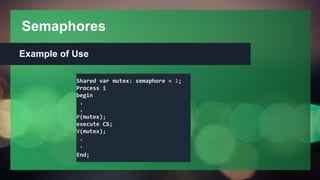
Details Binary and Counting Semaphores with example, highlighting usage for mutual exclusion and bounded concurrency.
Covers limitations such as priority inversion and risk of deadlocks due to improper semaphore use.
Lists references for further self-study materials and literature on process synchronization and related concepts.
Introduction
What is processsynchronization?
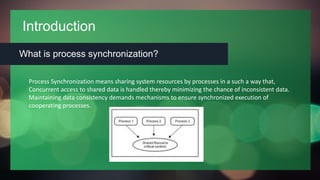
Process Synchronization means sharing system resources by processes in a such a way that,
Concurrent access to shared data is handled thereby minimizing the chance of inconsistent data.
Maintaining data consistency demands mechanisms to ensure synchronized execution of
cooperating processes.
3.
Introduction
On the basisof synchronization:
Processes are categorized as one of the following two types:
• Independent Process : Execution of one process does not affects the execution of other
processes.
• Cooperative Process : Execution of one process affects the execution of other processes.
Process synchronization problem arises in the case of Cooperative process also because resources
are shared in Cooperative processes.
4.
Critical Section
Problem
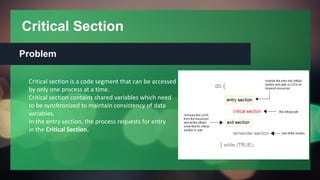
Critical sectionis a code segment that can be accessed
by only one process at a time.
Critical section contains shared variables which need
to be synchronized to maintain consistency of data
variables.
In the entry section, the process requests for entry
in the Critical Section.
5.
Critical Section
Solution ToProblem
A solution to the critical section problem must satisfy the following three conditions:
• Mutual Exclusion : If a process is executing in its critical section, then no other process is
allowed to execute in the critical section.
• Progress : If no process is in the critical section, then no other process from outside can block it
from entering the critical section.
• Bounded Waiting : A bound must exist on the number of times that other processes are
allowed to enter their critical sections after a process has made a request to enter its critical
section and before that request is granted.
6.
Peterson’s Solution
Peterson’s Solutionis a classical software based
solution to the critical section problem.
In Peterson’s solution, we have two shared variables:
• boolean flag[i] :Initialized to FALSE, initially no one is
interested in entering the critical section
• int turn : The process whose turn is to enter the
critical section.
7.
Peterson’s Solution
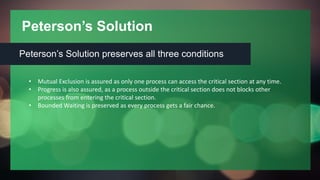
Peterson’s Solutionpreserves all three conditions
• Mutual Exclusion is assured as only one process can access the critical section at any time.
• Progress is also assured, as a process outside the critical section does not blocks other
processes from entering the critical section.
• Bounded Waiting is preserved as every process gets a fair chance.
8.
Process Synchronization
Synchronization Hardware
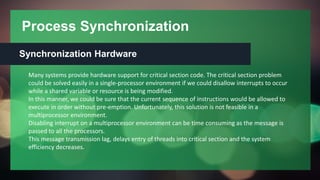
Manysystems provide hardware support for critical section code. The critical section problem
could be solved easily in a single-processor environment if we could disallow interrupts to occur
while a shared variable or resource is being modified.
In this manner, we could be sure that the current sequence of instructions would be allowed to
execute in order without pre-emption. Unfortunately, this solution is not feasible in a
multiprocessor environment.
Disabling interrupt on a multiprocessor environment can be time consuming as the message is
passed to all the processors.
This message transmission lag, delays entry of threads into critical section and the system
efficiency decreases.
9.
Mutex Locks
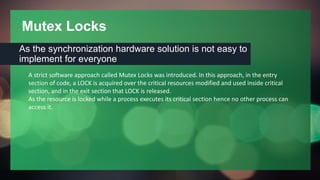
As thesynchronization hardware solution is not easy to
implement for everyone
A strict software approach called Mutex Locks was introduced. In this approach, in the entry
section of code, a LOCK is acquired over the critical resources modified and used inside critical
section, and in the exit section that LOCK is released.
As the resource is locked while a process executes its critical section hence no other process can
access it.
10.
Semaphores
Introduction
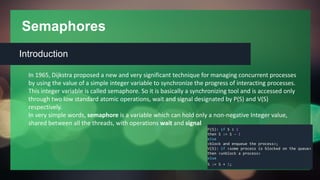
In 1965, Dijkstraproposed a new and very significant technique for managing concurrent processes
by using the value of a simple integer variable to synchronize the progress of interacting processes.
This integer variable is called semaphore. So it is basically a synchronizing tool and is accessed only
through two low standard atomic operations, wait and signal designated by P(S) and V(S)
respectively.
In very simple words, semaphore is a variable which can hold only a non-negative Integer value,
shared between all the threads, with operations wait and signal
P(S): if S ≥ 1
then S := S - 1
else
<block and enqueue the process>;
V(S): if <some process is blocked on the queue>
then <unblock a process>
else
S := S + 1;
11.
Semaphores
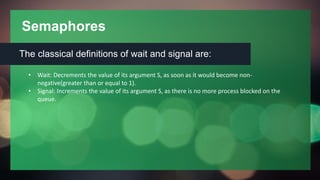
The classical definitionsof wait and signal are:
• Wait: Decrements the value of its argument S, as soon as it would become non-
negative(greater than or equal to 1).
• Signal: Increments the value of its argument S, as there is no more process blocked on the
queue.
12.
Semaphores
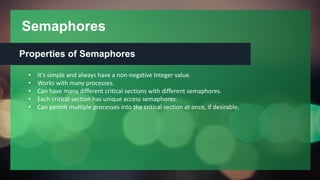
Properties of Semaphores
•It's simple and always have a non-negative Integer value.
• Works with many processes.
• Can have many different critical sections with different semaphores.
• Each critical section has unique access semaphores.
• Can permit multiple processes into the critical section at once, if desirable.
13.
Semaphores
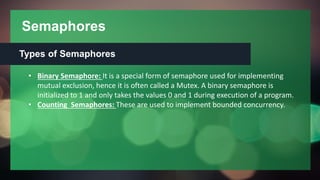
Types of Semaphores
•Binary Semaphore: It is a special form of semaphore used for implementing
mutual exclusion, hence it is often called a Mutex. A binary semaphore is
initialized to 1 and only takes the values 0 and 1 during execution of a program.
• Counting Semaphores: These are used to implement bounded concurrency.
Semaphores
Limitations of Semaphores
•Priority Inversion is a big limitation of semaphores.
• Their use is not enforced, but is by convention only.
• With improper use, a process may block indefinitely. Such a situation is called Deadlock. We
will be studying deadlocks in details in coming lessons.
16.
For Self Studies
References
•Abraham Silberschatz, Greg Gagne, and Peter Baer Galvin, "Operating System Concepts,
Ninth Edition ", Chapter 5
• https://www.geeksforgeeks.org/process-synchronization-set-1/
• https://en.wikipedia.org/wiki/Synchronization_(computer_science)