Election Algorithms
          and
Distributed Processing
      Section 6.5
Outline
• Election algorithms – introduction
• Traditional election algorithms
  – Bully algorithm
  – Ring algorithm
• Wireless election algorithms
Need for a Coordinator
• Many algorithms used in distributed
  systems require a coordinator
  – For example, see the centralized mutual
    exclusion algorithm.
• In general, all processes in the distributed
  system are equally suitable for the role
• Election algorithms are designed to
  choose a coordinator.
Election Algorithms
• Any process can serve as coordinator
• Any process can “call an election” (initiate
  the algorithm to choose a new
  coordinator).
  – There is no harm (other than extra message
    traffic) in having multiple concurrent elections.
• Elections may be needed when the
  system is initialized, or if the coordinator
  crashes or retires.
Assumptions
• Every process/site has a unique ID; e.g.
  – the network address
  – a process number
• Every process in the system should know the
  values in the set of ID numbers, although not
  which processors are up or down.
• The process with the highest ID number will
  be the new coordinator.
• Process groups (as with ISIS toolkit or MPI)
  satisfy these requirements.
Requirements
• When the election algorithm terminates a
  single process has been selected and
  every process knows its identity.
• Formalize: every process pi has a variable
  ei to hold the coordinator’s process
  number.
  – ∀i, ei = undefined or ei = P, where P is the
    non-crashed process with highest id
  – All processes (that have not crashed)
    eventually set ei = P.
The Bully Algorithm - Overview
• Process p calls an election when it notices
  that the coordinator is no longer
  responding.
• High-numbered processes “bully” low-
  numbered processes out of the election,
  until only one process remains.
• When a crashed process reboots, it holds
  an election. If it is now the highest-
  numbered live process, it will win.
Figure 6-20
           1                              1
                    5                              5
    2                                 2
         election                         OK
                            6                              6
4           election                          OK
                                 4
        election
                        3                              3
    0                                 0
               7                          7


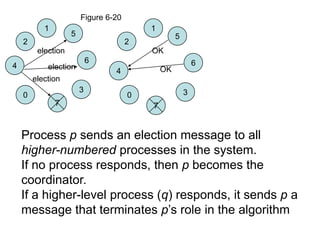
    Process p sends an election message to all
    higher-numbered processes in the system.
    If no process responds, then p becomes the
    coordinator.
    If a higher-level process (q) responds, it sends p a
    message that terminates p’s role in the algorithm
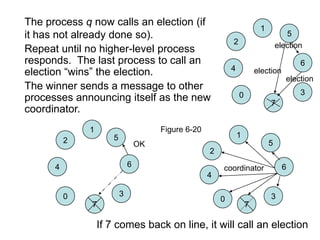
The process q now calls an election (if
                                                                         1
it has not already done so).                                                        5
                                                            2                    election
Repeat until no higher-level process
responds. The last process to call an                                                   6
                                                            4
election “wins” the election.                                           election
                                                                                    election
The winner sends a message to other
                                                                0                       3
processes announcing itself as the new                                       7
coordinator.
              1                       Figure 6-20
                     5                                          1
          2                      OK                                          5
                                                    2

      4                      6                          coordinator                6
                                                    4

          0              3                                                   3
                                                        0
              7                                                     7

                  If 7 comes back on line, it will call an election
1                                            1                                         1
                       5                                         5                                           5
    2                                          2                                     2                    election
         election                                       OK
                               6                                         6                                       6
4           election                                        OK                       4
                                       4                                                         election
        election                                                                                             election
                           3                                         3                                           3
    0                                          0                                         0
               7                                        7                                             7


                                   1
                                       5                                                 1
                   2                               OK                                                 5
                                                                             2

               4                               6                                 coordinator                6
                                                                             4

                   0                       3                                                          3
                                                                                 0
                                   7                                                         7
                                                                 Figure 6-20
Analysis
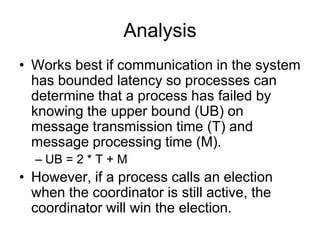
• Works best if communication in the system
  has bounded latency so processes can
  determine that a process has failed by
  knowing the upper bound (UB) on
  message transmission time (T) and
  message processing time (M).
  – UB = 2 * T + M
• However, if a process calls an election
  when the coordinator is still active, the
  coordinator will win the election.
A Ring Algorithm - Overview
• The ring algorithm assumes that the
  processes are arranged in a logical ring
  and each process is knows the order of
  the ring of processes.
• Processes are able to “skip” faulty
  systems: instead of sending to process
  j, send to j + 1.
• Faulty systems are those that don’t
  respond in a fixed amount of time.
A Ring Algorithm
• P thinks the coordinator has crashed;
  builds an ELECTION message which
  contains its own ID number.
• Sends to first live successor
• Each process adds its
  own number and
  forwards to next.
• OK to have two
  elections at once.
Ring Algorithm - Details
• When the message returns to p, it sees its own
  process ID in the list and knows that the circuit is
  complete.
• P circulates a COORDINATOR
  message with the new high
  number.
• Here, both 2 and 5
  elect 6:
  [5,6,0,1,2,3,4]
  [2,3,4,5,6,0,1]
Elections in Wireless Environments
• Traditional algorithms aren’t appropriate.
  – Can’t assume reliable message passing or
    stable network configuration
• This discussion focuses on ad hoc
  wireless networks but ignores node
  mobility.
  – Nodes connect directly, no common access
    point, connection is short term
  – Often used in multiplayer gaming, on-the-fly
    file transfers, etc.
Assumptions
• Wireless algorithms try to find the best node
  to be coordinator; traditional algorithms are
  satisfied with any node.
• Any node (the source) can initiate an
  election by sending an ELECTION message
  to its neighbors – nodes within range.
• When a node receives its first ELECTION
  message the sender becomes its parent
  node.
Figure 6-22.


• Node a is the source.
  Messages have a unique ID to manage possible
  concurrent elections
Figure 6.22


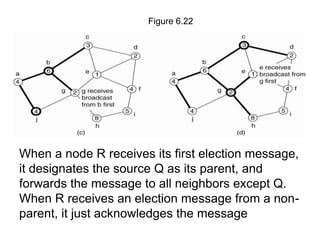
• Figure 6-22. Election algorithm in a
  wireless network, with node a as the
  source. (a) Initial network. (b)–(e) The
  build-tree phase

When a node R receives its first election message,
it designates the source Q as its parent, and
forwards the message to all neighbors except Q.
When R receives an election message from a non-
parent, it just acknowledges the message
• Figure 6-22. (e) The build-tree phase.
   (f) Reporting of best node to source.


If R’s neighbors have parents, R is a leaf; otherwise it
waits for its children to forward the message to their
neighbors.
When R has collected acks from all its neighbors, it
acknowledges the message from Q.
Acknowledgements flow back up the tree to the
original source.
Wireless Elections
• At each stage the “most eligible” or “best”
  node will be passed along from child to
  parent.
• Once the source node has received all the
  replies, it is in a position to choose the
  new coordinator.
• When the selection is made, it is
  broadcast to all nodes in the network.
Wireless Elections
• If more than one election is called (multiple
  source nodes), a node should participate in only
  one.
• Election messages are tagged with a process id.
• If a node has chosen a parent but gets an
  election message from a higher numbered
  node, it drops out of the current election and
  adopts the high numbered node as its parent.
  This ensures only one election makes a choice.
Chapter 6 - Summary
• “Synchronization is … doing the right thing
  at the right time.”
• Synchronization in distributed systems is
  related to communication.
• Complicated by lack of global clock,
  shared memory.
• Logical clocks support global event order.
• Distributed mutex: important class of
  synchronization algorithms.
• Leader election algorithms are sometimes
  needed.

Election algorithms

  • 1.
    Election Algorithms and Distributed Processing Section 6.5
  • 2.
    Outline • Election algorithms– introduction • Traditional election algorithms – Bully algorithm – Ring algorithm • Wireless election algorithms
  • 3.
    Need for aCoordinator • Many algorithms used in distributed systems require a coordinator – For example, see the centralized mutual exclusion algorithm. • In general, all processes in the distributed system are equally suitable for the role • Election algorithms are designed to choose a coordinator.
  • 4.
    Election Algorithms • Anyprocess can serve as coordinator • Any process can “call an election” (initiate the algorithm to choose a new coordinator). – There is no harm (other than extra message traffic) in having multiple concurrent elections. • Elections may be needed when the system is initialized, or if the coordinator crashes or retires.
  • 5.
    Assumptions • Every process/sitehas a unique ID; e.g. – the network address – a process number • Every process in the system should know the values in the set of ID numbers, although not which processors are up or down. • The process with the highest ID number will be the new coordinator. • Process groups (as with ISIS toolkit or MPI) satisfy these requirements.
  • 6.
    Requirements • When theelection algorithm terminates a single process has been selected and every process knows its identity. • Formalize: every process pi has a variable ei to hold the coordinator’s process number. – ∀i, ei = undefined or ei = P, where P is the non-crashed process with highest id – All processes (that have not crashed) eventually set ei = P.
  • 7.
    The Bully Algorithm- Overview • Process p calls an election when it notices that the coordinator is no longer responding. • High-numbered processes “bully” low- numbered processes out of the election, until only one process remains. • When a crashed process reboots, it holds an election. If it is now the highest- numbered live process, it will win.
  • 8.
    Figure 6-20 1 1 5 5 2 2 election OK 6 6 4 election OK 4 election 3 3 0 0 7 7 Process p sends an election message to all higher-numbered processes in the system. If no process responds, then p becomes the coordinator. If a higher-level process (q) responds, it sends p a message that terminates p’s role in the algorithm
  • 9.
    The process qnow calls an election (if 1 it has not already done so). 5 2 election Repeat until no higher-level process responds. The last process to call an 6 4 election “wins” the election. election election The winner sends a message to other 0 3 processes announcing itself as the new 7 coordinator. 1 Figure 6-20 5 1 2 OK 5 2 4 6 coordinator 6 4 0 3 3 0 7 7 If 7 comes back on line, it will call an election
  • 10.
    1 1 1 5 5 5 2 2 2 election election OK 6 6 6 4 election OK 4 4 election election election 3 3 3 0 0 0 7 7 7 1 5 1 2 OK 5 2 4 6 coordinator 6 4 0 3 3 0 7 7 Figure 6-20
  • 11.
    Analysis • Works bestif communication in the system has bounded latency so processes can determine that a process has failed by knowing the upper bound (UB) on message transmission time (T) and message processing time (M). – UB = 2 * T + M • However, if a process calls an election when the coordinator is still active, the coordinator will win the election.
  • 12.
    A Ring Algorithm- Overview • The ring algorithm assumes that the processes are arranged in a logical ring and each process is knows the order of the ring of processes. • Processes are able to “skip” faulty systems: instead of sending to process j, send to j + 1. • Faulty systems are those that don’t respond in a fixed amount of time.
  • 13.
    A Ring Algorithm •P thinks the coordinator has crashed; builds an ELECTION message which contains its own ID number. • Sends to first live successor • Each process adds its own number and forwards to next. • OK to have two elections at once.
  • 14.
    Ring Algorithm -Details • When the message returns to p, it sees its own process ID in the list and knows that the circuit is complete. • P circulates a COORDINATOR message with the new high number. • Here, both 2 and 5 elect 6: [5,6,0,1,2,3,4] [2,3,4,5,6,0,1]
  • 15.
    Elections in WirelessEnvironments • Traditional algorithms aren’t appropriate. – Can’t assume reliable message passing or stable network configuration • This discussion focuses on ad hoc wireless networks but ignores node mobility. – Nodes connect directly, no common access point, connection is short term – Often used in multiplayer gaming, on-the-fly file transfers, etc.
  • 16.
    Assumptions • Wireless algorithmstry to find the best node to be coordinator; traditional algorithms are satisfied with any node. • Any node (the source) can initiate an election by sending an ELECTION message to its neighbors – nodes within range. • When a node receives its first ELECTION message the sender becomes its parent node.
  • 17.
    Figure 6-22. • Nodea is the source. Messages have a unique ID to manage possible concurrent elections
  • 18.
    Figure 6.22 • Figure6-22. Election algorithm in a wireless network, with node a as the source. (a) Initial network. (b)–(e) The build-tree phase When a node R receives its first election message, it designates the source Q as its parent, and forwards the message to all neighbors except Q. When R receives an election message from a non- parent, it just acknowledges the message
  • 19.
    • Figure 6-22.(e) The build-tree phase. (f) Reporting of best node to source. If R’s neighbors have parents, R is a leaf; otherwise it waits for its children to forward the message to their neighbors. When R has collected acks from all its neighbors, it acknowledges the message from Q. Acknowledgements flow back up the tree to the original source.
  • 20.
    Wireless Elections • Ateach stage the “most eligible” or “best” node will be passed along from child to parent. • Once the source node has received all the replies, it is in a position to choose the new coordinator. • When the selection is made, it is broadcast to all nodes in the network.
  • 21.
    Wireless Elections • Ifmore than one election is called (multiple source nodes), a node should participate in only one. • Election messages are tagged with a process id. • If a node has chosen a parent but gets an election message from a higher numbered node, it drops out of the current election and adopts the high numbered node as its parent. This ensures only one election makes a choice.
  • 22.
    Chapter 6 -Summary • “Synchronization is … doing the right thing at the right time.” • Synchronization in distributed systems is related to communication. • Complicated by lack of global clock, shared memory. • Logical clocks support global event order. • Distributed mutex: important class of synchronization algorithms. • Leader election algorithms are sometimes needed.