Crystal Structure and Defects
– Microstructure
– Crystal Structure and Crystallography
– Crystal Defects
Microstructure of Materials
¾ Spatial arrangements of atoms play an important role in
determining the electrical properties.
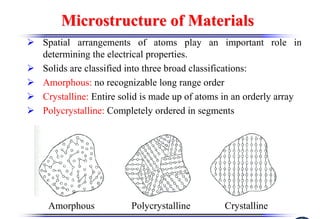
¾ Solids are classified into three broad classifications:
¾ Amorphous: no recognizable long range order
¾ Crystalline: Entire solid is made up of atoms in an orderly array
¾ Polycrystalline: Completely ordered in segments
Amorphous Polycrystalline Crystalline
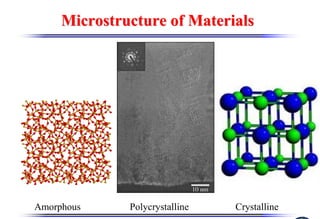
Microstructure of Materials
Amorphous Polycrystalline Crystalline
Crystal Structure
Crystal Structure
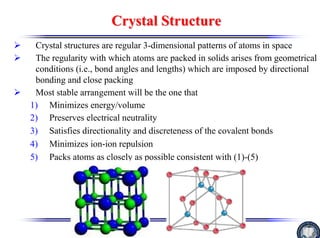
¾ Crystal structures are regular 3-dimensional patterns of atoms in space
¾ The regularity with which atoms are packed in solids arises from geometrical
conditions (i.e., bond angles and lengths) which are imposed by directional
bonding and close packing
¾ Most stable arrangement will be the one that
1) Minimizes energy/volume
2) Preserves electrical neutrality
3) Satisfies directionality and discreteness of the covalent bonds
4) Minimizes ion-ion repulsion
5) Packs atoms as closely as possible consistent with (1)-(5)
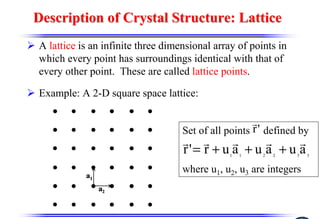
Set of all points defined by
where u1, u2, u3 are integers
Description of Crystal Structure: Lattice
¾ A lattice is an infinite three dimensional array of points in
which every point has surroundings identical with that of
every other point. These are called lattice points.
¾ Example: A 2-D square space lattice:
a1
a2
3
3
2
2
1
1
a
u
a
u
a
u
r
'
r
r
r
r
r
r
+
+
+
=
'
r
r
Bravais
Bravais Space Lattices
Space Lattices
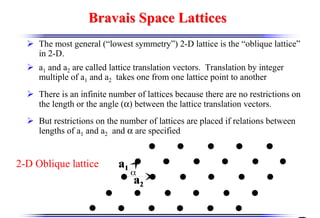
¾ The most general (“lowest symmetry”) 2-D lattice is the “oblique lattice”
in 2-D.
¾ a1 and a2 are called lattice translation vectors. Translation by integer
multiple of a1 and a2 takes one from one lattice point to another
¾ There is an infinite number of lattices because there are no restrictions on
the length or the angle (α) between the lattice translation vectors.
¾ But restrictions on the number of lattices are placed if relations between
lengths of a1 and a2 and α are specified
a1
a2
α
2-D Oblique lattice
Bravais
Bravais Lattices in 2
Lattices in 2-
-D
D
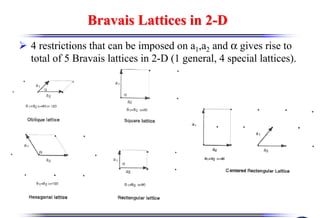
¾ 4 restrictions that can be imposed on a1,a2 and α gives rise to
total of 5 Bravais lattices in 2-D (1 general, 4 special lattices).
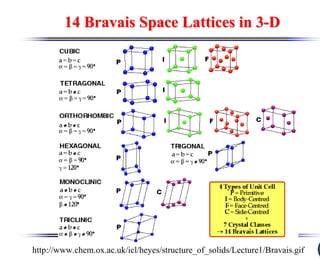
14
14 Bravais
Bravais Space Lattices in 3
Space Lattices in 3-
-D
D
http://www.chem.ox.ac.uk/icl/heyes/structure_of_solids/Lecture1/Bravais.gif
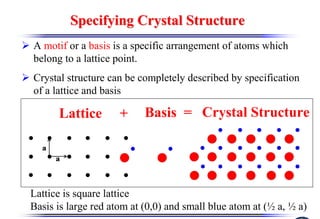
Specifying Crystal Structure
¾ A motif or a basis is a specific arrangement of atoms which
belong to a lattice point.
¾ Crystal structure can be completely described by specification
of a lattice and basis
a
a
Lattice + Basis = Crystal Structure
Lattice is square lattice
Basis is large red atom at (0,0) and small blue atom at (½ a, ½ a)
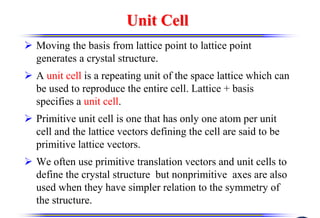
Unit Cell
Unit Cell
¾ Moving the basis from lattice point to lattice point
generates a crystal structure.
¾ A unit cell is a repeating unit of the space lattice which can
be used to reproduce the entire cell. Lattice + basis
specifies a unit cell.
¾ Primitive unit cell is one that has only one atom per unit
cell and the lattice vectors defining the cell are said to be
primitive lattice vectors.
¾ We often use primitive translation vectors and unit cells to
define the crystal structure but nonprimitive axes are also
used when they have simpler relation to the symmetry of
the structure.
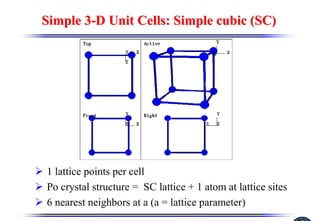
Simple 3
Simple 3-
-D Unit Cells: Simple cubic (SC)
D Unit Cells: Simple cubic (SC)
¾ 1 lattice points per cell
¾ Po crystal structure = SC lattice + 1 atom at lattice sites
¾ 6 nearest neighbors at a (a = lattice parameter)
Simple 3
Simple 3-
-D Unit Cells: Body centered cubic (BCC)
D Unit Cells: Body centered cubic (BCC)
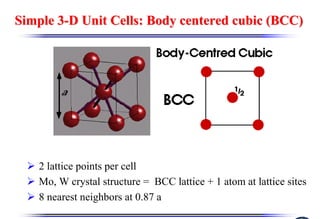
¾ 2 lattice points per cell
¾ Mo, W crystal structure = BCC lattice + 1 atom at lattice sites
¾ 8 nearest neighbors at 0.87 a
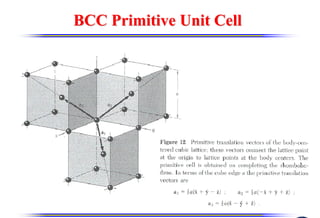
BCC Primitive Unit Cell
FCC Unit Cell and FCC Crystal Structure
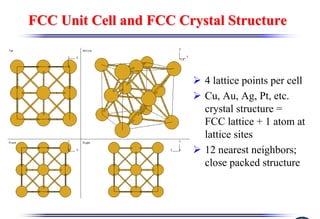
¾ 4 lattice points per cell
¾ Cu, Au, Ag, Pt, etc.
crystal structure =
FCC lattice + 1 atom at
lattice sites
¾ 12 nearest neighbors;
close packed structure
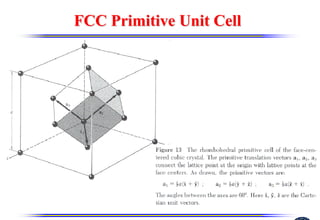
FCC Primitive Unit Cell
The Diamond Lattice
The Diamond Lattice
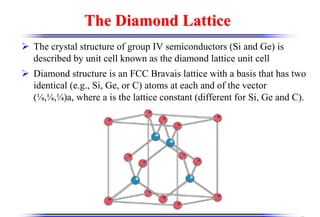
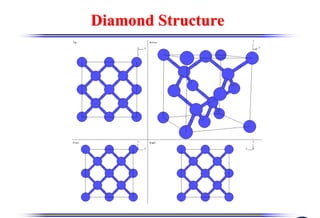
¾ The crystal structure of group IV semiconductors (Si and Ge) is
described by unit cell known as the diamond lattice unit cell
¾ Diamond structure is an FCC Bravais lattice with a basis that has two
identical (e.g., Si, Ge, or C) atoms at each and of the vector
(¼,¼,¼)a, where a is the lattice constant (different for Si, Ge and C).
Diamond Structure
Diamond Structure
The Diamond Lattice
The Diamond Lattice
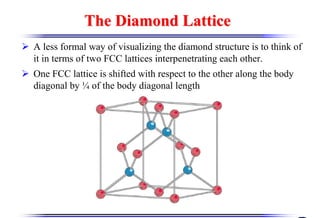
¾ A less formal way of visualizing the diamond structure is to think of
it in terms of two FCC lattices interpenetrating each other.
¾ One FCC lattice is shifted with respect to the other along the body
diagonal by ¼ of the body diagonal length
The
The Zincblende
Zincblende Structure
Structure
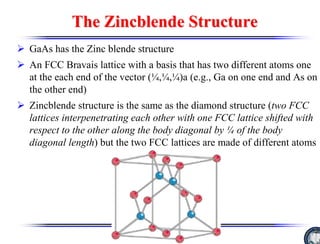
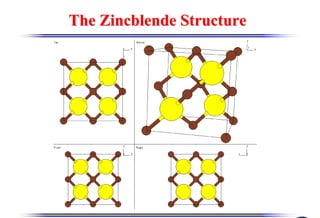
¾ GaAs has the Zinc blende structure
¾ An FCC Bravais lattice with a basis that has two different atoms one
at the each end of the vector (¼,¼,¼)a (e.g., Ga on one end and As on
the other end)
¾ Zincblende structure is the same as the diamond structure (two FCC
lattices interpenetrating each other with one FCC lattice shifted with
respect to the other along the body diagonal by ¼ of the body
diagonal length) but the two FCC lattices are made of different atoms
The
The Zincblende
Zincblende Structure
Structure
Miller Indices
Miller Indices
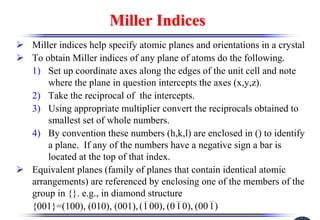
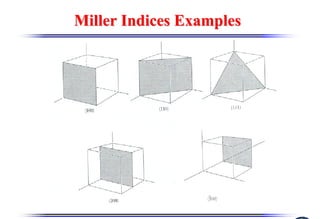
¾ Miller indices help specify atomic planes and orientations in a crystal
¾ To obtain Miller indices of any plane of atoms do the following.
1) Set up coordinate axes along the edges of the unit cell and note
where the plane in question intercepts the axes (x,y,z).
2) Take the reciprocal of the intercepts.
3) Using appropriate multiplier convert the reciprocals obtained to
smallest set of whole numbers.
4) By convention these numbers (h,k,l) are enclosed in () to identify
a plane. If any of the numbers have a negative sign a bar is
located at the top of that index.
¾ Equivalent planes (family of planes that contain identical atomic
arrangements) are referenced by enclosing one of the members of the
group in {}. e.g., in diamond structure
{001}=(100), (010), (001), )
1
00
(
),
0
1
0
(
),
00
1
(
Miller Indices Examples
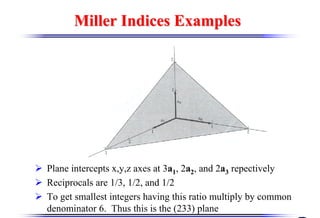
¾ Plane intercepts x,y,z axes at 3a1, 2a2, and 2a3 repectively
¾ Reciprocals are 1/3, 1/2, and 1/2
¾ To get smallest integers having this ratio multiply by common
denominator 6. Thus this is the (233) plane
Miller Indices Examples
Crystallographic Directions
¾ Miller indices enclosed within [ ] are used to designate
directions within a crystal
¾ Note also that the Miller indices also give the direction of
the normal vector of the plane they describe
¾ Miller indices enclosed within < > are used to designate
equivalent (family of) directions.
e.g., in simple cubic lattice [100] is the x-axis direction,
<100> describes all directions parallel to the x, y and z
axis.
Crystal Defects
Crystal Defects
¾ Defects are imperfections which cause disruption in
what otherwise would be a perfect lattice.
¾ Defects are classified based on their dimensionality
¾ Point defects (0-D)
¾ Line defects (1-D)
¾ Surface Imperfections (2-D)
¾ Volume defects (3-D)
Point Defects
Point Defects
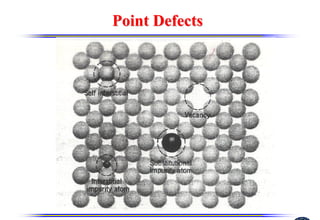
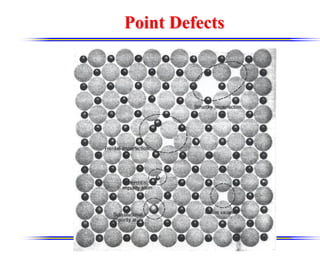
¾ Vacancy: absence of an atom in a lattice point where there is
suppose to be an atom. Formed when atoms are removed from
their lattice positions (typically to the surface) as a result of
thermal fluctuations. AKA Schottky defects.
¾ Interstitial: Atom located in a “void” (I.e., a position that is not
part of the lattice or basis) within the crystal structure.
¾ Frenkel Defect: A vacancy-interstitial pair.
¾ Substitutional Impurity: Impurity atoms (an atom that does not
belong to the basis) that take up the lattice positions that are
ordinarily occupied by the atoms that make up the crystal.
¾ Interstitial Impurity: Impurity atoms that are present in the
interstitial sites.
Point Defects
Point Defects
Point Defects
Point Defects
Line Defects
Line Defects
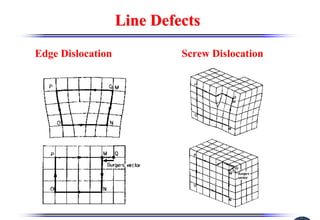
¾ Dislocations: Boundary between two regions of a surface
which are perfect themselves but are out of registry with each
other. The resulting lattice distortion is centered along a line.
¾ Burgers Vector, b: A vector by which the lattice on one side
of an internal surface containing the dislocation line is
displace relative to the lattice on the other side.
¾ There are two special cases of dislocations
¾ Edge Dislocation: b and normal vector along the
dislocation line l are perpendicular
¾ Screw Dislocation: b and normal vector along the
dislocation line l are parallel
Line Defects
Line Defects
Edge Dislocation Screw Dislocation

Crystal structure.pdf

  • 1.
    Crystal Structure andDefects Crystal Structure and Defects – Microstructure – Crystal Structure and Crystallography – Crystal Defects
  • 2.
    Microstructure of Materials Microstructureof Materials ¾ Spatial arrangements of atoms play an important role in determining the electrical properties. ¾ Solids are classified into three broad classifications: ¾ Amorphous: no recognizable long range order ¾ Crystalline: Entire solid is made up of atoms in an orderly array ¾ Polycrystalline: Completely ordered in segments Amorphous Polycrystalline Crystalline
  • 3.
    Microstructure of Materials Microstructureof Materials Amorphous Polycrystalline Crystalline
  • 4.
    Crystal Structure Crystal Structure ¾Crystal structures are regular 3-dimensional patterns of atoms in space ¾ The regularity with which atoms are packed in solids arises from geometrical conditions (i.e., bond angles and lengths) which are imposed by directional bonding and close packing ¾ Most stable arrangement will be the one that 1) Minimizes energy/volume 2) Preserves electrical neutrality 3) Satisfies directionality and discreteness of the covalent bonds 4) Minimizes ion-ion repulsion 5) Packs atoms as closely as possible consistent with (1)-(5)
  • 5.
    Set of allpoints defined by where u1, u2, u3 are integers Description of Crystal Structure: Lattice Description of Crystal Structure: Lattice ¾ A lattice is an infinite three dimensional array of points in which every point has surroundings identical with that of every other point. These are called lattice points. ¾ Example: A 2-D square space lattice: a1 a2 3 3 2 2 1 1 a u a u a u r ' r r r r r r + + + = ' r r
  • 6.
    Bravais Bravais Space Lattices SpaceLattices ¾ The most general (“lowest symmetry”) 2-D lattice is the “oblique lattice” in 2-D. ¾ a1 and a2 are called lattice translation vectors. Translation by integer multiple of a1 and a2 takes one from one lattice point to another ¾ There is an infinite number of lattices because there are no restrictions on the length or the angle (α) between the lattice translation vectors. ¾ But restrictions on the number of lattices are placed if relations between lengths of a1 and a2 and α are specified a1 a2 α 2-D Oblique lattice
  • 7.
    Bravais Bravais Lattices in2 Lattices in 2- -D D ¾ 4 restrictions that can be imposed on a1,a2 and α gives rise to total of 5 Bravais lattices in 2-D (1 general, 4 special lattices).
  • 8.
    14 14 Bravais Bravais SpaceLattices in 3 Space Lattices in 3- -D D http://www.chem.ox.ac.uk/icl/heyes/structure_of_solids/Lecture1/Bravais.gif
  • 9.
    Specifying Crystal Structure SpecifyingCrystal Structure ¾ A motif or a basis is a specific arrangement of atoms which belong to a lattice point. ¾ Crystal structure can be completely described by specification of a lattice and basis a a Lattice + Basis = Crystal Structure Lattice is square lattice Basis is large red atom at (0,0) and small blue atom at (½ a, ½ a)
  • 10.
    Unit Cell Unit Cell ¾Moving the basis from lattice point to lattice point generates a crystal structure. ¾ A unit cell is a repeating unit of the space lattice which can be used to reproduce the entire cell. Lattice + basis specifies a unit cell. ¾ Primitive unit cell is one that has only one atom per unit cell and the lattice vectors defining the cell are said to be primitive lattice vectors. ¾ We often use primitive translation vectors and unit cells to define the crystal structure but nonprimitive axes are also used when they have simpler relation to the symmetry of the structure.
  • 11.
    Simple 3 Simple 3- -DUnit Cells: Simple cubic (SC) D Unit Cells: Simple cubic (SC) ¾ 1 lattice points per cell ¾ Po crystal structure = SC lattice + 1 atom at lattice sites ¾ 6 nearest neighbors at a (a = lattice parameter)
  • 12.
    Simple 3 Simple 3- -DUnit Cells: Body centered cubic (BCC) D Unit Cells: Body centered cubic (BCC) ¾ 2 lattice points per cell ¾ Mo, W crystal structure = BCC lattice + 1 atom at lattice sites ¾ 8 nearest neighbors at 0.87 a
  • 13.
    BCC Primitive UnitCell BCC Primitive Unit Cell
  • 14.
    FCC Unit Celland FCC Crystal Structure FCC Unit Cell and FCC Crystal Structure ¾ 4 lattice points per cell ¾ Cu, Au, Ag, Pt, etc. crystal structure = FCC lattice + 1 atom at lattice sites ¾ 12 nearest neighbors; close packed structure
  • 15.
    FCC Primitive UnitCell FCC Primitive Unit Cell
  • 16.
    The Diamond Lattice TheDiamond Lattice ¾ The crystal structure of group IV semiconductors (Si and Ge) is described by unit cell known as the diamond lattice unit cell ¾ Diamond structure is an FCC Bravais lattice with a basis that has two identical (e.g., Si, Ge, or C) atoms at each and of the vector (¼,¼,¼)a, where a is the lattice constant (different for Si, Ge and C).
  • 17.
  • 18.
    The Diamond Lattice TheDiamond Lattice ¾ A less formal way of visualizing the diamond structure is to think of it in terms of two FCC lattices interpenetrating each other. ¾ One FCC lattice is shifted with respect to the other along the body diagonal by ¼ of the body diagonal length
  • 19.
    The The Zincblende Zincblende Structure Structure ¾GaAs has the Zinc blende structure ¾ An FCC Bravais lattice with a basis that has two different atoms one at the each end of the vector (¼,¼,¼)a (e.g., Ga on one end and As on the other end) ¾ Zincblende structure is the same as the diamond structure (two FCC lattices interpenetrating each other with one FCC lattice shifted with respect to the other along the body diagonal by ¼ of the body diagonal length) but the two FCC lattices are made of different atoms
  • 20.
  • 21.
    Miller Indices Miller Indices ¾Miller indices help specify atomic planes and orientations in a crystal ¾ To obtain Miller indices of any plane of atoms do the following. 1) Set up coordinate axes along the edges of the unit cell and note where the plane in question intercepts the axes (x,y,z). 2) Take the reciprocal of the intercepts. 3) Using appropriate multiplier convert the reciprocals obtained to smallest set of whole numbers. 4) By convention these numbers (h,k,l) are enclosed in () to identify a plane. If any of the numbers have a negative sign a bar is located at the top of that index. ¾ Equivalent planes (family of planes that contain identical atomic arrangements) are referenced by enclosing one of the members of the group in {}. e.g., in diamond structure {001}=(100), (010), (001), ) 1 00 ( ), 0 1 0 ( ), 00 1 (
  • 22.
    Miller Indices Examples MillerIndices Examples ¾ Plane intercepts x,y,z axes at 3a1, 2a2, and 2a3 repectively ¾ Reciprocals are 1/3, 1/2, and 1/2 ¾ To get smallest integers having this ratio multiply by common denominator 6. Thus this is the (233) plane
  • 23.
  • 24.
    Crystallographic Directions Crystallographic Directions ¾Miller indices enclosed within [ ] are used to designate directions within a crystal ¾ Note also that the Miller indices also give the direction of the normal vector of the plane they describe ¾ Miller indices enclosed within < > are used to designate equivalent (family of) directions. e.g., in simple cubic lattice [100] is the x-axis direction, <100> describes all directions parallel to the x, y and z axis.
  • 25.
    Crystal Defects Crystal Defects ¾Defects are imperfections which cause disruption in what otherwise would be a perfect lattice. ¾ Defects are classified based on their dimensionality ¾ Point defects (0-D) ¾ Line defects (1-D) ¾ Surface Imperfections (2-D) ¾ Volume defects (3-D)
  • 26.
    Point Defects Point Defects ¾Vacancy: absence of an atom in a lattice point where there is suppose to be an atom. Formed when atoms are removed from their lattice positions (typically to the surface) as a result of thermal fluctuations. AKA Schottky defects. ¾ Interstitial: Atom located in a “void” (I.e., a position that is not part of the lattice or basis) within the crystal structure. ¾ Frenkel Defect: A vacancy-interstitial pair. ¾ Substitutional Impurity: Impurity atoms (an atom that does not belong to the basis) that take up the lattice positions that are ordinarily occupied by the atoms that make up the crystal. ¾ Interstitial Impurity: Impurity atoms that are present in the interstitial sites.
  • 27.
  • 28.
  • 29.
    Line Defects Line Defects ¾Dislocations: Boundary between two regions of a surface which are perfect themselves but are out of registry with each other. The resulting lattice distortion is centered along a line. ¾ Burgers Vector, b: A vector by which the lattice on one side of an internal surface containing the dislocation line is displace relative to the lattice on the other side. ¾ There are two special cases of dislocations ¾ Edge Dislocation: b and normal vector along the dislocation line l are perpendicular ¾ Screw Dislocation: b and normal vector along the dislocation line l are parallel
  • 30.
    Line Defects Line Defects EdgeDislocation Screw Dislocation